What I Want to Say About Play Boosters...

Note: This article was translated from Chinese by AI and may contain errors. Read the original Chinese version.
What Is a Play Booster?
It all started with this article that Maro published on October 16, 2023:
You can click the link above to read the original; if you don’t mind Simplified Chinese and are too lazy to read English, you can also read the translated version on iyingdi directly:
What Are Play Boosters (Simplified Chinese translation)
Why Make the Play Booster?
I won’t spend space here on why the Play Booster came about or which problems it is meant to solve. But the first half of Maro’s article can be summarized in three key points, so you can understand why Wizards of the Coast made this decision:
- The arrival of Set Boosters reduced everyone’s willingness to crack Draft Boosters, which in turn lowered the frequency of Limited events at card stores
- Set Boosters are by design not suited for Limited and cannot directly replace Draft Boosters
- The two kinds of boosters were cannibalizing each other’s markets, and players on both sides could not get full satisfaction or the products they needed
So the Play Booster was born as the solution to these problems.
So… What’s in a Play Booster?
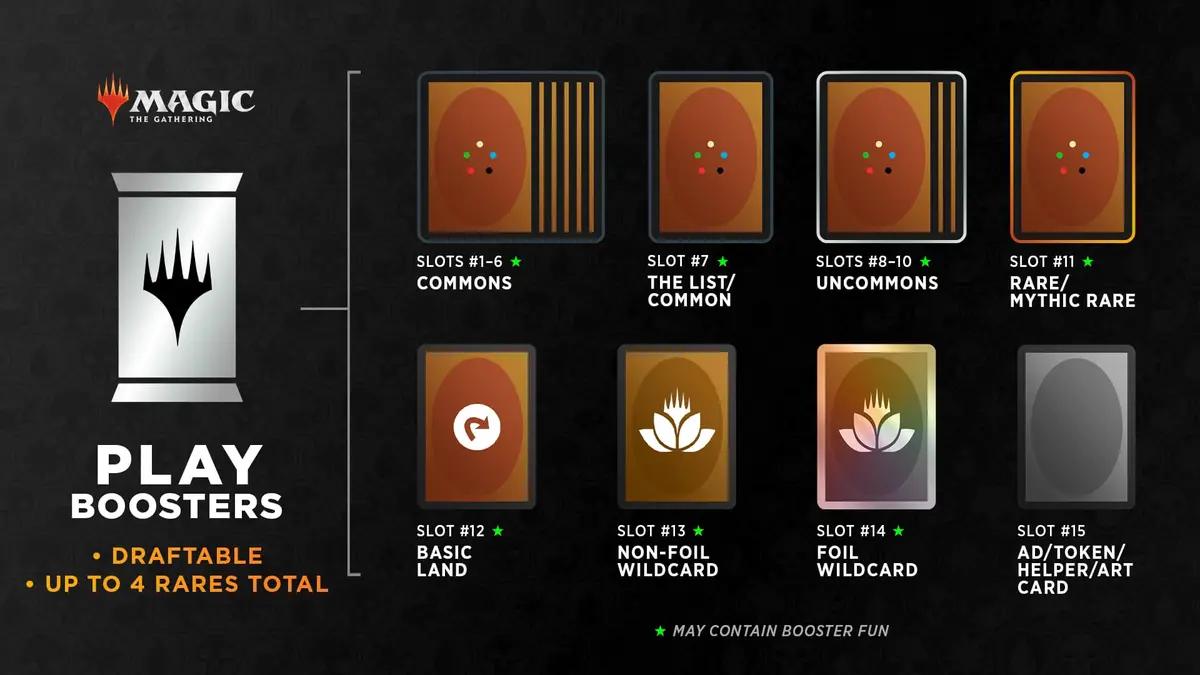
As the image introducing the Play Booster in the article explains, each pack has 15 cards; excluding 1 ad card/token card/art card, there are 14 usable cards, including:
- 6 commons,
- a 7th common or 1 The List card,
- 3 uncommons,
- 1 rare/mythic rare,
- 1 basic land,
- 1 non-foil card of any rarity,
- 1 foil card of any rarity
How Does the Play Booster Affect MTG Players?
1. Play Boosters Will Replace Set and Draft Boosters
After Murders at Karlov Manor releases in February 2024, Play Boosters will replace the existing Set Boosters and Draft Boosters as a single multi-purpose booster, serving both players who like Limited and players who like cracking packs. Of course, Collector Boosters are unaffected and will continue to exist.
2. The Cost of Playing Limited and Opening Boosters Goes Up
However, the Play Booster will use the same pricing strategy as current Set Boosters, while each box, in order to also serve Limited, will contain 36 packs, the same as a Draft Booster box. In short, prices went up.
Let’s do a simple calculation using Wilds of Eldraine (WOE) boosters:
All amounts below are in US dollars, rounded to two decimal places
The price information comes from mtggoldfish, with a reference date of October 18, 2023, Taipei time
- WOE Draft Boosters (36 packs): about $119.99 per box; about $3.33 per pack
- WOE Set Boosters (30 packs): about $129.99 per box; about $4.33 per pack
If that pricing were applied to Play Boosters (36 packs), with a single pack priced the same as a Set Booster at about $4.33, a box would be about $155.88, and the difference of about $25.89 from a Set Booster box is the extra cost per box that Set Booster box openers will bear in the future.
Now for playing in Limited events, without considering the store’s costs and profit for running events:
- Each draft using 3 Play Boosters costs $3 more than the original 3 Draft Boosters;
- And a sealed event using 6 boosters costs at least $6 more
From the booster cost alone, that is at least nearly 30% extra, and once you add the store’s event expenses, inventory costs and a reasonable profit, the amount a player pays to enter a Limited event will surely be more than 30% higher, even 40% or more.
That is a very considerable price increase, and I believe it will directly affect players’ willingness to take part in Limited.
One point here that might be questioned: although the price per pack or per box went up, hasn’t the chance of opening rares/mythics per pack also gone up? Doesn’t that mean the expected value of opening packs went up too?
However, this view ignores that the Play Booster has 1 fewer non-foil card of any rarity than the Set Booster, and the rate of art cards is also lower, while the 2 extra cards are commons, which don’t matter at all to people who want to open packs; and compared with the Draft Booster, the 30% price increase mentioned above is a very, very large impact. A price increase is a price increase, and this shock is huge and irreversible for the original users.
3. The Limited Experience Will Change; the Specific Effects Need More Observation
3.1 One Fewer Usable Card Per Pack
The Play Booster has only 14 usable cards, 1 fewer than the 15 usable cards in the original Draft Booster. Although Maro and Wizards believe this solves the problem of players “ending up with too many cards they can’t use” after Limited, the missing card is a common slot, so I think the impact is small, and Maro specifically raising this point in his article actually looks like a distraction.
3.2 A Higher Chance of Bombs Per Pack, but More Low-Rarity Removal Too
Also, a Play Booster can contain up to 4 rares/mythics. Maro and Wizards think bombs have indeed increased, but they have also added more common/uncommon removal to balance this. The effect is quite interesting, and I think they have already applied this principle to the Wilds of Eldraine (WOE) Limited format. I’m not saying this without basis: if you have played WOE Limited, you will find that good common/uncommon removal has increased substantially. Just listing the common removal spells below makes the trend obvious, not to mention the removal among uncommons or higher rarities:
- White: Cooped Up, Kellan’s Lightblades
- Blue: Beluna’s Gatekeeper, Bitter Chill, Johann’s Stopgap, Vantress Transmuter
- Black: Candy Grapple, Feed the Cauldron, Shatter the Oath
- Red: Cut In, Frantic Firebolt, Torch the Tower
- Green: Curse of the Werefox, Spider Food
From this trend, the density of removal in future Play Boosters will rise further, and the indiscriminate draft approach of taking removal first and creatures later may be relatively weakened. After all, removal alone basically can’t win; returning to the basic draft principle of “curve is king” for further strengthening may be more realistic.
3.3 Watch Out for The List Cards, but Don’t Worry Too Much
Finally, a brief word on The List cards, which appear at a 12.5% rate. The probability breakdown given in Maro’s article is as follows:
- 10 Special Guest reprints: 1.56% appearance rate
- 30 commons or uncommons: 9.38% appearance rate
- 10 rares or mythic rares: 1.56% appearance rate
The impact of these 50 cards on Limited is inevitable, but we have an existing design to benchmark against, namely cards like Enchanting Tales (Enchanting Tales, WOT) in WOE or the Multiverse Legends (Multiverse Legend, MUL) in MOM. In current Draft Boosters their rate is 1 per pack. Recall how it feels to face those cards in Limited; I personally think it will be quite close. However, the chance of facing these cards is lower, only one eighth of before. So there’s no need to be overly pessimistic about being blown up by an opponent’s The List card; treat them as a foreseeable threat to guard against, but don’t worry too much; after all, you won’t necessarily run into one, and if you do, you won’t necessarily lack an answer.
Wrap-Up: MTG Really Is Getting More Expensive, and the Price Increase Will Affect Their Goal of Promoting Standard
Back to the price increase mentioned earlier: this is the most tangible effect for players. When the cost of entering a Limited event goes up, it directly affects ordinary players’ willingness to open boxes and play Limited; and this in turn affects trading volume in the secondary market. If most players keep their current habit of mainly buying cards, with opening packs or playing Limited as a supplement, then gradually you won’t be able to buy the cards you need at reasonable prices in the domestic trading market; and the habit among Taiwanese players of buying cards without following exchange rates will aggravate this situation. A further effect is that the cost and difficulty of acquiring new cards for every format rise too. My personal guess is that the number of Standard players will be hit, because Standard inevitably uses a large number of new cards, so the cost of building a Standard deck will be pushed up or the cards will be hard to get. Under this repelling effect, MTGA, as a comparatively “economical” full Standard platform, will once again absorb more players moving over from paper cards. The phenomenon we see now, that Standard is hard to promote, will get worse after the Play Booster appears. This is my personal prediction, for reference only.
This does not take into account the players who originally opened Set Boosters switching to Collector Boosters, which would cause a large, excessive influx of foil rares/mythics into the market and leave cards unable to hold their value; but in that scenario, commons/uncommons would become harder to get, which would likewise push up the difficulty of building a Standard deck with new cards.
To put it plainly, this is just a game. How much money and effort you are willing to invest depends on what you can afford, and is a matter of opinion. Of course I will keep playing, but the degree of my investment will inevitably be affected. I hope this article lets readers understand some foreseeable effects, and you are welcome to reply with your own views. Thank you.
- Title
- What I Want to Say About Play Boosters...
- Author
- cephille
- Created at
- October 19, 2023
- License
- This work is licensed under CC BY-NC-SA 4.0 .