A First Look at Bloomburrow Limited

Note: This article was translated from Chinese by AI and may contain errors. Read the original Chinese version.
The Ten Two-Color Archetypes
In recent set designs, each two-color pair gets a cycle of ten uncommons and commons (one set per pair), plus a rare legendary creature to reinforce that pair’s theme. In Limited we won’t always open or draft the rare for a given pair, but building or drafting around the uncommons and commons is perfectly viable. So in the sections below, I will focus on how each pair’s uncommons and commons develop, and offer some initial deckbuilding directions along with a few useful individual cards and combinations.
If you need a rules rundown of the Bloomburrow mechanics, you can read this article: Bloomburrow Mechanics Explained
The content of this article is adapted and expanded from the Bloomburrow entry on the MTG wiki. It was also written before BLB prerelease events began, so it is only meant as a first understanding of the set. If later Limited practice shows that some statements are wrong or need adjusting, readers are welcome to leave a comment or send a message with suggestions on the Guildmages’ Forum Facebook page. Thank you!
BlueWhite — Flying & Non-Flying Matters
Creature type: Birds
Number of UW cards: 13 + 1 (1 from SPG, Ledger Shredder, which shows up less often)
Number of cards in other color pairs: 2 (black’s Maha, Its Feathers Night and red’s Dragonhawk, Fate’s Tempest, which fit the theme less well)
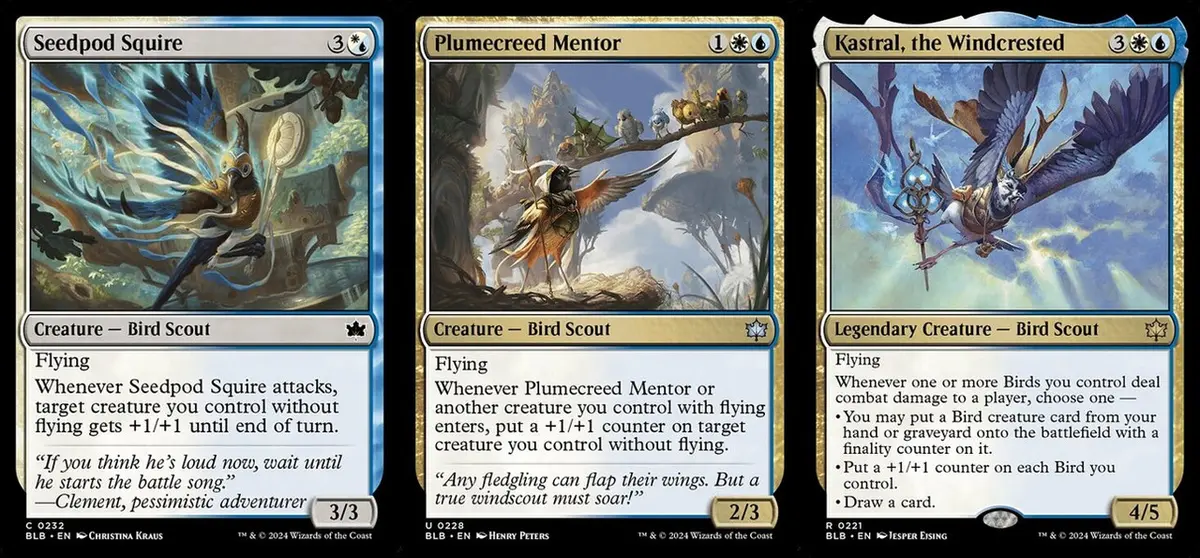
The uncommon Plumecreed Mentor shows what Azorius cares about: flying and non-flying creatures. Whenever it or any other creature with flying enters under your control, it permanently grows another creature you control without flying (put a +1/+1 counter on it). The common Seedpod Squire is a flyer itself, and when it attacks it can also pump a non-flying creature you control.
Then there is the rare Kastral, the Windcrested. This big bird can turn your little birds into a squadron of bombers after an attack or two, or fill your hand to the brim. But because it is a rare, it is strong enough fighting solo, and it no longer cares about non-flyers. Only it and other birds that fly get the bonus. Naming only the Bird type emphasizes the link between Azorius and Birds. Besides, letting flying Dragons or Angels benefit as well might not fit the flavor.
Side note: I think the fact that the two-color commons in BLB use hybrid mana shows the designers considered deckbuilding flexibility. Hybrid mana is easier to cast than gold mana, so putting it on the commons of the matching pair feels very appropriate to me.
Takeaway Tips
- When you enter Azorius, besides taking plenty of flyers, you also need enough non-flying creatures to soak up the theme’s bonuses so you get the full effect.
- Auras that grant flying, and creatures whose abilities can give a target flying, can supplement the flying theme. Basically, an Aura like Feather of Flight can be counted as a card with flying. But something like Waterspout Warden is not reliable enough, so when building I still recommend treating it as a non-flyer.
- The creature type for Azorius is Birds, with 14 cards. Most flyers you get in this pair are Birds (though white still has a few Bats), but when building or drafting you should still watch the count of flying and non-flying creatures to get the most synergy.
- Conversely, if you see almost no flyers in the blue and white cards passed to you while drafting, don’t go Azorius. Chances are the players upstream or downstream of you already moved in.
BlueBlack — Threshold
Creature type: Rats
Number of UB cards: 14 + 2 (two from SPG, Rat Colony and Relentless Rats, which likewise show up rarely)
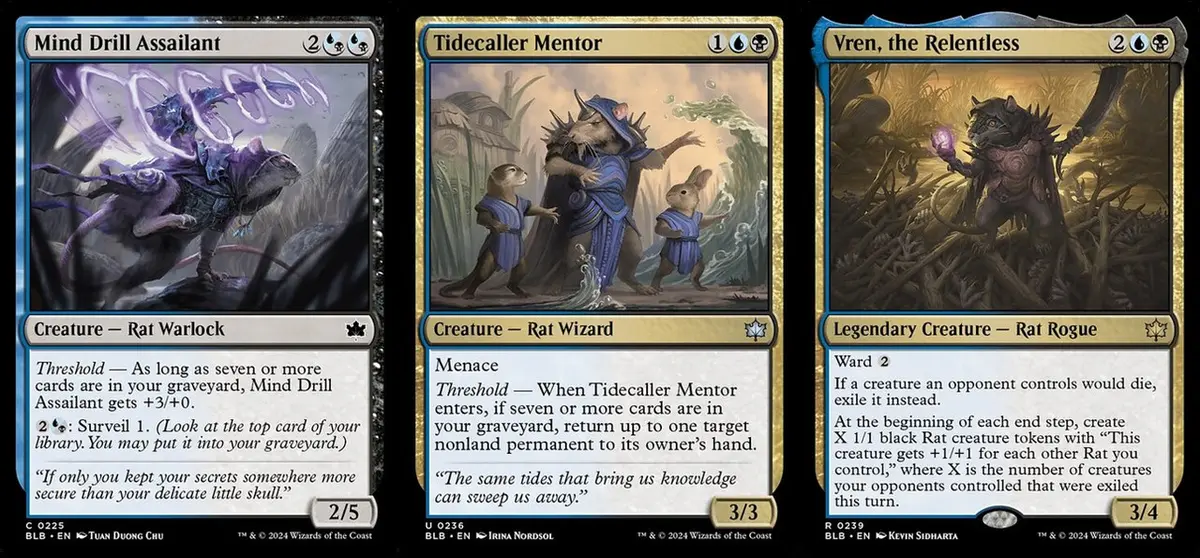
The uncommon Tidecaller Mentor is an excellent three-mana 3/3 with menace. With threshold it also gives you the bonus of returning a nonland permanent to hand when it enters. It is playable even without threshold but gets stronger when you reach it, so when building you should include as many cards as possible that reliably fill the graveyard and speed up threshold. The common Mind Drill Assailant fills this gap nicely. It is a solid blocker with a built-in surveil activated ability, and once you reach threshold it turns into a 5/5 and goes from defense to offense.
The legendary rare Vren, the Relentless supports threshold less obviously. Exiling the opponent’s dying creatures reads more like a way to stop their threshold. Its own effect leans toward supporting the Rats theme in blue-black. It is a bit like a weakened Kalitas, Traitor of Ghet: at each end step it checks how many of your opponents’ creature cards were exiled this turn, and you create that many 1/1 Rat tokens.
To strengthen the threshold theme, you will want cards like Wick’s Patrol in the deck, holding the early game with high-toughness creatures such as Nightwhorl Hermit and Mind Drill Assailant, then using Wick’s Patrol in the mid-to-late game to kill and mill at once, unlock threshold, and counterattack. That is probably the most reasonable way to build blue-black.
Takeaway Tips
- Threshold is a mechanic that cares intensely about how many cards are in your graveyard. A card’s strength with and without threshold is night and day. So besides the cards that reward threshold, the deck also needs graveyard-filling effects such as surveil and mill to reach it faster.
- The creature type for blue-black is Rats, with 16 cards. If your pool has more rares like Vren, the Relentless or Wick, the Whorled Mind, consider taking more Rats to collect the payoffs, but be careful not to take too many small Rats, or you won’t be able to hold up early against aggro.
- To transition smoothly into threshold, it is very important to have creatures with toughness 4 or more and a threshold payoff as early blockers.
RedBlack — Opponent Loses Life Matters
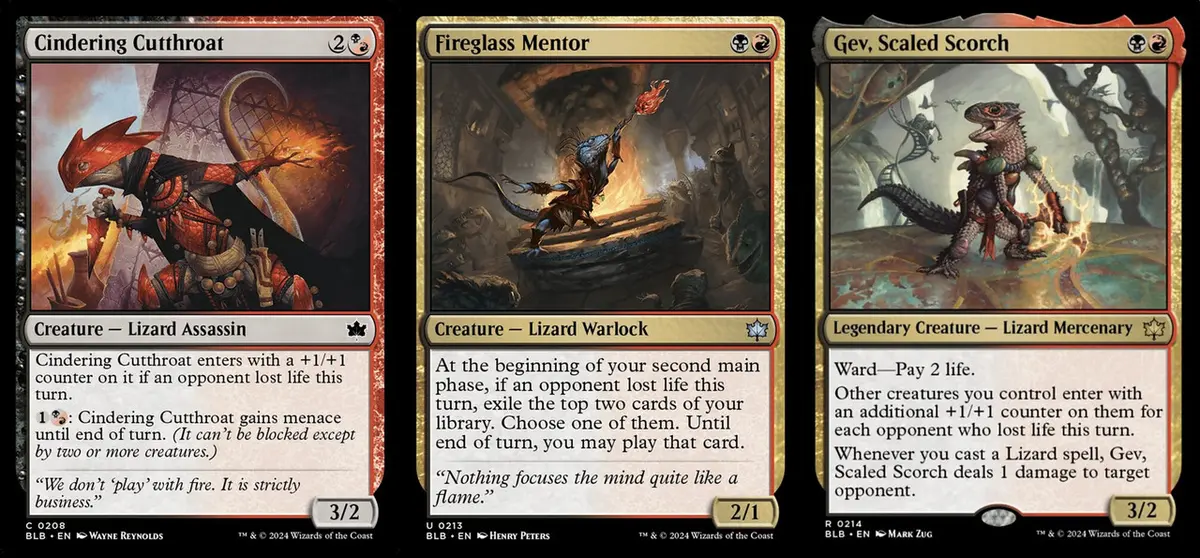
Creature type: Lizards
Number of BR cards: 16
The uncommon Fireglass Mentor checks during your second main phase whether an opponent lost life this turn. If so, you exile the top two cards of your library, and you may play one of them until end of turn. This effect has a few implicit caveats:
- Black-red cares about the opponent losing life to get rewards (well, obviously);
- Your black-red curve probably should not be too high, or you will be sad when you exile cards you can’t use;
- In extreme cases, when you don’t want to trigger Fireglass Mentor (for example, your library is getting too small), you may be forced to give up attacking that turn.
These points tell us that, with proper building, the core of black-red is attacking and making the opponent lose life while continually gaining extra resources. But besides watching the theme, you also need to keep the curve low to get the best out of this trait.
As for the common Cindering Cutthroat, besides being a theme payoff, its activated ability granting menace also helps you deal damage when attacking and meet the theme’s condition. The legendary rare Gev, Scaled Scorch is really impressive. It merges the black-red theme with the theme creature type, Lizards. Just casting a Lizard can damage the opponent and satisfy the theme, and creatures entering can then add counters because the theme is satisfied. Its casting cost is also quite low, so this card is a big signal that you should enter black-red.
Takeaway Tips
- Black-red encourages attacking, or other ways of making the opponent lose life, to get rewards.
- Black-red also needs to avoid letting the curve get too high, or it will conflict with the effects of the core payoff cards.
- The creature type for black-red is Lizards, with 16 cards. The legendary rare Gev, Scaled Scorch is an important tribal payoff.
RedGreen — Expend
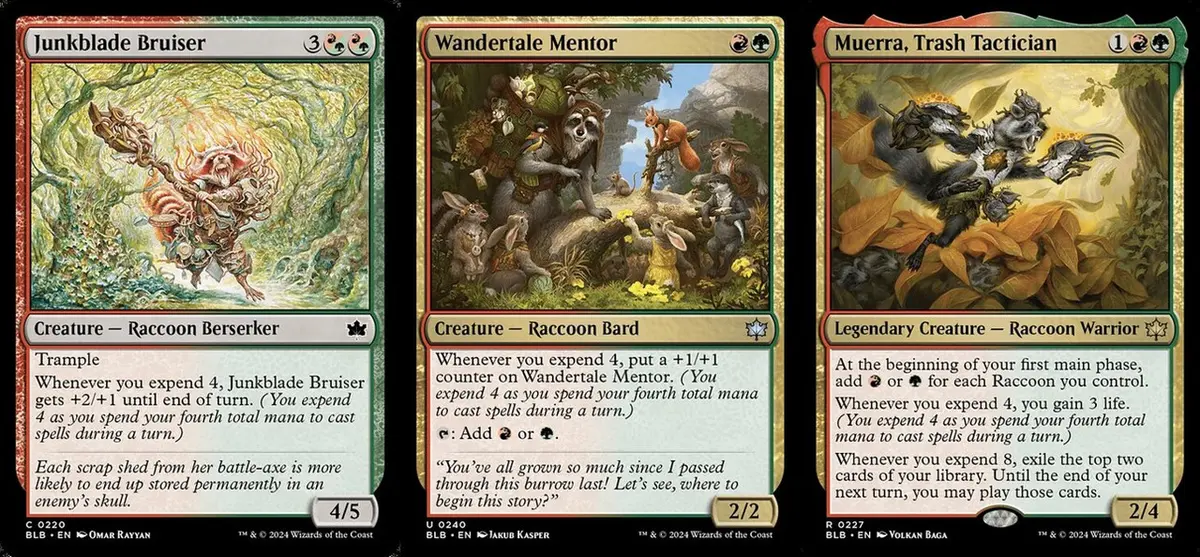
Creature type: Raccoons
Number of RG cards: 14
The uncommon Wandertale Mentor does two things: it produces mana, and with expend 4 it grows itself. The common Junkblade Bruiser has a fine body, and expend 4 gives it +2/+1 until end of turn. The legendary rare Muerra, Trash Tactician gives you more mana and gets bigger benefits from the expend mechanic. However, strictly speaking, the effects of these cards are not very enticing for building around this mechanic, at least not for me.
Expend is a curious mechanic. It only rewards you when you cast spells with enough total mana spent, and the rewards on these three cards look a bit… subtle. Take Muerra, Trash Tactician: its expend 4 gains you 3 life, and only expend 8 draws you extra cards, which must be used before the end step of your next turn. Meeting expend 8 in a single turn means paying 8 or more mana for one expensive spell, or casting two or three small and medium spells, which basically only happens very late in Limited. Of course, Muerra’s extra mana lets this happen sooner, giving a chance to start snowballing around turns five or six.
After a first look at BLB’s red-green cards, I don’t think expend is a mechanic worth building around. It is better suited as a supporting theme for extra advantage. The matching creature type for red-green is Raccoons, but after looking at the previewed cards, I don’t see much tribal synergy either. Rather than banding together, perhaps Raccoons care more about living their own happy spending lives.
Takeaway Tips
- Expend may not be a mechanic to build around. It is probably better as a supporting theme for extra advantage.
- The creature type for red-green is Raccoons, with 14 cards, but the tribal synergy is not significant.
WhiteGreen — Tokens Go-Wide and Offspring
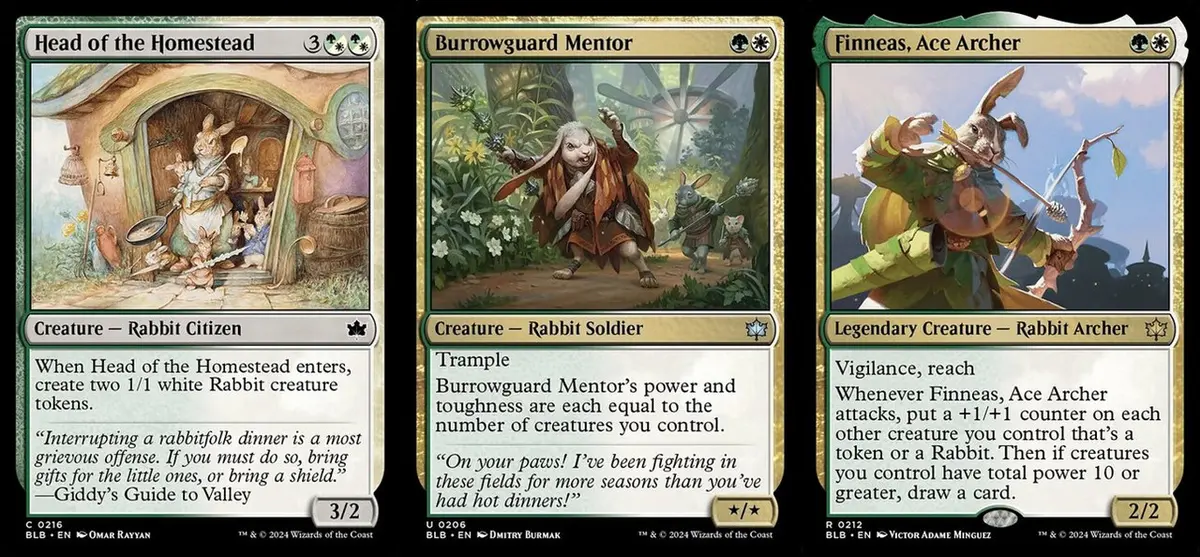
Creature type: Rabbits
Number of GW cards: 14
Number of cards in other color pairs: 1 (the Naya Baylen, the Haymaker)
The uncommon Burrowguard Mentor is simple and brutal: the more creatures you have, the stronger it gets, and it comes with trample so you needn’t worry about getting through. The common Head of the Homestead makes three bodies for five mana, which is very efficient as a card supporting the theme. The legendary rare Finneas, Ace Archer puts counters on your Rabbits all at once as long as it survives to attack, and may even draw you a card. Unfortunately this effect does not affect itself, and without protection spells to escort it, there probably won’t be a second attack after you send it out.
Next, the creature type for green-white is Rabbits, which is very important when analyzing this theme. The uncommon Hop to It makes three Rabbits at once. That may be a bit ordinary in other white decks, but in green-white, besides widening the board in one go, it can trigger lords like Harvestrite Host multiple times, giving a pump and refilling your hand in one. Finally, as usual for tokens go-wide, cards like Inspired Charge are indispensable, and Rabbit Response is the must-have card that turns those seemingly harmless 1/1 bunnies into an overwhelming threat!
Lastly, a brief word on offspring. The green and white offspring cards are of course good cards for this pair, but offspring is not a theme to build around. I mention it last only because offspring makes two bodies for one card, which fits the green-white go-wide theme. Incidentally, offspring appears in all five colors and is not unique to green-white.
Takeaway Tips
- Green-white encourages you to go wide, so both payoff cards and go-wide cards are necessary. When building, I suggest focusing on the go-wide cards and using payoffs as support.
- The creature type for green-white is Rabbits, with 14 cards. The type is also an important core element of this pair, and many go-wide cards make 1/1 Rabbit tokens.
- Offspring is not unique to green-white, but its two-for-one nature also fits the green-white go-wide theme.
BlackWhite — Life Gain & Life Loss
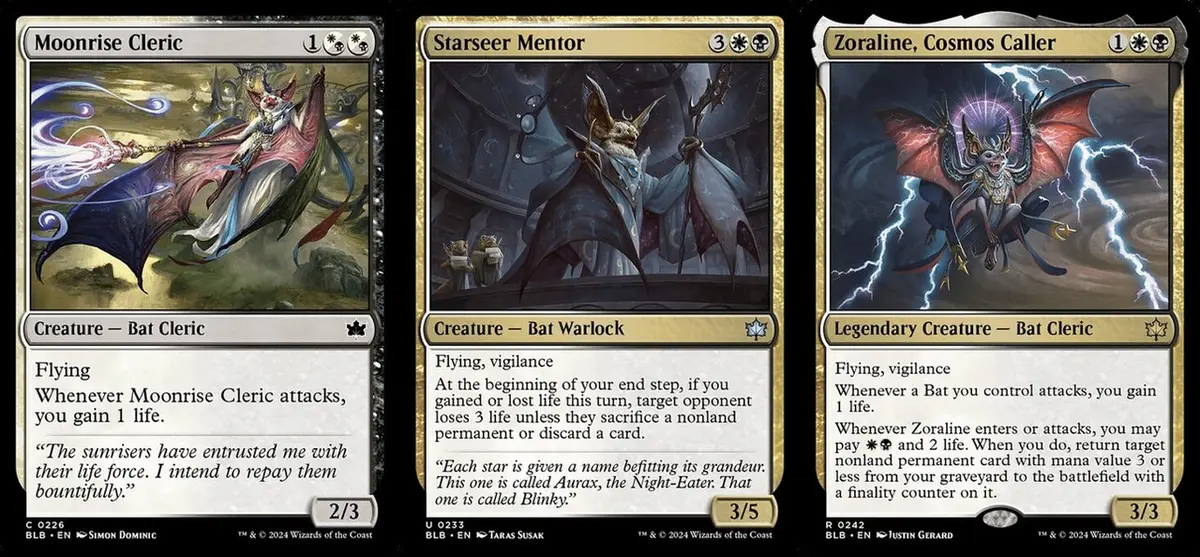
Creature type: Bats
Number of WB cards: 12
The uncommon Starseer Mentor is a five-mana 3/5 with flying and vigilance, a super sturdy body, and at your end step, if your life total changed this turn, it starts eating away at your opponent’s resources. The common Moonrise Cleric is a theme trigger source that gains you 1 life just by attacking. The legendary rare Zoraline, Cosmos Caller should be one of the strongest cards in this set. Its abilities match the white-black theme closely: whenever a Bat attacks you gain 1 life, and whenever it enters or attacks you can pay two mana and 2 life to return a permanent card with mana value 3 or less from your graveyard to the battlefield. I also have to mention the Enchantment Lunar Convocation for white-black. This two-mana Enchantment takes the life-change theme to the extreme. It doesn’t only care whether your life total went up or down: when you gained and lost life in the same turn, you also create a 1/1 black Bat, which in turn keeps feeding tribal payoffs like Zoraline, Cosmos Caller for an impressive snowball!
From the angles discussed above, white-black should perhaps be built opposite to other pairs: prioritize theme payoffs and tribal creatures, and don’t worry too much about theme triggers, because most triggers are already attached to the payoff cards and tribal creatures.
Bats are also the creature type representing white-black. They fly, and each one carries some good abilities. Besides the strong Bats mentioned above, such as Starseer Mentor and Zoraline, Cosmos Caller, I want to single out Wax-Wane Witness. A four-mana 2/4 with flying and vigilance should be very popular in Limited. Since they can attack and defend while also gaining life for theme payoffs, I believe Bats should be a popular tribal choice in Limited.
Takeaway Tips
- White-black cares about life changes. The theme payoff cards and the 12 matching Bats mostly have abilities that trigger the theme, so prioritize these two kinds of cards when building.
- Moreover, the theme’s payoffs can even snowball, so don’t miss strong theme payoff cards.
- Among the Bats, the common and uncommon slots each have at least one card with toughness 4 or more, flying, and vigilance, which deserve special attention.
RedBlue — Spellslinger and Prowess
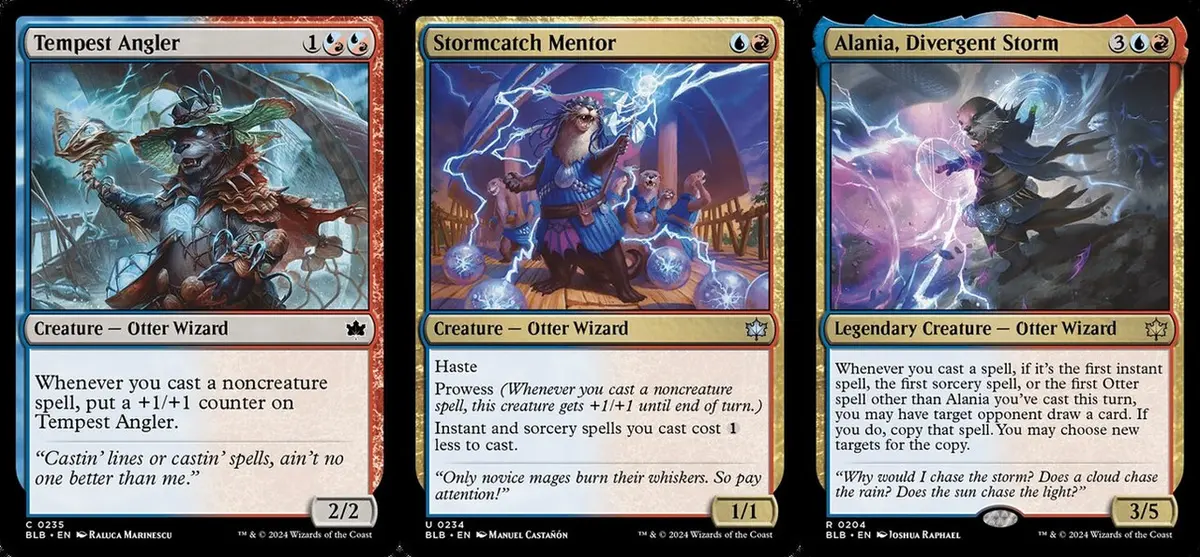
Creature type: Otters
Number of UR cards: 14
The uncommon Stormcatch Mentor looks multifunctional at first glance, but it fizzles immediately whenever you can’t cast noncreature spells. The common Tempest Angler has a failing body, and you must cast at least two noncreature spells before it barely becomes a threat, so it doesn’t make me want to play it.
The legendary rare Alania, Divergent Storm also has a huge gap between ceiling and floor. At best it lets the first instant, sorcery, and Otter spell you cast each turn be copied, but at worst it is just a Thraben Purebloods. Giving the opponent a card is still a considerable drawback. Although this set shouldn’t have something like Mindbreak Trap come on, even if it did I wouldn’t put it in my main deck, it is still a considerable liability against opponents with sweepers or counterspells.
When building red-blue, the ratio of noncreature spells (mainly instants and sorceries) to creature spells (mainly Otters) may need to be adjusted close to 1 : 1 to bring out the pair’s advantages. It is a pair that isn’t easy to build well, so I suggest trying it after you have some Limited experience!
Oh, and if you open Ral, Crackling Wit, its [+1] loyalty ability also creates a 1/1 blue and red Otter token, so it can be counted as an Otter card too.
Takeaway Tips
- To play red-blue well, you need both instants and sorceries and the 14 Otter creatures of the pair. If either side is unbalanced, I suggest not playing red-blue.
- Until a strong build is found, red-blue easily ends up drawing or building toward the weaker side. It is not a pair I recommend beginners try, but if you are confident in your Limited deckbuilding, or want to try a high-spell-count build, it is still worth playing.
BlackGreen — Forage and Food Tokens
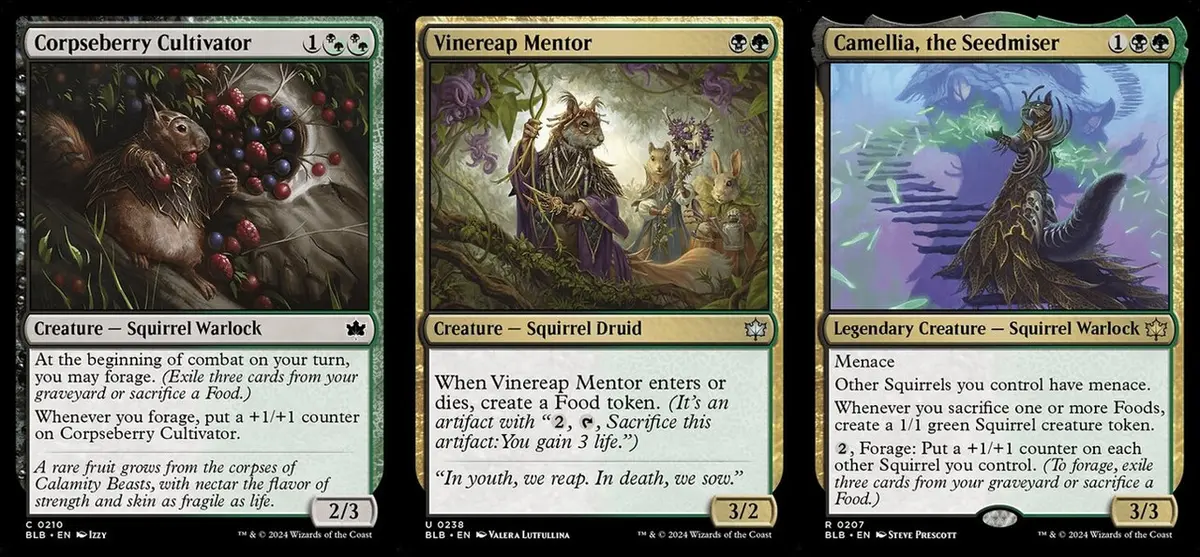
Creature type: Squirrels
Number of BG cards: 14 + 1 (SPG’s Toski, Bearer of Secrets, which shows up less often)
The uncommon Vinereap Mentor practically has “value” written on it, and it is one of the few two-color uncommons with a built-in theme trigger. The common Corpseberry Cultivator is quite capable once forage triggers once and it becomes a 3/4. The legendary rare Camellia, the Seedmiser is a Squirrel tribal lord that benefits from the forage mechanic. Squirrels and Camellia herself have menace, and she can sacrifice Foods to make Squirrels, growing the whole family along the way. All the benefits of playing this pair are gathered on her.
The problem with black-green is still whether your deck can trigger forage reliably. That means:
- You need enough cards that create Food tokens, or individual cards that keep creating Food;
- Or your deck is good at filling the graveyard, giving you enough cards to forage with.
As for the Squirrel tribal theme, most Squirrel creatures benefit from the forage mechanic, so the issue is still the one above: how to trigger forage reliably, which is a very important question in black-green. To trigger forage reliably in Limited, you probably rely mainly on sacrificing Foods, with exiling three cards from your graveyard as a supplement. So cards that actively create Food, such as Bakersbane Duo and Cache Grab, will be very important, and you should pay close attention to them when building black-green.
Takeaway Tips
- How to trigger forage reliably will be a very important question in black-green.
- In Limited, forage will probably be triggered mainly by sacrificing Food tokens, with exiling three cards from the graveyard as a supplement.
- The creature type for black-green is Squirrels, with 15 cards. Most of them have forage payoffs, so the issue mentioned earlier really matters.
RedWhite — Valiant Aggro
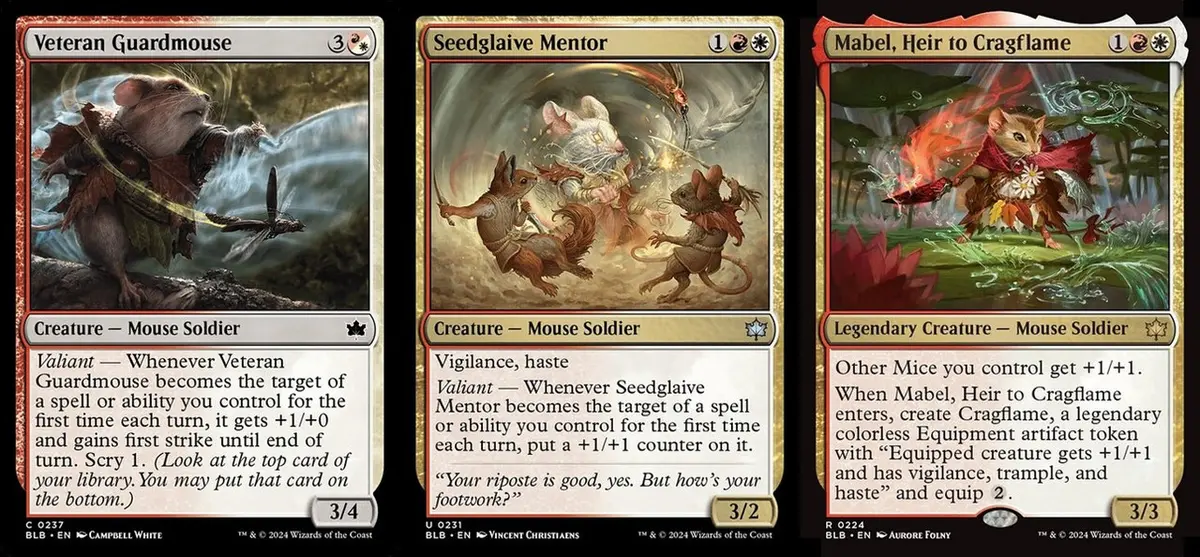
Creature type: Mice
Number of RW cards: 15
The uncommon Seedglaive Mentor is an aggressive three-mana beater, which sets the tone that BLB red-white goes the aggro route. The valiant mechanic encourages you to play many cheap combat tricks, Auras, or buff-style activated abilities to trigger it. The common Veteran Guardmouse leaves me not so satisfied. For aggro, a four-mana 3/4 is a bit too clunky. Valiant gives it a pump and first strike, but even when triggered, 4 first-strike damage may not be enough to punch through the defenses the opponent has built. It is a card designed more for defense than aggro. Seeing this left me with question marks all over my head: so in red-white I attack early and defend late!?
No choice, let’s look at our star here, the legendary rare Mabel, Heir to Cragflame, a three-mana 3/3 Mouse lord that creates a very strong Equipment when it enters… So red-white also has to go Mouse go-wide & Equipment aggro!? Is it a good idea to cram this many themes into one pair?
All right, let’s look at the pair’s creature type, Mice. Fortunately they pull their weight. Creatures like Thistledown Players and Brambleguard Captain can reliably trigger your creatures’ valiant, while other little Mice like Flowerfoot Swordmaster, besides making many at once, can even deal a huge amount of damage in one turn with several valiant triggers backing them up!
To trigger valiant, besides spells like the high-quality Mabel’s Mettle, Auras (Feather of Flight, War Squeak, and so on) and even equipping Equipment can all trigger it. Now you can understand why Mabel, Heir to Cragflame gives you an Equipment: in the mid-to-late game you can move it from one valiant creature to another to trigger a wave!
From all this we can piece together how to build red-white. See the key points below:
Takeaway Tips
- The creature type for red-white, Mice, has 15 cards and is tied to the valiant mechanic. Valiant is actually not hard to trigger: combat tricks, Auras, equipping Equipment, and even targeting with an ability you control can all trigger it.
- Valiant only has an effect the first time it triggers each turn, not afterward.
- There are quite a few Mouse lord-style creatures among the red-white uncommons and rares, which can push your deck’s strength further.
- Low-cost creatures, valiant triggers, plus some card-draw and protection spells, and red-white will run well!
BlueGreen — Enter Effects and Flicker
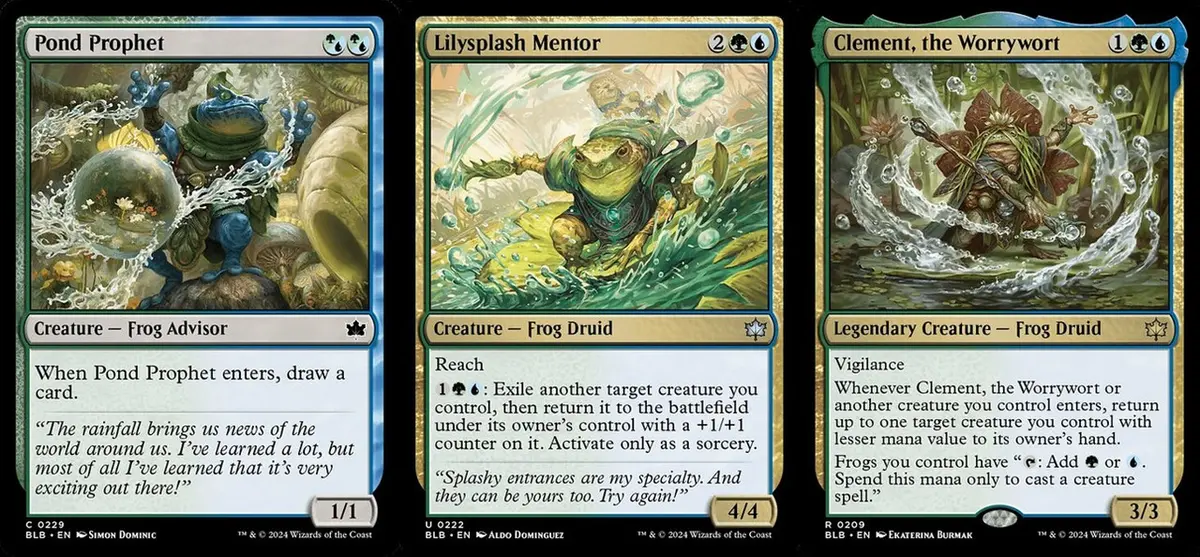
Creature type: Frogs
Number of UG cards: 19
Number of cards in other color pairs: 1 (SPG’s Frogmite, which shows up less often)
The uncommon Lilysplash Mentor has a decent body and a built-in activated ability that triggers enter and leave effects, and the returned creature even grows. It’s a pity it can’t be activated at instant speed, which is probably a restriction set because it would be too strong and too profitable. The common Pond Prophet doesn’t lose you a card on entering, but its 1/1 body, in the power-inflated Limited of today, is basically just for repeatedly milking enter-the-battlefield abilities. And the legendary rare Clement, the Worrywort lets your creatures hop around with joy: big ones back to small, small ones back to big, in and out, what a delight!
In addition, the Frogs of blue-green can roughly be divided into the following categories:
- Flicker targets (the ones being returned): Frogs with enter abilities, usually cheap and suited to being recast after returning to hand, such as Bellowing Crier and Sunshower Druid;
- Flicker sources (the ones returning others): Frogs that can actively trigger enter and leave effects, such as Stickytongue Sentinel and Lilysplash Mentor.
- There is also a third kind, Frogs that benefit from enter and leave effects (just stand there and watch), such as Three Tree Scribe and Dour Port-Mage.
When building, watch the number of Frogs in the first two categories. And if you also have the third kind, congratulations, you should be able to build a blue-green hopping deck of decent strength! Enjoy it and let frogs jump start!
Takeaway Tips
- Besides caring about enter and leave effects, blue-green’s matching creature type, Frogs, has 20 cards with quite different functions each, so you need to balance the number of Frogs that return others and Frogs that get returned.
- Before they are pumped, Frogs top out at about 4/4 and basically have no trample. Besides some Frogs that can tap down the opponent’s creatures, you might consider adding creatures with bigger bodies or trample to gain an edge in creature combat.
Other Themes and Cycles
Tribal Payoffs for the Five Colors
The creature types corresponding to the five colors are:
- White: Bats, Birds, Mice, Rabbits
- Blue: Birds, Frogs, Otters, Rats
- Black: Bats, Lizards, Rats, Squirrels
- Red: Lizards, Mice, Otters, Raccoons
- Green: Frogs, Rabbits, Raccoons, Squirrels
Valley Callers
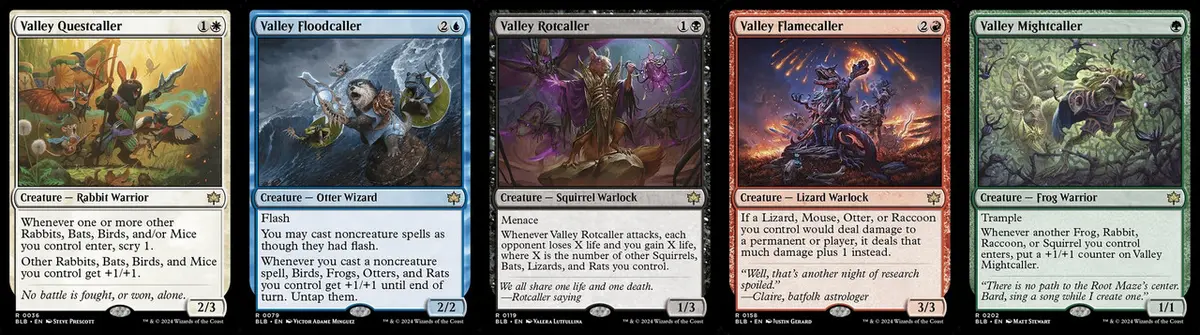
The Valley Callers are five mono-colored rare creatures. Each brings its color’s matching creature type a team pump like an anthem, plus some special effects.
On the card art you can see the creatures of the matching type that the card mentions appearing together, which is great flavor!
Typal Lords
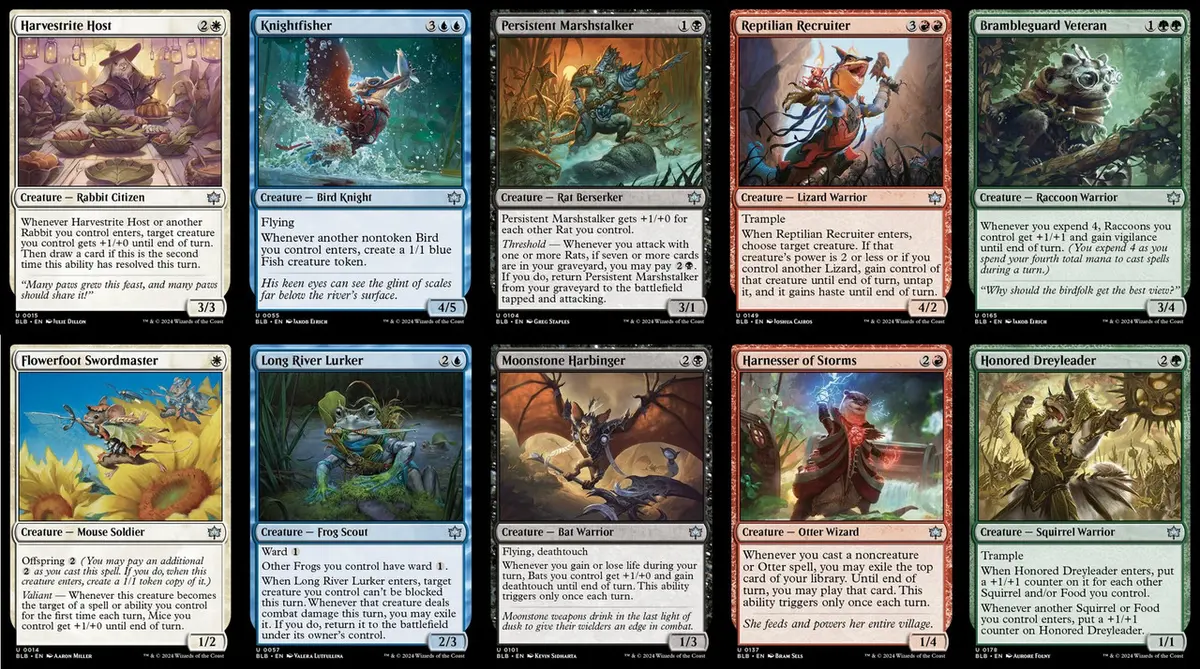
This isn’t talking about the traditional cards that give a matching creature type a team Glorious Anthem effect, like Elvish Archdruid, Goblin King, and Lord of Atlantis. It refers to the mono-colored uncommon buff creatures for the ten creature types of Bloomburrow, which require you to meet specific conditions to trigger their effects. Note that they all need proper deckbuilding to reach their full potential. Taking more creatures of that type is not necessarily stronger, and sometimes you also need to satisfy the matching pair’s mechanic for the effects to keep happening.
Villages
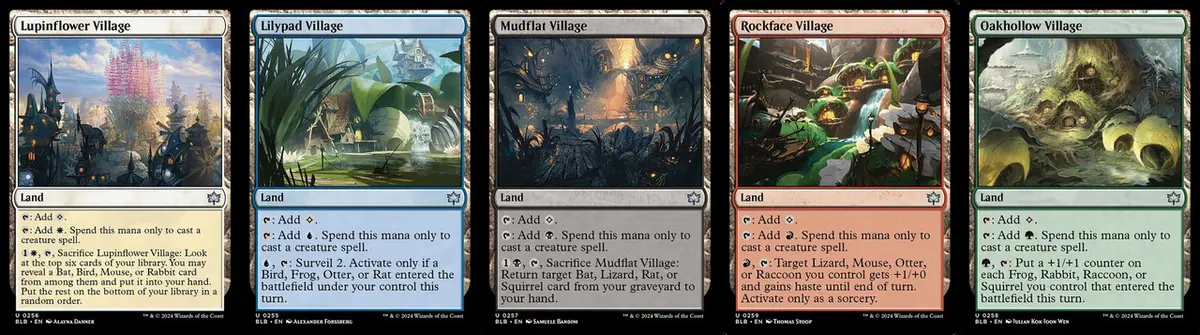
The Villages are a cycle of five mono-colored uncommon lands, but don’t forget that the colored mana they produce can only be spent on creature spells, and they only produce colorless mana for noncreature spells. However, creatures are the core of Limited, so when you open the Village of the matching color, go ahead and put it in your deck. The Villages also correspond to the creature types of the five-color pairs, and at the right time you can activate the land’s ability to give you or the creatures of that type you control some benefit.
Duos
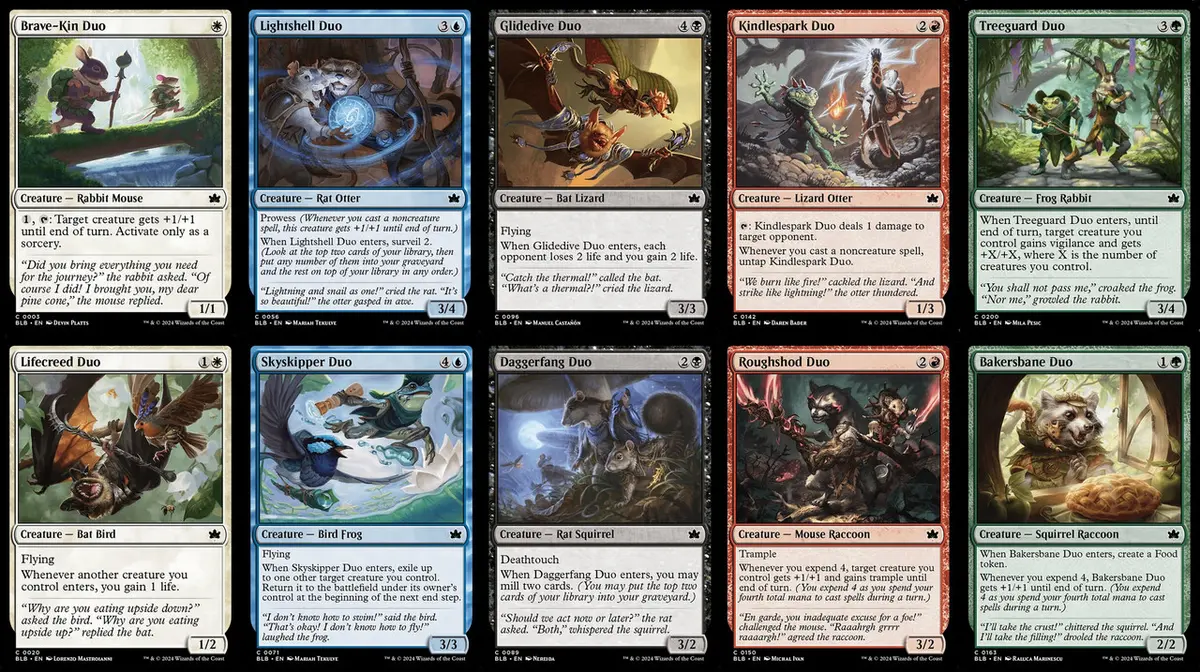
The Duos are a set of ten mono-colored creatures with two creature types each, specially designed by the team to make Limited deckbuilding easier. Naturally, their types match the ten color pairs mentioned earlier. For example, white’s Brave-Kin Duo corresponds to the Mice of redwhite and the Rabbits of whitegreen, while another white card, Lifecreed Duo, corresponds to the Bats of blackwhite and the Birds of bluewhite. Their abilities are also more or less related to the themes of the matching pairs.
Tribal Cost-Reduction or Bonus Spells
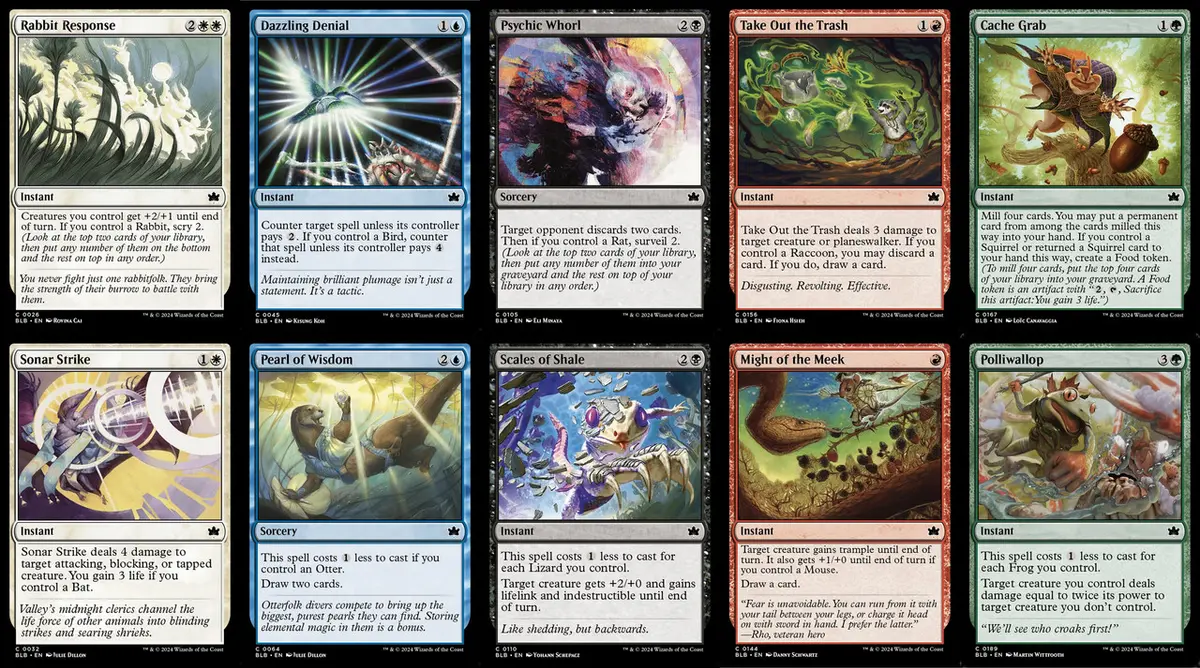
This refers to the ten common spells in BLB whose effects are very close to many cards we know well, but when you control a creature of the right type, you can cast them for less, or get an extra bonus.
For example, Pearl of Wisdom, a blue three-mana sorcery that draws two cards. Isn’t that our old friend who has beaten us black and blue, Divination? This Otter-themed Divination lets you cast it for one less mana when you control an Otter.
But don’t forget that these cards can be cast just the same without a creature of the matching type. You don’t need to push to get the full effect, so use them when the time is right.
Calamity Beasts
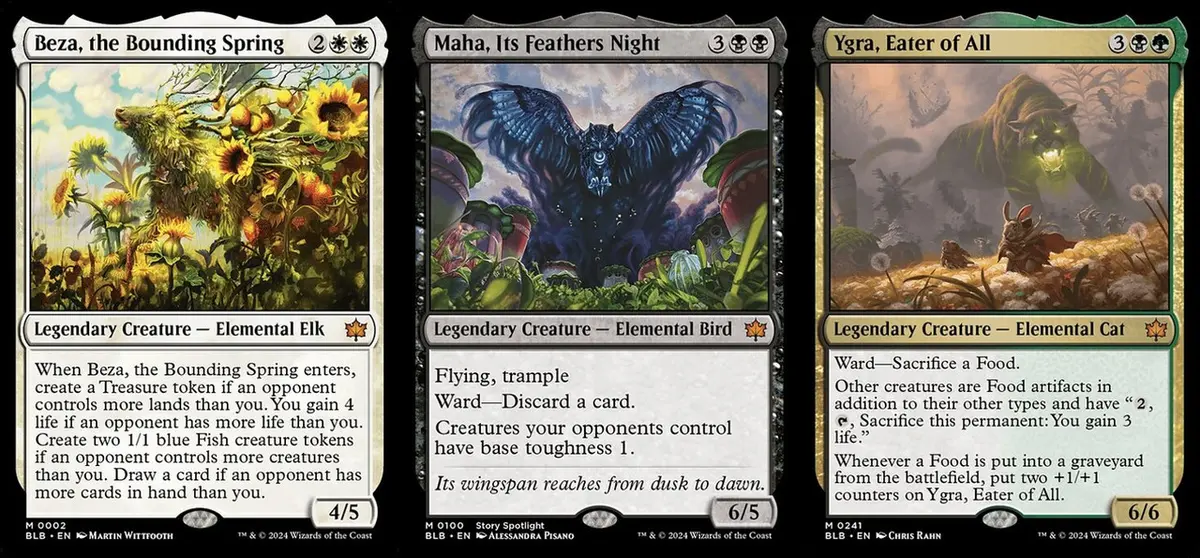
If the ten creature types above represent the residents of Bloomburrow, then the Calamity Beasts coexist with them and bring hazards on the scale of natural disasters. They don’t only bring destruction, though; they also bring the changing of the seasons. Besides the powerful named legendary Calamity Beasts at mythic rare, there are also uncommon and rare Calamity Beasts that are not legendary. These beasts generally have the following traits:
- Each creature’s own effect is extremely powerful, and its body dominates creatures of the same mana value;
- They don’t have much synergy with Limited themes, since they are strong enough on their own;
- Calamity Beasts all additionally have the Elemental creature type, symbolizing their role as natural disasters in Bloomburrow.
Mono-Colored Classes
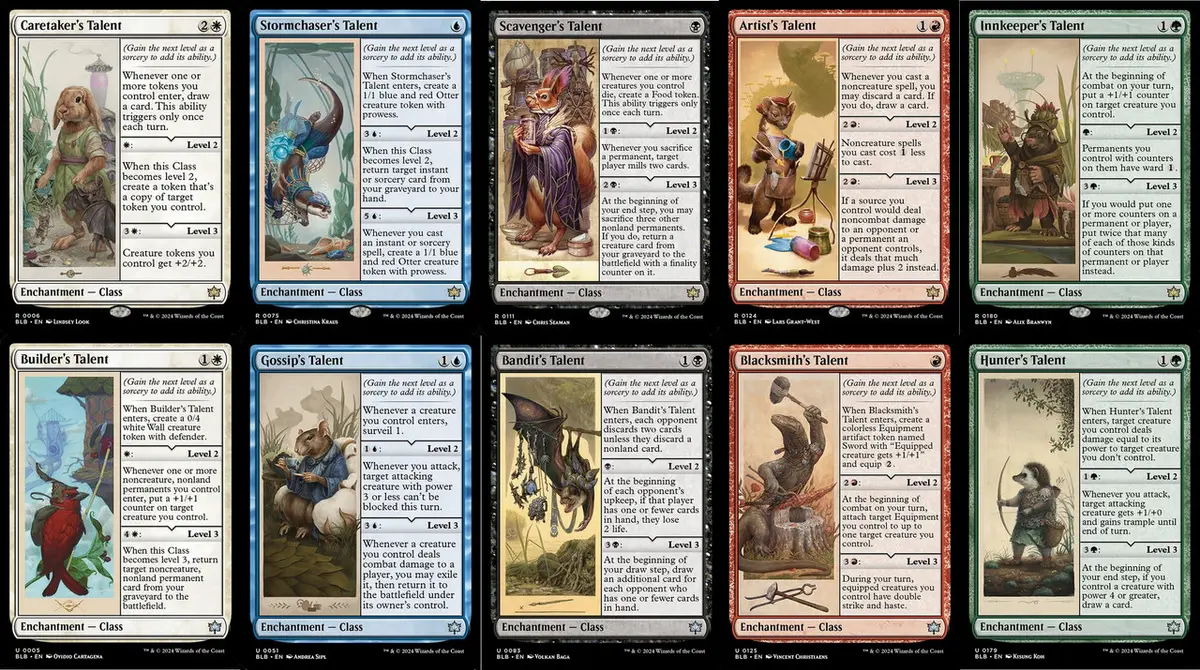
There are 10 mono-colored Class cards, 5 uncommons and 5 rares. They are somewhat similar to planeswalkers in use. Most have less impact on the turn they enter than a one-shot spell of the same cost, because they always need a little time for their influence to ferment! You can cast them at sorcery timing and then unlock each level in turn to strengthen your advantage, and the accumulated advantage gradually rolls onto the broad road to victory.
Bloomburrow’s Special Guests (Special Guest, SPG)
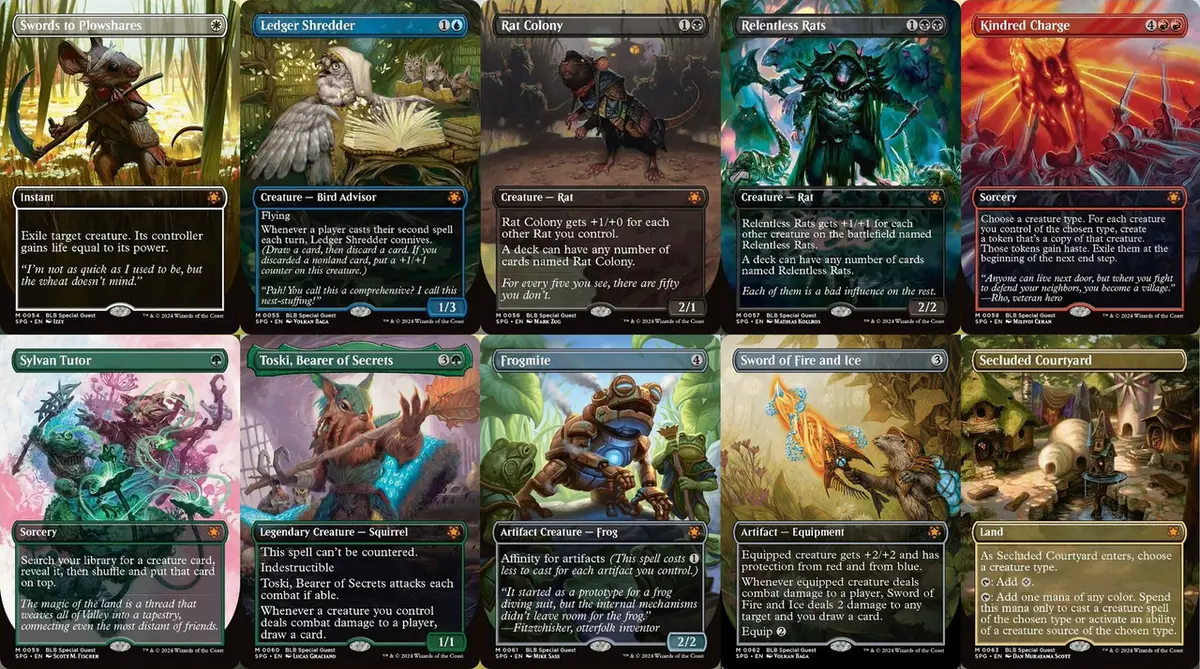
SPG 0054 to 0063 are the ten Special Guest cards you can open in regular Bloomburrow boosters. A few are related to the themed creature types, and some, for reasons unknown, are absurdly powerful, like Sword of Fire and Ice, which is also in this SPG. Basically, treat the SPG cards as a small supplement and bit of fun for themes or flavor, but since there aren’t many and they don’t show up often, just take them as a little Limited surprise (scary?)!
Conclusion: Let’s Play BLB Limited!
Although the introduction above should give readers a first understanding of BLB Limited deckbuilding, so you won’t feel lost when you first approach prerelease or other Limited events, the strength of each pair and how the mechanics interact still depend heavily on what you learn from actual play and discussion. That is also the charm of Limited: even after dozens or hundreds of games, every time you can still discover new combinations or run into unexpected situations!
In short, let’s play Limited!!!
- Title
- A First Look at Bloomburrow Limited
- Author
- cephille
- Created at
- July 22, 2024
- License
- This work is licensed under CC BY-NC-SA 4.0 .