A First Look at Bloomburrow Standard

Note: This article was translated from Chinese by AI and may contain errors. Read the original Chinese version.
Before We Start
This Standard update isn’t just new cards flooding into the card pool, it’s also the first Standard rotation in two years. A whole crowd of familiar faces, including The Wandering Emperor, Memory Deluge, Raffine, Scheming Seer, and Kumano Faces Kakkazan, are leaving Standard, and the environment is in for a great reshuffle. Let’s see together how the adorable little animals will shine!
Deck Overview
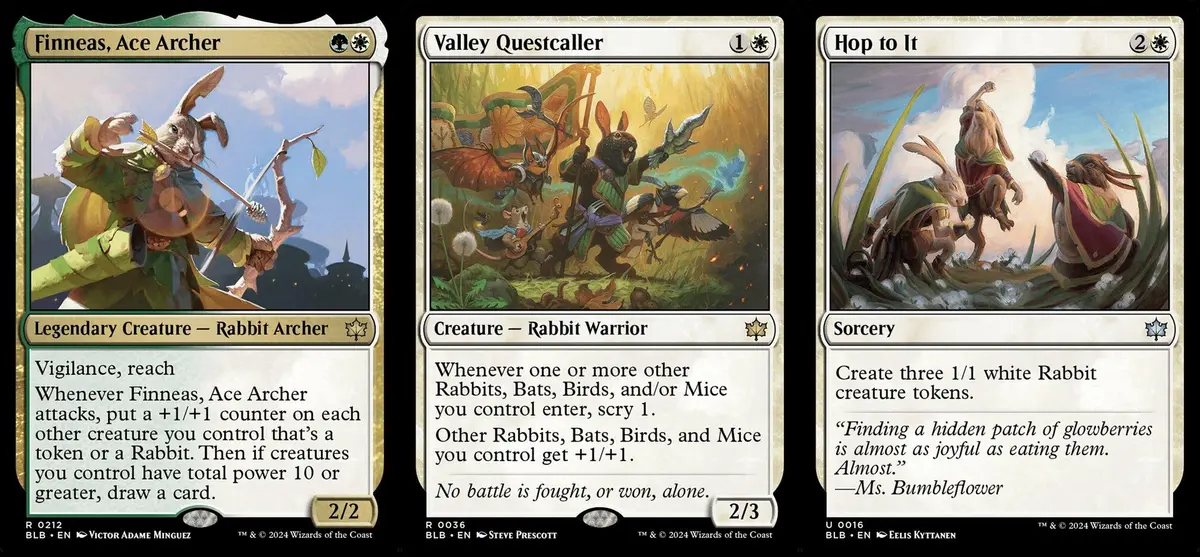
Selesnya Rabbit
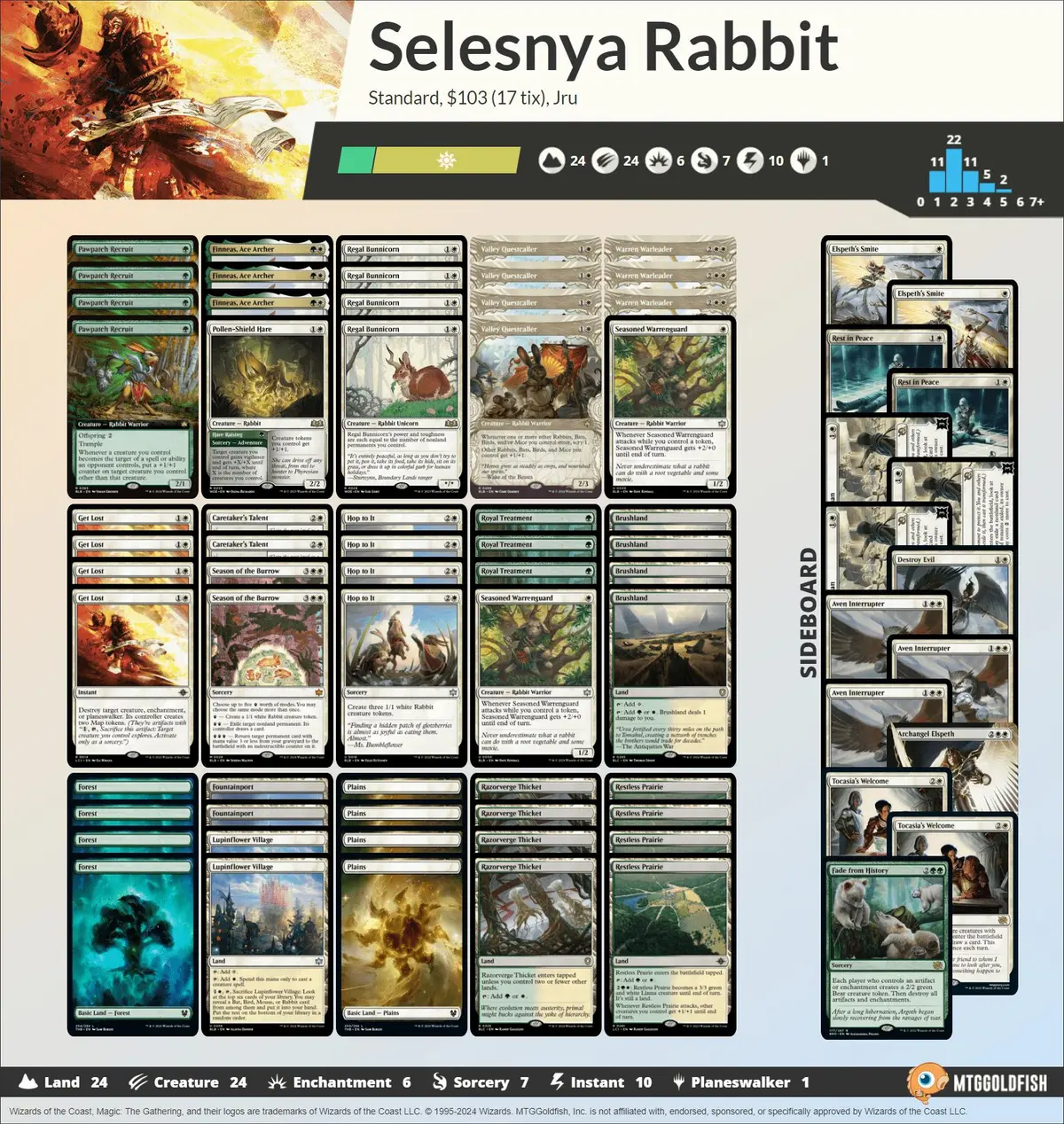
Since this is the age of adorable little animals, let’s start with the most adorable of all, the Rabbits!
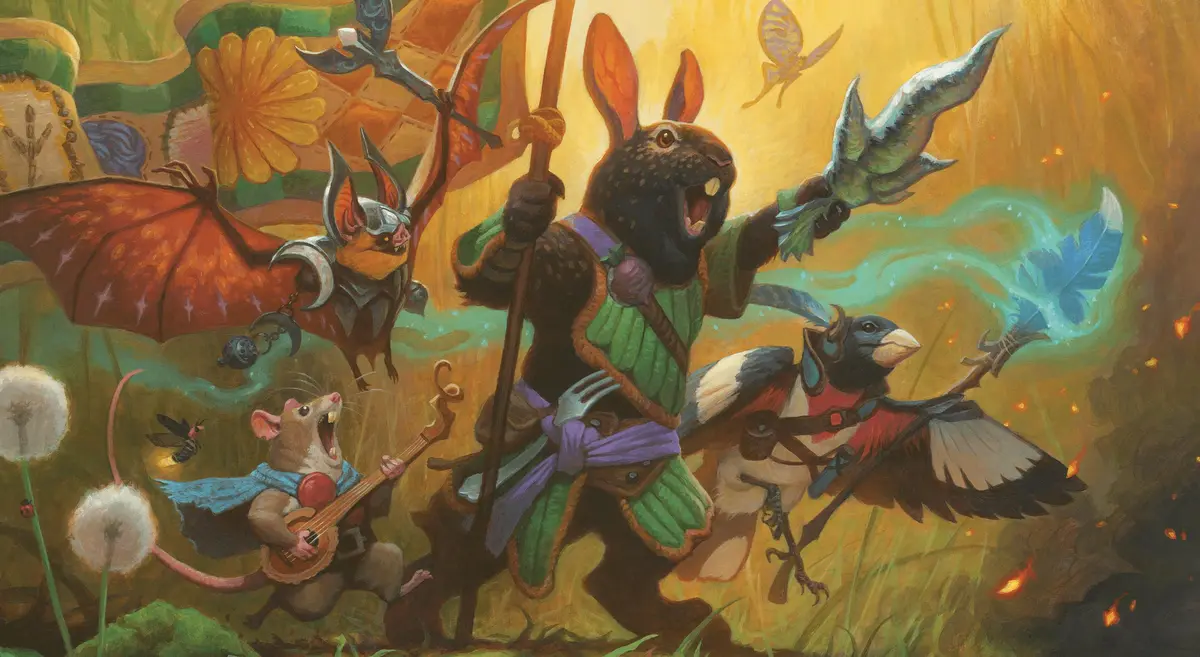
This set is the first time in history that Rabbits have become a playable theme. Before this, Rabbits were only scattered single cards with no theme whatsoever, while this time the Rabbit theme is tokens and going wide, and the completeness of the new cards is astonishing. Almost every point on the curve gives you the card you most want to see. Going wide also fits extremely well with WOE’s Regal Bunnicorn, beautifully folding Standard’s existing powerful Rabbit single cards into the new set’s theme.
Orzhov Bat
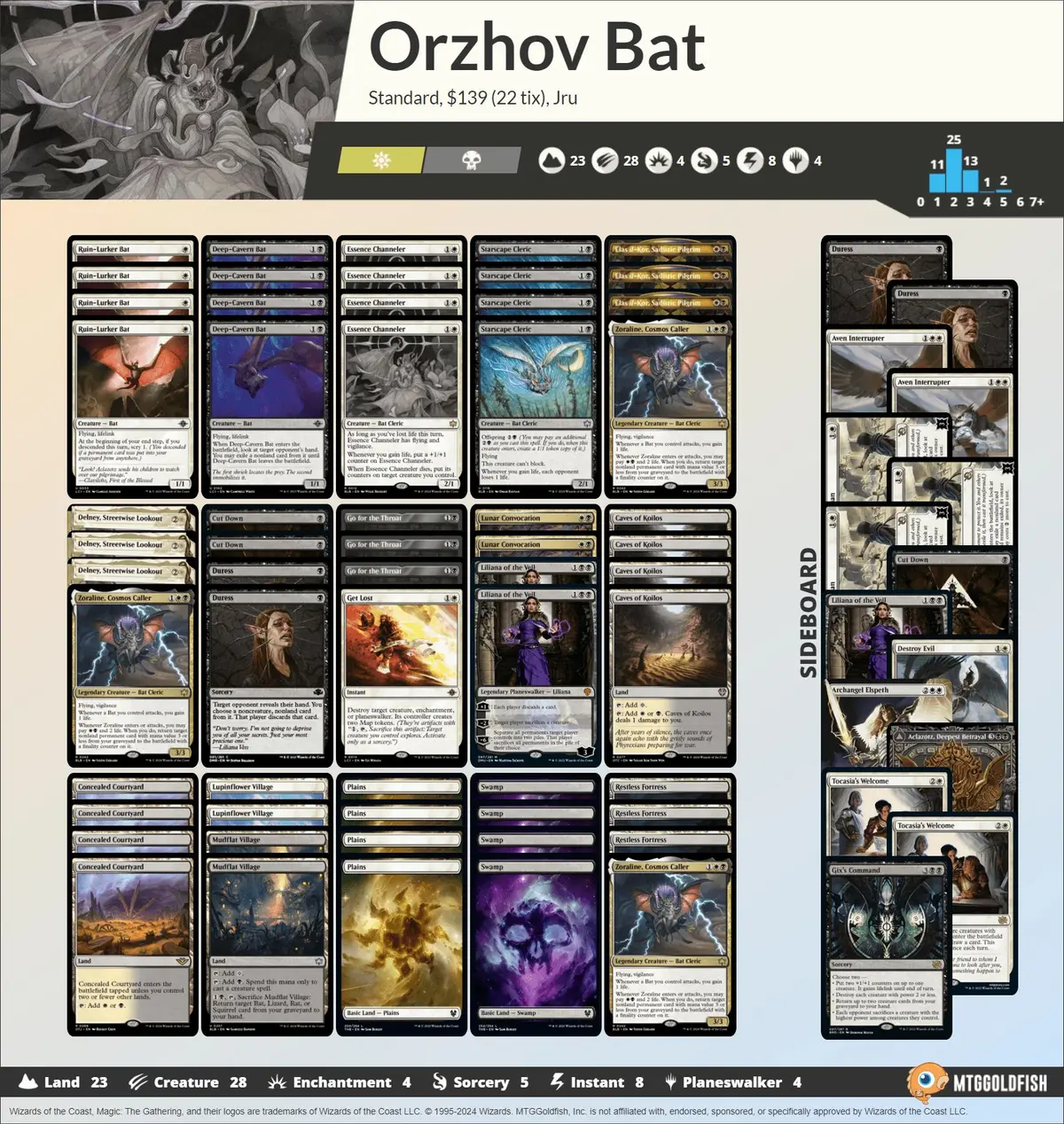
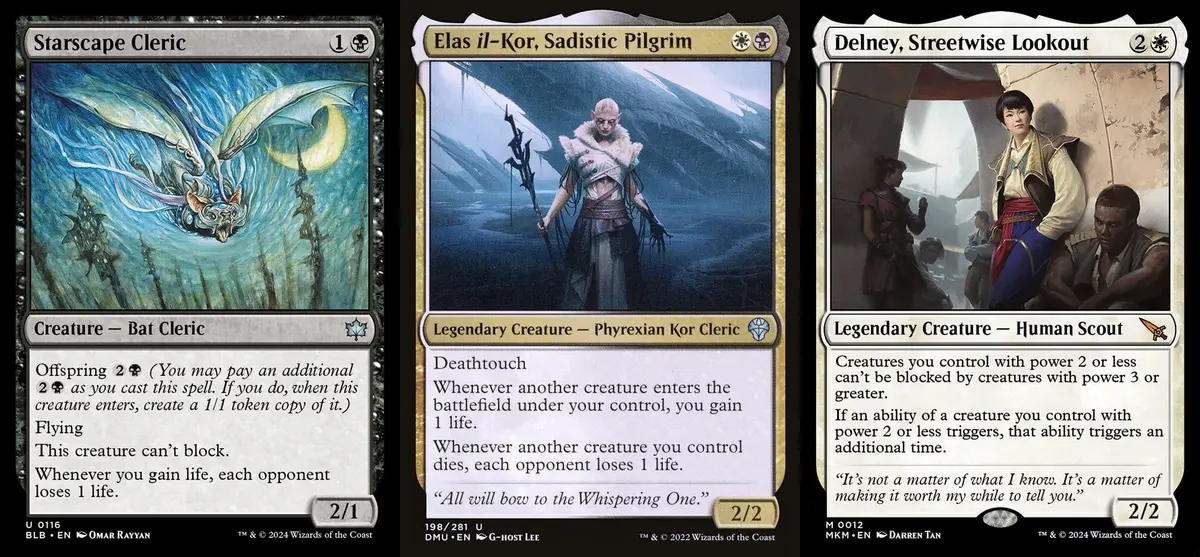
This set’s Bat material isn’t as lavish as the Rabbits’. Although LCI also has some Bats to support it, including the top-tier two-drop Deep-Cavern Bat, the number of quality creatures is still insufficient overall. Fortunately, this time the Bat theme is gaining or draining life, so single cards that interact with the theme are easier to find. For example, Elas il-Kor, Sadistic Pilgrim provides great support, and looking closely you’ll find this deck has quite a few creatures with power 2 or less that have triggered abilities, so Delney, Streetwise Lookout was also drafted into overtime work.
Also, Delney + Elas il-Kor + Starscape Cleric is actually a small combo. Suppose you already have Delney + Elas il-Kor on the battlefield, and you cast Starscape Cleric with offspring. If there are no responses along the way and you order the stack correctly, the opponent ends up losing 32 life. The detailed process is as follows:
Combo stack resolution sequence
- Starscape Cleric itself enters, and its ETB triggers offspring and Elas il-Kor’s lifegain ability, which triggers an extra time because of Delney.
- By ordering your own triggers, choose the resolution order: Offspring A -> Offspring B -> lifegain -> lifegain.
- Offspring A resolves, creating Starscape Cleric token A, and token A entering triggers Elas il-Kor’s lifegain twice.
- Now you have two Starscape Clerics, and the stack is: lifegain -> lifegain -> Offspring B -> lifegain -> lifegain.
- Because you have two Starscape Clerics, and each lifegain trigger of the opponent-loses-life ability is triggered an extra time by Delney, each lifegain now drains the opponent for 4.
- The two lifegain triggers resolve, the opponent loses 8, and the stack is now: Offspring B -> lifegain -> lifegain.
- Offspring B resolves, creating Starscape Cleric token B, again triggering lifegain twice.
- Now you have three Starscape Clerics, and the stack is: lifegain -> lifegain -> lifegain -> lifegain.
- With three Starscape Clerics, plus Delney’s extra trigger, the opponent loses 6 on each lifegain.
- The four lifegain triggers on the stack finish resolving: 6 x 4 = 24 life, plus the 8 life from earlier, for a total of 32 life lost.
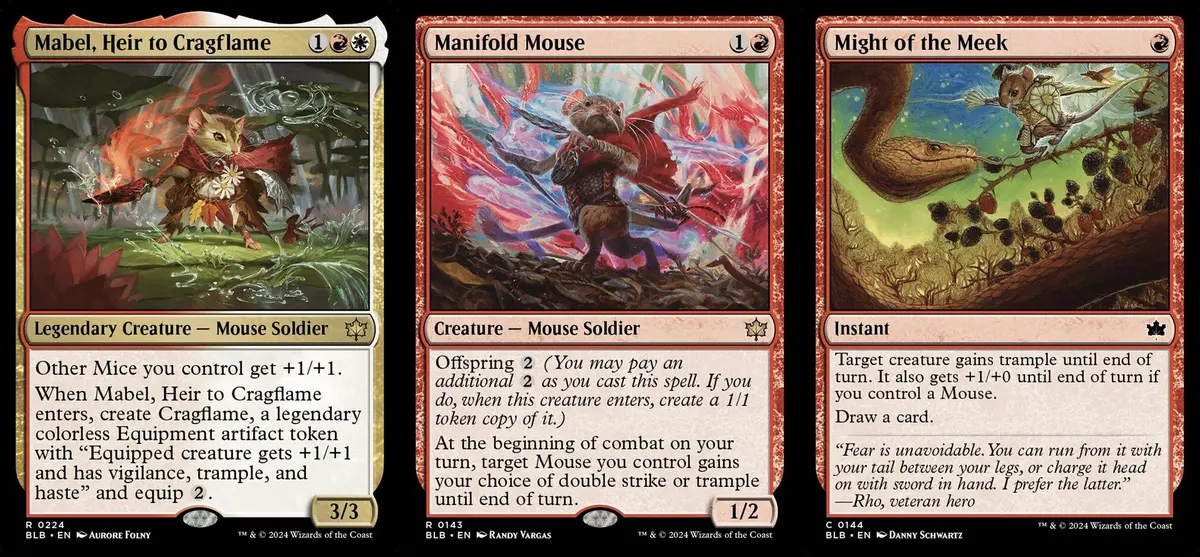
Boros Mouse
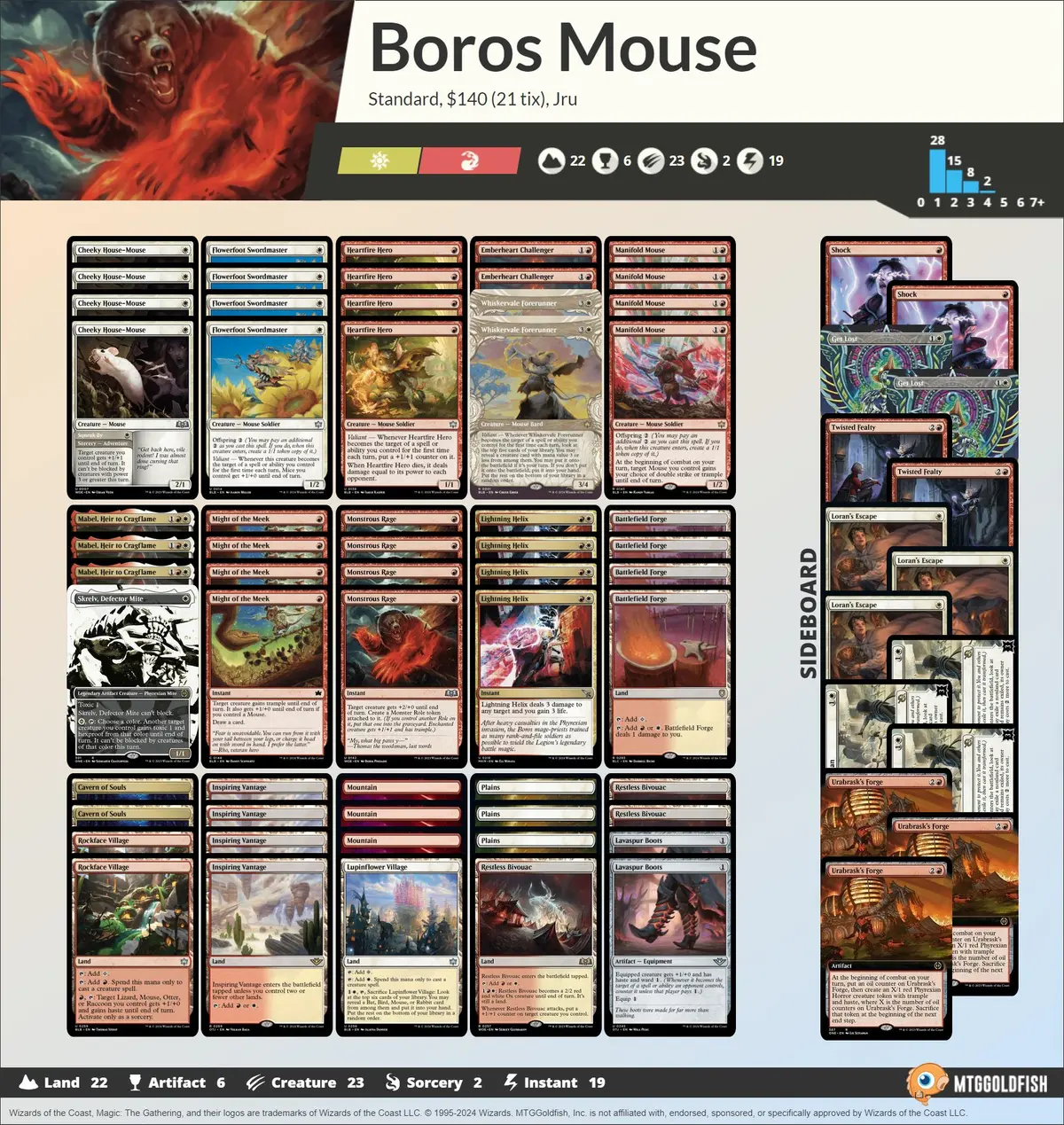
This set’s Mouse theme cards rival the Rabbits in lavishness, and the new cards from this set alone provide a fairly complete skeleton. The key to building Mice is how to keep triggering valiant consistently. Besides some Mice that come with abilities that can target and pump spells, cheap Equipment is also a good choice. I originally considered Lost Jitte too, but on reflection the Jitte needs to connect before it generates value, which is a bit of Win More for Mice. Lavaspur Boots, which gives haste and ward, can more truly change the direction of the game. That said, it can’t be denied that the Jitte’s “target creature can’t block this turn” is of great value, whether for seizing tempo on offense or for providing extra instant-speed windows to trigger valiant, so readers can also choose between the two Equipment based on their own understanding.
Dimir Rat
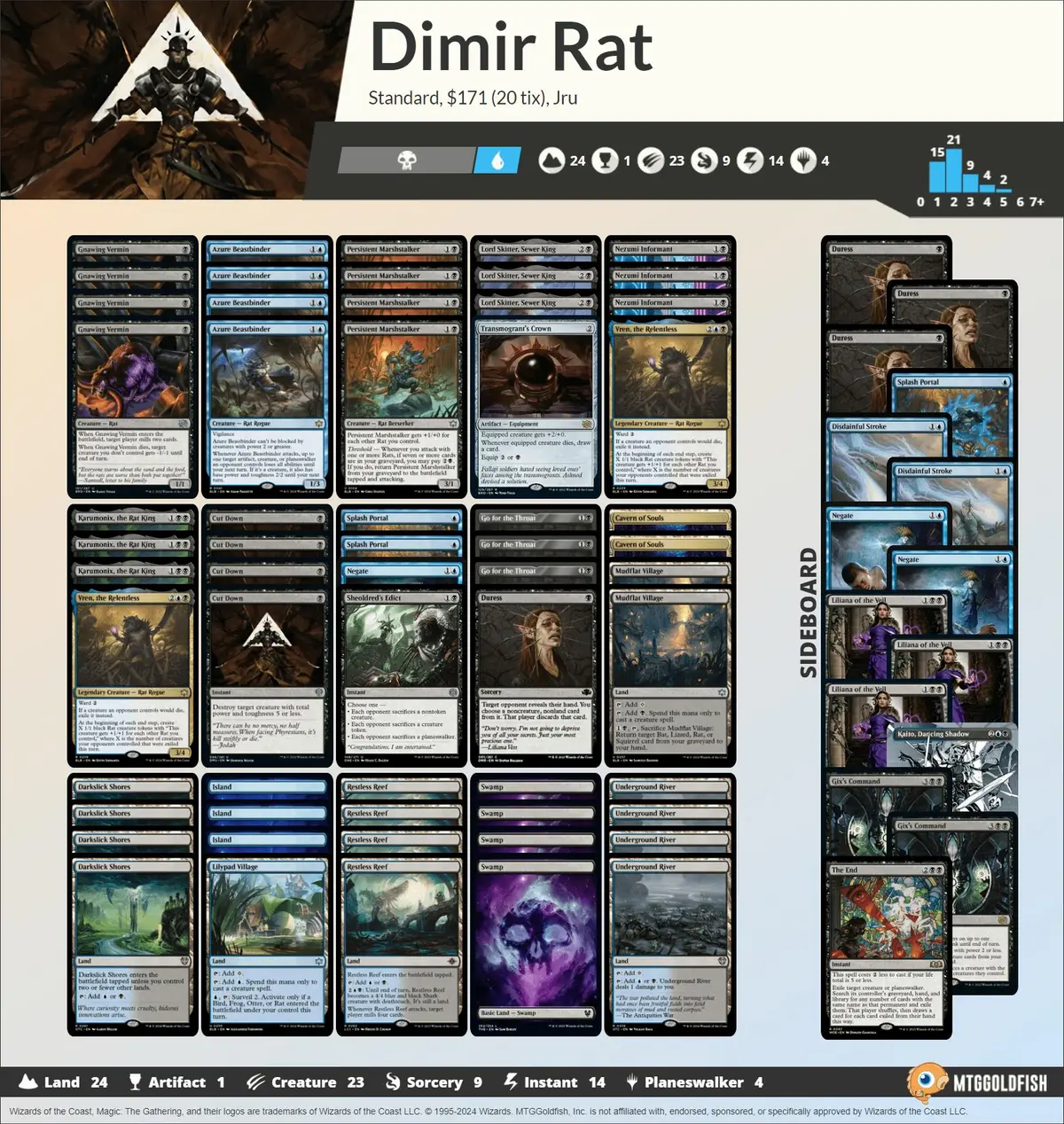
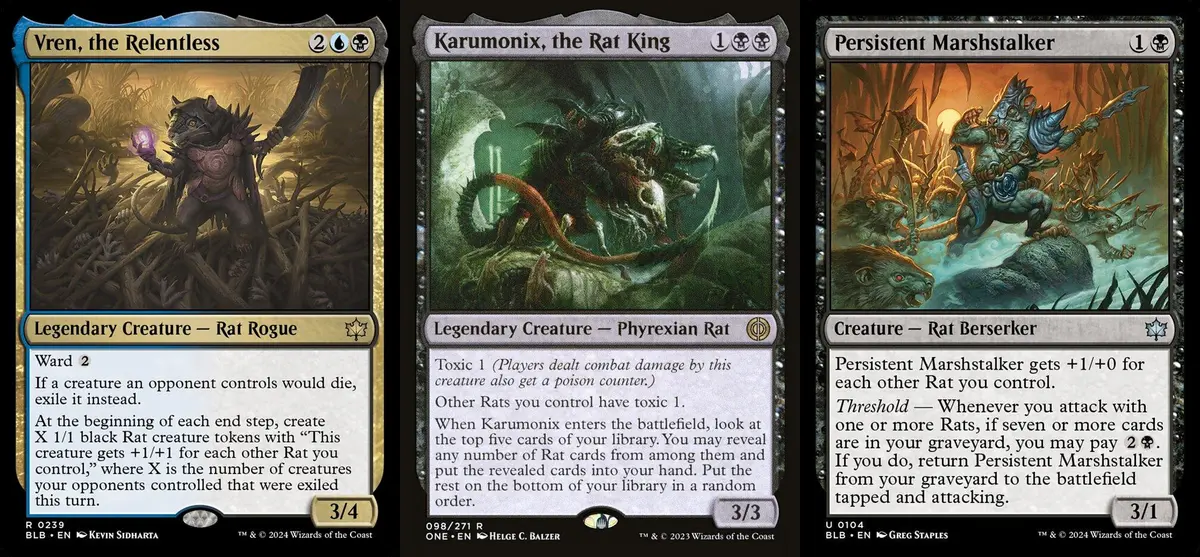
Standard in the previous two years intermittently had some Rat cards, among them quality cards like Karumonix, the Rat King with tribal payoffs written all over them. However, the total number of Rat single cards was really too small, let alone the number of useful ones, so that previously, wanting to play a Rat deck, even pulling in cards you’d normally only put in Limited decks barely scraped together one deck’s worth. Fortunately, this set filled in the curve that earlier Rat decks lacked. For example, the two-drop slot now has Persistent Marshstalker, an undying strong source of damage, and Azure Beastbinder, with high evasion and built-in strong disruption, finally making Rats a fairly complete deck.
Rakdos Lizard
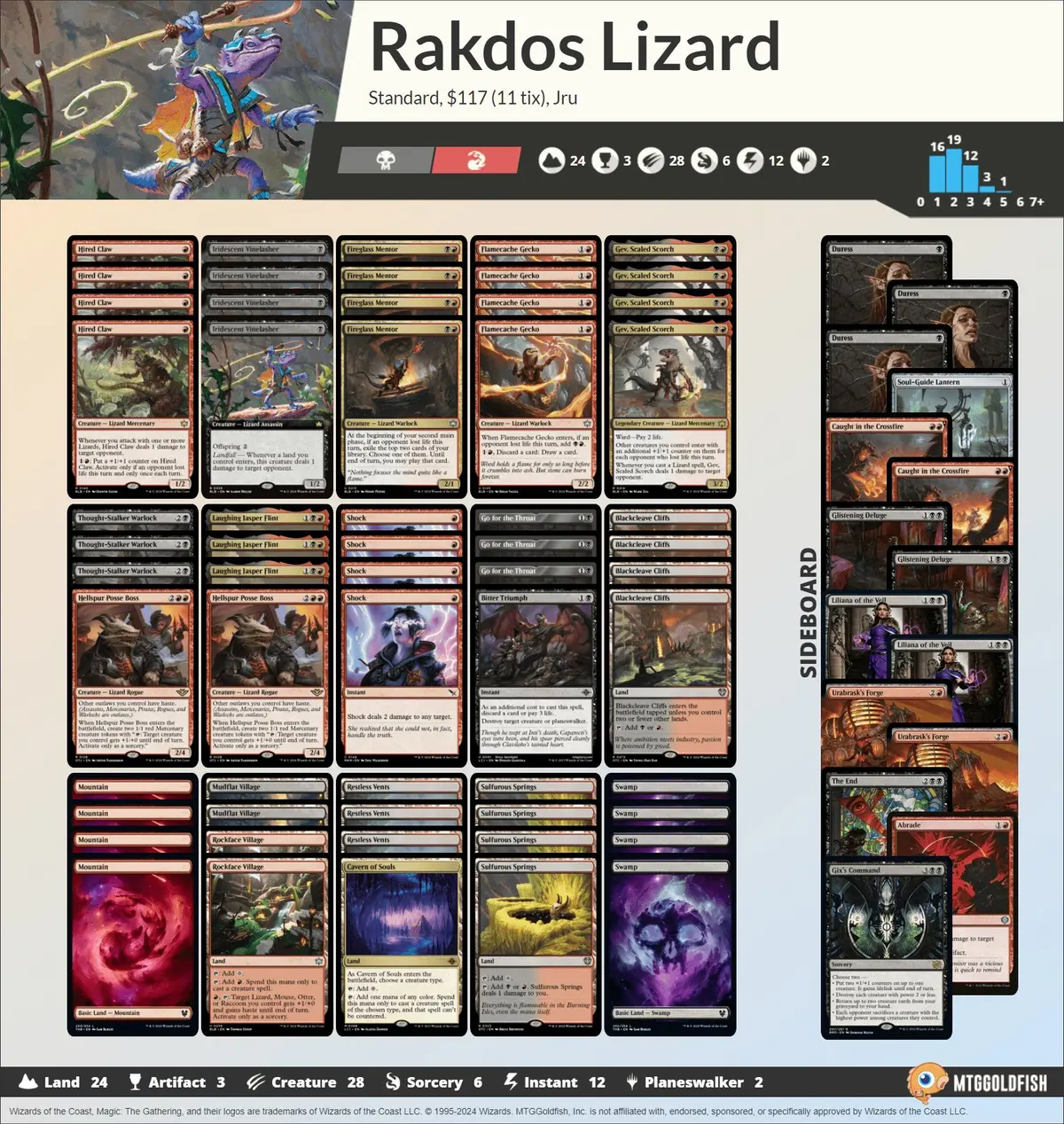
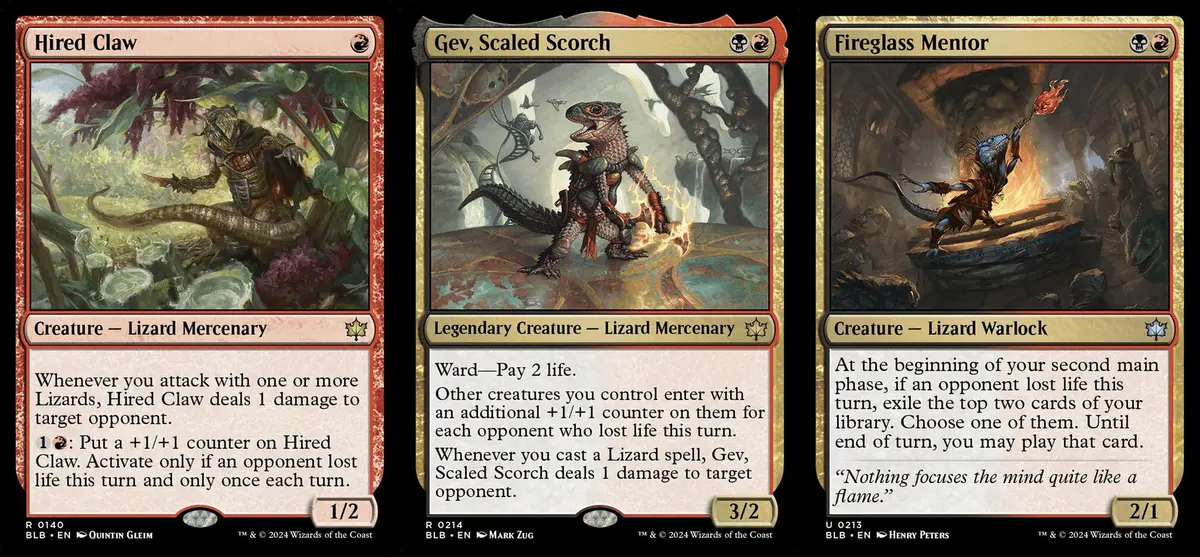
Which tribe’s material in this set is the most lavish? Lizards deserve first place. The Lizard theme mechanic is damage, which is so easy to pair with in Rakdos that you don’t even need to force pairings. Your usual game plan is just dealing damage. Gev, Scaled Scorch is an extremely efficient lord, Fireglass Mentor provides a card-advantage point, and Hired Claw & Iridescent Vinelasher have ultra-fast-tempo burn-to-the-face ability, making this a very complete fast-paced deck that races life with many attack dimensions.
But the Lizards’ benefits aren’t limited to this set. Look closely and you’ll find that the useful cheap Lizards in this set are basically all Outlaws, and a considerable share of OTJ’s Rakdos Outlaws are Lizards. So Outlaw lords like Laughing Jasper Flint & Hellspur Posse Boss have also joined the Lizard team harmoniously.
If you’ve forgotten the OTJ mechanics, you can refer to this article: Outlaws of Thunder Junction Mechanics Explained
Rakdos Outlaw
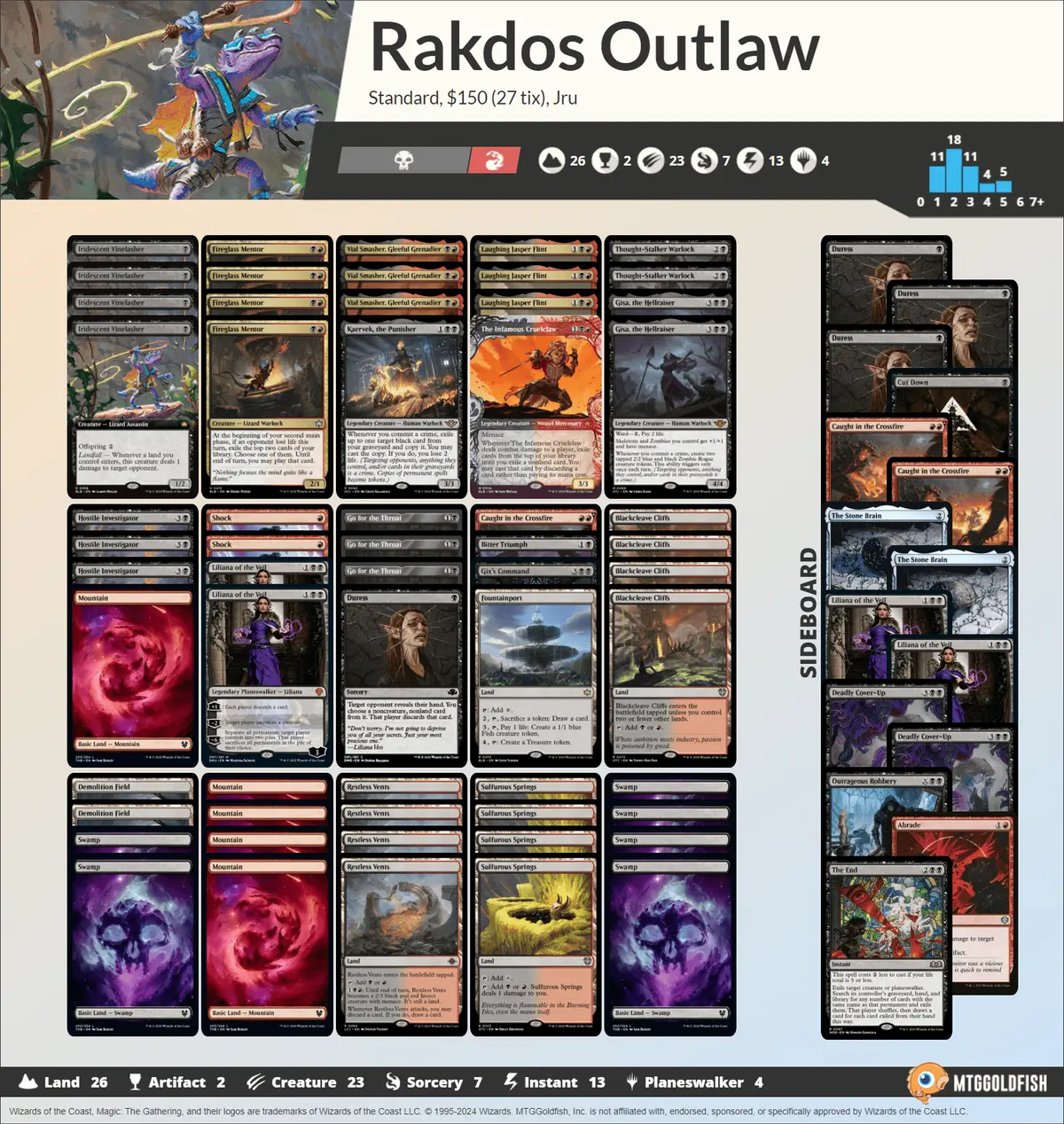
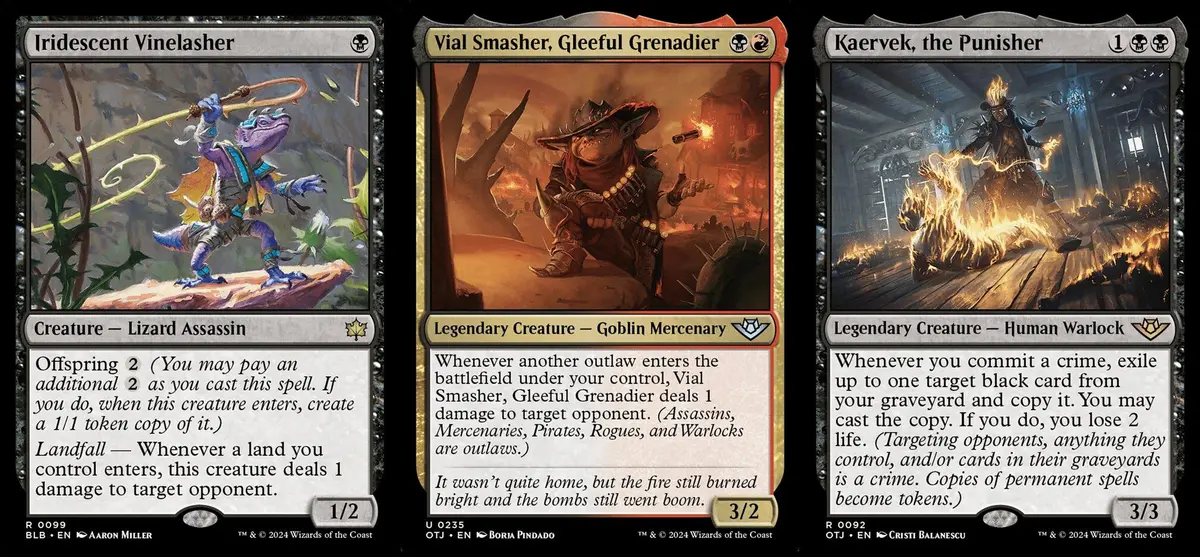
I said above that this set’s cheap quality Lizards are almost all Outlaws, but beyond that, their ability to deal damage to the opponent is almost always Commit a crime. So besides the Lizard tribal deck above, you can also think in reverse, using the Lizards’ useful single cards to strengthen the existing Outlaw approach. I should single out Iridescent Vinelasher for praise again: one card provides two landfall sources for crime + damage, greatly increasing the deck’s flexibility.
Rakdos Midrange
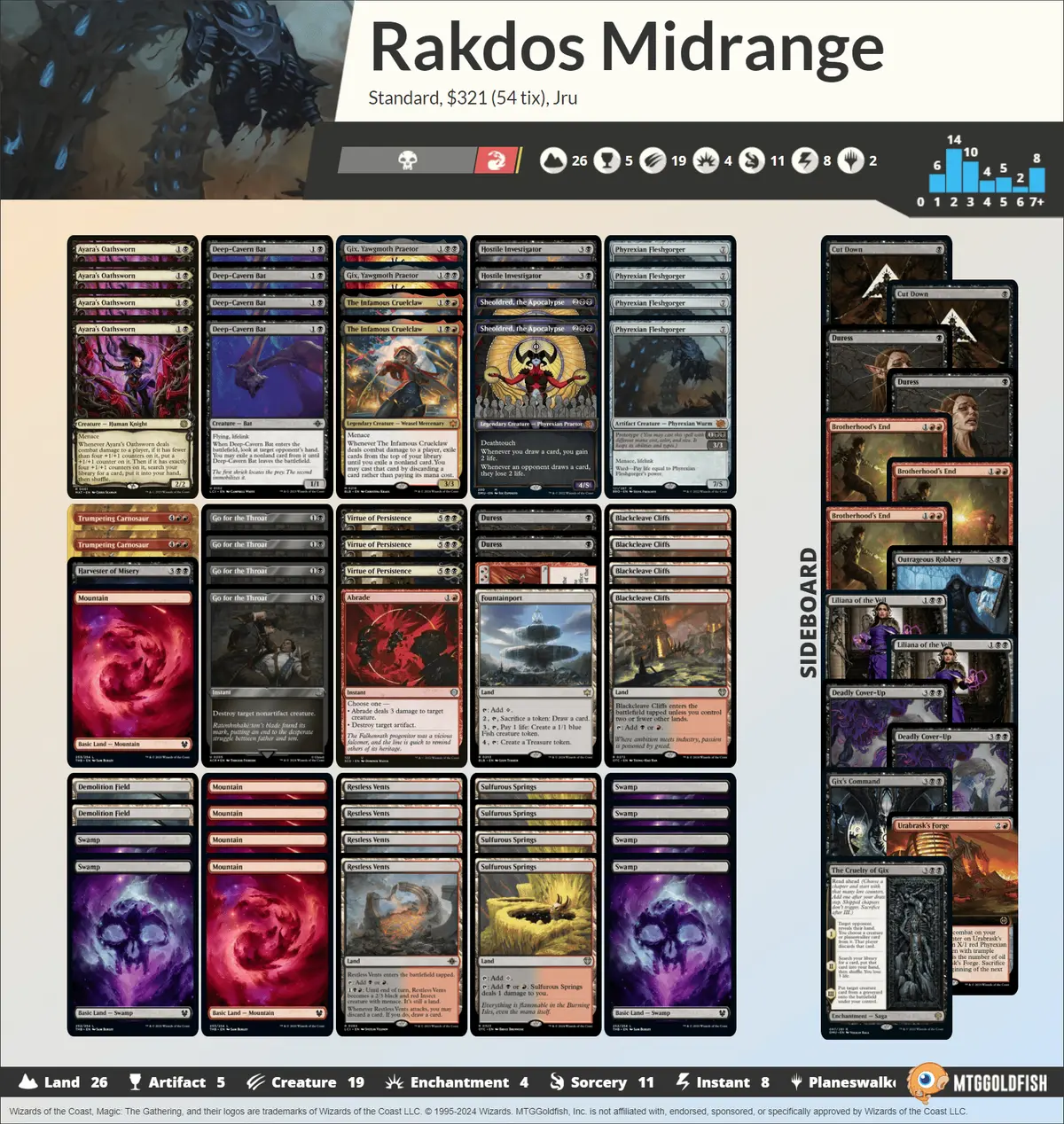
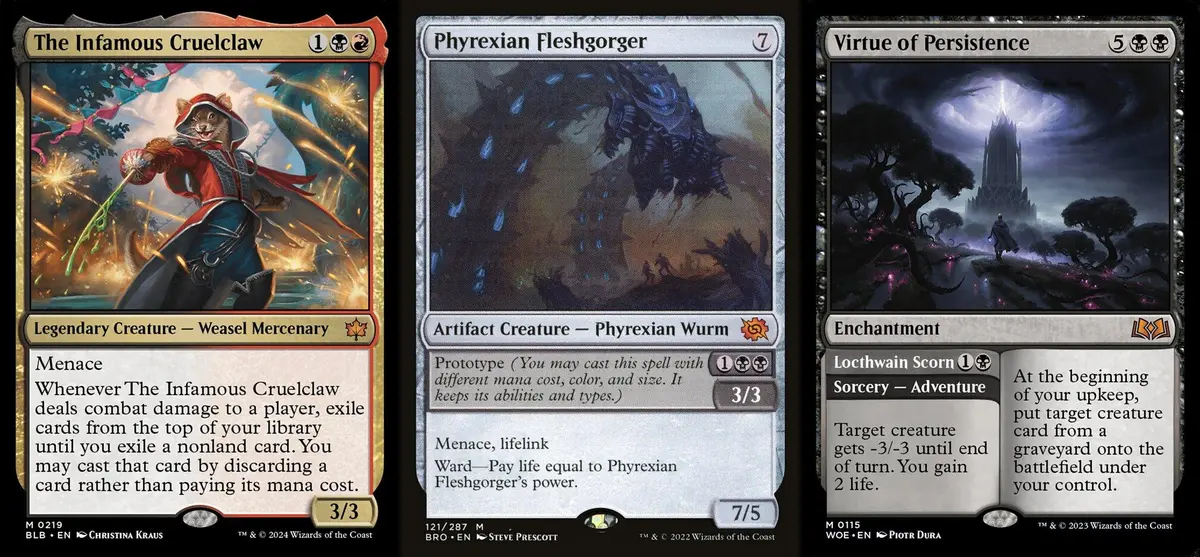
The Infamous Cruelclaw doesn’t directly gain cards. What it gains is mana, so how do you reasonably raise the expected value of what it gains? The answer is to include cards whose bodies are powerful high-cost cards but come with cheap-curve options, like Phyrexian Fleshgorger with prototype, Virtue of Persistence // Locthwain Scorn with adventure, the pseudo-channel Trumpeting Carnosaur & Harvester of Misery, and the split card Push // Pull. Reusing Phyrexian Fleshgorger also has another benefit: it perfectly dodges black’s mainstream cheap removal Cut Down & Go for the Throat.
Finally, there’s one more interesting topic: should the two-drop slot include Caustic Bronco? If you can saddle it consistently, it can indeed likely blow open the opponent’s main artery with a single punch, but conversely, when it isn’t saddled, attacking may blow yourself up. Judging from this deck’s creature count, saddling consistency is probably not going to be ideal.
Golgari Midrange
Golgari Midrange decklist link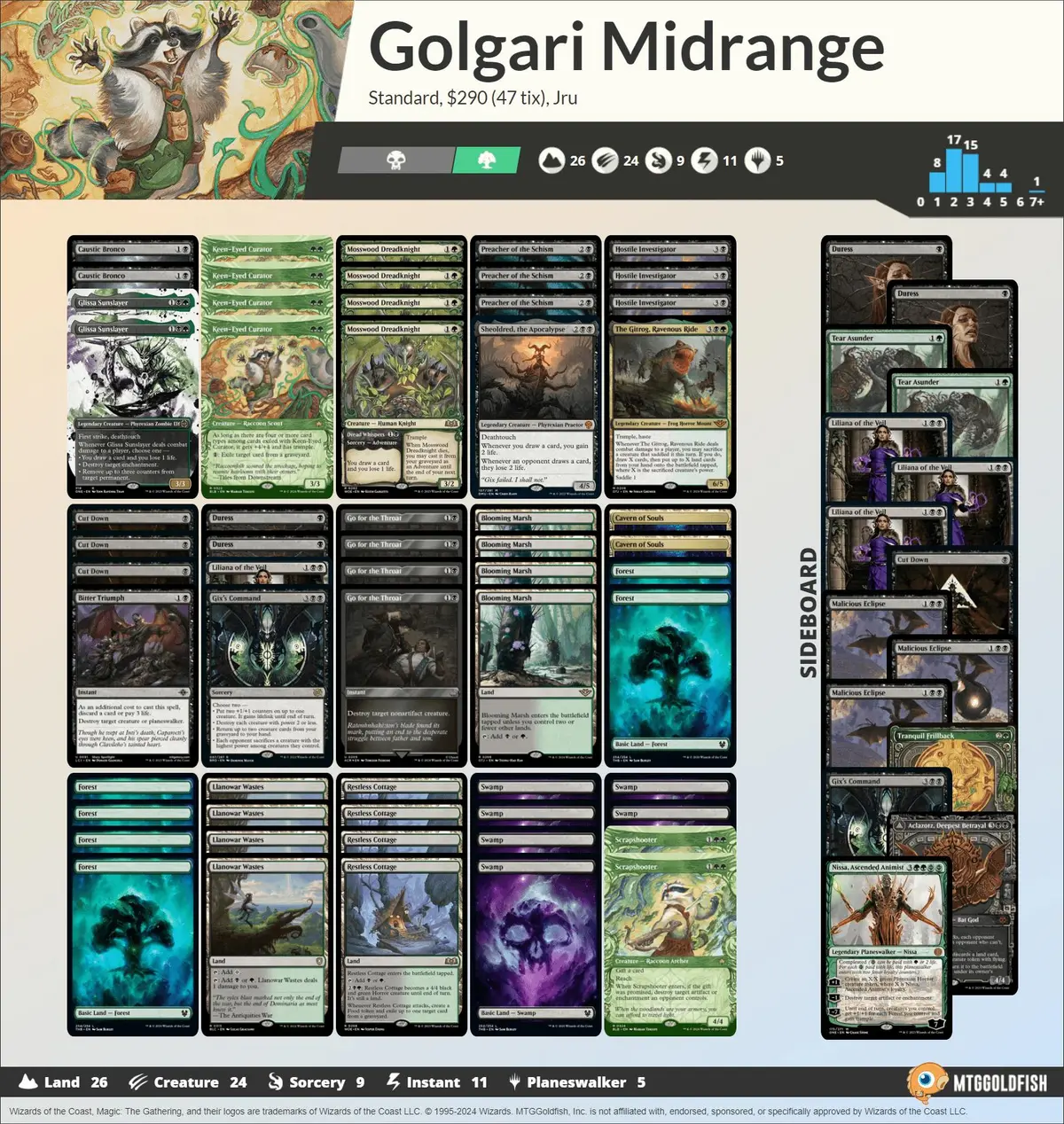
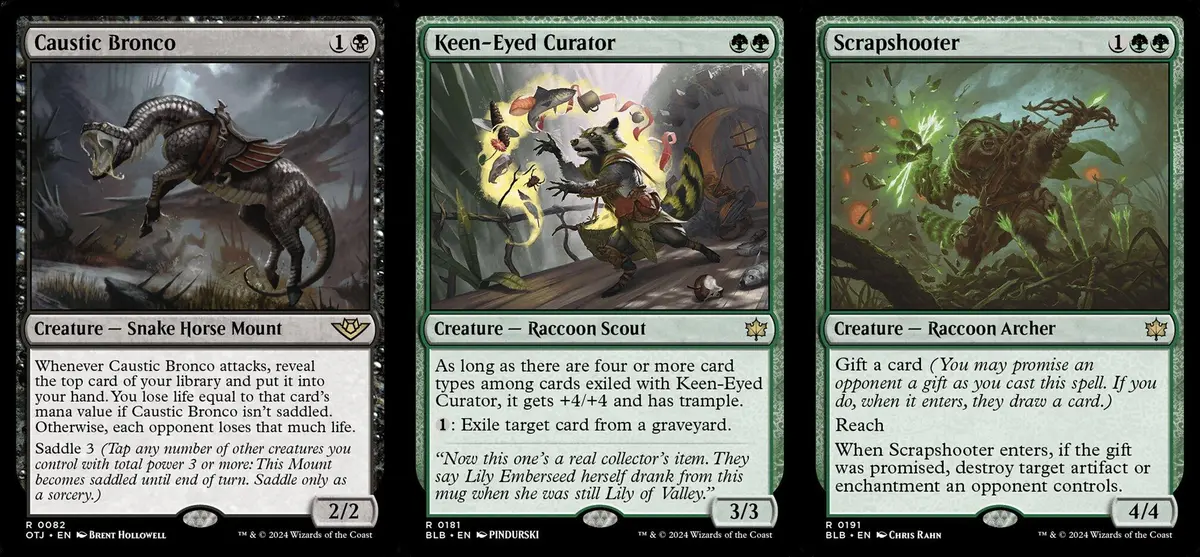
New, more threatening sources of damage have been added to the traditional Golgari midrange deck.
Dimir Midrange
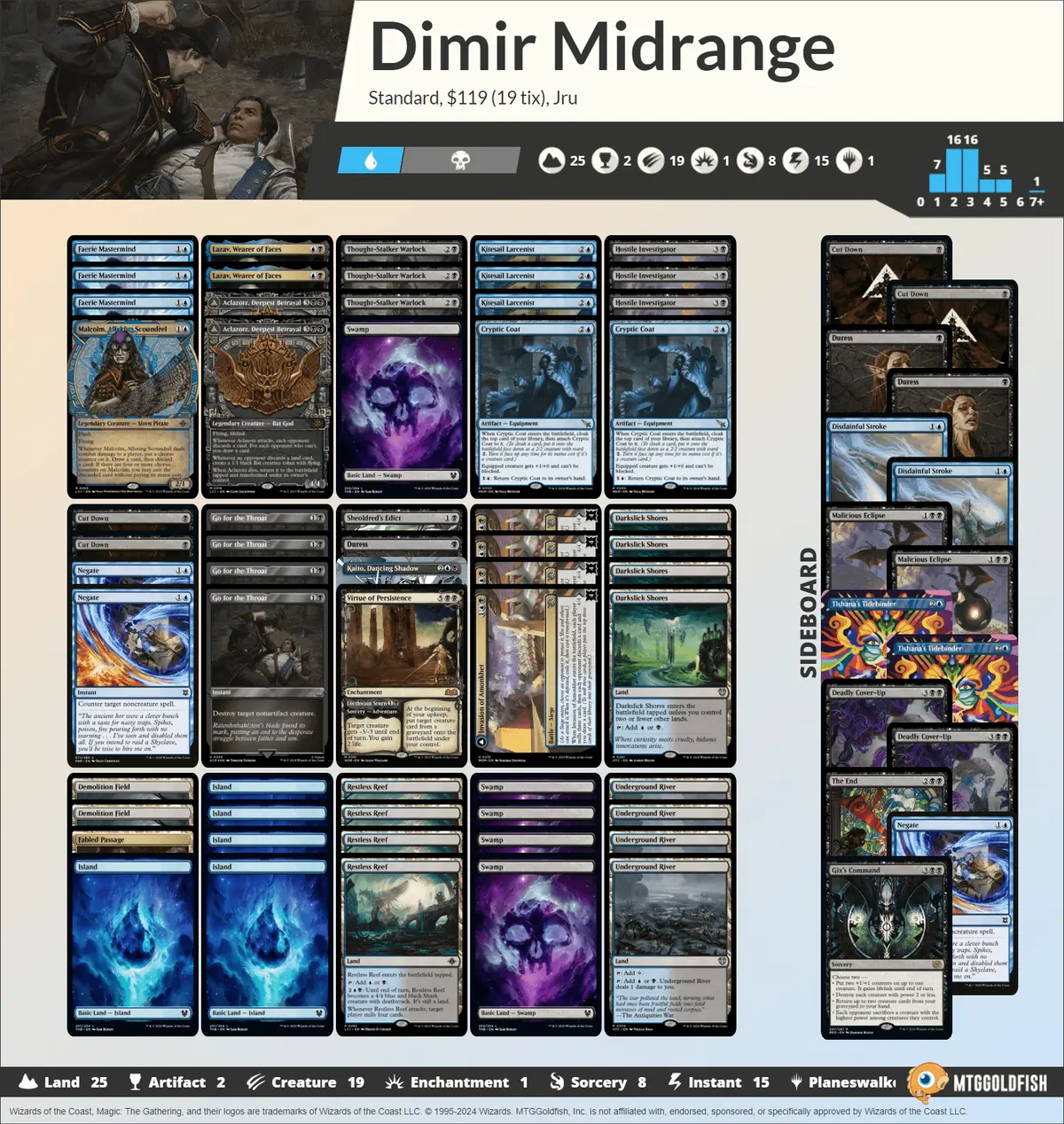
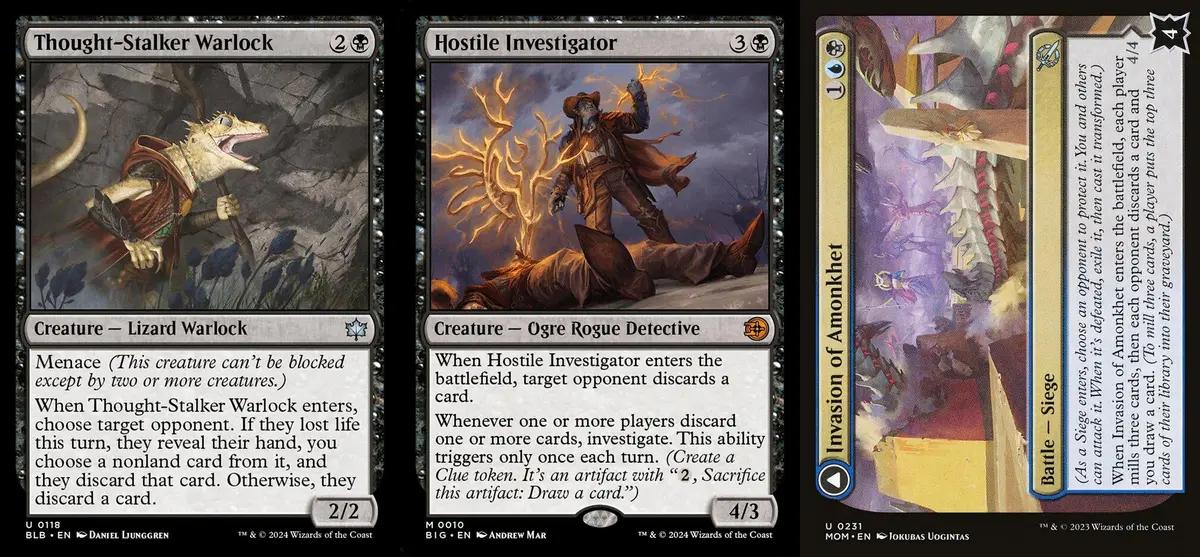
Invasion of Amonkhet // Lazotep Convert is already close to my faith. Previously Standard always had at least two Amonkhet decks, and a creature with a quality ETB ability like Thought-Stalker Warlock is exactly what I wanted. In addition, these two cards plus Hostile Investigator form a golden discard triangle, and I believe its annoyance level absolutely approaches 100%.
Dimir Rack
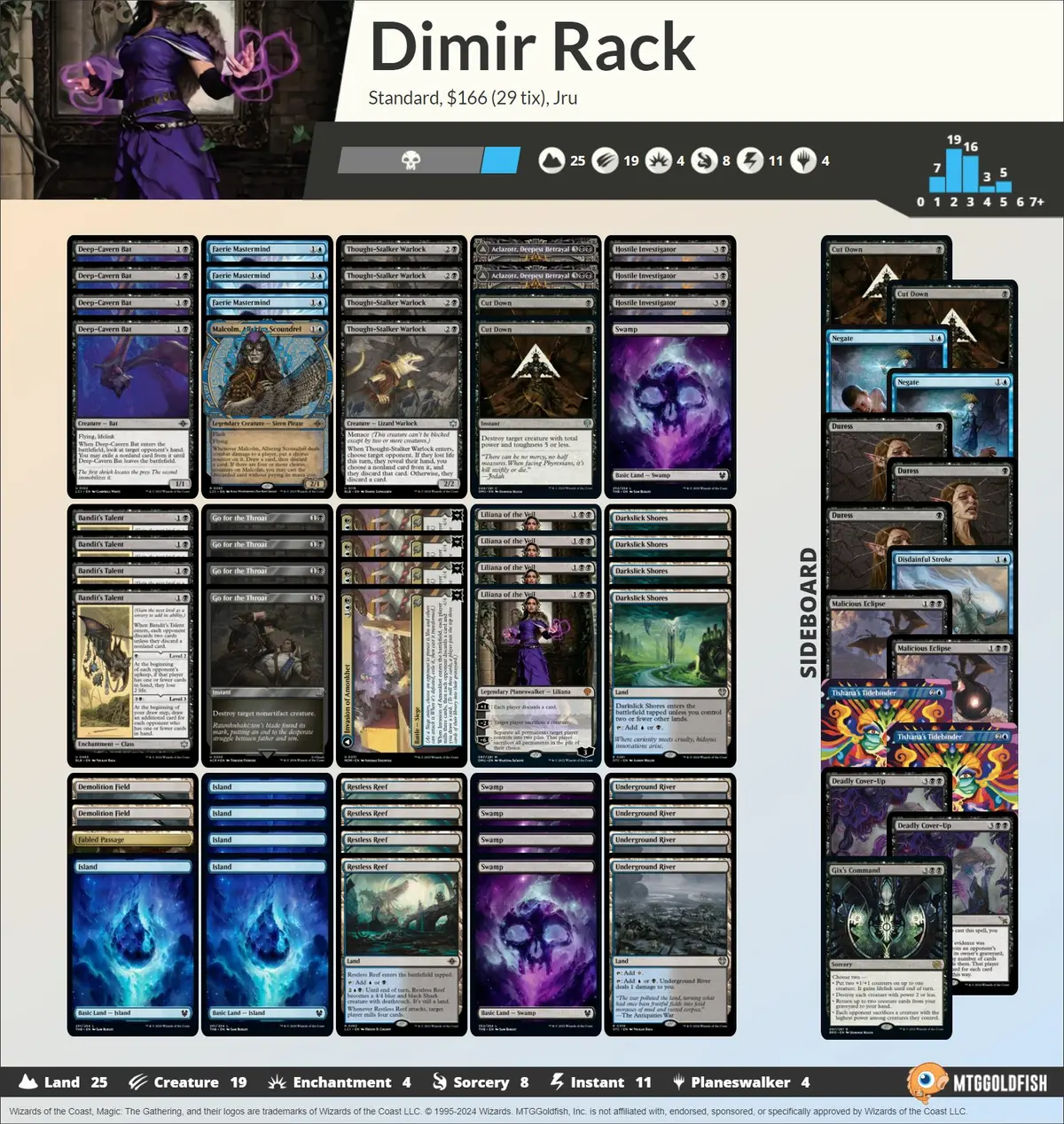
Just mixing in a small discard package is already annoying enough, so why not try a real discard theme? Bandit’s Talent is a brand-new breakthrough among The Rack-type single cards, combining discard, a win condition, and card advantage in one, and it’s a hard-to-remove enchantment too. It largely patches the discard theme’s original blind spot, namely that once the opponent has no hand, you also can’t produce a good threat yourself and get turned around by a single topdeck.
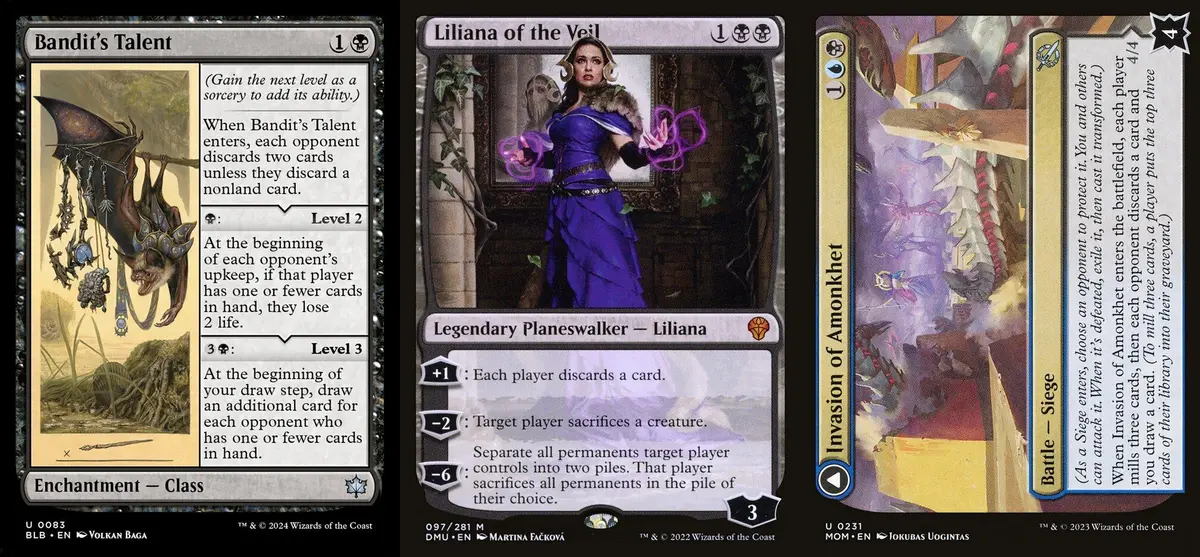
Dimir Flying
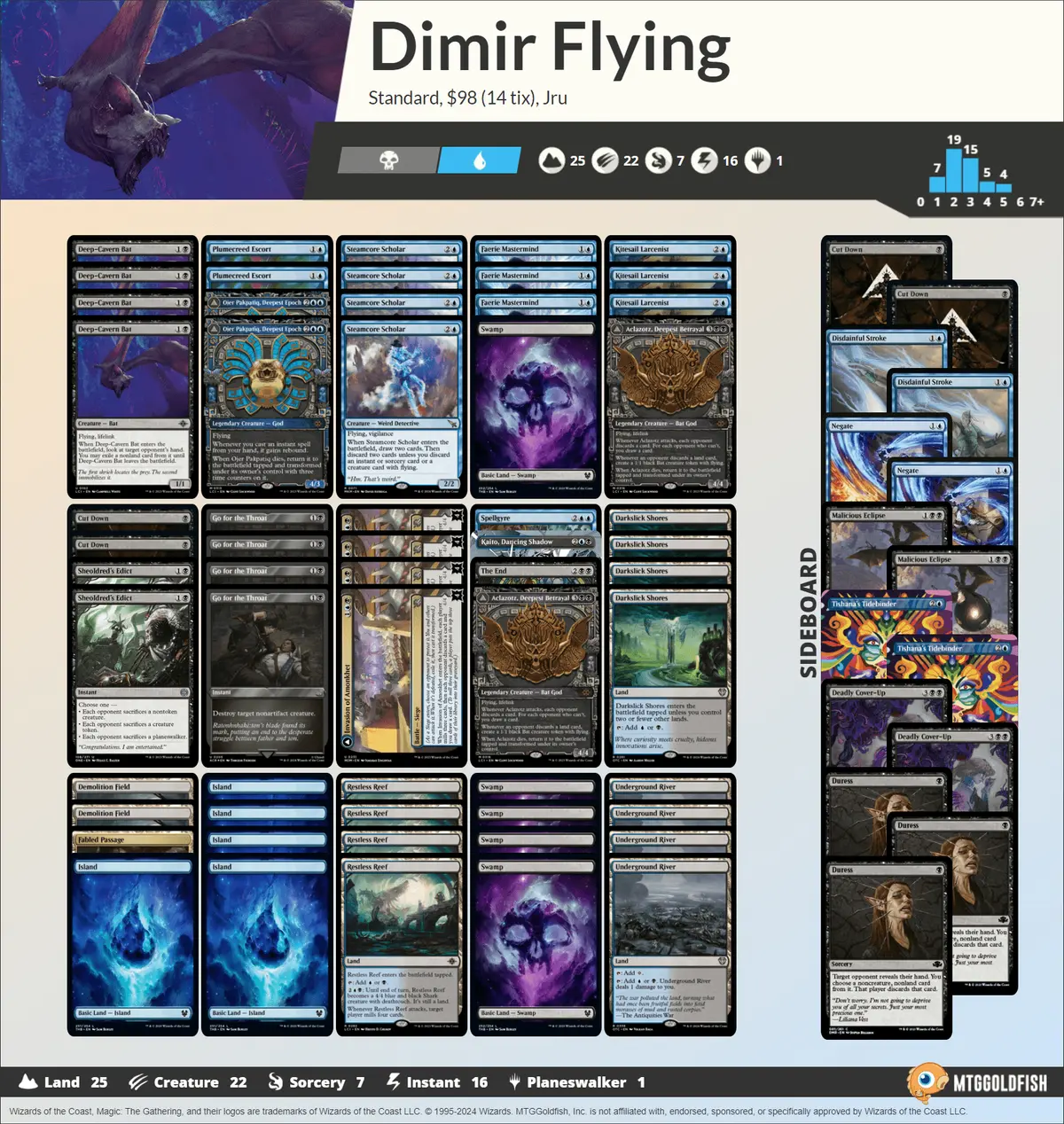
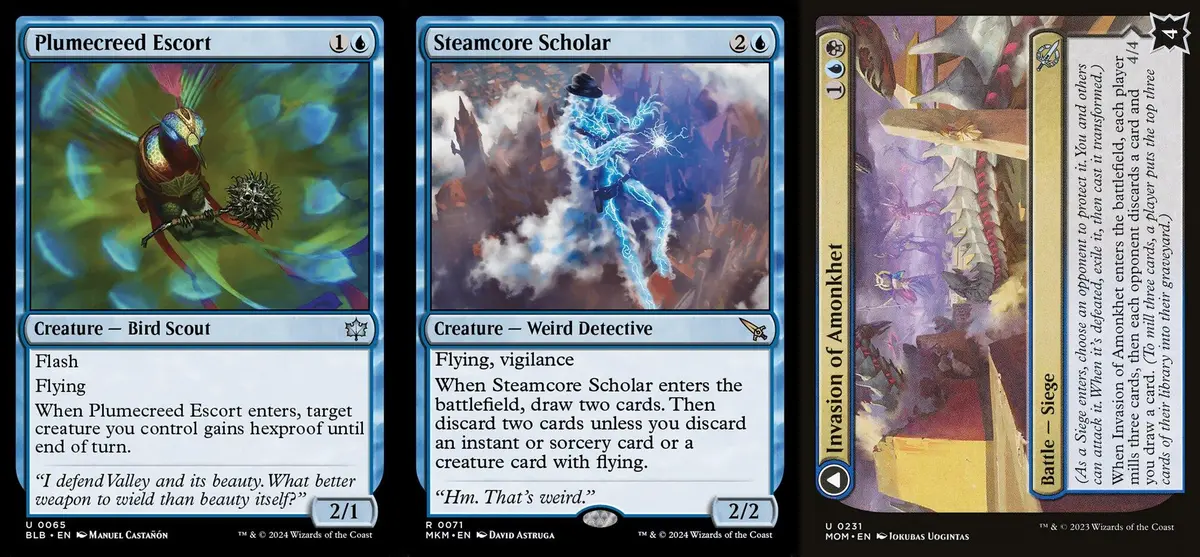
Previously the two-drop slot included Zephyr Sentinel as a pseudo-protection spell. Although there was a chance to repeatedly get its ETB, it could also break your own tempo, and now it has been swapped for Plumecreed Escort, which gives hexproof more directly.
Azorius Fly Tempo
Azorius Fly Tempo decklist link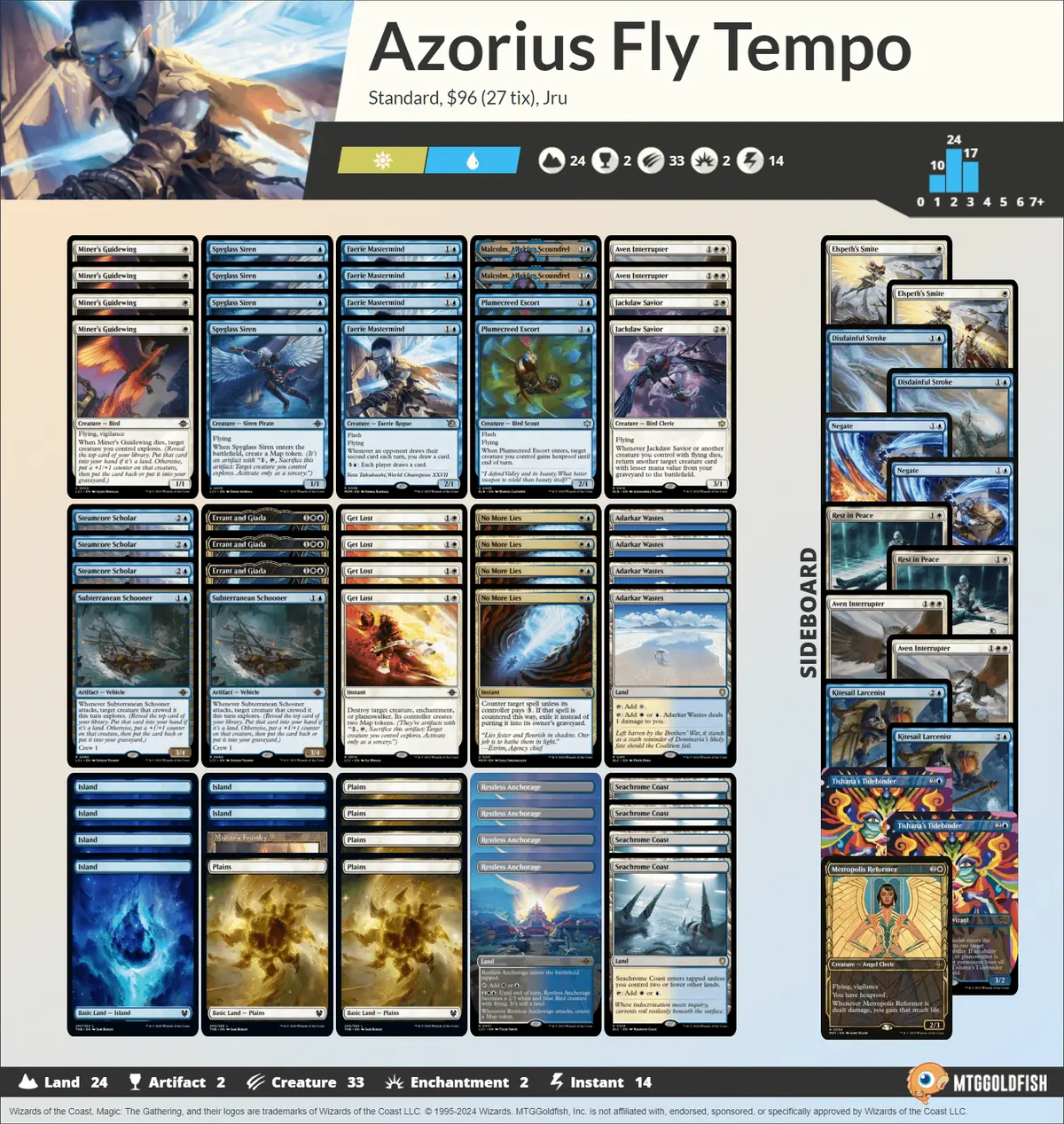
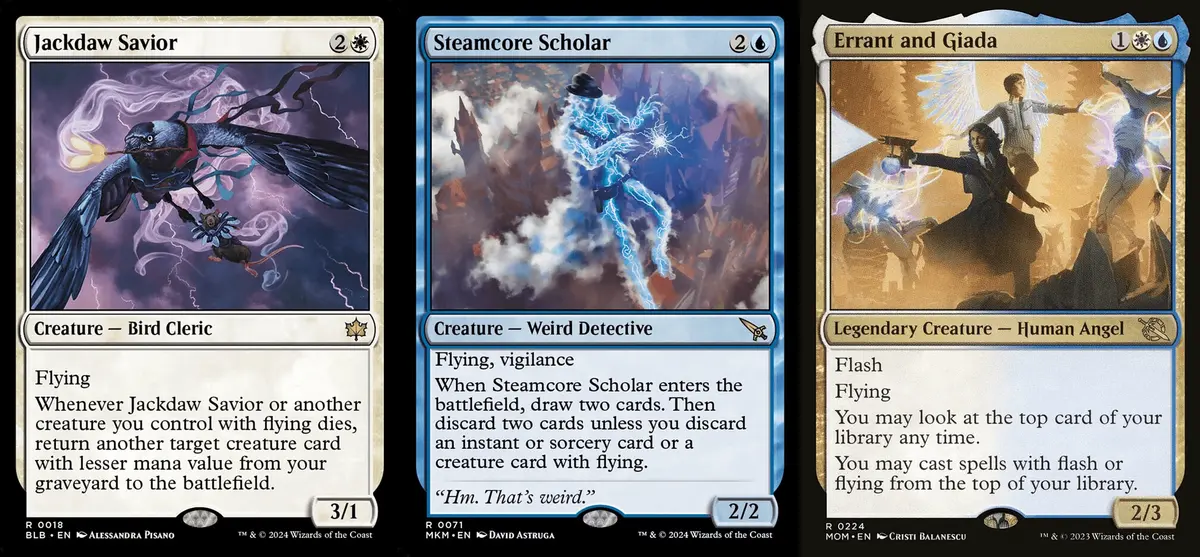
Errant and Giada was already quite good at generating value, and now there’s also Jackdaw Savior as another resource staying-power point.
Azorius Control
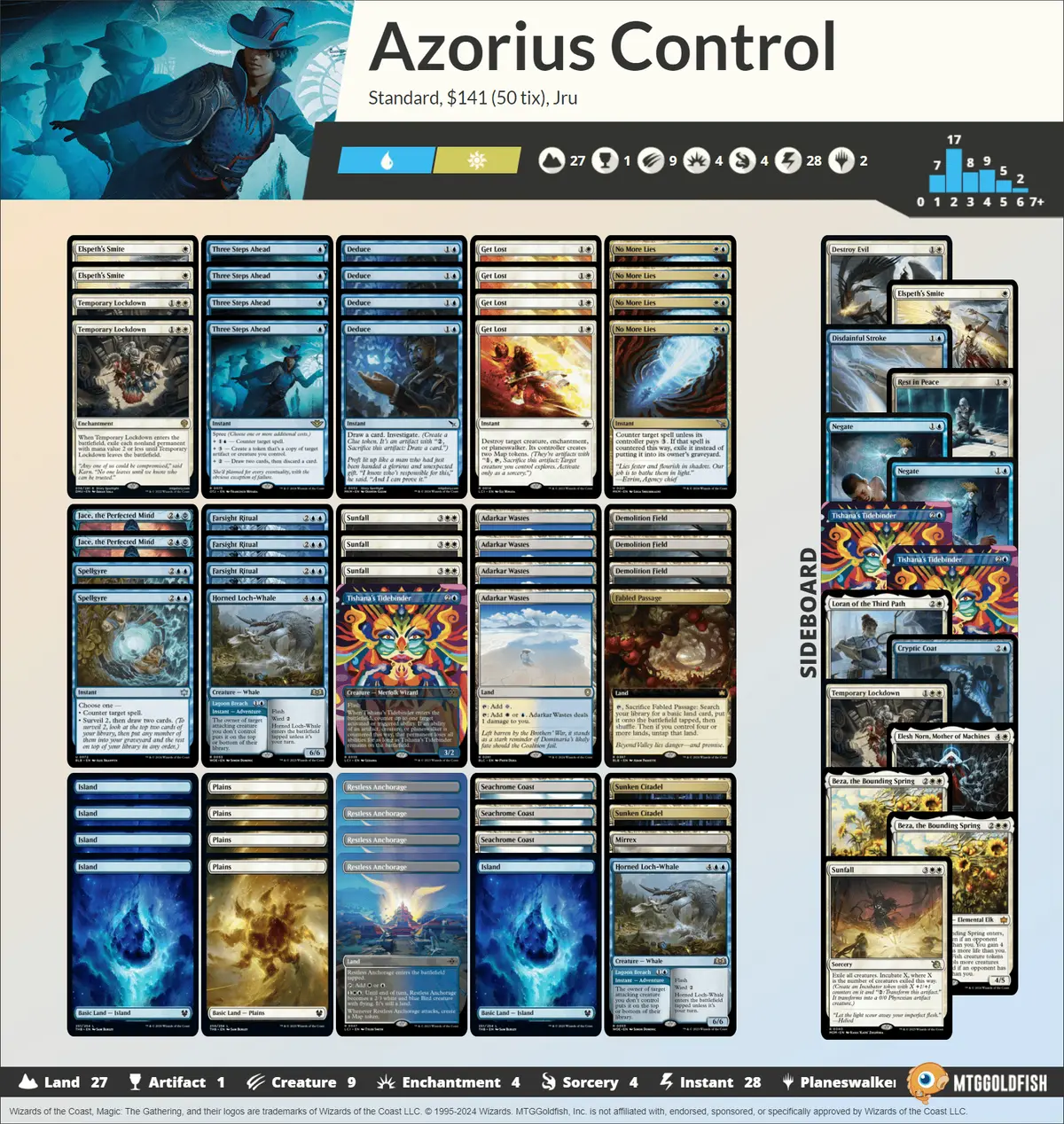
What hurts control the most in this Standard rotation? Is it The Wandering Emperor? Although that hurts quite a bit, in my view it’s actually secondary. The most painful point is losing Memory Deluge, which can be called the pinnacle of four-mana instant-speed card advantage spells in the Pioneer card pool, with not only a large amount of resources but also extremely deep card selection. I have a guess that a four-mana card advantage spell that rivals Memory Deluge may never appear again.
Complaints aside, life goes on, so what should control do after losing both a powerful finisher and a card advantage spell at once? The finisher side is actually easy to handle: Restless Anchorage & Mirrex are both existing, qualified finishers. Jace, the Perfected Mind milling the opponent out directly is also a very hard-to-guard-against method, and in terms of win-condition dimensions it is far trickier than The Wandering Emperor. Dimir control was already playing it this way, and of course Azorius control can use this trick too. As for Horned Loch-Whale // Lagoon Breach serving as both removal and a finisher, I already tested its practicality in Standard a year ago, and its power can be guaranteed.
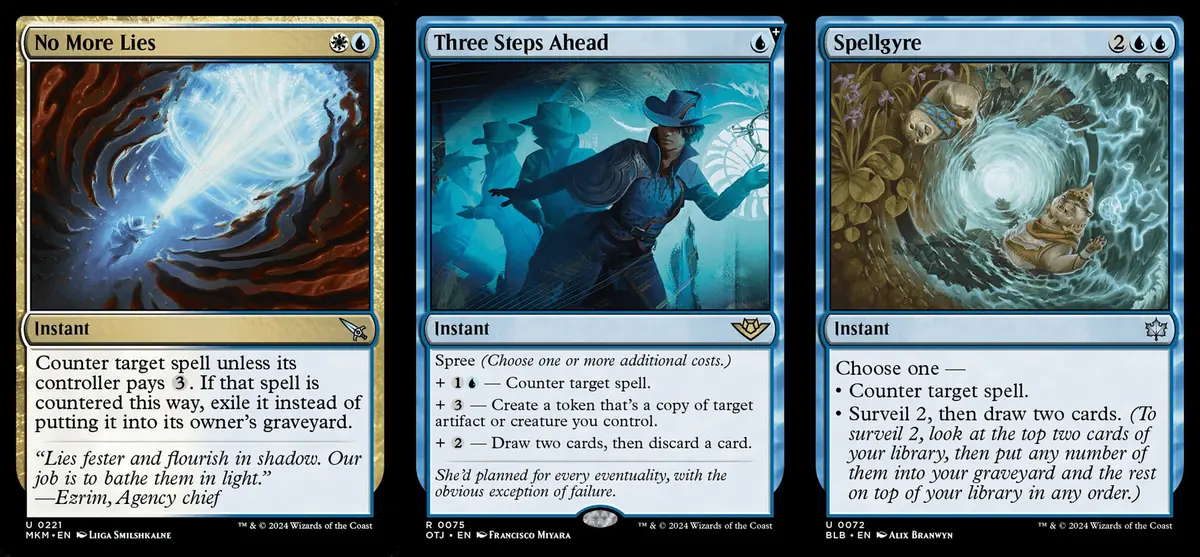
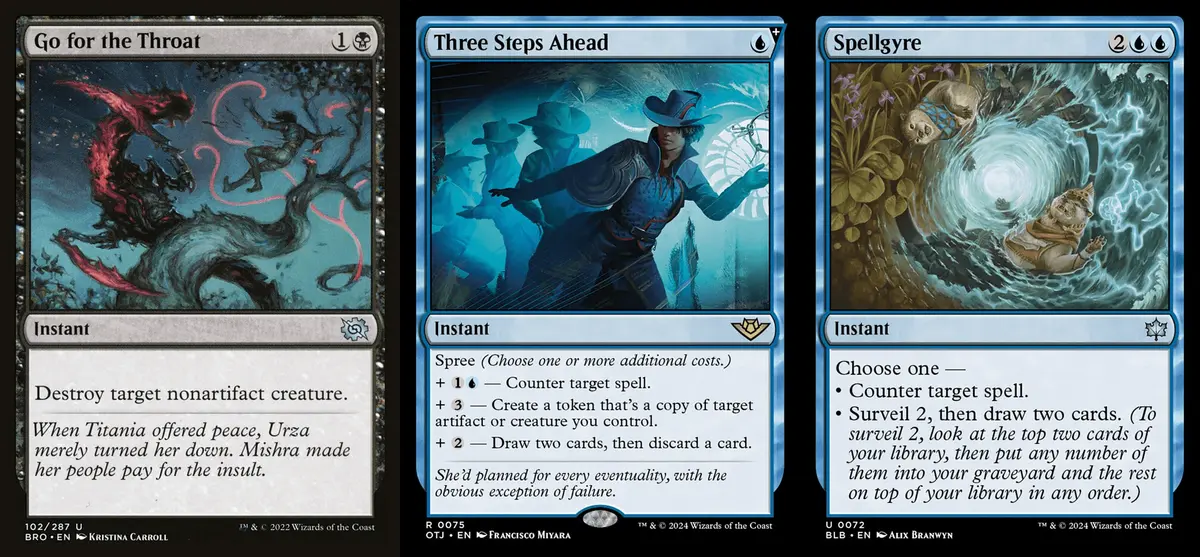
The biggest problem now is actually how to generate card advantage. But the real problem isn’t a lack of card advantage spells, because after OTJ added Three Steps Ahead, control’s card advantage was strengthened once again, and Jace is also an extra draw point, so logically just adding a few regular card advantage spells is plenty. On that point, the new four-mana Spellgyre is perfect: surveil 2 and draw 2 meets the passing line, and the bonus counterspell option raises the deck’s flexibility another level. Also, Three Steps Ahead & Spellgyre are both multi-purpose counter-and-draw cards, so even against Cavern of Souls they won’t become completely dead cards. So what exactly is wrong with the current card advantage spells? The problem is that they are all “draw” effects, meaning that as long as a Sheoldred, the Apocalypse is standing across from you, any replenishment of your hand comes with a huge price. My final answer is to mix Spellgyre & Farsight Ritual for the four-mana card advantage slot. Farsight Ritual cast normally is equivalent to Memory Deluge, and the deck has several ways to produce tokens, which can serve as extra fodder when necessary to find the key answer cards as fast as possible.
Finally, white-splash control has one more new addition worth mentioning: Beza, the Bounding Spring. It’s basically a creature version of Sunset Revelry, with the extra ability to give a Treasure. Against more aggressive opponents, this one card can squeeze out considerable room to survive.
Dimir Control
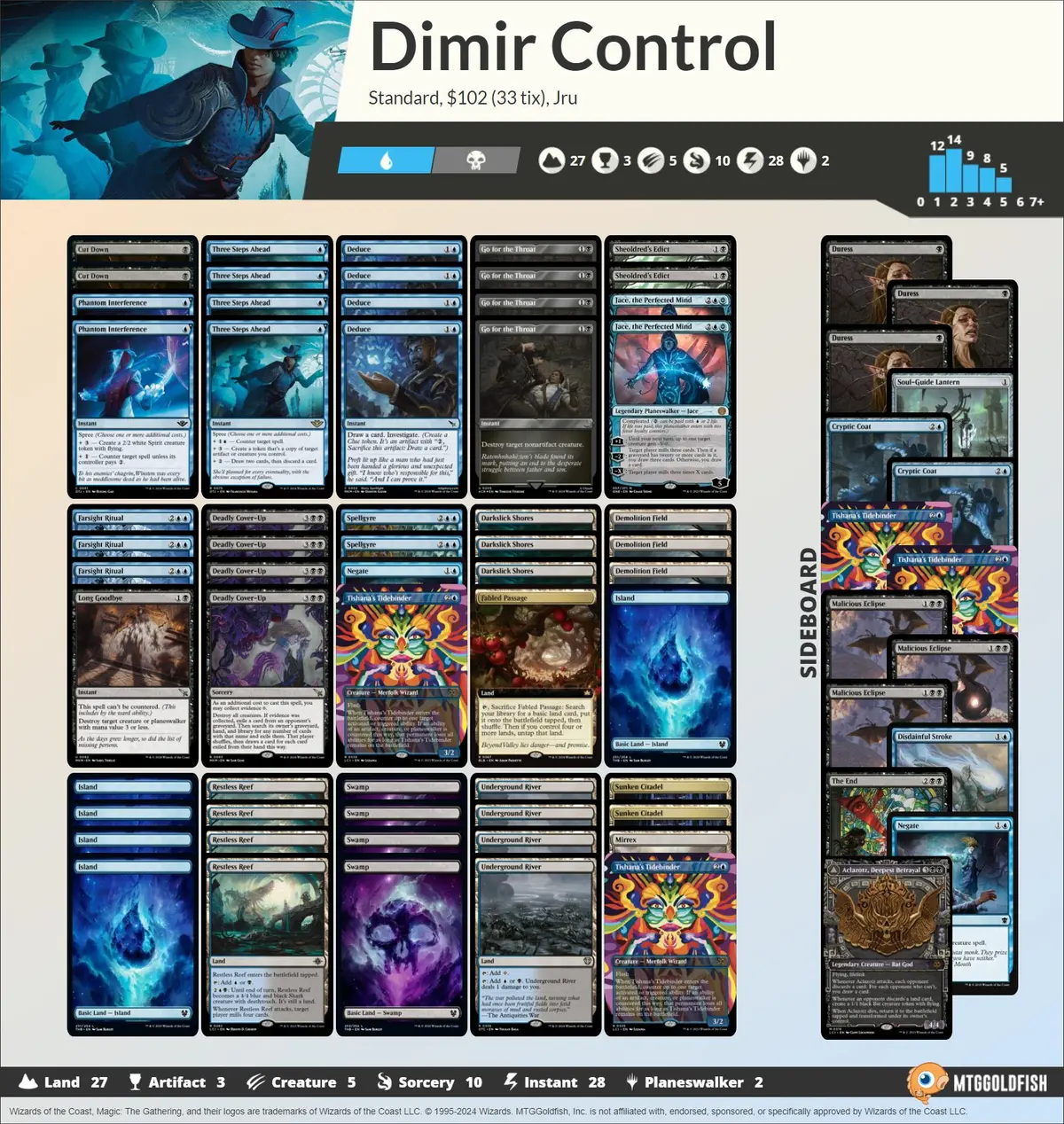
The adjustment approach is basically the same as the Azorius control above, but black’s instant-speed removal is already excellent enough, so there’s no need to make Horned Loch-Whale // Lagoon Breach work overtime.
Selesnya Token
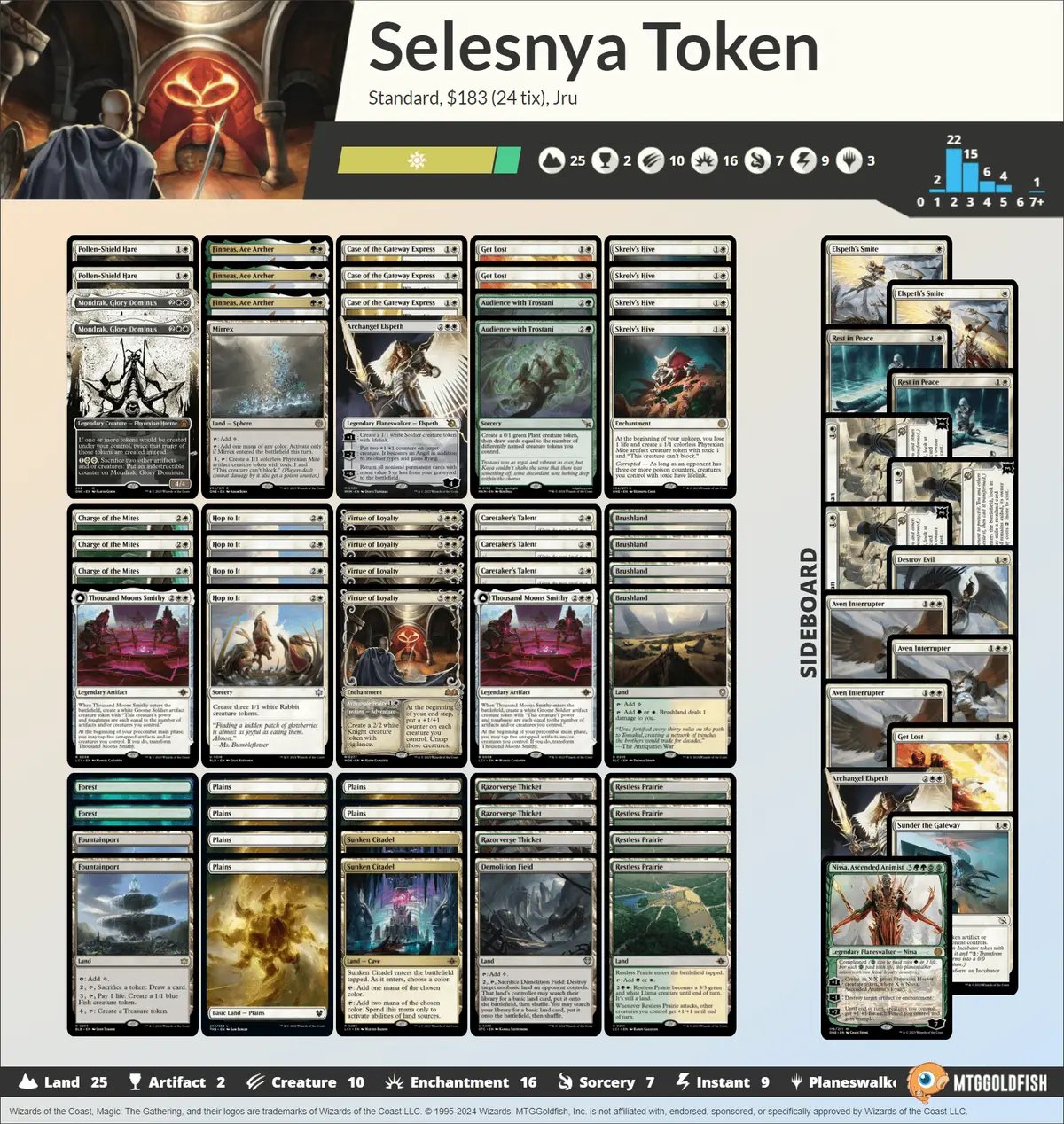
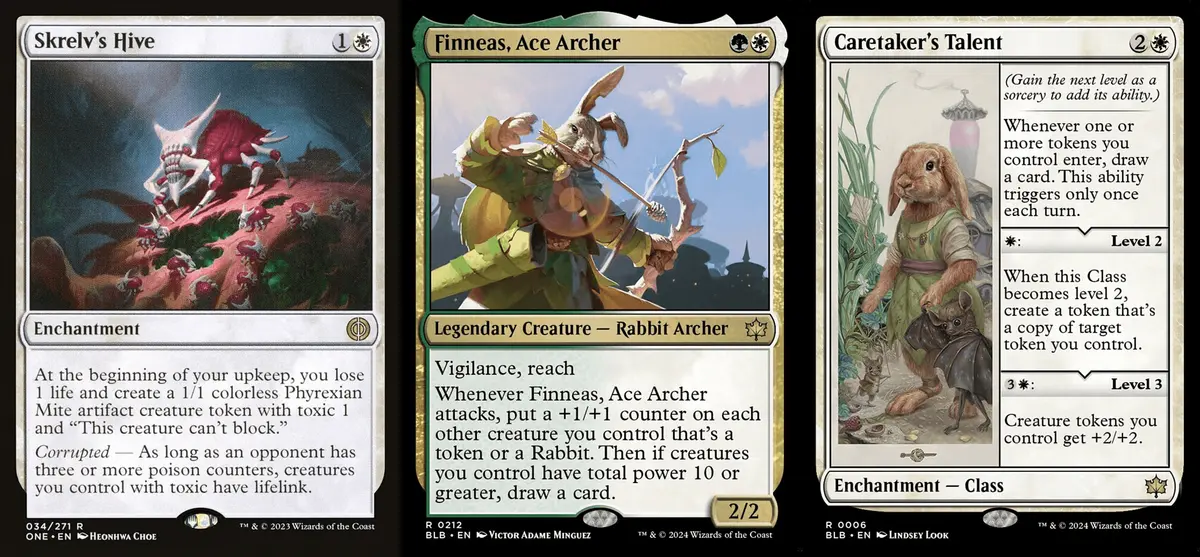
Finneas, Ace Archer is not just a Rabbit lord but also a token lord. This set has many supporting pieces for the Rabbit approach, and even setting the tribe aside, they are perfectly fine as pieces for a pure token theme, Caretaker’s Talent being one example. Also, although this set’s Rabbit theme is tokens, when it comes to the actual token count the situation is a bit subtle, since there are still many quality creature cards, which leaves Pollen-Shield Hare // Hare Raising in an in-between position. Put in a true token theme, though, it does the lord’s job more competently.
Boros Reanimator
Boros Reanimator decklist link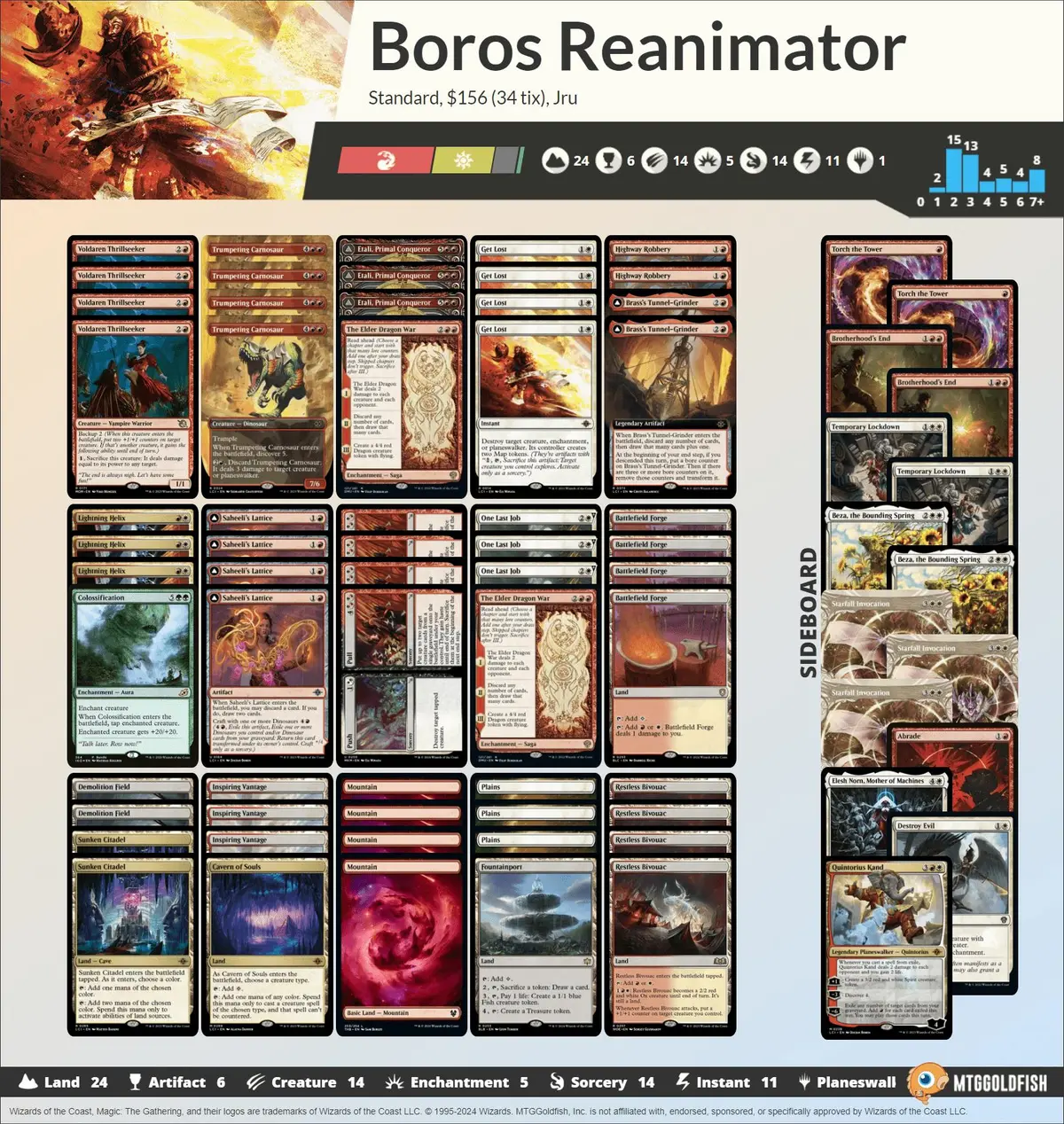
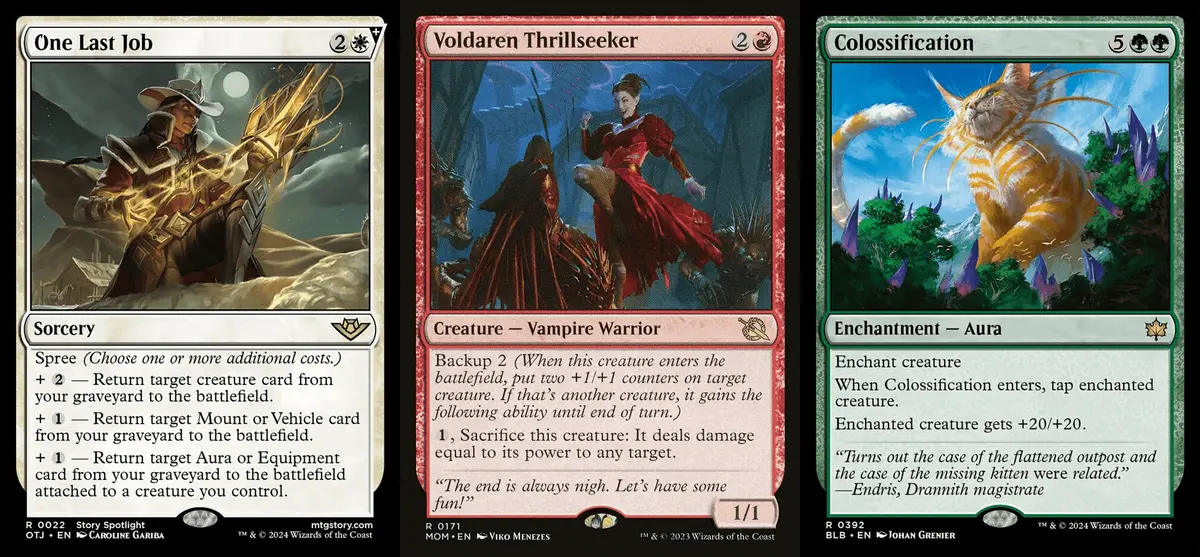
The main game plan is still to use lots of looting effects to stack Trumpeting Carnosaur & Etali, Primal Conqueror // Etali, Primal Sickness into the graveyard, then use One Last Job & Pull to dig them onto the battlefield. Beyond that, it also bolts on a dream Plan B: use One Last Job to return both Voldaren Thrillseeker & Colossification to the battlefield and choose to attach Colossification to Voldaren Thrillseeker (One Last Job puts the Aura directly onto the battlefield, so this way you don’t have to choose an attach target when casting the spell). The instant One Last Job finishes resolving, Voldaren Thrillseeker is already a 21/21 creature, which can immediately sacrifice itself to Fling the opponent in the face, and the ETB triggered abilities still unresolved on the stack no longer matter. Of course this combo is terribly expensive, requiring 5 mana to kill immediately even if Voldaren Thrillseeker is already on the battlefield, so it can’t be the main game plan. It’s just one more sneaky way to win.
PS: Colossification is not in BLB’s regular booster card pool, but entered the Standard card pool through other preconstructed products.
Mono Green Aggro
Mono Green Aggro decklist link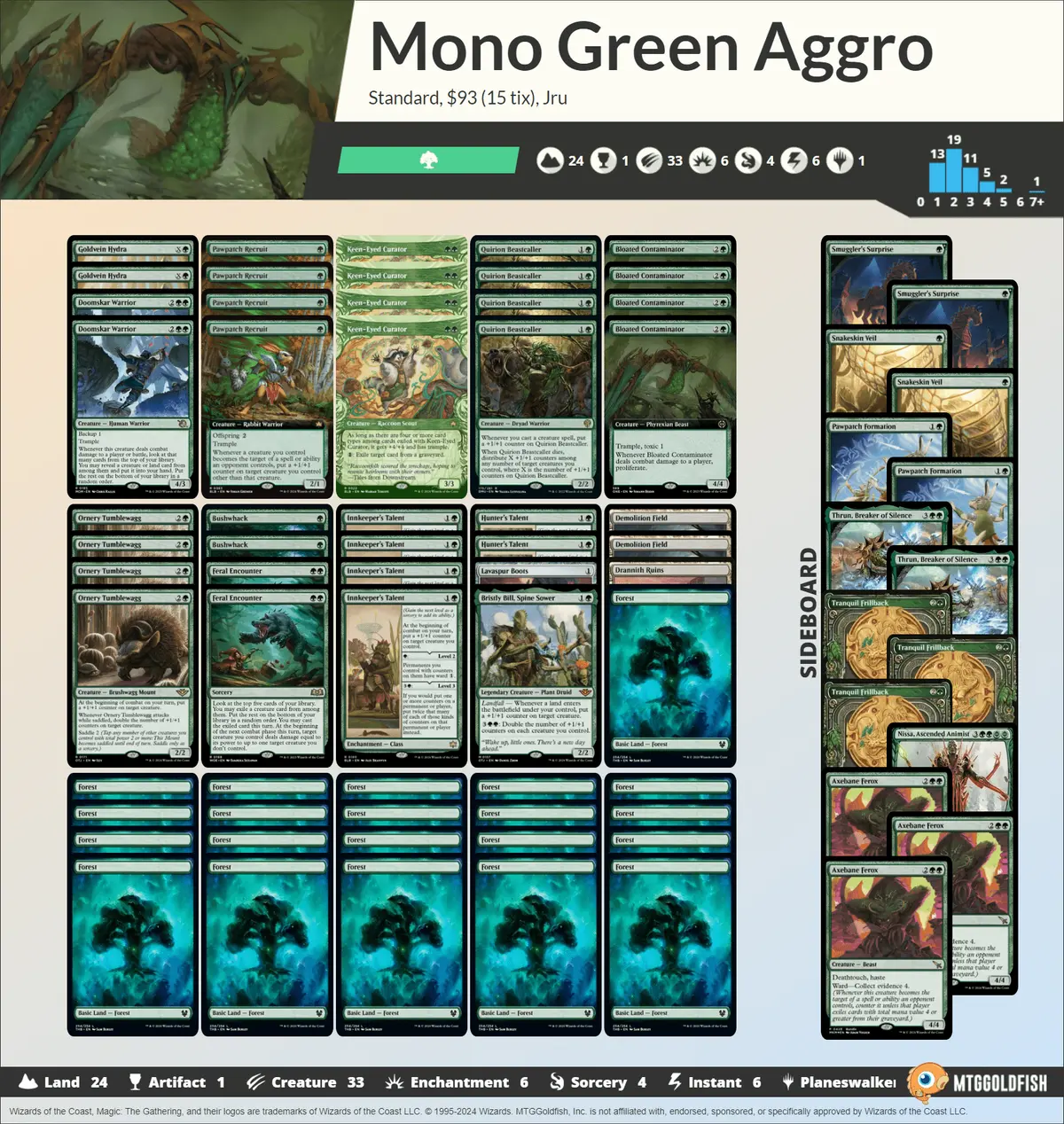
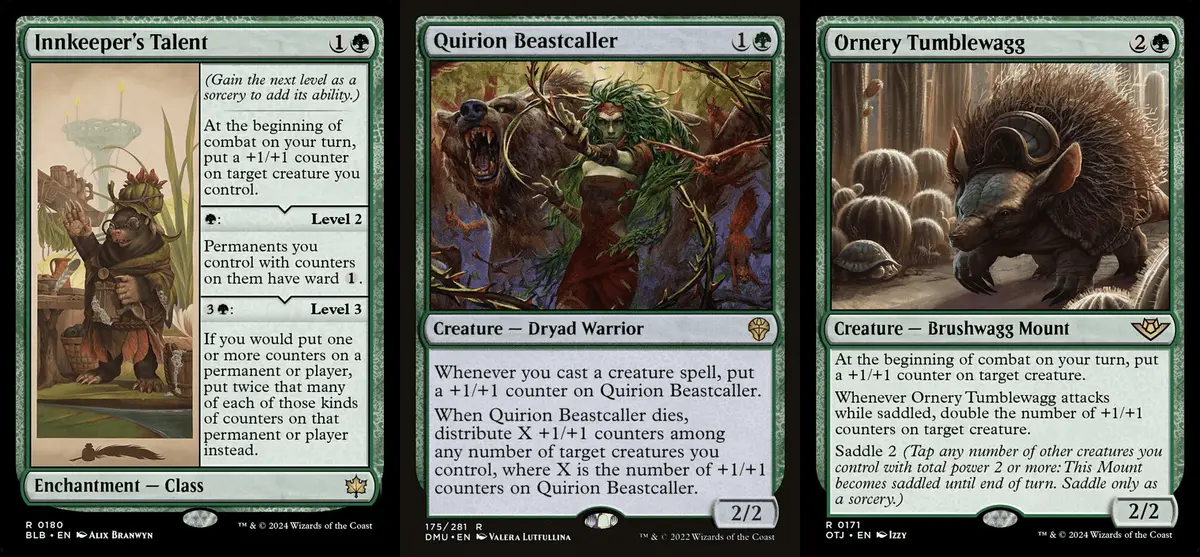
It’s called Mono Green Aggro, but it actually mixes in a fair amount of +1/+1 counters theme, to get the most value from the new card Innkeeper’s Talent. Anyone who got pummeled by Luminarch Aspirant back in the ZNR era should understand how strong this card’s tempo is.
Mono Red Aggro
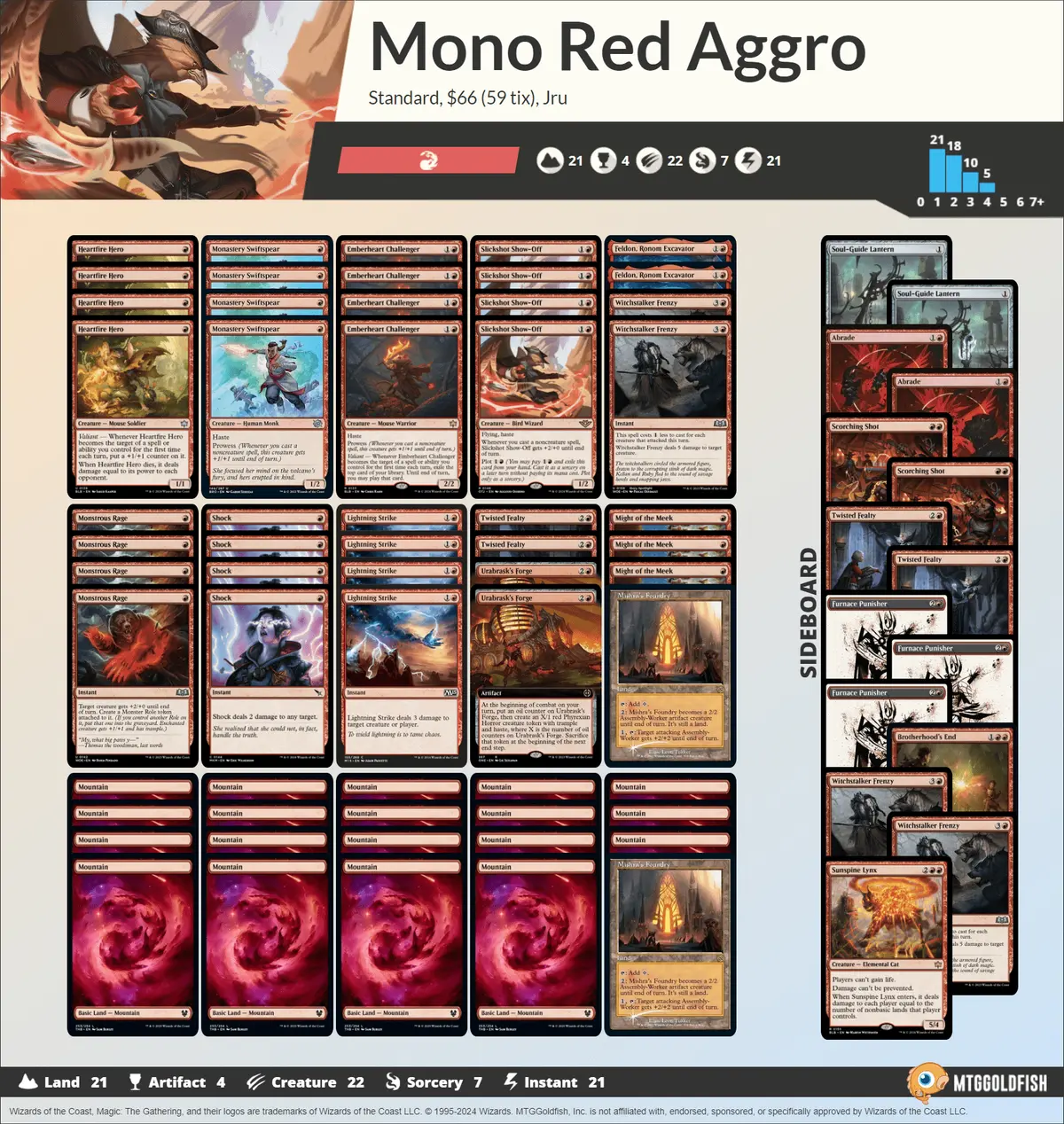
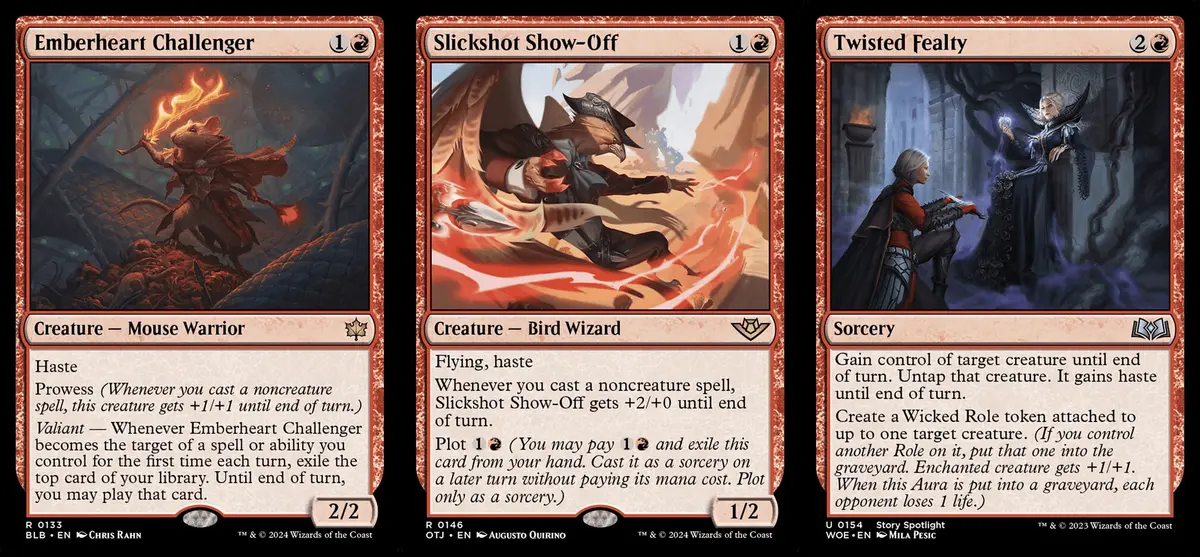
Following the previous set’s Slickshot Show-Off, now there’s Emberheart Challenger. The strength of Standard two-mana prowess-type creatures is getting more and more outrageous… But red aggro’s quality two-drop curve was already overflowing, and rather this rotation made red aggro lose Kumano Faces Kakkazan, a strong one-mana curve play, which hurts more. Seeing that red Mouse’s valiant approach also suits red aggro’s tempo, I borrowed a few cards from the valiant Mouse archetype to fill the slot.
Mono Black Aggro
Mono Black Aggro decklist link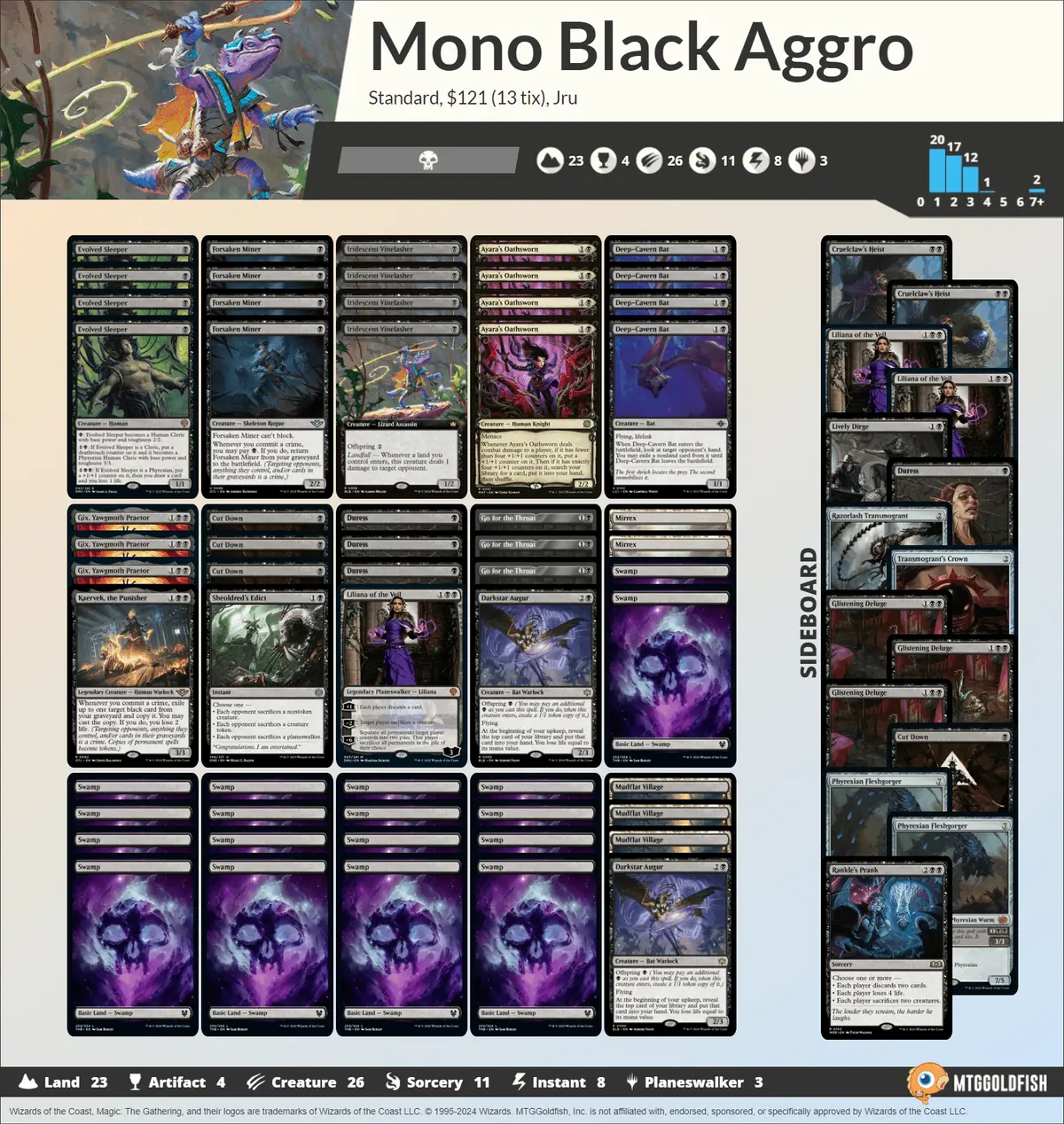
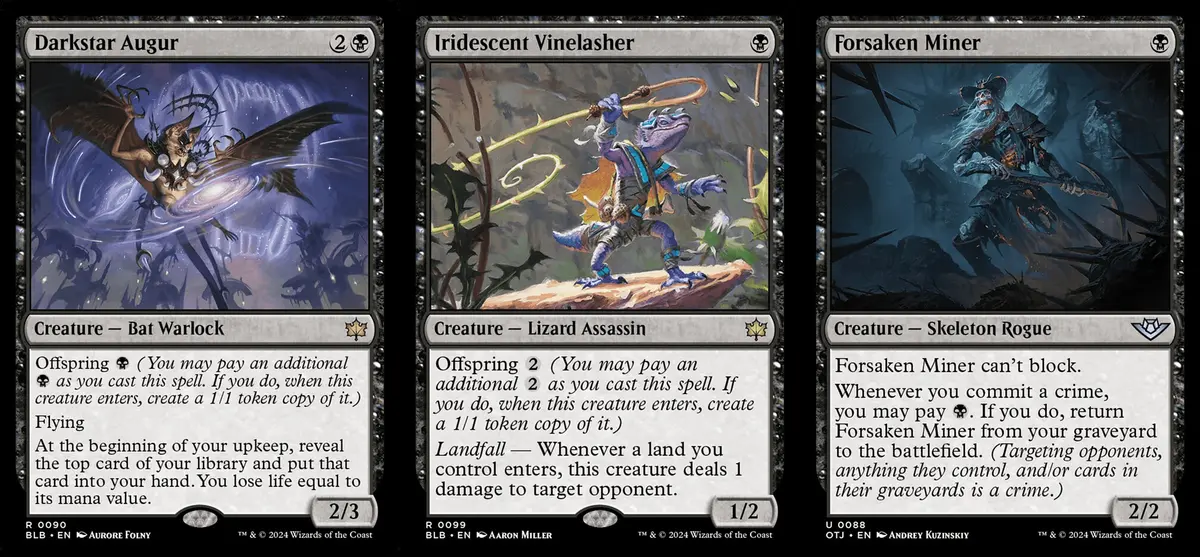
Dark Confidant’s ability has recently been used almost like an evergreen mechanic (who knows, maybe one day it really will become a keyword ability). The previous set had Caustic Bronco, and this set has Darkstar Augur. It’s certainly profitable, but it really hurts too. To get the most out of Darkstar Augur, the most intuitive option is still to build an aggro deck with a low-cost curve. Iridescent Vinelasher also happens to reinforce the low-cost damage slot, and its landfall crime-and-hit-the-opponent ability also makes it convenient to resurrect Forsaken Miner, strengthening the staying power of low-cost damage.
Compared with a regular aggro deck, this one’s resource count should count as especially large, but quite a few of the cards trade life for resources, so in some matchups with more life pressure, you can swap Darkstar Augur with the sideboard’s Phyrexian Fleshgorger.
Orzhov Questcaller
Orzhov Questcaller decklist link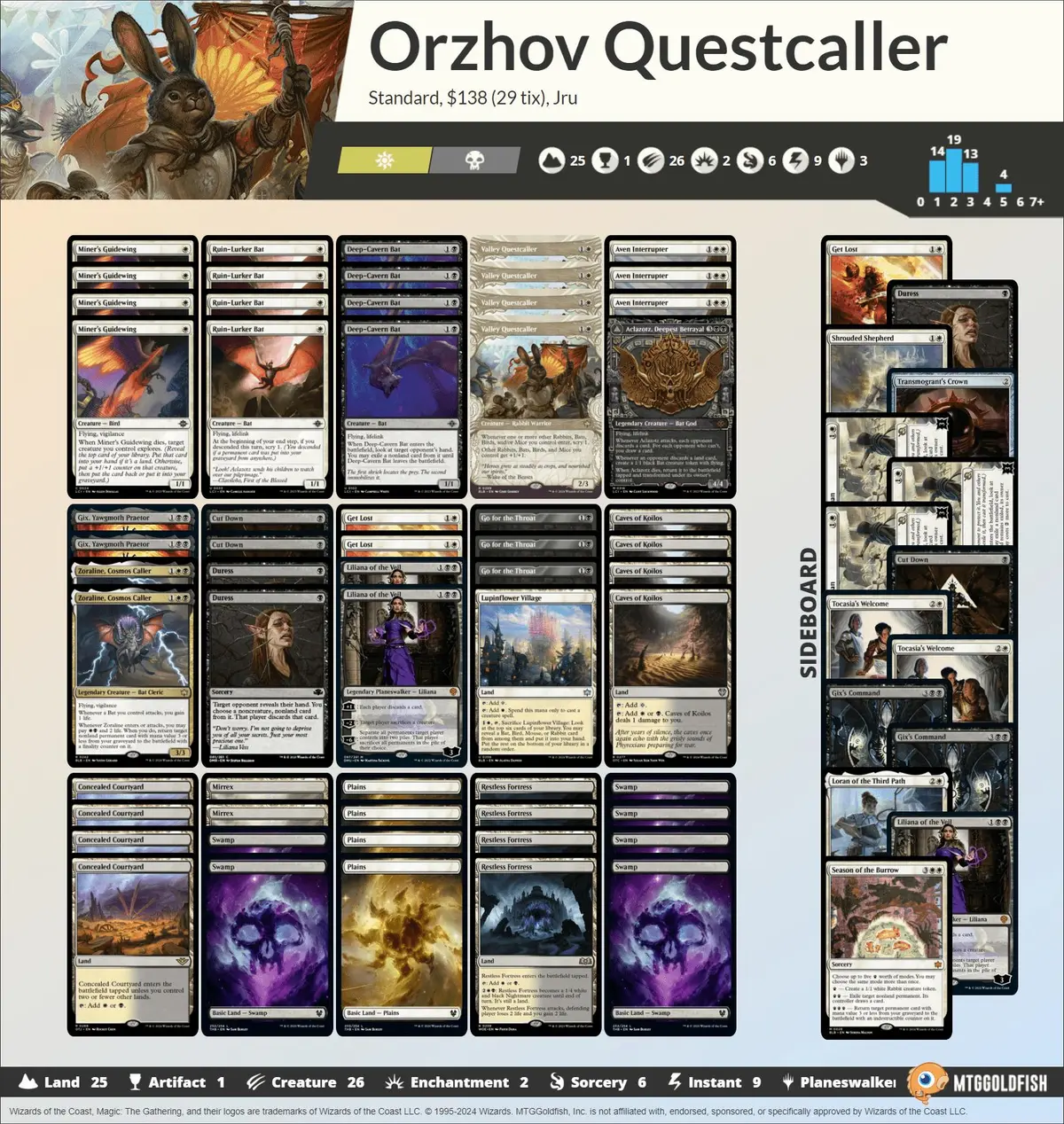
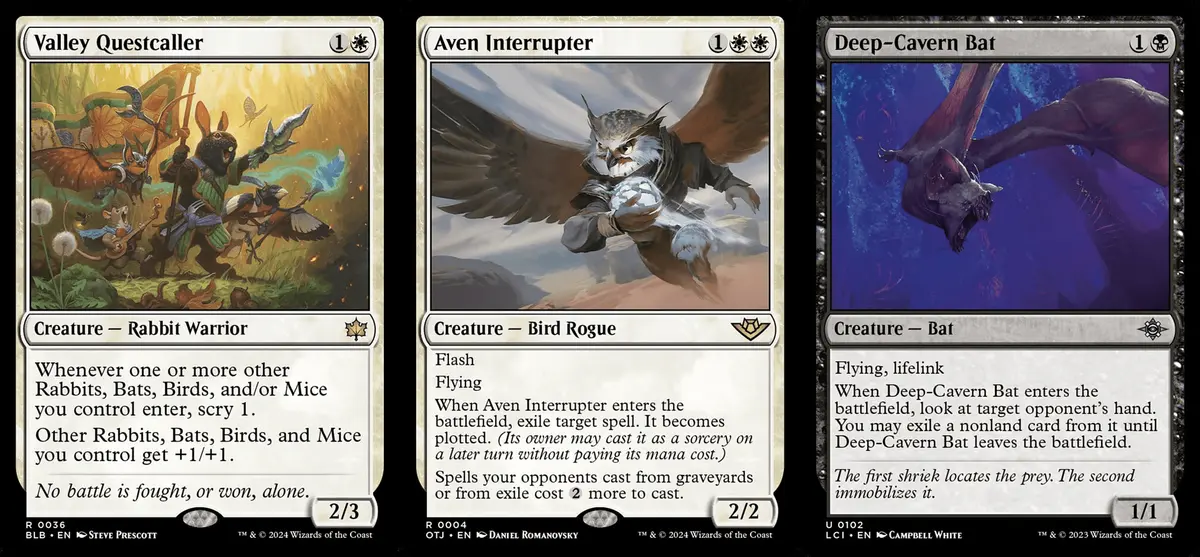
Deck summary: Valley Questcaller and its happy companions. This one really did go a bit off the rails, mainly because I fancied Valley Questcaller’s multi-tribe lord ability and tried to blend the related tribes into one deck. Because it’s the simplest kind of stat-pumping lord, it works better in a fast-paced aggressive deck. As for why Gix, Yawgmoth Praetor, whose tribe has nothing to do with Questcaller at all, showed up… because by the time I was done building it was almost a flier squadron, and with damage this evasive, not making use of Gix felt like a bit of a waste.
Golgari Insidious Viper
Golgari Insidious Viper decklist link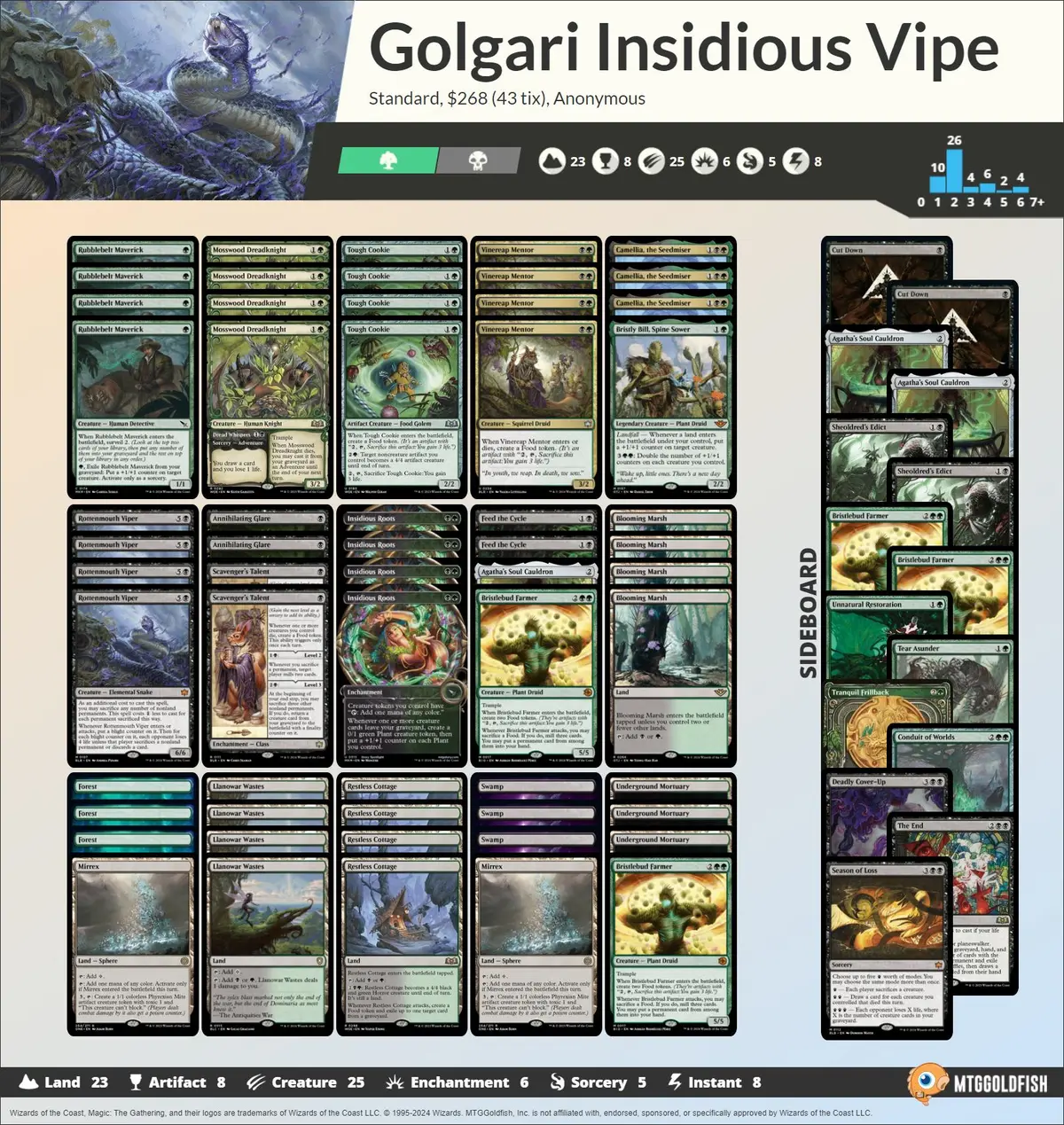
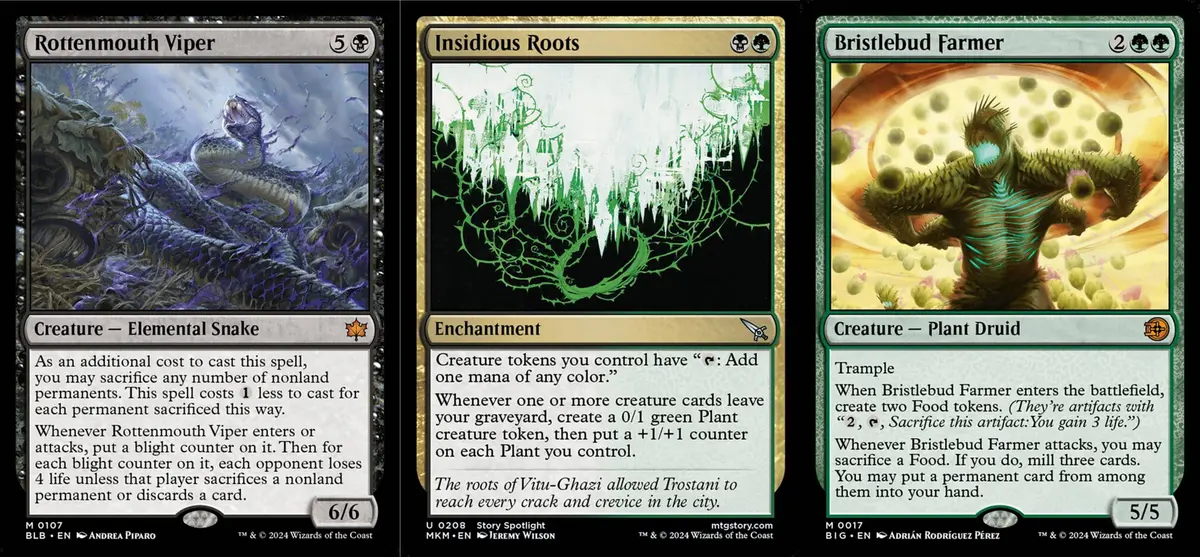
It centers on the plant-growing enchantment Insidious Roots and BLB’s new six-mana mythic Snake Rottenmouth Viper, and packs lots of cards that can make Food. Early on, you hope to accelerate out a Snake, mid-game you play the enchantment, and using collect evidence, forage (exile 3 cards from your graveyard), graveyard recursion, graveyard retrieval, and even effects like casting Mosswood Dreadknight // Dread Whispers via adventure from the graveyard when it dies, you trigger the enchantment’s plant-growing ability (create a 0/1 Plant token and put a +1/+1 counter on every Plant). And since growing plants can put counters on all Plants, don’t forget that OTJ’s quality Cacti are all Plants! Bristly Bill, Spine Sower is the landfall plant-growing king, and when it dies it can be fed to Agatha’s Soul Cauldron in the late game, so the opponent has to watch out for your creatures with counters suddenly growing big and strong. Bristlebud Farmer enters with the right tribe and two Food, and each attack’s card advantage can additionally trigger the plant-growing! Keep planting the vegetables, and perhaps you can cast a few more Snakes!
Crippled Domain
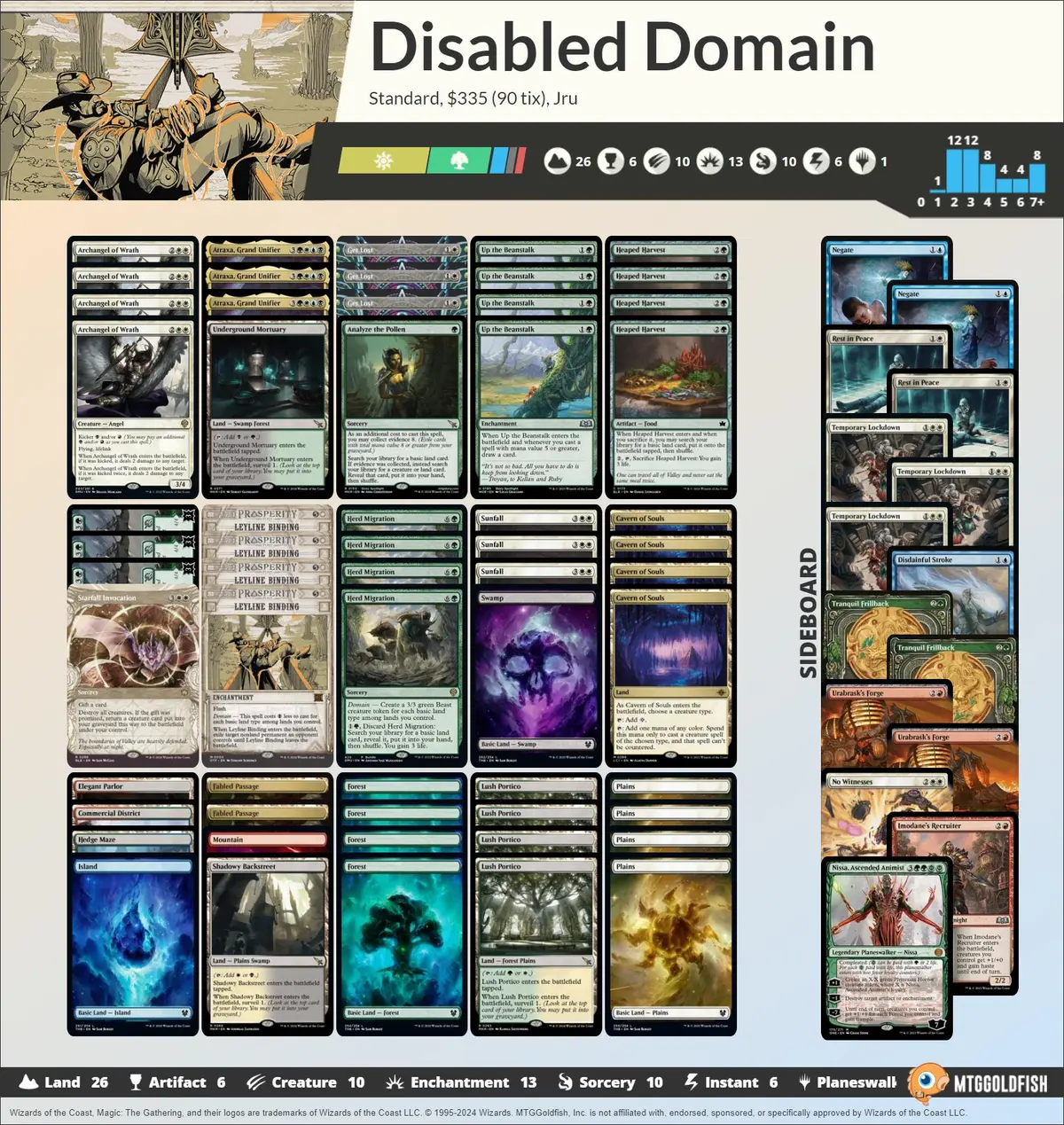
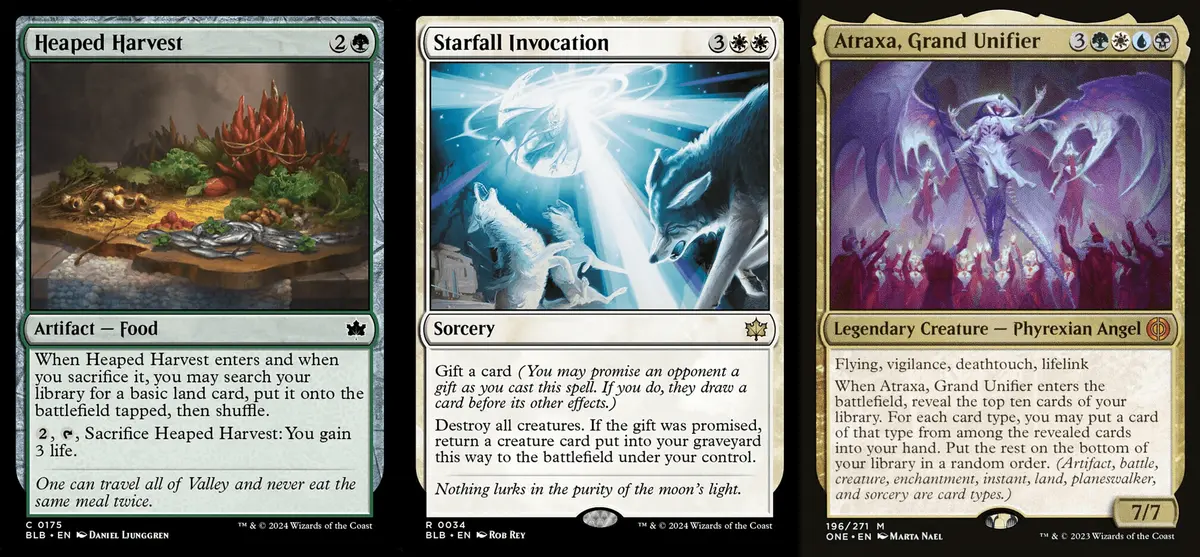
Domain was really cut so hard in this Standard rotation that it makes you want to cry. After painfully losing the three-type cycle lands, the difficulty of assembling the land types will rise sharply, and for now we can only rely on MKM’s surveil lands to hold it up. Another loss is Topiary Stomper, which paired with Invasion of Zendikar // Awakened Skyclave also made for a very smooth game flow in the past. This problem is relatively minor, though, since as the environment evolved in its late stage, the Ancient Cornucopia build was also proven viable, so I originally adjusted from a baseline Ancient Cornucopia version of the deck. But as I kept building I noticed a problem: before, with tri-lands, casually dropping a few could fill the land types, or if you were one type short it was easy to fetch a basic to complete it. Without tri-lands, if the three-mana acceleration can’t fetch a land, then never mind color fixing, Domain’s power takes a direct cut. And without the tri-lands’ ability to give the secondary colors, the color requirements of spells in the original Ancient Cornucopia build became a little risky, so in the end the three-mana slot was changed to a land-fetching spell, giving the new card Heaped Harvest a trial period. Judged purely on three-mana land fetching, Standard has a handful of spells better than it, but most of their bonus value is also not high, and Heaped Harvest can at least reliably fetch one more land, strengthening color fixing and deck thinning. In addition, I also picked a new card for the sweeper slot, Starfall Invocation. Although its board-clearing ability isn’t as strong as Sunfall, and it requires gifting the opponent a card to gain extra value, our deck happens to have the most profitable ETB creature, Atraxa, Grand Unifier, so giving the opponent a card to get an Atraxa for ourselves is still acceptable.
Conclusion
Honestly, this Standard first look was probably the one where I had the least feel for deckbuilding in the past year. I usually try building around 60 lists at the start of each set, and the total number of trial decks this time wasn’t much lower than that, but decks that “used only a few new cards” or “used no new cards at all” made up over 50%. The reason is also intuitive: BLB isn’t a set with many generically strong single cards. The set’s design is very focused on specific tribes and their supporting mechanics, which makes it easy this time to build a few decks with strong BLB-era flavor, but beyond that it’s harder to find a clear role for the new cards. After all, this article is mainly about uncovering cards from the new set, so the “post-disaster reconstruction” decks caused by old cards rotating out are not included for now. Thank you all for reading.
- Title
- A First Look at Bloomburrow Standard
- Author
- Jru
- Created at
- July 31, 2024
- License
- This work is licensed under CC BY-NC-SA 4.0 .