A Beginner's Guide to Magic: The Gathering
Note: This article was translated from Chinese by AI and may contain errors. Read the original Chinese version.
Before We Start
This article is written for complete beginners with zero experience. It helps newcomers understand the basic rules of MTG and points to the resources you will need when looking things up. Feel free to share it and to accompany new players as they join the game; we hope this article can become a one-stop encyclopedia for newcomers.
Table of Contents
Basic Rules of the Game
Parts of a Card
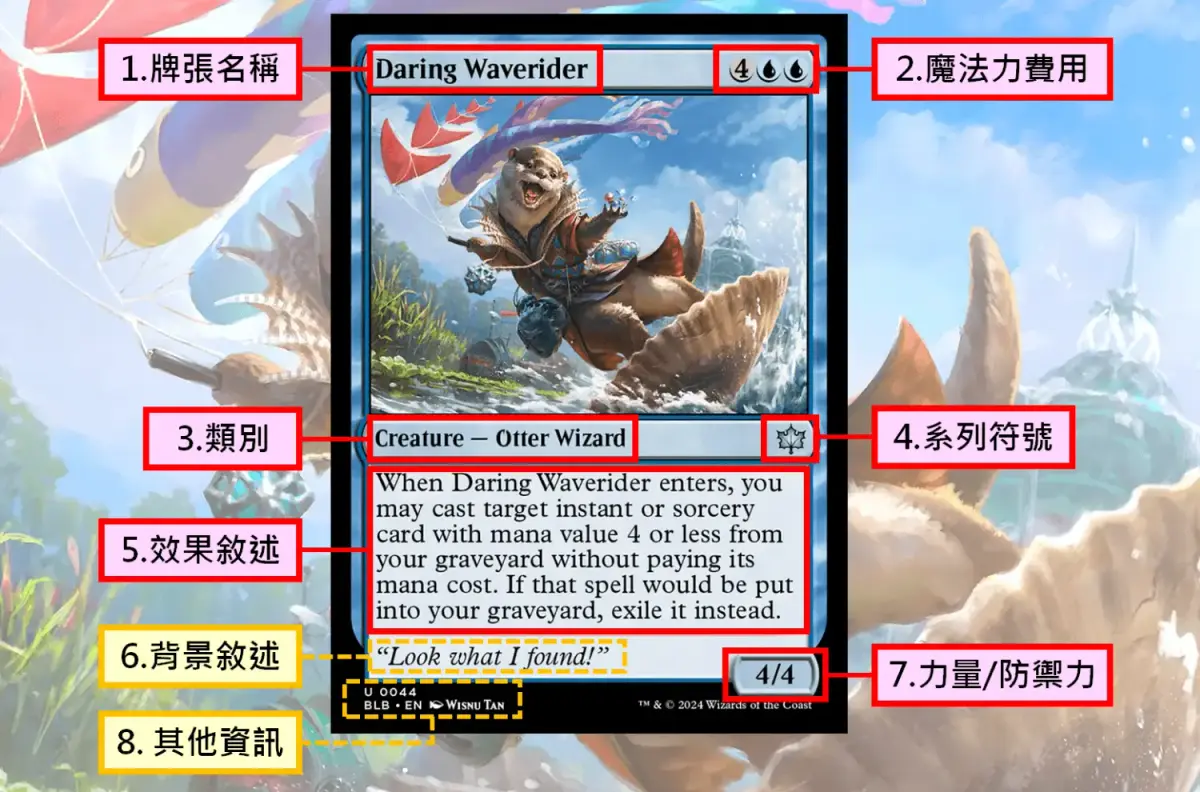
- 1. Card Name
The example card is Daring Waverider.
Under the normal deck construction rules of a format, a deck may contain at most 4 copies of a card with the same name, except basic lands, which have no limit on the number of copies in a deck.
- 2. Mana Cost
This is the cost required to cast the card. Using Daring Waverider as an example, casting it requires 4 mana of any color and 2 blue mana. A more detailed explanation of mana costs follows later.
- 3. Type
This shows the card’s type. The common types are the seven: land, creature, sorcery, instant, artifact, enchantment, and planeswalker, plus other rare types (such as Kindred and Battle). Every card has at least one type, but it may have several at once (for example, an artifact creature has both the artifact and creature types). In addition, each type may have its own subtypes.
For example, Daring Waverider’s type line reads “Creature — Otter Wizard”, where the type is creature and the subtypes are Otter and Wizard.
- 4. Set Symbol
The set symbol indicates both the card’s set and its rarity: the symbol itself shows which set the card belongs to, and its color shows the card’s rarity. There are four rarities, from lowest to highest, as below; here we use Commander Legends: Battle for Baldur’s Gate (CLB) as the example:
- C: Common, black in color.
- U: Uncommon, silver in color.
- R: Rare, gold in color.
- MR: Mythic Rare, orange-red in color.
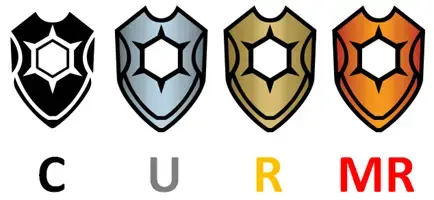
Seeing that orange-red always makes the heart race, and if you don’t see it, it’s “Boss, one more pack!”
- 5. Rules Text
This describes the card’s effects in the game.
- 6. Flavor Text
It has no actual effect and only provides background story for the card. Flavor text is printed in italics, and not every card has it.
- 7. Power/Toughness
The number on the left is the creature’s power (how much damage it can deal), and the number on the right is its toughness (how much damage it takes to die).
- 8. Other Information
Additional information such as the set code, collector number, rarity, language, and artist.
The Five Colors
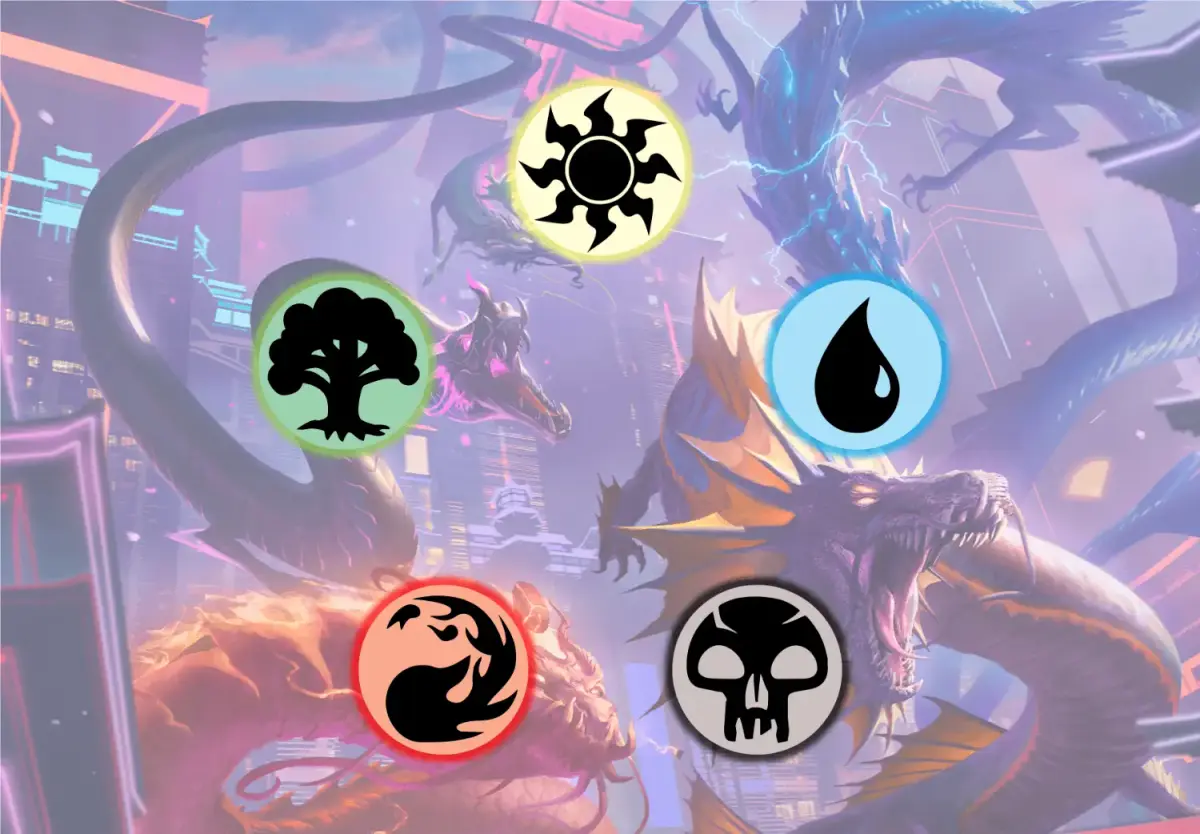
MTG cards come in five colors: White, Blue, Black, Red, and Green. Each color has its own strengths and blind spots, and this design is also known in MTG as the color pie. The traits of each color are as follows:
- White
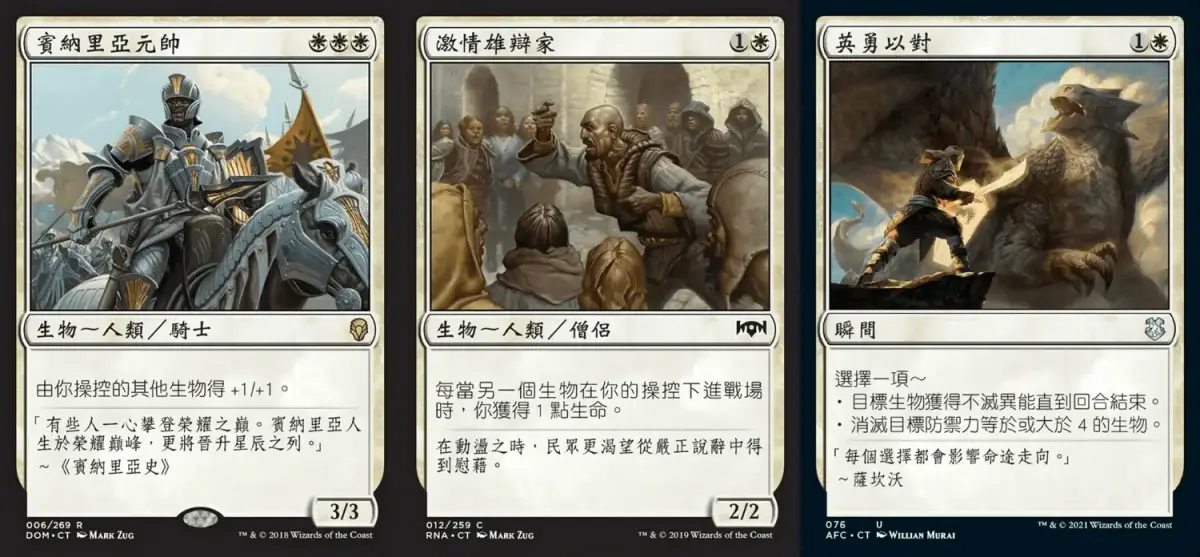
- Group Effects: White is a color that values teamwork. Individual creatures may not be especially strong, but it has many ways to flood the board and abilities that strengthen all your creatures.
- Life Gain: Gaining life is also one of white’s trademarks. Incidentally, life totals in MTG have no upper limit.
- Protection and Enhancement: White has strong self-protection and enhancement abilities, able to protect your resources from the opponent’s disruption or strengthen your own creatures.
- Removal: White is the only color with direct removal for every card type. White’s strength is mass removal (commonly called a “sweeper”), and it also has single-target removal, but removing creatures often comes with conditions, timing restrictions, or the side effect of giving the opponent resources in return.
White has the broadest range of answers of any color, but some of its abilities have application limits or require teamwork to reach their full potential.
- Blue
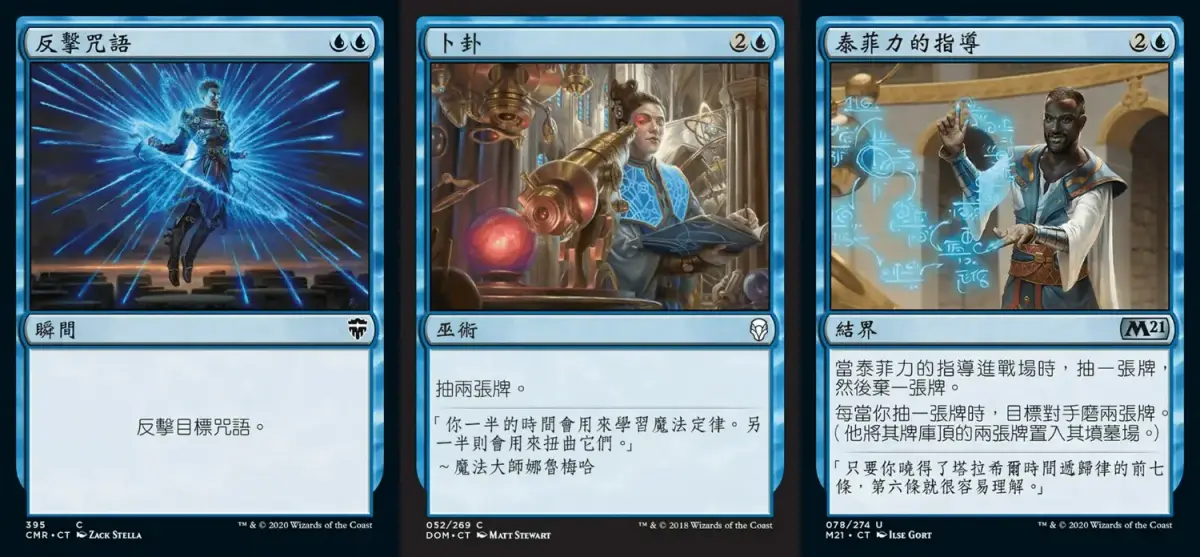
- Counterspells: To counter means to nullify a spell the opponent casts, commonly nicknamed “kang” by Chinese-speaking players. This is blue’s most irreplaceable trait.
- Card Draw: Although every color can draw cards, blue’s card draw is usually the most efficient.
- Milling: Milling means putting cards from the opponent’s library directly into the graveyard. In some matchups, attacking the opponent’s library is an easier route to victory than attacking their life total.
- Removal: Because it already has the special ability of counterspells, blue is the weakest of the five colors at dealing with permanents on the battlefield; it usually just returns things on the battlefield to hand or library, which makes it hard to solve a problem cleanly. But blue has another distinctive way of handling things: directly taking control of the opponent’s stuff (NTR).
Blue is the color with the most distinctive character, and most of its strengths are hard for other colors to replicate. Simply loving to counter spells is reason enough to choose blue.
- Black
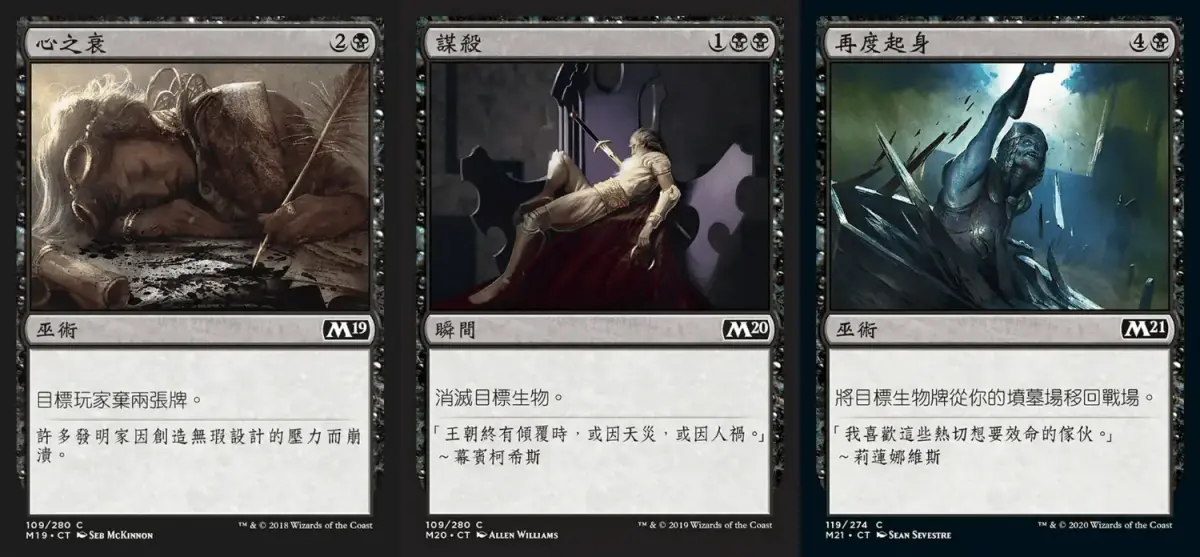
- Hand Disruption: Making the opponent discard cards from hand is black’s signature move.
- Graveyard Use: Black is good at using graveyard resources, such as recurring cards from the graveyard or using the graveyard as another resource base to develop other applications.
- Curses and Weakening: Black can inflict negative effects on players or creatures to continuously reduce their abilities.
- Removal: Black is the most efficient color at removing creatures and planeswalkers, which are the things you most need to remove in most matchups. However, black is very weak at removing enchantments, and cannot touch artifacts at all.
Black has a very broad range of answers alongside its powerful effects, but much like making a pact with a demon, black often asks you to pay an extra price, such as paying life or sacrificing creatures.
- Red
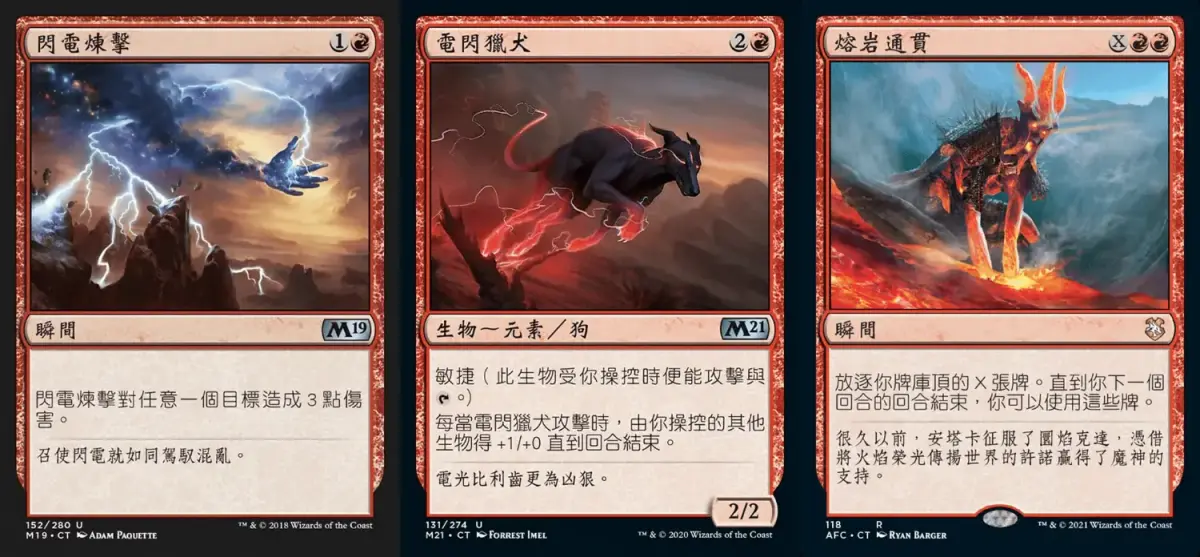
- Damage: Red’s trademark is damage, whether to players, creatures, or anything on the battlefield that can be dealt damage. Abilities that deal damage in non-combat ways are commonly called “burn”.
- Haste: Under MTG’s basic rules, a creature cannot be declared as an attacker on the turn it enters the battlefield (summoning sickness), unless it has the ability “haste,” which ignores the summoning sickness rule, and the biggest source of haste is red.
- Randomness: Red is an impulsive color, not good at long-term planning, so red easily produces random actions with unpredictable payoffs.
- Removal: Most of red’s removal comes from the burn mentioned above. In addition, red has some means of dealing with artifacts, but is helpless against enchantments.
With both damage and haste, red is clearly a color good at fast-paced aggro.
- Green
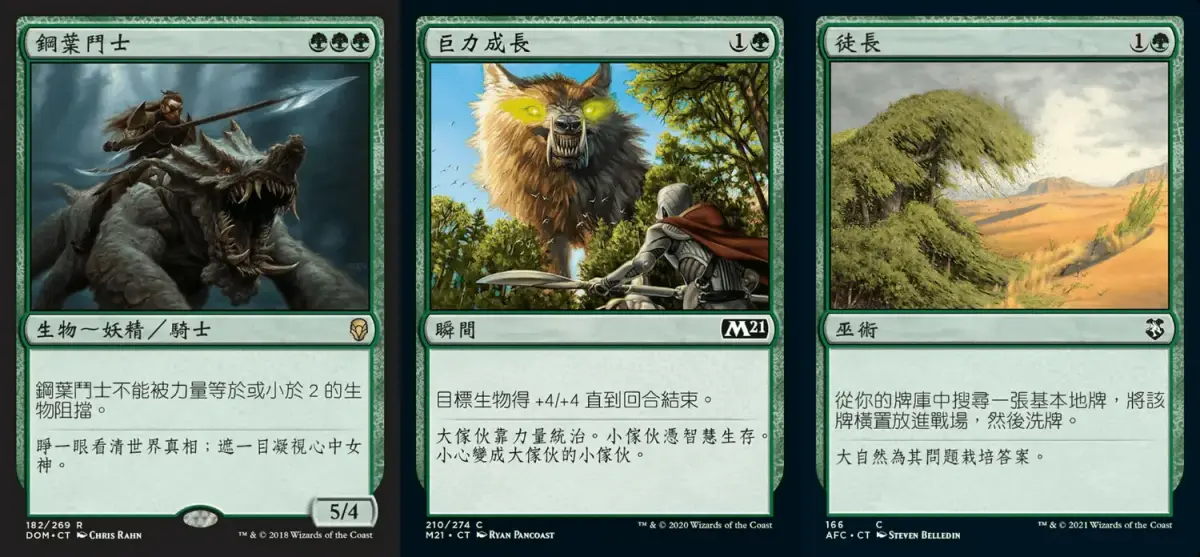
- Powerful Creatures: Green creatures usually have simpler abilities, but their base combat strength is the highest of all colors, with numbers high enough to be a defining mechanic.
- Creature Support: Green’s tricks often revolve around creatures, such as strengthening creatures, protecting creatures, and tutoring creature cards to hand.
- Ramp: Green is good at quickly adding mana: your opponent may have only 4 mana available on their fourth turn, while on your fourth turn you already have 7.
- Removal: Green is good at dealing with artifacts and enchantments; removing the opponent’s creatures usually relies on your own creatures, such as making the two sides’ creatures fight.
Overall, green is the simplest and most brutal color, with no overly complicated game plan, simply running the opponent over with powerful threats.
- Colorless and Multicolor
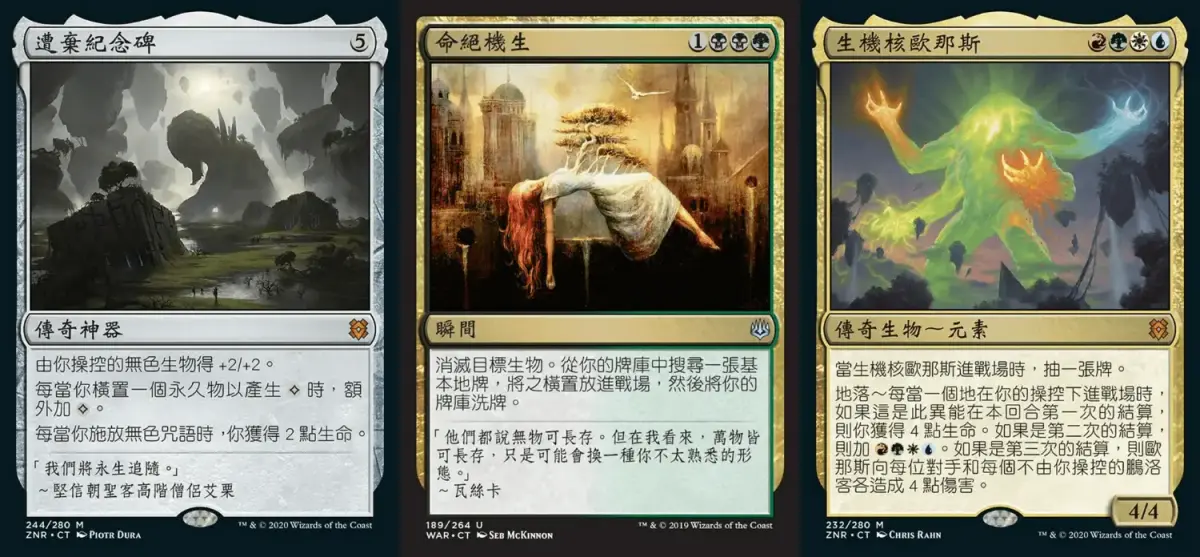
In MTG there is no rule that a card must be only one color, and there are also colorless and multicolor cards. Colorless cards have abilities of all kinds with no clear definition; multicolor cards have the traits of all the colors they have.
Card Types
Starting to feel overwhelmed or spaced out by this point? That’s okay, it’s normal. You can save this page and refer back to it any time. MTG is a relatively complex but highly interactive and great game, and if you’ve found a color you love, we recommend you keep learning.
Common Types:
Basically every set today includes these types, seven in all: land, creature, sorcery, instant, artifact, enchantment, and planeswalker. Planeswalker cards are the rarest; some special side sets may not include them, but the other six types can in principle be found in every set.
- Land
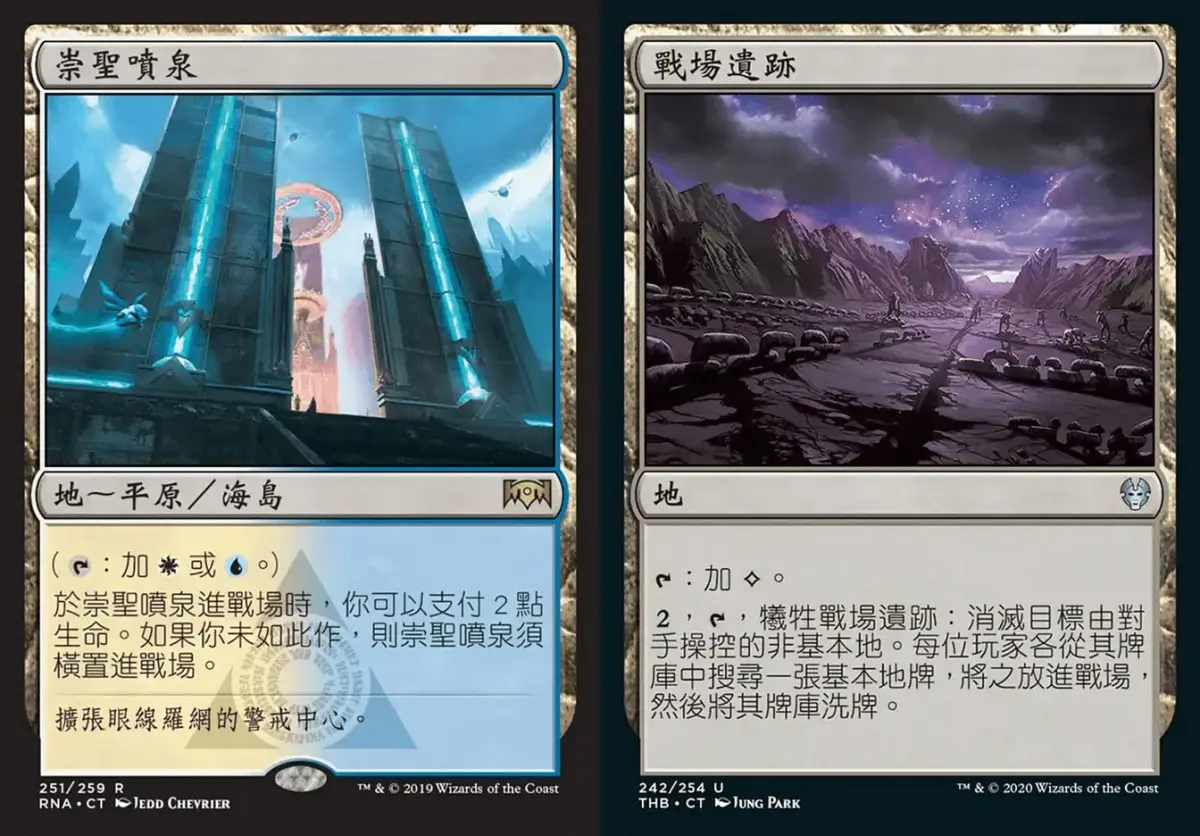
In the story, the player is a wizard who casts all kinds of spells by drawing on the magic in the earth.
Lands are the main source of mana in MTG, and usually have the ability to tap for a specified mana. Whether casting spells, activating abilities, or performing other actions in the game, mana is often a necessary resource. Of course, besides producing mana, many lands also have additional special functions.
Each turn, a player may play one land card (Play Land), which is colloquially called “dropping a land”. Using any card other than a land is called casting a spell (Cast Spell).
Also, lands are always colorless, unless the card’s text states what color it is.
- Creature
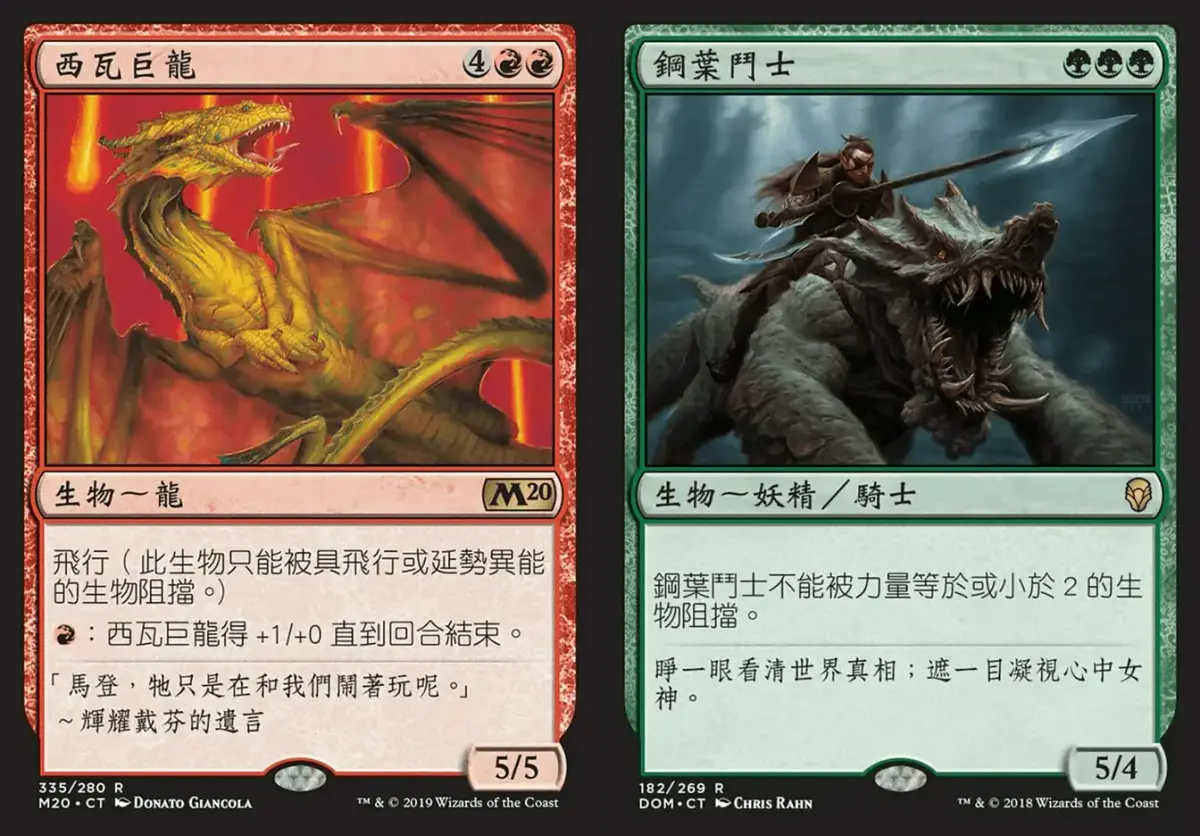
Creatures are the main units of offense and defense between players. Each creature has its power/toughness printed in the bottom right corner: the left number is the creature’s power (how much damage it can deal), and the right number is its toughness (how much damage it takes to die). As long as the damage accumulated on the creature is greater than or equal to its toughness, it dies. If a creature has been dealt damage but has not died when the turn ends, all damage on it is removed (put simply, it returns to full health).
Also, if a creature entered the battlefield this turn, that creature cannot be declared as an attacker, nor can it activate abilities whose cost includes the tap symbol on itself. This rule is called “summoning sickness,” and some special abilities let a creature ignore this rule (for example haste).
- Sorcery
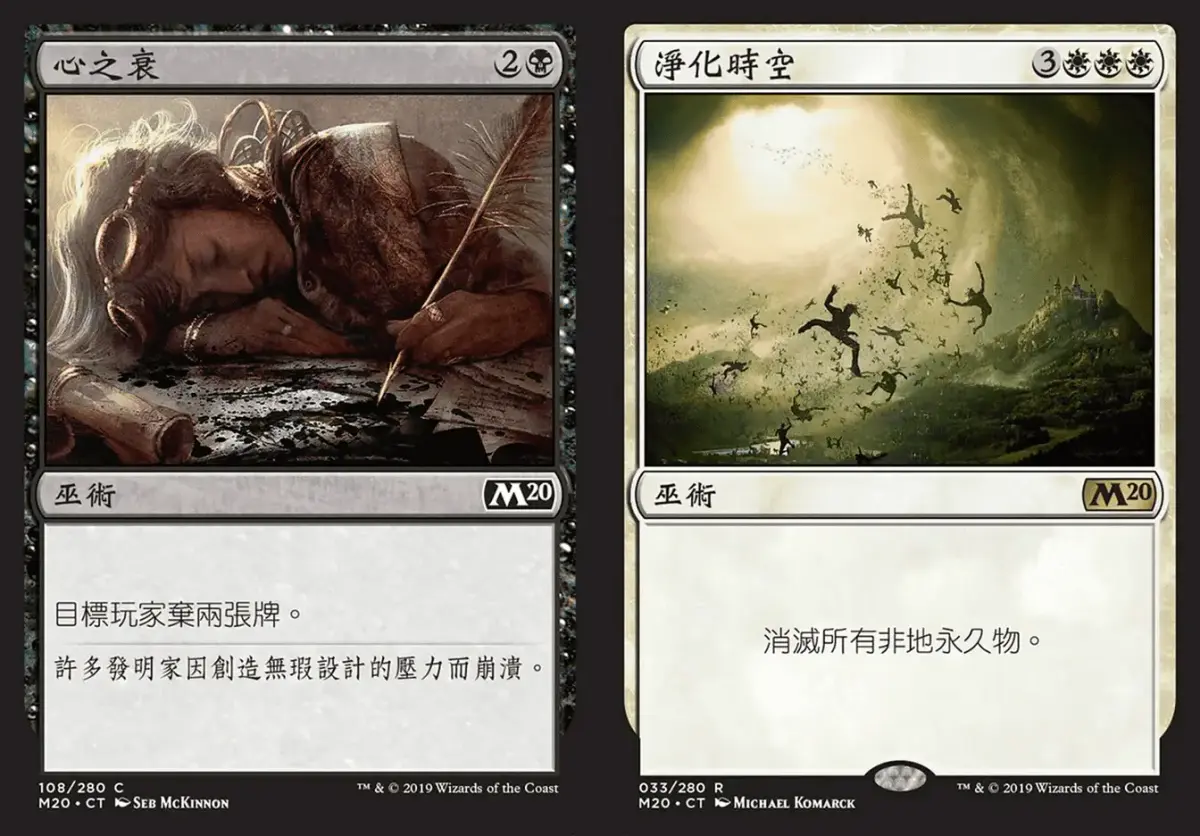
Casting a sorcery is like casting a magic spell that immediately affects the game, such as making the opponent discard cards or dealing damage.
Sorcery cards never enter the battlefield; after their effects finish resolving, they go straight to the graveyard.
- Instant
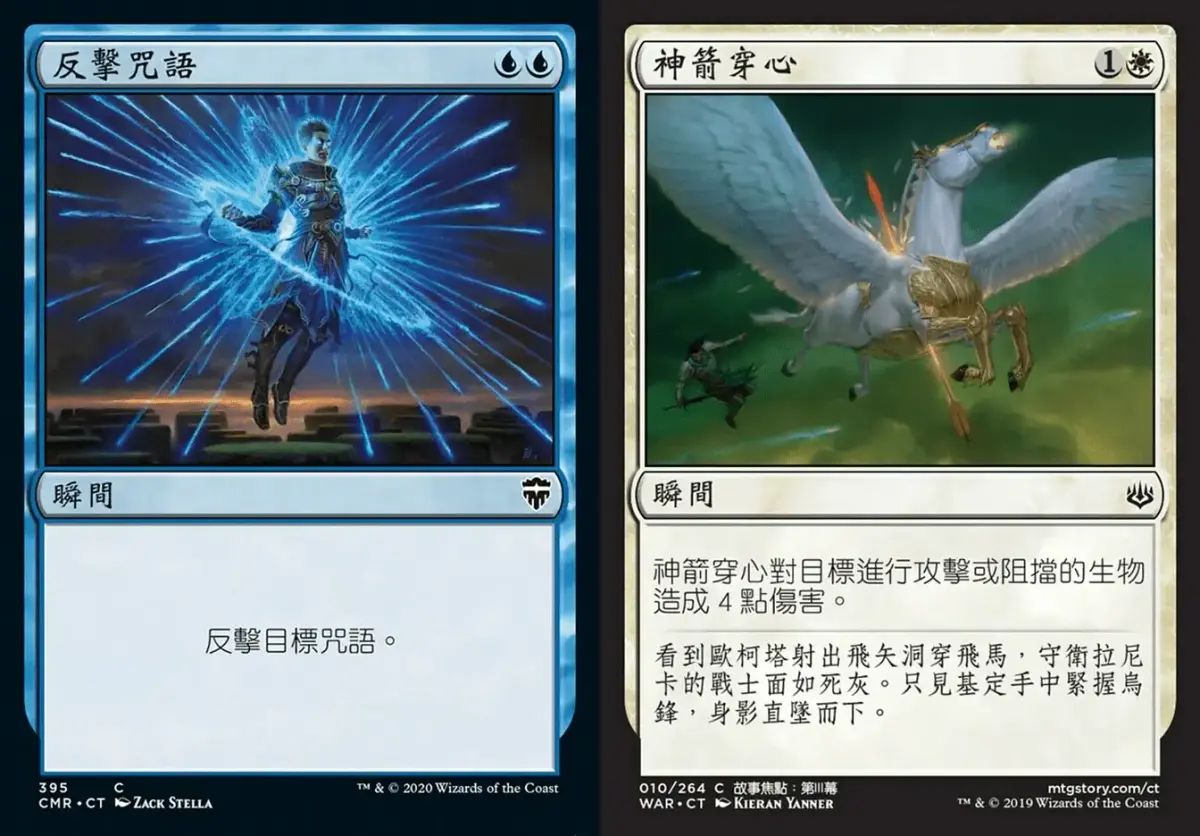
Their nature is roughly the same as sorceries; the difference is that they can be cast at different times, and instants have a wider and more flexible window of use. See the “Timing, Responses, and the Stack” section for the full explanation.
- Artifact
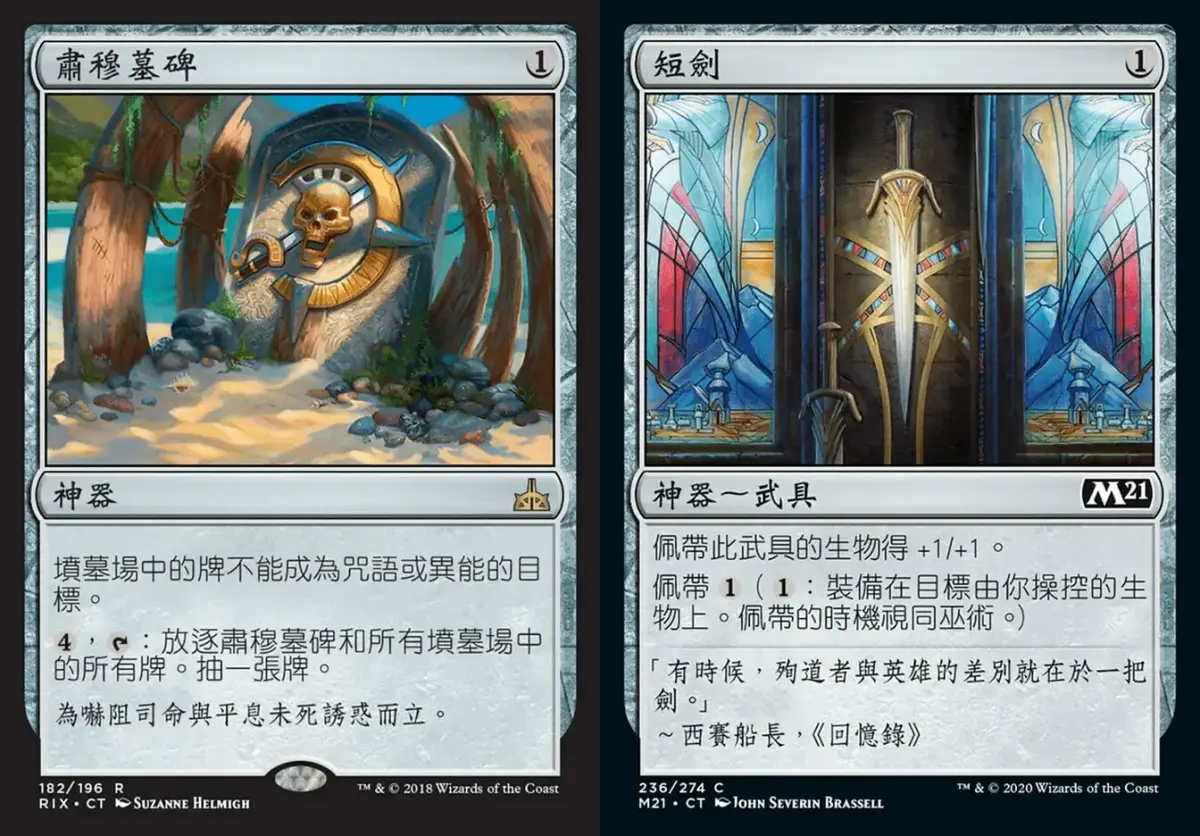
Artifacts are like physical devices or tools that stay on the battlefield and keep using their abilities. Because artifacts are not creatures, they do not directly take part in combat between creatures. Most artifacts are colorless cards.
A common artifact subtype is Equipment, a kind of gear that gives creatures extra bonuses. Equipment enters the battlefield unattached; you can activate its equip ability to attach it to a creature you control, and once a creature is equipped, it gains the extra bonus the equipment provides. When the equipped creature leaves the battlefield, the equipment stays on your side of the battlefield, and by activating the equip ability again, the next creature can pick it up. Of course, even if the equipment is still attached to a creature, you can directly activate the equip ability to switch the equipment to another teammate.
- Enchantment
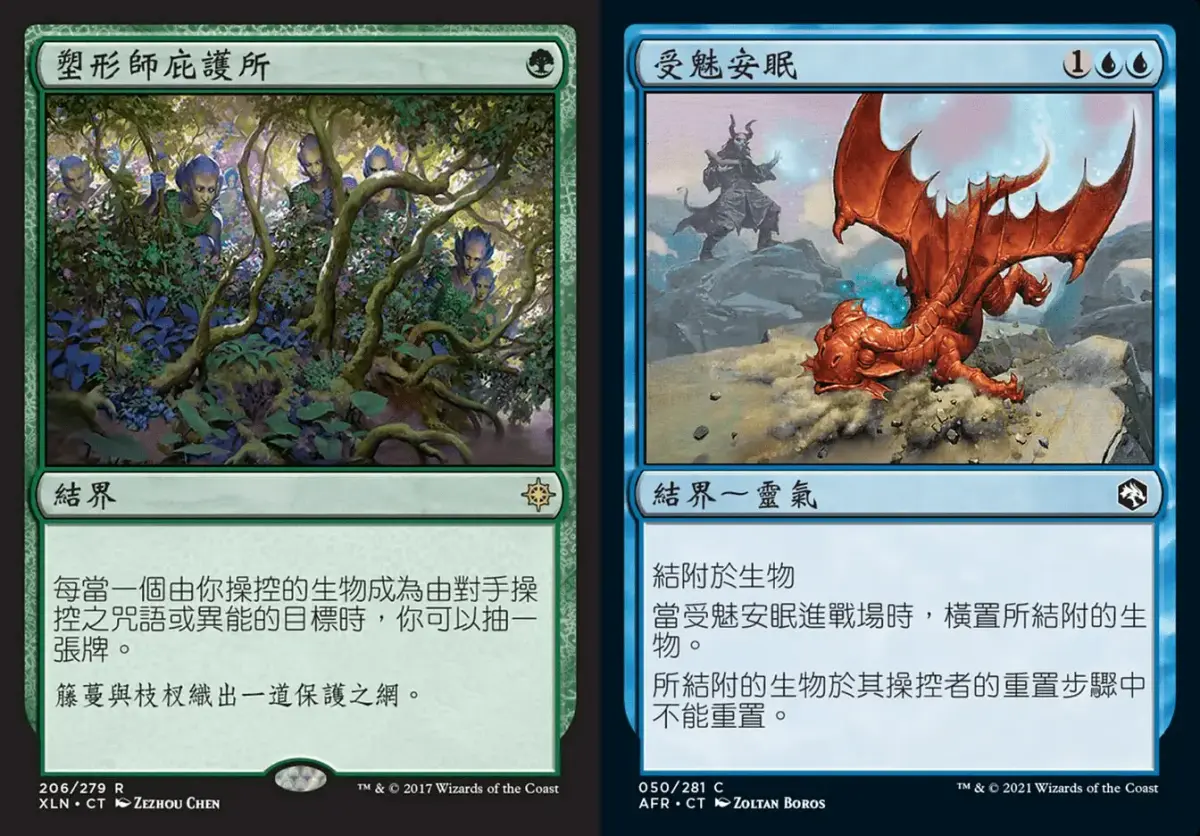
Enchantments are similar to artifacts in that they stay on the battlefield and keep using their abilities, but enchantments are mostly colored cards.
A common enchantment subtype is the Aura, which attaches to a specified object and affects it; when the enchanted object leaves the battlefield, the Aura goes to the graveyard.
- Planeswalker
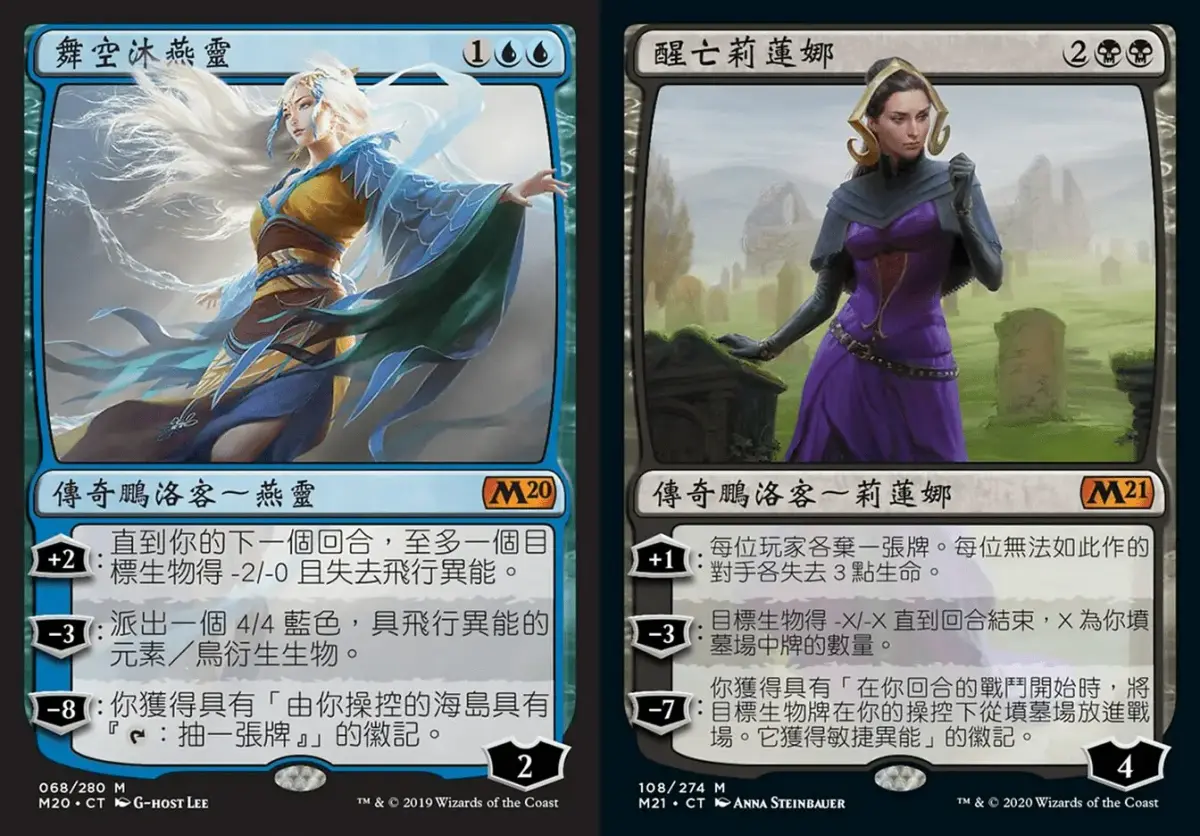
In Chinese, planeswalkers are also called “traveling mages” (the Chinese MTG site iyingdi, “Traveling Mages’ Camp”, takes its name from this). Planeswalkers are the most special of these seven common types, and also the type with the most complicated rules. They were not part of MTG from the beginning; the first planeswalker card appeared in 2007.
When a planeswalker enters the battlefield, it comes with a number of “loyalty counters” equal to the number in its bottom right corner, which can colloquially be understood as its health. When a planeswalker is dealt damage, it loses that many loyalty counters, and if the loyalty counters on a planeswalker become 0, that planeswalker goes to the graveyard. A planeswalker can be attacked by creatures, and the defending player can block creatures attacking a planeswalker with creatures, just as they would protect themselves.
For a detailed explanation of the combat phase, see the “Turn Structure” section later.
Each planeswalker can activate one loyalty ability per turn on your own turn, at sorcery speed. That means choosing one of the abilities on the planeswalker, adding or removing loyalty counters on it according to the [+N] / [-N] value left of the colon, and then carrying out the effect described to the right of the colon. To activate a [-N] loyalty ability, the planeswalker must have at least N loyalty counters; for example, if this planeswalker currently has only 2 loyalty counters, it cannot activate a [-3] ability.
For a detailed explanation of sorcery speed, see the “Timing, Responses, and the Stack” section later.
In addition, all planeswalkers also have the supertype “Legendary”; supertypes will be explained shortly.
Rare Types:
Besides the common types above, there are some rare types, whose cards may appear in a set only once every few years, or even in only one set in history. Typical examples are Kindred and Battle. Because these rare types are uncommon and have higher rules complexity, this article will not go into detail.
- Kindred and Battle
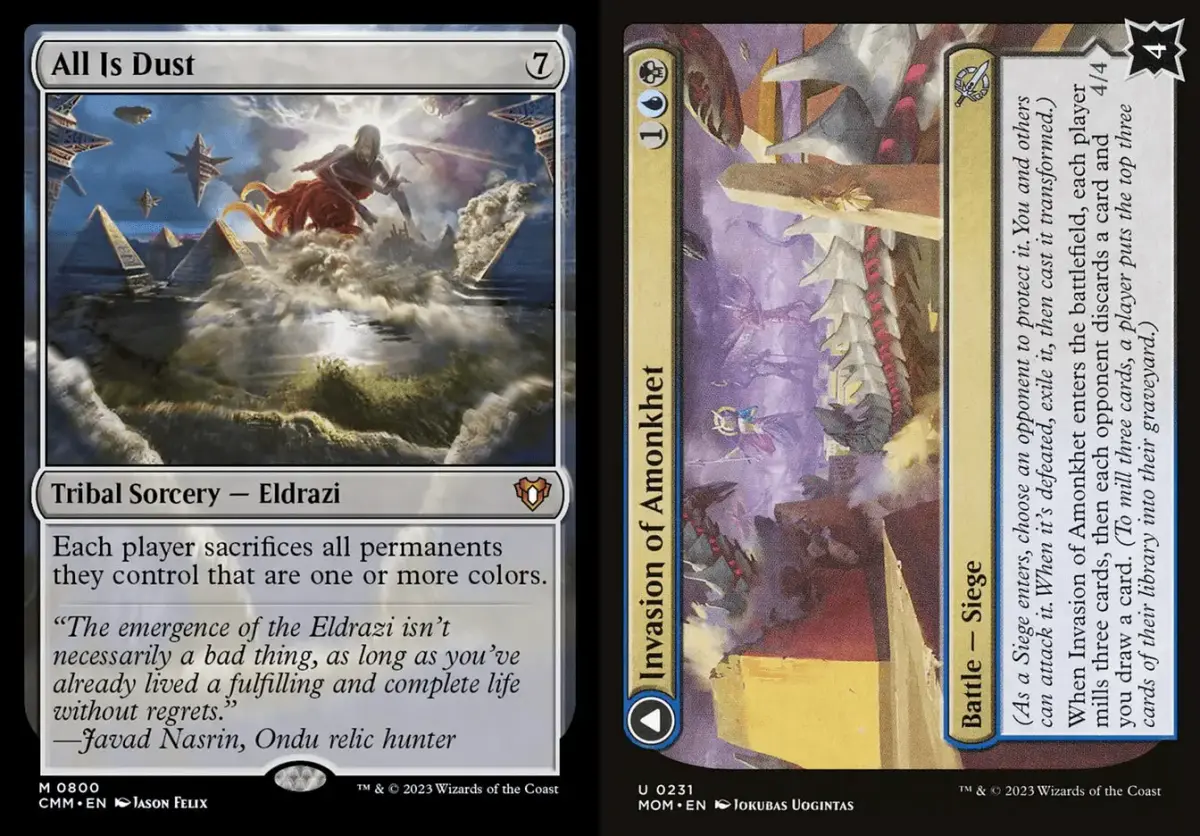
PS: The Kindred type used to be called Tribal. The type name was swapped out for reasons of political correctness, and any old card whose type line reads Tribal is now treated as Kindred.
Supertypes:
These can be simply understood as extra supplements to the main types, and these types come with some special rules of their own.
- Legendary
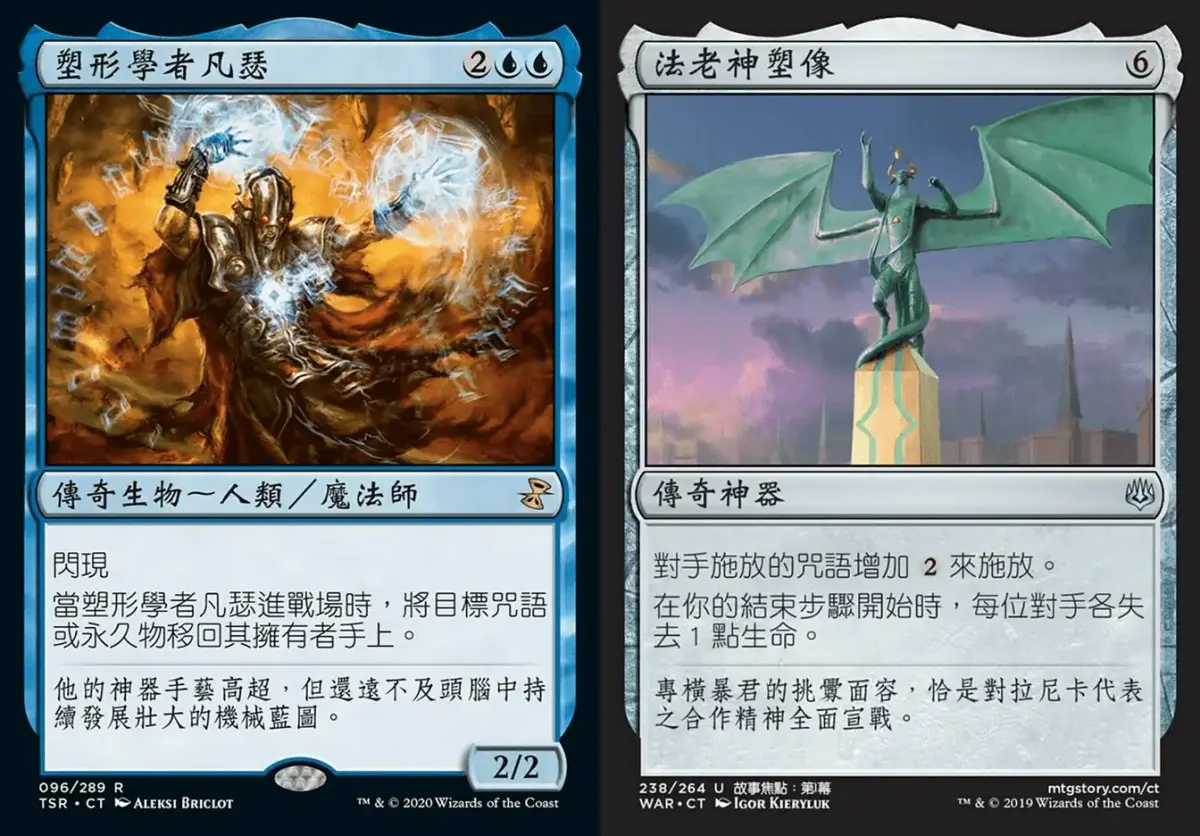
If a player controls multiple legendary permanents with exactly the same name, that player chooses one of them and puts the other permanents with that name into the graveyard. This rule is also known as the “legend rule”.
In the story, cards with the Legendary type are usually named, important characters, items, events, and so on.
- Basic
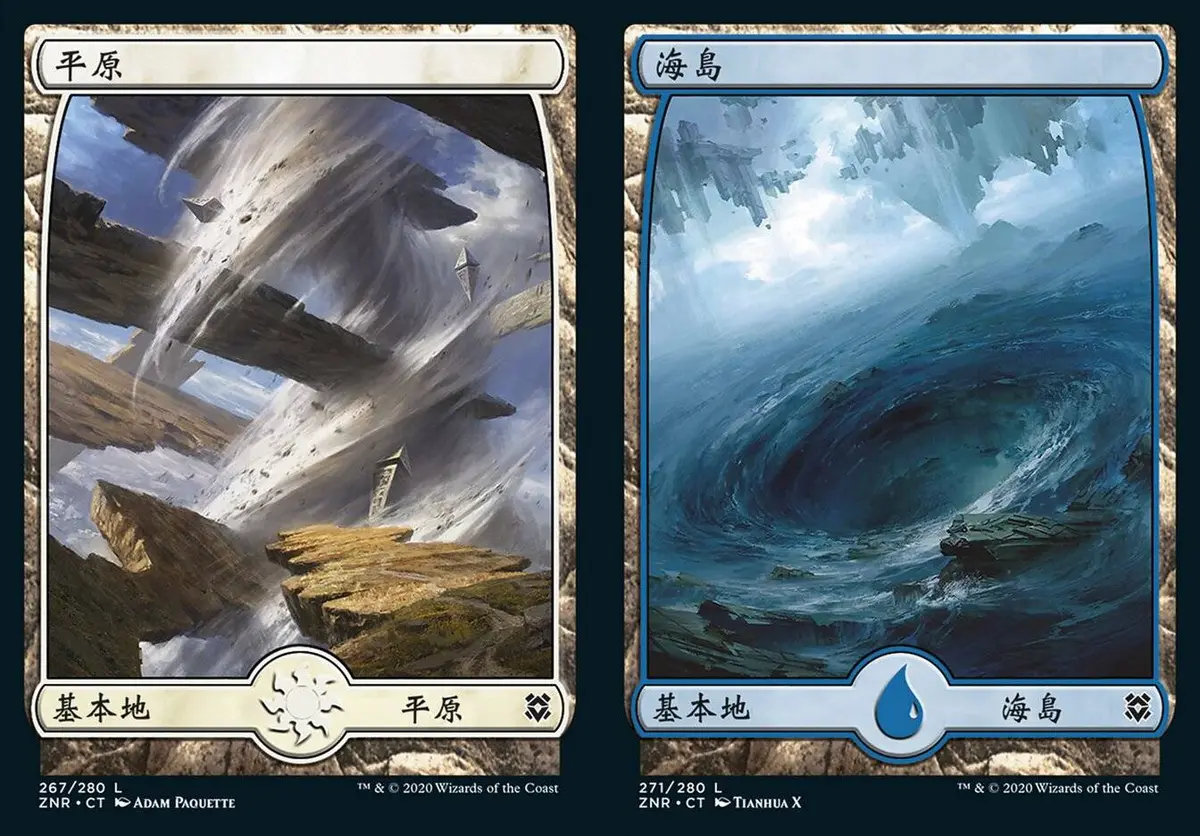
The Basic supertype appears only on land cards, i.e. basic lands. Under deck construction rules, basic lands have no limit on copies with the same name.
Producing Mana and Casting Spells
To cast a spell, you need to pay the spell’s mana cost, so first we need to get mana, which is generally produced by lands.
MTG has five basic land types. The names of the basic lands of these types and the colors of mana they produce correspond as follows:
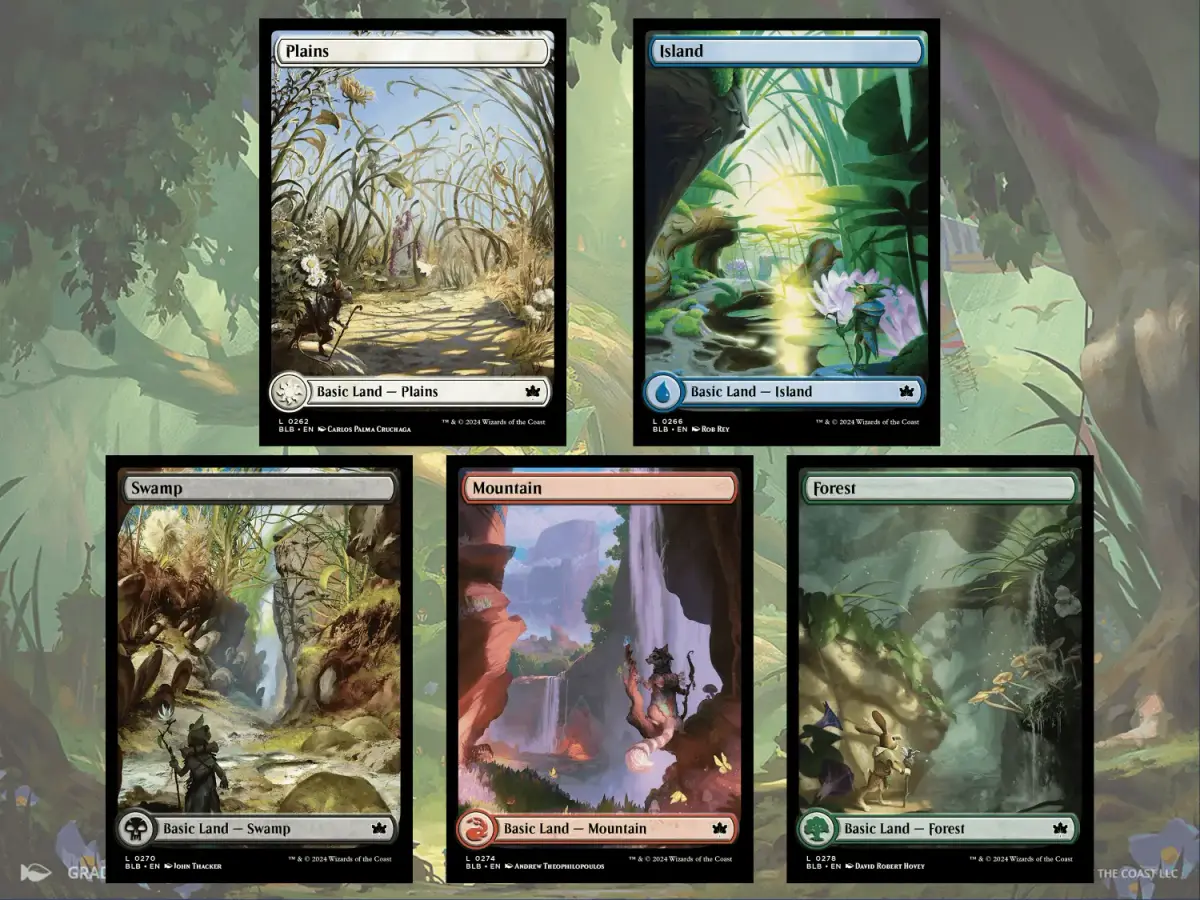
| Basic Land | Color Produced |
|---|---|
| Plains | White |
| Island | Blue |
| Swamp | Black |
| Mountain | Red |
| Forest | Green |
Tapping a land by turning it 90° draws mana from it. The mana basic lands can produce is shown in the table above; other special lands produce specified mana according to their own effects.
Now that we have mana, we can cast spells. The mana needed to cast a spell is written in the card’s upper right corner. Take the image below as an example: this bird costs 3 in total, of which 1 is a colored requirement of white, which can only be paid with white mana, and the remaining 2 are generic, which can be paid with mana of any color, or even colorless mana.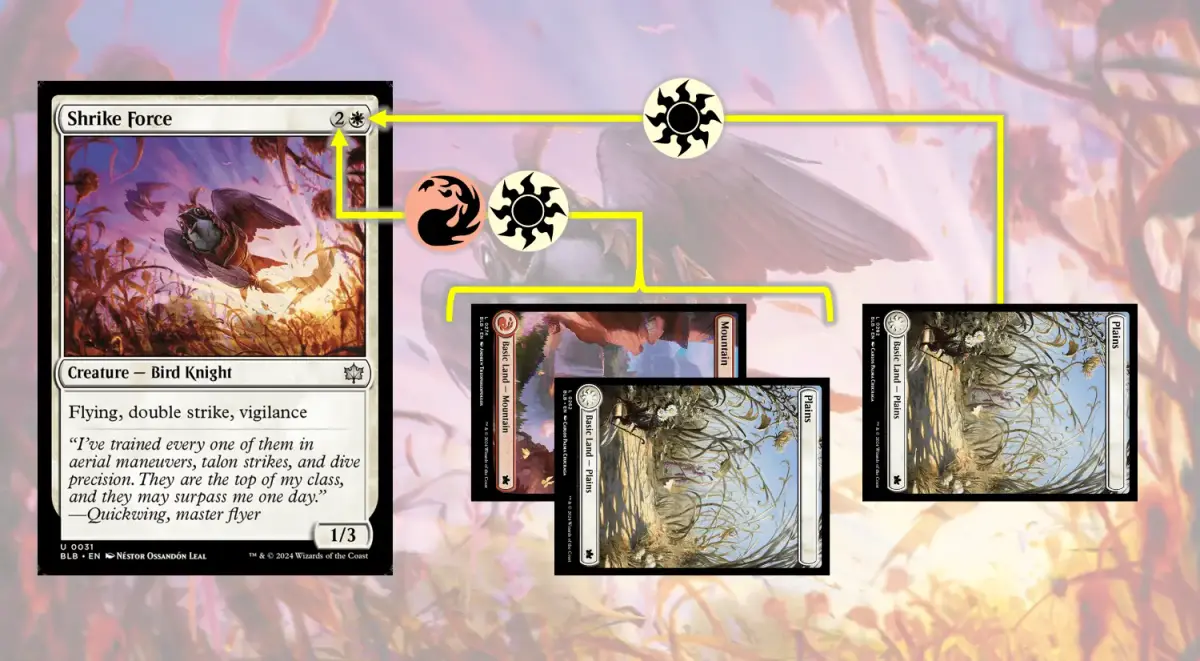
Lands are not the only source of mana; MTG has all kinds of ways to get mana. Also, when the mana produced is colorless, it is shown with the diamond-shaped colorless symbol: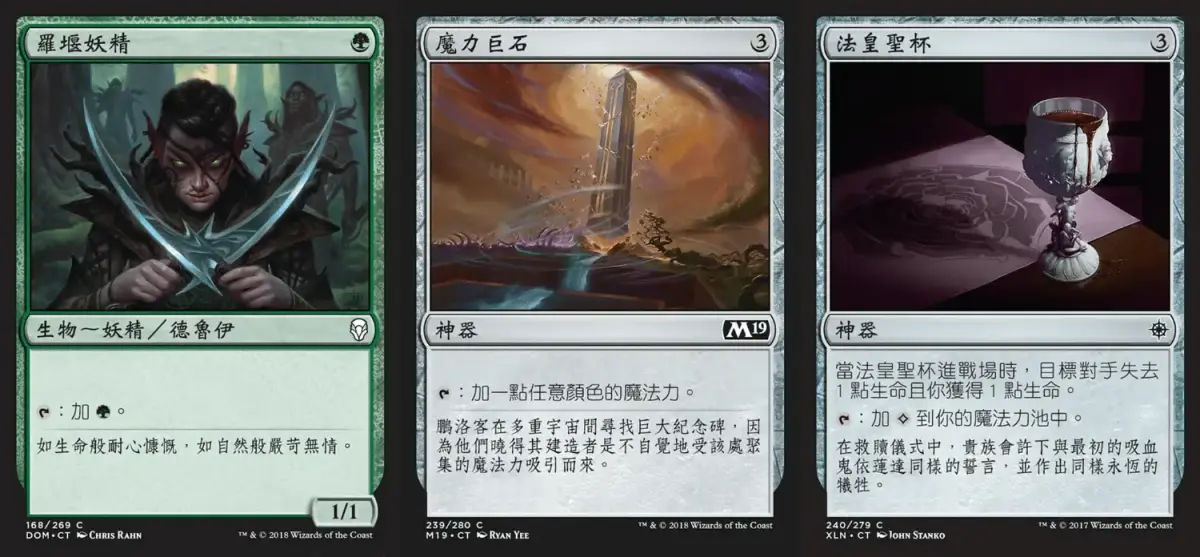
Battlefield Layout
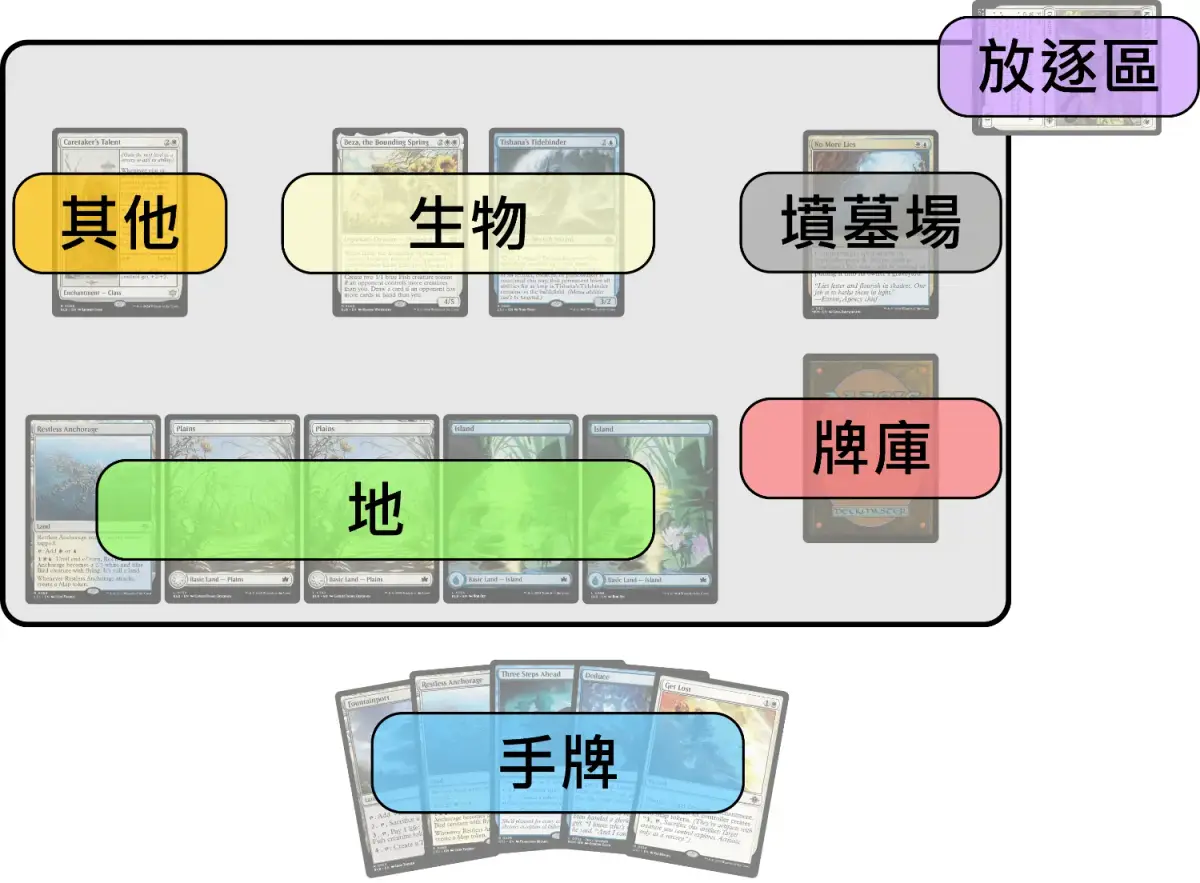
In fact, MTG has no hard rules about how to arrange the play area, but you need to make sure the library, graveyard, exile zone, and battlefield are all clearly distinguishable, and the exile zone is usually laid out turned 90° sideways. The recommended layout is shown above.
For the battlefield, lands are usually placed in the lower half near the player, and other cards in the upper half near the opponent, with creature cards and other noncreature cards ideally kept in separate areas. These are not rules requirements, and you can adjust the layout to the actual game state; the highest principle is that the current state of the battlefield can be clearly identified.
There is also a special case to watch out for: nonland cards that have the ability to produce mana should not be placed together with lands. Even though they function the same by producing mana, whether something is a land is still an essential difference.
Starting and Ending the Game
The first step of the game is to decide who plays first. If no rule specifies which player decides, a player is chosen by a fair random method, and that player decides the play/draw order for this game. (In the MTG player community, it is common to decide by rolling two six-sided dice and comparing the numbers.)
Then the game begins, and all players draw seven cards as their starting hand. If this starting hand is really bad, you have a compensation measure available, namely the mulligan rule.
A mulligan means you can shuffle your whole hand back into your library and draw a new seven; doing this once counts as one mulligan, after which you can choose whether to keep this hand or mulligan again, repeating until you decide to keep a hand. However, after mulliganing N times, you must put N cards from your hand on the bottom of your library in any order. Mulligans reduce the chance of a player being stuck for the entire game because of a bad opening hand, but each mulligan reduces your starting hand by one card, so you cannot mulligan without limit in pursuit of a perfect hand.
When all players have decided to keep their starting hands, the game officially begins; the turn structure is introduced in the next section.
The game ends when any of the following conditions is met:
- When a player concedes, that player loses the game.
- When a player’s life is less than or equal to 0, that player loses the game.
- When a player would draw a card for any reason but their library has no cards, that player loses the game.
- When any player meets a special win or special loss condition.
PS: The scenarios above are for a one-on-one duel; multiplayer games are somewhat more complicated.
In a BO3 (best-of-three) match, the first game is called the main-deck game, and the second and third games are called sideboard games. After entering the sideboard games, before the game starts players may swap cards between their main deck and sideboard, and after the game ends the deck must be restored to its main-deck configuration. From the sideboard games on, the player who lost the previous game decides who plays first.
Turn Structure
For a complete explanation of the turn structure rules, see our earlier article: “The Turn Structure Explained”. This article gives only a simple overview.
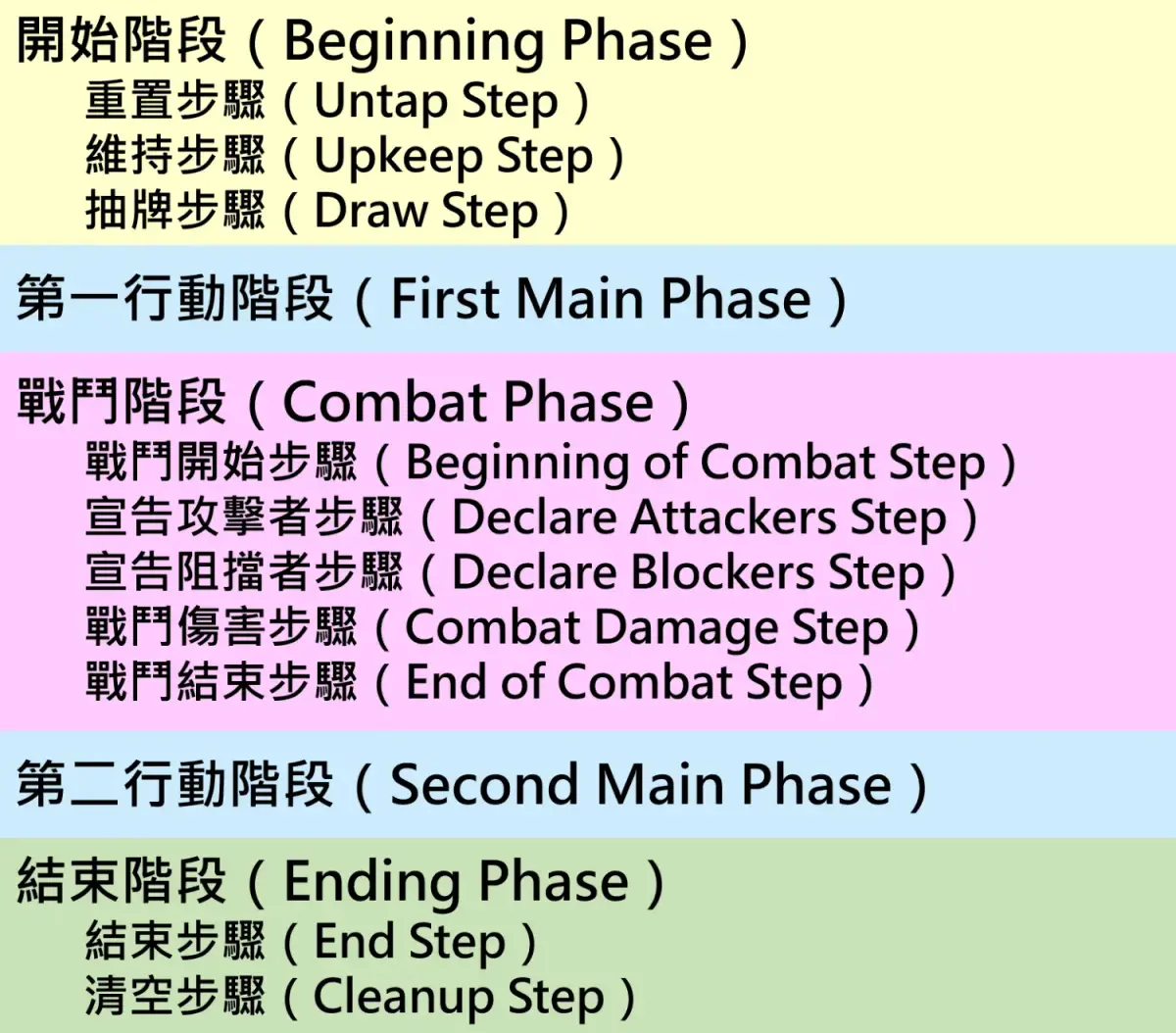
Since the turn structure is explained from the perspective of the active player, “you” below always refers to the active player.
Beginning Phase
- Untap Step
Untap all your tapped permanents. During this step players cannot cast spells or activate abilities, and no abilities go on the stack. - Upkeep Step
Abilities that trigger “at the beginning of your upkeep” trigger now, after which players may cast instants and activate abilities. - Draw Step
You draw a card; the starting player skips this draw on the first turn of the game. After drawing, players may cast instants and activate abilities during this step.
- Untap Step
First Main Phase
The main phase is the time in the game when you do your main actions, including playing lands and casting any spells. The timing of cards in MTG can be divided into sorcery speed and instant speed, and the definition of sorcery speed includes exactly this: during your own main phase (for a detailed explanation of timing, see the “Timing, Responses, and the Stack” section later).Combat Phase
The combat phase has five steps in total. Each step first performs the actions specified for that step, after which players may cast instants and activate abilities.- Beginning of Combat Step
This step has no specified turn action; abilities that trigger “at the beginning of combat on your turn” trigger now. - Declare Attackers Step
Only untapped creatures can be declared as attackers. Choose any number of creatures you want to attack with, and declare which player or planeswalker each of them attacks; these creatures attack together, and are tapped once declared as attackers. - Declare Blockers Step
Only untapped creatures can be declared as blockers. For each creature declared as a blocker, the defending player chooses an attacking creature for it to block. Multiple blocking creatures may block one attacking creature at the same time, which is called a “gang block”. - Combat Damage Step
All attacking or blocking creatures deal damage simultaneously, in an amount equal to their power. Unblocked creatures deal damage to whatever they are attacking (a player, planeswalker, battle, etc.), and blocked creatures and their blockers deal damage to each other. In the case of a gang block, the combat damage is divided as desired among those blocking creatures. - End of Combat Step
This step has no specified turn action.
- Beginning of Combat Step
Second Main Phase
The same actions can be taken as in the first main phase. Note that only one land can be played per turn; if you already played a land in the first main phase, you cannot play one in this phase.Ending Phase
- End Step
Abilities that trigger “at the beginning of your end step” trigger now, after which players may cast instants and activate abilities. - Cleanup Step
If you have more cards in hand than your maximum hand size (7 by default), discard down to that number, damage on all creatures is removed, and all “until end of turn” and “this turn” effects end.
- End Step
Let’s look at a few examples of creatures attacking and blocking in the combat phase:
In the examples below, the attacking side is shown in red text and the blocking side in green text.
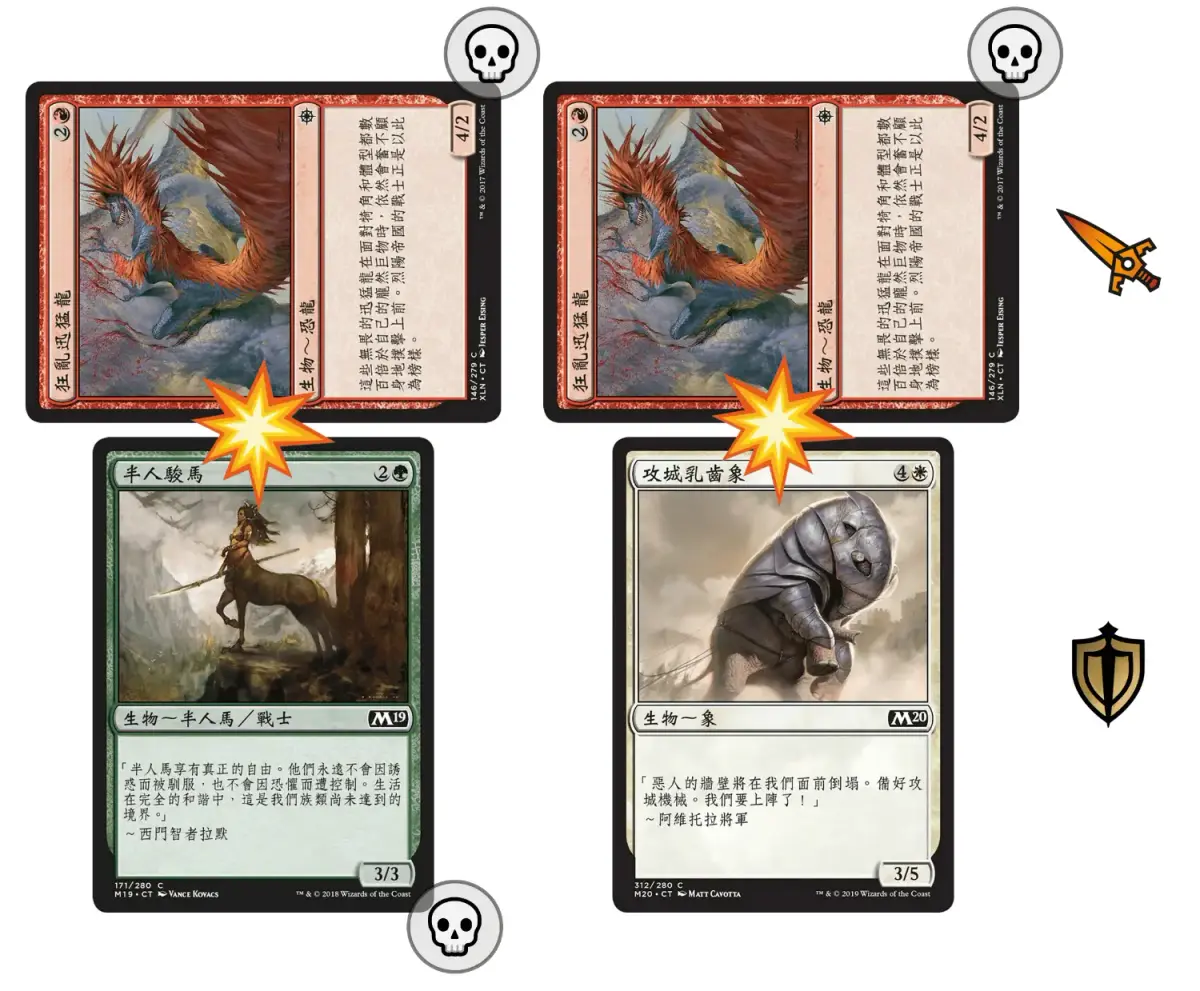
In this example, the opponent attacks with two 4/2 Frenzied Raptors, and we block one with a 3/3 Centaur Courser and the other with a 3/5 Siege Mastodon. The damage is resolved as follows:
In the combat on the left of the picture, the Frenzied Raptor deals 4 damage to the Centaur Courser, and the Centaur Courser deals 3 damage to the Frenzied Raptor. Both sides take damage greater than or equal to their toughness, so both die.
In the combat on the right of the picture, the Frenzied Raptor deals 4 damage to the Siege Mastodon, and the Siege Mastodon deals 3 damage to the Frenzied Raptor. The Frenzied Raptor likewise dies from lethal damage, but the Siege Mastodon has 5 toughness, so a mere 4 damage is not enough to kill it. It survives this combat, and if it is still alive at the end of the turn, the damage accumulated this turn is removed.
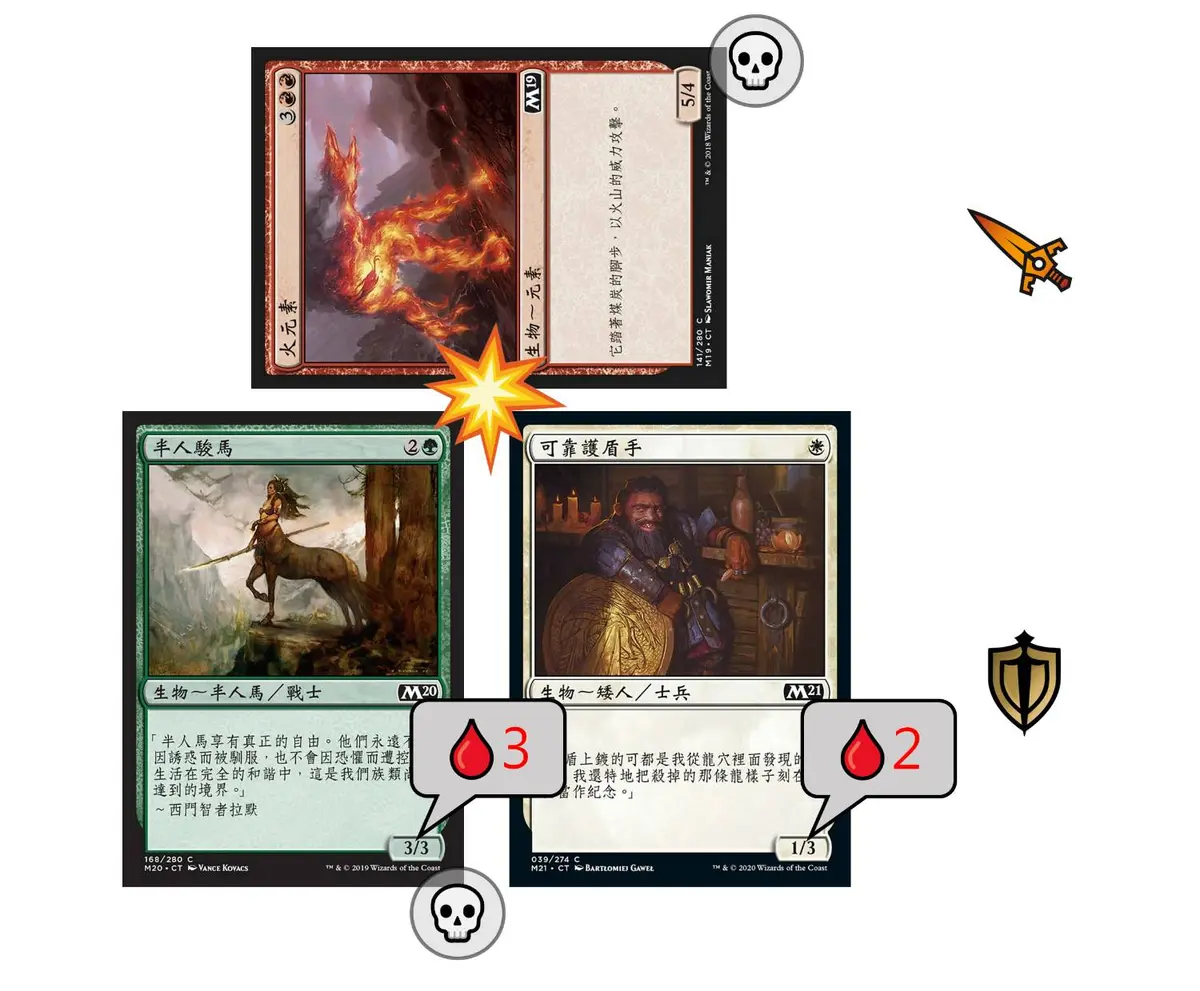
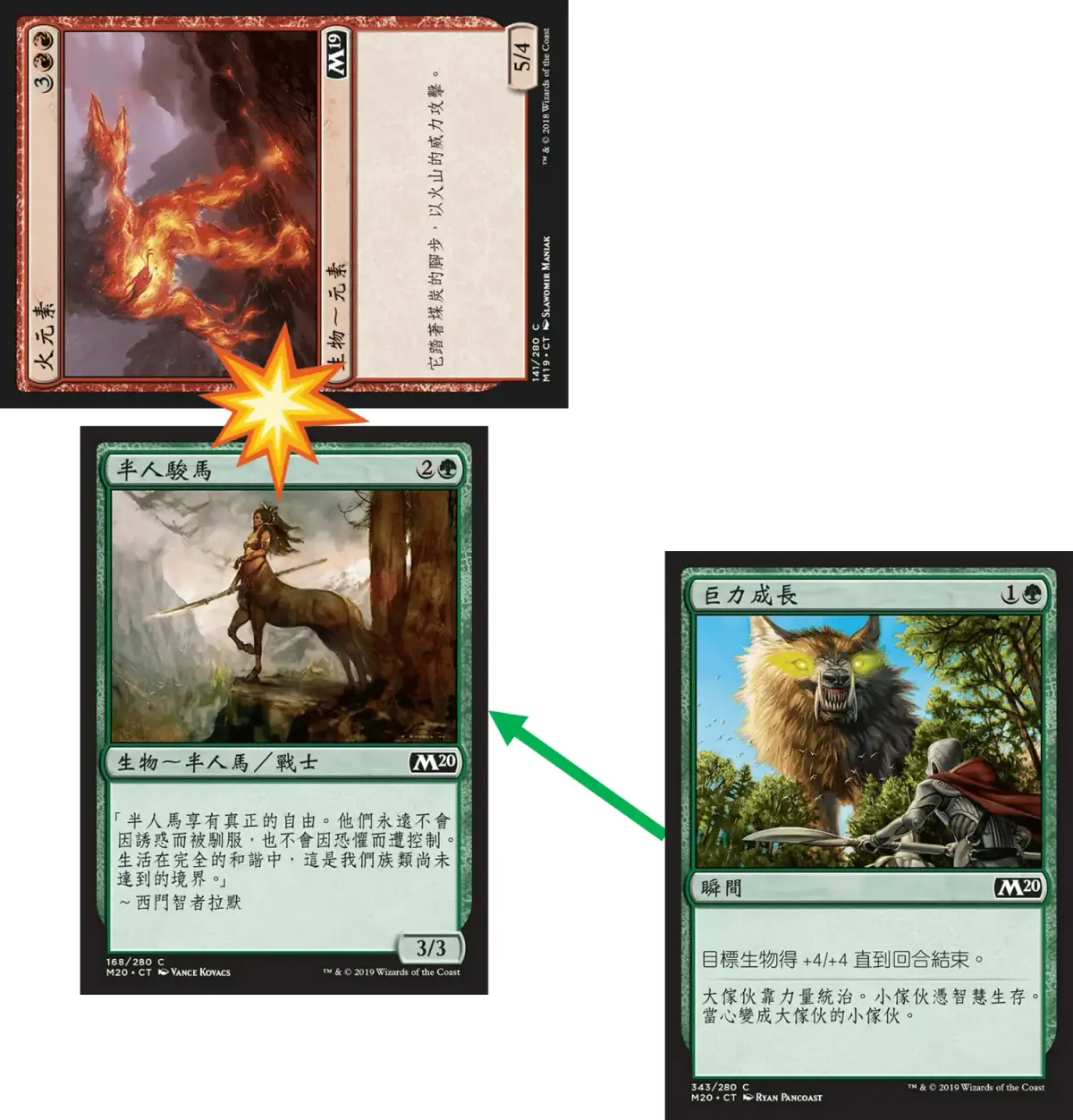
Next, let’s see how a gang block is handled. Suppose the opponent attacks with a 5/4 Fire Elemental, and we gang block with a 3/3 Centaur Courser and a 1/3 Staunch Shieldmate. When damage is resolved, the opponent can choose to divide the Fire Elemental’s 5 combat damage as they like between my two blocking creatures. Suppose the opponent chooses to assign 3 damage to the Centaur Courser and 2 damage to the Staunch Shieldmate. In that case the Centaur Courser dies, while the Staunch Shieldmate, having 3 toughness, is not killed by 2 damage and survives.
From this combat we can see that although the result is a one-for-one trade with each side losing one creature, the attacker lost a 5-mana 5/4 creature while the defender lost only a 3-mana 3/3 creature, so the defender can be said to have successfully traded small for big.
Timing, Responses, and the Stack
- Sorcery Speed and Instant Speed
Timing in MTG indicates when you can cast spells or activate abilities. There are two kinds of timing: “sorcery speed” and “instant speed”.
Sorcery speed means you can only act during your own main phase when the stack is empty; the stack will be explained shortly. Playing a land and casting spells of any type other than instant are both limited to sorcery speed.
Instant speed, broadly speaking, means you can act at any time, including during the opponent’s turn. The only spells that can be cast at instant speed are those of the instant type, though some effects can make a sorcery-speed card usable at instant speed. Also, abilities in MTG default to being activatable at instant speed, and if an ability can only be activated at sorcery speed, it will be specially noted.
The above is a loose description; for a detailed introduction, please see the article “The Turn Structure Explained”.
Let’s use an example to see the power of instants. Suppose it’s the opponent’s turn, and they have a 5/4 Fire Elemental while I have a 3/3 Centaur Courser. In the opponent’s eyes, attacking with the Fire Elemental is risk-free, so they attack. However, I choose to block with the Centaur Courser, and before damage is resolved I cast an instant: Titanic Growth, giving the Centaur Courser +4/+4 and making it a 7/7. Now it is the 5/4 Fire Elemental that crashes into a wall and one-sidedly hands over a free kill.
- Responses and the Stack
First, let’s restate an important point: in MTG, using any card other than playing a land is called “casting a spell”, and these cards do not take effect immediately after being cast; instead, they first wait in an area called “the stack” in the state of a spell.
As an analogy, suppose you cast a creature spell. It’s as if you performed a summoning magic, reciting an incantation to summon this creature, but after the incantation is finished it still takes a while to take effect and summon the creature you want. Reciting the summoning incantation is the moment you announce casting the card, and the time after the incantation is finished while waiting for it to take effect is the time when the card sits on the stack in the form of a spell.
So why does casting a card involve so many steps? Because there is room for interactive play within it: the opponent doesn’t just stupidly wait for your spell to resolve and take effect before figuring out how to deal with it; while the spell is still on the stack after being cast, the opponent can already “respond” to you.
Let’s look at this example. We have a 3/3 Centaur Courser, and the opponent casts Lightning Strike targeting it, planning to deal it 3 damage. If the Lightning Strike spell resolves successfully, the Centaur Courser is toast, but I can respond to the Lightning Strike by first casting a Titanic Growth on it.
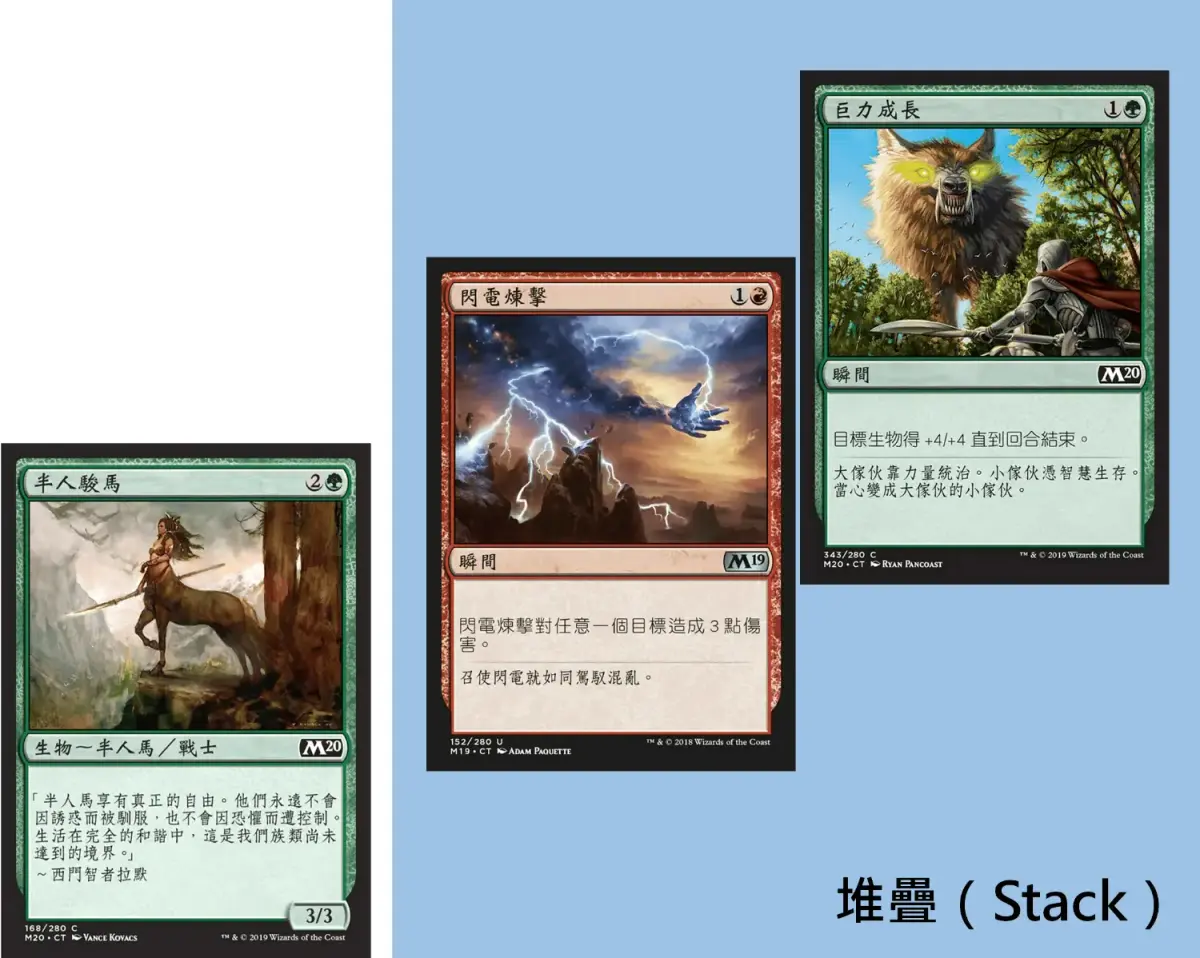
Now two spells will be on the stack waiting to resolve: the opponent’s Lightning Strike at the bottom and my Titanic Growth on top, literally stacked on one another. If no player wants to respond further, the stack starts being processed, resolving from top to bottom in order, which is commonly called last in, first out.
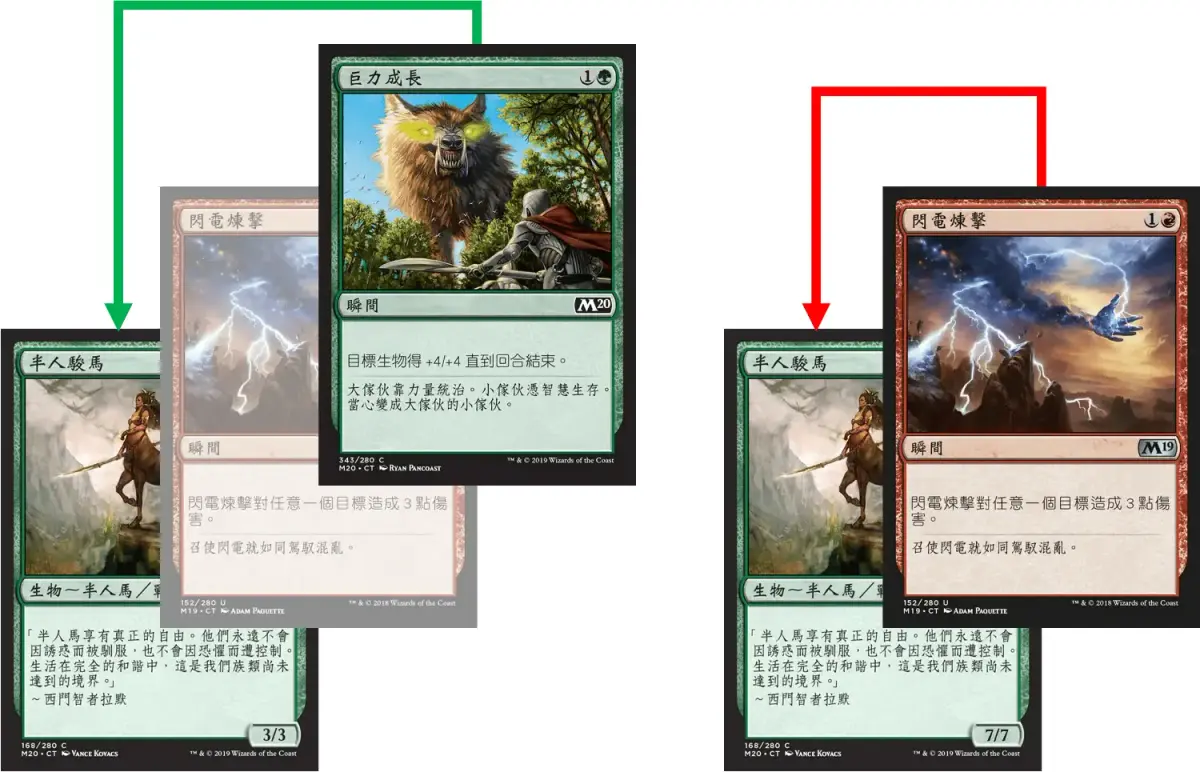
Because my Titanic Growth is at the top of the stack, it resolves first, making the Centaur Courser +4/+4 and a 7/7. Then the Lightning Strike resolves and deals it 3 damage, but since it now has 7 toughness, taking 3 damage isn’t enough to kill it.
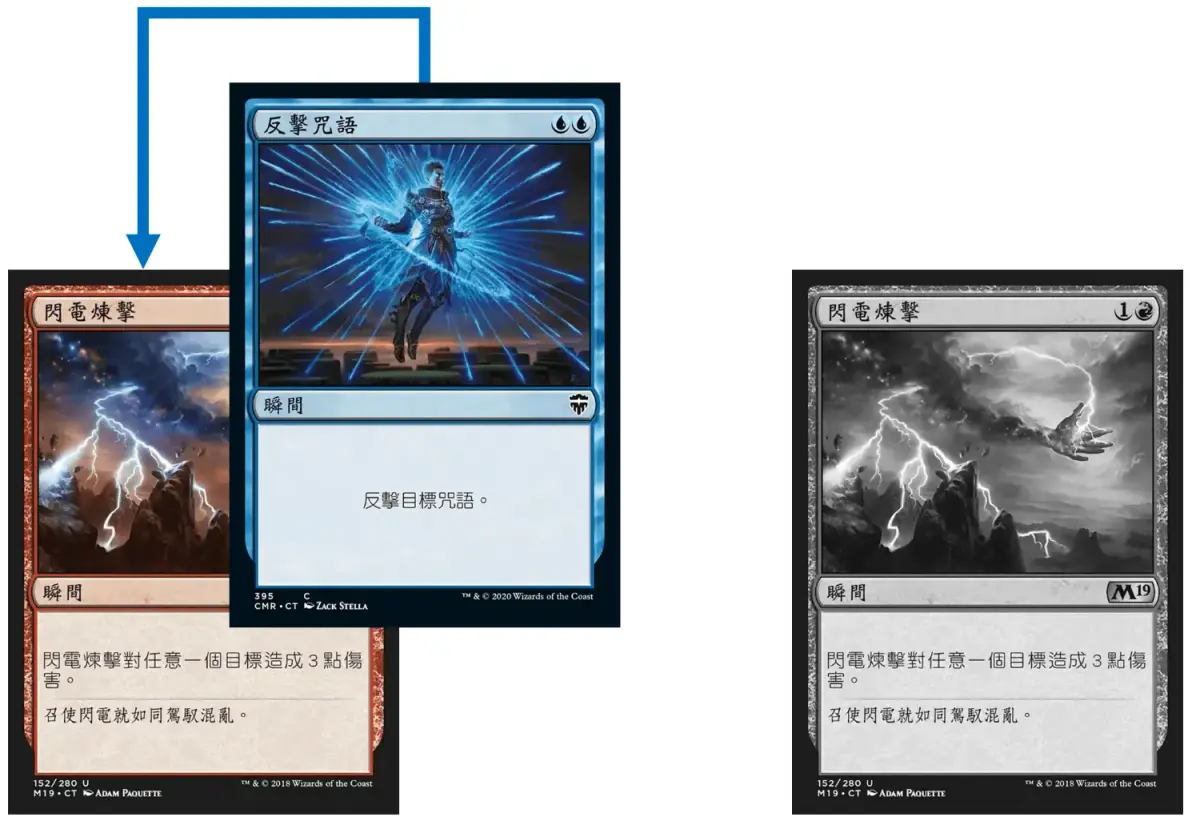
Remember we said earlier that a major trait of blue is the counterspell? Counterspells are a mechanic that lives on the stack, able to directly nullify a spell on the stack.
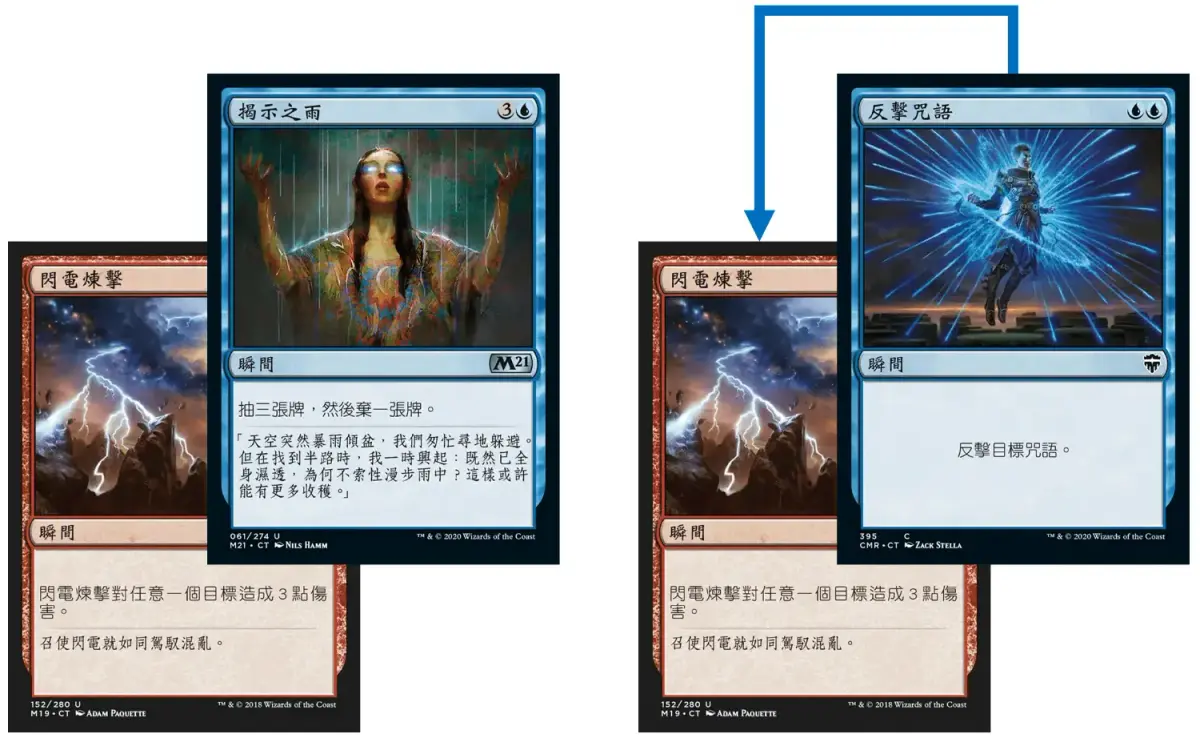
The stack can be piled up without limit, as long as you can cast that many cards at once. Also, new responses can be added to the stack at any time. Suppose the opponent casts a Lightning Strike that you badly want to counter, but you currently have no counterspell in hand. You can first respond by casting an instant that draws cards; once that card draw resolves, you draw, and if that draw happens to find a counterspell, you can continue to respond to that Lightning Strike and counter it.
Common Terms and Keywords
Here are explanations of some common terms in MTG:
- Permanent: Any object that stays on the battlefield permanently is called a permanent. By type, everything except instants and sorceries is a permanent (Kindred is a complicated special case, skipped here). Many cards’ effects refer to nonland permanents (Nonland Permanent), which means permanents other than lands.
- Play: Playing a card can be split in two depending on whether it is a land:
- Land cards: Playing a land is what is commonly called “dropping a land”.
- Nonland cards: Playing a nonland card means casting a spell (Cast Spell).
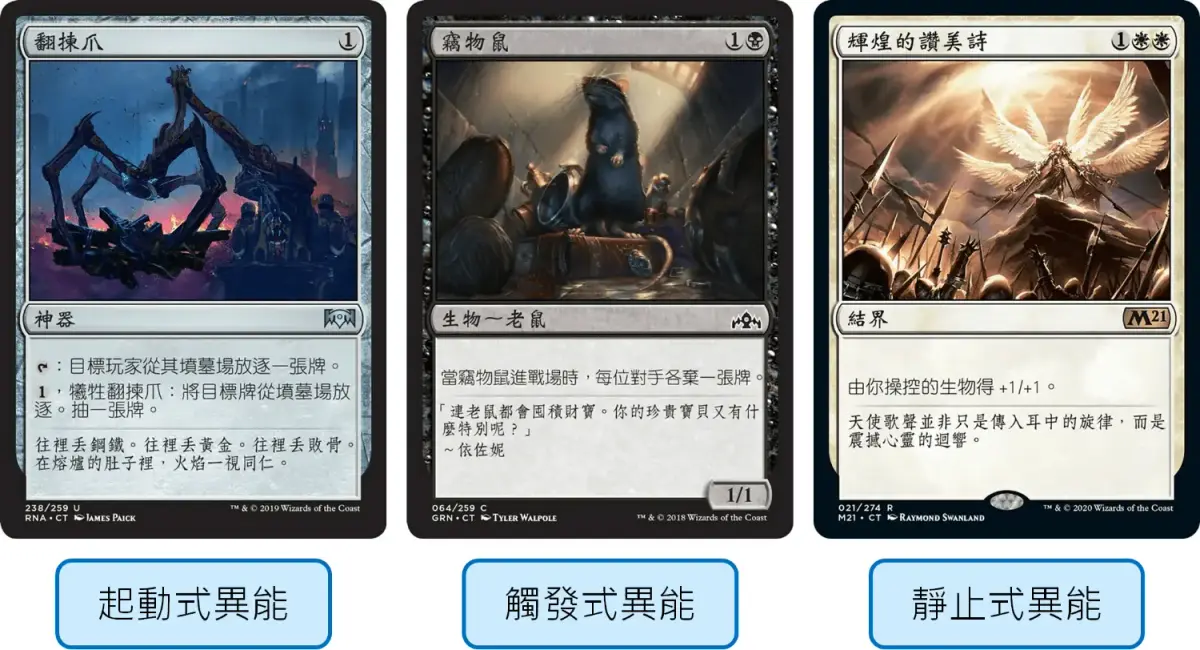
- Abilities: Apart from spells, basically any effect that affects the game can be classed as an ability. There are three main kinds of abilities:
- Activated abilities: The text format is “[cost]: [effect]”. After paying the specified activation cost, the ability goes on the stack.
- Triggered abilities: The text format is “[When / Whenever / At], [trigger condition], [effect]”. When an event in the game meets the trigger condition, the ability goes on the stack.
- Static abilities: Abilities that don’t use the stack and are always in effect.
Many abilities in MTG have been condensed into a single keyword. The benefit is that card text becomes very concise, but the downside is that if you don’t know what the keyword means, you can’t understand the card at all. Here are translations and explanations of several keyword abilities that are used with high frequency when MTG cards are designed:
- Flying: A creature with flying can only be blocked by creatures with flying or reach. A creature with flying can block it whether or not that creature has flying.
- Reach: A creature with flying can only be blocked by creatures with flying or reach.
- Menace: A creature with menace can only be blocked by two or more creatures.
- Vigilance: A creature with vigilance doesn’t tap when attacking.
- Trample: If a creature with trample is blocked, then when damage is resolved, if all blockers have been assigned lethal damage, the remaining damage can be assigned to what it is attacking.
- Deathtouch: Any source with deathtouch that deals damage to a creature destroys that creature; during combat damage, 1 damage from a deathtouch source is lethal damage.
- Lifelink: Damage dealt by a source with lifelink causes that source’s controller to gain that much life.
- Haste: If a creature has haste, it can attack or activate activated abilities whose cost includes the tap symbol even if its controller hasn’t controlled it continuously since their most recent turn began.
- Flash: You may cast a card with flash at instant speed.
- Prowess: A triggered ability meaning “Whenever you cast a noncreature spell, this creature gets +1/+1 until end of turn.”
- Defender: A creature with defender can’t attack.
- First Strike: During combat damage, if any creature has first strike or double strike, there are two combat damage steps: in the first combat damage step first-strike damage is resolved, and in the second combat damage step regular damage is resolved.
- Double Strike: A creature with double strike deals both first-strike damage and regular damage during combat damage, for two instances of damage in total.
- Indestructible: A permanent with indestructible can’t be destroyed, and doesn’t die from damage.
- Ward: Ward is a triggered ability. “Ward (cost)” means “Whenever this permanent becomes the target of a spell or ability an opponent controls, counter it unless that player pays (cost).”
- Hexproof: A permanent or player with hexproof can’t be the target of spells or abilities the opponent controls.
- Hexproof from XX: Has hexproof from sources that meet condition XX.
- Protection from XX: Can’t be blocked by, targeted by, or have Equipment or Auras attached from sources that meet condition XX (if already attached, Equipment becomes unattached but stays on the battlefield, and Auras go to the graveyard), and prevents all damage dealt by sources that meet condition XX.
- Equip: An activated ability unique to Equipment. Pay the specified cost to attach this Equipment to target creature you control; it can only be activated at sorcery speed.
- Crew: An activated ability unique to Vehicles. Crew is followed by a number N; as the cost, tap any number of other untapped creatures you control with total power ≥ N, and this permanent becomes an artifact creature until end of turn.
Besides abilities, many game actions have also been turned into keywords, called keyword actions. Common keyword actions are explained below:
- Scry: “Scry N” means look at the top N cards of your library, then put any number of them on the bottom of your library in any order and the rest on top in any order.
- Surveil: “Surveil N” means look at the top N cards of your library, then put any number of them into your graveyard in any order and the rest on top of your library in any order.
- Fight: Two creatures each deal damage equal to their own power to the other.
- Counter: To counter a spell or ability means to cancel it and remove it from the stack. It won’t resolve, and its effects won’t happen at all. A countered spell is put into its owner’s graveyard.
This is definitely a game with a great deal of interaction. If you run into more complex and puzzling questions in the future, you’re welcome to ask and exchange ideas on the Guildmages’ Forum page.
Formats
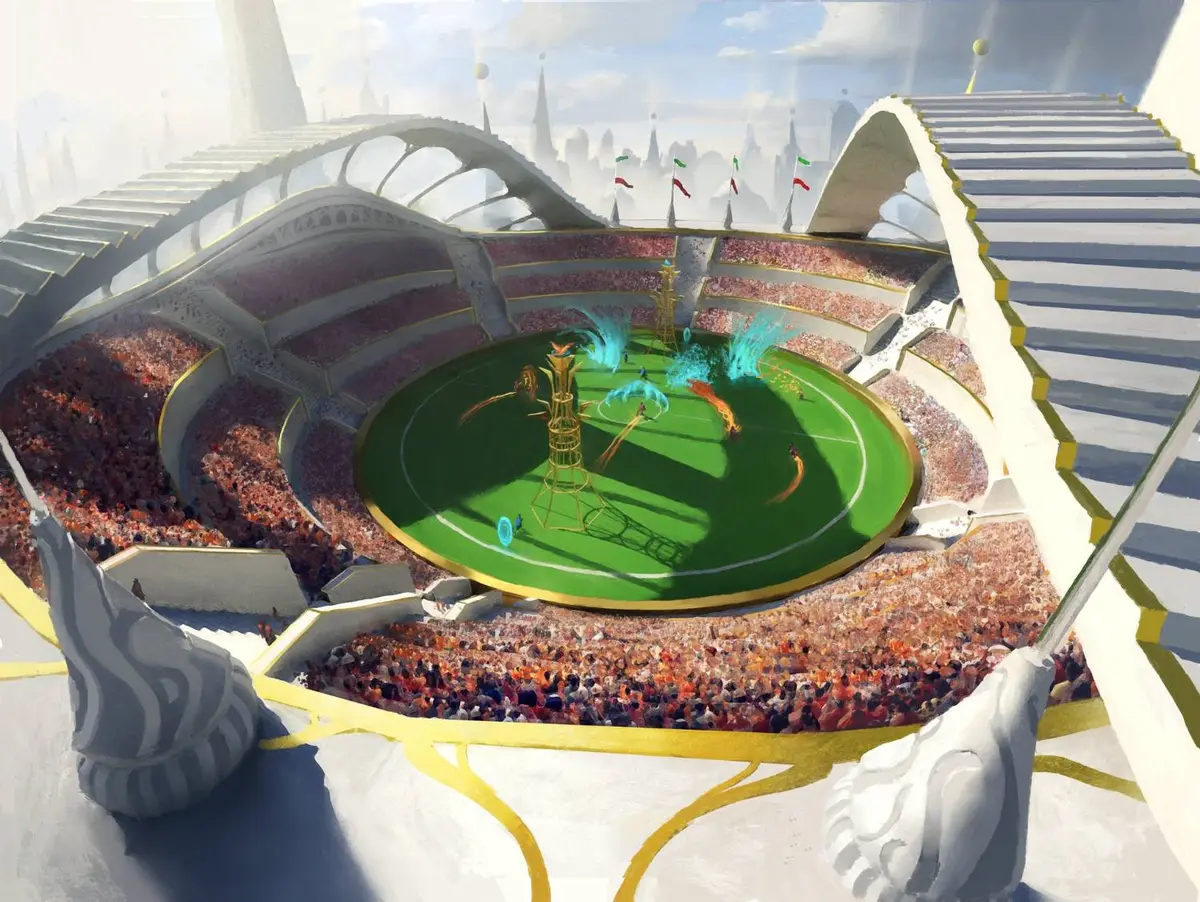
MTG formats can be divided into two broad categories: Constructed and Limited. Constructed uses decks that players build themselves, and is further divided into several formats according to the size of the available card pool and other construction rules. In Limited, players don’t need to prepare their own decks; instead, players open booster packs on the spot and use those packs to build a deck to play with. Limited can be further divided into two types according to the rules: Sealed and Draft.
Limited
The construction rules for Limited are: main deck ≥ 40 cards; every other card you open during the game is a sideboard card, and basic lands are freely available. Starting life is 20.
Sealed Deck
Each player opens 6 booster packs, and these cards are the card pool you can use to build your deck for this event.Booster Draft
Each player uses 3 booster packs. After the match starts, each person opens their first booster pack, picks one card from it, and passes the remaining cards to the left to the next player, continuing to pass to the left in this way until all of the cards in all the packs have been picked. Then open the second booster pack and pick in the same way, except the passing direction changes to the right; finally, open the third booster pack and pass to the left as with the first pack. After all the cards in the three booster packs have been picked, the cards you have kept are the card pool you can use to build your deck for this event.Further reading:
“How Beginners Can Improve at Limited: Sealed Edition”
“How Beginners Can Improve at Limited: Draft Edition”
Constructed
The construction rules for Constructed are: main deck ≥ 60 cards, sideboard ≤ 15 cards; players battle using decks they build themselves. Starting life is 20. Each format has its own separate banned list. The limit on non-basic-land cards with the same name is 4 across the main deck and sideboard combined.
- Standard
A rotating format: as new Standard sets are released, old sets are periodically removed from the available card pool, keeping the Standard card pool within roughly the last 2-3 years of sets. The rotation cycle is once a year, with the old-set rotation happening when the first Standard set of each year is released, so that the oldest year of Standard sets leaves Standard.
The only special exception currently is the Foundations set released on November 15, 2024. That set is not subject to the normal rotation rules, and has instead been individually set to leave Standard in 2029.
PS: In 2025 the definition of the rotation cycle was changed. To accommodate the change between old and new cycles, no sets will leave Standard in 2026, and the rules above apply starting in 2027.
All formats other than Standard are non-rotating formats, and old sets do not become unplayable as new sets are added.
Pioneer
Allows Standard sets starting from Return to Ravnica (October 2012) to the present.Modern
Allows Standard sets starting from Eighth Edition (July 2003) to the present, plus the Modern Horizons sets and a small number of sets individually designated as legal in Modern.Legacy
Allows all sets in MTG history to the present, including all kinds of non-Standard side sets.Pauper
Allows all sets in MTG history to the present, but the card must have been printed at the lowest rarity, Common (C), at least once.Vintage
Allows all sets in MTG history to the present, and this format in principle does not use a banned list, but instead uses a restricted list (limit one).
PS: Vintage does still have banned cards, but these are banned because of the special nature of the rules of some special sets or mechanics, not because of power level.
Constructed (MTGA-Exclusive Formats)
The following formats are digital-only formats exclusive to MTGA:
- Alchemy
The available card pool is the last two years of Standard sets plus the Alchemy-exclusive Alchemy sets. Compared with paper, the Alchemy format makes use of the nature of digital games to add two special kinds of cards:
- Alchemy cards: cards whose mechanics use the nature of digital games, with effects that physical cards cannot achieve.
- Rebalanced cards: some cards have had their card information modified, such as increases or decreases in casting cost, and a rebalanced card cannot be used in its original version.
Historic
A non-rotating format on MTGA that can use all cards included in MTGA, including Alchemy cards and rebalanced cards; a rebalanced card cannot be used in its original version.Timeless
Similar to Vintage on MTGA, it can use all cards included in MTGA. This format does not use a banned list, but instead uses a restricted list (limit one). In addition, rebalanced cards are not used; the original version of the card is used instead.
- Retired format: Explorer
It can be understood as a mini Pioneer on MTGA, able to use cards legal in the Pioneer format. The banned list principle is to stay in sync with the paper Pioneer format (though there are slight differences). It used to be split into its own format because MTGA did not have the complete Pioneer card pool, and the missing cards included key cards of meta decks, so it became a separate format. In May 2025, the official view was that MTGA’s card pool had been filled out to a degree similar enough to the paper Pioneer meta, so Explorer was converted into Pioneer, with the banned list fully identical to paper. However, note that MTGA’s Pioneer card pool still has missing cards relative to paper, and there will be follow-up plans to add the missing Pioneer cards.
Other Special Formats
- Commander
A special construction rule, with the available card pool being all cards in MTG history. A deck consists of exactly 100 cards including the commander, usually 1 commander + 99 other cards, with some special exceptions of 2+98. The commander must be a legendary creature, a legendary Vehicle, a legendary Spacecraft with power and toughness, or a legendary card that specifically says on the card that it can be your commander.
The colors of the mana symbols on the commander are your commander’s color identity, and no card in the deck may have a color symbol outside the commander’s color identity; the limit on non-basic-land cards with the same name in the deck is one.
At the start of the game, the commander waits in the command zone, and the player may cast the commander from the command zone. When the commander would move to a zone other than the battlefield, you may choose to have it return to the command zone (this is a loose, awkward way of putting it), after which you may cast the commander from the command zone again. But if you have previously cast the commander from the command zone N times this game, the cost of this cast increases by 2×N, which is called the commander tax. When the same commander card has dealt a cumulative 21 combat damage to the same player, that player immediately loses the game, which is called commander damage.
Commander is usually a multiplayer game, with starting life of 40.
- Brawl
The basic rules are the same as Commander, but it can be seen as a cut-down version of Commander, with a deck total of 60 cards (1 commander + 59 deck cards), and only cards from the Standard card pool can be used. One special point is that besides legendary creatures, planeswalkers can also be used as the commander.
Resources

This section introduces several commonly used MTG-related resource websites. Each website title below is also a hyperlink to the site.
MTGGoldfish
Known colloquially as the “goldfish site”, it is MTG’s main all-purpose tool. Its most basic and commonly used features are:
Metagame Statistics and Example Decklists
On the top tab bar, choose “Deck” → “Popular Decks / Metagame” to display the current metagame’s deck shares and a list of example decks. Click into a deck to see its full decklist; the toolbar above the deck list lets you choose the format and the time range.Card Price Tracking
Search for a card name in the upper right corner of the site, or click a single card in a decklist, to see that card’s details. The price information is in the upper right corner, displayed as Tabletop $ XX.XX in US dollars, which is often an important price reference for players when trading cards.Deck Building
On the top tab bar, choose “Deck” → “Create Deck” to start editing a deck. When editing is finished, the system will check whether the deck meets the construction rules and give the deck’s price.
Scryfall
The best MTG card search engine. The home page offers card name search, and after choosing “Advanced Search” you can do advanced searches.
Traditional Chinese MTG Card Search Site
The official card search engine in Traditional Chinese. Its database starts from the 2022 set “Dominaria United (DMU)”; there is no data for earlier sets on this site.
Buffalo Bill Card Search, 3rd Generation
The author’s personal favorite Chinese-language MTG tool site, with a card search engine and deck editing features. The interface is entirely in Chinese and very user-friendly.
The card database includes English, Chinese, and Japanese, and it is one of the few sites where you can search nearly the complete MTG card pool using Chinese card names.
MTG Wiki
As the name suggests, it is MTG’s Wikipedia, where you can basically find all information about MTG.
Guildmages’ Forum Facebook Page
The Facebook page of this website, Guildmages’ Forum (魔風集會所). Whenever a new article goes online, it is announced on the page.

- Title
- A Beginner's Guide to Magic: The Gathering
- Author
- Jru
- Created at
- September 10, 2024
- Updated at
- August 19, 2025
- License
- This work is licensed under CC BY-NC-SA 4.0 .
Related Articles

I Drafted Alone: Solo Drafting with Reality Fracture (FRA)
October 16, 2026
Article Translation — Reid Duke's "Level One": Choosing Your Deck
August 17, 2026
Article Translation: Reid Duke's "Level One": Sequencing
July 24, 2026
Article Translation: Reid Duke's "Level One": Playing in a Grand Prix: Part I
June 13, 2026