Planeswalker Evolution: Chandra

Note: This article was translated from Chinese by AI and may contain errors. Read the original Chinese version.
Before We Start
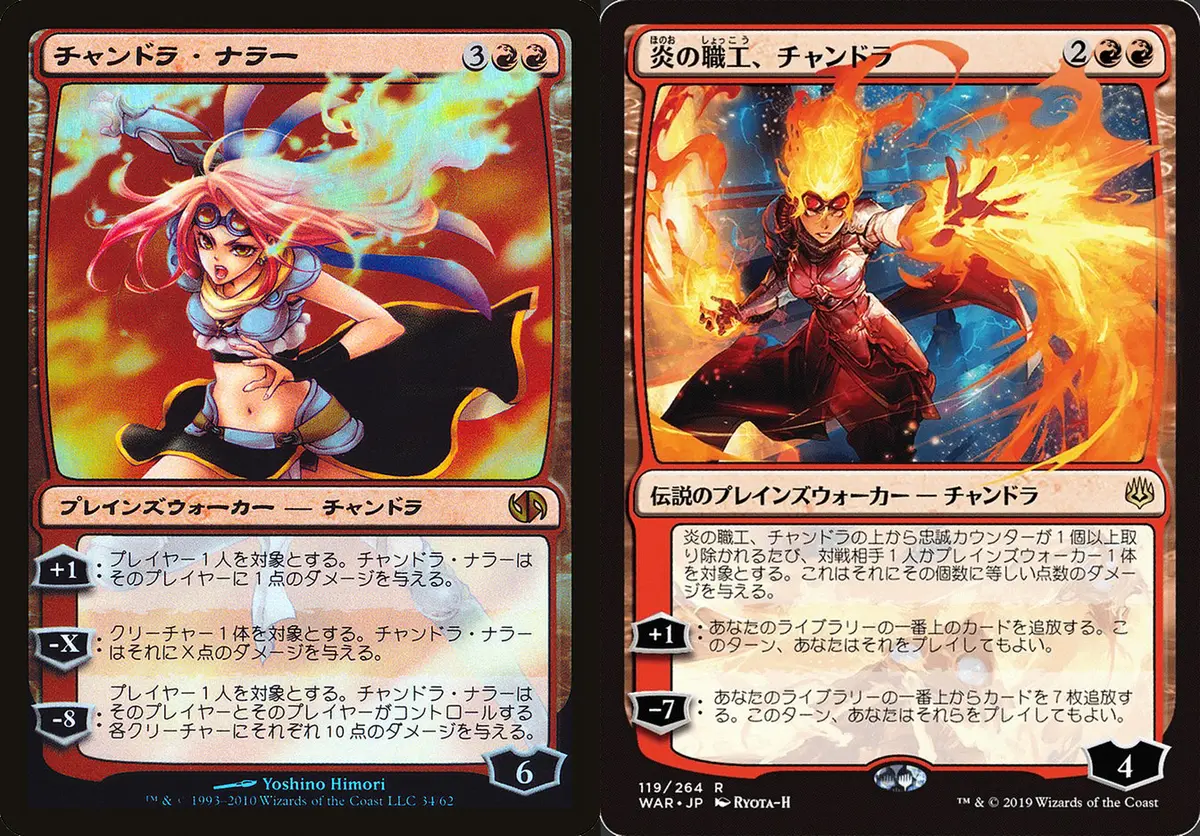
Chandra Nalaar is one of the first five planeswalkers Wizards of the Coast ever printed, and the mono-red representative of the original five. In more than ten years she has missed a core set only once, in M19, and with the versions printed through Commander Masters she has the most printings of any planeswalker at 19, which makes her practically Wizards’ own favorite daughter. This article reviews her versions to help newer players understand how Chandra’s cards have evolved.
Chandra Nalaar
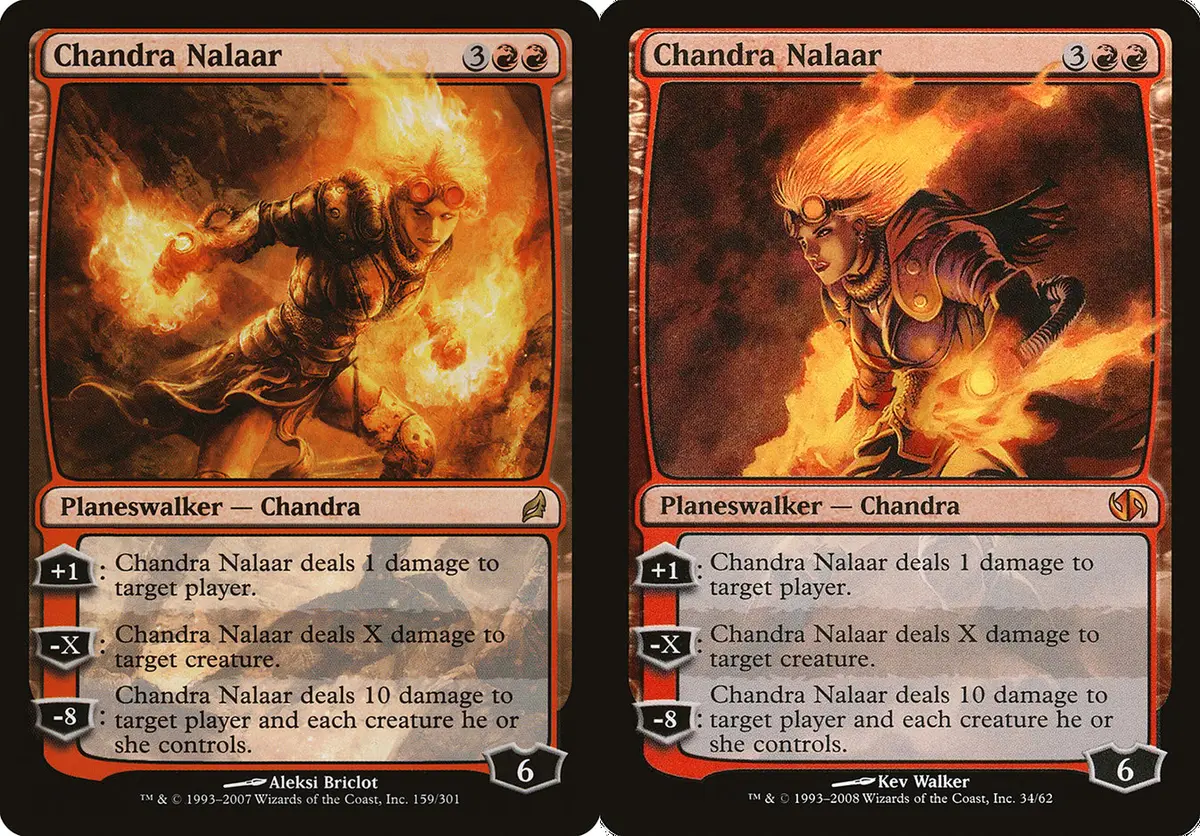
+1: Chandra Nalaar deals 1 damage to target player or planeswalker.
-X: Chandra Nalaar deals X damage to target creature.
-8: Chandra Nalaar deals 10 damage to target player or planeswalker and each creature that player or that planeswalker’s controller controls.
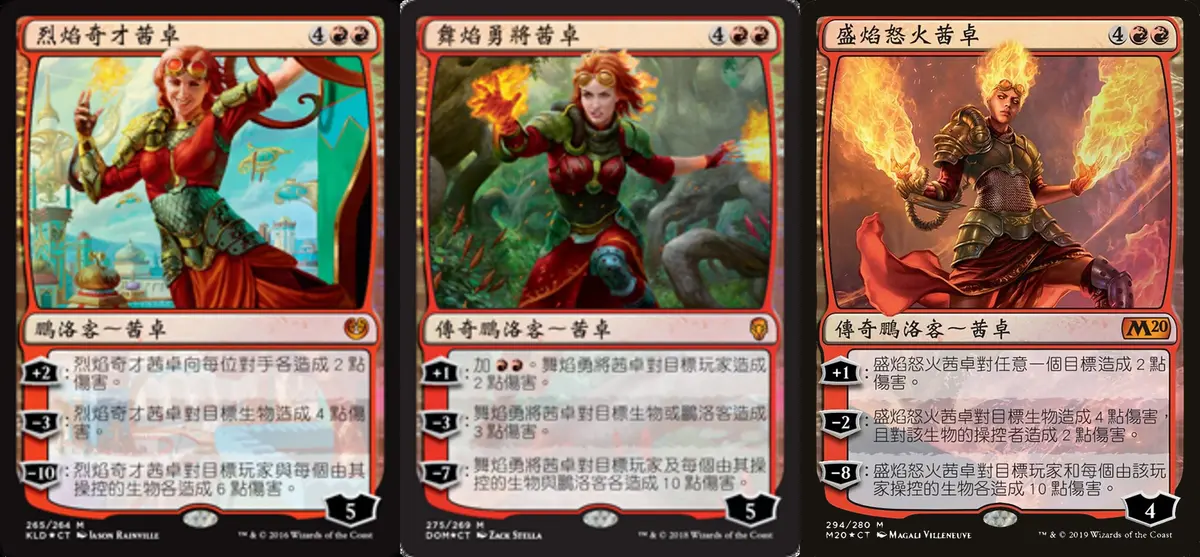
The earliest version of Chandra, debuting in Lorwyn, uses a pure burn ability set: direct damage + single-target removal + a one-sided sweeper ultimate. Judging from the cost, abilities and loyalty, the prototype is Cone of Flame. Although five mana is on the high side, the removal ability isn’t bad even by today’s standards; if you want to nitpick, the +1 that can only hit a player or planeswalker for one damage is designed too weakly. Later derivative versions with the same ability set, KLD Chandra, Pyrogenius, DOM Chandra, Bold Pyromancer and M20 Chandra, Flame’s Fury, all raised that damage to two, and Chandra, Flame’s Fury went further and made it any target, making it the strongest version of the original ability set.
Chandra Ablaze
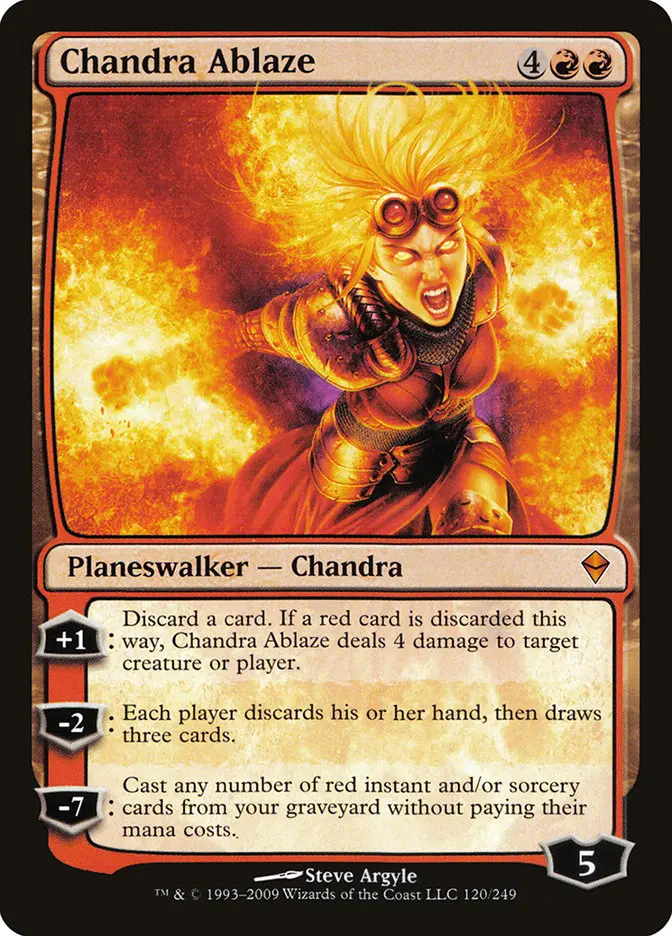
+1: Discard a card. If a red card was discarded this way, Chandra Ablaze deals 4 damage to any target.
-2: Each player discards their hand, then draws three cards.
-7: Cast any number of red instant and/or sorcery cards from your graveyard without paying their mana costs.
Chandra 2.0, debuting in Zendikar, combines Sonic Burst, Wheel of Fortune and overloaded Mizzix’s Mastery. She can turn a red card in hand into four damage while filling the graveyard, can refill her own hand, and her ultimate casts everything in the graveyard for free in one go, which all looks good. However, the +1 is a big problem: besides forcing a discard, discarding a nonred card gets no reward at all. As the positive ability of a six-mana planeswalker it’s really bad, and it kept Chandra Ablaze from ever reaching the effect the designers envisioned in actual play.
Chandra, the Firebrand
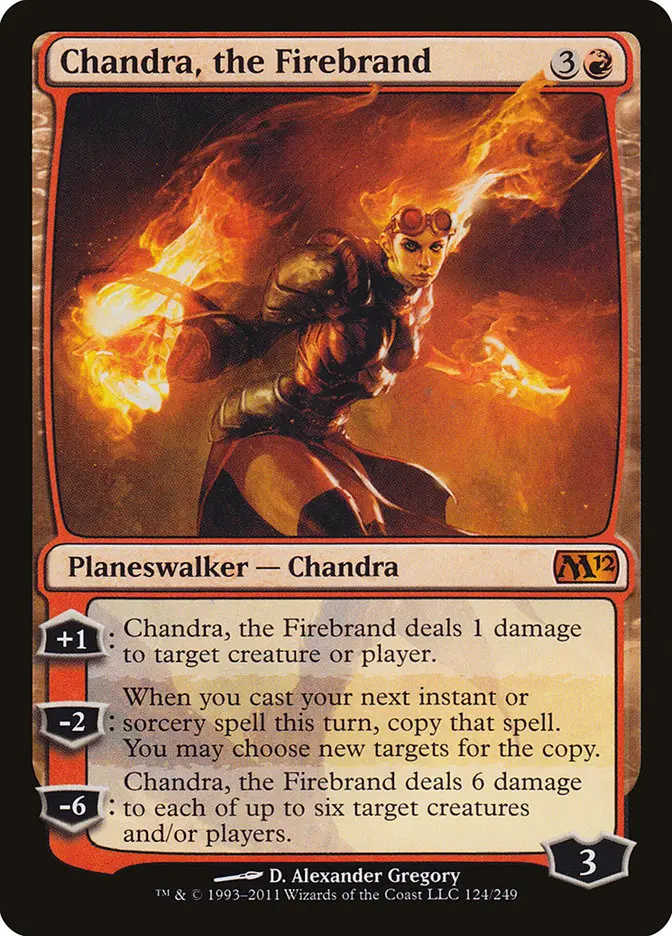
+1: Chandra, the Firebrand deals 1 damage to any target.
-2: When you cast your next instant or sorcery spell this turn, copy that spell. You may choose new targets for the copy.
-6: Chandra, the Firebrand deals 6 damage to each of up to six targets.
After two core sets, Chandra Nalaar handed the baton to the new core-set version Chandra, the Firebrand in M12. After the somewhat flawed previous two versions, the Firebrand’s three abilities are designed relatively reasonably: it fixed the original +1’s flaw by letting it hit any target, and the -2 copy ability can also be seen on Ral, Storm Conduit from War of the Spark. Unfortunately her starting loyalty is a bit low, and a range of dealing one damage can hardly be called enough self-protection and output, so she still didn’t make much of a showing.
Chandra, Pyromaster
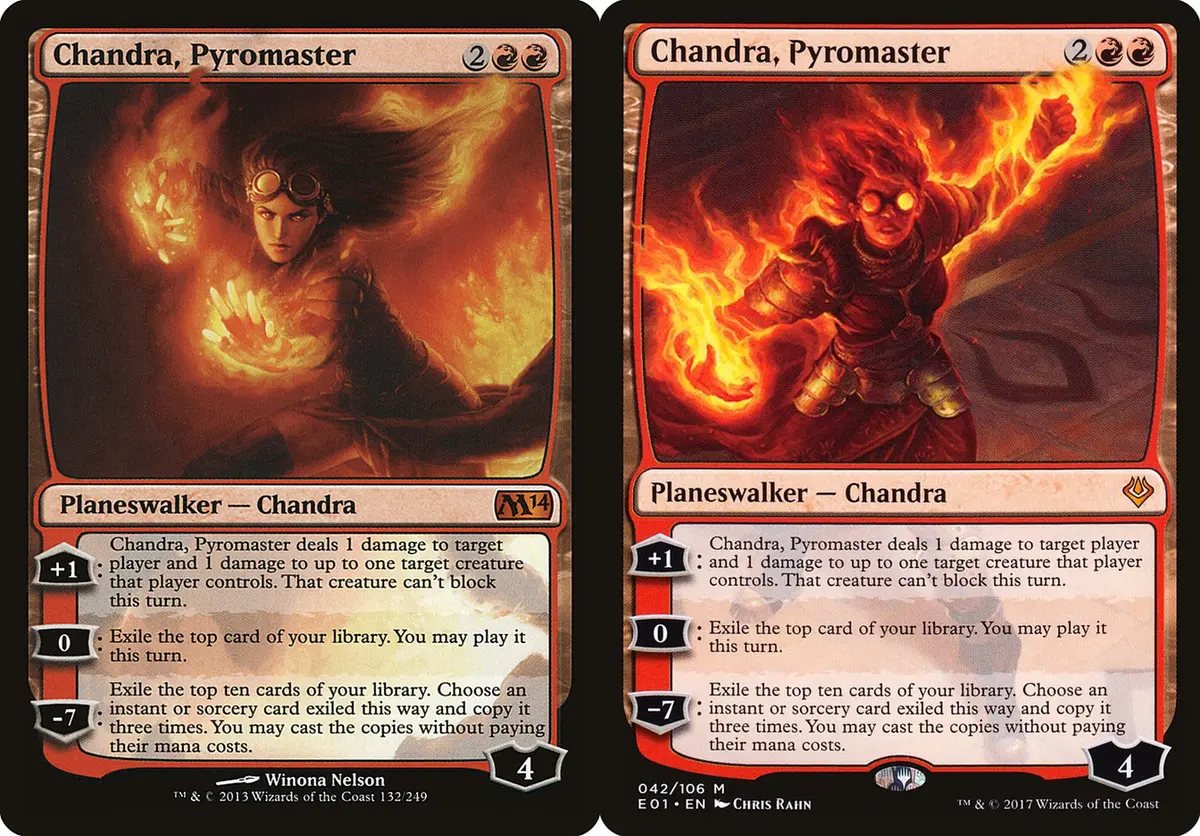
+1: Chandra, Pyromaster deals 1 damage to target player or planeswalker and 1 damage to up to one target creature that player or that planeswalker’s controller controls. That creature can’t block this turn.
0: Exile the top card of your library. You may play that card this turn.
-7: Exile the top ten cards of your library. Choose an instant or sorcery card exiled this way and copy it three times. You may cast the copies without paying their mana costs.
The third-generation core set Chandra, M14’s Chandra, Pyromaster, is the first red single card to introduce impulse draw (exile the top card of your library, you may play it this turn), announcing that red was no longer just a short-game color. That alone was enough for Pyromaster to shine in Standard, and it joined hands with Scavenging Ooze in the Modern Jund decks of the day, making it the first Chandra strong enough to be put on the table. At the same time the +1 was strengthened again, and the extra path-clearing effect often became the key to winning.
Chandra, Fire of Kaladesh // Chandra, Roaring Flame
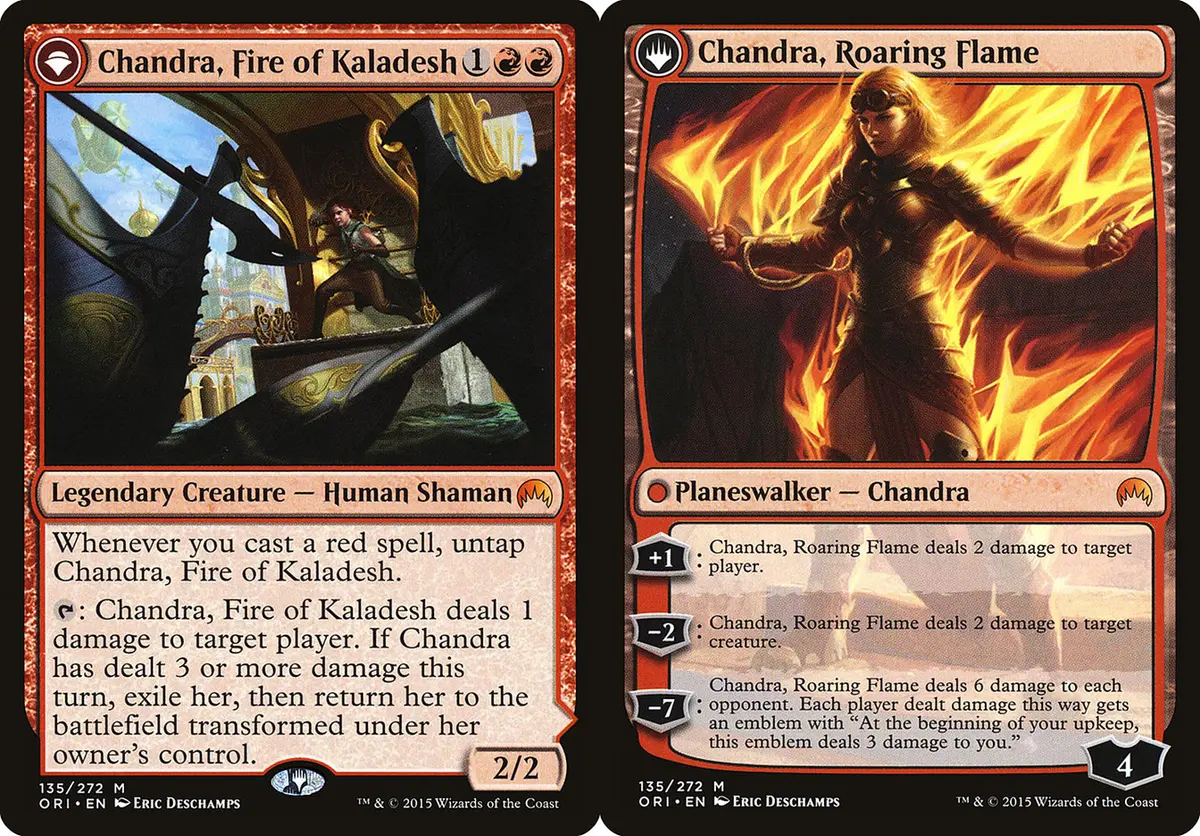
Whenever you cast a red spell, untap Chandra, Fire of Kaladesh.
{T}: Chandra, Fire of Kaladesh deals 1 damage to target player or planeswalker. If Chandra has dealt 3 or more damage this turn, exile her, then return her to the battlefield transformed under her owner’s control.
//
+1: Chandra, Roaring Flame deals 2 damage to target player or planeswalker.
-2: Chandra, Roaring Flame deals 2 damage to target creature.
-7: Chandra, Roaring Flame deals 6 damage to each opponent. Each player dealt damage this way gets an emblem with “At the beginning of your upkeep, this emblem deals 3 damage to you.”
The Chandra first printed as a transforming double-faced card in Magic Origins; her creature side is the kid Chandra before her spark ignited, and it is currently the only version that can be used as a commander. After transforming, a fixed two damage is quite good for a three-mana planeswalker, and the ultimate sets an emblem as a countdown timer. The planeswalker abilities are strong, but you can only use them after transforming. Although some lists played it in the early days of the format, honestly, Prodigal Pyromancer, a 3/2/2 that can only shoot faces or planeswalkers, was only Limited-level strength back then, and the untap-on-red-spell ability depends on surviving summoning sickness and having the right hand, so it soon vanished from meta lists.
Chandra, Flamecaller
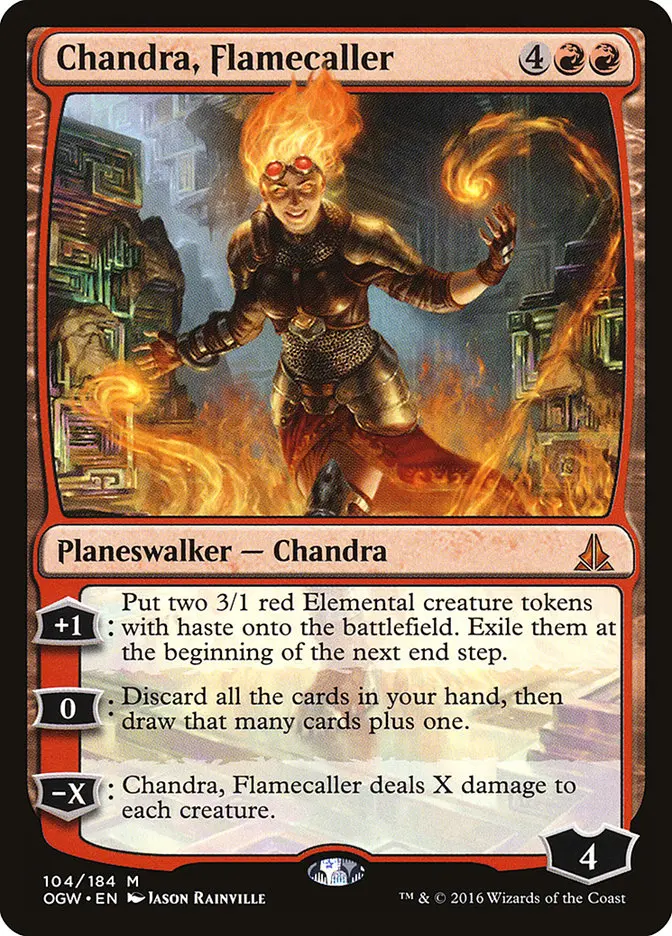
+1: Create two 3/1 red Elemental creature tokens with haste. Exile them at the beginning of the next end step.
0: Discard your hand, then draw that many cards plus one.
-X: Chandra, Flamecaller deals X damage to each creature.
The six-mana big Chandra, empowered by Nissa’s ley line power during the fight between two great Eldrazi Titans in Oath of the Gatewatch, gained for the first time the ability to make Elemental tokens and a small sweeper. The +1 makes two 3/1 haste Elementals at once, dealing a full 6 damage, and an opponent with an empty board can’t last more than a few turns; the -X sweeper, whose prototype is Slice and Dice, lets you adjust the damage freely, and you can also use the 0 to refill your hand as needed, which is very flexible. In Standard at the time she was a mainstay top-end of the Eldrazi ramp decks and was very active.
Chandra, Torch of Defiance
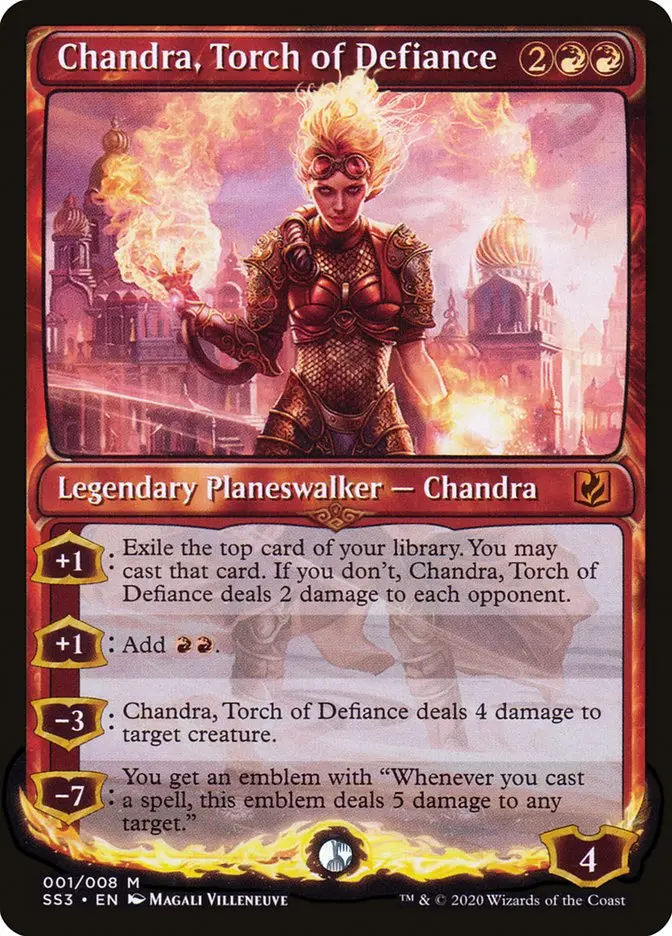
+1: Exile the top card of your library. You may cast that card. If you don’t, Chandra, Torch of Defiance deals 2 damage to each opponent.
+1: Add {R}{R}.
-3: Chandra, Torch of Defiance deals 4 damage to target creature.
−7: You get an emblem with “Whenever you cast a spell, this emblem deals 5 damage to any target.”
Chandra, who after fighting the Eldrazi went home to visit family on Kaladesh, is the second planeswalker after Jace, the Mind Sculptor, and the first red one in history, to have four abilities: the treatment of a true favorite daughter. Combining direct damage, ramp, removal and card advantage, her overall strength is the best of all versions, and since she was also printed in Signature Spellbook and sold directly, her price is quite friendly. In Dominaria, a rules change about damage targets made Torch of Defiance lose her ability to hit planeswalkers directly, but this is a minor flaw in an otherwise great card.
Chandra, Fire Artisan
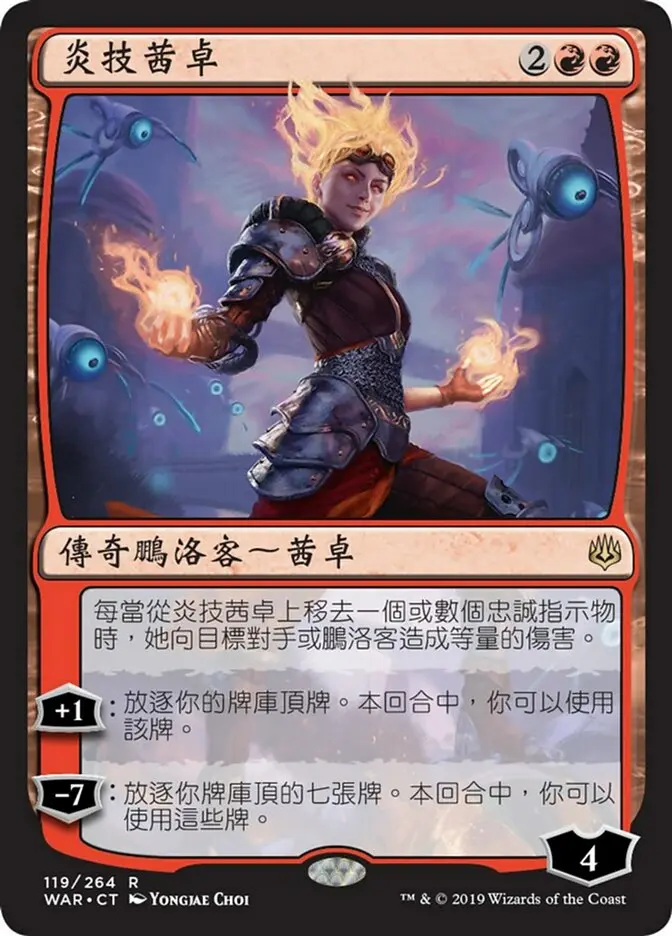
Whenever loyalty counters are removed from Chandra, Fire Artisan, she deals that much damage to target opponent or planeswalker.
+1: Exile the top card of your library. You may play that card this turn.
-7: Exile the top seven cards of your library. You may play them this turn.
This Chandra, tutored by the legendary pyromancer Jaya Ballard and put to the test in War of the Spark, is focused on refilling her hand, hitting the opponent with direct damage in a passive form introduced here for the first time. Although she has no self-protection, if the opponent chooses to attack the planeswalker to stop you from drawing, they have to take another round of bombardment with what little life they have left, which fits the needs of a red aggro top-end quite well, and she performed decently in her day.
Chandra, Novice Pyromancer // Chandra, Acolyte of Flame // Chandra, Awakened Inferno
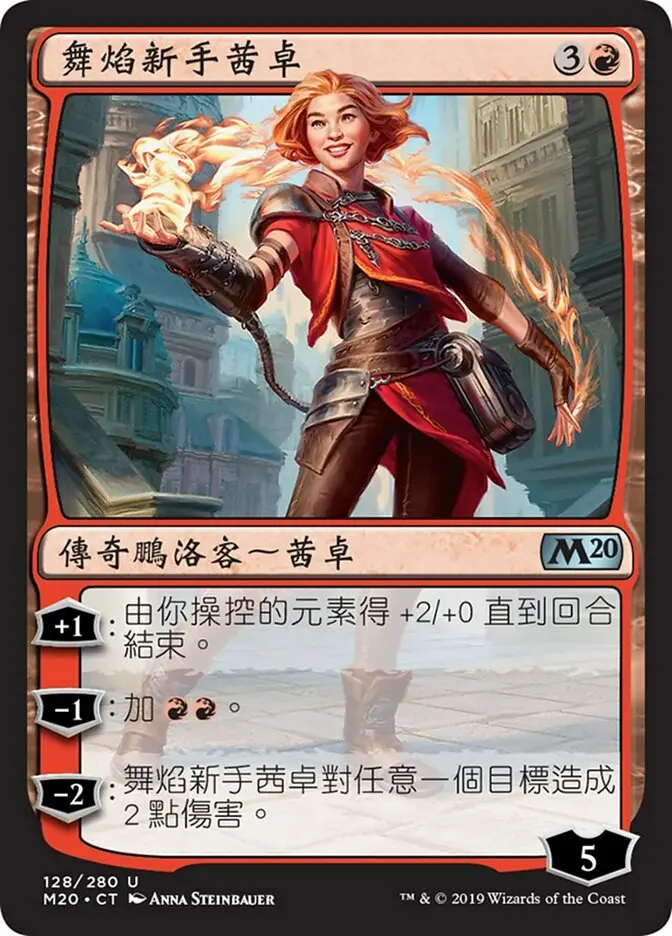
+1: Elementals you control get +2/+0 until end of turn.
−1: Add {R}{R}.
−2: Chandra, Novice Pyromancer deals 2 damage to any target.
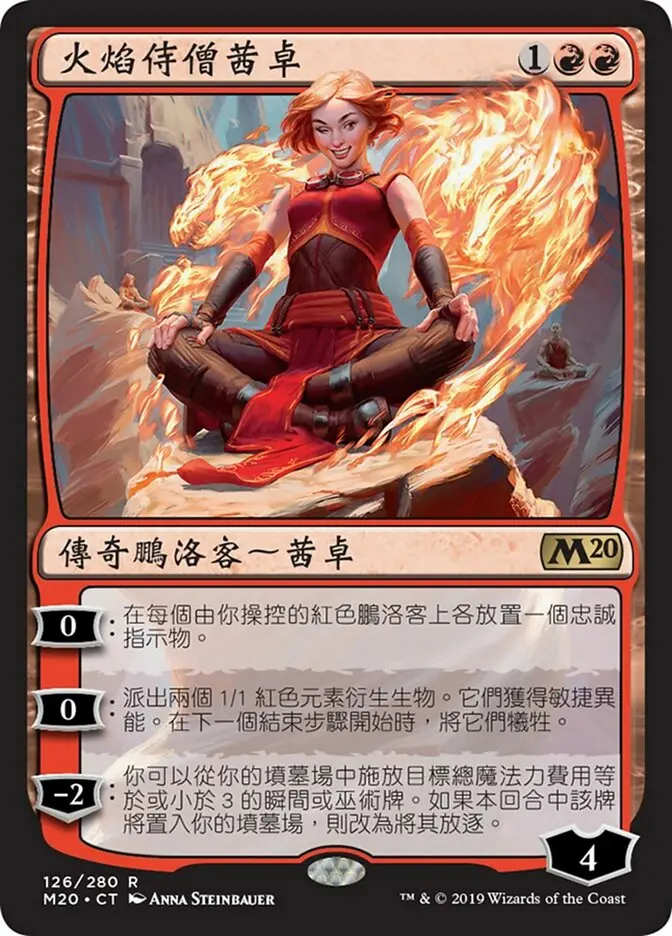
0: Put a loyalty counter on each red planeswalker you control.
0: Create two 1/1 red Elemental creature tokens. They gain haste. Sacrifice them at the beginning of the next end step.
−2: You may cast target instant or sorcery card with total mana value 3 or less from your graveyard. If that card would be put into your graveyard this turn, exile it instead.
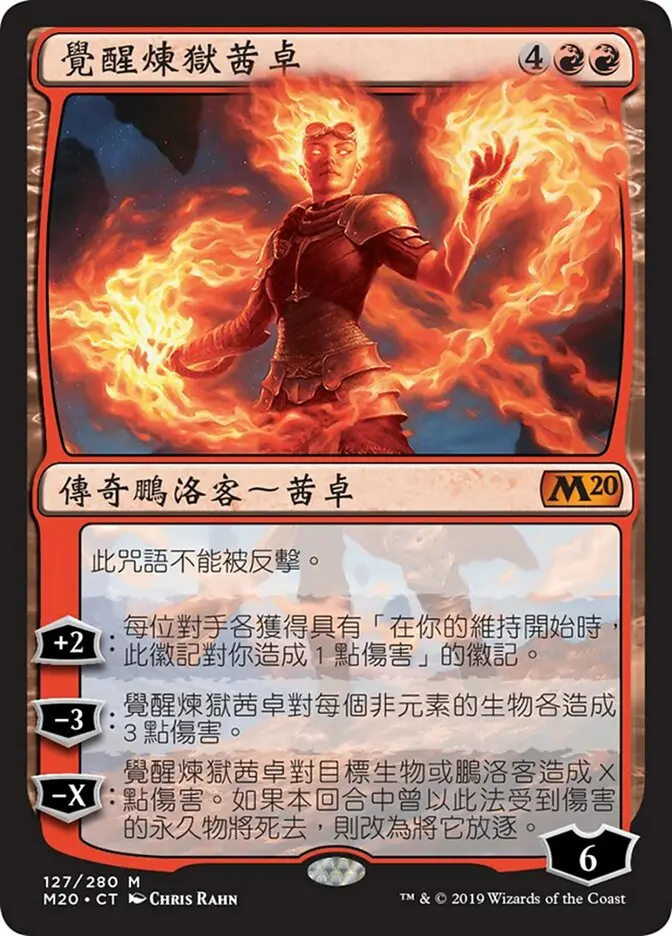
This spell can’t be countered.
+2: Each opponent gets an emblem with “At the beginning of your upkeep, this emblem deals 1 damage to you.”
−3: Chandra, Awakened Inferno deals 3 damage to each non-Elemental creature.
−X: Chandra, Awakened Inferno deals X damage to target creature or planeswalker. If a permanent dealt damage this way would die this turn, exile it instead.
The M20 set was themed around Chandra and Elementals, so it gave you 3+1 Chandras at once (the fourth was the preconstructed Chandra, Flame’s Fury), and the number of Chandra versions began to pull away from everyone else. Unlike the uncommon planeswalkers of the previous set, which had only one activated ability, Chandra, Novice Pyromancer has a full three-ability set that can ramp and remove, and it’s a real shame Wizards didn’t print a five-color cycle in the Welcome Decks. Chandra, Acolyte of Flame supports many strategies, with uses in Elemental tribal, sacrifice, red burn and planeswalker decks. Chandra, Awakened Inferno is a destroyer you can’t refuse: hefty loyalty, uncounterable, able to spot-remove or sweep, and a +2 that sets an emblem for direct damage. Even the protect-from-everything of The One Ring can’t stop it, and as a reliable finisher it stands at the top of all versions.
Chandra, Heart of Fire // Chandra, Flame’s Catalyst
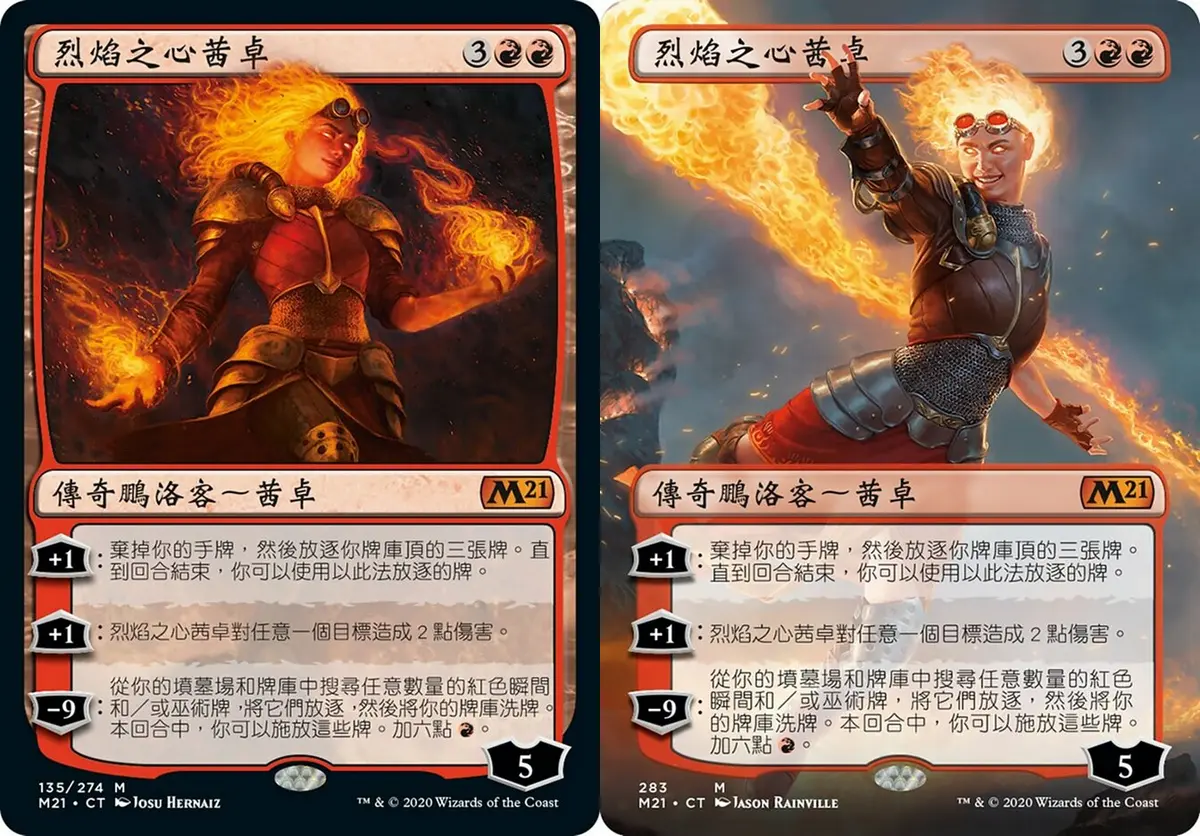
+1: Discard your hand, then exile the top three cards of your library. Until end of turn, you may play the cards exiled this way.
+1: Chandra, Heart of Fire deals 2 damage to any target.
−9: Search your graveyard and library for any number of red instant and/or sorcery cards, exile them, then shuffle your library. You may cast those cards this turn. Add {R}{R}{R}{R}{R}{R}.
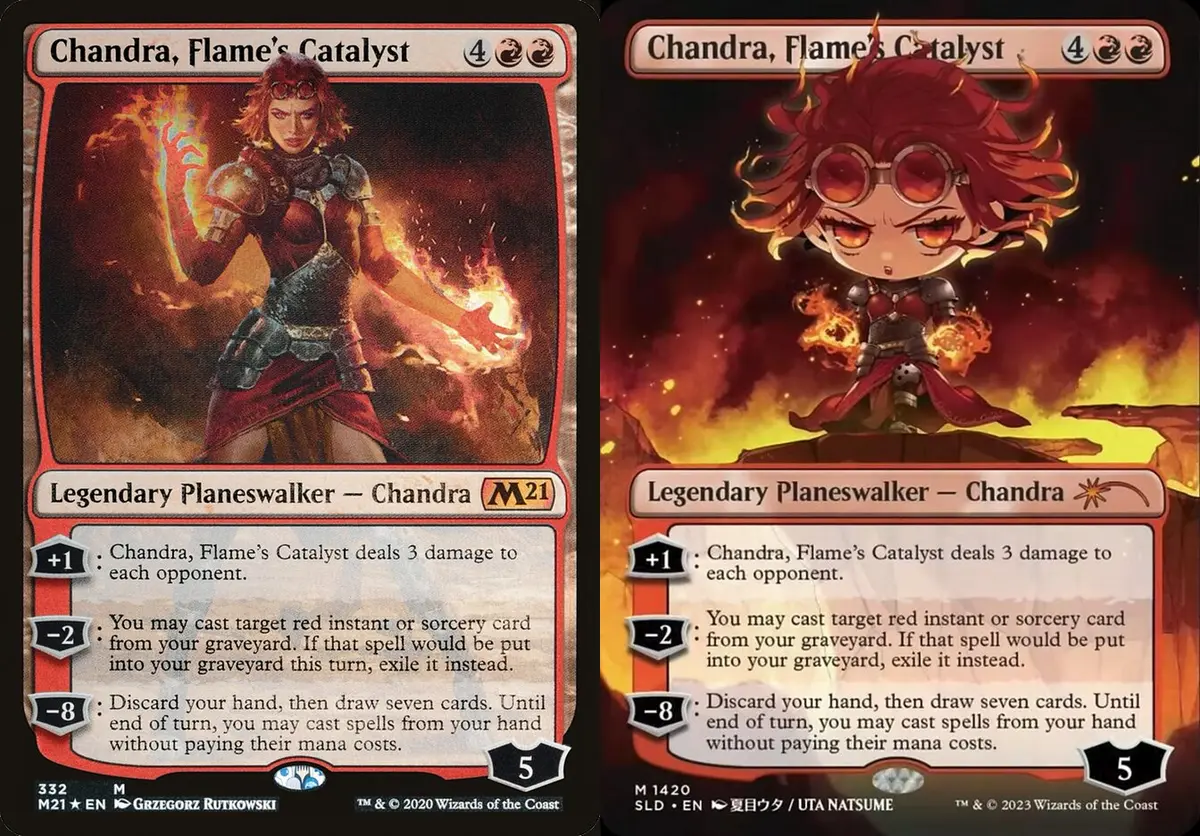
+1: Chandra, Flame’s Catalyst deals 3 damage to each opponent.
−2: You may cast target red instant or sorcery card from your graveyard. If that spell would be put into your graveyard this turn, exile it instead.
−8: Discard your hand, then draw seven cards. Until end of turn, you may cast spells from your hand without paying their mana costs.
Ever since Chandra, Pyromaster, Chandras that can impulse draw have been quite popular, with the sole exception of M21’s Chandra, Heart of Fire. The +1 impulse draw of three is powerful, but the price is discarding your whole hand, leaving you at the opponent’s mercy on their turn, and if the exiled cards are bad you can collapse at once. If you want to treat this Chandra as the top of a red burn deck, the cost also seems a bit clunky. Dealing two with the +1 can’t handle increasingly sturdy midsize creatures, and the ultimate is subtly unappealing. On the other hand, the planeswalker-deck Chandra, Flame’s Catalyst, whose ultimate draws seven with a one-turn Omniscience, is quite interesting and makes you want to try to develop a deck for it, and its popularity in Commander even made Wizards print a separate Secret Lair version with chibi art.
Chandra, Dressed to Kill
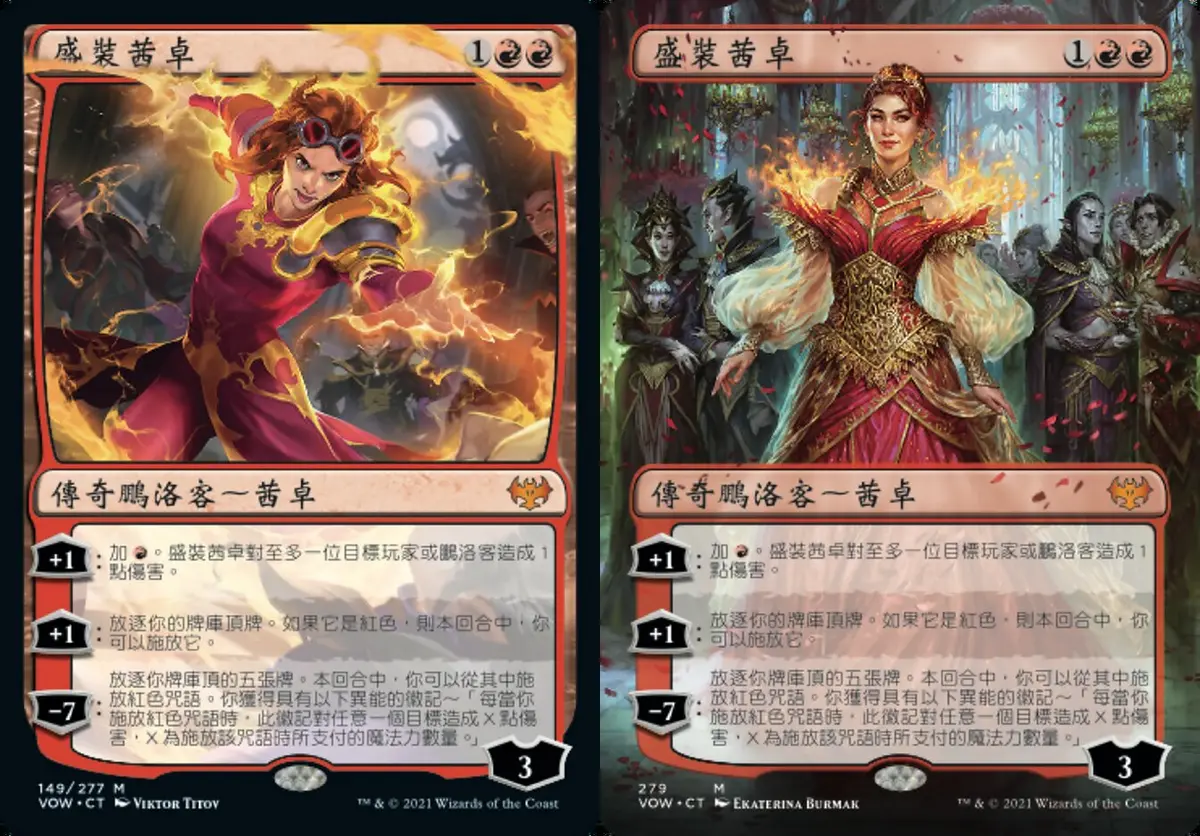
+1: Add {R}. Chandra, Dressed to Kill deals 1 damage to up to one target player or planeswalker.
+1: Exile the top card of your library. If it’s red, you may cast it this turn.
−7: Exile the top five cards of your library. You may cast red spells from among them this turn. You get an emblem with “Whenever you cast a red spell, this emblem deals X damage to any target, where X is the amount of mana spent to cast that spell.”
The Chandra who rarely put on a dress to get into Olivia, Crimson Bride’s wedding in Crimson Vow. Overall she’s a condensed version of Chandra, Torch of Defiance without the removal ability: as long as you can protect her, she provides a bit of ramp and a steady stream of resources, and with all-positive abilities she steadily marches toward her ultimate. The overall design is excellent.
Chandra, Hope’s Beacon
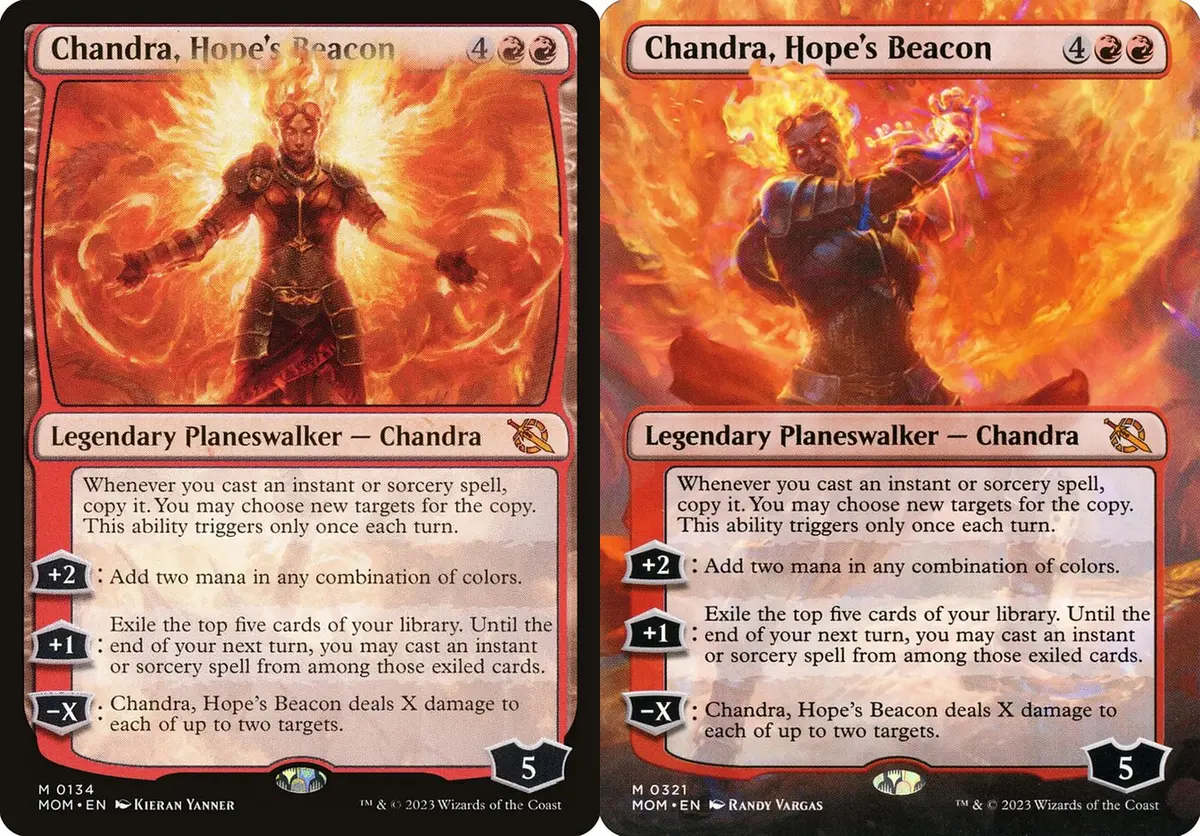
Whenever you cast an instant or sorcery spell, copy it. You may choose new targets for the copy. This ability triggers only once each turn.
+2: Add two mana in any combination of colors.
+1: Exile the top five cards of your library. Until the end of your next turn, you may cast an instant or sorcery spell from among the exiled cards.
−X: Chandra, Hope’s Beacon deals X damage to each of up to two targets.
The Chandra who, in the story of March of the Machine, went with Wrenn and Seven into New Phyrexia for a final stand. The strength of her activated abilities sits between a five- and six-drop, but the built-in passive that copies the first instant or sorcery each turn, like Double Vision, is a very vicious design. Paired with the mana-producing activated ability, she can copy a two-mana spell the turn she enters, and there are plenty of situations where a single spell decides the game after she survives a turn. Her ceiling is very high, making her the most dangerous version ever.
Chandra, Legacy of Fire
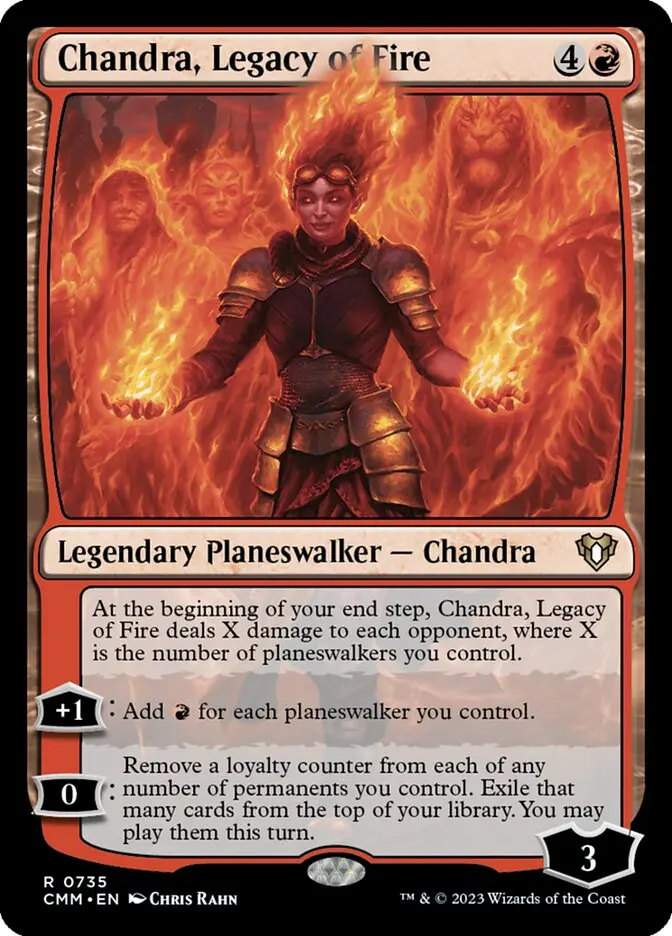
At the beginning of your end step, Chandra, Legacy of Fire deals X damage to each opponent, where X is the number of planeswalkers you control.
+1: Add {R} for each planeswalker you control.
0: Remove a loyalty counter from each of any number of permanents you control. Exile that many cards from the top of your library. Until end of turn, you may play them.
The Chandra in Commander Masters, with a crowd of spectral figures behind her, designed for planeswalker-tribal decks. Her activated abilities are impulse draw or ramp combined with passive direct damage, with the count based on the number of planeswalkers you control. Because she was built for a specific purpose, she performs far worse than the other versions outside of a planeswalker-tribal commander deck.
Conclusion

From the evolution of Chandra’s versions, we can see how Wizards has adjusted the balance of red. For a very long time red was a color that was strong in short games but could only live on topdecks in long games; to go long you could only mix in other colors or pair it with less efficient artifacts for card draw. With the impulse draw of Chandra, Pyromaster as the dividing line, red began to gain limited card-advantage ability and could compete with other colors in mid-to-long games. That’s the end of this brief introduction to Chandras past. See you next time!
- Title
- Planeswalker Evolution: Chandra
- Author
- JerobaMTG
- Created at
- December 25, 2023
- License
- This work is licensed under CC BY-NC-SA 4.0 .