Aetherdrift (DFT) Limited Primer — Blue

Note: This article was translated from Chinese by AI and may contain errors. Read the original Chinese version.
Aetherdrift (DFT) will hold its prerelease events on February 7, 2025, and officially launch one week later on February 14, 2025. Want to learn more about single-card ratings and recommendations in Limited? Then check out this DFT Limited primer series!
- For the mechanics, see this article: Aetherdrift Mechanics Breakdown
Rating Scale
5.0: Must-take, unconditionally; gives you a near-winning advantage
4.5: Must-take if you’re in the right colors; gives you a huge advantage
4.0: Worth a first pick, with excellent synergy with the color pair’s theme; can be the deciding card for splashing, switching colors, or moving into a color pair
3.5: The best uncommons and commons in the set and other cards of sufficient strength, with good synergy with the color pair’s theme; can be the key card for moving into a color pair
3.0: Important cards for a color pair’s theme and other above-average cards; you’ll want them in your final deck
2.5: Average, usually a decent curve filler
2.0-1.0: Below average; you generally prefer not to play them, but they can be filler when necessary (not too many)
0.5-0.0: Unplayable; basically never play them, as they will only help you lose
Ratings

Score: 3.0
Comment: Although this engine costs three mana and skips a turn first, and paying two mana to draw is rather slow, it is great for refilling resources in the mid to late game. Once you reach Max speed it additionally becomes Sphinx's Tutelage , turning from a resource engine into a way to win; I recommend playing at most one.

Score: 3.0
Comment: A one-mana Unsummon effect can generate a huge tempo swing in Limited, especially in an environment where you need to stack up to Max speed.

Score: 2.0
Comment: Although its body can block every ground attacker, I don’t think it’s a good choice in a Limited format that prizes attacking efficiency; players who like playing slow decks can include it.
Team Score: 3.0
Comment: Although it’s a vanilla creature, those stats are high enough to be worth as much as an ability. It’s a bulwark that’s hard to break through without removal, and this set also has a few scattered cards that support vanilla creatures.

Score: 3.5
Comment: An uncommon that can be a first pick. A two-mana 2/1 flyer has top-tier destructive power in Limited, and its extra ability will give the opponent a big headache, and can even stop the opponent’s high-cost Vehicle bombs.

Score: 3.0
Comment: Blue’s high-quality removal this time, but you should still pick good creatures costing three or less before taking this card.

Score: 2.5
Comment: In the white-blue artifacts theme you can look forward to casting this for 4 mana; considering you won’t play many of them, you can pick it later.

Score: 2.5
Comment: A three-mana 2/2 flyer is very poor on defense, and you need to keep your advantage constantly to realize this card’s value.

Score: 2.5
Comment: It’s an artifact itself, provides artifact synergy, and can ramp. It does nothing in other color pairs, but it’s definitely a core card of the white-blue theme. It can’t take part in combat itself, but it can serve as a pilot.

Score: 2.5
Comment: Most of the time it will be used for cycling, and for two mana it’s a rather poor combat trick.

Score: 2.5
Comment: The score is mainly for the draw-two on entering, but the cost is a little high and Crew 3 only lets it hit for 3, which is a bit inefficient for five mana, so you won’t want to use too many.

Score: 3.0
Comment: Plain and unremarkable, yet I think it will be a three-drop your deck needs; vigilance plus a chance to loot and grow once, a very functional common.

Score: 3.0
Comment: I consider it one of the strongest artifact synergy cards in this set; a 3/4 flyer body at a cheap cost is worth picking.

Score: 2.0
Comment: Past defenders mostly just stand there dazed and can’t build an advantage, but with artifact synergy in this set you may need it.

Score: 2.0
Comment: The only merfolk in this set is this card itself. The body contributes nothing to offense or defense, and only when you have lots of lands in the mid to late game can it draw resources; you’d only want to use it in Sealed.
Team Score: 3.0
Comment: Early on it draws out removal and crews vehicles; in the mid to late game, once you can draw three or four cards, it becomes a resource engine that must be answered. Its strength lies in the big draw at high cost, so you needn’t worry much about the weak body.

Score: 5.0
Comment: It spreads out the board, contributes on both offense and defense, and can generate value the turn it enters; if the opponent has no answer, it ends the game outright.
Note: I suddenly wonder whether Enduring Curiosity was designed wrong?

Score: 3.0
Comment: A common that gives one-for-two on entering has been a staple creature in the last few sets, especially since one can go attack through crewing while the other stays home for defense. An excellent common creature.

Score: 3.5
Comment: The creature you steal can’t attack or block, but it can be used to crew, which is effectively dismantling the opponent’s best defender while adding an attacking pilot for you, making it easy to break the opponent’s defenses.

Score: 2.5
Comment: Crew 2 makes it hard to take part in combat early, but paired with the Exhaust theme it becomes a frightening card-draw engine.

Score: 2.0
Comment: It costs 3 mana + 2 mana to sacrifice one artifact to find an artifact costing 1 more, and you also have to account for the cost of the sacrificed artifact, which is very bad for tempo, and the artifact you find won’t necessarily solve your problem.

Score: 1.5
Comment: Past good mill strategies in Limited were built on high-quality uncommons; if you pick only one rare and make it the deck’s core, you face the problem of never drawing it, but in Sealed it can be a way to win.
Team Score: 3.0
Comment: One of the core cards that makes me want to focus on a turtle-defense plan; as long as you can stall the game, this kind of out-of-dimension attack on the library is quite deadly in Limited.

Score: 2.5
Comment: Although this set doesn’t have a draw-two strategy like FDN, it’s still a soft removal spell that doesn’t lose you a card.

Score: 3.0
Comment: At first glance the body is a bit poor, but the -1/-0 effect is actually very powerful.

Score: 2.5
Comment: You have to cycle/discard at least once for it to be a decent flyer.

Score: 2.5
Comment: The Exhaust ability’s cost is a bit too much; a flyer with a blocker’s body, so personally I consider it filler only.

Score: 2.0
Comment: You want to stack Max speed but this card doesn’t help at all; most of the time it can’t take part in combat and can only serve as a pilot.

Score: 2.0
Comment: You have to keep two mana up to counter the opponent’s next creature, which is quite hard to use when on the draw.

Score: 2.0
Comment: In an environment with vehicles, it’s useful to bring one, and in intense Limited exchanges it also has a chance to hit the opponent’s key noncreature spell; a one-mana counter is hard for the opponent to play around.

Score: 3.5
Comment: It can bounce the opponent’s creature and also slow them down, and the body itself is decent too; the last straw that breaks the opponent’s defenses.

Score: 2.5
Comment: The effect itself isn’t practical, but its priority goes up in cycling-style decks.

Score: 3.0
Comment: A very good way for blue to refill resources, and you can even run one or two.

Score: 3.5
Comment: What’s strong about this card is the 4/4 flyer with Crew 2, but looking carefully at the rest of the set, there is no effective blue uncommon/common looting, and cycling cards must be used on your own turn to effectively trigger the flyer-making ability, so the tempo isn’t really that great.

Score: 2.0
Comment: The effect looks wonderful, but top Limited decks contain very few cards costing five or more; I’d rather bring a threat myself than hope the opponent plays a threat and then trade with this card.
Team Score: 3.5
Comment: Quite a few effects in this set produce little things that are painless to give away, and trading that kind of trash for the opponent’s best card should crush the opponent’s morale.

Score: 2.5
Comment: It’s great with the white-blue artifacts theme; there are plenty of good 4-5 mana uncommons and commons with artifact synergy, and this card itself can also serve as a pilot.

Score: 3.0
Comment: A very nice soft removal spell, and since this set has a cycling theme, this card’s priority rises further.

Score: 2.5
Comment: The ideal use case is when your board is ahead of the opponent’s: you attack with quality creatures + a vehicle and use this card’s effect to reset them, achieving offense and defense in one! But the problem is that this kind of card won’t make your board advantaged and does nothing for the board.
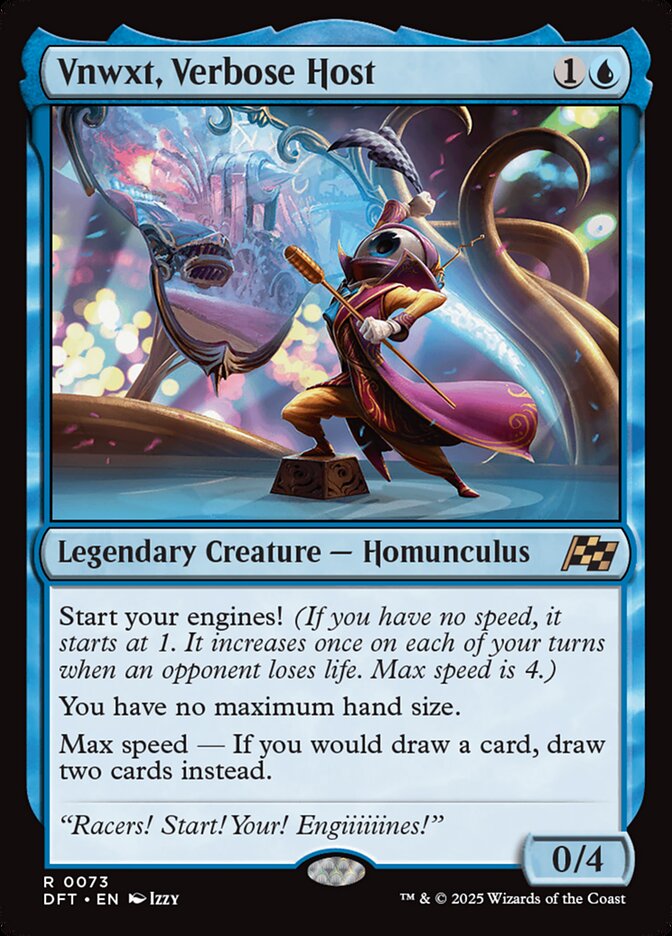
Score: 4.0
Comment: Blue has lots of flyers, and after reaching Max speed you gain a large resource gap every turn, and the body itself is also quite excellent.

Score: 3.5
Comment: Having both flash and cycling gives it considerable flexibility, but be careful that the thing you want to copy isn’t removed before it enters.
Conclusion
In this Limited format, blue has excellent resource engines and many cards that gain tempo, but it has no clear offensive goal and its creatures are relatively thin, which suits it as a support color for other themes, depending on whether you want to gain an advantage in combat or gain long-term resources. From a creature-combat perspective, white-blue artifact synergy will be the strong color pair this time, while blue-red has quality creatures and removal; if you like resource wars, blue is also highly recommended.
- Title
- Aetherdrift (DFT) Limited Primer — Blue
- Author
- jeffchen
- Created at
- February 4, 2025
- License
- This work is licensed under CC BY-NC-SA 4.0 .