Duskmourn (DSK) Limited Review — Blue

Note: This article was translated from Chinese by AI and may contain errors. Read the original Chinese version.
Duskmourn: House of Horror (DSK) has its prerelease events on September 20, 2024, and officially releases a week later on September 27, 2024. Want to know more about how each card rates in Limited, with recommendations? Then check out this series of DSK Limited reviews!
- For the mechanics, see this article: Duskmourn Mechanics Explained
- For a first look at the Limited archetypes, see this article: Duskmourn Limited Preliminary Look
Rating Scale
5.0: Always take it
4.5: Always take it if you’re in the right colors
4.0: First-pick quality
3.5: Strong enough, but not necessarily a first pick
3.0: Above average (you’ll really want it in your final deck)
2.5: Average, maybe around the 6th or 7th pick of a draft
2.0 to 1.0: Below average (you’d rather not play it than play it)
0.5 to 0.0: Unplayable (basically never play it, it will only help you lose)
Card Ratings
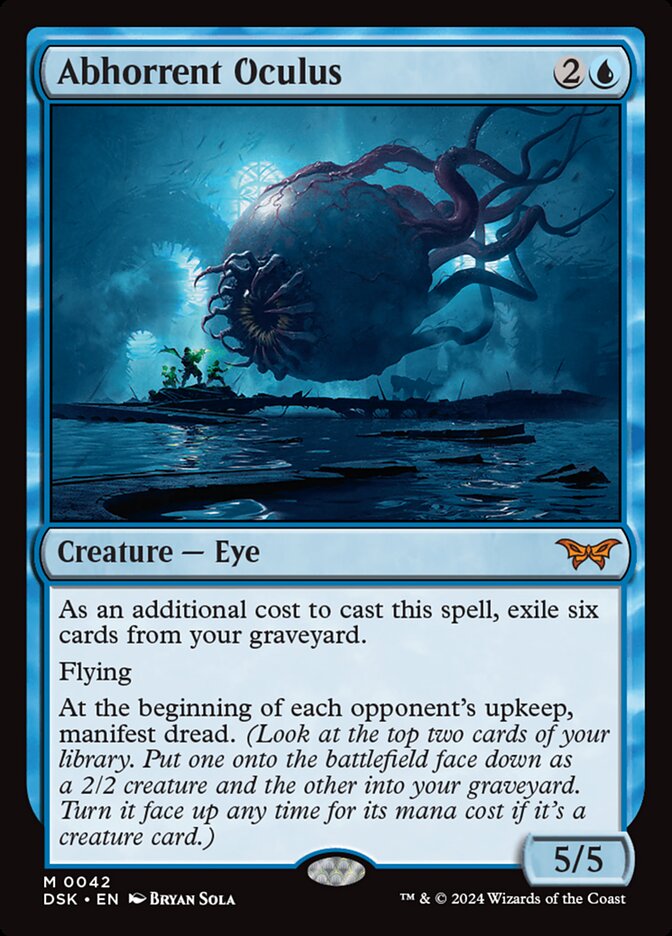
Rating: 4.0
Comment: Once it’s on the battlefield it’s already a strong flyer, and it can dominate the board all by itself. However, exiling six cards from your graveyard is a steep cost in Limited, so make sure you have enough ways to fill the graveyard before playing it. Also, exiling six cards is part of the casting cost, so you can bypass it by putting it onto the battlefield through reanimation or by manifesting dread.
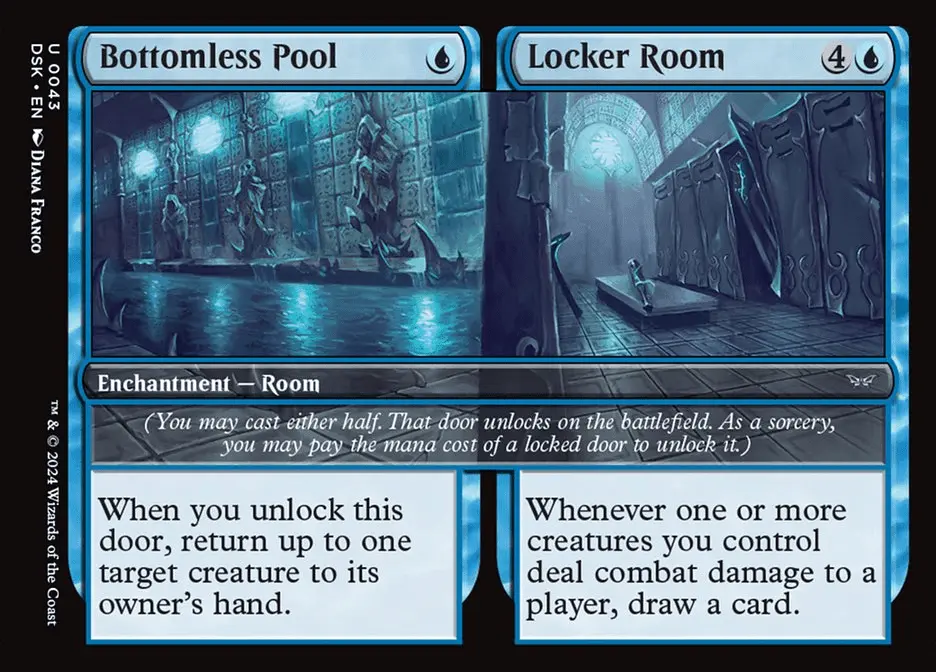
Rating: 2.5
Comment: Blue is in theory the color with better evasion, and it can generate card advantage fairly easily with the right half. The full cost is admittedly a bit clunky on its own, but the Unsummon on the left half makes up for the flexibility problem.
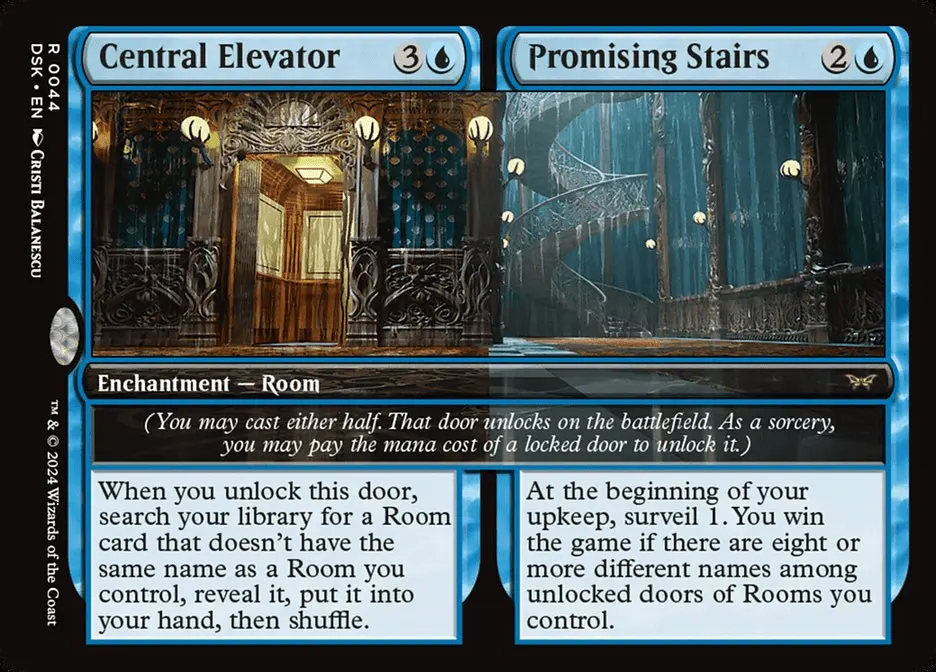
Rating: 1.5
Comment: It focuses too much on the Room theme. Even though Rooms are the signature mechanic of this set, going for the alternate win condition on the right half is still unrealistic, and its only reliable contribution is surveil 1 each turn. Consider playing it as a tutor only when your deck has other bomb-level Rooms.

Rating: 2.5
Comment: A 5-toughness body has a decent survival rate once it hits the table. You can use it to lead a strong damage dealer into an attack, or to support creatures with survival abilities.

Rating: 2.0
Comment: A mana creature with very limited uses; a lot of the time it will just be a vanilla 2/1.

Rating: 3.0
Comment: Its floor is yet another variant of Wind Drake, but it also provides some extra value.

Rating: 2.5
Comment: A 5/7 with vigilance is among the more capable cycling-land creatures in this set.

Rating: 1.5
Comment: Counterspells like Quench turn into dead cards far too easily in Limited, and surveil 2 is basically a consolation prize; you don’t want to spend 2 mana just to surveil 2.

Rating: 1.0
Comment: Sure, stealing effects have to be designed carefully, but at 6 mana it really shouldn’t be a card with a side effect. And once you’ve stolen the creature, it has no abilities and its power is gutted, which is honestly so dumb it’s funny. It is still removal that nets you a card, but 6 mana is too clunky, and this set has a much higher share of enchantment removal than other sets.

Rating: 4.5
Comment: It can generate an absurd amount of card advantage in a short time, and having flash makes it very hard to play around.

Rating: 2.0
Comment: Essentially a cantrip. It can help a delirium deck stock up a sorcery type without losing a card, or let a survival creature attack safely once.

Rating: 3.5
Comment: In an enchantment-themed environment, the expected card advantage is pretty good, and flash lets it dodge some of the windows in which the opponent could use removal, making its card advantage more consistent.

Rating: 2.0
Comment: As a 2-drop it’s a decent curve play, but at 3 mana it’s too weak.

Rating: 2.5
Comment: Should be a great tool for dragging the game out. 7 toughness is already a hard wall to get through, and if the opponent pushes too aggressively and runs out of blockers, getting punched back for 2 cards is no joke. If you want to drag the game into a late-game resource battle, it’s a great helper.

Rating: 3.5
Comment: A 4/4 flyer already puts on a lot of pressure, and it can also neutralize one of the opponent’s blockers, making it a threat that’s very hard to deal with in combat.

Rating: 2.5
Comment: Purely from a card-advantage view, it doesn’t gain you cards or board presence. What you counter has to be valuable enough to matter, otherwise you might effectively be looting the opponent and filling their graveyard for them.

Rating: 3.0
Comment: It’s awkward early in the game, because losing a land costs too much tempo and you won’t always have a good permanent to bounce. But when you have a good ETB creature on the battlefield, it becomes a nice source of value. So although it’s a 2-drop, don’t plan on using it as a 2-mana curve play.

Rating: 4.0
Comment: A god of tempo, and it can also act as indirect removal.

Rating: 2.5
Comment: Each half on its own is merely playable, not strong, but combined into one card the added flexibility makes it usable.

Rating: 3.5
Comment: Honestly, this card’s rating swings wildly between situations: in a Room deck it’s a god-tier card, but outside a Room deck it’s just a flyer with an unimpressive body.

Rating: 2.5
Comment: Among 4-mana card-advantage spell variants, it’s rare to see one that doesn’t play with how deep you look, but instead directly gives you extra board resources.

Rating: 0.0
Comment: Its only use is that you never have to think about which card to discard.

Rating: 0.0
Comment: Without enough support in your deck, this is more likely to blow yourself up.
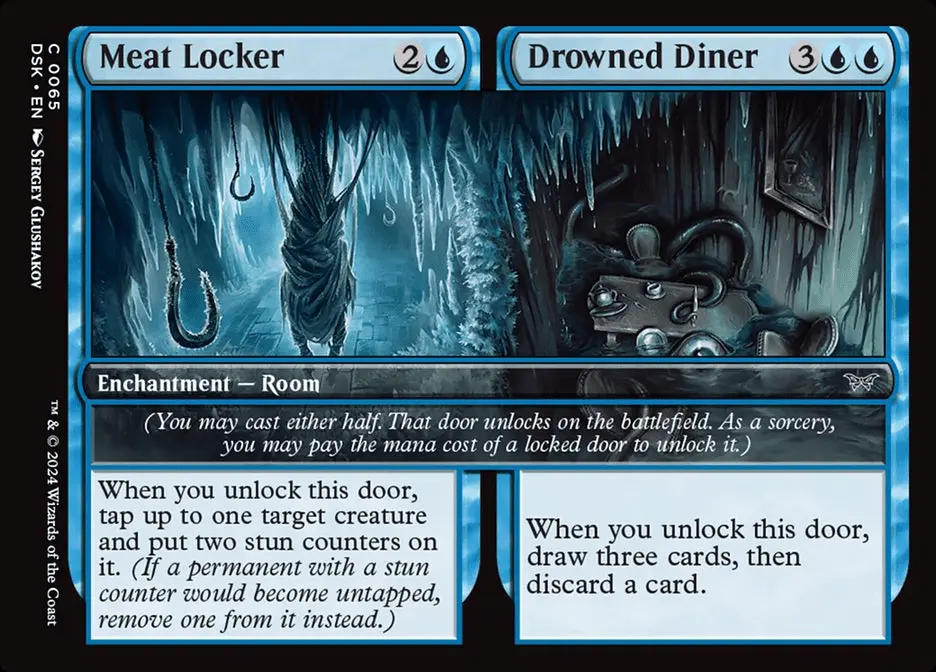
Rating: 2.5
Comment: In a graveyard-matters environment, draw 3 discard 1 is much stronger than simply drawing 2, but a 5-mana sorcery-speed play would still be too clunky if that were all it did. With the added ability to lock down one of the opponent’s main damage dealers for two turns, spending a turn to draw cards is no longer a serious tempo hole.

Rating: 4.0
Comment: Judged on its abilities alone, it’s a 5.0-level bomb. It can’t be blocked, so it can only be handled by removal, and in Limited attacking the library is often deadlier than attacking life totals, and this guy is incredibly efficient at it. However, the color requirement of this card is simply too heavy for Limited, and since this is a graveyard-synergy set, the risk of self-mill is higher than in a normal set, so I docked it a little.
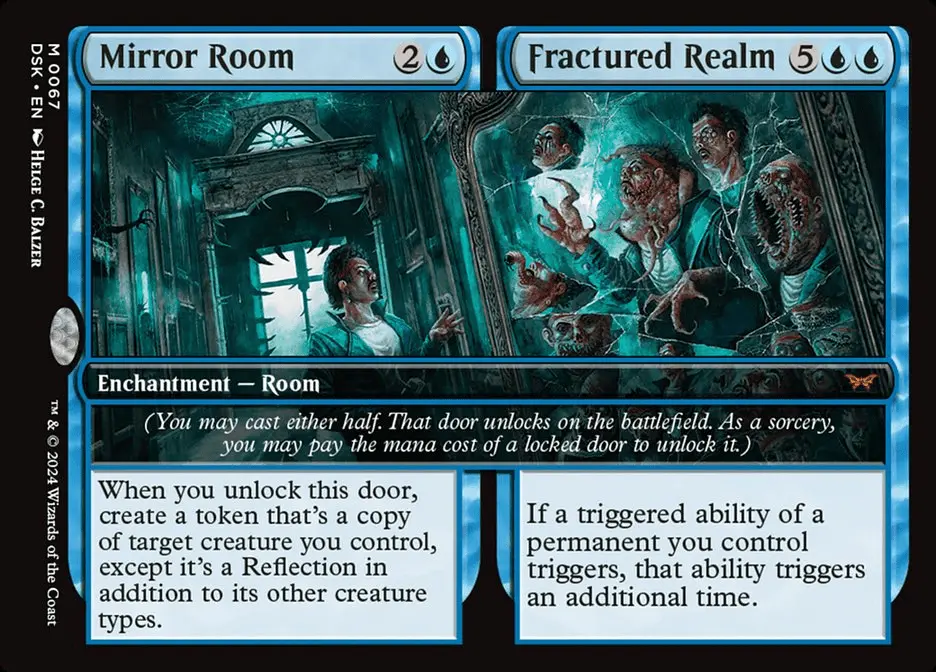
Rating: 3.0
Comment: It can be read as a regular 3-mana Clone variant that throws in an extra bonus; but that bonus is far too clunky. The ceiling is high but it’s hard to make use of, so it’s only a better-than-nothing option.

Rating: 4.5
Comment: A high-power flyer that keeps generating cards and filling the graveyard. Nothing to complain about.

Rating: 2.0
Comment: A card that demands a fully built-around deck.

Rating: 2.0
Comment: A flyer of this size didn’t need the drawback of entering tapped, did it…?

Rating: 2.0
Comment: A 0/3 body can block creatures in a 2-power-damage-dealer theme, but those themes usually have ways to pump, so it isn’t a reliable stopper. The mill can target any player, so it can attack the opponent’s library or fill your own graveyard, but you need to trigger eerie multiple times to get enough value.
It can do either, but neither effect is very efficient. Then again, it’s hard to ask for too much from a 1-drop.

Rating: 4.0
Comment: A cheap threat that can only be handled by removal. Once it connects with a single hit, it’s already ahead.

Rating: 2.0
Comment: Whether you can actually cast it is secondary. The point is that it gives blue a rare cheap blocker that easily makes favorable blocks, letting you drag the game into the late game, or letting other evasive guys sneak in a few free hits once your defense is solid.

Rating: 3.0
Comment: Blue’s tap-based Auras are getting more and more godly these days…

Rating: 1.5
Comment: You normally don’t have many instants and sorceries in Limited, and this set also has many spells that are enchantments. Only consider it if your deck truly needs an extreme graveyard.

Rating: 2.0
Comment: Neither the card itself nor the token it gives you is strong enough, and it has no extra card types of its own to help fill delirium. Consider it only when your deck is heavily into a sacrifice theme.

Rating: 2.0
Comment: Cancel has always been bad in Limited. With the added option of manifesting dread, at least it won’t become a dead card that does nothing, but its efficiency is still very low.

Rating: 3.0
Comment: Turning a creature into a 0/2 with no abilities is practically the same as neutralizing it.
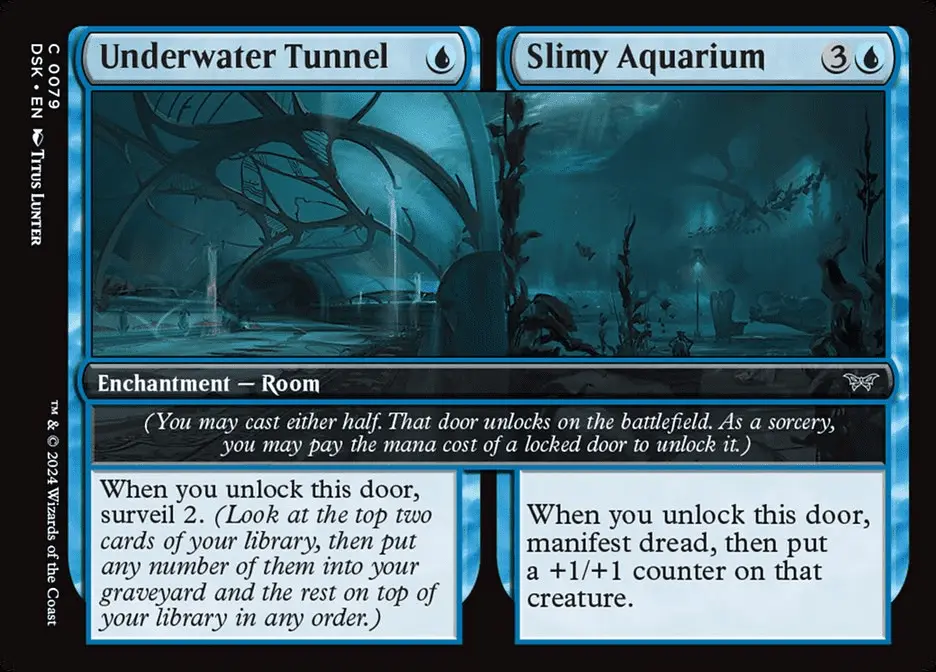
Rating: 2.5
Comment: A 3/3 for 4 mana is really not very efficient. Paired with the surveil 2 on the left half you have a chance to stack a creature on top of your library, but given the cost the efficiency still doesn’t look great. It does have the bonus of filling the graveyard twice, though.

Rating: 2.5
Comment: In terms of card advantage it neither gains nor loses anything, and it can at least grab a tempo advantage on the board.

Rating: 2.5
Comment: As long as you can trigger eerie once, you’ve made at least some profit. The ceiling is considerable, but the expected value isn’t high.

Rating: 2.0
Comment: The cost is a bit heavy, but from a battlefield-resource view it’s at least a bounce effect that doesn’t lose you cards. It’s a low-priority but barely usable piece of blue removal.
Conclusion
Blue in this set has a huge number of card-draw engine cards, though most of them work through attacking, and about half of the creatures have evasion. My guess is that blue’s game plan this time won’t be a purely defensive control style, but a tempo style that earns value while it fights.
- Title
- Duskmourn (DSK) Limited Review — Blue
- Author
- Jru
- Created at
- September 18, 2024
- License
- This work is licensed under CC BY-NC-SA 4.0 .