Duskmourn: House of Horror (DSK) Draft Report


Note: This article was translated from Chinese by AI and may contain errors. Read the original Chinese version.
Before We Start
After Duskmourn: House of Horror (DSK) went live on MTGA on September 24, 2024, I started my DSK Premier Draft ladder climb. Along the way I tried every color pair (except Izzet), and I was lucky enough to just barely reach Mythic on September 30, 2024. Here is a quick write-up of what I learned from the climb.

- All 17lands data below was collected on October 2, 2024.
- Although this article uses a lot of 17lands data, I never looked at any 17lands information while I was climbing. I relied on the GF team’s earlier DSK Limited analysis, my own understanding, and discussions within the team. The 17lands data is only used as supporting evidence while writing this article
but maybe some people won’t believe me, XD
Is DSK Fast or Slow?
In my earlier article DSK Limited First Look, based on this set’s enchantment-heavy environment and its focus on delirium and graveyards, I predicted a rather slow format, but…
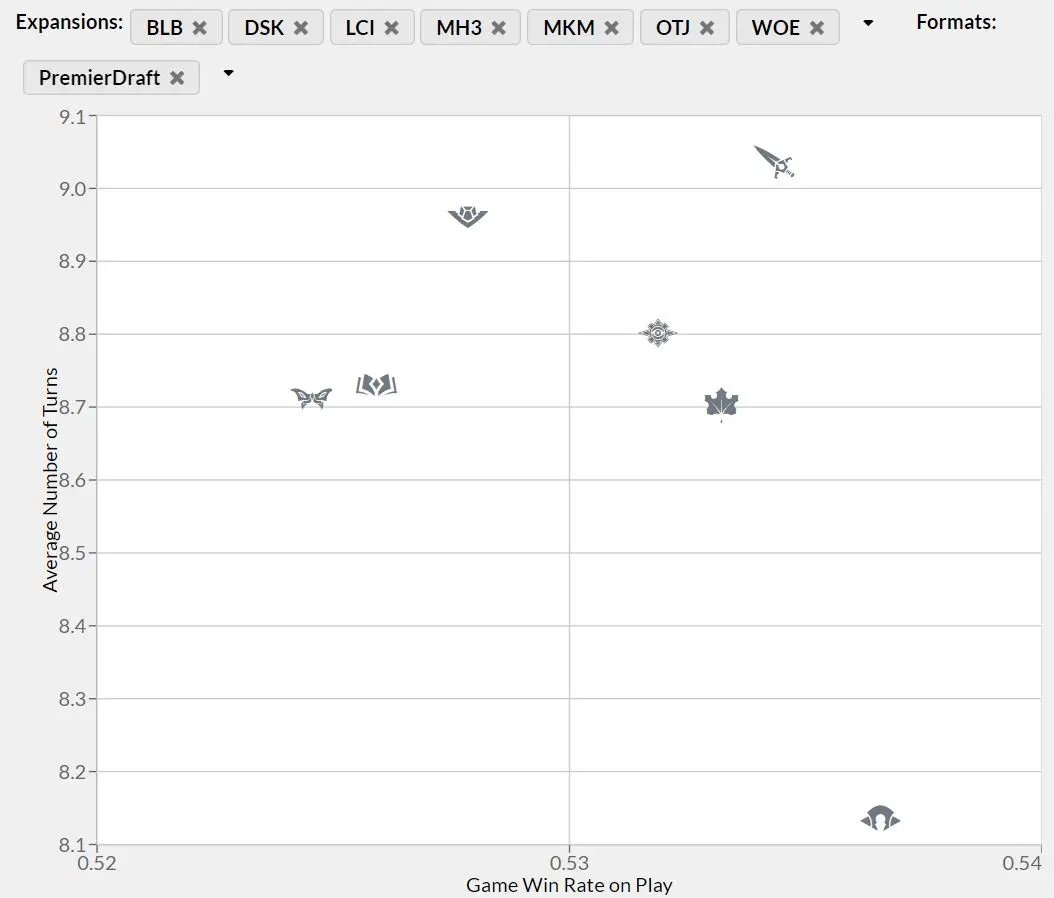
…I was immediately proven wrong, XD
From the 17lands Format Speed chart, we can see that DSK is actually not particularly slow. Compared with BLB (Bloomburrow), which we all know is fast, the average number of turns to win is about the same, and the on-the-play win rate in DSK is only 0.01 lower than in BLB.
Bloomburrow is already about as fast as any recent draft benchmark, yet DSK did not become slower just because it is an enchantment-heavy set. So how did that happen?
DSK Color Pair Strength
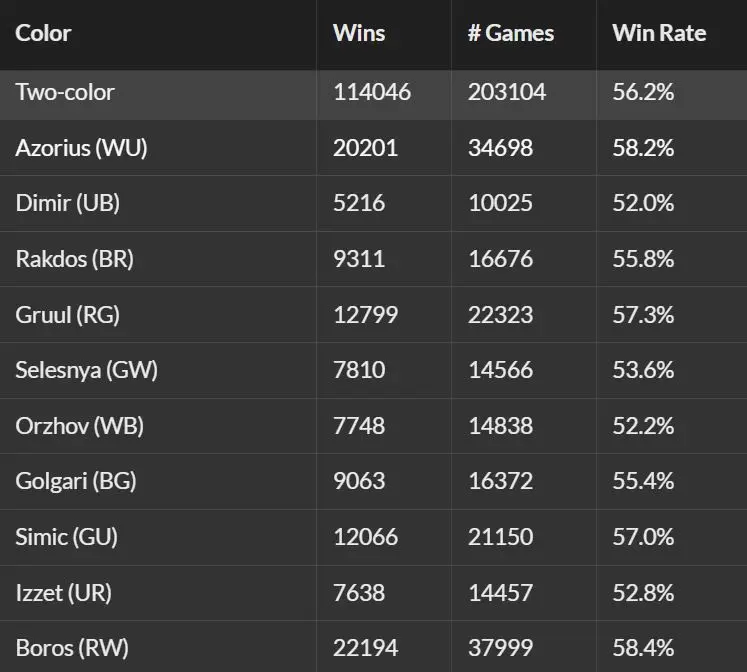
Looking at two-color win rates, the highest is Boros (RW) at 58.4%, followed by Azorius (UW) at 58.2%, and in third place is Gruul (RG) at 57.3%. Simic (UG), helped by the manifest dread theme and green’s solid bodies, takes fourth at 57.0%. All four of these color pairs are well above the two-color average win rate of 56.2%.
At the bottom is Dimir (UB) at 52.0%, followed by Orzhov (WB) at 52.2%. Izzet (UR), which was expected to be less promising, sits at 52.8% with the support of red and blue.
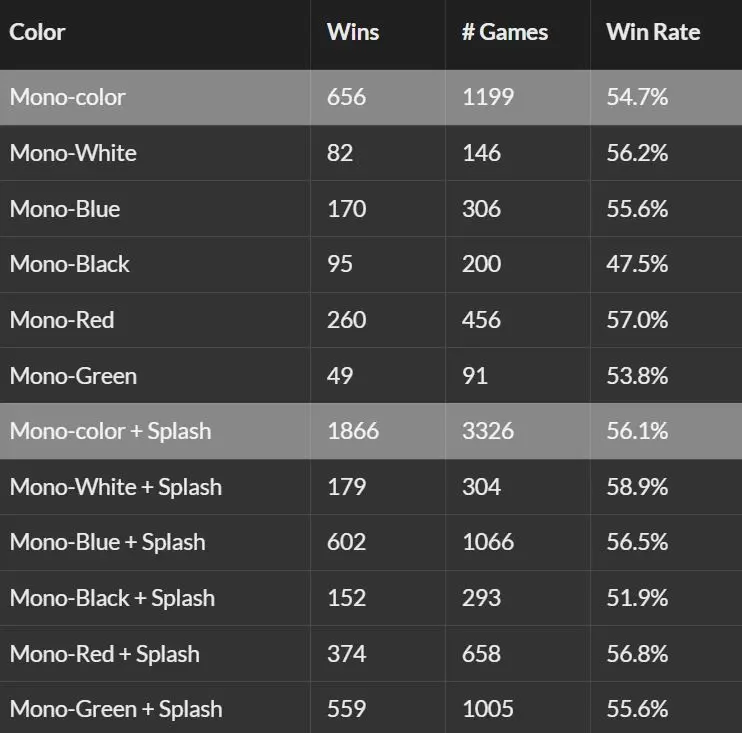
Looking at single-color win rates, we can see one more thing: black’s win rate is significantly low. We will cover that in a later article.
My Ladder Road to Mythic
First, I only realized after I had finished that my 17lands client wasn’t running. But after I reopened it, it still caught the final match, which happened to be the Gruul deck that went from Diamond 1 up to Mythic. The image below shows what gets recorded when the client is running.
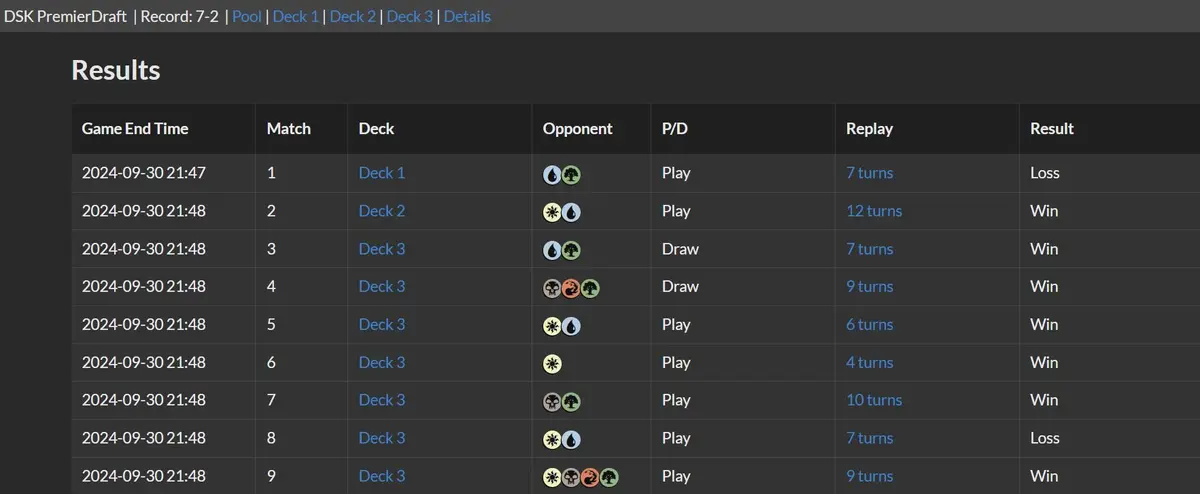
It is very convenient to use. It records your draft pool (Pool), and every deck change during matches is recorded in “Deck”. The image shows what expands when you click “Details”. It also includes the opponent’s deck type in each match (Opponent), play/draw (P/D), and the match result (Result). You can even click “Replay” to replay the game, which is super useful! I recommend it if you want to gather material or log your drafts to improve.
In Replay you can even see the opponent’s hand, which you can’t see during the game. It’s so powerful!
This also tells us something indirectly: the data collected on 17lands comes basically from players like me who want to review and improve through recorded data, so the average skill level of players captured there is also higher than that of typical MTGA players. That makes the win rate data on 17lands especially representative. From my own subjective, non-professional feel, it can roughly be divided into three categories:
- Above 55%, you can basically consider it a high win rate;
- Below 50%, the win rate is basically not good;
- 45% or lower, basically this archetype is hard to play.
Match Record Summary
Below I analyze the drafts for each color pair in more detail. If you don’t have time to read through it, you can look at this record summary and skip straight to the next chapter on key cards.
| Color pair | Drafts | Wins | Losses | Win % | 17lands Win % |
|---|---|---|---|---|---|
| RW | 5 | 28 | 12 | 70.0% | 58.4% |
| RG | 5 | 21 | 12 | 63.6% | 57.3% |
| WG | 3 | 18 | 8 | 69.2% | 53.6% |
| UG | 3 | 8 | 9 | 47.1% | 57.0% |
| RB | 2 | 11 | 6 | 64.7% | 55.8% |
| BG | 2 | 13 | 5 | 72.2% | 55.4% |
| UW | 1 | 4 | 3 | 57.1% | 58.2% |
| BW | 1 | 2 | 3 | 40.0% | 52.2% |
| UB | 1 | 0 | 3 | 0.0% | 52.0% |
| RU | 0 | 0 | 0 | NA | 52.8% |
| Total | 23 | 105 | 64 | 62.1% | 56.2% |
In total I played 23 DSK Premier Drafts on MTGA, with 105 match wins and an average win rate of 62.1%. I climbed from Silver to Mythic in 7 days (2024/9/24 ~ 2024/9/30).
Color pair reviews and draft notes (very long; read when you have time)
Note: Since I don’t have 17lands data, for the matches of each color pair below I only provide photos or screenshots as a conceptual reference. The image resolution is limited, so please bear with me.
RW (28 wins, 12 losses)
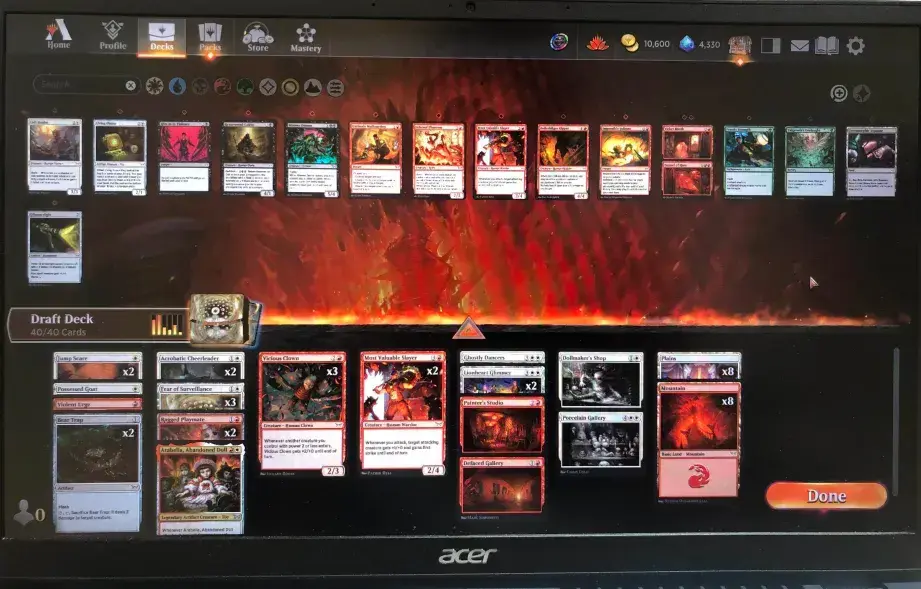
7-2 (Silver rank)
The curve looked great, but in practice it always felt a bit lacking, and I won mostly by attacking with bombs. In three games I first played the white two-mana mythic-rarity Room Dollmaker’s Shop//Porcelain Gallery, then slammed Ghostly Dancers on five to unlock the six-mana side, then sent out a 3/1 flyer and the attack exploded for the win.
After playing it I think the Room Painter’s Studio//Defaced Gallery is bad: the +1/+0 on attack doesn’t get you much, and the three-mana half that digs two cards deep… you have no room to do that when you’re behind.
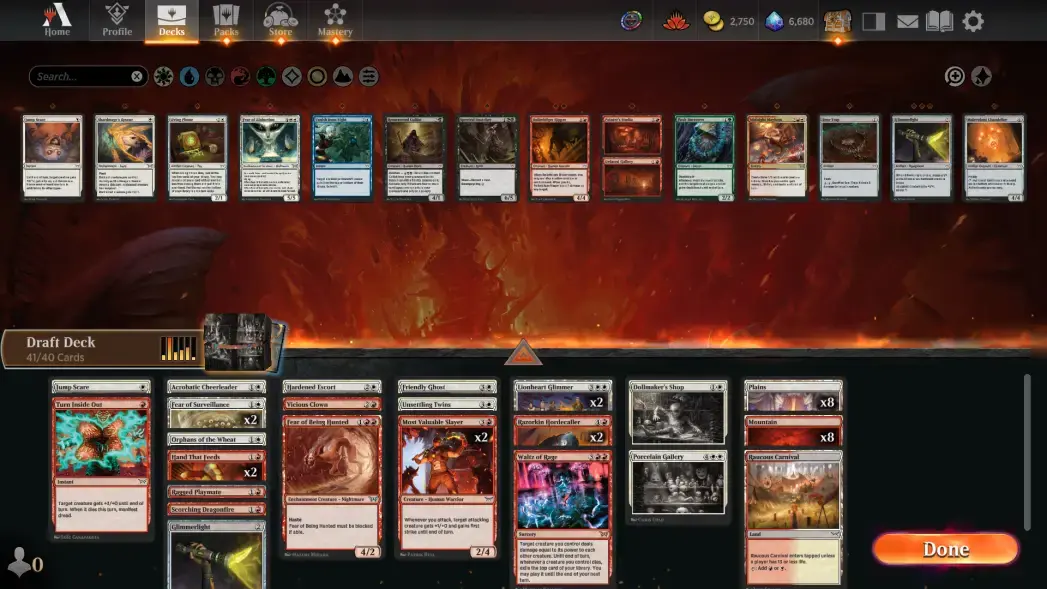
7-1 (Platinum rank)
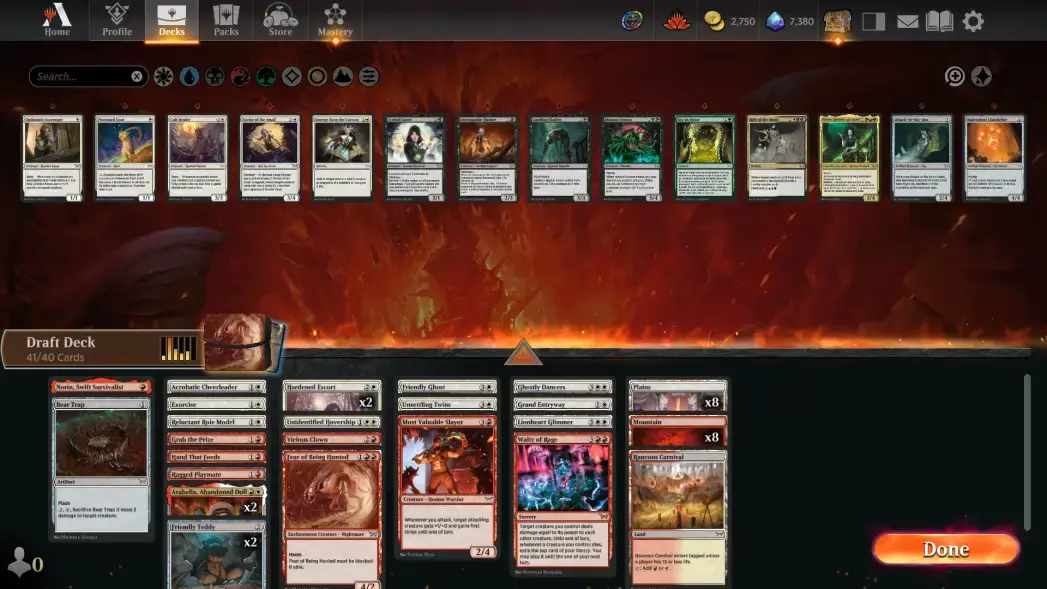
This time I brought Fear of Being Hunted to go with Most Valuable Slayer. Attacking with +1/+0 and first strike makes it a 5/2 first striker that must be blocked, and with a smooth curve going from three to four, unless the opponent has a removal spell, almost every blocker just gets eaten by the 5/2 first striker without hurting it. So much fun!
I also really have to say that the four-mana Midnight Mayhem in RW is a trap card. At four mana you should prioritize Most Valuable Slayer, or at least Unsettling Twins. Three 1/1s with a pile of fancy abilities are far weaker than simply slamming a creature on curve.
On the use of combat tricks, this match also let me feel a significant difference between white and red: white’s Jump Scare is better than red’s Turn Inside Out. Without Most Valuable Slayer giving first strike, Turn Inside Out, which adds no toughness, makes you lose your original creature, and although manifest dread adds offensive power, it is relatively unstable, and using it on defense is even worse. Jump Scare, on the other hand, can give flying on offense to get through, or make the creature bigger for a favorable trade, and on defense it can ambush and let a ground creature jump up and eat the opponent’s flyer. After you cast it, the opponent may even keep holding back against your single white mana, which gains you even more tempo. Our RW deck basically won’t lose the tempo battle anyway, and the tempo the opponent gives up through hesitant attacks greatly increases our win rate!
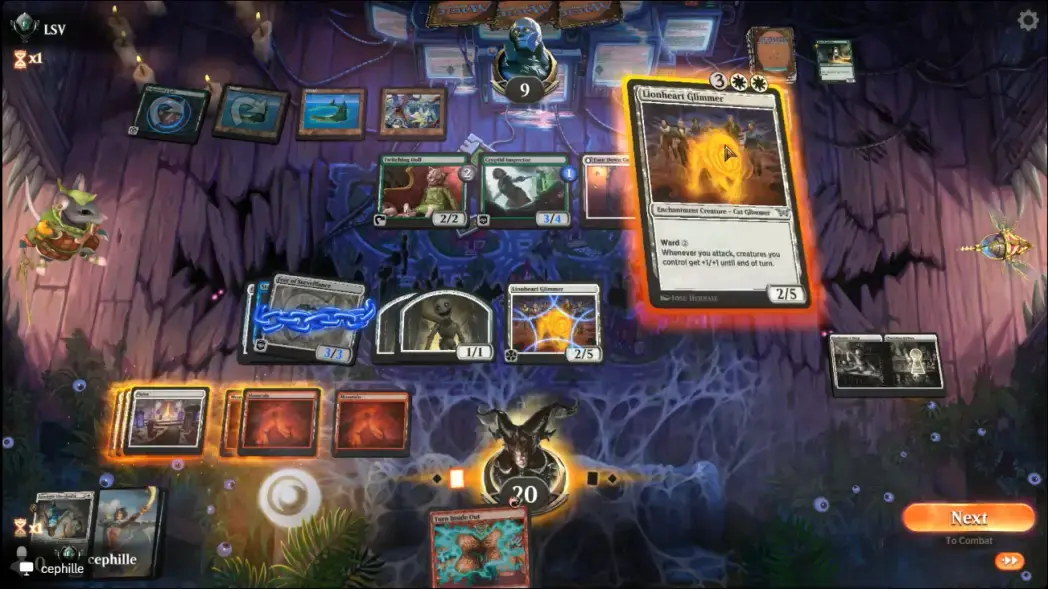
Note: In this run I faced LSV of Channelfireball. He was playing UG splashing black, and I slammed two Lionheart Glimmer in a row and flat-out crushed him, which is a small highlight moment for me, XD (Thanks to T1BloodMoon for the screenshot. I was laughing while streaming; it was hilarious, XD)
6-3 (Platinum rank)
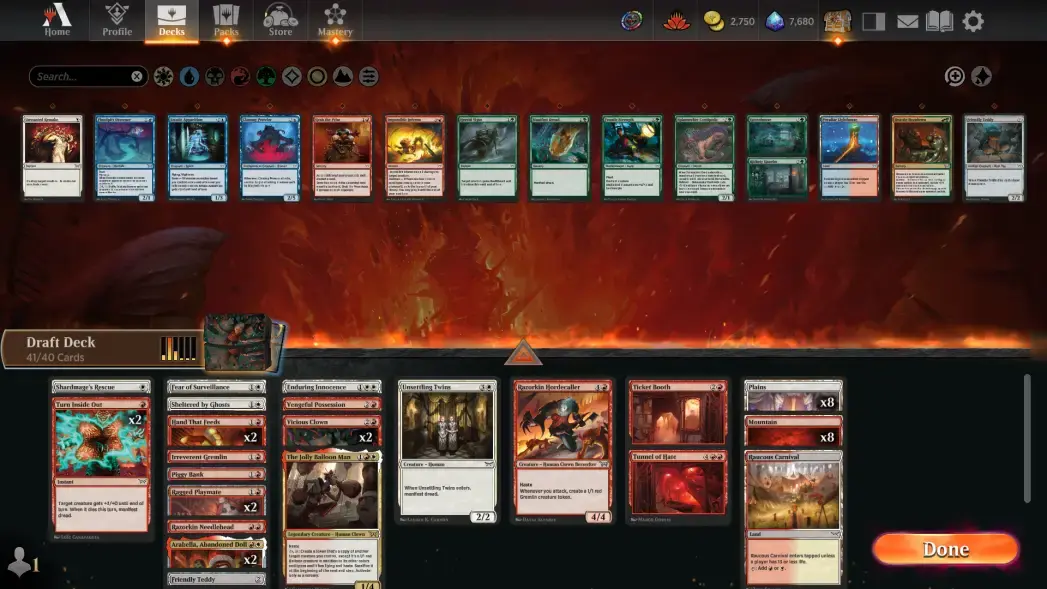
I call this one the “Norin cha-cha”. If I hadn’t mistaken the opponent’s Flesh Burrower for a manifest dread in one of the games and had protected Arabella, Abandoned Doll, it should have been 7 wins… should have, XD
With Norin, Swift Survivalist on the battlefield, our way of playing becomes much more varied!
Sir, report! Arabella, Abandoned Doll can’t come back if she’s played without a trick, what do we do? No problem! We’ve got Noooo-rin!!! Play without fear of dying! Just exile her and recast her. Back and forth that’s several points of life difference, and the opponent grinds their teeth in anger, XD
2-3 (Platinum rank)
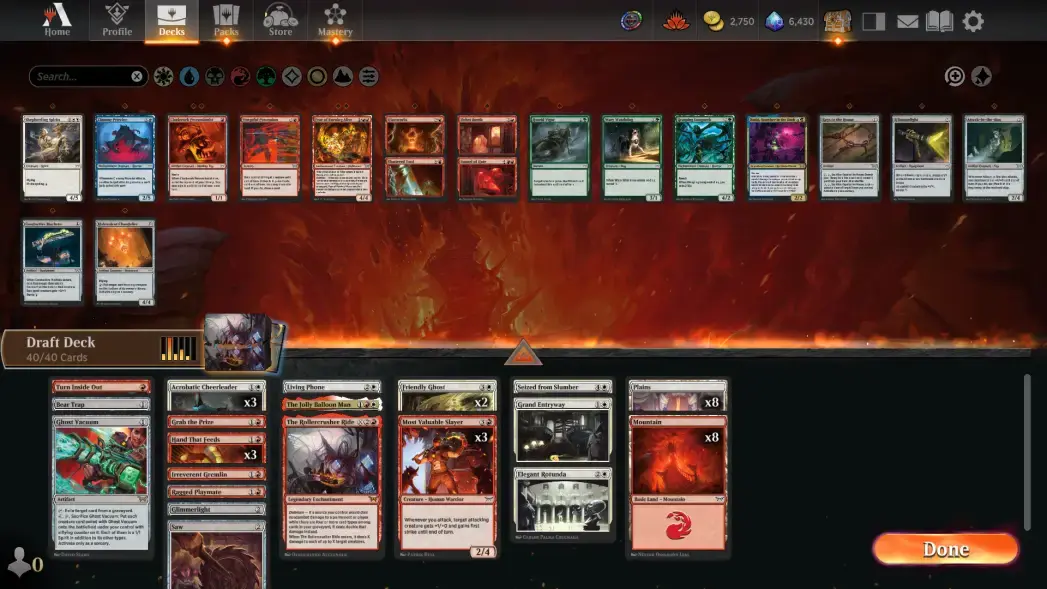
I first-picked the clown Vicious Clown wanting to try a traditional RW deck, but with no key card Most Valuable Slayer in the four-drop slot, stability was far worse. Even with the rest of the curve filled in, once you fall slightly behind it is very hard to come back. In high-rank drafts, holes in the curve get magnified even more.
6-3 (Platinum rank)
This was my revenge RW run right after the 2-3 one. This time I took Most Valuable Slayer as soon as I saw it, and also got two Friendly Ghost, but I never saw a single Vicious Clown this time, leaving a small gap in the three-drop slot. But since the two-drop slot was plentiful enough, the problem wasn’t big, and transitioning to four mana welcomed the most comfortable offensive burst RW can have!
RG (21 wins, 12 losses)
7-2 (Gold rank)
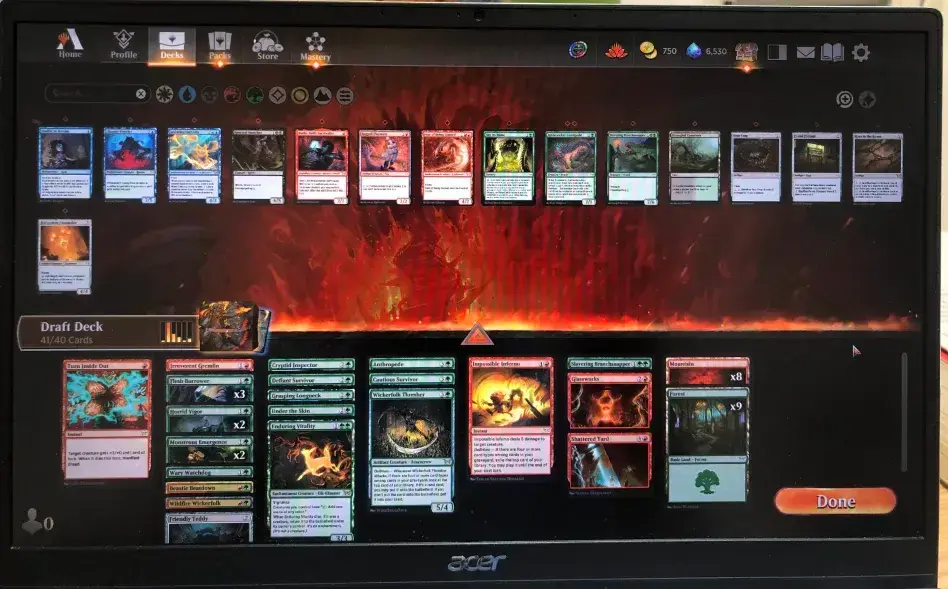
My first time trying Friendly Teddy. Basically I won by attacking with a bunch of on-curve creatures, and when Horrid Vigor nastily surprised a blocking/attacking opponent, that was the game. Three Flesh Burrower attacked wildly, with another deathtouch creature attacking alongside, and they held their own on blocks too.
Don’t forget that Monstrous Emergence has you deal damage to the target creature, not the targeted/revealed creature, so if you pick a deathtouch creature with this sorcery, it will not be deathtouch damage.
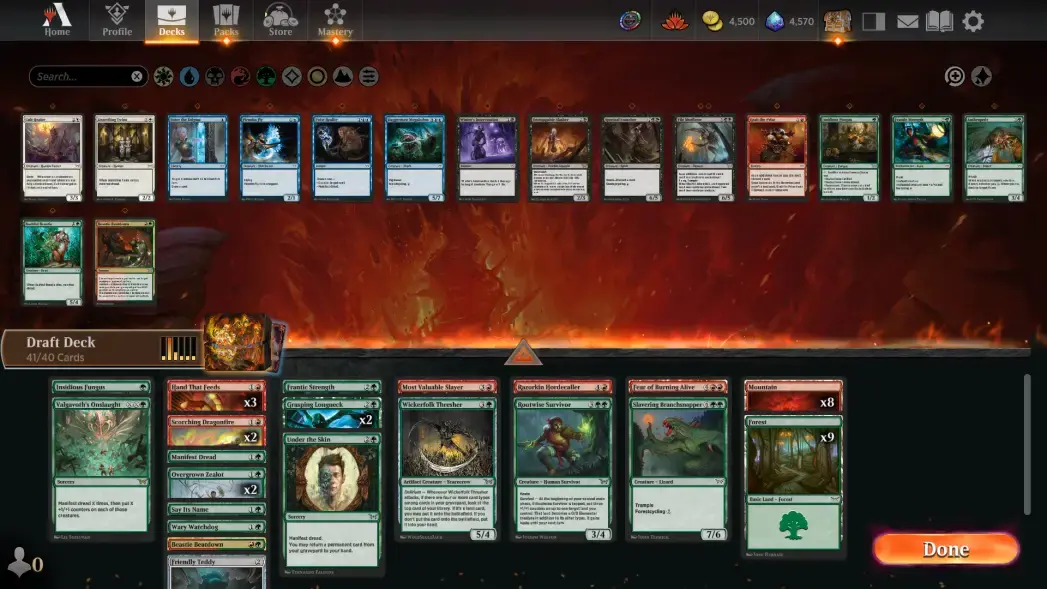
7-2 (Diamond rank)
Again the old RG winning path: attack hard to stack delirium, recur from the graveyard and run another wave, and the game is almost won. The bomb Valgavoth’s Onslaught basically never showed up.
Finally, a note on the RG uncommon sorcery Beastie Beatdown: it is nowhere near the green equivalent Monstrous Emergence. The old problem of getting 2-for-1’d by removal is still there, and waiting for delirium to add those two counters makes you miss the best window to use it as removal, so it is also a rather trappy win-more card. This set has quite a few uncommons that are replaced by commons that do the same job; for example, the green good boy Wary Watchdog totally beats black uncommons like Cynical Loner, which is rather interesting.
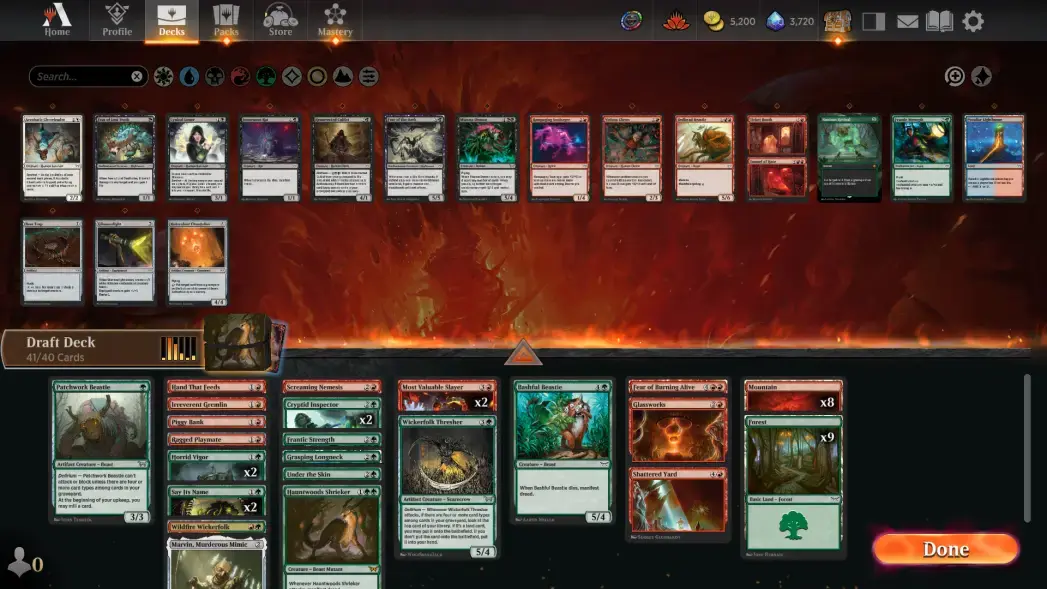
7-2 (Diamond → Mythic rank)
This RG was drafted very well: everything it should have was there, and I got the strong side of both delirium and manifest dread! Basically I mowed through to six wins and reached Mythic, then played a few easy games to finish up!
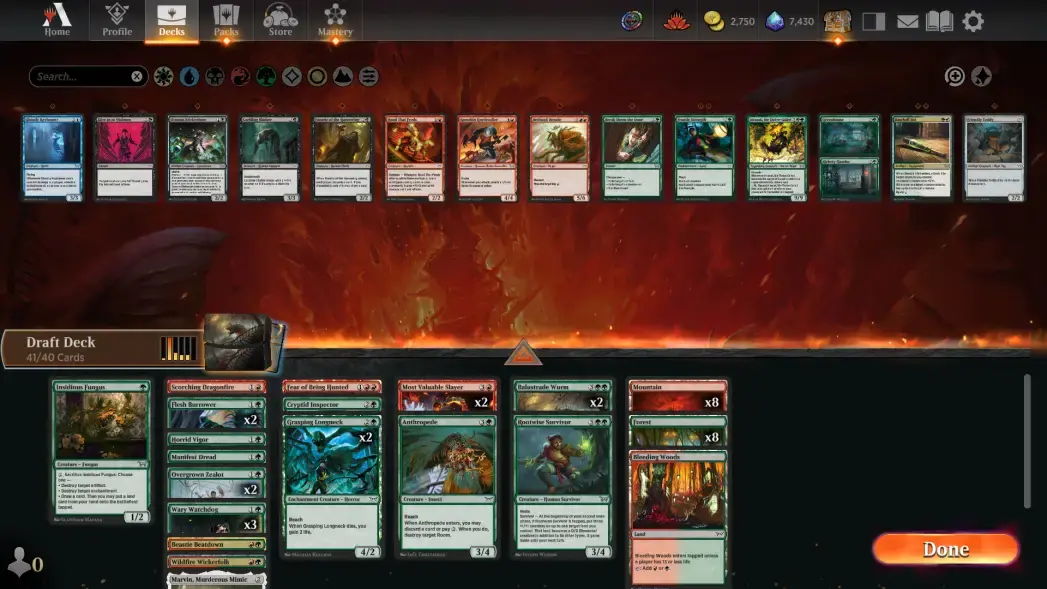
0-3 (Platinum rank)
This was most likely MTGA’s rigged matchmaking: I flooded out in two games and drew everything in the wrong order in the other. Thanks, MTGA.
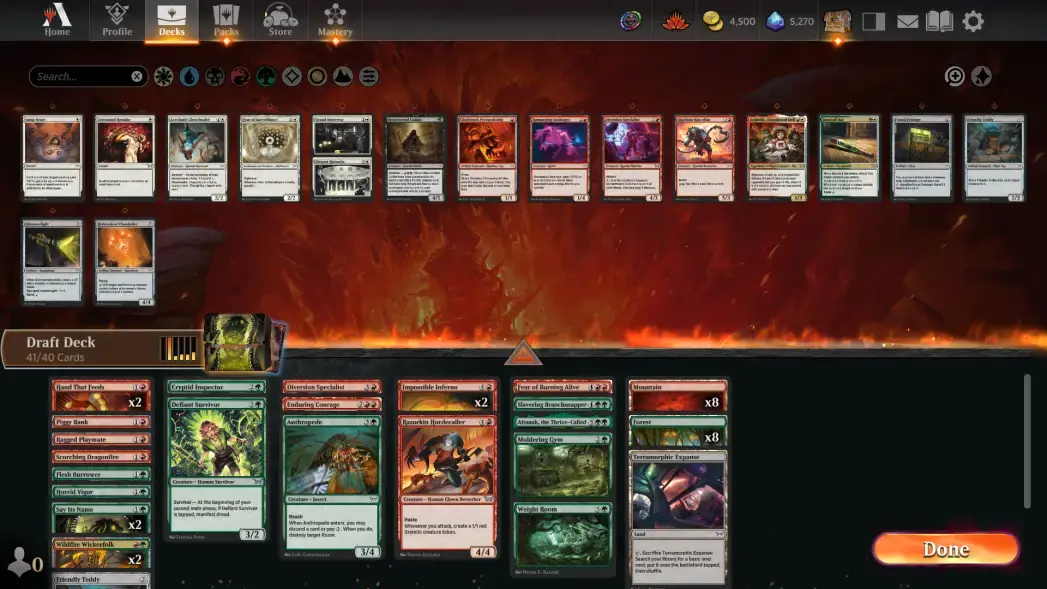
0-3 (Diamond rank)
The three-drop curve of this pool was too weak, and I drifted between RW and RG for too long during the draft, so the final strength wasn’t enough. The five-mana instant Impossible Inferno really isn’t worth playing: we need to hit delirium and crush the opponent as fast as possible, not waste mana killing the opponent’s creatures. A mediocre build like this simply can’t withstand the stronger decks at high ranks.
WG (18 wins, 8 losses)
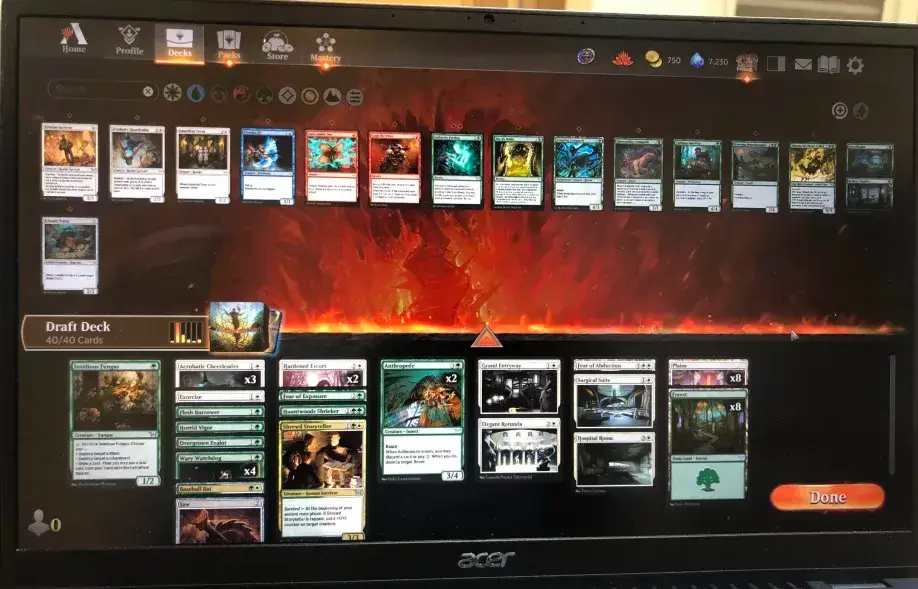
7-2 (Gold rank)
After playing it, I deeply felt that unless survival triggers by attacking and living through it, it is mostly just an ordinary, below-average mechanic. The bat Baseball Bat is very important, but you won’t necessarily get one. And the one-mana 2/1 Veteran Survivor gets worse the more you use it, so I just cut it: even if you play it turn one and the opponent has no blocker on turn two, you can’t eat anything without a graveyard, and if the opponent plays a blocker you have to attack backed by a trick, and standing still it is very weak. For the three-mana Shrewd Storyteller to become strong, you need two or more tricks or equipment to keep it alive after attacking, but then your play becomes very linear, and if the opponent has a single removal spell for it, you collapse easily. The other one, Cautious Survivor, is a passable four-mana 4/4 body, but its value after survival is too small, merely filling the curve.
For WG to be really good, it should still go the low-curve snowball route. I didn’t even want to play the seven-mana 9/9 trampler; at the top of the curve a single ETB card that gets value and fights back, Fear of Abduction, is enough. And both of my losses came from flooding and giving up tempo. I don’t really recommend focusing too much on survival. As for survival effects triggered by voluntarily tapping, unless you’re already ahead on board, tapping your own blocker while behind will make your head explode even faster, XD
After this run I also deeply felt that adding one more trick helped my deck even more than adding a quality removal spell like Exorcise. It sounds strange, but this is my most sincere feeling:
The vast majority of removal spells are nowhere near as good as the synergy of on-curve creatures plus combat tricks. After removal resolves you are still far from winning, but with creatures attacking/defending plus combat tricks, victory is not far away.
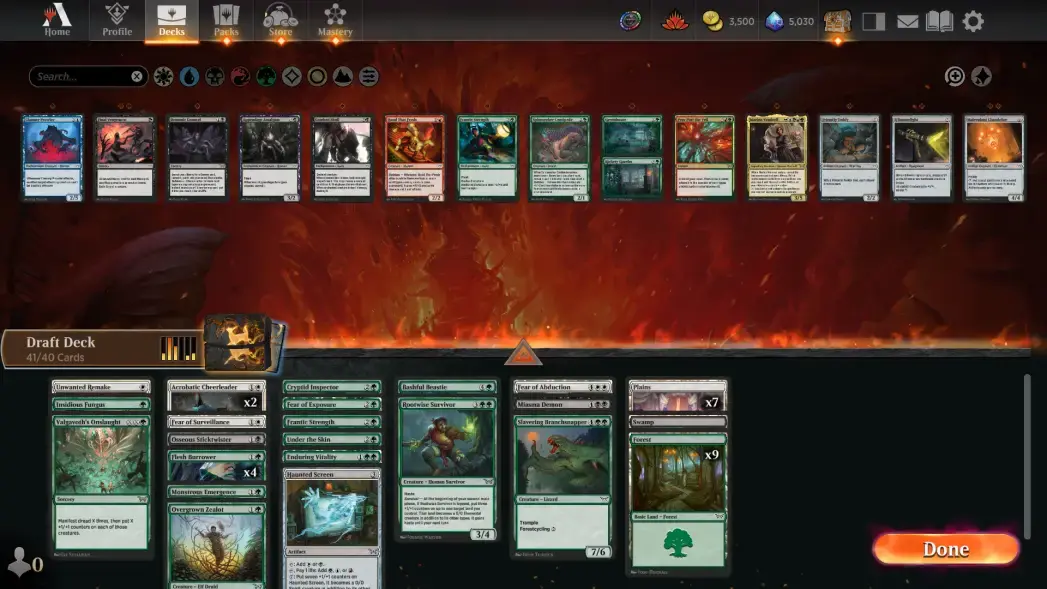
WG splashing B, 6-3 (Diamond rank)
Again I won by attacking with the two-drop curve. There was actually no need to splash black; just playing WG would have been fine.
There was also a WG 5-3 run at Platinum rank whose photo I didn’t save. As I recall, I took two Shrewd Storyteller and later cut down to one; with a good enough curve it didn’t matter whether I played it or not.
UG (8 wins, 9 losses)
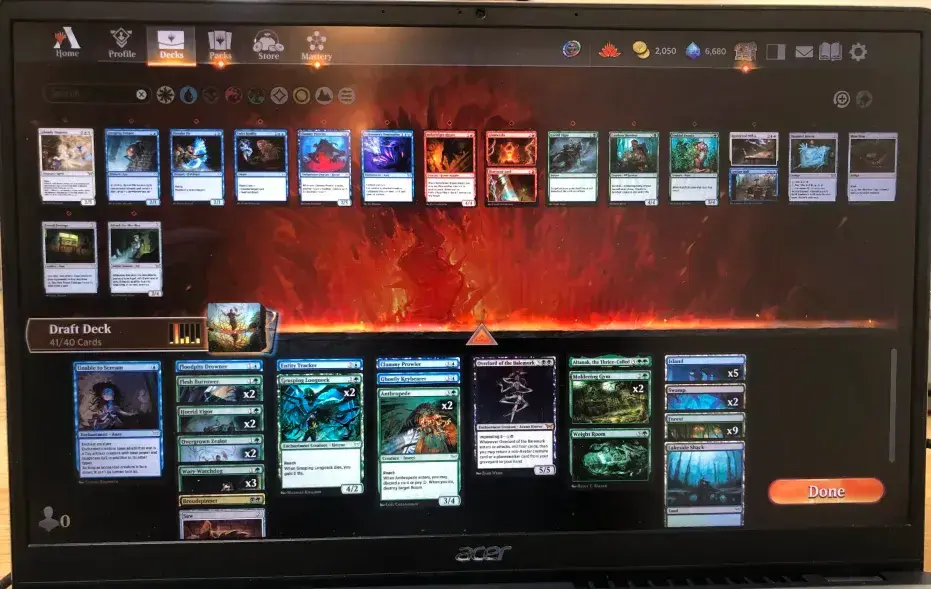
UG splashing B, 5-3 (Platinum rank)
I opened Overlord of the Balemurk in the third pack and couldn’t resist the temptation to take it. But in fact I shouldn’t have taken it, and even having taken it I didn’t need to play it; I should have just focused on UG. The penalty for playing it was running two more Moldering Gym//Weight Room that got in the way of my own tempo.
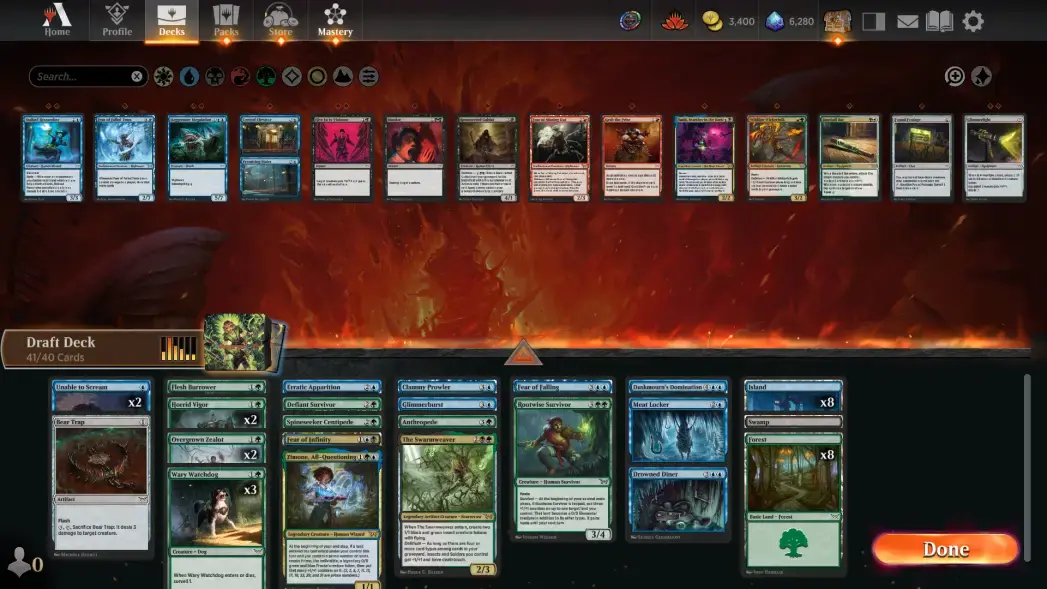
UG splashing B, 2-3 (Diamond rank)
Splashing black for The Swarmweaver was worth it, but just playing that one card was enough. When I took it out, I found the other creatures weren’t very strong, and once you fall behind there’s no saving it.
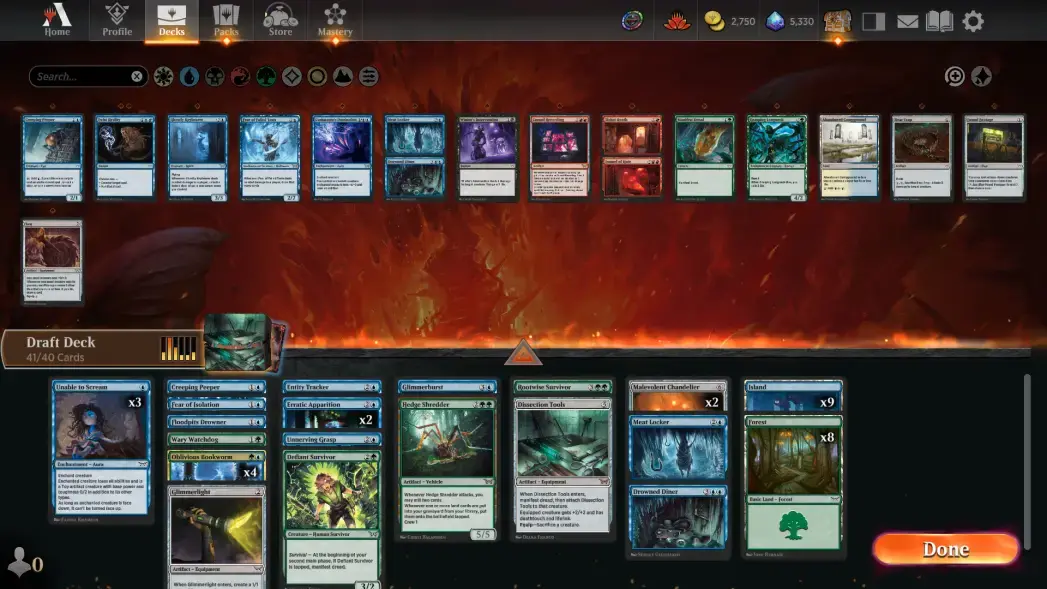
1-3 (Diamond rank)
This is the classic UG case of missing one side. I took four Oblivious Bookworm but never got a single Growing Dread; I think the players next to me were also in UG. Funnily, I thought the end-of-turn draw-and-discard of Oblivious Bookworm was mandatory and was so afraid of decking myself that I took two Malevolent Chandelier early. However, since the UG manifest dread theme already makes your library thinner than others’, several of the UG opponents I faced also ended up dying by drawing out their own libraries, so the choice wasn’t wrong, but one would have been enough.
RB (11 wins, 5 losses)
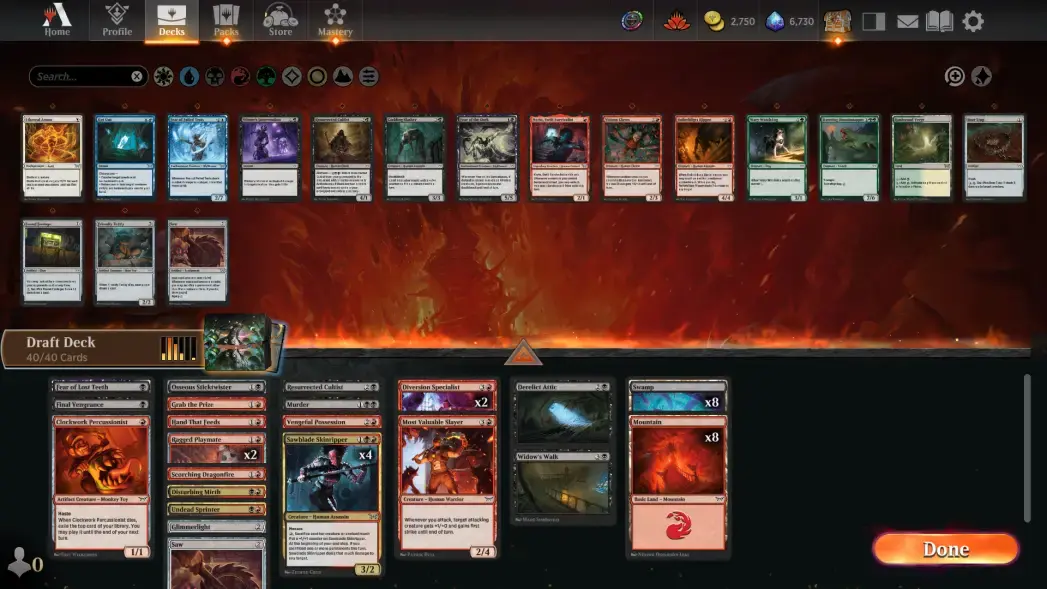
7-2 (Platinum rank)
This was a pool worthy of 7-0 or 7-1; the 7-2 was simply because I didn’t play well. This RB build is the one where I think I assembled the theme most completely during my whole climb. Four Sawblade Skinripper being passed to me as 4 copies clearly means nobody was playing it, and the Threaten effect Vengeful Possession was also a very important signal. Although I only had one Most Valuable Slayer, the deck had many menace creatures that were already hard to block, and giving them first strike on top just means they fly over! I also found a chance to pick up black’s Derelict Attic//Widow’s Walk during the draft. Besides Sawblade Skinripper, this deck has Fear of Lost Teeth, which can attack alone first to trigger and get +1/+0 and deathtouch. Basically the opponent either can’t block or doesn’t want to, and after combat you sacrifice with Sawblade Skinripper to spray deathtouch damage and happily kill the opponent’s big creature! Thanks to this combination I never even needed the Murder I’d included just to be safe. A removal-plus-offense package like this, with a complete RB sacrifice shell, is just that strong!
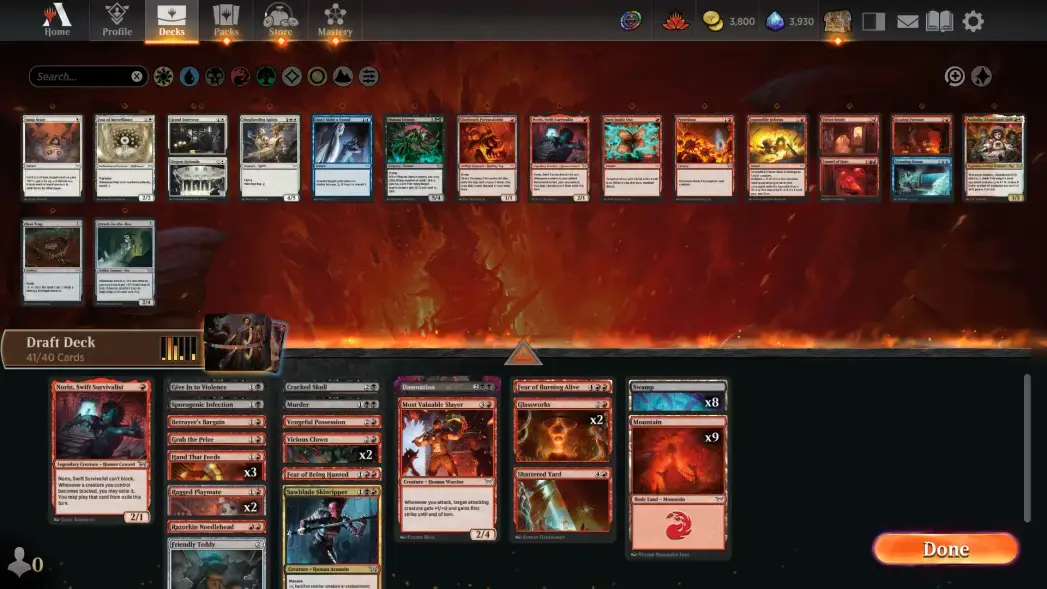
4-3 (Diamond rank)
This was an experimental build. In the third pack I was passed Damnation 4th pick, and wondered what would happen if I played a heavy-removal deck with a weak curve. The result was four straight wins followed by three losses, so there was clearly a ceiling it couldn’t get past. One game left a deep impression: I drew only a single creature the whole game, Damnation swept three creatures, removal killed two more, and I still got run over by UW Eerie. This pool should have just been built as RW, but let’s call it learning by trial and error!
BG (13 wins, 5 losses)
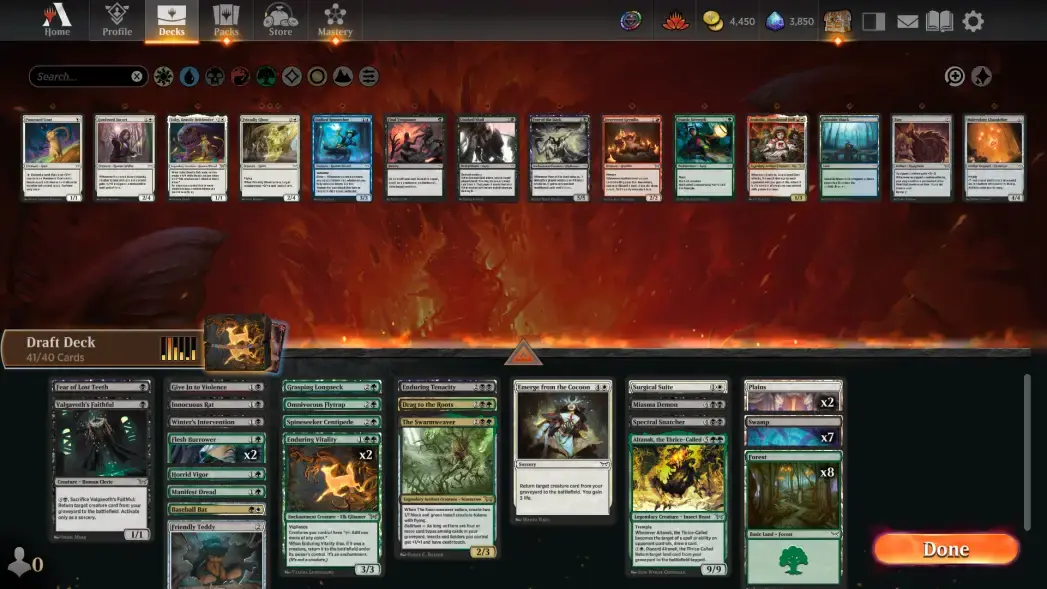
BG splashing W, 7-2 (Diamond rank)
After first-picking the “Bambi”, Enduring Vitality, I was passed another one, which was a bit surprising, but at high-rank drafts everyone basically focuses on their own picks, so it’s nothing unusual. With Bambi the deck plays very flexibly: creatures on turns two and three, then on turn four you can jump to a six-mana Demon, which is very explosive! I originally ran Toby, Beastie Befriender but found it had little synergy, so I cut it and just focused on using Bambi to ramp or recur from the graveyard.
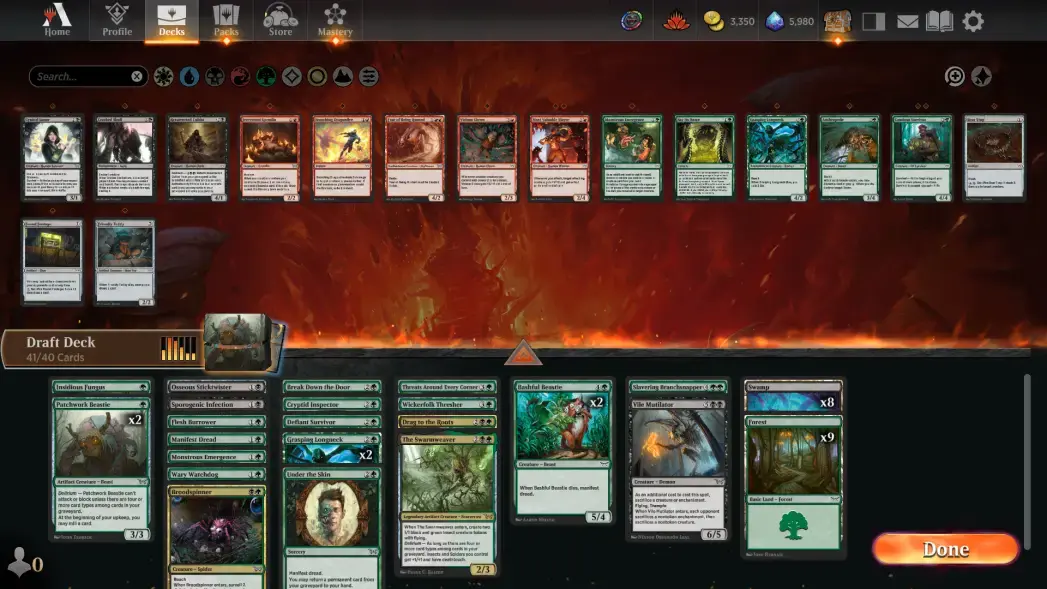
6-3 (Platinum → Diamond rank)
A very well-drafted BG. Basically you need Patchwork Beastie, a bunch of creatures with two types, graveyard recursion (the best is Under the Skin; Say Its Name is fine too), and then some burst for after you hit delirium. The Swarmweaver is a very important bomb for this color pair.
UW (4 wins, 3 losses)
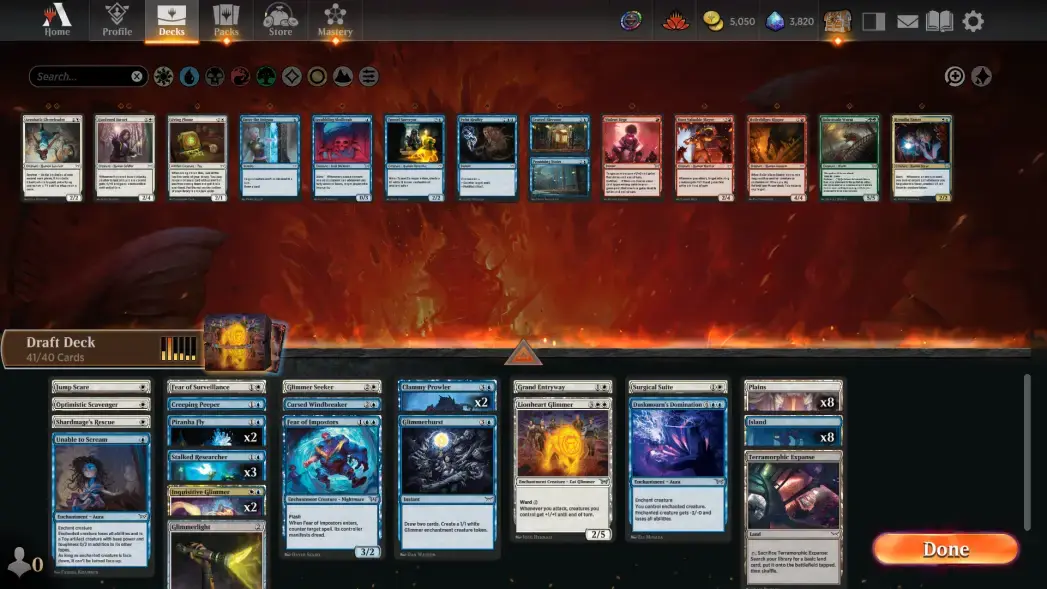
4-3 (Diamond rank)
This pool was actually not bad, but in several games I was on the draw and the Izzet Doors deck generated too much value and there was nothing I could do. Basically, on the play: Optimistic Scavenger on turn one, then the flashlight Glimmerlight or Fear of Surveillance on turn two; Inquisitive Glimmer on turn three to unlock Grand Entryway//Elegant Rotunda at reduced cost. If the opponent has no sweeper, I honestly don’t know how you’d lose.
A quick word on why UW has such a high win rate and is so strong. I think it comes down to Optimistic Scavenger, plus blue’s various cheap Auras like Unable to Scream and Stay Hidden, Stay Silent, which both neutralize creatures and trigger Eerie to strengthen your board advantage.
One more thing: earlier I had a UG 1-3 run, and my only win came from coincidentally countering the opponent’s UW Eerie. The opponent curved out with UW plays on turns one, two, and three, and I stuck three Unable to Scream in a row on their creatures and shut them down, XD Still, to withstand UW’s smoothest starts, that’s probably the only way.
UB (0 wins, 3 losses)
No photo recorded, 0-3 (Silver rank)
This was my very first draft. I kept trying to draft the UB style from that article about my prerelease opening, so I took two copies of the three-mana counterspell Twist Reality, lots of removal, Island/Swamp cycling, and Live or Die planning to bring the landcyclers back from the graveyard for the late game. It turned out playing like that was terrible: black-based creatures defend poorly, and trading removal one-for-one against aggro is a huge loss. In one game I played against RW and remember it vividly: I had four or five lands on the battlefield, played two creatures to block one of the opponent’s, then used two removal spells to kill one creature each, and then I had no hand while the RW opponent still had 4 cards in hand! Seriously? How am I supposed to win playing UB with no resources!?
Here is a response to the black win rate problem I mentioned earlier. It was basically all reflected in these matches:
- Weak low-drop creatures can only trade at a disadvantage (
martyrstyle); - Removal is one-for-one and relatively expensive, so against fast RW, RG, and even UW it can’t get ahead;
- If you want to draw cards to refill resources, that basically hands the opponent a lethal turn or a crippling turn.
BW (2 wins, 3 losses)
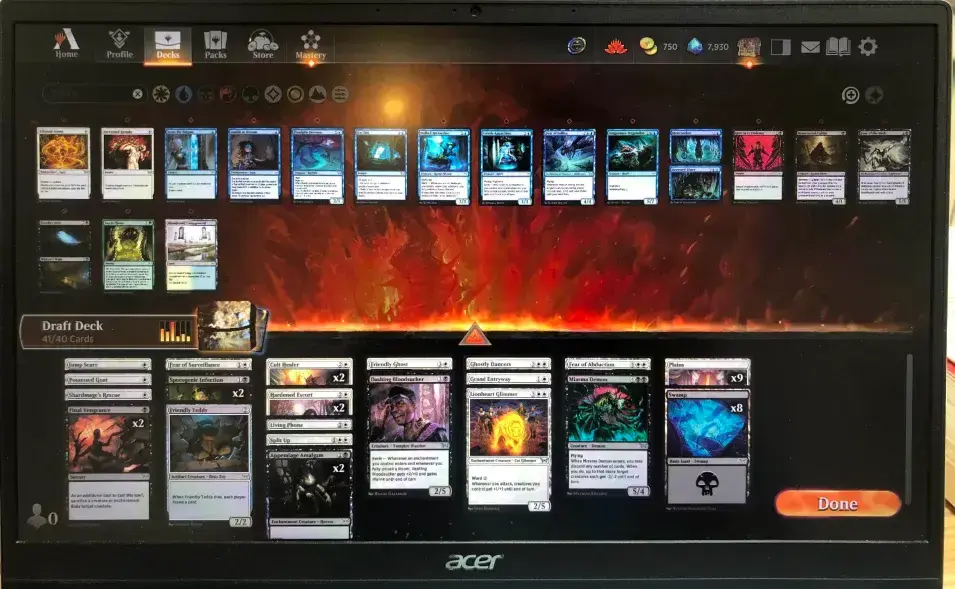
2-3 (Gold rank)
Basically this pool should count as mono white splashing black, not really WB in the true sense, since I never got any of the graveyard recursion pieces. The problem with this deck was the curve: too few two-drops, so it was easy to get run down to low life early and be unable to block. And the high end of the curve had no real bombs, so overall it just couldn’t play.
RU (not used, 0 wins, 0 losses)
The following section is experience shared by Jeffchen.
This set’s Izzet is nominally the Rooms theme, but in actual play it feels more like Izzet tempo. You use red removal to hold off the early attacks and take the chance to unlock Rooms for resources, and finally win with flyers. To play this color pair you first need to pick up good red burn like Scorching Dragonfire, and for creatures you want Creeping Peeper or Stalked Researcher early to bridge. Rampaging Soulrager is a good card that does both offense and defense, but it costs three and needs two Rooms unlocked to become a 4/4, so it suffers from being too slow. For uncommon Rooms I recommend Bottomless Pool//Locker Room, and for common Rooms I recommend Underwater Tunnel//Slimy Aquarium and Meat Locker//Drowned Diner. Ghostly Keybearer is the signal that tells you it’s safe to play Izzet; and if you see the rare Roaring Furnace//Steaming Sauna, that’s fantastic!
This set’s gold uncommon Intruding Soulrager is very useless; in most cases you’re forced to trade it with the opponent’s two-drop. The other one, Smoky Lounge//Misty Salon, is only a passable flyer, and you can only use it once you’ve stabilized the board.
Conclusion: don’t go into Izzet on purpose. The advice is to take enough strong bombs and good removal, and only play it if the player upstream passes a signal card. This set’s Izzet uncommons and commons can’t support its power level, it is easily run through by other color pairs, and playing mainly defense is not a good strategy. (cephille: Defense just gets you crushed by aggro, XD)
Key Cards
The key cards here prioritize commons that the color pair needs; only when the commons aren’t strong enough to carry the color pair do I list uncommons, or even rares.


The three categories listed in the table above, low-cost curve creatures, theme cards, and combat tricks and removal, are what I consider the three most important dimensions of a DSK draft deck. The cards mentioned are also ones I found from actual play that each color pair must have, and the more copies the better. However, for the last few color pairs, WB, UB, and UR, I don’t have much personal experience, so the cards listed there are for reference only. If you want to try them, I suggest relying mostly on how they feel in your own testing.
Special Thanks: Friendly Teddy

Sharp-eyed readers will notice that I put the teddy bear Friendly Teddy into the main deck of at least 10 pools. I originally rated this card rather low, and I never felt happy playing it; but one day Jeffchen said to me, “Hey! The teddy bear is really strong!” Half doubtful, I tried it once in RG, and have been a believer in the Teddy Church ever since. If a pack has a decent removal spell (Murder, Trapped in the Screen, etc.) but no on-curve creature suited to my color pair, then if there’s a teddy bear in that pack, I’ll definitely take it, and there’s a high chance it makes my main deck.
Besides being a good fit for both types to help build delirium, it is a two-drop you don’t feel bad about losing, and when you play it in RG or RW, drawing a card on offense versus drawing a card on defense are worlds apart! Your opponent also draws a card, but may not have enough time to use the extra resource, while we, as the aggressor, can get significant gains from it!
Friendly Teddy, your good friend on the DSK draft road!
Extended Discussion: Differences Between MTGA Draft and Paper Draft
- Premier Draft is a Bo1 draft, so you don’t need to think about sideboards and can focus entirely on your draft strategy. Paper, however, is basically played Bo3, so in later picks you still need to think about whether there are sideboard cards worth taking.
- On MTGA, especially at high ranks from Platinum up, you will see some strong cards get passed to you, and if you can’t use them, feel free to pass them along! After all, you are very unlikely to ever face those players drafting with you. In paper drafts, though, if there is a really, really strong bomb (such as The Rollercrusher Ride or Valgavoth’s Onslaught arriving in the third pack when you aren’t playing that color at all), you may still want to think about whether to take it.
However, if you have already drafted an excellent deck with curve, theme, and combat tricks, then apart from unexpected low-probability events like mana flood, or the super bombs mentioned in point two that can trade 1-for-N, as long as you stick to your game plan, I think you don’t need to worry too much about these two differences in DSK draft.
Conclusion: Climbing the Ladder With Friends Was the Most Passionate Thing I Did This Year!
Thanks to my teammates at Guildmages’ Forum for their support and advice on this Limited run. Special thanks to Jeffchen and faintmama for discussing each draft with me and giving me valuable advice. Through this practice, I feel my view of Limited has broadened, and I can take losses to flood in stride. I also deeply felt the importance of these three things:
A smooth curve with many two-card combinations for a strong aggressive strategy (especially in RW and RG), a snowball plan carried by commons and uncommons alone (RB and UW), and, most important of all and running through everything, the skillful use of combat tricks. Curve, theme, and combat tricks: you cannot do without any of the three in a draft. And this seems to go back to early MTG Limited theory, except that the individual cards we use now are stronger.

I personally think an extreme-aggro Limited environment that pairs with its themes like BLB is still rare, and in future Limited environments, especially drafts, we should all pay special attention to the combination of the three above. Basically, in my draft records, my best runs all won six to seven games through those three things, and the bombs were merely the icing on the cake or helped me turn games around when behind. If you took a pile of impressive-looking bombs and still went under four wins, very likely one of these three elements is missing from your deck. One or two bombs alone cannot rescue a flawed draft build, let alone the fact that you won’t necessarily draw them! To quote an important idea Jeffchen told me:
“After you build your deck, kick out the R/MR cards and look at it. If it is still strong, your draft strategy is right. Never take lots of UC cards that drag down the average, or cards with no synergy, just for one strong card. Bombs are your ceiling and you can only hope to meet them, but UCs decide the floor of your deck and are something you can control during the picks.”
If there is anything left unsaid, look for it in the draft. Let’s all get passionately drafting together!!!
- Title
- Duskmourn: House of Horror (DSK) Draft Report
- Author
- cephille, jeffchen
- Created at
- October 6, 2024
- License
- This work is licensed under CC BY-NC-SA 4.0 .