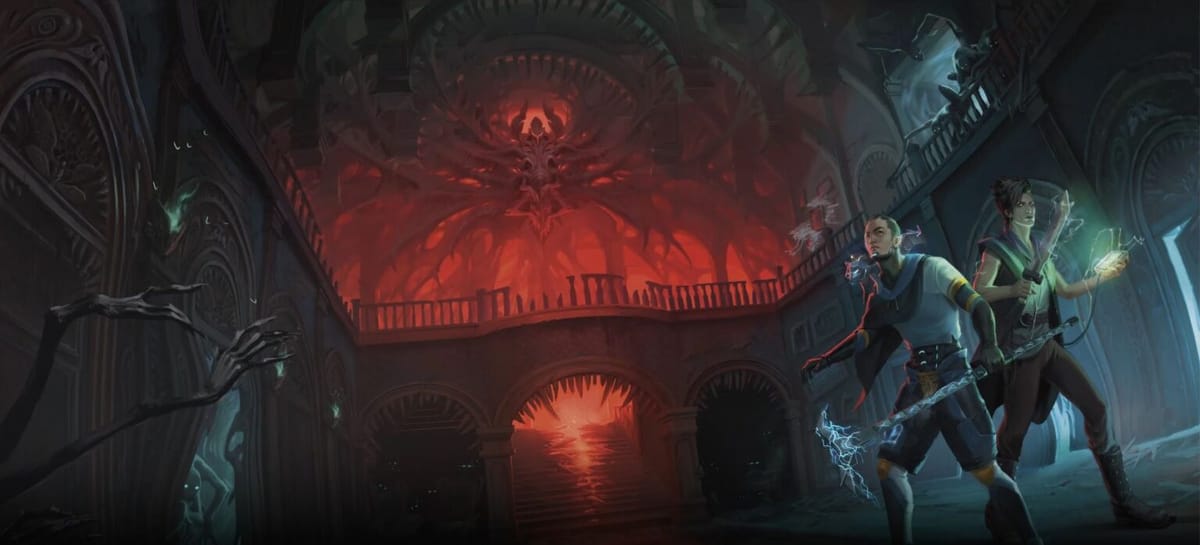
Duskmourn Limited First Look

Note: This article was translated from Chinese by AI and may contain errors. Read the original Chinese version.
The rules introduction for Duskmourn’s mechanics will not be repeated in this article. Readers who need it are welcome to go back and read this one: Duskmourn Mechanics Explained
The content of this article is adapted and expanded from the Duskmourn: House of Horror entry on the MTG wiki. In addition, this article was written before the DSK prerelease began and is only meant to give readers a preliminary understanding of the set. If some content turns out to be wrong or in need of adjustment during later Limited practice, readers are welcome to leave a comment or send a private message with suggestions on the Guildmages’ Forum 魔風集會所 Facebook page. Thank you!
Before We Start
Since Play Boosters began with MKM, Limited has gained stronger removal, stronger bombs, and a brand-new concept: the “curve bomb”. I saw this concept in an article published by a Chinese netizen on the WeChat platform, 老汉 MTG, and found it very apt.
Traditional Limited thinking has been comprehensively broken, with curve bombs and quality combat tricks overturning the idea of winning Limited through resource battles. Offense is the best defense: you rely on cheap removal or combat tricks to kill the opponent’s curve bomb in time, then slam down your own to take over the game. This scene has become a common sight. Many veterans have also relearned new ways of building to adapt to this shock, and that of course includes us.
I’m putting this up front: on one hand I’m glad someone wrote down the sense of dissonance that veterans have to adapt to, and on the other hand I hope readers will start paying attention to this kind of concept and level up in Limited along with our team’s articles. Readers who want more in-depth information are welcome to read this article for further reading. I won’t repeat what others have said here.
Further reading: [Limited Guide] Inner Cultivation: An Introduction to “Modern” Limited
Predicting the Speed of Duskmourn Limited
Compared with the recent Bloomburrow (BLB) Limited, judging from its design, Duskmourn Limited is bound to be a slower environment than BLB. You can feel this from the following points:
- Enchantment theme: The design of Rooms and unlocking requires players to invest more mana to earn a resource advantage.
- Delirium and reanimation themes: Setting up the graveyard takes time (this also indirectly answers the main reason Blue-Black performed poorly in BLB: by the time you meet the threshold, the Rabbits and Mice have long since broken your head, XD).
- Survival theme: White-Green’s Survival theme demands that your creature survive to the second main phase and be tapped. Rather than attacking and praying to survive, just lying down on your own is more efficient.
- Manifest dread theme: Although manifest dread doesn’t have an obvious slowing effect like the disguise mechanic in MKM, a 2/2 creature with the potential to turn face up and grow also makes players hesitate when attacking, and this opportunity cost brings a certain degree of slowdown to the environment.
- Said to be aggro, but focused on power 2 or less: What we normally understand as aggro is playing as many cheap creatures as possible that can grow, supported by combat tricks and burn to get the kill early. But DSK’s Red-White theme focuses on power 2 or less, which is intriguing; rather than aggro, it’s more of a go-wide steamroll approach. And the time spent going wide naturally slows the environment down as well.
Combining the five points above leads me to my initial conclusion: DSK Limited is definitely slower than BLB, and readers can verify this in the Limited games to come.
Introducing the Ten Two-Color Themes
Blue-White — Eerie Tempo
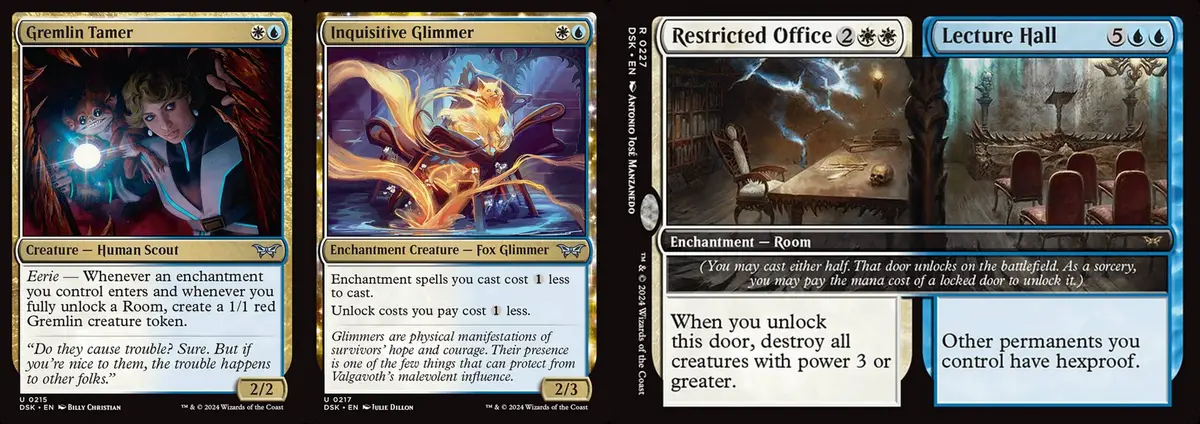
Number of enchantment cards in Blue-White: 36 + 1 (1 colorless enchantment land Valgavoth's Lair
)
The U card Inquisitive Glimmer serves as the accelerator for this approach, making enchantments and unlocking Rooms easier, and it will certainly be the key card of this approach. The other U card, Gremlin Tamer
 , is a relatively ordinary Eerie payoff card that works well when you have enough enchantment/Room cards. As for the R-rarity White-Blue Room, the white side Restricted Office // Lecture Hall
 can destroy all creatures with power 3 or more, which also hints that most of Blue-White’s creatures will have power 2 or less, so you can benefit one-sidedly from this sweeper. The blue side Restricted Office // Lecture Hallcan give your other permanents hexproof, and you only unlock this door when you have enough mana and need it.
Seeing a focus on creatures with power 2 or less also reminds us of the characteristics of Red-White, and the Room theme of Red-Blue is also highly linked with White-Blue’s Eerie theme. Does this imply that the three Jeskai color pairs (red, white, blue), namely White-Blue, Red-White, and Red-Blue, can work together with high synergy in Limited?
Takeaways
- Play enough enchantment/Room cards to earn plenty of Eerie payoffs.
- Blue-White has many power-2 creatures, so rather than ground combat, attacking with flyers will be more efficient.
- If your mana allows, splashing some red cards to form a Jeskai three-color deck may be a viable approach.
Blue-Black — Eerie Control
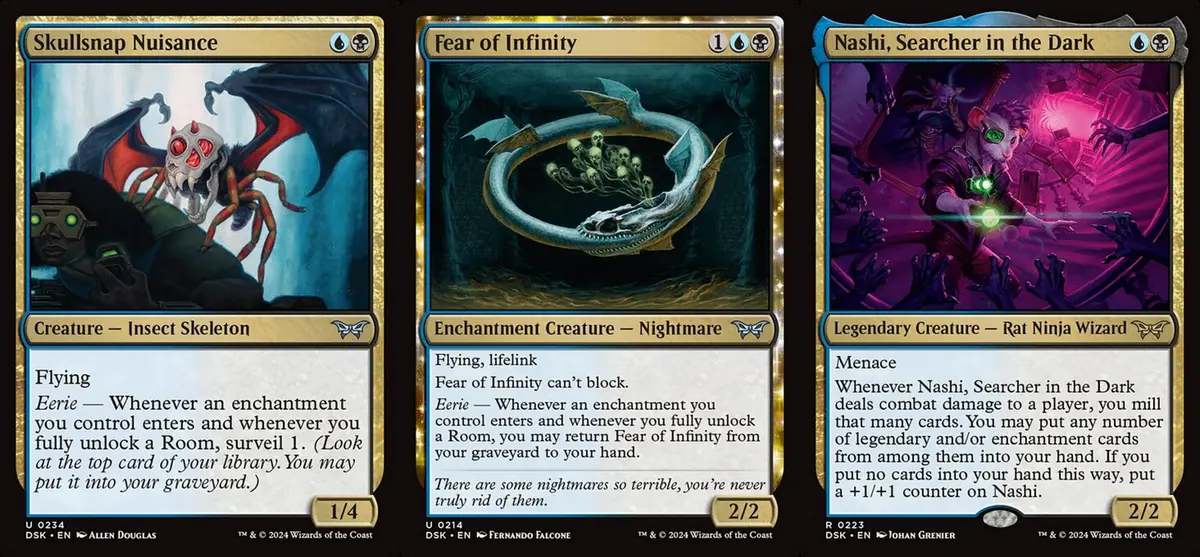
Number of enchantment cards in Blue-Black: 35 + 1 (1 colorless enchantment land Valgavoth's Lair
The U card Fear of Infinity is the core of this approach. Each time you trigger Eerie, you can retrieve it from the graveyard and cast it again to keep triggering Eerie. However, its inability to block prevents us from repeatedly blocking with a 2/2 flying lifelinker, keeping a healthy life total and a full pile of resources to crush the opponent’s offense. This forces us to attack to maintain our life total, which is undoubtedly a strange restriction for Blue-Black, a color pair that excels at resource battles. The other card, Skullsnap Nuisance
 , looks weak as an Eerie payoff at first glance, but a two-mana 1/4 flying body is quite supreme, and it also covers the weakness of Fear of Infinity. The R card Nashi, Searcher in the Dark
 also encourages you to attack to earn value, and your build also needs enough enchantments so you can reuse it repeatedly.
From a first look, Blue-Black is less a control deck than a variable-speed enchantment midrange deck, possibly able to shift gears between aggro and midrange. The design that the core card can’t block is quite subtle, and perhaps building toward a low-curve midrange deck that reuses enchantment enter effects might be more suitable.
Takeaways
- Blue-Black isn’t control in the true sense, but more of a variable-speed midrange deck, as you can tell from the core card encouraging players to attack.
Red-Black — Sacrifice
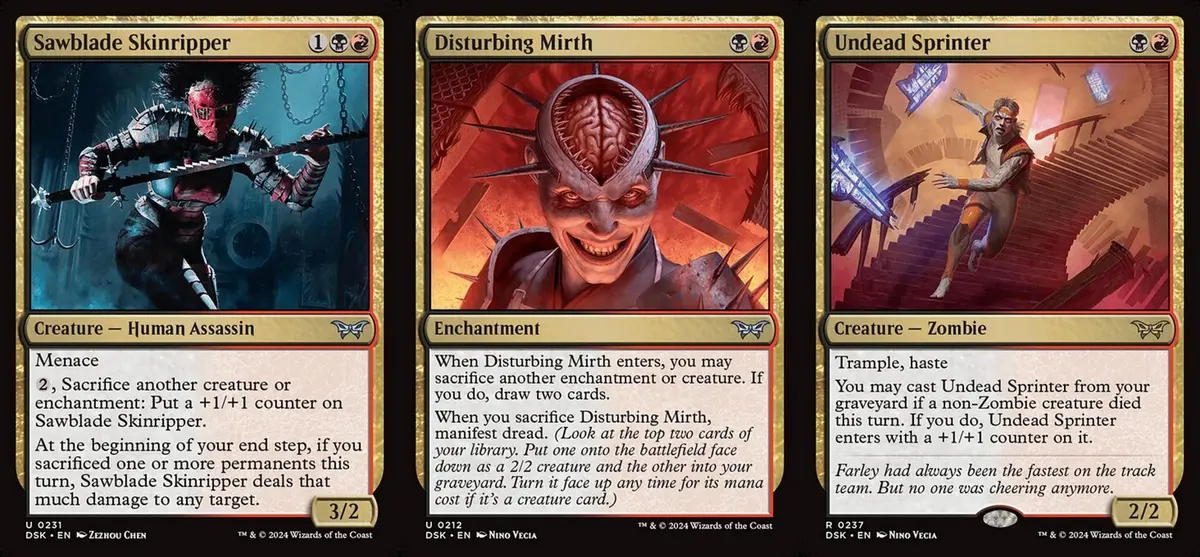
Number of cards in Red-Black that care about sacrificing creatures/enchantments: 8
Number of cards with activated abilities that can sacrifice permanents: 3
The U card Disturbing Mirth can’t sacrifice itself. Although this makes its payoff less reliable, when it works you earn card advantage, so when building you may need to pay attention to cheap permanents and cards that can create tokens. The other U card, Sawblade Skinripper
 , delivers efficient removal or extra damage as long as you’ve sacrificed any number of permanents by the end of the turn. Interestingly, the R card Undead Sprinter
 is very suitable as fodder for these two U cards. After returning, it’s a 3/3 trampling haste body, and it can also achieve the graveyard-synergy effect. However, this color pair still needs more fodder groundwork to let the theme cards perform better.
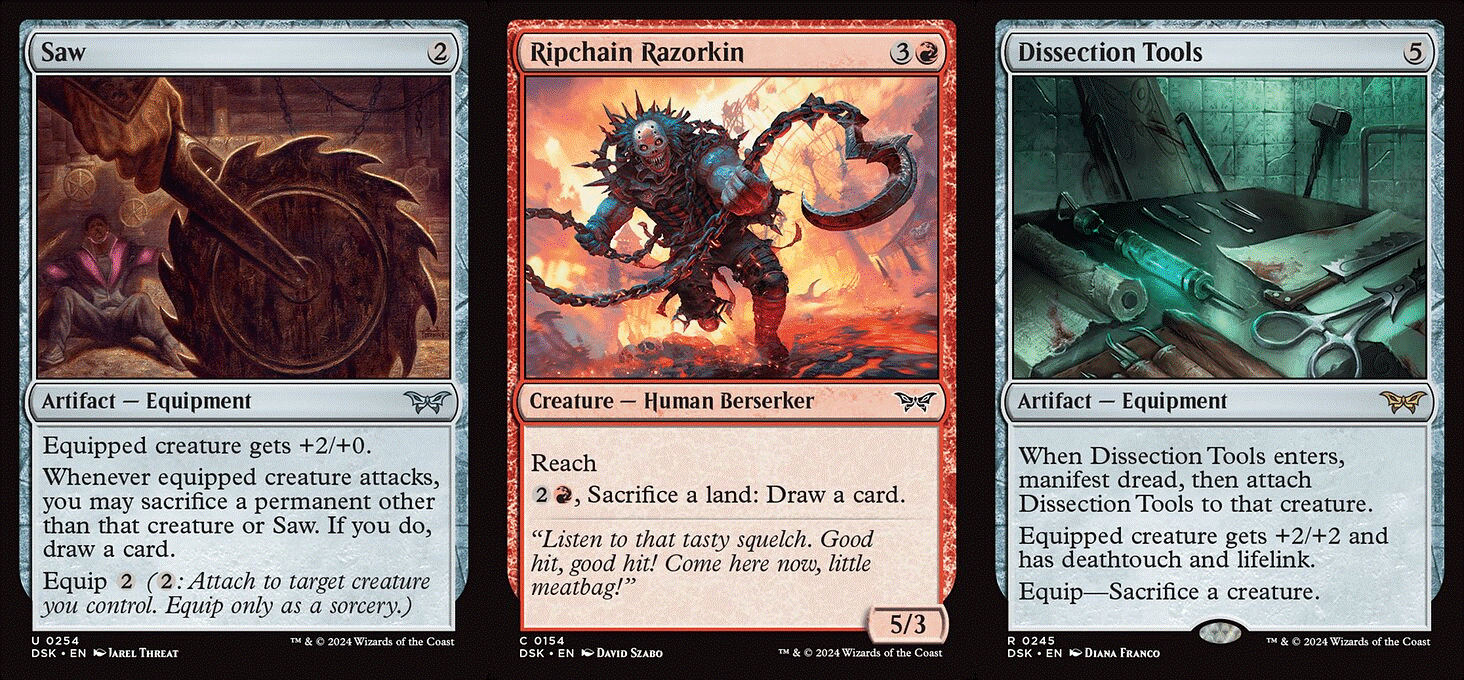
As an aside, the three cards above all have activated abilities that can sacrifice permanents, creatures, or lands, and this can also link up with the passive effect of Sawblade Skinripper, so they’re worth including in a Red-Black build.
Takeaways
- Cards that can create several creature tokens at once, or repeatedly, are very important in Red-Black.
- The R card Undead Sprinter, which can return, is not only fodder but also a help for launching surprise attacks in the mid to late game!
- Other cards with activated abilities that sacrifice permanents are also worth considering when building.
Red-Green — Delirium Stompy
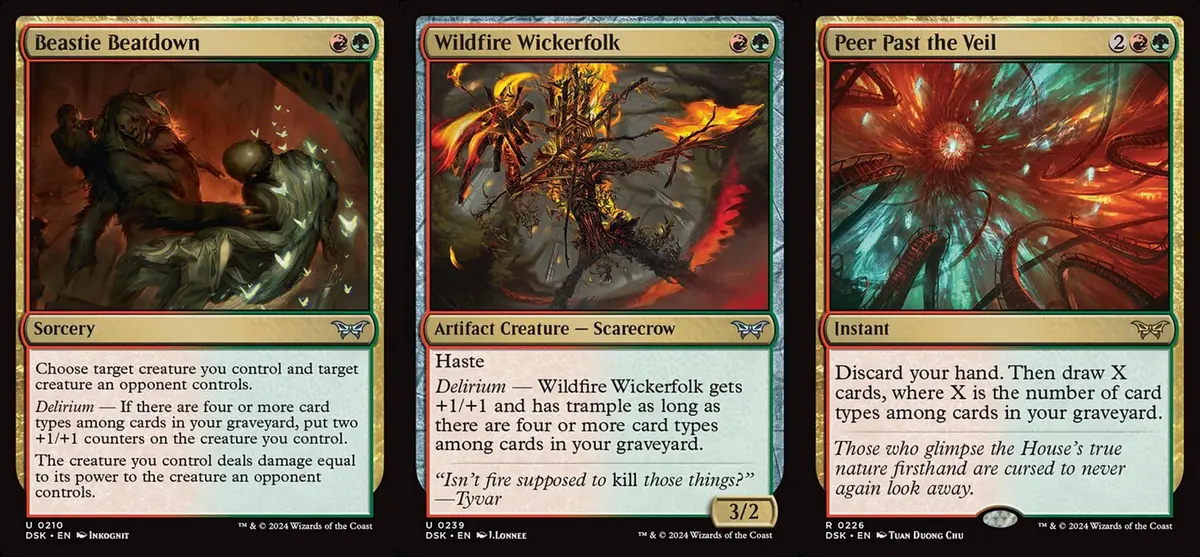
Number of Delirium cards in Red-Green: 13 + 1 (1 black-red-green three-color legend)
Red-Green Delirium’s creatures are very aggressive, as you can see from the U creature Wildfire Wickerfolk : a two-mana 3/2 haste body that, with Delirium, becomes a 4/3 and additionally gains trample. It also directly contributes two card types, artifact and creature. Obviously, this time Red-Green’s main play is quality, aggressive creatures that get an extra bonus once Delirium is on. The other card, Beastie Beatdown
 , is a usable removal spell before Delirium, and after Delirium it can make your creatures bigger. The R card Peer Past the Veil
 encourages you to fill the graveyard to trigger Delirium and get rewarded: the more card types in the graveyard, the more cards you draw back.
Takeaways
- Red-Green focuses on all-out Delirium aggression. If you choose creatures with two card types, such as artifact creatures and enchantment creatures, it will help you reach Delirium as soon as possible after early trades.
- Of course, when selecting cards you still need to check whether their pre-Delirium effect is acceptable. It’s not recommended to look only at the post-Delirium effect.
White-Green — Survival
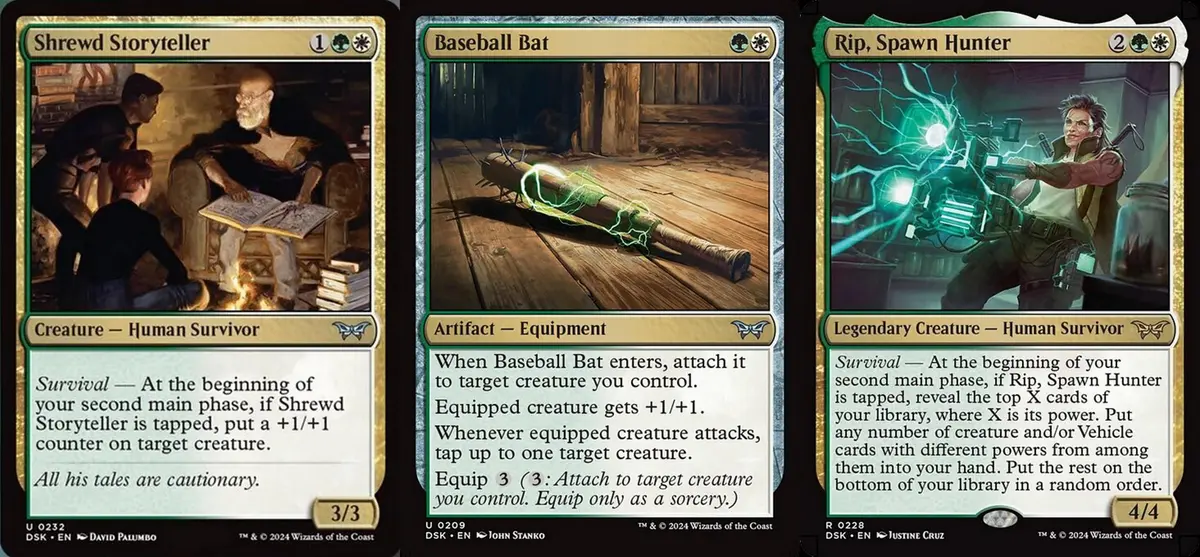
Number of Survival cards in White-Green: 12
Number of black Survival cards: 1 (Cynical Loner)
The U Equipment Baseball Bat encourages your creatures to attack, and its effect of tapping a target creature also raises the chance that your creatures survive after attacking. Cards like Shrewd Storyteller
 and the R card Rip, Spawn Hunter
 can trigger Survival for greater value.
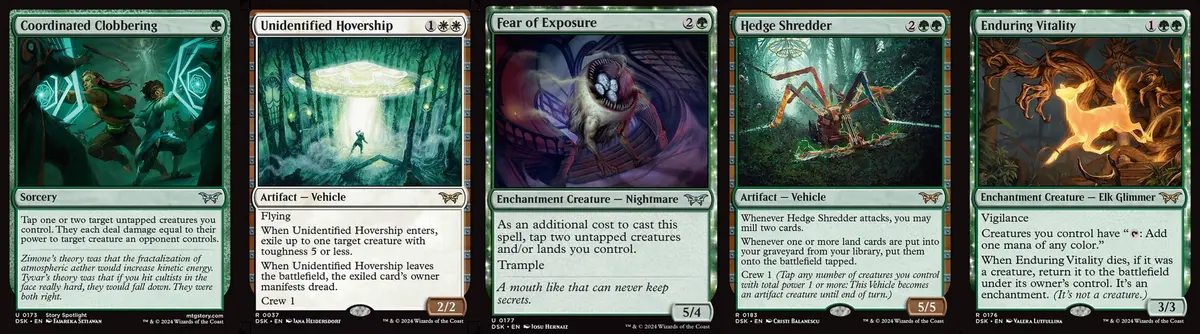
However, relying purely on attacking and then surviving to trigger Survival isn’t very reliable. So the other, more reliable sources of Survival triggers are worth noting too. For example, the crew abilities of the two Vehicles, the green death lawn mower Hedge Shredder and the white UFO Unidentified Hovership
 , can both let you proactively tap your creatures with Survival (survivors)! And for removal like Coordinated Clobbering
 , where tapping a creature is normally a side effect, it’s a different story if the creature you tap is a survivor. The same concept applies to Fear of Exposure
 : if you play two survivors in a row on turns one and two, then follow with Fear of Exposureon turn three, the tempo is flying high!
Incidentally, the passive effect of the R card Enduring Vitality makes your creatures into five-color mana creatures, so wouldn’t your survivors lie down after producing mana? That earns you another round of Survival value! There are still many small combos like this, not spelled out explicitly, in DSK Limited, which I’ll leave for readers to discover!
Takeaways
- Besides tapping after attacking proactively, Survival can also be achieved by crewing and by any other way of tapping creatures.
- White-Green should use survivors as much as possible to offset the side effects of some cards and earn the value of Survival.
- But you should still attack when you should. The Survival value earned by proactively lying down won’t necessarily offset the tempo loss when the opponent plays threats in succession.
Black-White — Reanimator
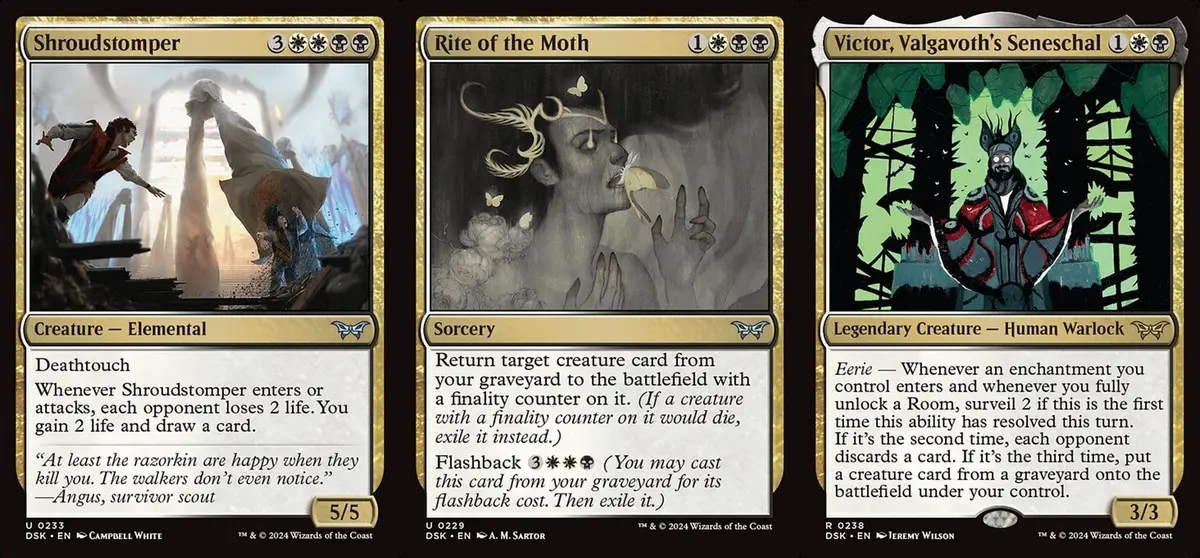
Number of reanimation cards in Black-White: 6
Black-White has some reanimation spells and permanents with reanimation effects. The U card Rite of the Moth has a simple, clear effect: reanimate! And with Flashback it can reanimate twice! However, because the creature it brings back carries an extra finality counter, basically without special handling the same creature can only return once. The other U creature, Shroudstomper
 , as a powerful, expensive creature closed to its color pair, is something Black-White is encouraged to reanimate rather than hard-cast, since there’s no need to make the benchmark creature hard to cast. The R legendary creature {% mtgcard “Victor, Valgavoth’s Seneschal
” tooltip=true %} focuses on the other theme shared by black and white, Eerie, and as Eerie triggers more times in the same turn, on the third time it returns to Black-White’s reanimation theme.
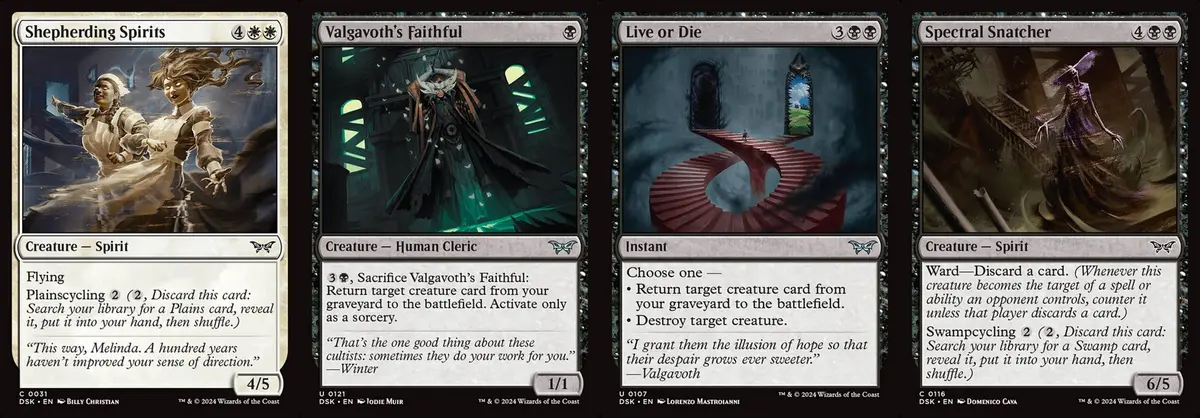
In addition, I’ll reveal a few possible tricks here for readers to test for fun!
The more common one is using single cards like Shepherding Spirits , which cycle for lands early, and then reanimating them in the mid to late game with Valgavoth's Faithful
 or Live or Die
 , creating a pseudo-ramp effect.
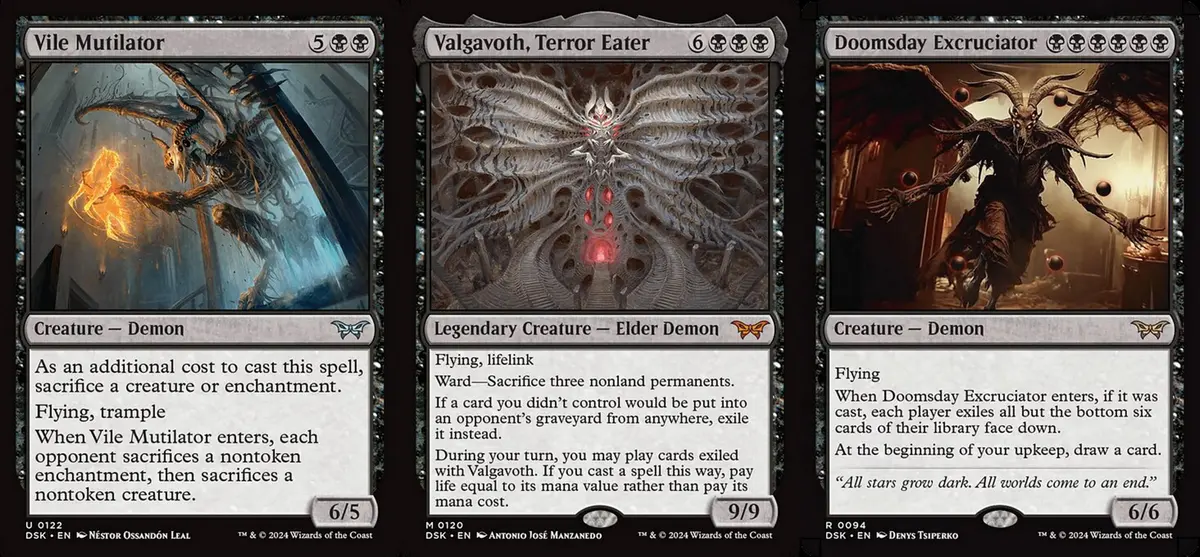
Of course, thinking more outside the box, you can also put those big demons that cost too much, or have side effects when cast, into the graveyard in any feasible way and reanimate them, creating a situation where only we benefit. Greatness, at any cost: that is the romance of black players, don’t you agree?
Takeaways
- Reanimation cards tend to cost a lot, so besides focusing on filling the graveyard early, you also need enough creatures to block so you don’t get run over by aggro.
- Surveil, mill, discard, and basic landcycling cards (______ cycling) are all ways to put big creatures that are hard to hard-cast into the graveyard.
- Both black and white link to the Eerie theme, so don’t forget to include some related cards to earn value.
Red-Blue — Rooms
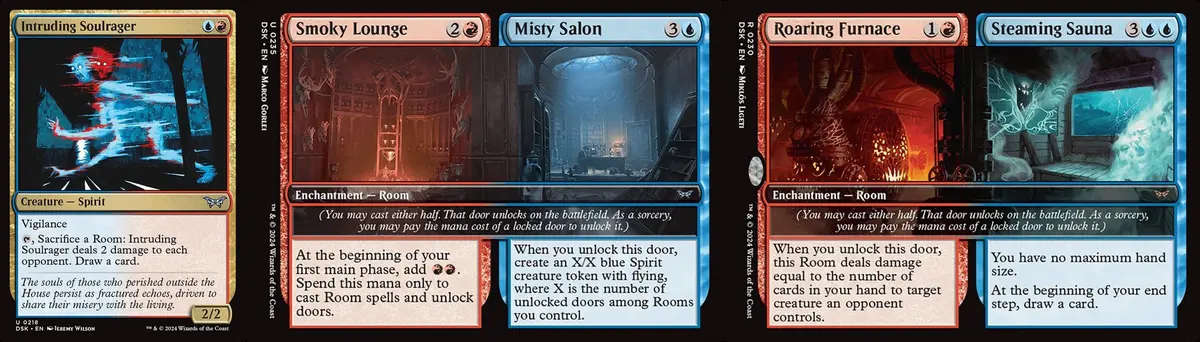
Number of Room cards in Red-Blue: 11
Number of Room cards outside Red-Blue: 12
For the U card Smoky Lounge // Misty Salon , if there’s no board pressure, I’d suggest first casting the red side, which makes your subsequent Room spells or unlocks much easier. Ideally, the blue door is suggested to be unlocked only once there are enough Rooms on the battlefield. What’s more puzzling is the other U card, a two-mana 2/2 vigilance creature whose ability requires sacrificing a Room to earn extra value. Of course we can understand this as a recycling method when we have multiple Rooms on the battlefield whose effects have already resolved, but… honestly the cost-performance is a bit low. Next, looking at the R card Roaring Furnace // Steaming Sauna
 , this is a great boost for the Room theme: a two-mana sorcery removal and a five-mana extra draw are both quite practical, and both take effect as soon as the door is unlocked. This R card should be the key signal for entering Red-Blue.
A blue card worth special mention is Ghostly Keybearer . With it on the battlefield, you can walk through the Rooms you control unimpeded, enjoying the thrill of mana cheating in Limited. In Red-Blue with its Room theme, it will also be a very key card!
Central Elevator // Promising Stairs
really does win the game after opening eight doors, XD
Takeaways
- The Red-Blue R card Roaring Furnace // Steaming Saunais an important signal that the color pair is open.
- Use Ghostly Keybearerwell to unlock Rooms and gain the advantage of mana cheating.
- The Eerie mechanic also cares about enchantments entering and Rooms unlocking, so don’t forget to include suitable Eerie cards to earn value.
Black-Green — Delirium Grind
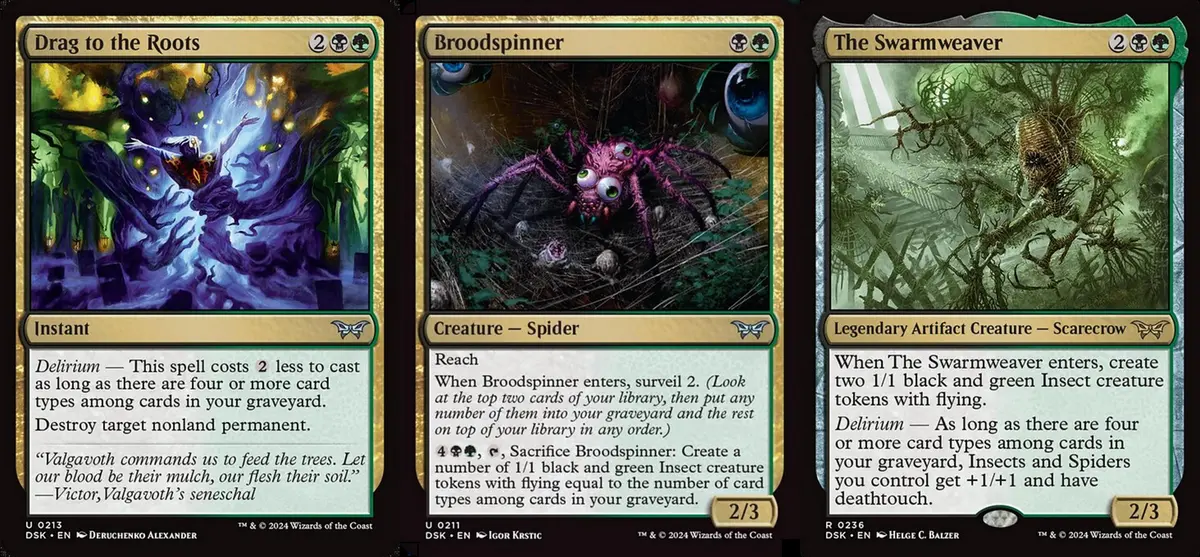
Number of Delirium cards in Black-Green: 11 + 1 (1 black-red-green three-color legend)
Black-Green’s Broodspinner supports the Delirium shell very well: surveil 2 speeds up Delirium, and in the mid to late game it can be sacrificed to make a row of 1/1 flying Insects to attack with. This also links better with the R legendary creature The Swarmweaver
 , creating more and bigger Insects. The other Black-Green U card, Drag to the Roots
 , is simply a dedicated removal spell made more efficient by Delirium, and worth playing even without Delirium.
It feels like Black-Green in this set will take the approach of filling the graveyard early to reach Delirium and counterattacking with flyers in the mid to late game. Honestly, if so, that’s more like what traditional Blue-Black would do. Besides the 1/1 flying Insects, Black-Green gets its flyers from the support of black’s demons, so when building you still need to watch the number of early blockers and mid-to-late-game finishers.
Takeaways
- Early on, Black-Green needs to withstand the opponent’s offense while filling the graveyard for Delirium, so high-toughness two- and three-drops are important.
- In the mid to late game, Black-Green counterattacks from the air with flyers that can punch through, so keep an eye on black’s demons to fill the flyer slots, since green creatures don’t fly.
- Of course, high-power green creatures with trample can also be used when building.
Red-White — Aggro
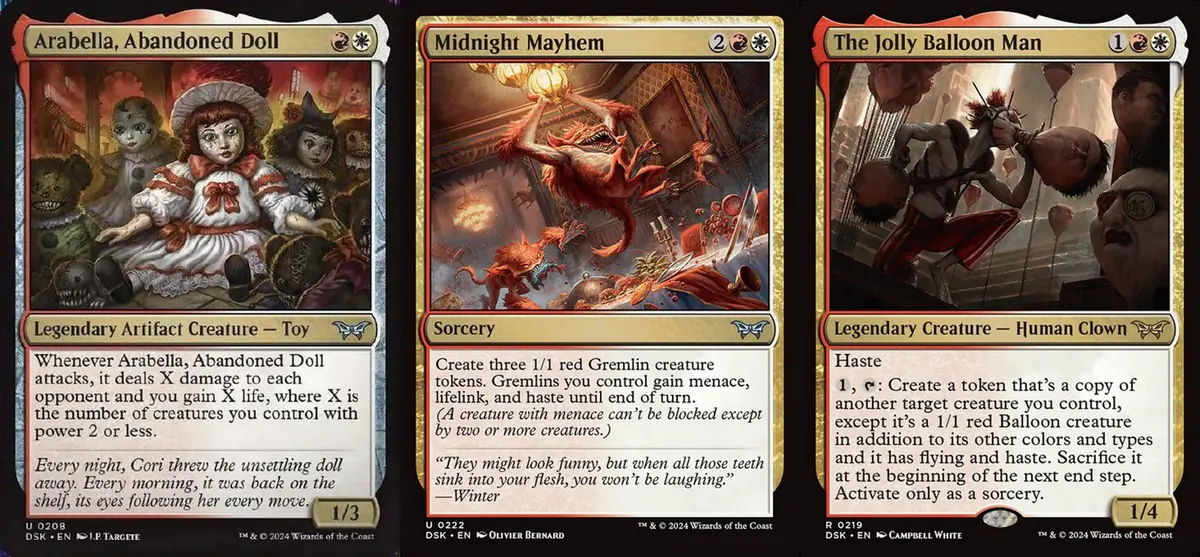
Number of usable creature cards with power 2 or less in Red-White: 33 (including 3 artifact creatures)
Seeing such a simple, brutal mechanic introduction left me speechless. It reminds me of OTJ’s White-Green Mounts… yes, that kind of feeling, simple and brutal, but… is it really just what it looks like on the surface?
From the effect of the U legendary creature Arabella, Abandoned Doll , Red-White cares about using a pile of small creatures with power 2 or less, the more the better, to rush down the opponent as fast as possible. Rather than aggro, you also need to combine it with a go-wide theme to amplify this effect. For example, Midnight Mayhem
 makes three 1/1 haste, menace, lifelink tokens for four mana, and the R legendary creature, the balloon-head guy The Jolly Balloon Man
 , can keep producing 1/1 copies of your creatures. They all illustrate how this theme operates.
Takeaways
- The more creatures with power 2 or less you can put out, the better. Conversely, creatures with power 3 or more may not suit this theme very well.
- If you have pump tricks, use them after the attack trigger for maximum effect.
- If you can’t rush down the opponent early, you need a reliable way to deal damage in the mid to late game to win
I need Sheoldred, the Apocalypse.
Blue-Green — Manifest Dread
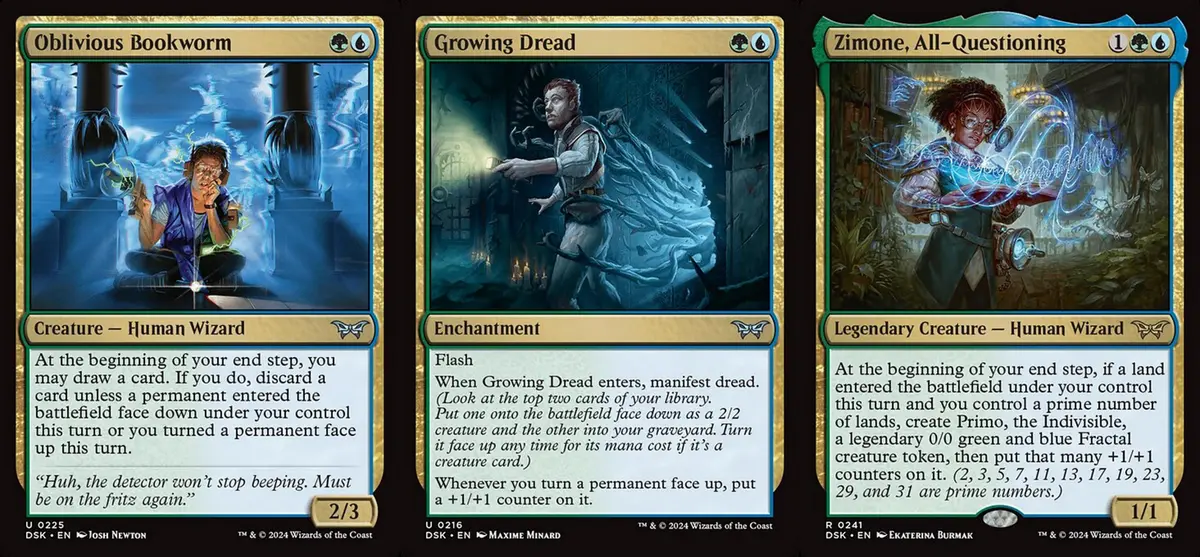
Number of manifest dread cards in Blue-Green: 20 (including 2 artifact Equipment)
Number of manifest dread cards in other color pairs: 8
First, I’d like to break the manifest dread ability into two parts to understand it:
- Look at the top two cards of your library; one enters as a face-down 2/2 manifested creature. If the face-down card is a creature card, you may pay its cost at any time to turn it face up.
- The other card is put into your graveyard.
The first part is easy to understand: it’s what traditional manifest does. However, this time manifest dread lets you look at one more card, which is better than the traditional manifest’s blind flip of the top card, and the chance of being able to turn it face up later is also much higher. The second part mills one extra card, and considering the possible reanimation spells if you add black and the Delirium mechanic of green decks, this extra milled card may be quite crucial.
Looking back at the core card Growing Dread , it gives you a manifest dread that earns card advantage when it enters, and if it can be turned face up, it can grow even bigger. The other card, Oblivious Bookworm
 , is a value card. Even just loot-style draw-one-discard-one each turn is quite strong, and with manifest dread it’s a solid extra draw. As for the R legendary creature Zimone, All-Questioning
 … uh… she has no connection to this theme, she’s off counting her primes, XD
Takeaways
- The two-color manifest dread cards offer limited support for the theme, so you still need mono-blue and mono-green cards to fill out the theme.
- Manifest dread effectively fills the graveyard, so it may link nicely with black’s reanimation and green’s Delirium themes.
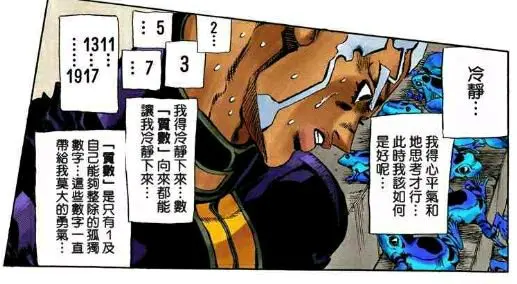
Who would have thought that even “prime numbers” could become an element of card design, XD
Other Themes and Cycles
Overlords
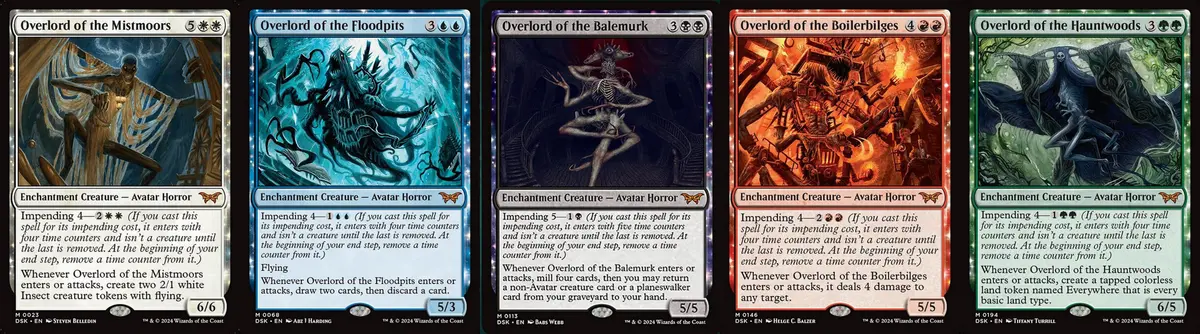
A set of five mythic rare enchantment creatures, all with this set’s new ability, Impending. All five are very powerful themselves, repeatedly triggering their specific abilities on entering and attacking, and can basically be compared to the five mono-colored Titans introduced in M11. This time the five Overlords also have Impending, letting them come down early as noncreature enchantments. However, to repeatedly trigger their abilities, they still need to be on the battlefield as creatures. If you’re close to being able to cast them directly, holding off a bit may be worth more!
Enduring Glimmers
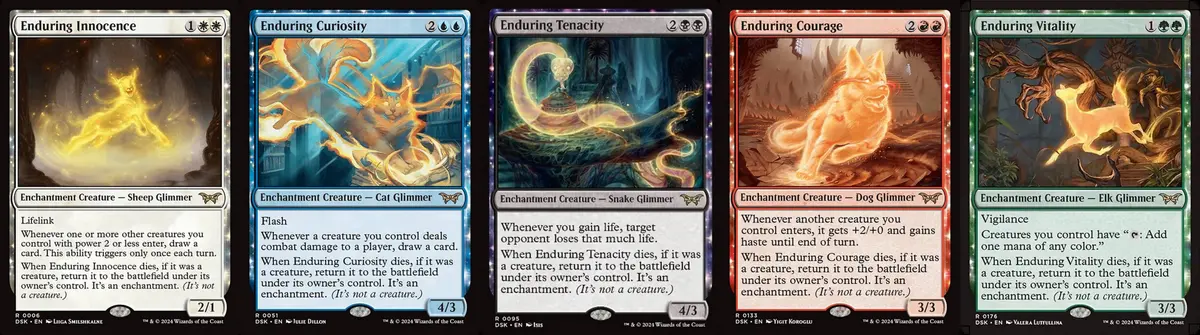
These are also mono-colored enchantment creatures unique to DSK, identified by names starting with “Enduring ______”. These creatures are relatively easy to understand: when the creature dies, it re-enters as a noncreature enchantment. And because these are rares, their passive effects are made very powerful too, and they give you two for one, which is very strong!
Leylines
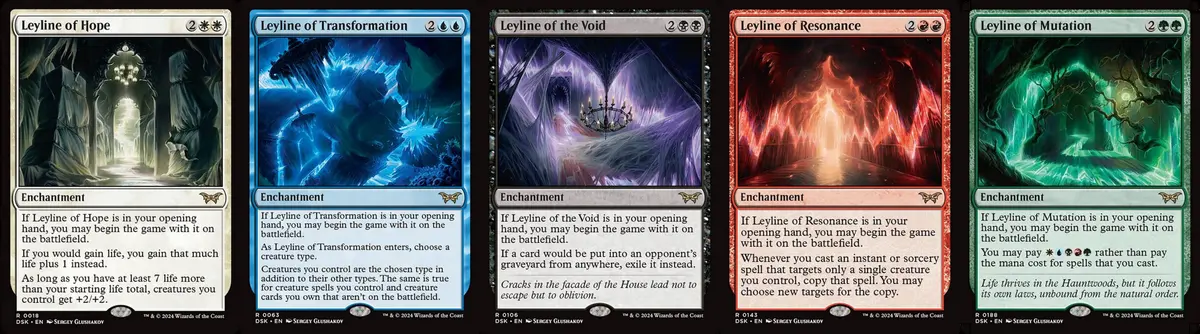
Besides the reprinted Leyline of the Void , DSK brings us 4 more brand-new mono-colored Leylines. A brief introduction to Leylines:
- They are all enchantments.
- If you have this card in your opening hand, you may begin the game with it on the battlefield.
Although DSK is an enchantment-themed environment and they may occasionally be used to fill out card types or Delirium, and these five Leylines may have some wonderful combinations yet to be developed, just like the Leylines before them, it’s still basically not recommended to play them in the main deck in Limited. If you don’t have the Leyline begin the game on the battlefield and only draw it later, you’ll understand what I’m saying, XD
But with more and more kinds of Leylines now, can I look forward to some very odd Leyline decks appearing in Standard or Pioneer, XDD
Basic Landcyclers (Typecyclers)
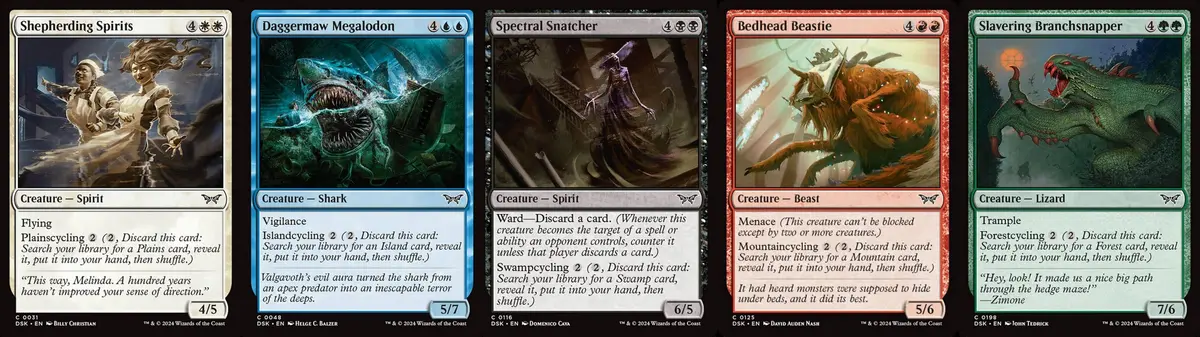
Like the five-card common cycle of landcyclers that appeared earlier in LCI, DSK also has such a five-card cycle of land cyclers. Their commonalities are very intuitive:
- Six-mana creatures,
- Each comes with a creature ability of its color,
- Pay {2}: basic landcycling of that color (it can find a nonbasic land with that type, but this shouldn’t happen in DSK Limited).
As a card that can serve as a land early, fill the graveyard for Delirium, and act as a mid-to-large threat in the mid to late game, it’s still worth playing in Limited decks.
Vergelands
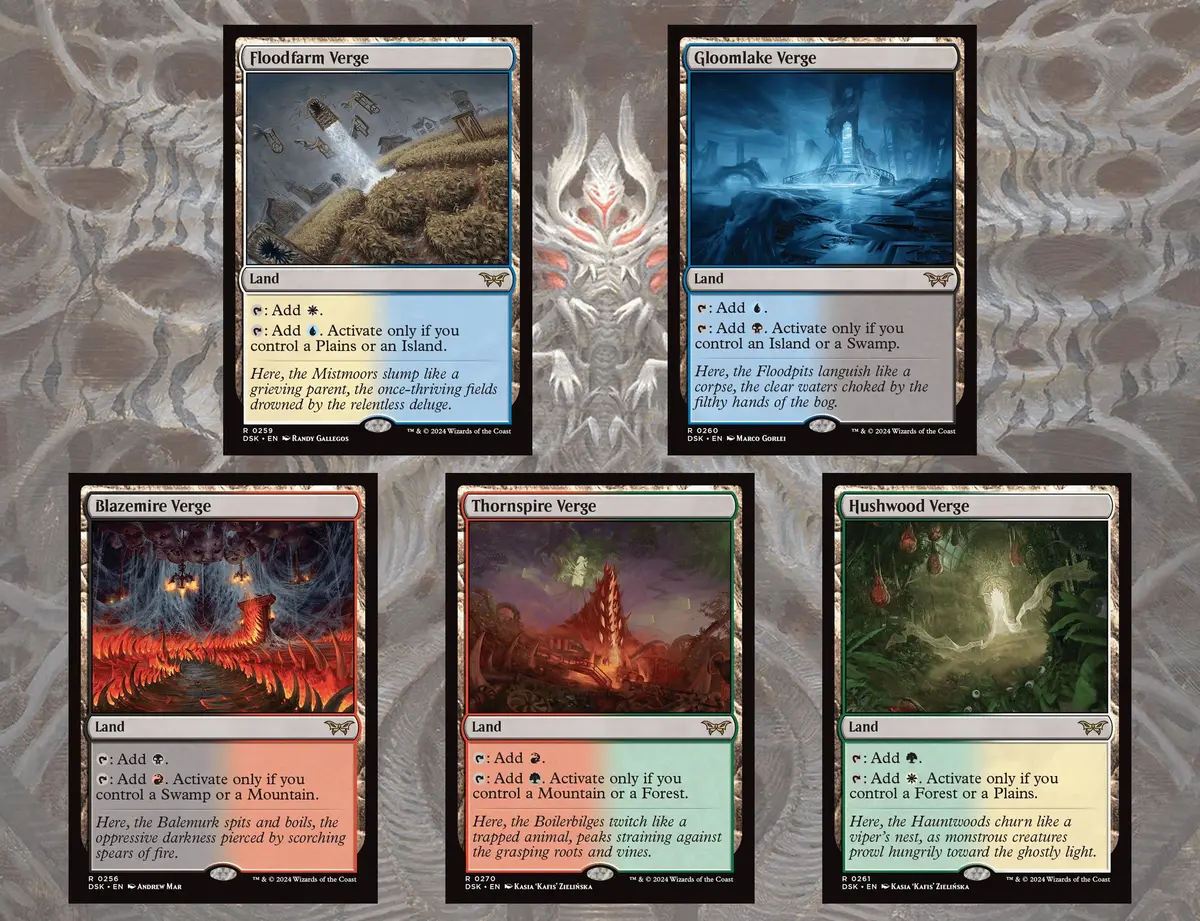
Functionally upgraded checklands, finally with no risk of having to enter tapped! However, the design concept may be closer to the four tainted lands in Torment (TOR) that interact with Swamps. DSK has only 5 Vergelands for allied color pairs, and when used with the corresponding basic land, they can produce the other color too, so basically in Limited they’re solid dual lands.
If your deck has so many nonbasic lands that it can’t produce the other color, in a sense you’re really lucky!
Triskaidekaphobia Lands
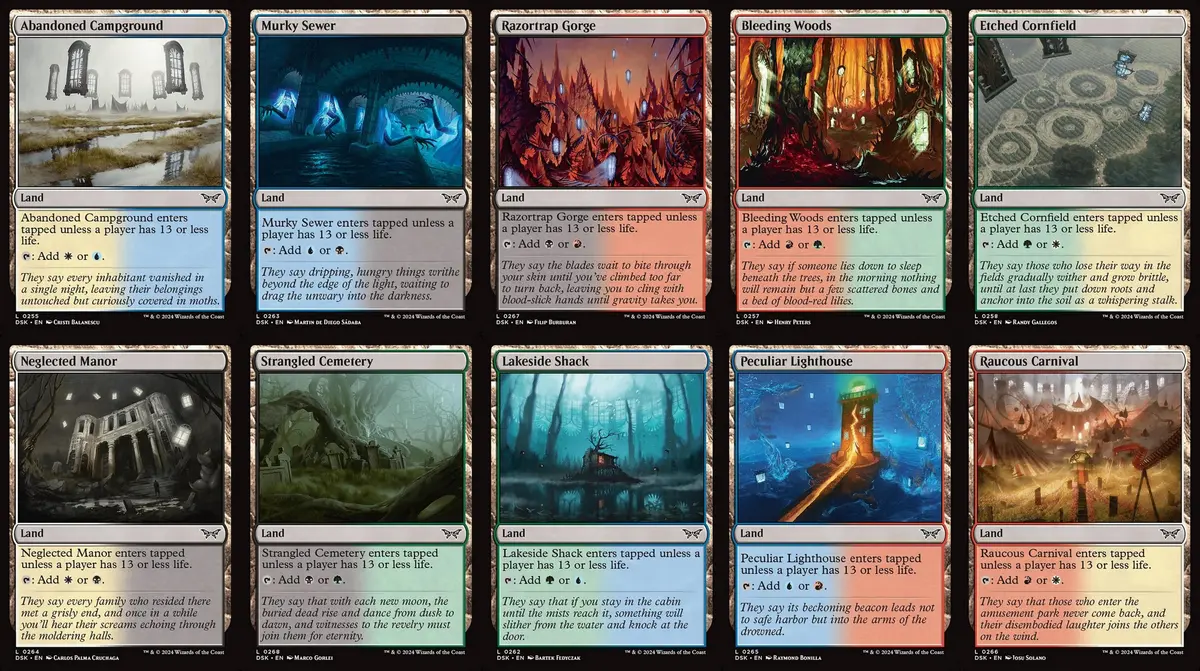
This translated name comes from the quirky enchantment in Shadows over Innistrad (SOI), Triskaidekaphobia . In Western culture, the number 13 has an ominous meaning, and this modern horror theme naturally doesn’t miss the chance, applying this concept to the design of DSK’s 10 dual lands. As long as any player’s life total is 13 or less, these lands can enter untapped. They’re relatively intuitive to use, and you only need to check once when they enter. Although in the early game they’re basically a dual land that enters tapped, in the midgame once your or your opponent’s life drops to 13 or below, they immediately give you a mana advantage!
In Limited, though, they’re just handy dual lands, so if you see ones in your color pair, put them in your deck!
A note unrelated to Limited: in other Constructed formats, these lands may have potential in two-color aggro decks, or in formats like Modern that are very good at fetching lands and losing life. Let’s keep watching.
Duskmourn’s Special Guests (Special Guest, SPG)
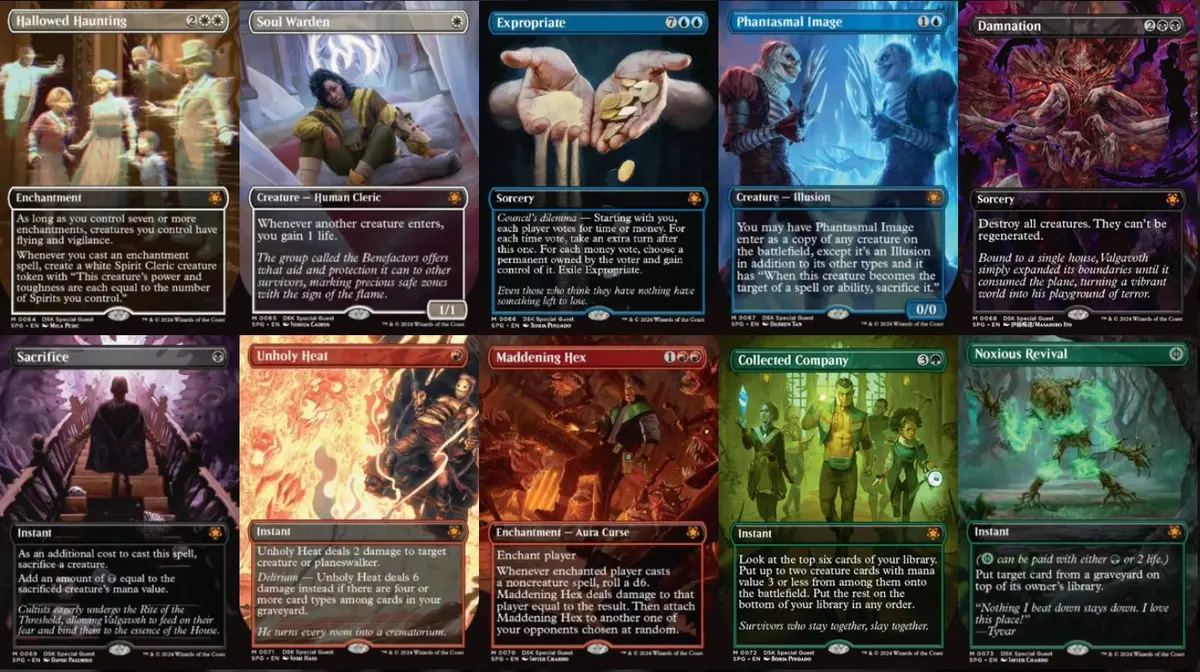
The 10 cards SPG0064 to 0073 are Special Guest cards that can be opened in regular Duskmourn booster packs. Ones worth special attention include Damnation , which means that when facing a black deck, besides guarding against removal, you also have to watch out for a possible four-mana sweeper; and Hallowed Haunting
 , which may also give a huge boost in this set’s enchantment theme. However, SPG cards appear at a rate of 1 per 64 packs, so like in previous sets, just keep it in mind, but don’t worry too much. Take it as a little Limited surprise (scare?)!
Conclusion: If I Were a New Player Who Started with Bloomburrow…
I hope the content above gives readers a preliminary understanding of DSK Limited deck building. But I still want to murmur a bit: say you were attracted to MTG by Bloomburrow’s cute little animals, and stayed after having a great time with a pile of rabbits, squirrels, and otters. Then when you open a DSK booster pack, what you see is… full-on horror imagery! Surprise! Shock!
I have to say, this move by Wizards is a textbook-level mystifying move, and it also highlights the old problem of single-plane product axes giving players a strong sense of disconnect, which is magnified even more in DSK. From the art style and story atmosphere to card design and even the speed of the Limited environment, it makes you feel like you’ve suddenly been dragged into playing a different game. Such a huge gap in play experience is absolutely not good for the long-term commitment of newcomers.
What players like is seeing their favorite themes reinforced and having new ways to play. This time the huge gap between BLB and DSK in every aspect undoubtedly adds needless resistance to promoting the game. Of course, this is a matter of opinion, and one camp is surely eagerly awaiting Duskmourn’s style and can’t put it down.
Let’s not be surprised by anything, and keep playing.
- Title
- Duskmourn Limited First Look
- Author
- cephille
- Created at
- September 17, 2024
- License
- This work is licensed under CC BY-NC-SA 4.0 .