Duskmourn Mechanics Explained

Note: This article was translated from Chinese by AI and may contain errors. Read the original Chinese version.
Duskmourn: House of Horror (DSK) will hold its prerelease on September 20, 2024. Let’s take a look at the mechanics of this set!
Room
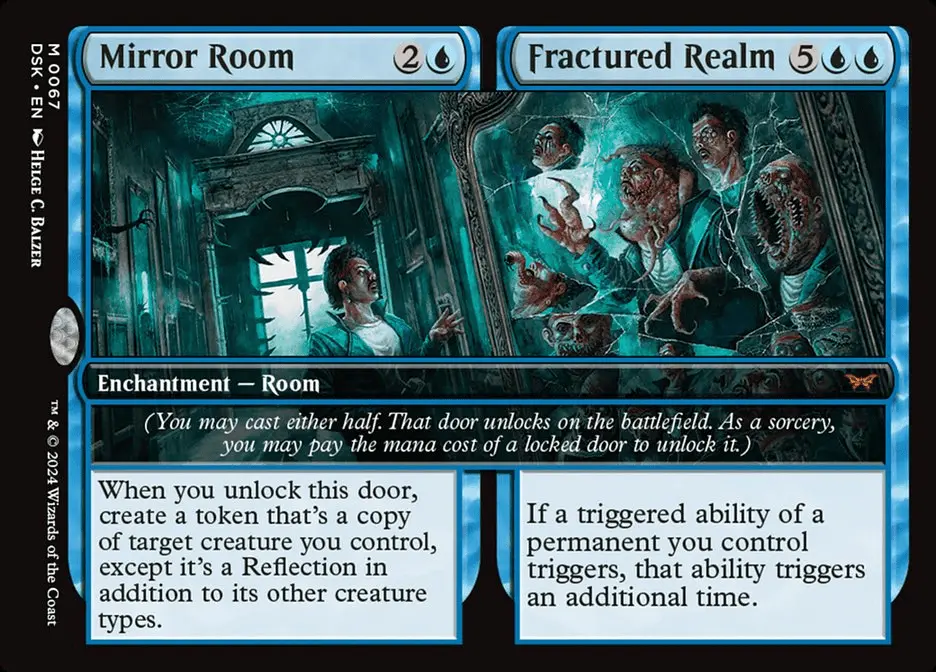
Rooms are a new enchantment type, and the first time a permanent has been designed as a split card.
A Room has a Door on each of its left and right sides. The two Doors have independent characteristics (name, cost, effect). When casting, the player can choose to cast either side. The Door you cast is unlocked when the Room enters the battlefield, and the Room card has the characteristics (name, cost, effect) of the unlocked Door. The other side remains locked, and you can pay its cost at sorcery speed to unlock that Door. Unlocking is a special action that doesn’t use the stack and can’t be responded to. When both sides are unlocked, the card has the characteristics of both the left and right sides, and its mana value is treated as the sum of the two sides.
If a Room is put onto the battlefield without being cast, both sides are locked, and you need to pay each cost separately to unlock them and gain their abilities.
If the Door you chose when casting has an ability that triggers when it unlocks, that ability triggers when the Room enters the battlefield.
When you copy a Room on the battlefield, regardless of its current locked/unlocked state, you get a copy token with both sides locked, and you can still pay costs to unlock them. However, if you copy a Room spell on the stack, the Door you chose to cast is also unlocked when the copy token enters the battlefield.
While a Room is in a zone other than the battlefield, the rules are exactly the same as for previous split cards.
Eerie
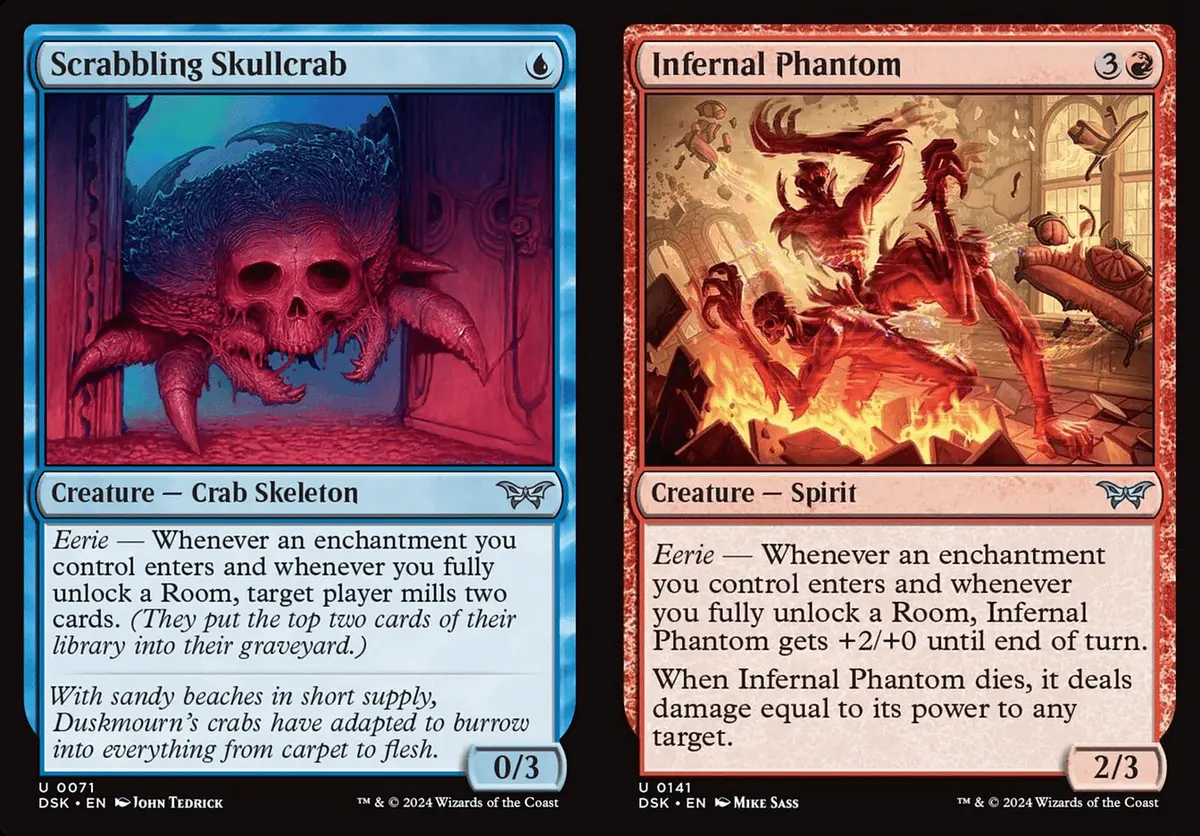
Eerie triggers on “Whenever an enchantment you control enters” or “Whenever you fully unlock a Room.” Fully unlocked means both Doors of the Room are unlocked.
Eerie can be seen as an enhanced Constellation, with fully unlocking as an additional trigger.
Impending
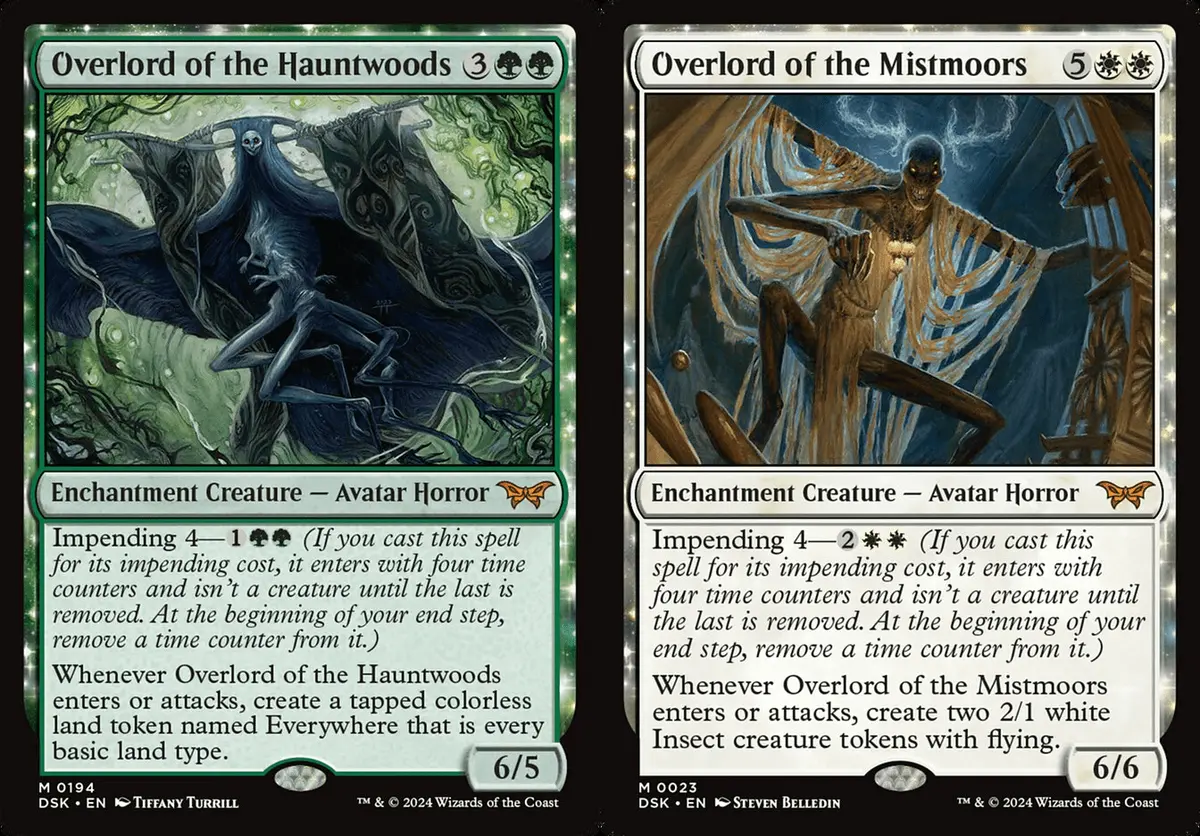
Impending is always followed by a number N and provides an alternative cost. If you cast the card for its impending cost, it enters with N time counters, and as long as it has a time counter on it, it isn’t a creature. At the beginning of your end step, a time counter is removed from it.
Although losing the creature type means it can’t attack or block, its other abilities still function normally. You can also pair it with effects that remove counters, such as Render Inert, to quickly turn it into a creature.
Manifest Dread
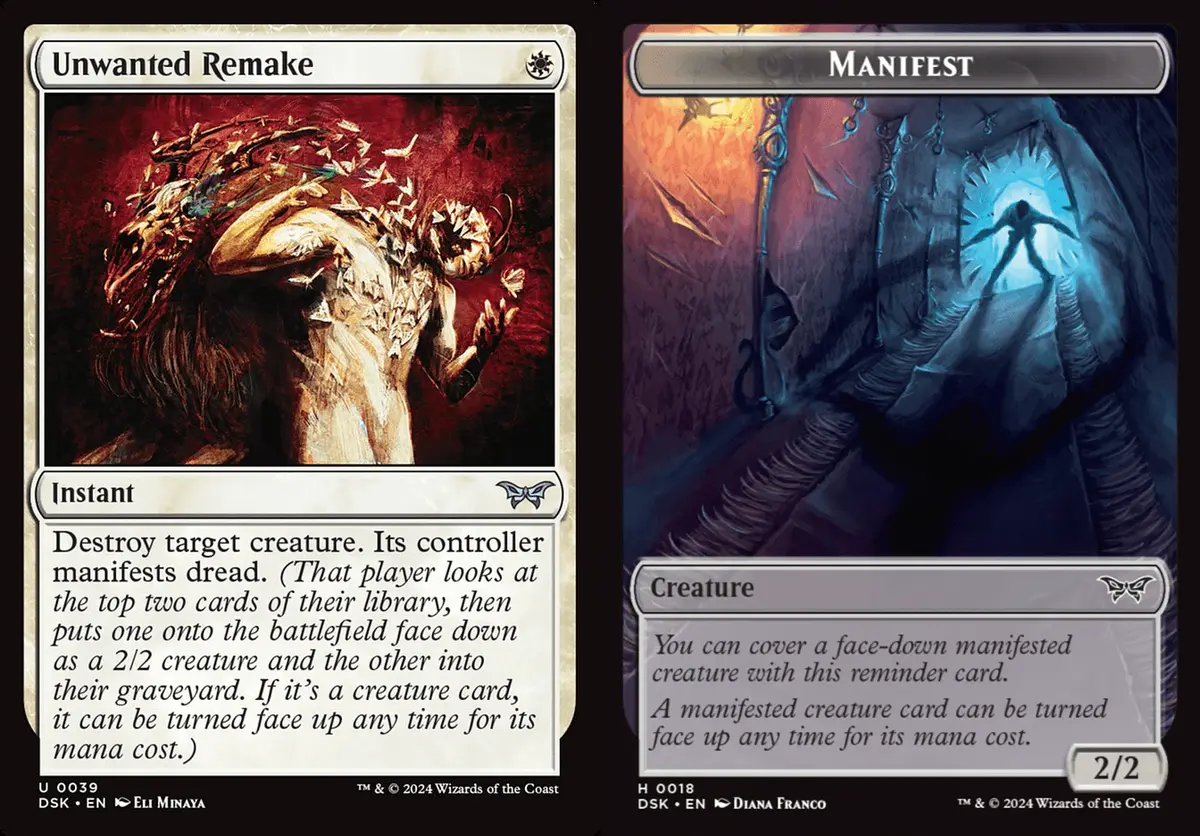
Manifest dread is a variant of manifest. When a player manifests dread, they look at the top two cards of their library, put one of them onto the battlefield face down, and put the other into their graveyard. The face-down card is a 2/2 creature with no name, mana cost, color, or creature subtypes, and its mana value is 0.
If the face-down card is a creature card, its controller can turn it face up any time they have priority by paying its mana cost. Turning it face up is a special action that doesn’t use the stack. If the card happens to be a Disguise or Morph creature card, you can also use the Disguise/Morph ability to turn it face up.
For more details on Disguise from MKM, see Murders at Karlov Manor Mechanics Explained.
Survival
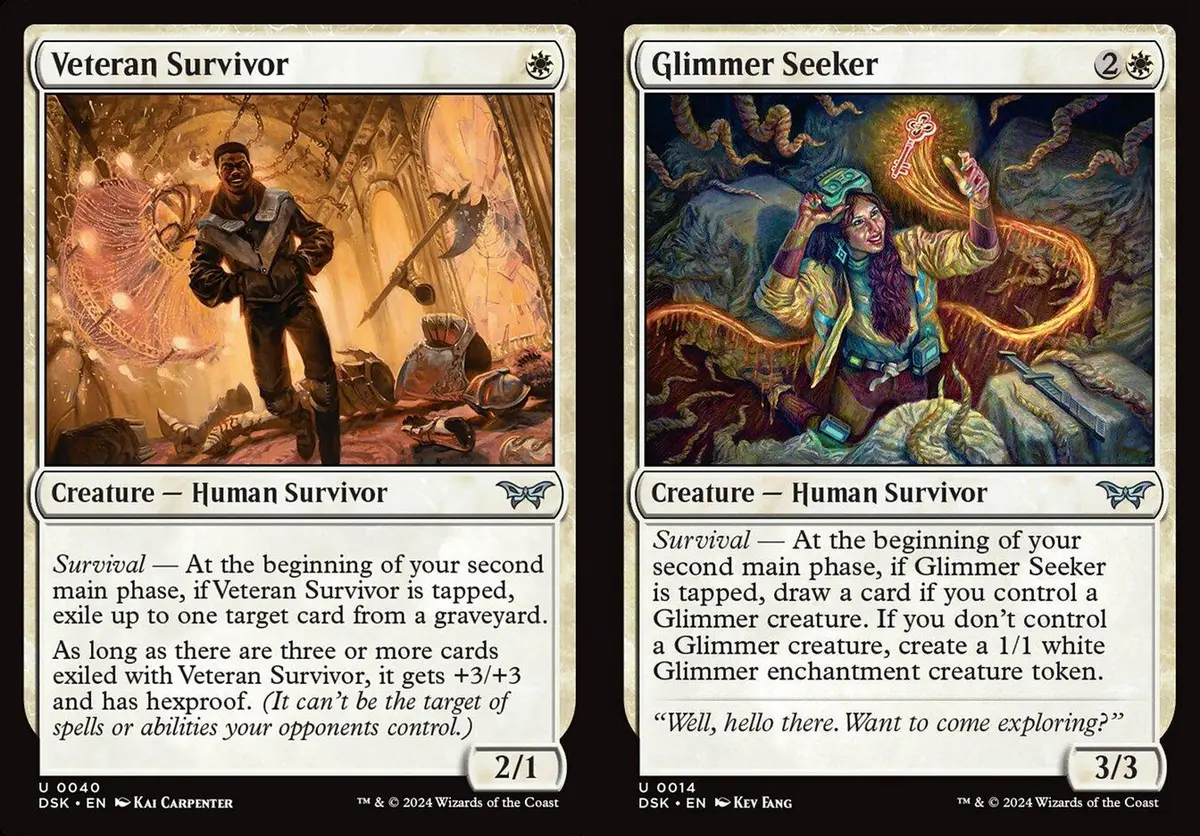
Survival abilities are all triggered abilities. At the beginning of your second main phase, if this card is tapped, the following ability triggers.
A card with survival must already be tapped at the beginning of the second main phase for the ability to go on the stack, and it checks again whether the card is tapped when the ability tries to resolve. If, for some reason, the card has become untapped by the time the ability resolves, the ability won’t resolve successfully.
Flavor-wise, it presumably means a creature that survived after going through the combat phase is defined as having “survived,” and the condition of being tapped in the second main phase presumably means the creature still lives after being attacked by horrible things. Interestingly, though, creatures with vigilance should have a hard time triggering survival unless you tap them in some special way. Does that mean creatures with vigilance have particularly big hearts? XD
Delirium
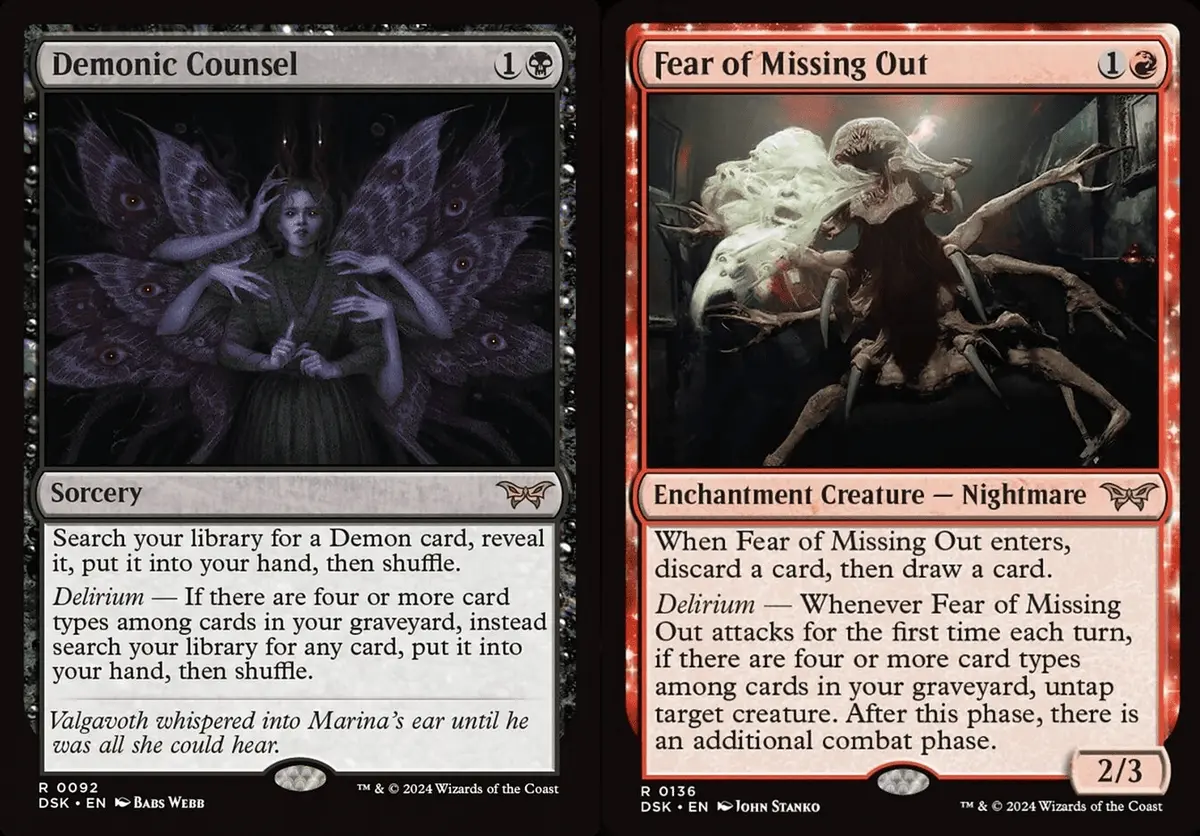
Delirium is a returning mechanic. As long as there are four or more card types among the cards in your graveyard, the delirium condition is met.
There are nine card types in total: land, creature, sorcery, instant, artifact, enchantment, planeswalker, battle, and kindred. Supertypes (legendary, basic) don’t count toward delirium.
Get Ready for Duskmourn
Duskmourn prerelease events begin on September 20, 2024. Head to a nearby store to try out the new set!
September 20 - September 27: Prerelease
September 27: Duskmourn release date
October 4 - October 10: Commander Celebration
October 12, 2024 - January 4, 2025: Year-End Store Championship
November 1 - November 7: Commander Celebration
November 1 - November 3: Play Days
- Title
- Duskmourn Mechanics Explained
- Author
- Jru
- Created at
- September 4, 2024
- License
- This work is licensed under CC BY-NC-SA 4.0 .