Deck Building Basics
Note: This article was translated from Chinese by AI and may contain errors. Read the original Chinese version.
Before We Start
“This card looks so cool! I really want to play a deck with it… but I can’t find any decklists…” I believe this is a problem many new Magic: The Gathering players run into: a card you fell in love with gets looked down on by veteran players, you search online for ages and can’t find a decklist, and you don’t know where to start yourself… When you finally piece something together, not only do you lose to everyone else, it often jams horribly too… So how exactly do you build your own deck? This installment introduces the basic method of building a deck, to help you put together a deck that works properly.
Pick Your Nine Cards
In constructed formats other than Commander, a legal deck needs at least 60 main deck cards and at most 15 sideboard cards, which means you need at least 60 cards to compete at the table. About 40% of these (24 cards) are lands, and for the remaining 36 slots, if we fill every nonland card to 4 copies, we end up with 9 different nonland cards in total. In other words, when you start building, you can first pick 9 cards you want to play from your card pool to make a deck prototype. This is my strong friend’s nine-card theory.
First we ask ourselves which card we most want to play, then think about how the other cards should work with it. For example, say today we decide to play Ghalta and Mavren, the big dinosaur vampire (?). We need to consider the characteristics of this card.
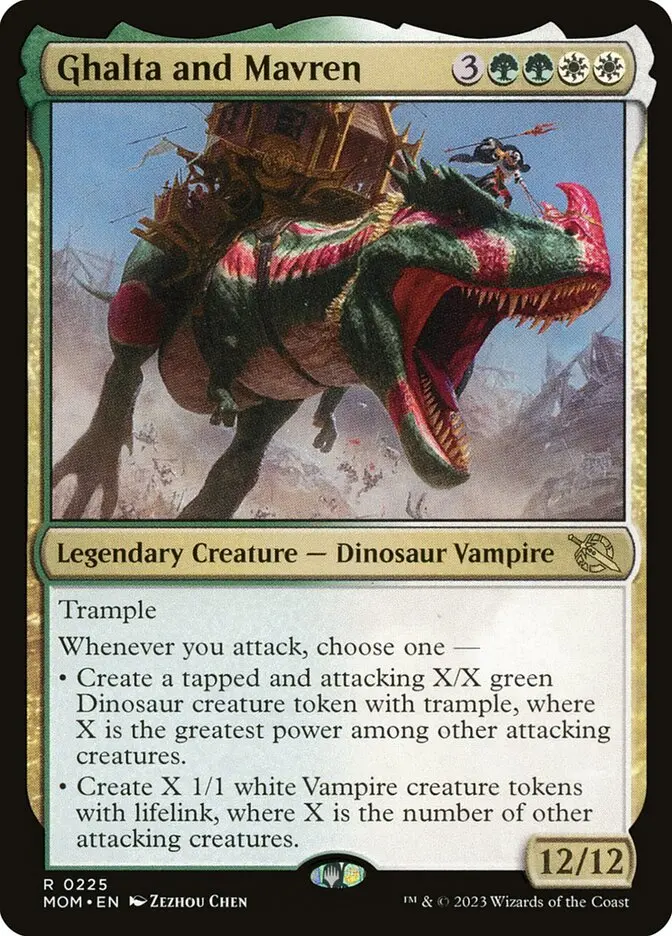
Trample
Whenever you attack, choose one —
‧Create an X/X green Dinosaur creature token with trample that’s tapped and attacking, where X is the greatest power among other attacking creatures.
‧Create X 1/1 white Vampire creature tokens with lifelink, where X is the number of other attacking creatures.
Ghalta and Mavren is a green-white two-color creature with a mana value as high as seven, and its ability needs other creatures to attack in order to trigger. With those two requirements as the premise, we can start from the two colors green and white, looking for cards that help us cast Ghalta and Mavren quickly, plus the other eight cards that make sure there are creatures to trigger the ability when this card enters.
As for how to pin these cards down, besides asking helpful players for advice or flipping through binders at the store for inspiration, you can also make good use of online resources to look up available cards. In my own habit, I usually use scryfall’s advanced search to set conditions for the cards I want, or go to mtggoldfish or Hareruya to look at decklists, understand the state of the metagame, and find archetypes worth borrowing.
If you are a new player who struggles with English, you can use the Traditional Chinese card search site to look up Chinese translations from Dominaria United onward; for Chinese cards printed before New Capenna you can use scryfall directly. When picking cards you can use the Chinese deckbuilding site 第三代水牛比爾 to hold your cards temporarily. This site saves your picks for you: as long as you log in from the same device and the same browser, it will show your last selection state, which is quite convenient for people who can’t finish building quickly. (If you log in from multiple devices or browsers, each will keep its own separate decklist.)
Calculating the Mana Curve
Once you have found your initial nine cards, congratulations, you have completed the first step of deck building. But don’t celebrate too early: they won’t be the final list, and next we’re going to hold an arena tournament to decide who goes and who stays. First we need to mentally simulate our play sequence and think about what we want to do each turn. For example, if I want to land Ghalta and Mavren on turn four, I need to ramp one mana on turn two and two mana on turn three, so that Ghalta and Mavren lands on time on turn four. For two mana, we can choose mana creatures (such as Llanowar Loamspeaker, Armored Scrapgorger, Bramble Familiar), land ramp (Azusa’s Many Journeys, Beanstalk Wurm) or artifact ramp (The Irencrag), filtering by theme fit, personal preference or budget, or you can directly refer to current tournament decklists. But here comes another question: how many copies of this mana cost should we play?
Before answering this question, we must make clear that Magic: The Gathering is a math game. Not only do you often need to do all kinds of numerical calculations while playing, you also need to count the number of cards at each mana cost when building a deck. Don’t think of it as too hard; you only need to know the probability of drawing a particular card or a card of a particular mana cost from the deck, and on average how many cards you need to draw to find one. Here is a simple method. Taking the land count mentioned earlier as an example, if we put 24 lands in a 60-card deck, how many lands do we draw on average per draw?
24 lands / 60 cards = 0.4 lands
On average we get 0.4 lands per draw, so how many lands do we draw on average in the opening hand? We can roughly calculate it like this:
0.4 lands x 7 draws = 2.8 lands
This means when you put 24 lands in your deck, the average number of lands in your 7-card opening hand is 2.8, and each additional card you draw adds 0.4 more. By the time you reach your fourth turn on the play, you will find that the number of lands you’ve drawn is exactly the 4 you need to make every land drop (0.4 x 10 = 4). Sounds amazing, right?
Back to the question of how many two-drops to play: suppose we want to have drawn 1 by turn two (8 cards seen on the play); the probability needed is at least 1/8 = 0.125, and 0.125 x 60 = 7.5, meaning at least 8 copies. Of course, we also have to consider removal and wanting to draw extra cheap removal, so the number of copies needed to draw two two-drops by turn two on the play is 7.5 x 2 = 15. The count for every other mana cost can be calculated this way to check whether it is reasonable, and you can use that as a baseline to filter and adjust the number of cards at each cost.
Example Prototype Decklist
Below is the prototype decklist for Ghalta and Mavren that I put together using the calculation method above:
Decklist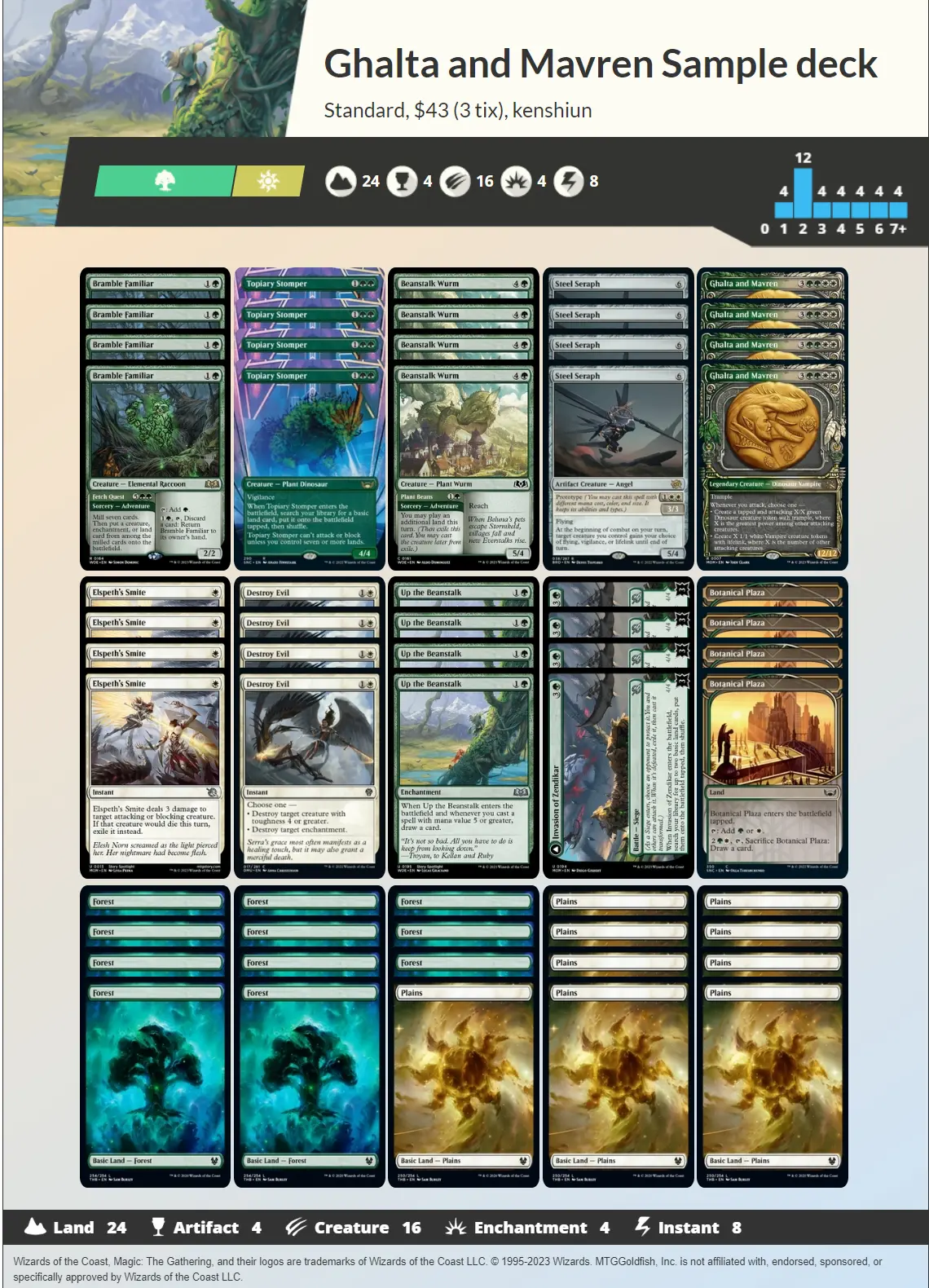
This deck refers to the structure of current Domain decks. The nine cards chosen are Ghalta and Mavren, Steel Seraph, Beanstalk Wurm, Invasion of Zendikar, Topiary Stomper, Bramble Familiar, Up the Beanstalk, Destroy Evil and Elspeth’s Smite, with a set of common dual lands, Botanical Plaza, filling in the lands for now. There are 4 one-drops and 16 two-drops (including Adventures). Using the method above, we can draw 2.33 spells of mana value two or less in the opening hand, and two-mana ramp cards will give us 1.06 by turn two. The mid-curve ramp cards Topiary Stomper and Invasion of Zendikar number eight, giving us 1.125 by turn three, which means this deck can run smoothly early on and reach seven mana as fast as turn four. Although there are only 4 copies of Ghalta and Mavren, giving only 0.67 by turn four, don’t forget we also have the Adventure of Bramble Familiar to use; looking through seven more cards raises that to 1.13, almost certain to cast it. The demo video is below:
Is That Enough?

Once the prototype decklist is done, your deck can be taken out to test play against others. The win rate may not be very high, but as long as you shuffle well, it will generally run smoothly. However, readers who calculated carefully following this article should notice that the example deck’s land count has a problem. If we use the Adventure of Beanstalk Wurm on turn two to ramp a land, Invasion of Zendikar on turn three, and cast Ghalta and Mavren on turn four, then we need to have drawn five lands by turn four, and 24 lands clearly can’t meet that requirement. Besides that, there’s another situation: when we’re on the play we draw 3.6 lands by turn three, and if we used Beanstalk Wurm to ramp a land on turn two, then on turn three we are quite likely to be stuck with no fourth land to play, so corresponding adjustments must be made in the build. And when we add lands, it also means cutting nonland cards, so many numbers have to be recalculated from scratch. It’s fine if you find it too troublesome and don’t want to keep calculating in detail; we already have a prototype decklist, and adjusting the list and designing the sideboard by feel from playtesting is entirely feasible. Maybe your unique creativity will become a rising star of the tournament scene, and getting results with an original deck is an unmatched thrill!
- Title
- Deck Building Basics
- Author
- JerobaMTG
- Created at
- October 29, 2023
- License
- This work is licensed under CC BY-NC-SA 4.0 .
Related Articles

I Drafted Alone: Solo Drafting with Reality Fracture (FRA)
October 16, 2026
Article Translation — Reid Duke's "Level One": Choosing Your Deck
August 17, 2026
Article Translation: Reid Duke's "Level One": Sequencing
July 24, 2026
Article Translation: Reid Duke's "Level One": Playing in a Grand Prix: Part I
June 13, 2026