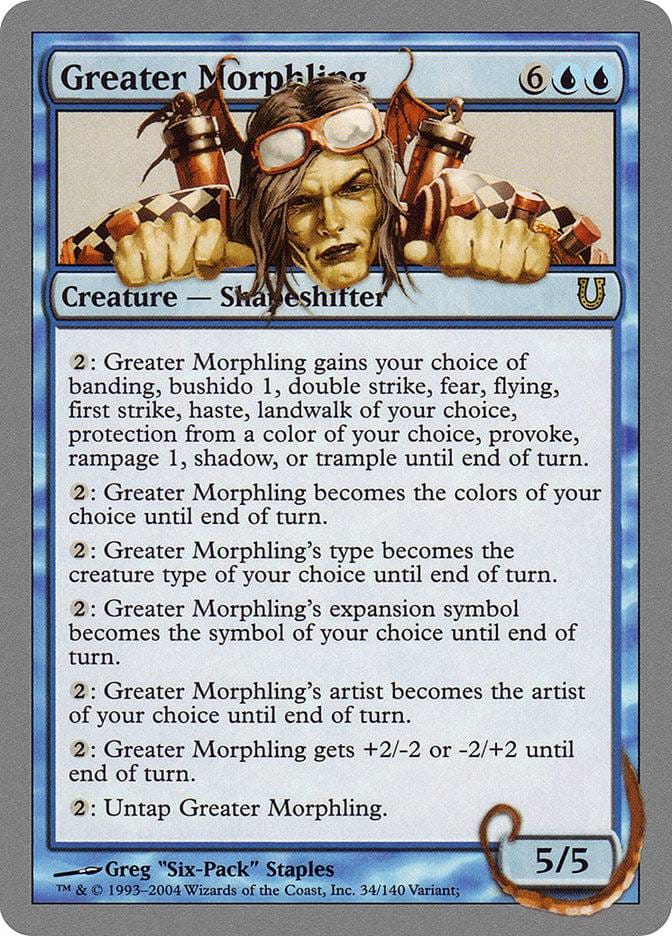
Stop Blaming Modern Cards for Having Too Much Text: The Essays MTG Has Written Over the Years

Note: This article was translated from Chinese by AI and may contain errors. Read the original Chinese version.
1. Introduction
Does it feel like modern Magic: The Gathering (MTG) cards have more and more text on them?
Let’s compare the classic one-mana white creature Savannah Lions with today’s Brightfield Glider
 . By the time you finish reading one common, the player next to you may have already finished a whole game.
This is really thanks to each set’s special mechanics and keyword abilities. As keywords matured, rules could be condensed, individual card interactions in Limited gained more layers, and the design space became more diverse.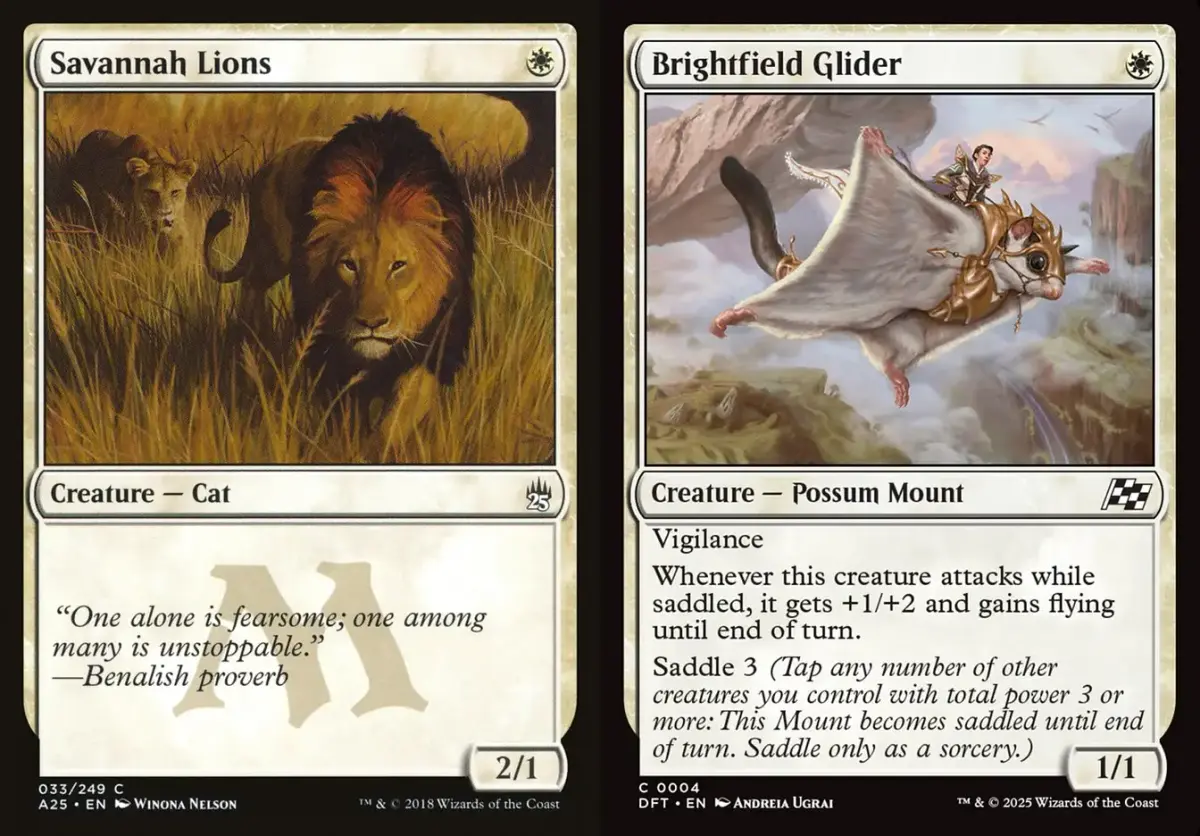
But that is not the point of this article.
Today, I want to take you on a trip through time, back to an era when keywords were not fully developed, to see just how wordy a card could get back then, and which classic cards, still good today, are hiding inside those seemingly long-winded “essays.”
2. How Did MTG Write Cards Before Keywords?
Today we are used to understanding card effects through keywords like “flying,” “trample,” and “lifelink.”
But before those keywords were systematized, the only thing designers could do was write out all the interaction logic on the card, word by word.
1. The Original Dual Lands
Underground Sea
Underground Sea
Underground Sea
Land
{T}: Add {B} or {U} to your mana pool.
This card counts as both a “Swamp” and an “Island,” and is affected by any spell that affects either of those types. If a spell destroys one of the land types, this card is destroyed; if a spell changes one of the land types, the other land type is unaffected.
In MTG’s early days, there was no modern “subtype” layout, so every interaction involving land types had to be written directly into the text box. So we got this somewhat painful-to-read wording.
But precisely because of the ring after ring of text around the border, these lands earned a classic nickname among players: “the circle lands.”
Despite the fussy text, its effect is extremely powerful and pure: a two-color land with no drawback at all. That is why it is still a regular in formats like Commander (EDH) and Legacy.
Simplified, It Actually Looks Like This

2. Forced to Become an Essay to Fit the Rules: Dance of the Dead
If the “circle lands” were only a matter of immature layout and systems, the next card was forced to become a whole essay by the evolution of the rules.

Dance of the Dead
Enchantment ~ Aura
Enchant creature card in a graveyard
When this Aura enters the battlefield, if it’s on the battlefield, it loses “enchant creature card in a graveyard” and gains “enchant creature put onto the battlefield with this Aura.” Return the enchanted creature card to the battlefield under your control tapped and attach this Aura to it. When this Aura leaves the battlefield, that creature’s controller sacrifices it.
Enchanted creature gets +1/+1 and doesn’t untap during its controller’s untap step.
At the beginning of the upkeep of the enchanted creature’s controller, that player may pay {1}{B}. If the player does, untap that creature.
On this card’s early version, the enchant type read “Enchant Dead Creature.”
But under modern rules, something that is not on the battlefield can only be called a “creature card,” which meant an already complicated effect had to be re-described rigorously.
The result is the “official essay” we see today.
But in fact, its core effect is very simple: efficient two-mana reanimation.
Even though the creature enters tapped and needs extra mana to untap, in the singleton EDH format this is still a quite useful pick.
3. The Pinnacle of Official Shenanigans
Next, let’s look at one of the cards with the highest text density in MTG history.
Bureaucracy
Bureaucracy
Bureaucracy
Enchantment
Pursuant to Section 3.1(4) of Richard’s Rules of Order, at the beginning of each player’s upkeep in this game, that player must perform all actions in the “Action Queue” in order, then add another action at the end. All actions must be simple ones that can be performed while sitting in a chair, and must not endanger health or safety. If a player fails to perform them in order, sacrifice Bureaucracy, and that player discards their hand.
This card comes from 1998’s first goofy Un-set, Unglued. The silver border means it belongs to no official Constructed format, so the designers let loose and used the most rigorous legal language to describe what is essentially a “memory game” effect.
In actual play it usually spirals out of control fast: patting your head, meowing, spinning in circles, knocking on the table…
Then the whole table goofs around together until someone cannot remember.
This card perfectly illustrates what bureaucracy means: using the wordiest procedure to make you do the most pointless things.
Finally, let’s look at what happens when the company pushes things to the limit itself.
Nowadays almost every set has pretty full-art basic lands, and lands have long been part of collecting and showcasing art. But have you ever wondered: what would a basic land look like if its effect were written out in full rules text?
You might think: “Isn’t it just tap for one mana?”
You are right,
but also not entirely right.
Because when the designers decided to write out everything you take for granted, we got this thing: the “full-text land.”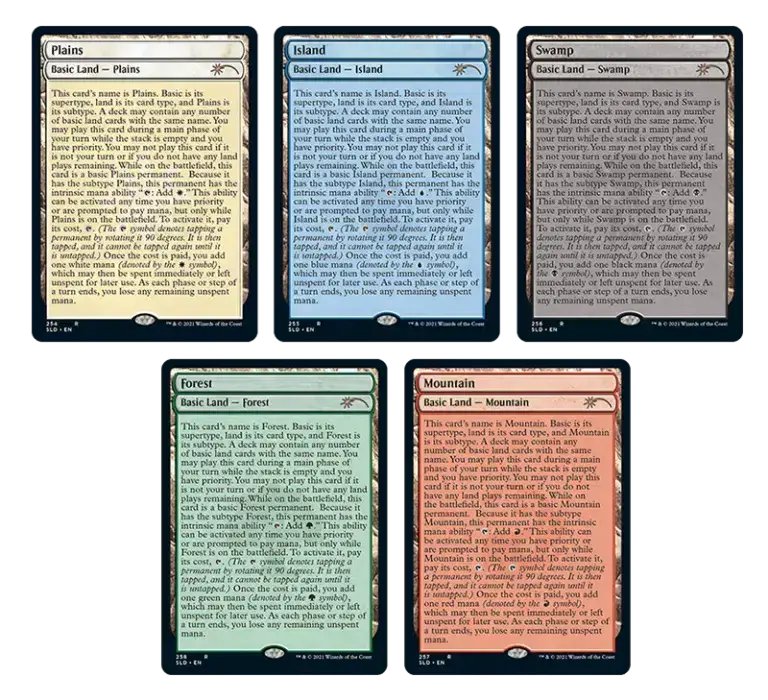
Let’s take Plains as an example
Plains
Basic Land ~ Plains.
This card’s name is “Plains.” “Basic” is its supertype, “Land” is its card type, and “Plains” is its subtype. A deck may contain any number of basic land cards with the same name. You may play this card during your turn, in a main phase, when the stack is empty and you have priority. If it is not your turn, or you have no land plays remaining, you may not play this card.While it is on the battlefield, this card is a “basic Plains permanent.” Because it has the “Plains” subtype, this permanent has the intrinsic mana ability: “{T}: Add {W}.” This ability may be activated any time you have priority or are asked to pay mana, but only while this Plains is on the battlefield. To activate it, pay its cost: {T}. (This symbol means to rotate the permanent 90 degrees to “tap” it. It is then tapped and cannot be tapped again until it untaps.) Once the cost is paid, you add one white mana (represented by the {W} symbol), which can be spent immediately or kept for later. When each phase or step of the turn ends, you lose all remaining unused mana.
In short: it is all nonsense.
It rambles on for an entire essay just to tell you “this is a Plains, and it can tap for one white mana.”
There is even a little highlight: in the bottom-left corner, where the artist’s credit should be, it is simply left blank, because this card has no illustration at all.
Although every sentence on the card is completely correct,
even for a basic land, this kind of rules description is really too much.
4. Conclusion
Card games evolve over time.
The more complete the rules, the more concise the wording; the more mature the mechanics, the more information keywords can carry.
Next time you see a new card and cannot help complaining “why is there so much text,” think about these cards at the level of an English reading comprehension test.
Maybe you will suddenly realize that modern designers are actually very merciful.
- Title
- Stop Blaming Modern Cards for Having Too Much Text: The Essays MTG Has Written Over the Years
- Author
- XSBeeble
- Created at
- December 31, 2025
- License
- This work is licensed under CC BY-NC-SA 4.0 .