A First Look at Edge of Eternities Standard

Note: This article was translated from Chinese by AI and may contain errors. Read the original Chinese version.
Deck Overview
Mono White Token Control
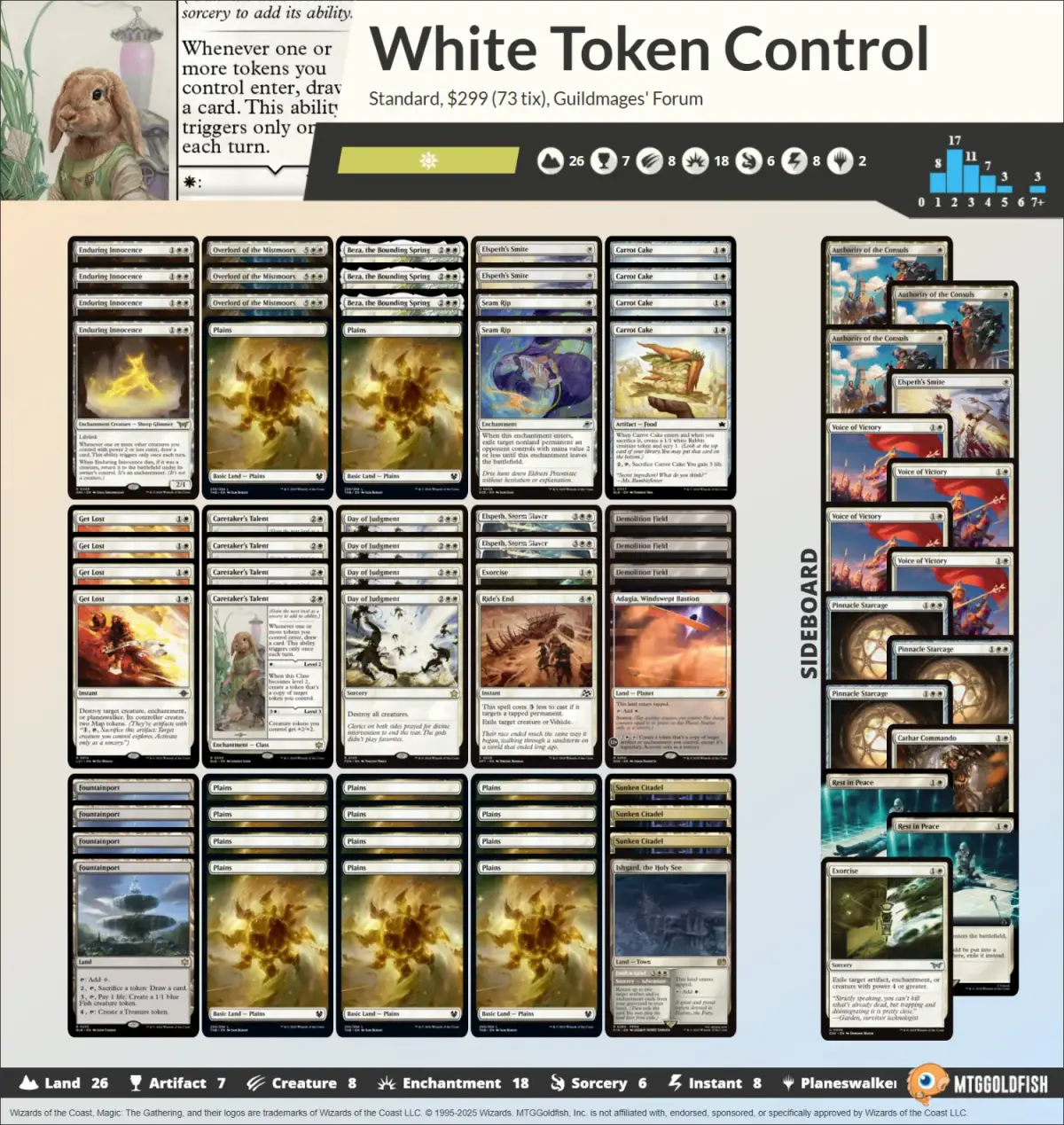
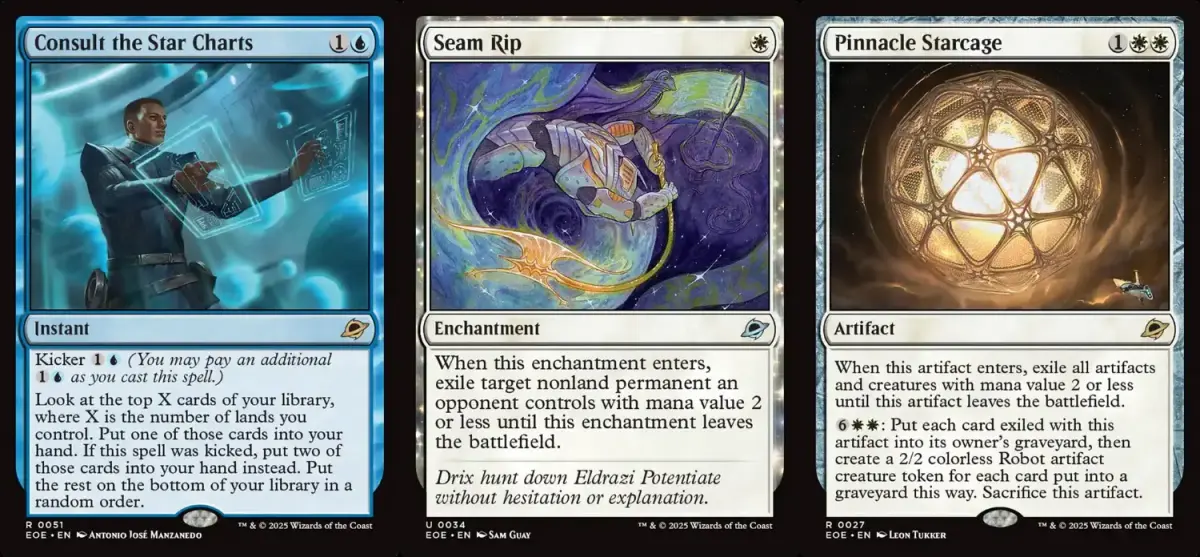
In this Standard rotation, Mono White Token Control lost only one card, Lay Down Arms. It was a strong one-mana removal spell, but we still have Elspeth’s Smite, which hasn’t rotated, and the set’s newcomer Seam Rip (an enchantment version of Portable Hole). As one-mana removal, those two are above average, so the overall structure took no major hit. There’s even a bit of a silver lining: without Lay Down Arms, you no longer have to agonize over your Plains count and can make full use of a mono-colored deck’s advantage of running lots of utility lands.
Speaking of white removal, I have to mention Pinnacle Starcage, the successor to Temporary Lockdown in this set. It can only deal with creatures and artifacts, but that’s not entirely a downside, because our sideboard also runs Authority of the Consuls and Rest in Peace. These targeted enchantments won’t hurt us by accident either. Against aggro in particular, Authority of the Consuls often shows up alongside it. The new Seam Rip is also cleverly designed as an enchantment, so the two anti-aggro removal pieces can coexist.
In fact, Pinnacle Starcage has one more advantage over Temporary Lockdown: it can exile artifact lands. That said, this is basically negligible in Standard.
Mono Green Aggro
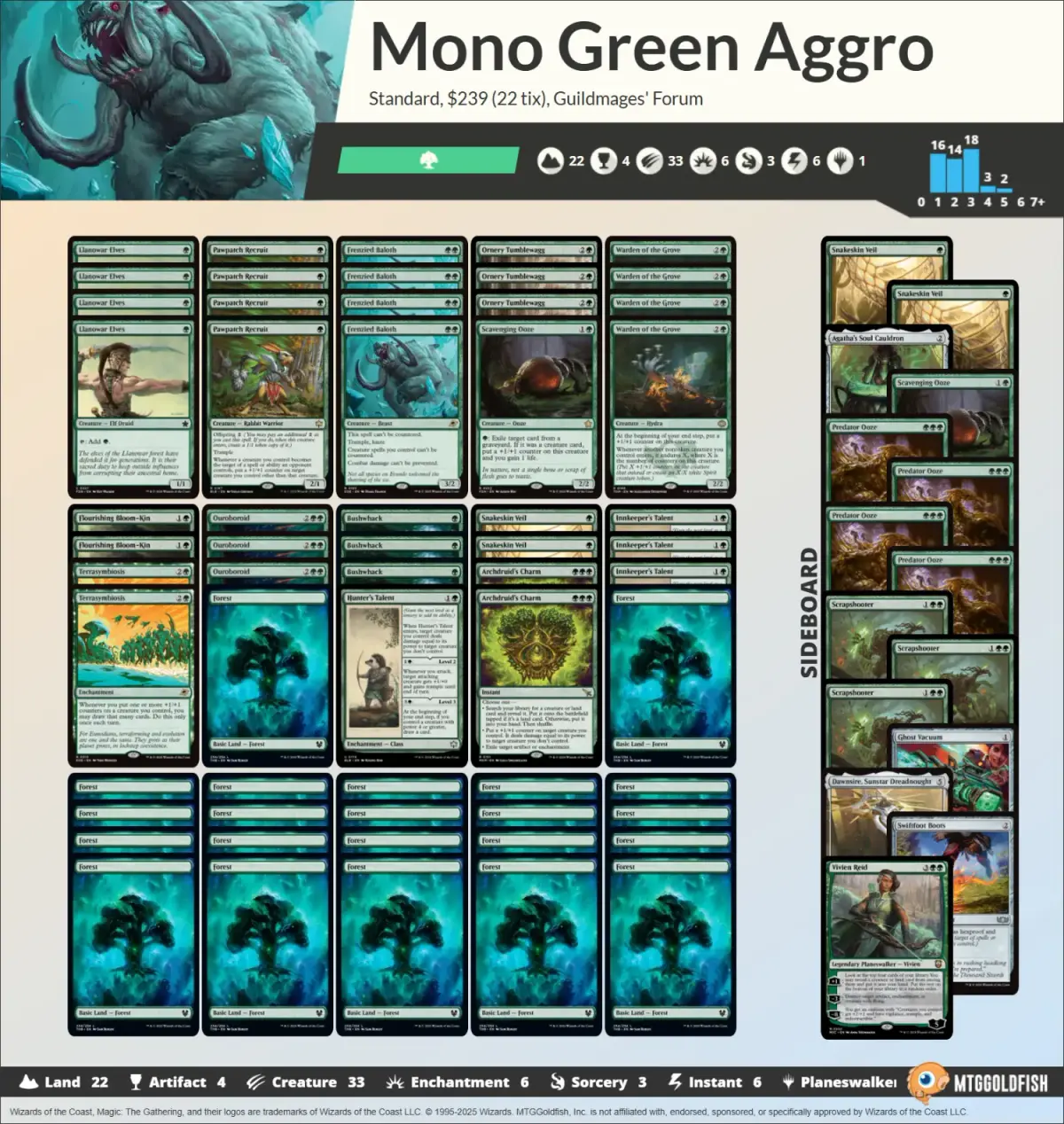
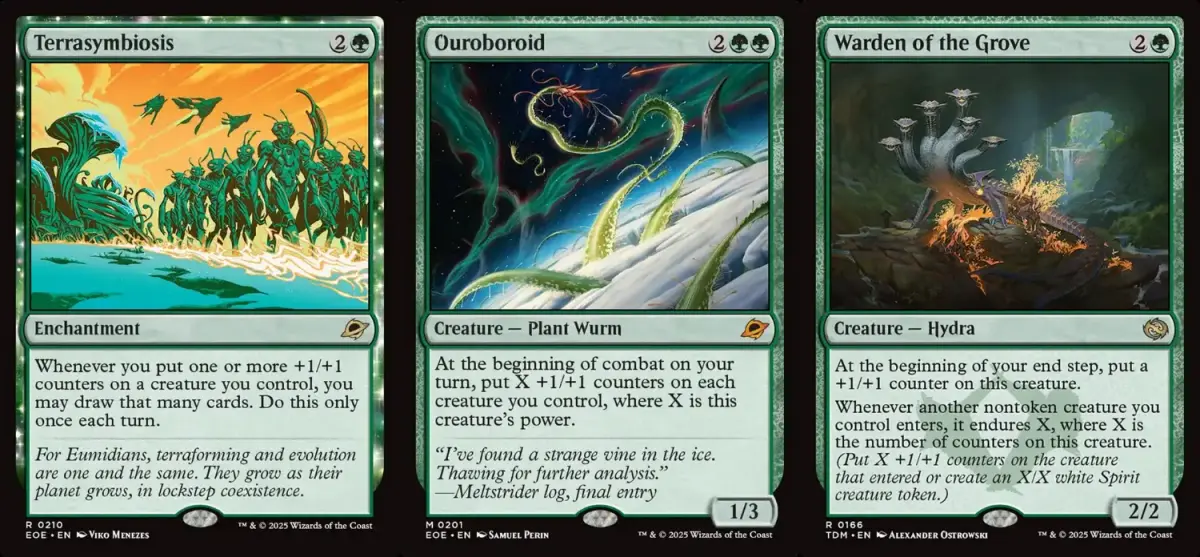
A green aggro deck themed around +1/+1 counters. Ouroboroid has a very high ceiling for board explosions, but placing +1/+1 counters on its own is still a bit too slow. It only shows its true strength alongside a series of counter-placing support cards like Warden of the Grove and Innkeeper’s Talent. Terrasymbiosis also provides valuable resource refueling for the counters package.
Mono Green Landfall
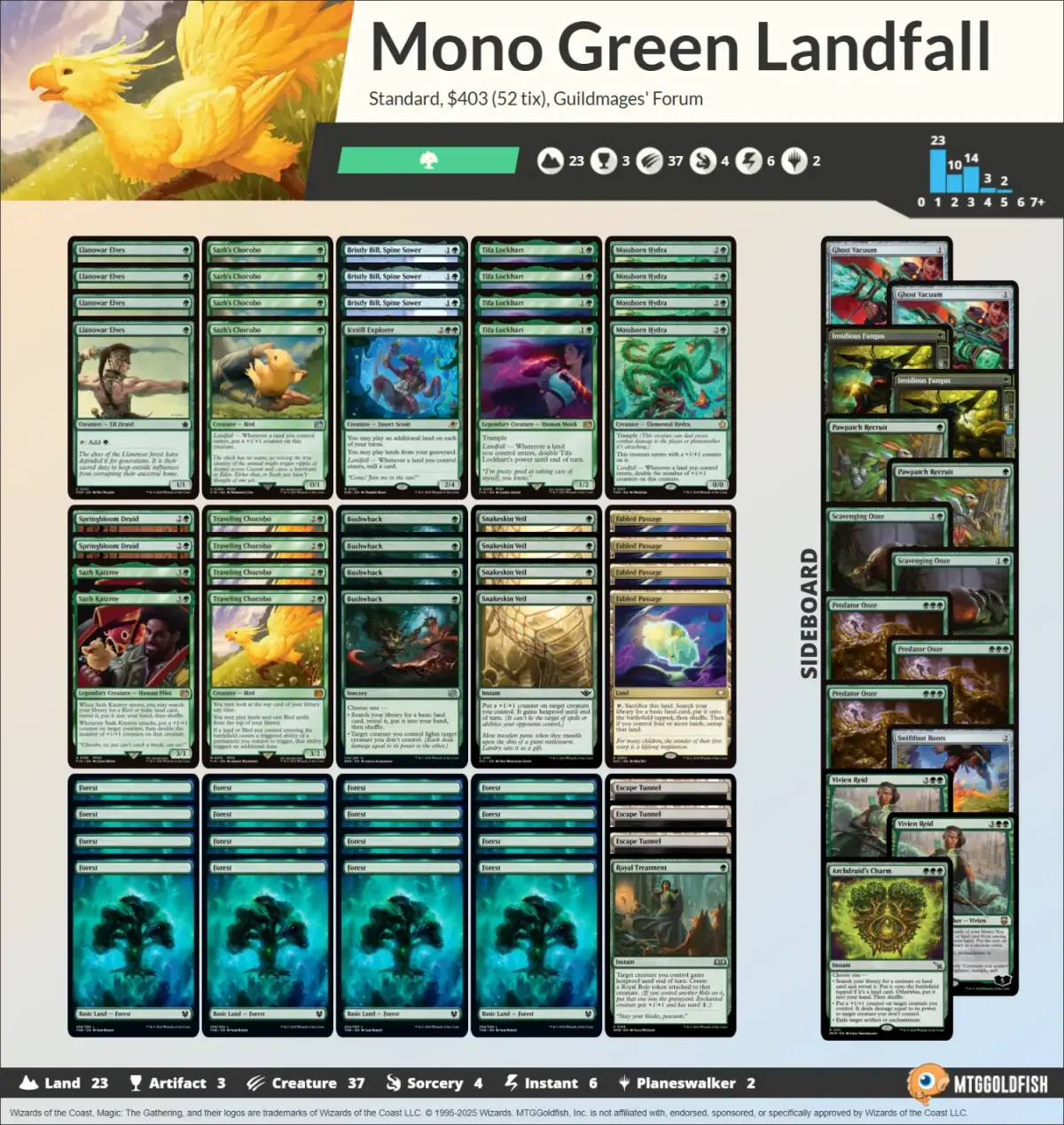
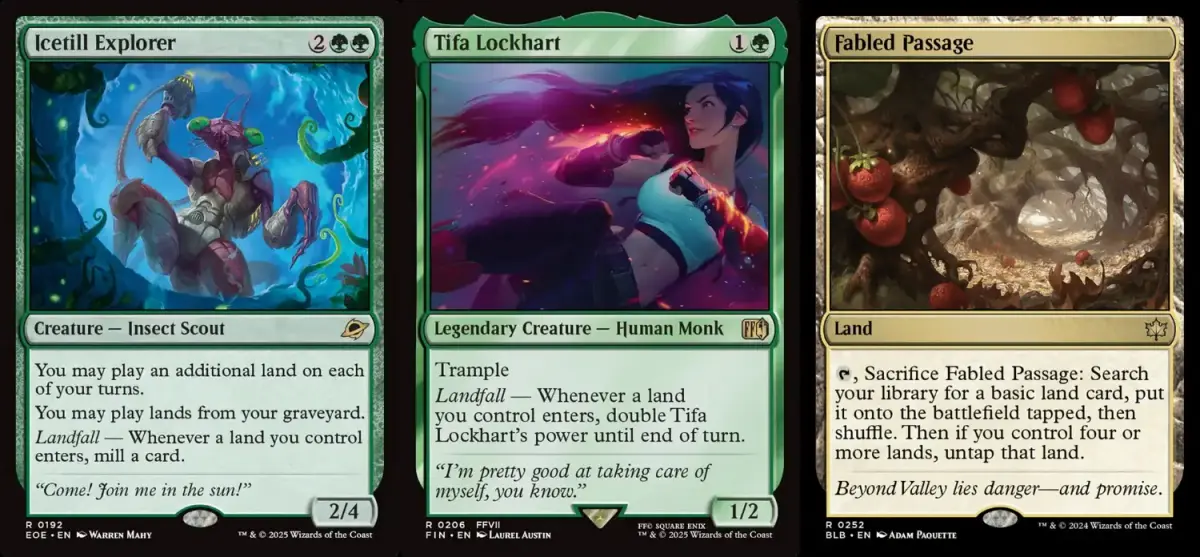
On top of the existing Chocobo landfall aggro base, this build adds one Icetill Explorer. As long as it’s on the battlefield, you can play fetch lands from your graveyard twice each turn, so you never lack landfall triggers while continuously thinning your library.
Mono Green Eldrazi
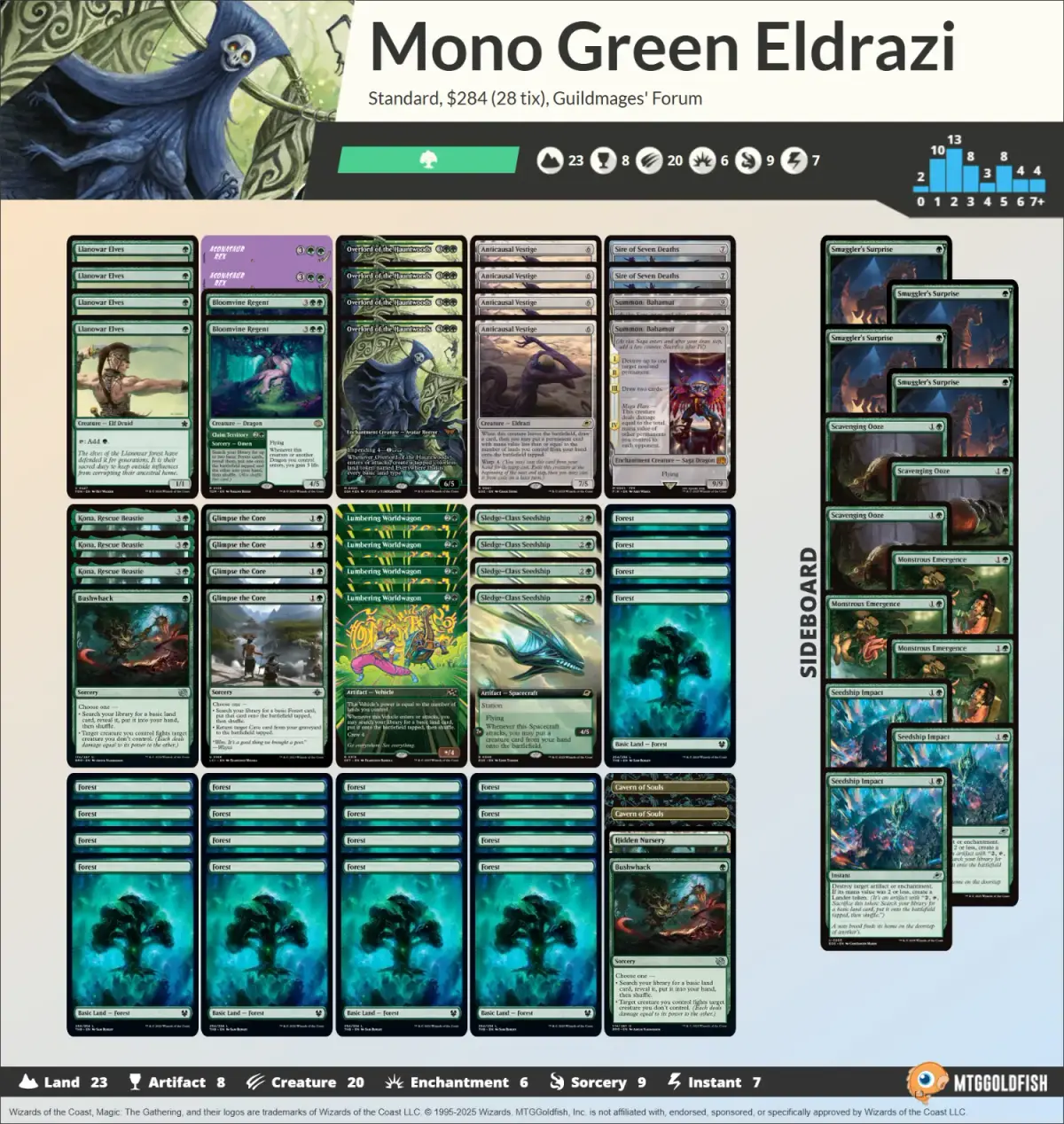
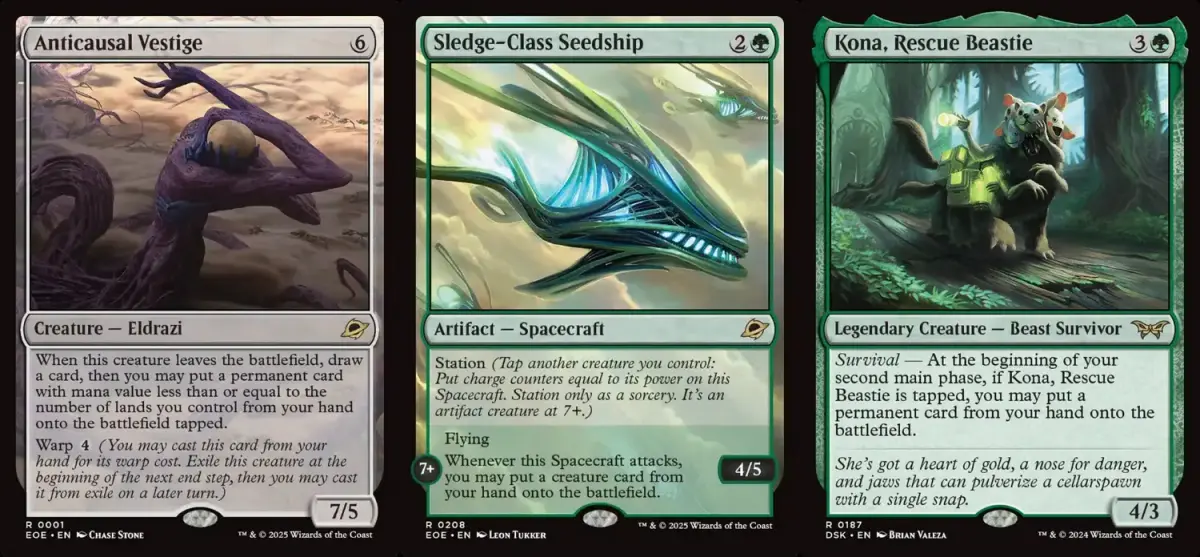
A pie-in-the-sky meme deck. At its core it’s a green ramp deck, but with Sledge-Class Seedship and Kona, Rescue Beastie, it has a chance to drop a big creature onto the battlefield immediately. The two even work together: any random Vehicle or Spacecraft can help Kona, Rescue Beastie satisfy its survival condition. However, this strategy can be stopped as soon as the opponent has a bit more removal, so the sideboard dutifully carries Smuggler’s Surprise, letting you switch back to the traditional instant-speed drop plan.
Mono Black Aggro
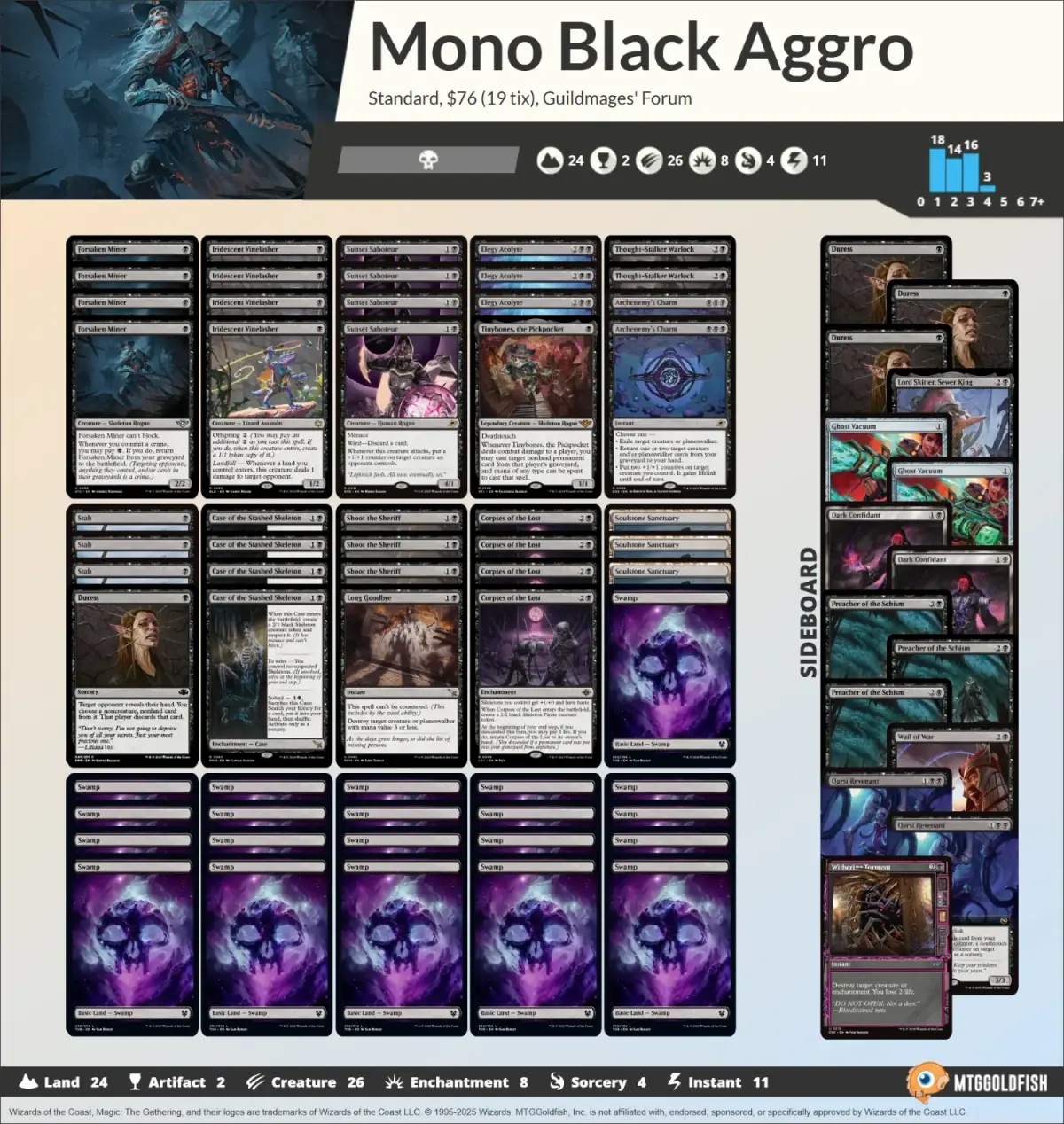
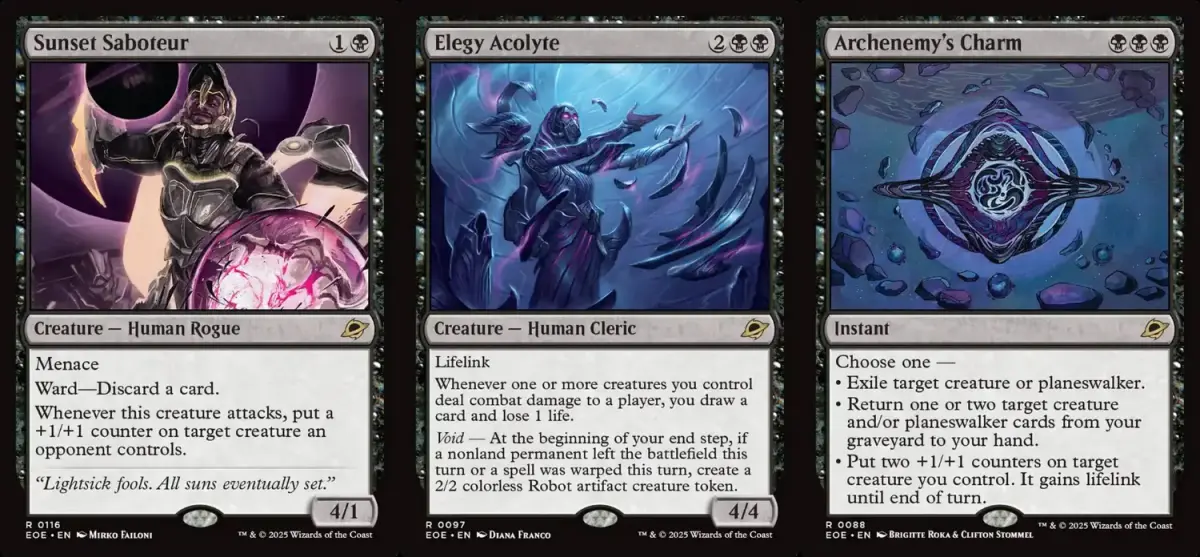
Sunset Saboteur was clearly born for aggro: high power, hard to block, and killing it costs the opponent a card. The Skeleton package is another relatively aggressive archetype in black, but since Standard doesn’t have enough quality Skeletons, that actually freed up some slots in the creature curve. Elegy Acolyte serves as a near-substitute for Gix, Yawgmoth Praetor, supplying extra staying power.
Orzhov Demon
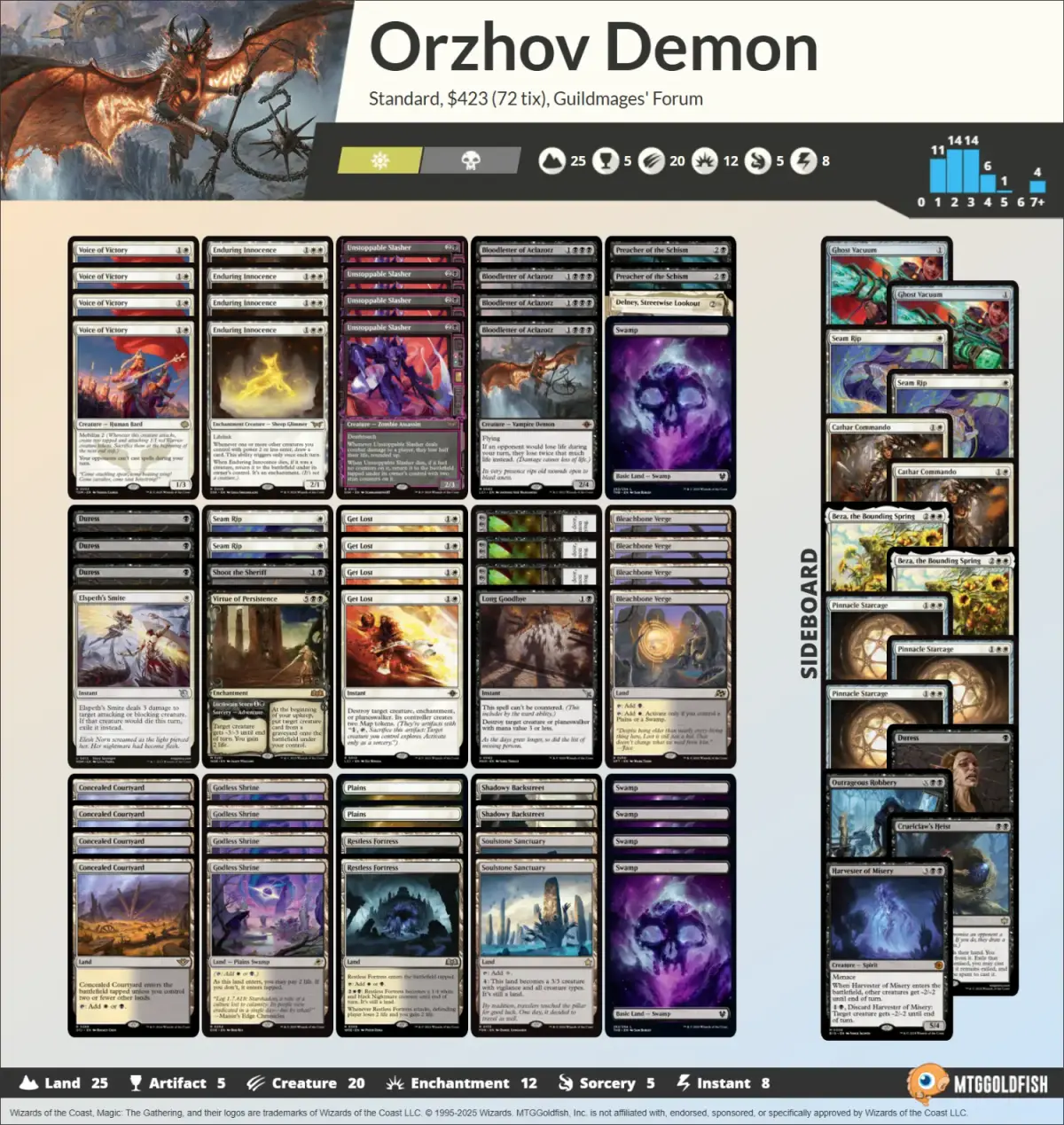
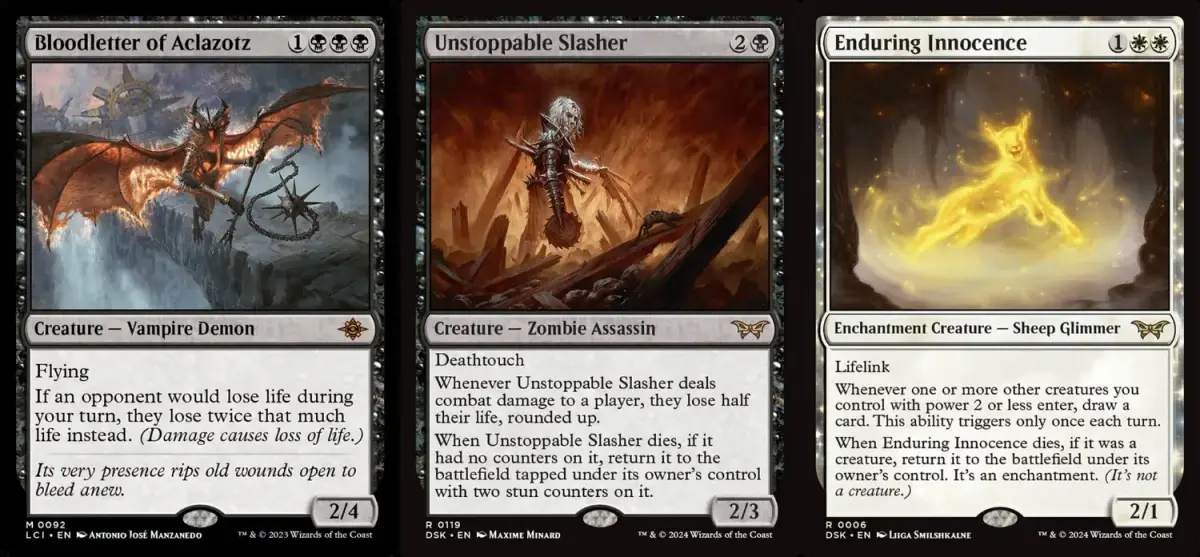
The biggest impact of this rotation on the Unholy Annex // Ritual Chamber archetype is the loss of Archfiend of the Dross and a card that isn’t a Demon but does a Demon’s job, Sheoldred, the Apocalypse. To keep playing Unholy Annex // Ritual Chamber, the most intuitive option is to bring back the classic pairing of Bloodletter of Aclazotz and Unstoppable Slasher. Built on that premise, you could actually just go mono black. But another big blow to black decks in this rotation is the disappearance of a large batch of useful cheap removal. Conveniently, Godless Shrine was reprinted this time and Concealed Courtyard hasn’t rotated yet, so splashing white costs little in mana base stability while patching the removal weakness, and the sideboard gets broader coverage as well.
Another benefit of adding white is access to Enduring Innocence as an extra resource engine. After all, both core pieces, Unstoppable Slasher and Bloodletter of Aclazotz, are 2-power creatures, and other strong curve plays like Voice of Victory and Preacher of the Schism also qualify. Even ignoring the combo that can kill in one swing, it performs well as a plain midrange grind deck.
Orzhov Control
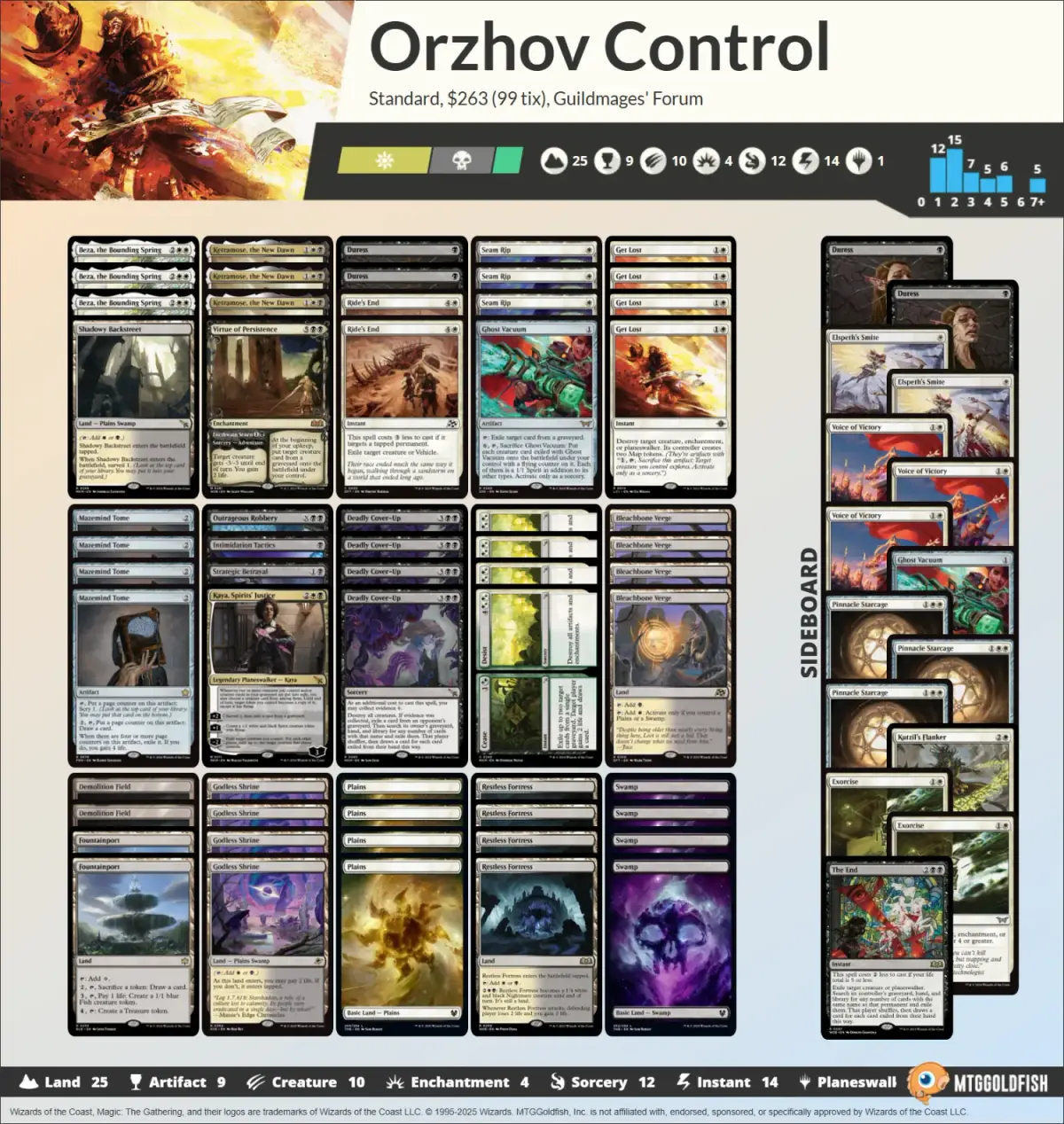
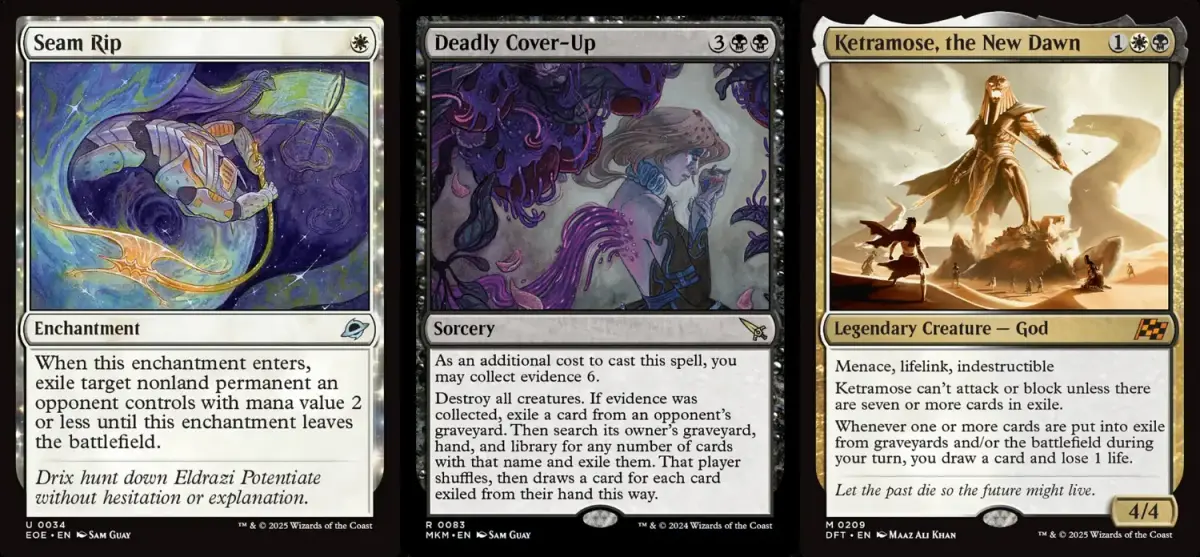
A control deck built around Ketramose, the New Dawn (commonly called the Black-White God). It picks generically useful exile-related cards as much as possible to extract value from the Black-White God. The pairing of Cease // Desist and Deadly Cover-Up is practically tailor-made for Ketramose, the New Dawn. When Cease draws cards, it can also exile a graveyard, and that one card then satisfies Deadly Cover-Up’s collect evidence 6. If you collect evidence when casting Deadly Cover-Up, exiling from graveyards happens once as a cost and once on resolution, which lets Ketramose, the New Dawn draw two cards, and it won’t wipe out Ketramose, the New Dawn, which has indestructible.
Given that you’re pairing with the Black-White God, among one-mana removal spells the new Seam Rip is indeed better than Cut Down and Elspeth’s Smite. This is a rare exception where, after the black decks lost their cards, one-mana removal actually got better. However, Seam Rip is only sorcery speed, so it can’t save you in certain tempo-sensitive board states, which is why the sideboard still dutifully keeps Elspeth’s Smite.
Izzet Vivi Cauldron
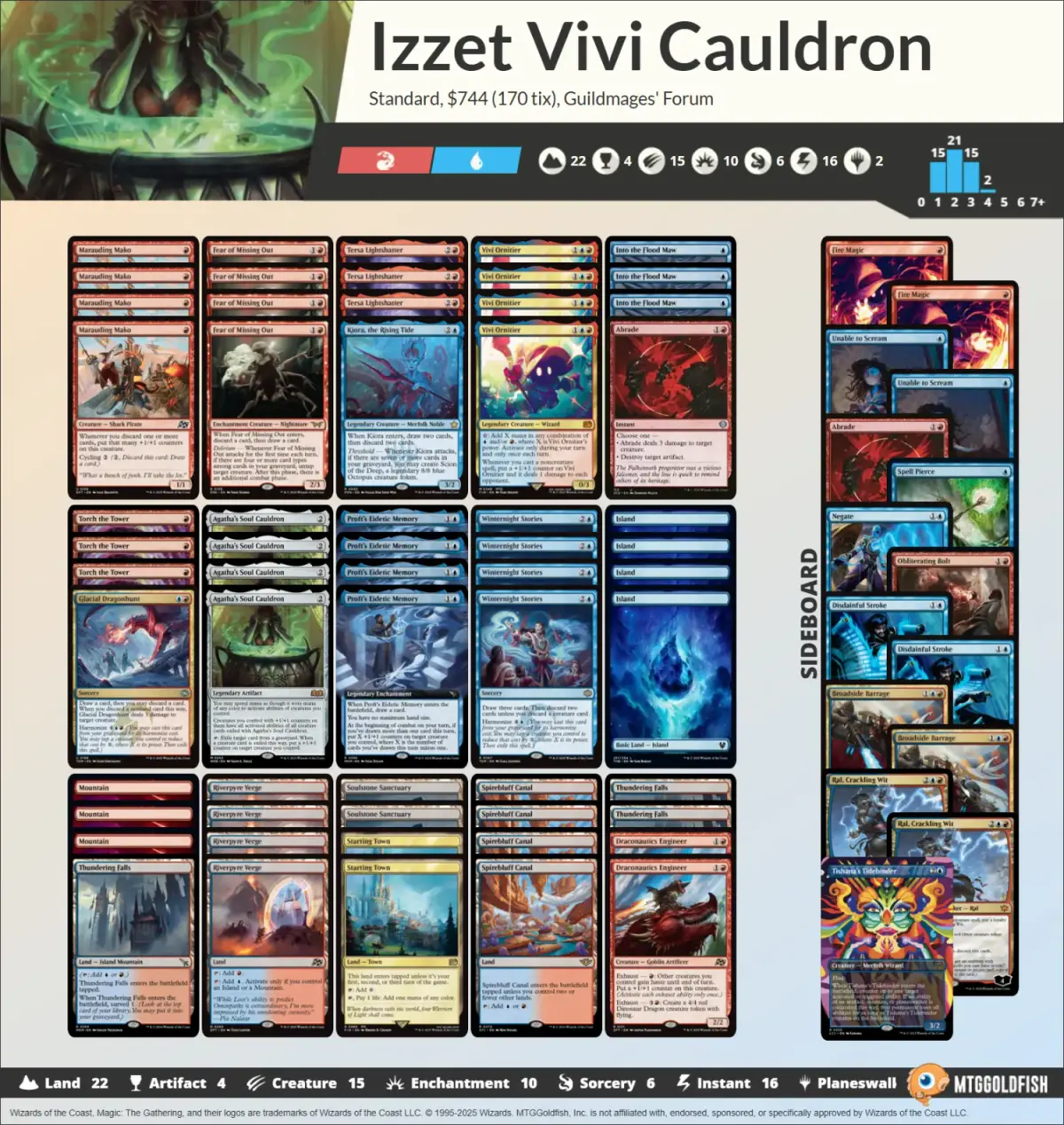
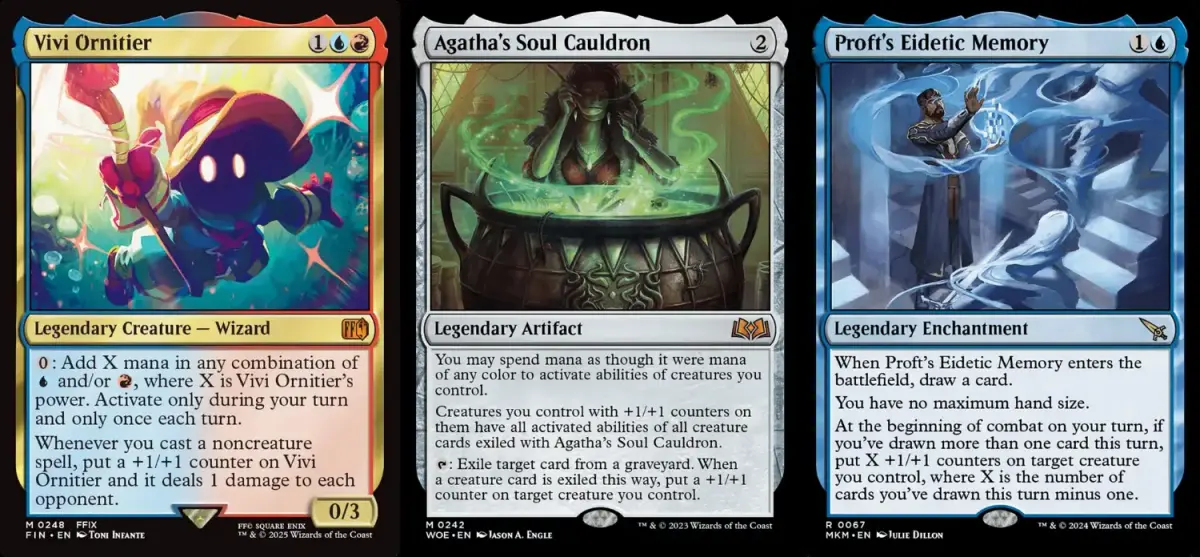
Honestly, this build uses no new cards at all. It’s just post-rotation reconstruction. The biggest pain point of this rotation for Vivi Cauldron is losing Voldaren Thrillseeker, so you can no longer have a creature commit seppuku at the slightest provocation, Fling itself out, and go for the head with out-of-nowhere damage. I took a quick pass through the creatures in current Standard with a win-the-game activated ability, and Draconautics Engineer seems like the more viable option. This card already showed up as a Plan B in the sideboard of some older Vivi Cauldron lists, and its Exhaust can also provide a win condition from a tricky angle, keeping the Vivi Cauldron deck’s strength of having many attack angles.
Izzet Pirate
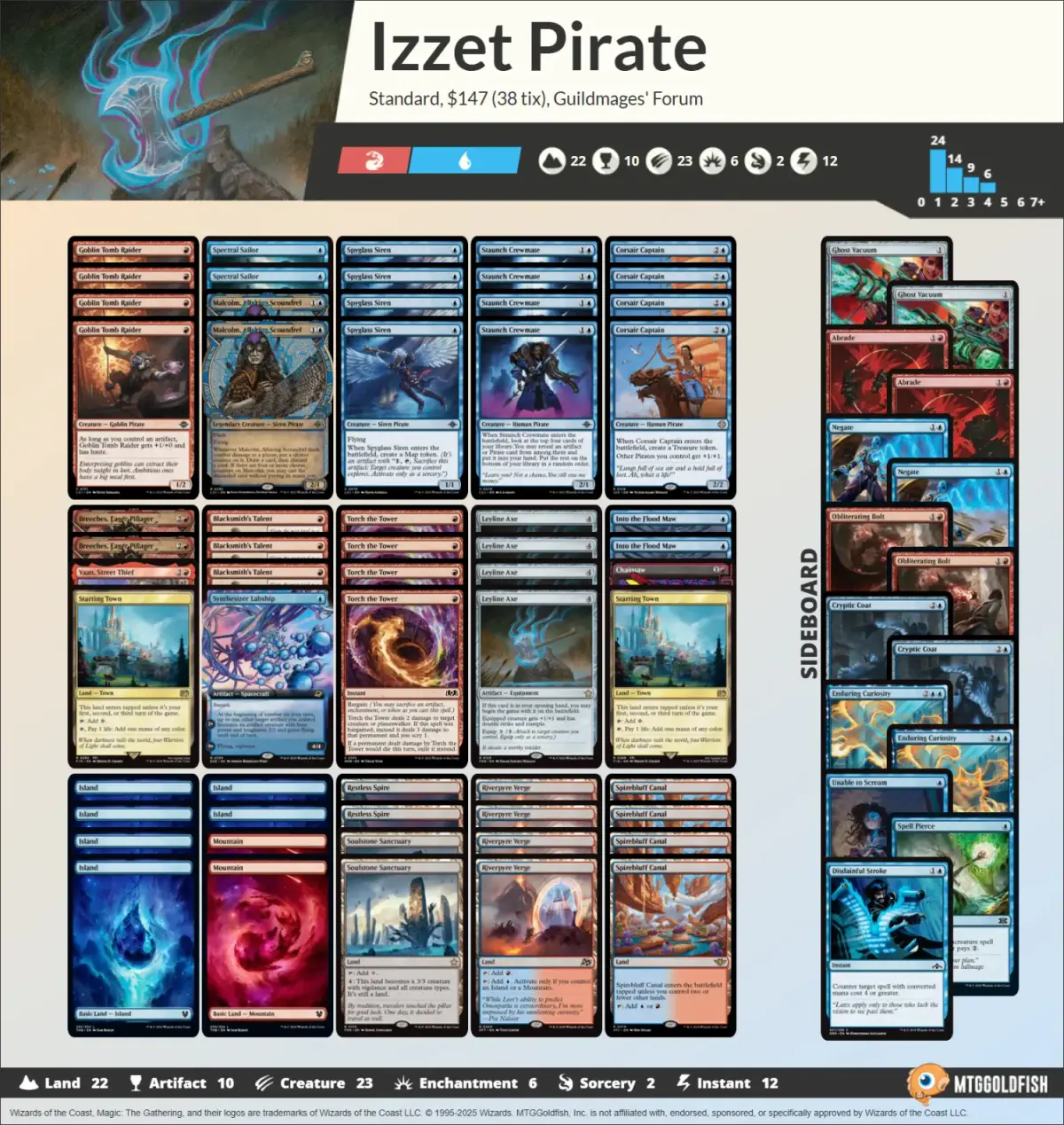
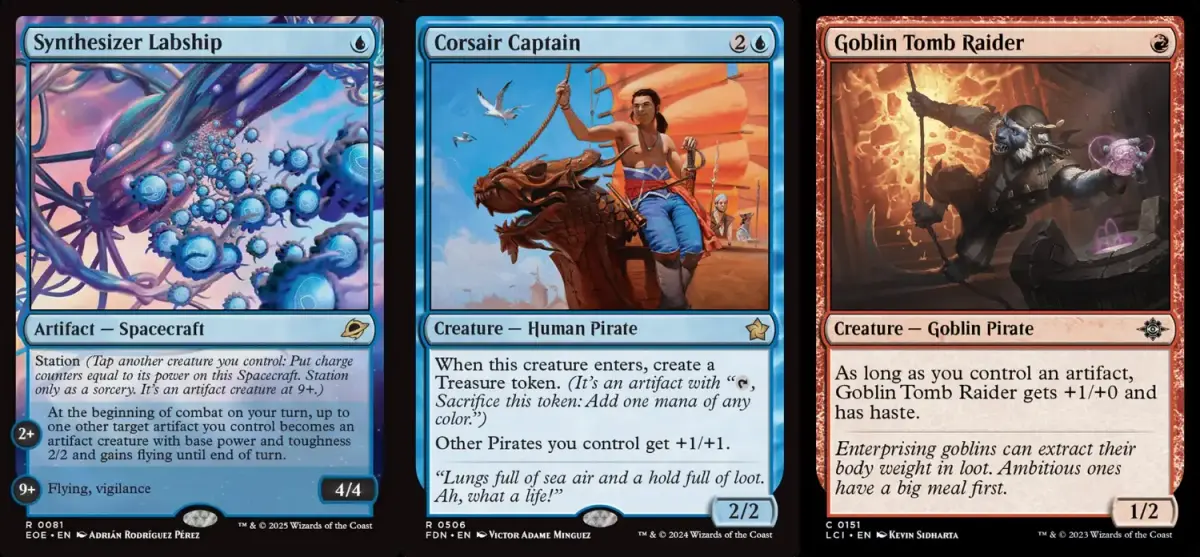
The Pirates of LCI are tightly tied to artifacts, which gives Synthesizer Labship some job opportunities. But considering how tight the Pirate tempo is, and that the removal slots can’t be skimped on, squeezing out a single slot is about the limit.
Recommended earlier article ~ Chart a Course: Pirate Captain Constructed Check-up
Boros Burn
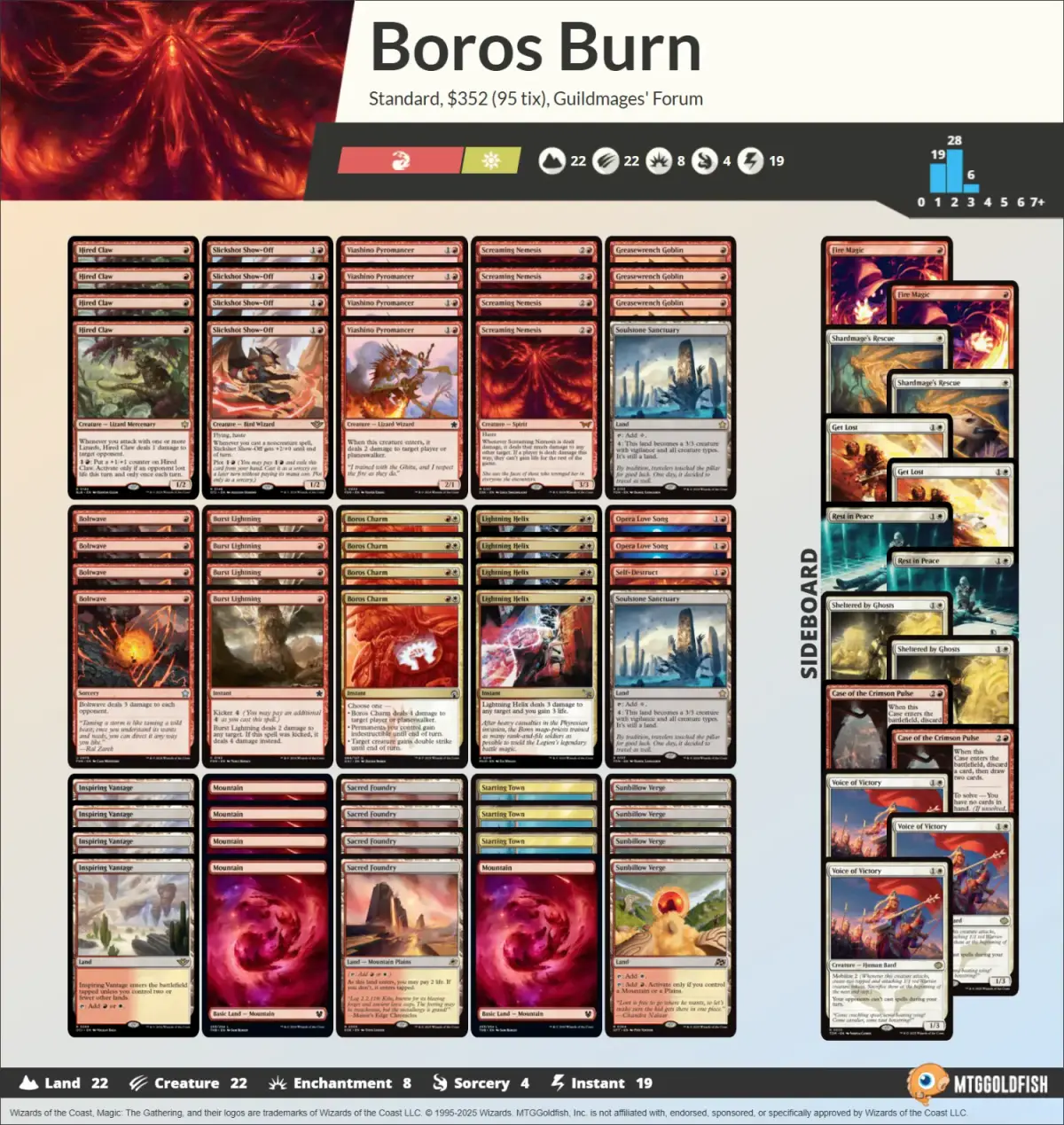
I have to say, although the rotation of Monastery Swiftspear doesn’t hurt creature-based aggro too badly, it still matters quite a bit for spell-based aggro like burn. I originally wanted to try the new Lightstall Inquisitor in the slot of Greasewrench Goblin, but on reflection the tempo didn’t seem right. Setting aside the floor case where the opponent exiles a tapped land, meaning our ETB does nothing (because against burn, a shockland entering untapped just gives us a free Shock, and whether the opponent wants to do that is sometimes hard to say), burn’s tempo was never as tight as creature-based aggro, and the most annoying thing about burn is that often the opponent has no effective interaction at all. Weighing everything, Boros Burn doesn’t seem to be the stage where Lightstall Inquisitor can shine, so I switched back to the old one-mana curve for now.
Overall, apart from rebuilding the mana base with Sacred Foundry, it uses no new cards at all, so it’s just post-rotation reconstruction of the old list.
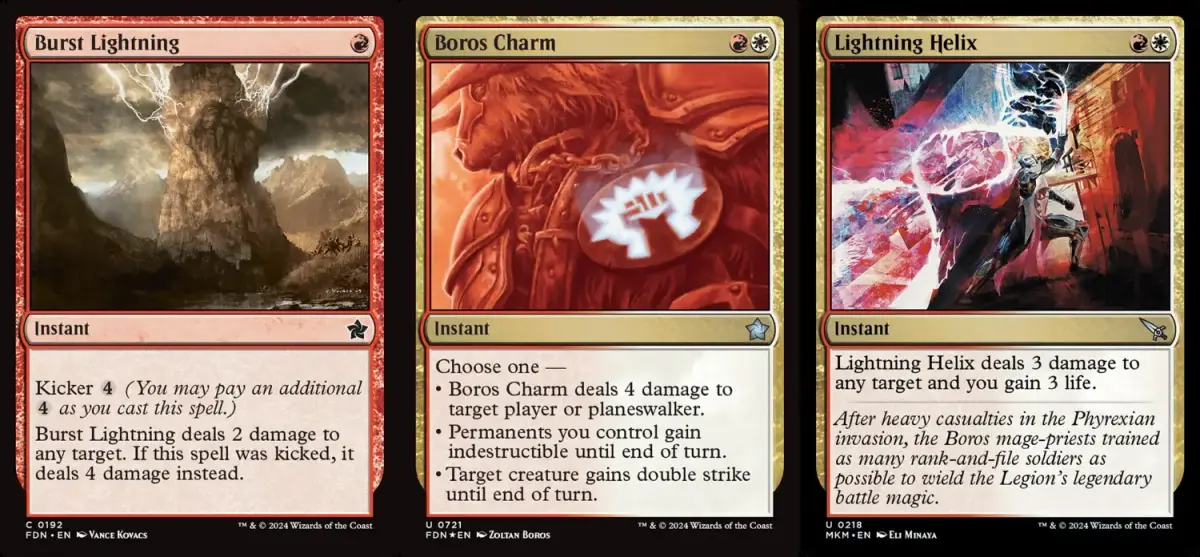
Gruul Aggro is in a similar situation, although Boros Burn at least gives Monastery Swiftspear a place worth mentioning. Creature-based aggro like Gruul had already optimized Monastery Swiftspear down to near-nonexistence, and the deck changed even less than Boros Burn, so I won’t pull out a separate section for it. The Gruul Aggro list after EOE is below:
Gruul Aggro decklist link
Boros Tannuk
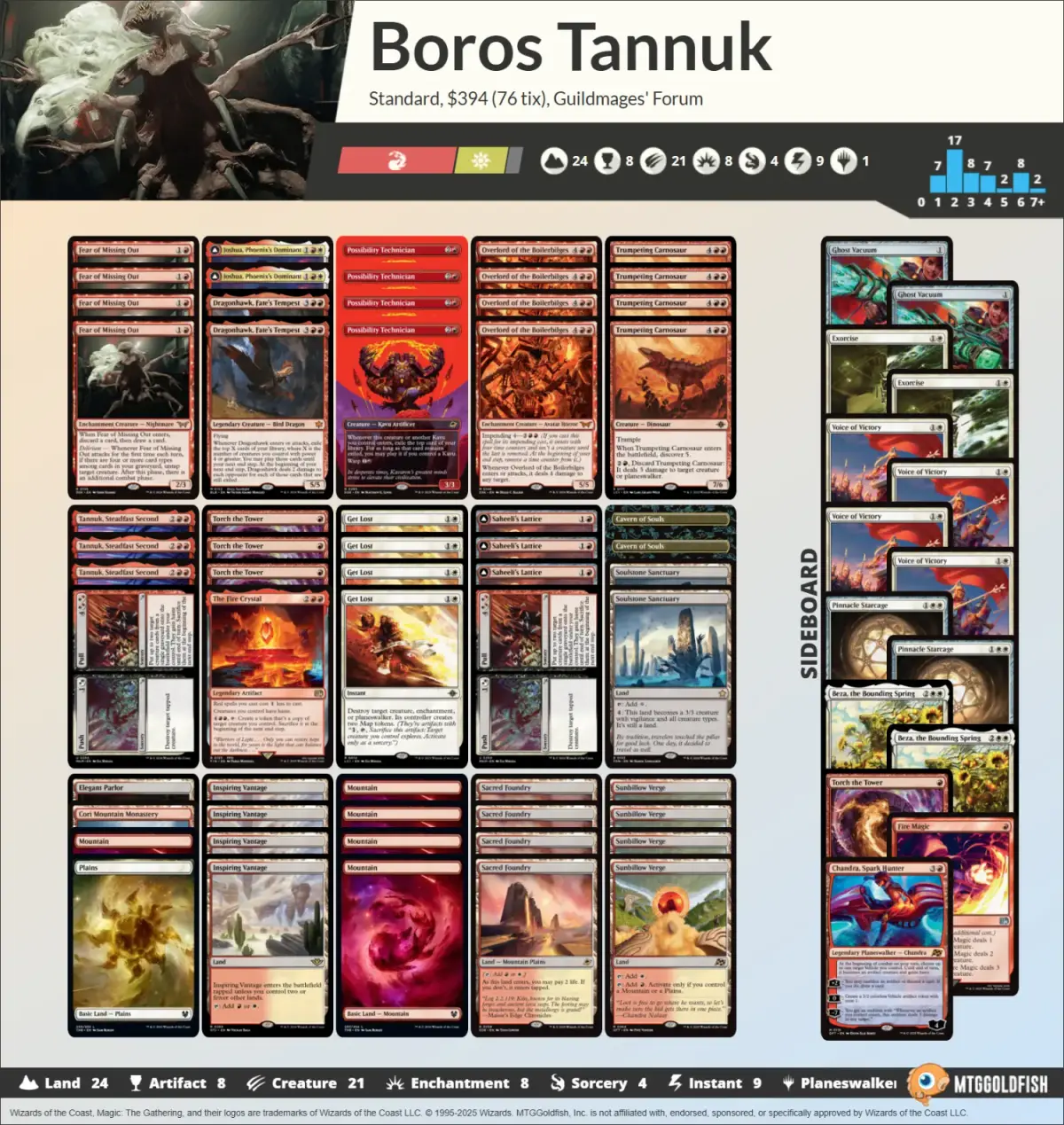
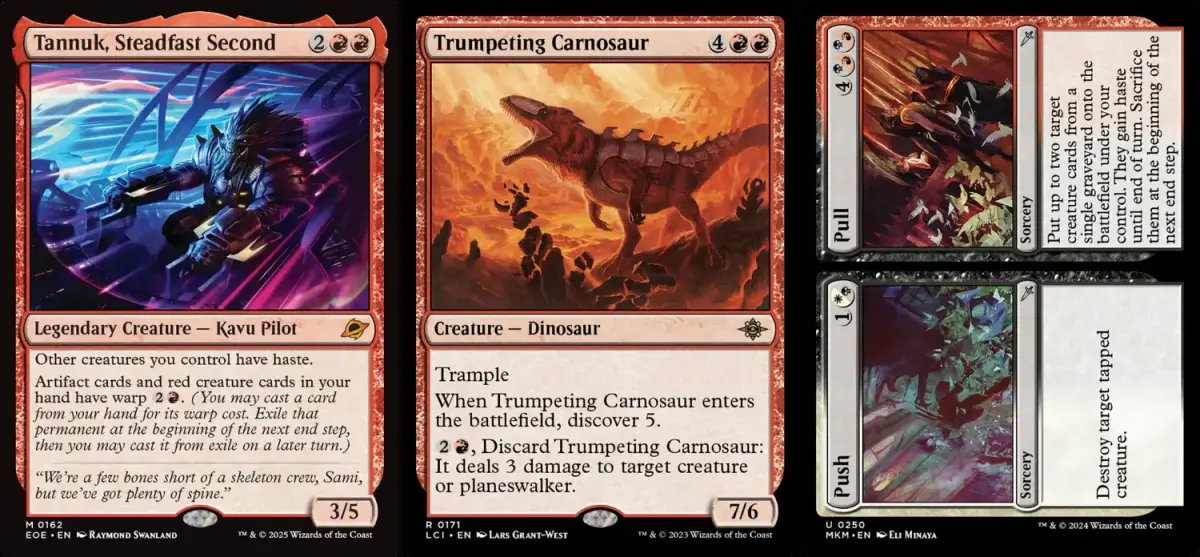
Tannuk, Steadfast Second can cast powerful artifacts and red creatures cheaply with Warp. To reach the ceiling while keeping the deck stable, the most intuitive approach is to pick creatures with powerful ETB abilities that are expensive on their own but have a flexible cheap alternative cost. Trumpeting Carnosaur and Overlord of the Boilerbilges both fit perfectly.
Even so, packing that many expensive cards is still a bit scary, so I mixed in a number of looting effects. The deck has a decent number of card types, so Fear of Missing Out can reach delirium without trouble, and big creatures that get discarded can be dug back onto the battlefield with Push // Pull for an explosive attack. To keep its left half from becoming a dead card, the deck lightly splashes white, which also fixes red’s feeble removal suite.
Boros Artifact
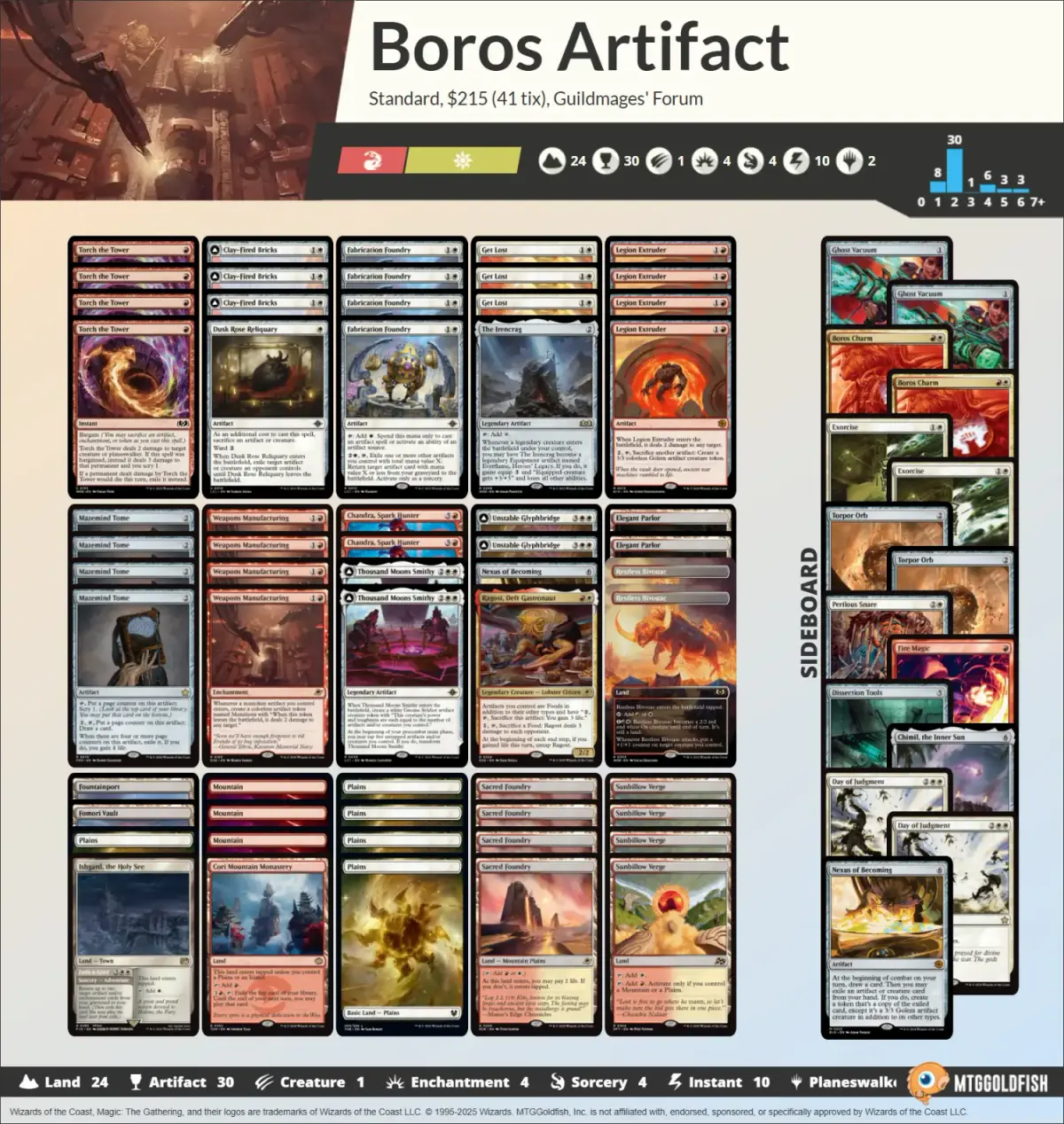
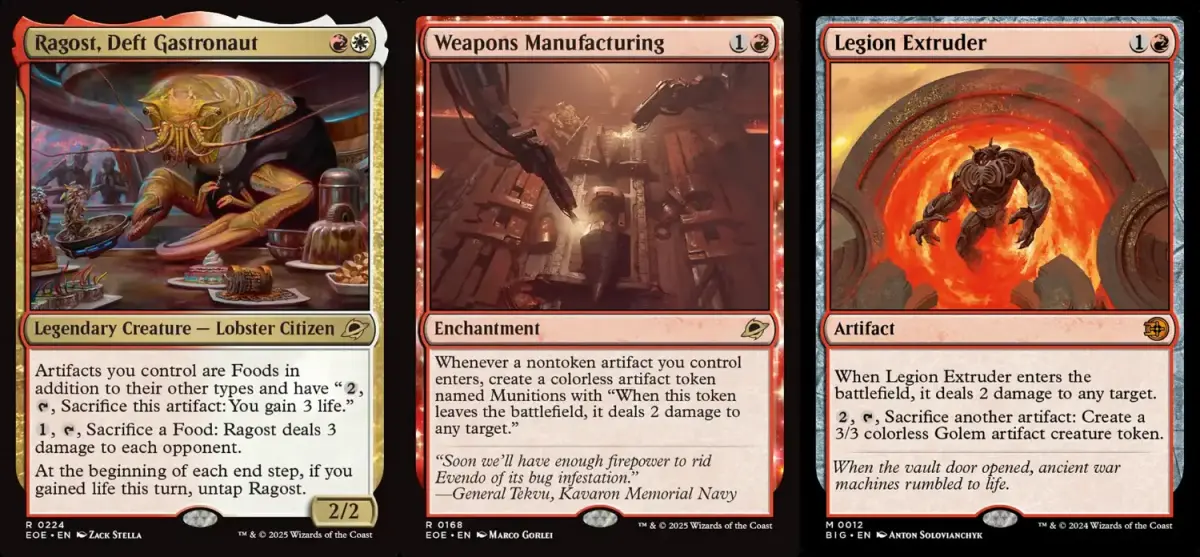
The core of the deck is the supply chain of Weapons Manufacturing + Legion Extruder, which continuously builds the board and deals damage. When people talk about artifact decks, they usually think of splashing blue for Simulacrum Synthesizer, but the blue side of the archetype is already quite complete. Also, that route is merely good at producing artifacts, and to get the most out of Weapons Manufacturing it also demands a number of sacrifice outlets. Furthermore, the Simulacrum Synthesizer route leaves very little slot room for artifacts that aren’t three mana or more, so there’s simply no room to play the Weapons Manufacturing + Legion Extruder package. Switching to red-white actually works out better.
Azorius Artifact
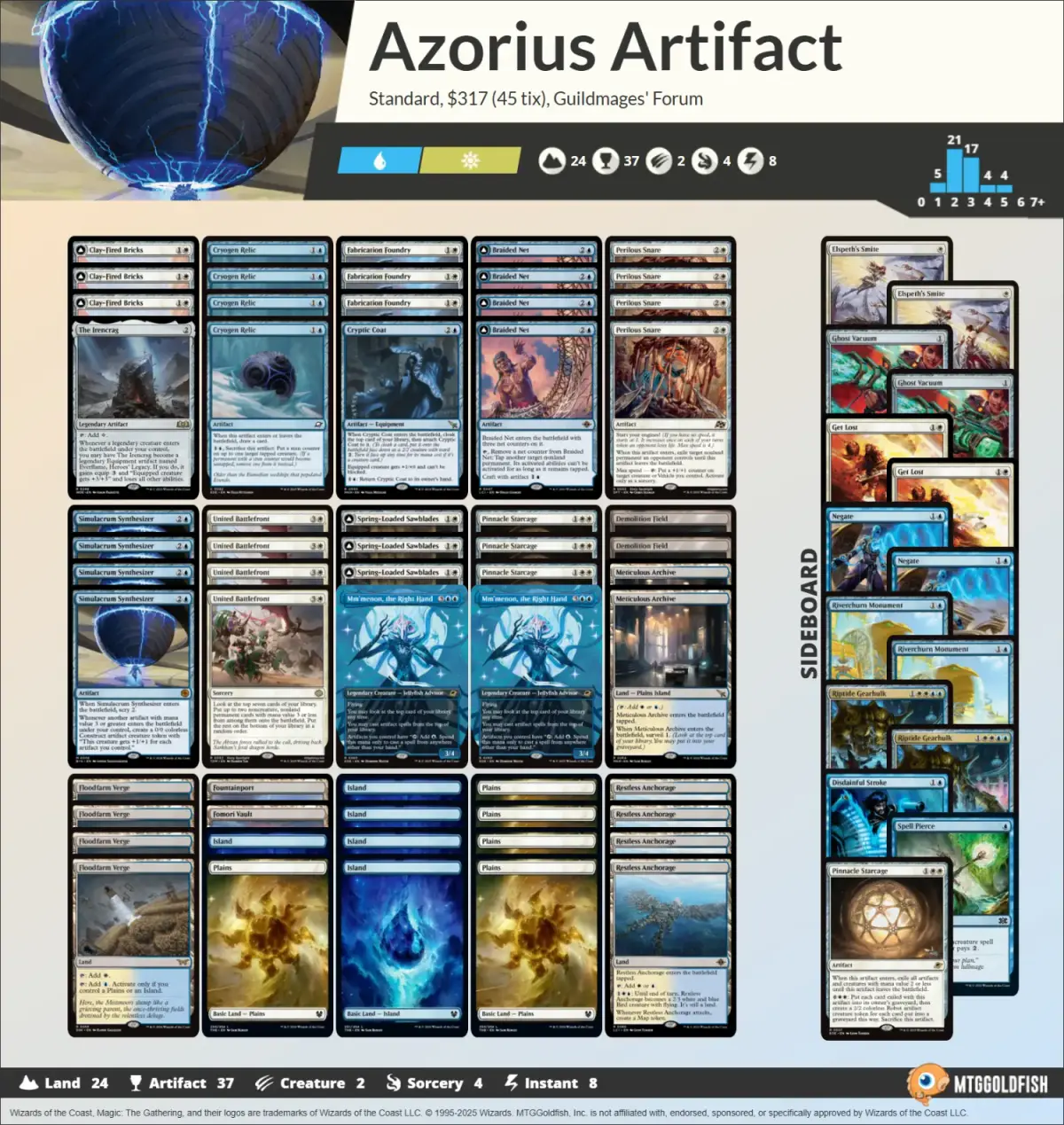
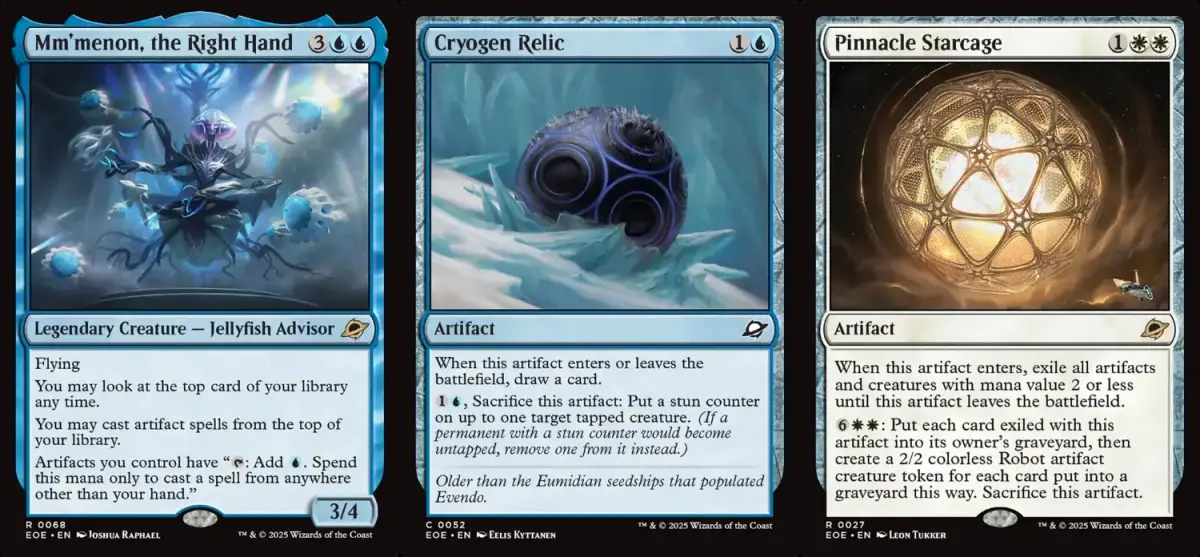
To make Mmmenon, the Right Hand work, you need a deck with very high artifact density. Ever since Simulacrum Synthesizer was born, Standard has never had trouble assembling a blue artifact deck.
Azorius Control
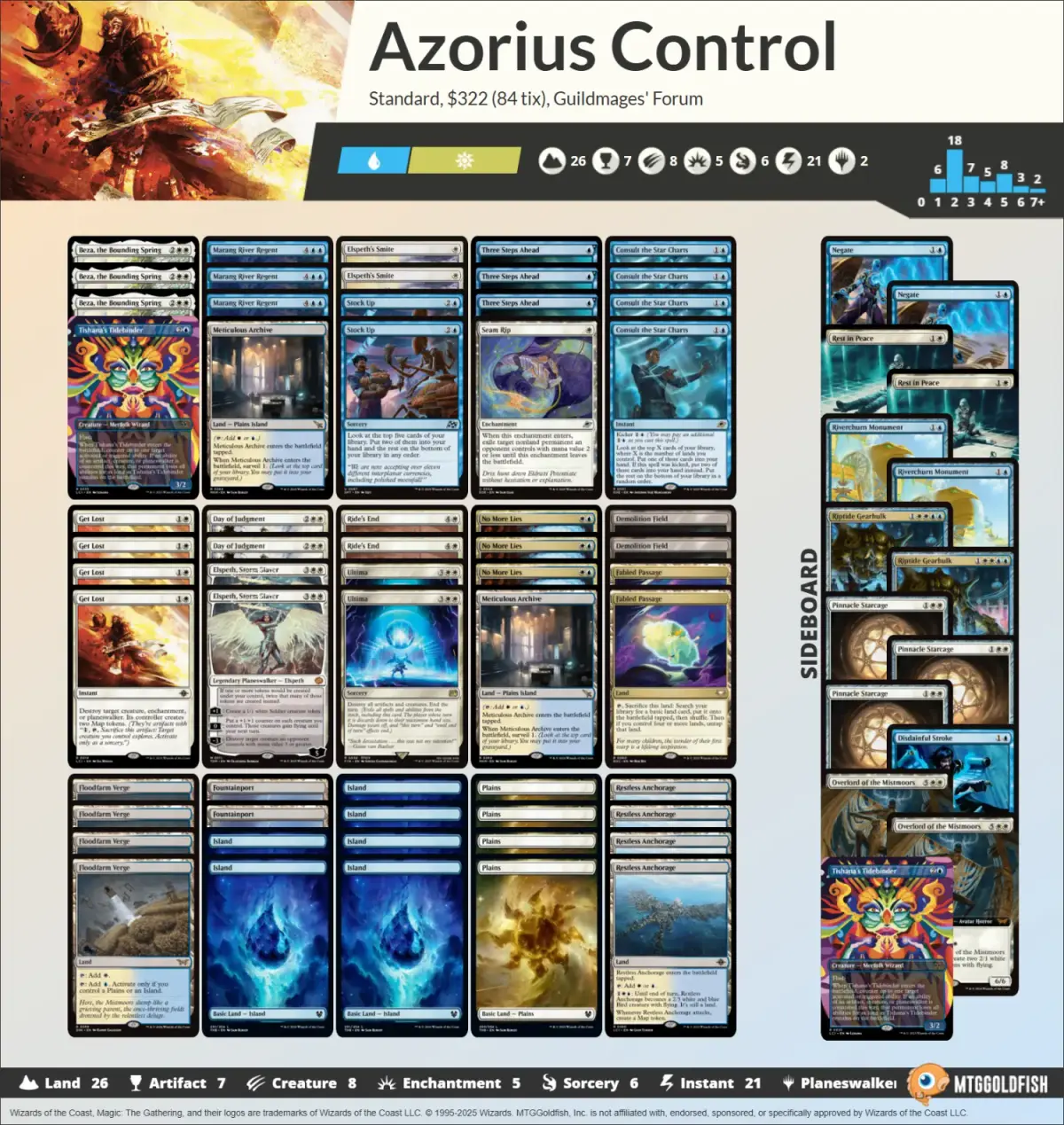
My past verdict on Memory Deluge was “the pinnacle of four-mana instant-speed card advantage spells in the Pioneer card pool, and I doubt whether a draw spell that rivals it will ever appear.” And this set really did deliver a successor on the same level: Consult the Star Charts.
In terms of total card advantage, Memory Deluge is still higher, but the depth and flexibility of Consult the Star Charts are really too good. In long matchups it practically picks up half your library to search through, and in fast games it also offers a two-mana card-filtering option. Unlike traditional powerful draw spells, it isn’t so clunky that you end up with a full hand but die before you can clear the board.
That said, although Azorius Control gets a super powerful card-draw spell this time and white removal is barely affected by the rotation, there is a big hole in the mana base. Adarkar Wastes rotated, and Seachrome Coast, which you may have made do with before, rotated along with it. Hallowed Fountain wasn’t reprinted this time, and Starting Town is not something a two-color control deck can afford to play, so all you can do is increase your tapped lands and basic lands and make do.
By the way, although the maindeck Ultima and the sideboard Pinnacle Starcage seem to be conflicting sweepers, the matchups where you need Pinnacle Starcage are probably so fast that you won’t have time to wait until five mana for Ultima, and when sideboarding they will most likely be swapped for each other. If you want to keep the number of maindeck sweepers the same while also adding Pinnacle Starcage, change all the maindeck Ultima into Day of Judgment.
Dimir Control
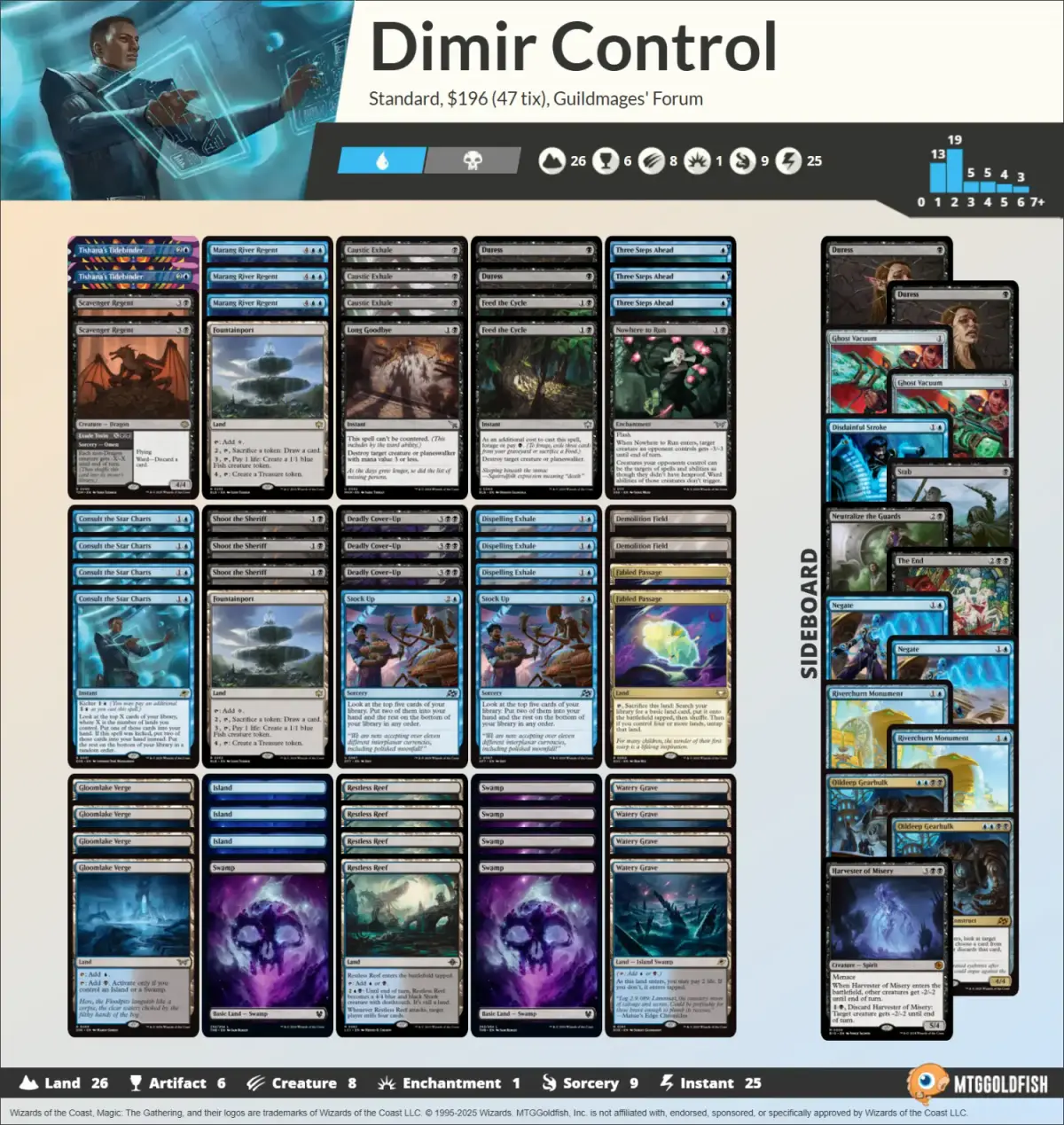
Dimir Control, like the Azorius Control above, is one of the decks that painfully lost its adjacent-color dual lands. But Dimir is lucky in that Watery Grave was reprinted this time, so there’s no need to worry about the mana base at all.
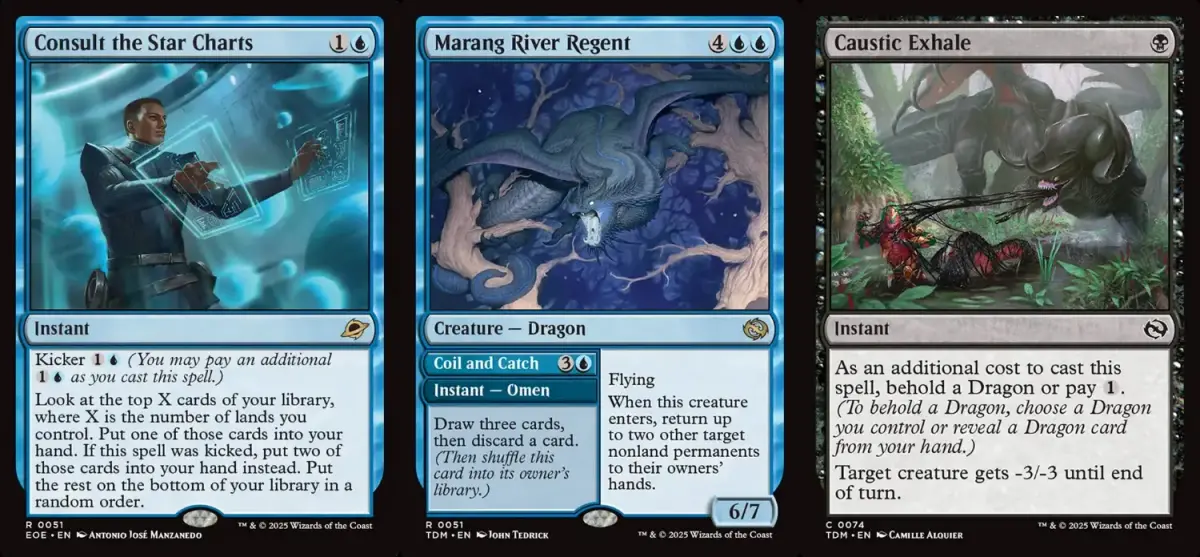
Although the lands are fine, the spells have plenty of problems. After Cut Down rotated, the only real unconditional one-mana instant-speed removal left is Stab, yet there are simply too many key low-cost threats with 3 toughness in the current environment. So for the one-mana removal slot I turned to Caustic Exhale. As long as you can Behold, it’s also a one-mana removal spell, and at worst it’s a two-mana removal spell. Removing slowly beats not removing at all. And since we’re already running Behold, it’s only natural to build a Dragon control deck, and Dispelling Exhale (the Behold counterspell) also fills the gap in Dimir’s rather weak two-mana defensive counterspells.
But Dimir Control has another big problem: its ability to deal with planeswalkers. Regular planeswalkers can be handled by counterspells plus specialized removal like The End, but the current environment happens to have Kaito, Bane of Nightmares, a particularly troublesome outlier. Sheoldred’s Edict, the best answer to it, rotated as well, so all I could do was try Feed the Cycle, which has a more flexible cost, and use Nowhere to Run to turn off hexproof, to see whether Shoot the Sheriff can force through an answer on the opponent’s turn.
Dimir Tempo
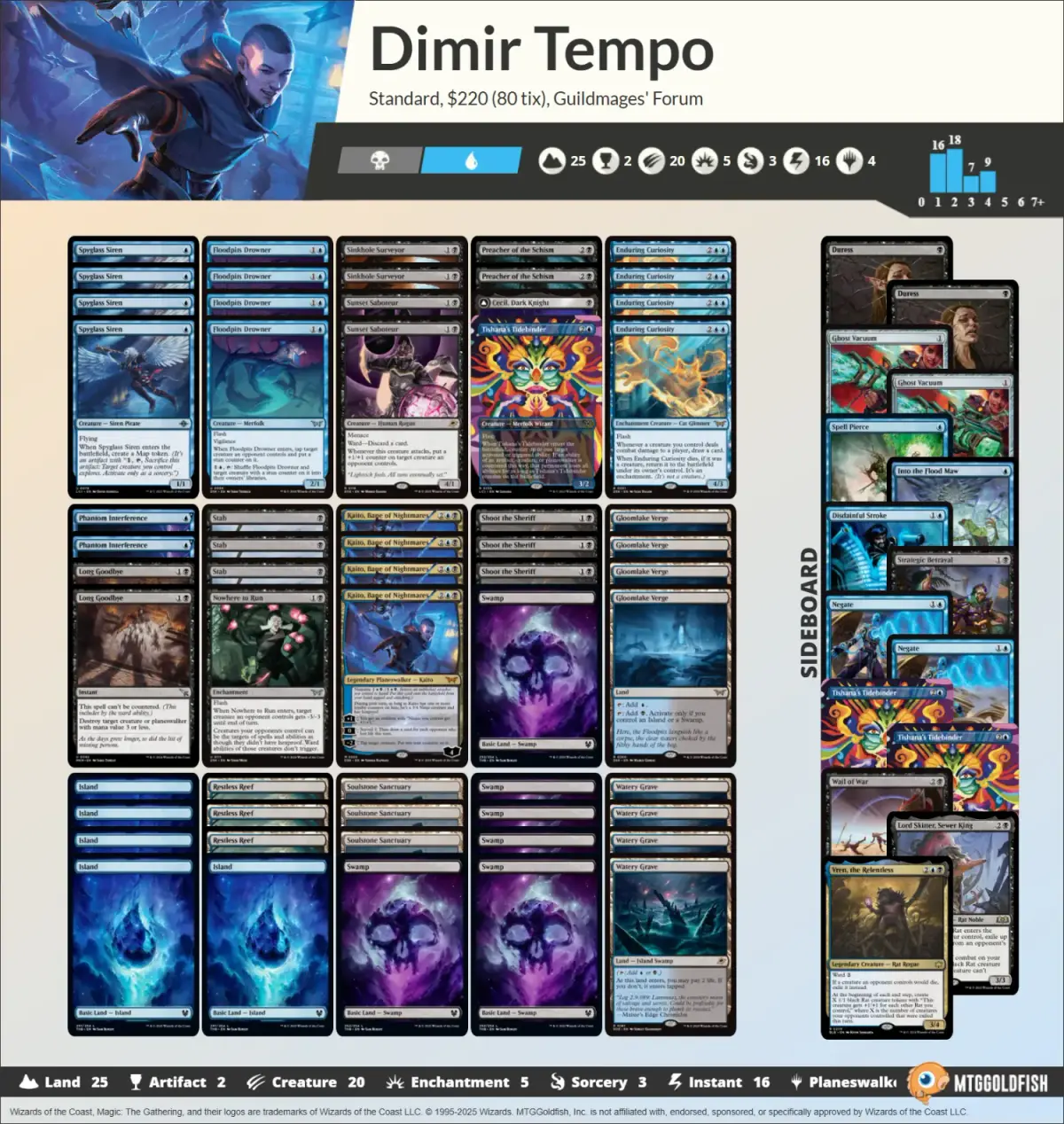
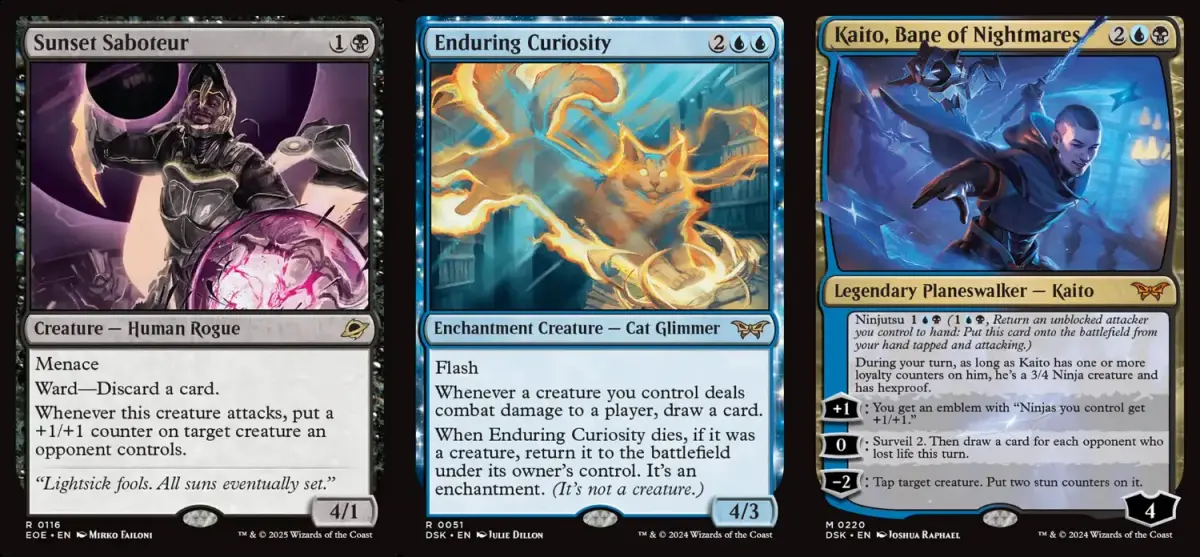
The two-mana curve uses the new Sunset Saboteur. It has no flash and no flying, but this guy’s attacking tempo is just too good, and for a two-drop curve, menace is sometimes not any easier to block than flying. As for the drawback of putting +1/+1 counters on the opponent’s creatures, it can be mitigated by the stun effects that Dimir is good at.
Also, the Rogue creature type of Sunset Saboteur brings up a detail worth watching in post-EOE Standard: the blind spot of Shoot the Sheriff. After Go for the Throat rotates, Shoot the Sheriff is expected to become its main successor, but there are actually quite a few Outlaw creatures in Standard, so Shoot the Sheriff often stumbles in odd places. This is especially interesting in Dimir decks: logically they are the main victims of black’s strong removal rotating out, yet Dimir happens to be a heavy user of Outlaw creatures, so in the new environment Dimir creatures have, oddly, become slightly more resistant to removal. When designing the removal ratios for black decks, I recommend carefully weighing backup answers against Outlaw creatures.
Golgari Melds
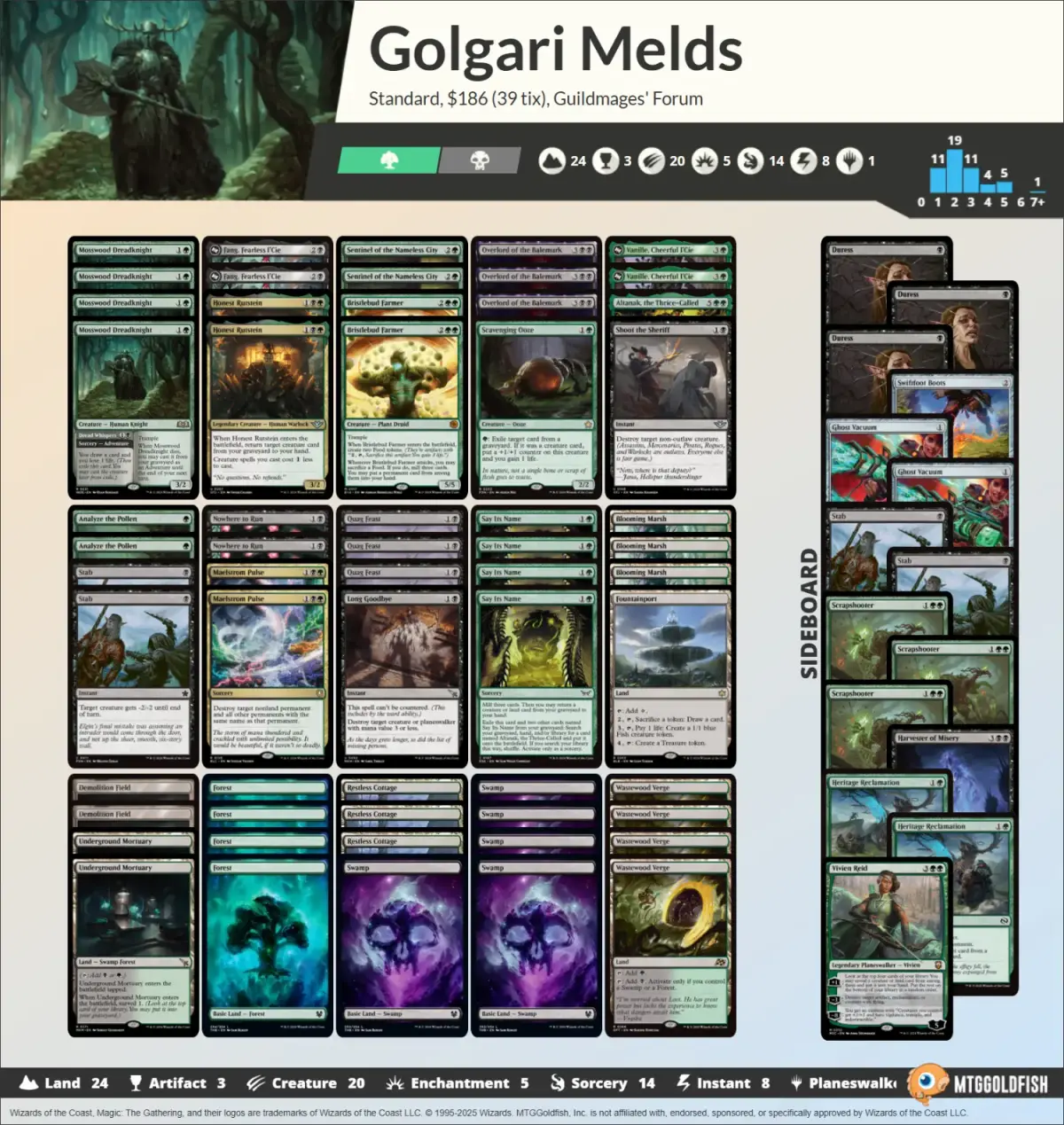
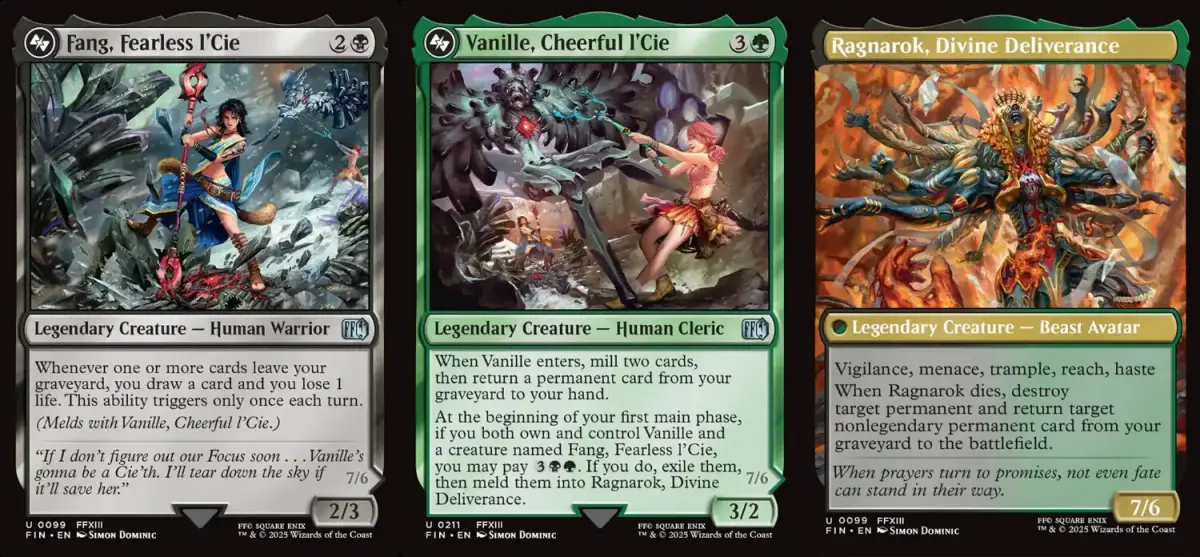
Although it carries the Meld banner, the underlying structure is a midrange grind deck built on self-mill plus graveyard recursion. One small advantage of choosing a self-mill deck now is that you can use Quag Feast at two mana. Sorcery timing is not very flexible, but at least it has huge reach, making up for the awkward state of black’s regular two-mana removal right now.
Honestly, the original core idea of this deck was Cosmogoyf plus a collect evidence package, but the more I built it the more I felt that a plain recursion-based grind deck would be better, so I moved Cosmogoyf down to the sideboard as a countermeasure against Rest in Peace. Then I felt there was no need to do even that, so a deck that started from Cosmogoyf ended up without Cosmogoyf.
Gruul Dinosaur
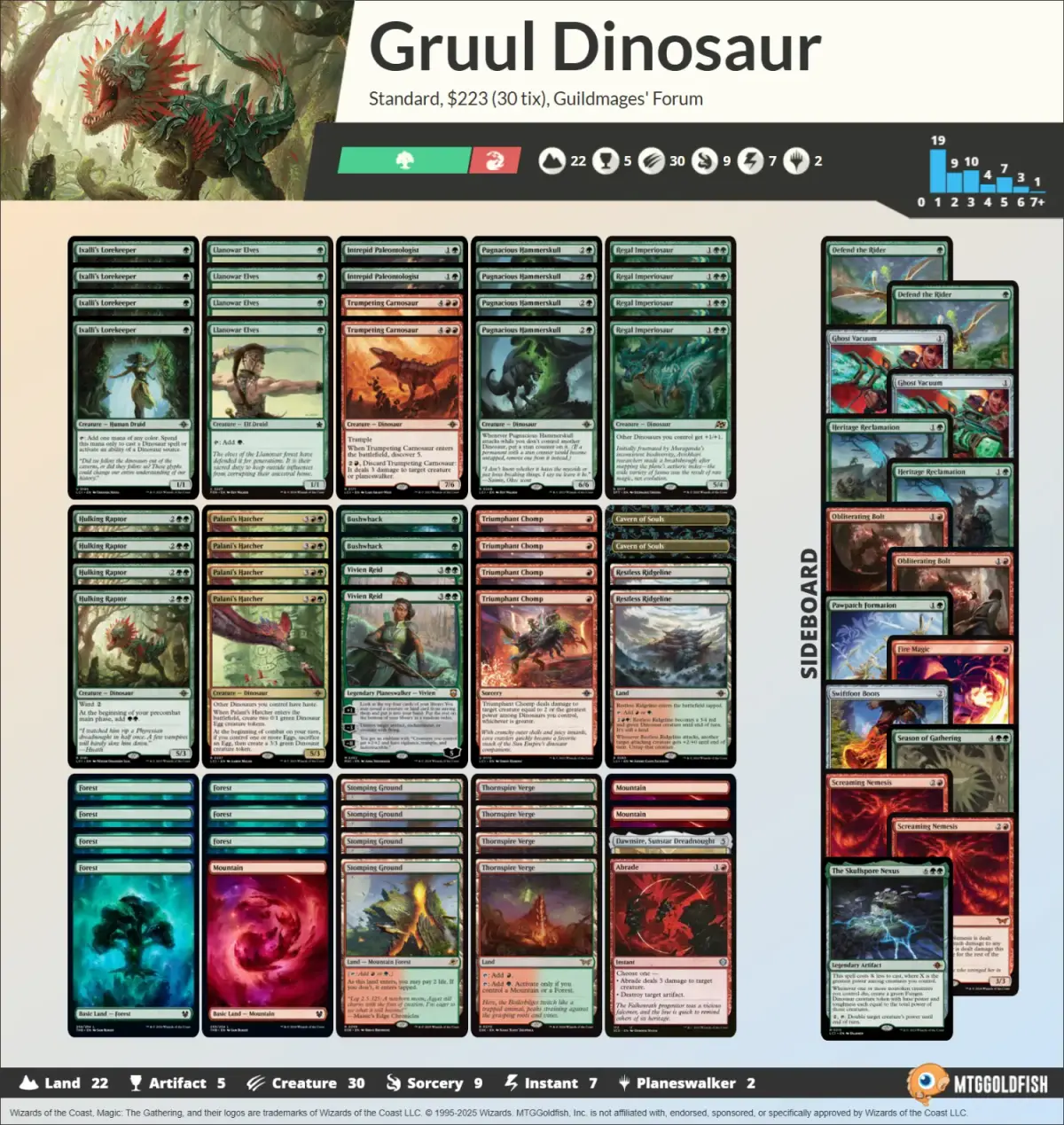
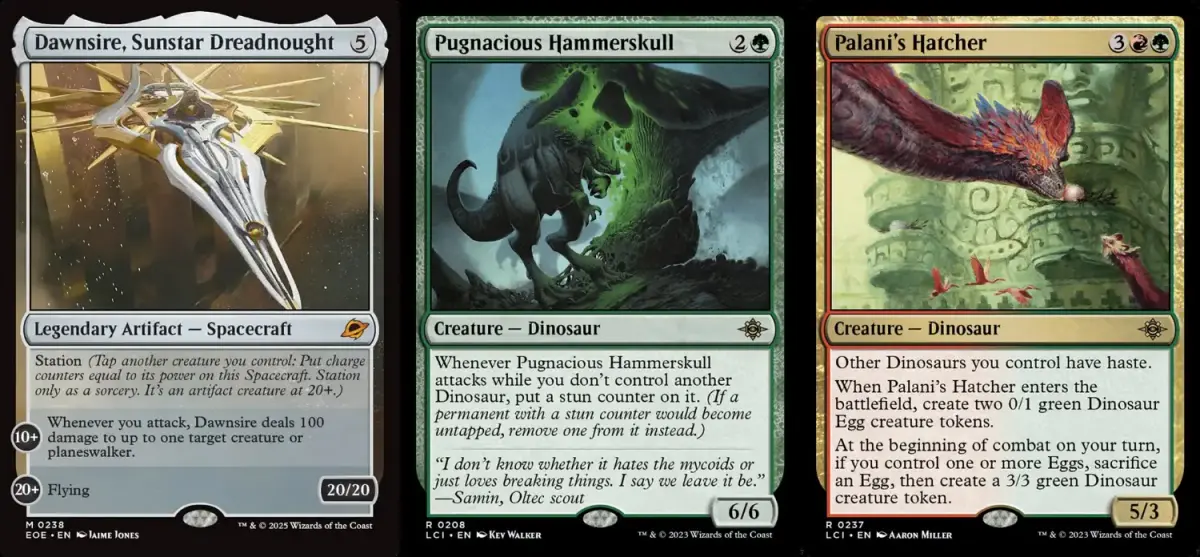
To get a Spacecraft going, you need to prepare high-power creatures, and the best source of cheap, high-power creatures in Standard is none other than Dinosaurs: any random three-drop is a 5- or 6-power creature. This Spacecraft build uses Dawnsire, Sunstar Dreadnought, which has the highest ceiling. Gruul’s weakness happens to be its very weak removal, and now it can just force its way through with 100 points of damage.
Temur Ferocious
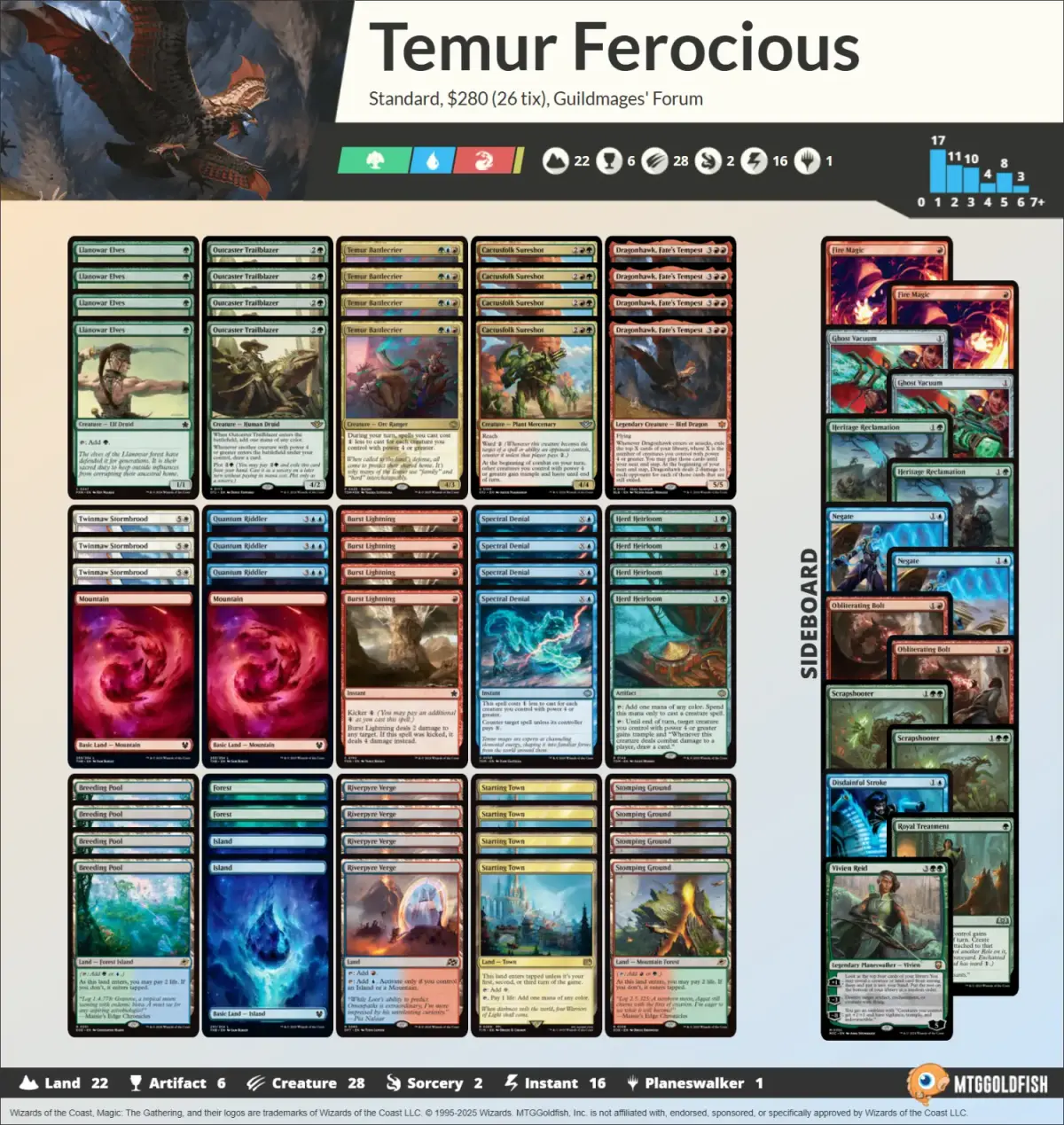
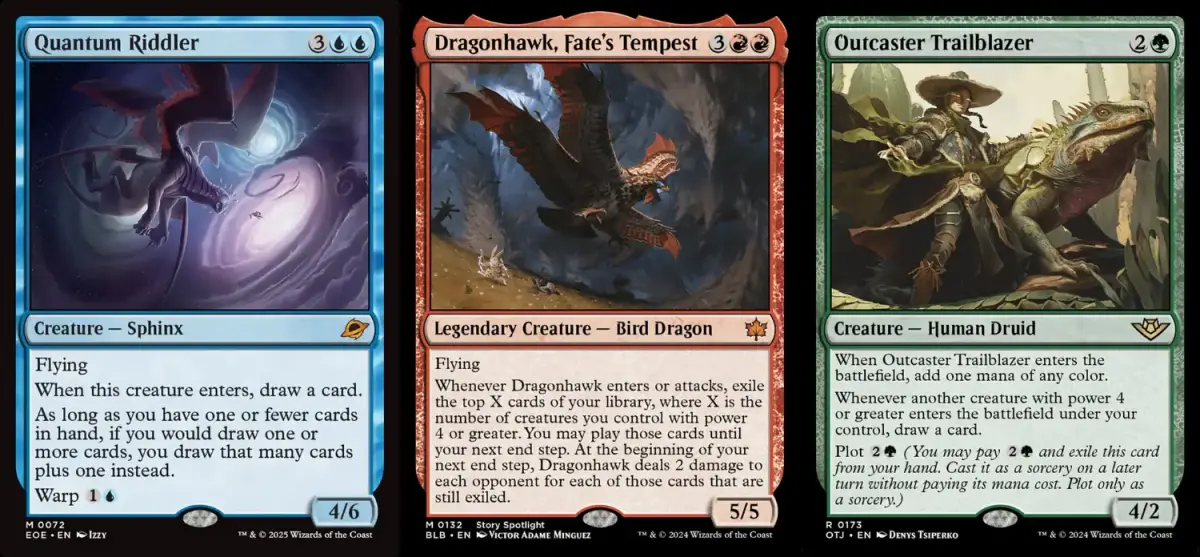
Ferocious decks have always lacked good proactive two-drops. If it’s a creature, you want it to be a Ferocious creature with at least 4 power, and Llanowar Elves + Herd Heirloom provide plenty of acceleration already, so no more mana creatures are needed. Quantum Riddler unexpectedly meets the job requirements here: when you have nothing to do at two mana, you can use Warp to cycle through your deck, and still keep the guarantee of calling down a Ferocious creature later.
Of course, this set also printed Stomping Ground + Breeding Pool, which is part of what makes Temur color combinations playable. Getting two shocklands that both happen to produce green also ensures that a turn-one Llanowar Elves has green mana to cast it. Because Herd Heirloom + Starting Town can both produce any color, Twinmaw Stormbrood // Charring Bite is not just a five-damage burn spell with Omen, and there is also a chance to cast the creature side.
Temur Greenshell
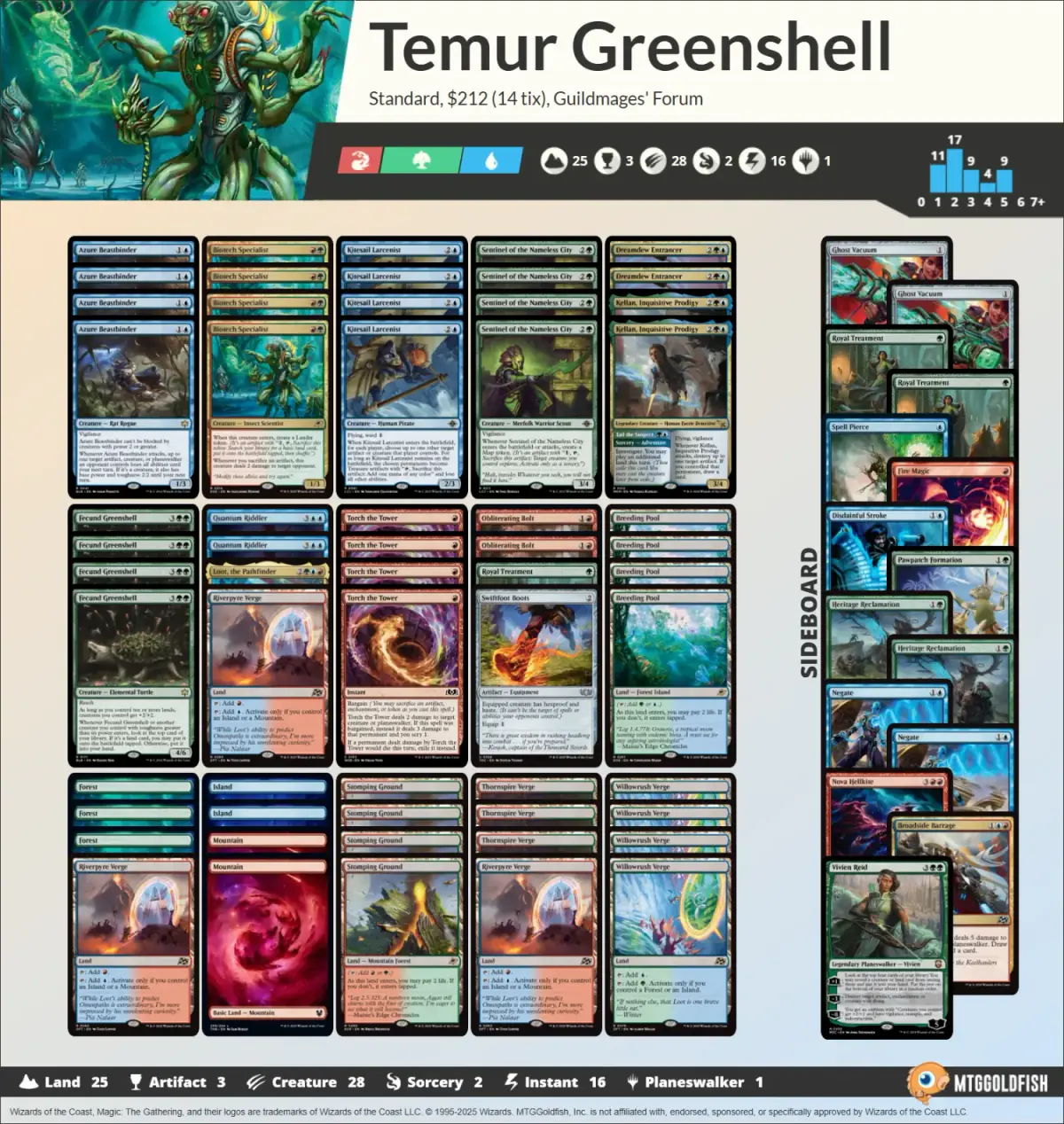
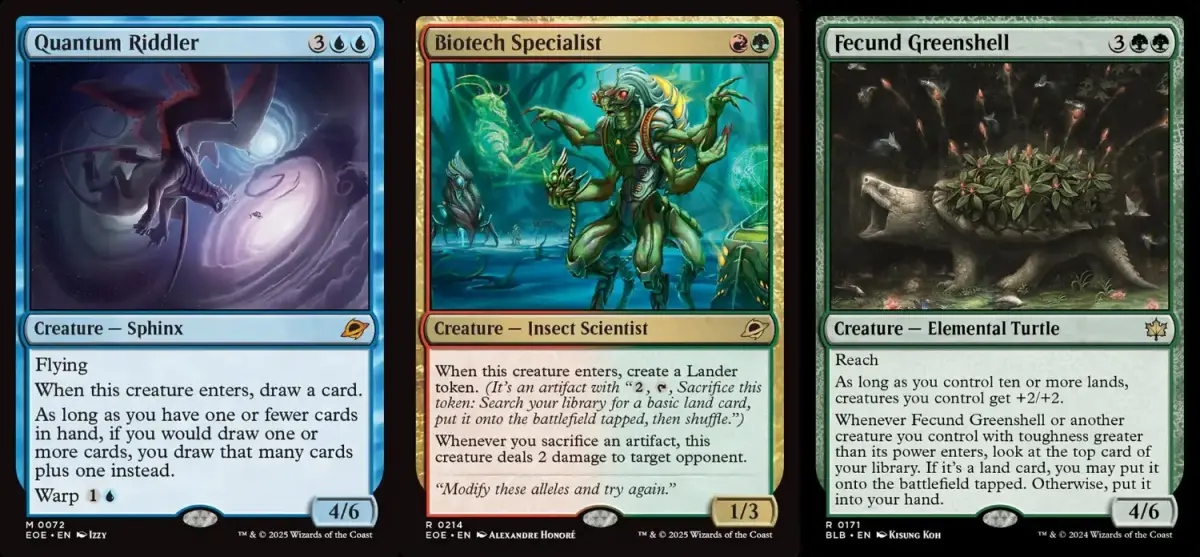
I don’t know what I was on when I put together this unhinged deck. The core idea of the whole deck is to get the most out of Fecund Greenshell: stuff in every creature with toughness greater than power, picking members with good general-purpose value where possible. But once it was all stuffed in, I found that, surprisingly, there are quite a few synergies among these members.
For example, Biotech Specialist wants more sacrificable artifacts in the deck, and the adventures of Sentinel of the Nameless City and Kellan, Inquisitive Prodigy // Tail the Suspect can also create artifact tokens. In turn, Kellan, Inquisitive Prodigy // Tail the Suspect can blow up the artifact tokens made by the creatures above to draw cards, or pair with Kitesail Larcenist to turn the opponent’s creature into an artifact and force a board clear. Azure Beastbinder likewise gives the removal-light Temur color combination a few more disruption options, and paired with various red damage sources it can force through big creatures.
Conclusion
Standard deckbuilding for this set turned out to be surprisingly hard. I saw a great many powerful single cards that excited me during preview season, but when I actually tried to assemble them into decks, no amount of tuning made them fit together.
Warp is a powerful ability, but cards with good enough general-purpose value are very scarce. Warp creatures have a high curve to begin with, so the number you can put in one deck is limited, and as luck would have it most of them are designed to shine only under specific themes. The result is that even though it’s the set’s headline feature, it’s hard to build a deck that makes the most of it. Station is in a similar situation: it runs too clunkily, and I don’t know how to adjust it.
The other obstacle in deckbuilding this time was the mana base. All the pain lands plus the adjacent-color fastlands rotated at once, but shocklands were only half replenished, and only two of those were adjacent-color shocklands. As a result, for some adjacent-color decks that demand good tempo, I’d figured out the whole list, but looking left and right the lands just couldn’t keep up, so I painfully put them on ice until the rest of the lands are filled in.
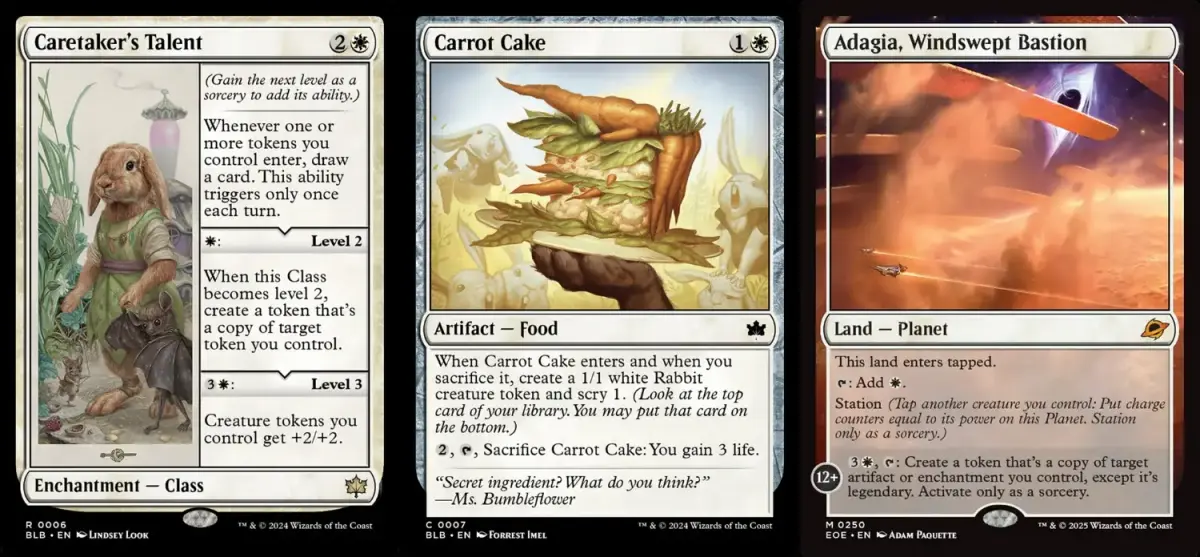
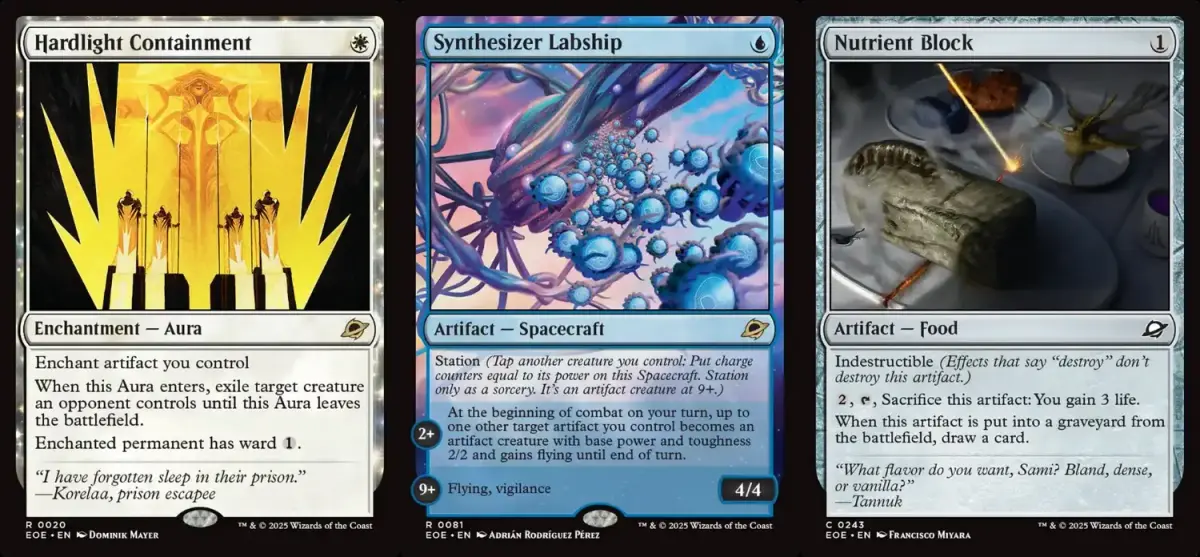
For example, when I saw the cards below during preview season, a White-Blue artifact aggro deck had already taken shape in my mind. But when you want to guarantee color fixing while also not tolerating early tempo loss, the current card pool’s lands simply can’t support it (or rather, the expected value doesn’t pass), so the White-Blue decks that survived are all ones that aren’t picky about color requirements or tempo.
- Title
- A First Look at Edge of Eternities Standard
- Author
- Jru
- Created at
- July 28, 2025
- License
- This work is licensed under CC BY-NC-SA 4.0 .