FINAL FANTASY (FIN) Limited Guide: Multicolor

Note: This article was translated from Chinese by AI and may contain errors. Read the original Chinese version.
FINAL FANTASY (FIN) holds its Prerelease on June 6, 2025. Want to know more about how each card rates in Limited and what to pick? Then check out this series of FIN Limited guides!
- For the mechanics, see this article: FINAL FANTASY Mechanics Breakdown
Rating Scale
5.0: An unconditional first pick that gives you a near-winning advantage
4.5: An unconditional first pick if you’re in the right colors; gives you a huge advantage
4.0: Worth a first pick; fits the archetype’s theme extremely well and can be the deciding card for splashing, switching colors, or moving into the archetype
3.5: The set’s top uncommons and commons, plus other strong cards that fit the archetype’s theme well and can be key to moving into the archetype
3.0: Important cards for the archetype’s theme, plus other above-average cards you’ll want in your final deck
2.5: Average; usually a decent curve filler
2.0 to 1.0: Below average; you generally prefer not to play them, but they can fill out the deck if needed, just not too many
0.5 to 0.0: Unplayable; basically never put it in your deck, because it will only help you lose
Archetype Themes
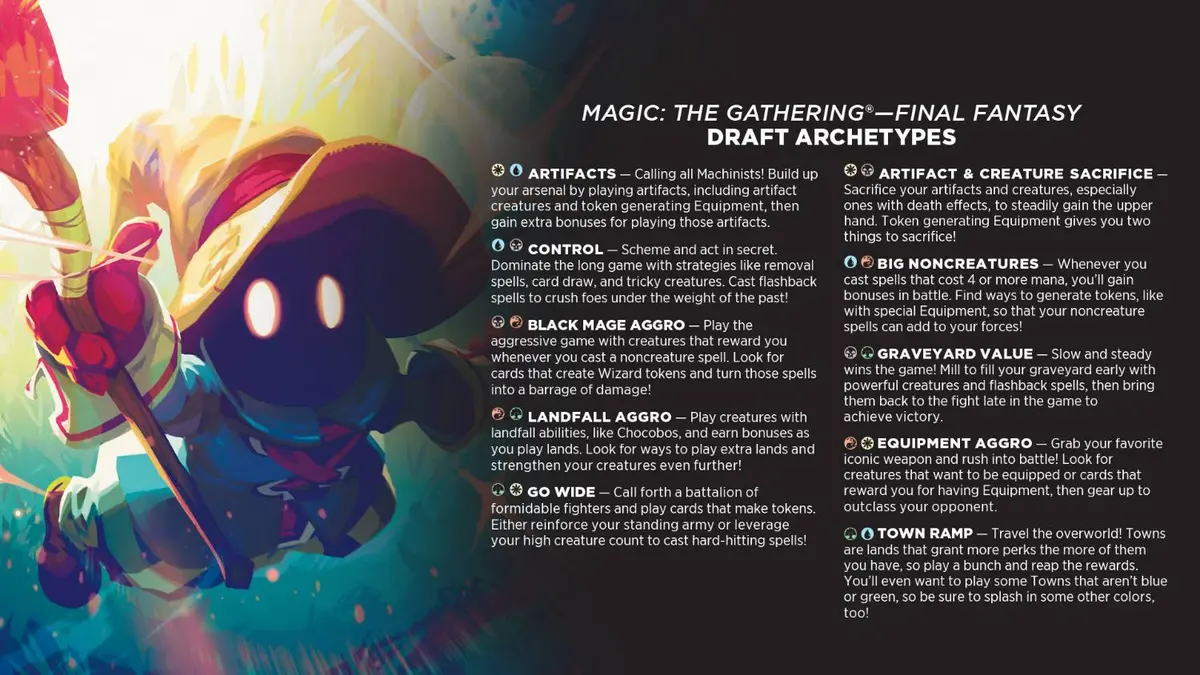
Starting from the official draft overview, let’s expand a bit on the core cards and interactions of the ten color pairs. In addition, each of the ten color pairs has 2 legendary uncommon creatures that serve as the core of the mechanic or reinforce it.
If you aren’t familiar with Final Fantasy and want a better sense of what makes each legendary character special, feel free to watch this video:
歴代主人公 vs 全ラスボス。迫力の戦闘シーン - Dissidia Final Fantasy NT 日本語 & English Battle movie
White-Blue — Artifacts
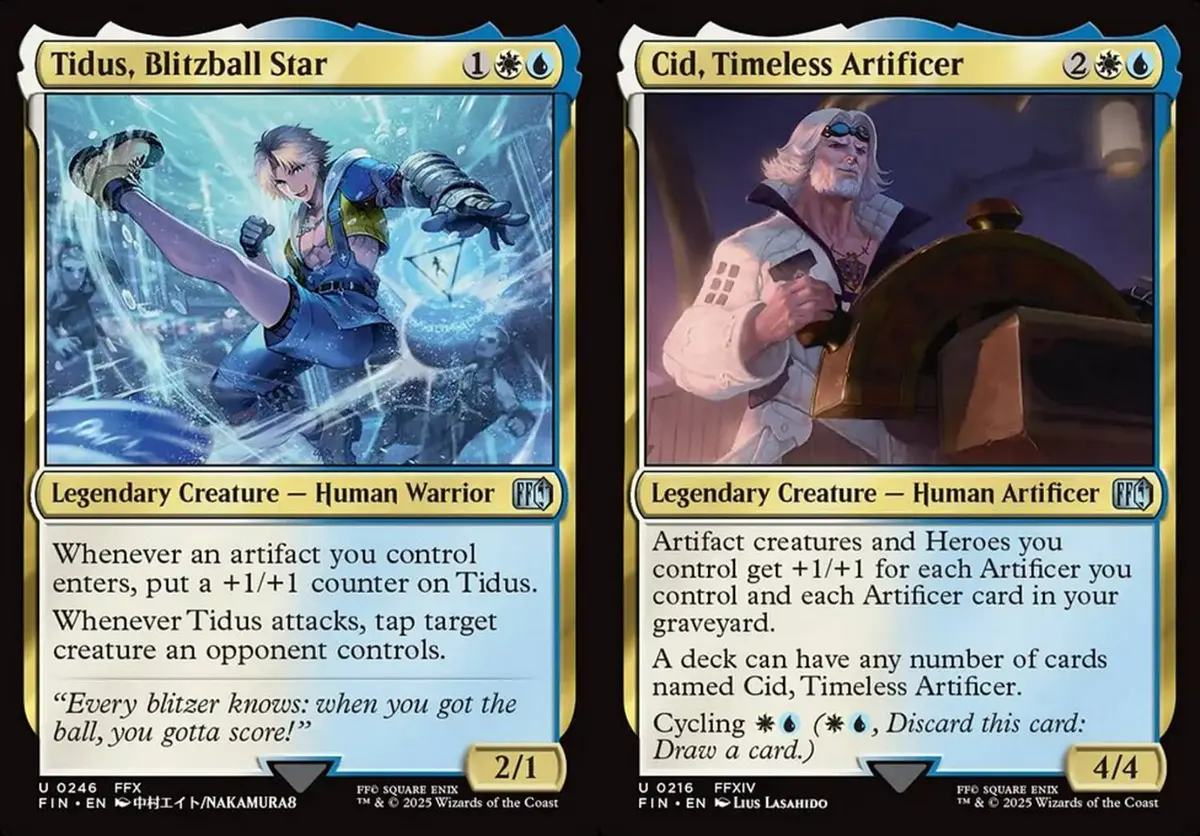
Keep casting artifacts or making artifact tokens, and your Tidus, Blitzball Star keeps growing and walks into the end zone unopposed! The other legendary uncommon, Cid, Timeless Artificer
 , encourages you to grab every copy of him you can see, building up Cids on the battlefield and in the graveyard through looting and combat trades, so your Hero tokens and artifact creatures get the huge bonuses that time has accumulated! Don’t forget that Equipment with Job select first creates a 1/1 colorless Hero when it enters, and Cid will be a great mentor to those little heroes!
Blue-Black — Control
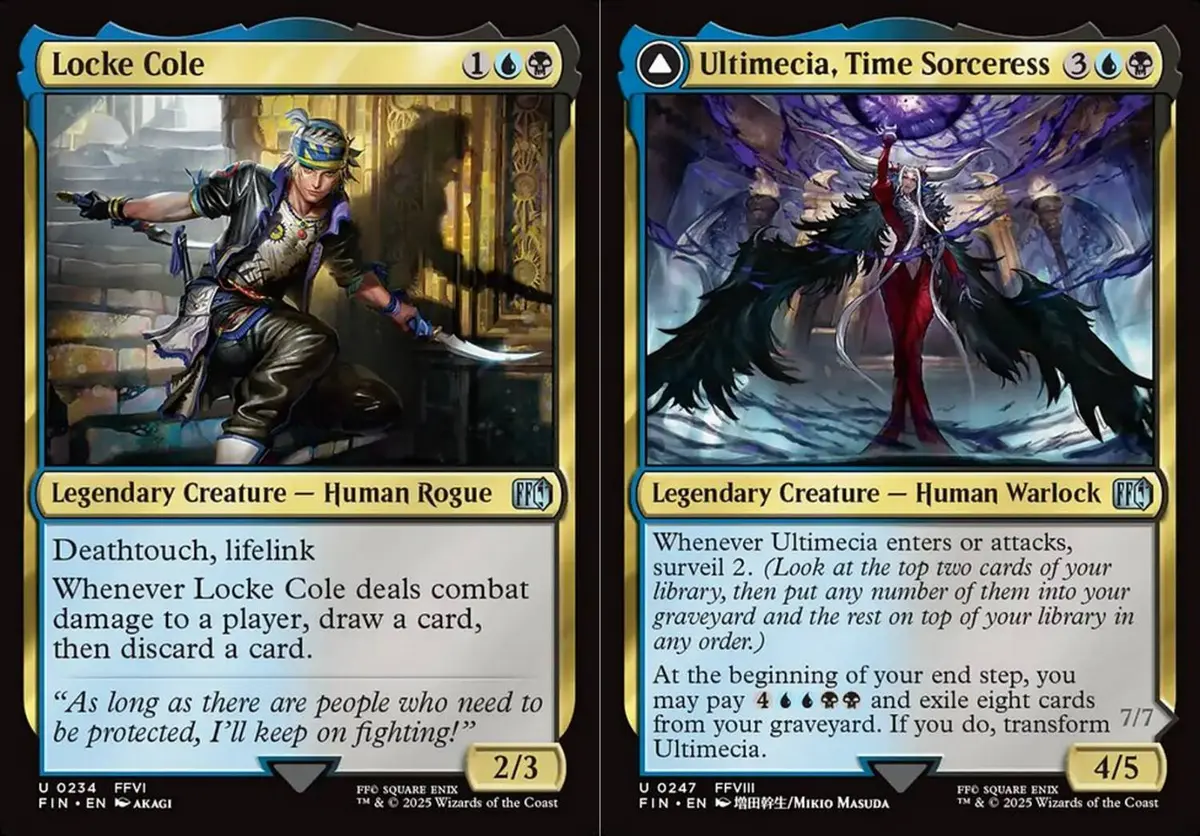
Blue-black returns to the most traditional control theme, and besides the control staples of card filtering, counterspells, and removal, it can also gain benefits from building up your graveyard. The legendary uncommons Locke Cole and Ultimecia, Time Sorceress // Ultimecia, Omnipotent
 filter your cards as they attack, and once the graveyard reaches 8 or more cards late in the game, you can transform Ultimecia to take an extra turn.
Black-Red — Black Wizard Aggro
Here we use the MTG creature type Wizard rather than the Mage used in the FF games, to avoid confusing readers.
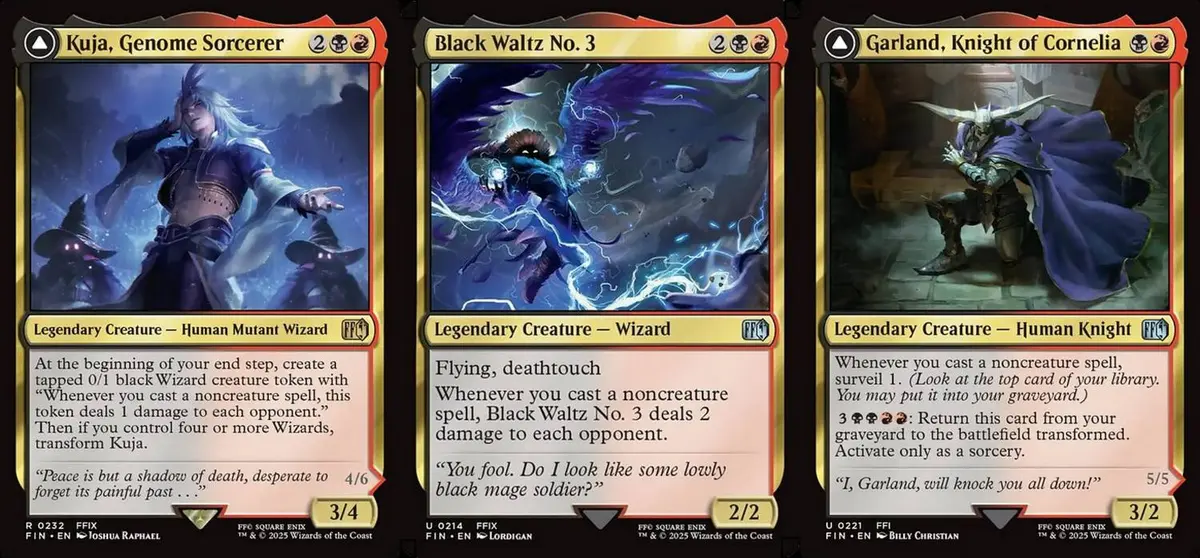
The main mechanic is making black 0/1 Wizards, and pairing them with the legendary uncommon Black Waltz No. 3 and lots of noncreature spells to win through noncombat damage. In this archetype, the rare Kuja, Genome Sorcerer // Trance Kuja, Fate Defied
 is worth mentioning, who keeps making 0/1 Wizards and, once transformed, doubles the damage those Wizards deal. These two cards will be the core cards that make black-red run.
As for the other legendary uncommon, Garland, Knight of Cornelia // Chaos, the Endless , he has no connection to the archetype theme. He’s more of a card that blue-black and black-green, the two graveyard-value archetypes, will want, and readers can try him out in actual Limited games.
Red-Green — Landfall Aggro
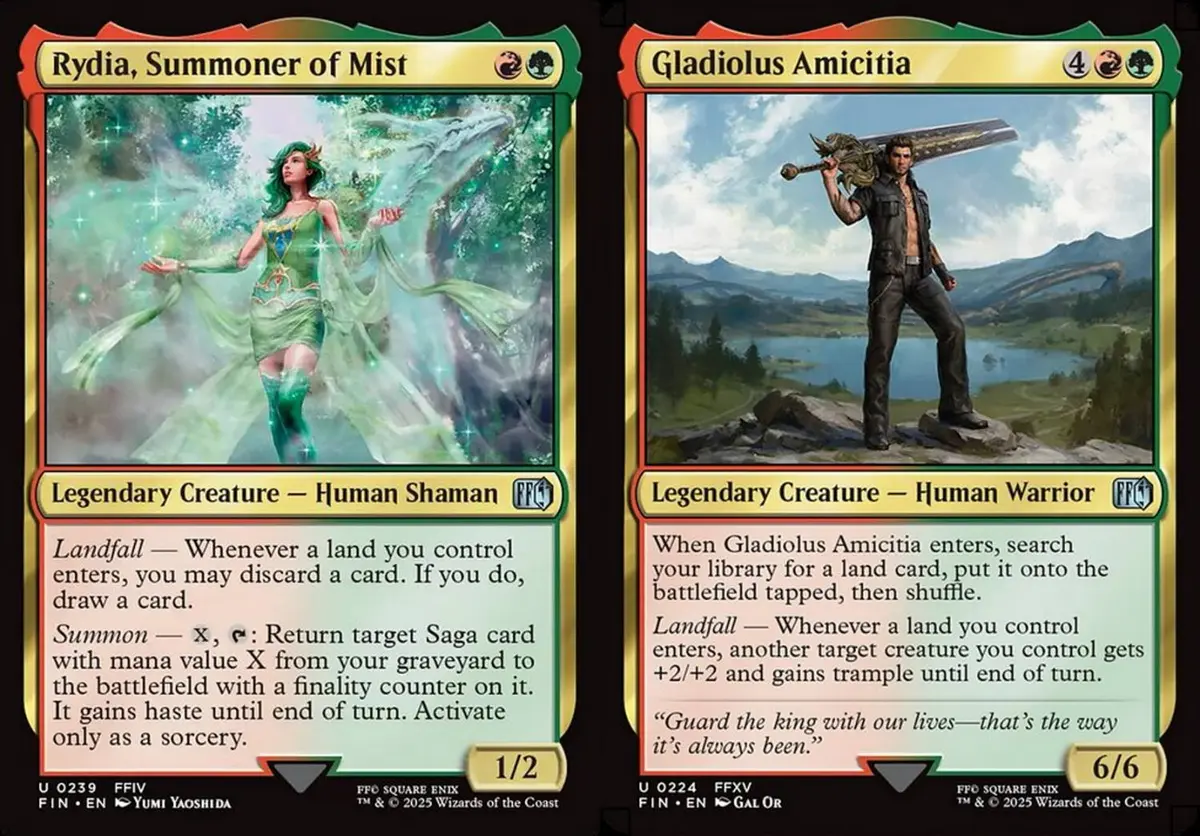
In red-green, landfall is a very important theme. Of the two legendary uncommons, Rydia, Summoner of Mist helps you filter out cards you don’t need, while Gladiolus Amicitia
 fetches a land when it enters, which triggers landfall, and landfall giving other creatures +X/+X and trample is exactly what red-green needs. In this archetype you need to include some extra ways to fetch lands and put extra lands onto the battlefield, so that you can trigger landfall multiple times.
In addition, Rydia’s second ability hints at another theme: Saga creatures. This set has 15 enchantment creature cards that are Sagas on the front face, and no noncreature Sagas, which makes giving them haste quite important. After all, without haste, a three-chapter Saga creature can basically only attack on chapter II, when it’s past summoning sickness; once it reaches chapter III, it gets sacrificed.
There’s also one more theme that the legendary uncommons don’t mention but that works as a subtheme in red-green: Birds. There are 4 Bird cards in total (6 if you add white), plus 5 noncreature spells that make 2/2 Bird tokens, and the vast majority of the Birds either benefit from landfall or help landfall happen, so they’re worth readers’ attention in Limited too.
Green-White — Go Wide
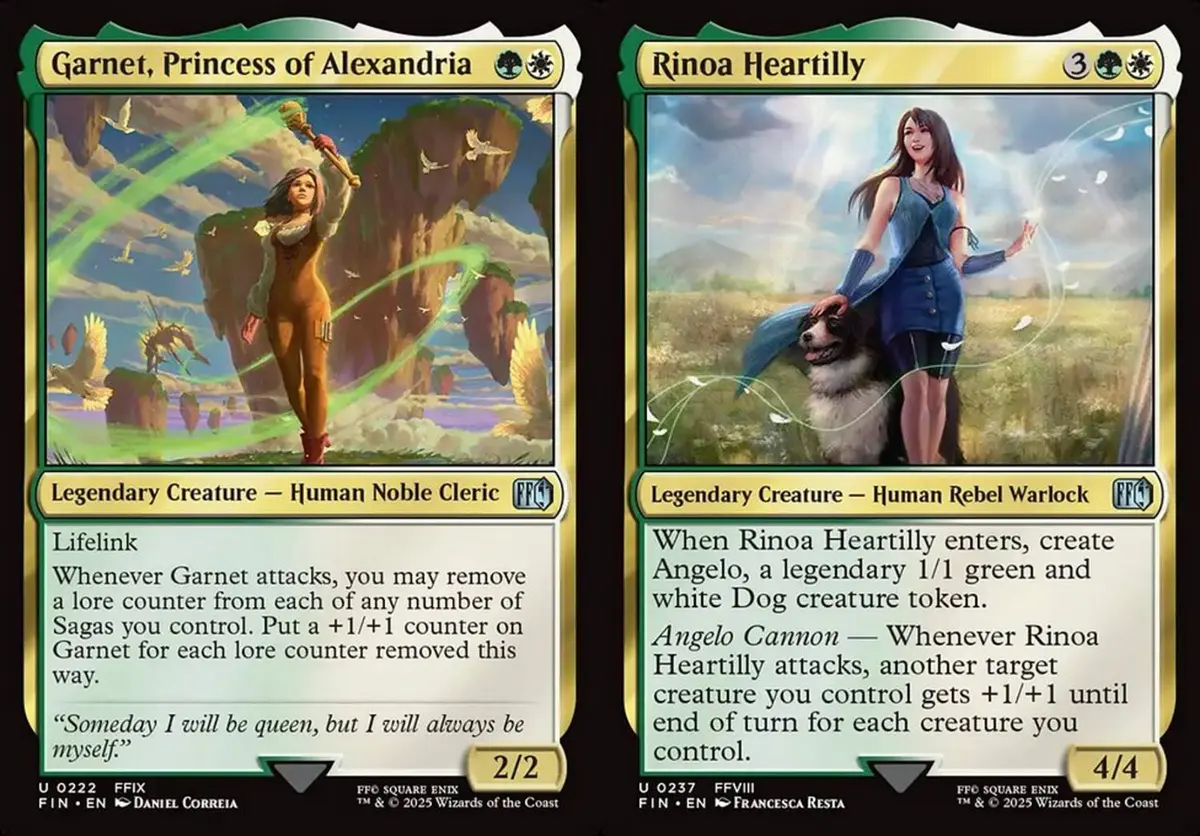
Although green-white’s mechanic is going wide, these two legendary uncommons can’t add much to that theme. Rinoa Heartilly needs you to spread out your board first before her offensive pump effect works; Garnet, Princess of Alexandria
 is more of a member of the small Cleric subtheme, and also lets your Saga creatures survive a bit longer before the countdown.
To go wide effectively, you’ll need to borrow green’s Bird theme, as well as white cards that create 1/1 Hero tokens, such as Aerith Rescue Mission .
White-Black — Artifact & Creature Sacrifice
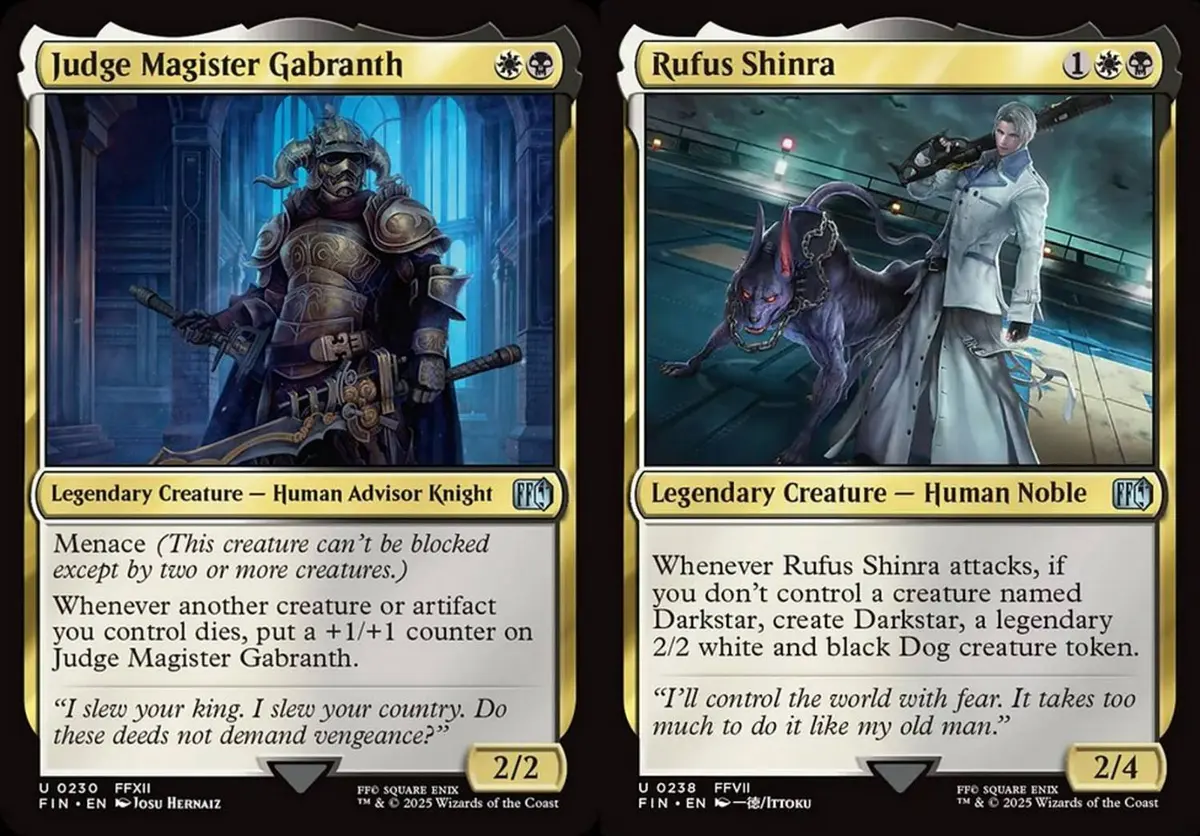
White-black focuses on effects when artifacts and creatures die. The legendary uncommon Judge Magister Gabranth can easily grow very large without you noticing, while the other, Rufus Shinra
 , implies that this archetype needs to make some artifacts//creatures to serve as sacrifice fodder.
In addition, the mythic Sephiroth, Fabled SOLDIER // Sephiroth, One-Winged Angel and his signature weapon The Masamune
 can be seen as a sacrifice engine, or an amplifier for one. Also, apart from Judge Magister Gabranth, the other three cards mentioned above are all from FFVII. Interested readers can look further into the story (FFVII has a remake too!).
Blue-Red — Big Noncreatures
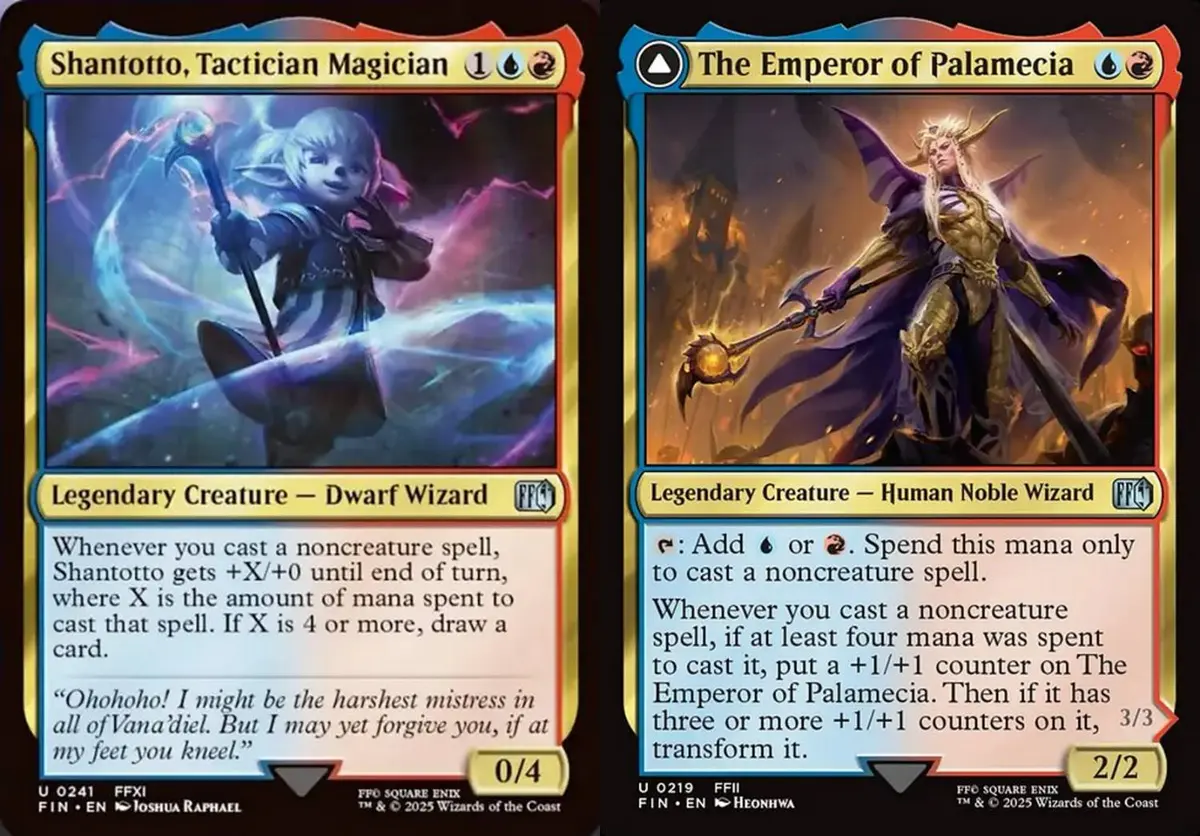
In blue-red, The Emperor of Palamecia // The Lord Master of Hell is a very efficient noncreature-spell mana dork that helps you spend four or more mana to cast noncreature spells, which also makes him bigger and even transforms him; once transformed, he cares about the number of noncreature, nonland spells in your graveyard to deal extra damage. Shantotto, Tactician Magician
 , on the other hand, benefits from noncreature spells you cast by spending four or more mana: besides getting +4/+0 or more, she also draws cards to refill your hand.
Many of blue-red’s sorceries/instants have Flashback, and the flashback costs are all at least four mana, which also helps you meet the archetype’s theme. Casting Vehicles that cost four or more counts too, so you can use that to fill out part of your creature curve, but I don’t recommend playing too many.
Black-Green — Graveyard Value
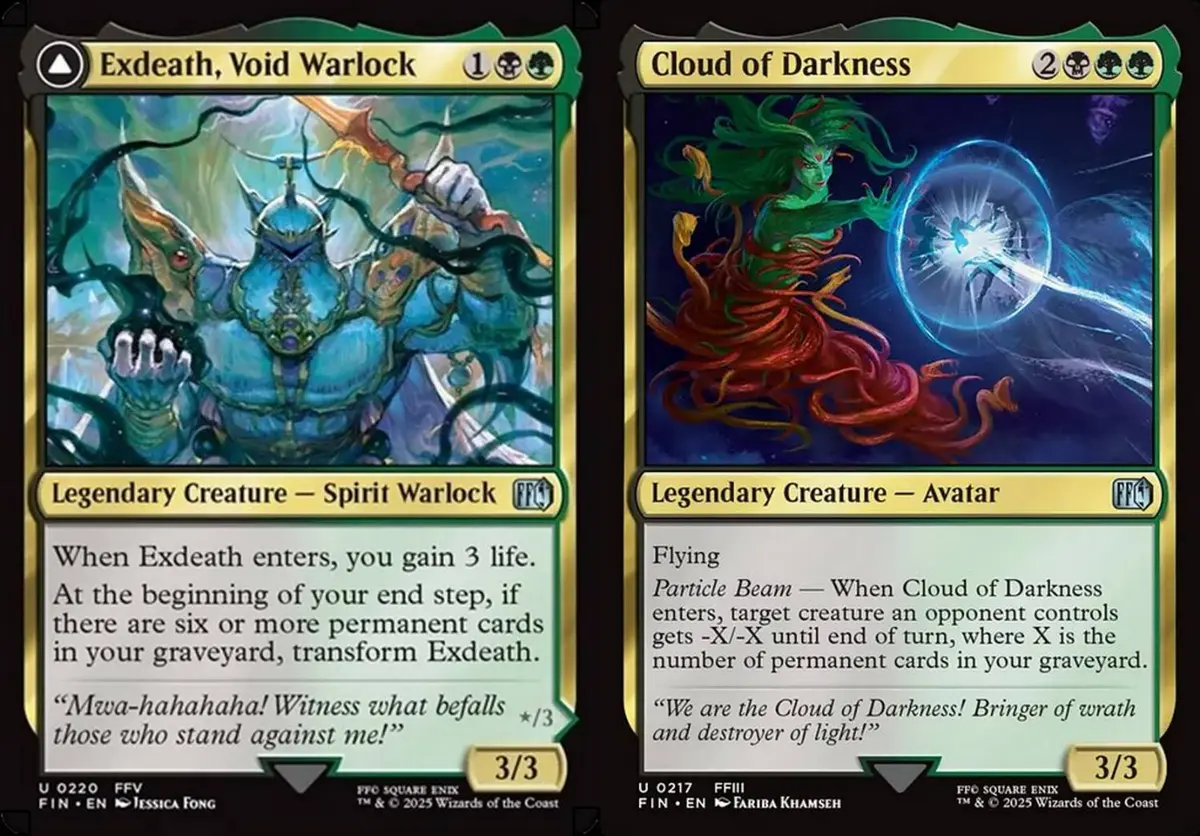
Both uncommons of black-green care about the number of permanent cards in your graveyard. That means that for this archetype to work well, there’s an implicit message that you shouldn’t play too many sorceries/instants. However, looking at payoff cards such as Exdeath, Void Warlock // Neo Exdeath, Dimension's End and Cloud of Darkness
 , both are a bit mediocre filler before they hit their threshold, so I suggest approaching it from a different angle.
If black-green’s graveyard value is about recursion from the graveyard, then cards that mill yourself to fill the graveyard, like green’s Town Greeter and black’s Shinra Reinforcements
 , become very important, since every permanent card you put in there has a chance to turn into a resource in the mid-to-late game. Don’t forget that Saga creatures also go to the graveyard after their final chapter resolves, which makes them well suited as mid-sized threats in black-green.
Red-White — Equipment Aggro
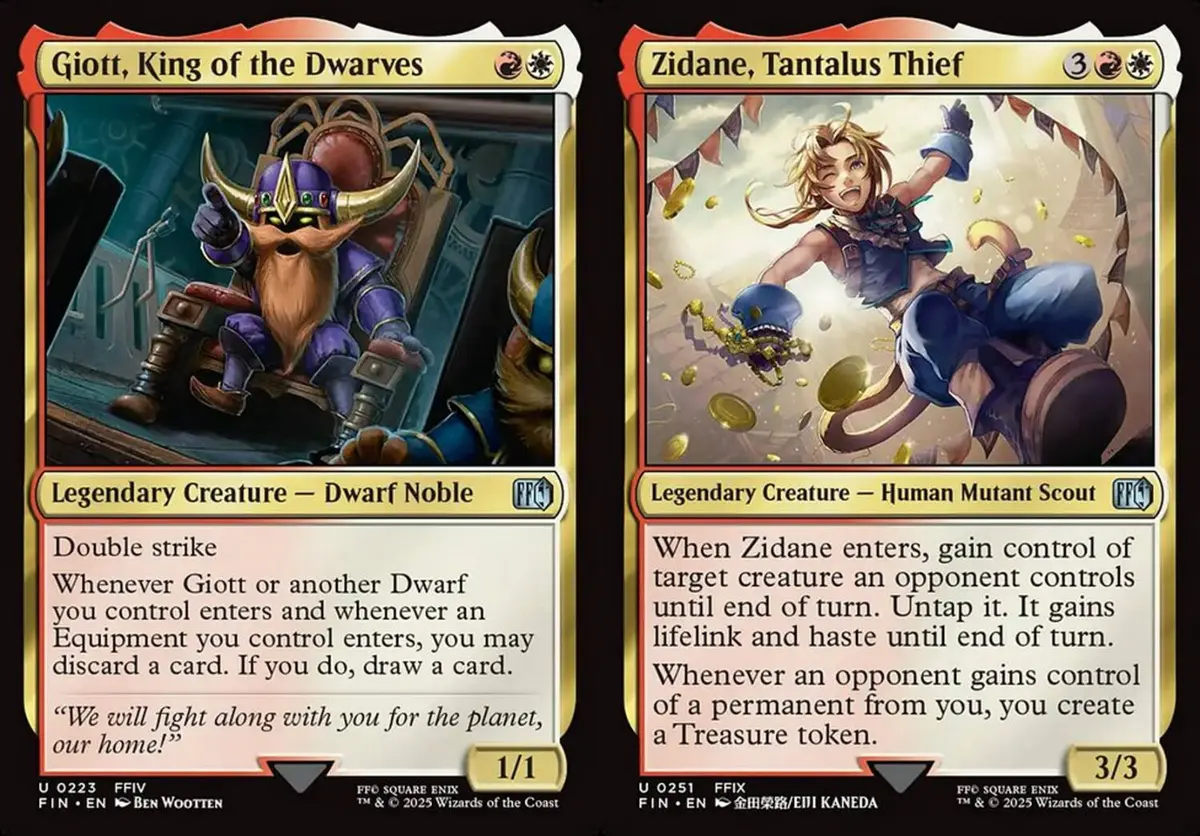
This set has 26 Equipment cards (plus 1 more, Sidequest: Play Blitzball // World Champion, Celestial Weapon , whose back face is an Equipment), including 16 Equipment with Job select, so building a deck around them is definitely fine. The legendary uncommon Giott, King of the Dwarves
 is well suited to carrying Equipment himself, and his extra rummage effect lets you filter your hand effectively; as for the Dwarf subtheme, there are only 3 creatures, so you can basically treat it as nonexistent. The other one, Zidane, Tantalus Thief
 , has less to do with the Equipment theme, but his enters effect of Act of Treason
 , and the Treasure you get when you give the creature back, both create extra value.
Green-Blue — Town Ramp
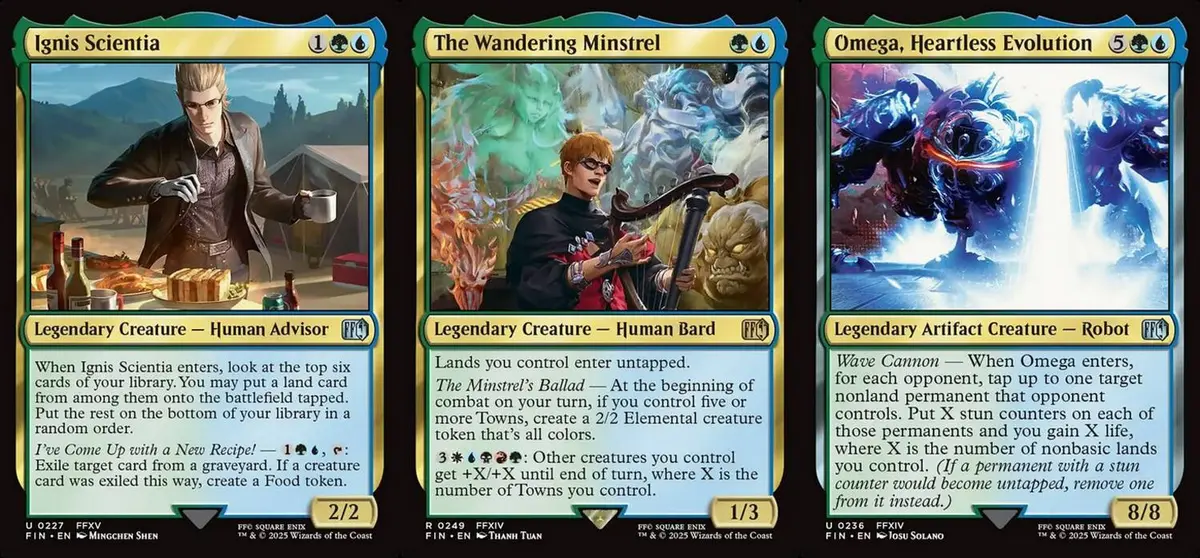
This set has 23 Town cards. Since the dual lands themselves are Towns, even if you don’t play blue-green you’ll still end up using 2 to 3 Towns; this also means Towns will be popular in the draft, because everyone takes them. So to get into the blue-green Town theme, you need to raise the pick order of Town cards to make sure you have enough of them.
The legendary uncommon Ignis Scientia can basically ramp you a land when he enters, and the more Towns you have, the bigger the impact Omega, Heartless Evolution
 has on the game when you cast it late. As for the rare legend The Wandering Minstrel
 , besides giving your Towns the effect of Amulet of Vigor
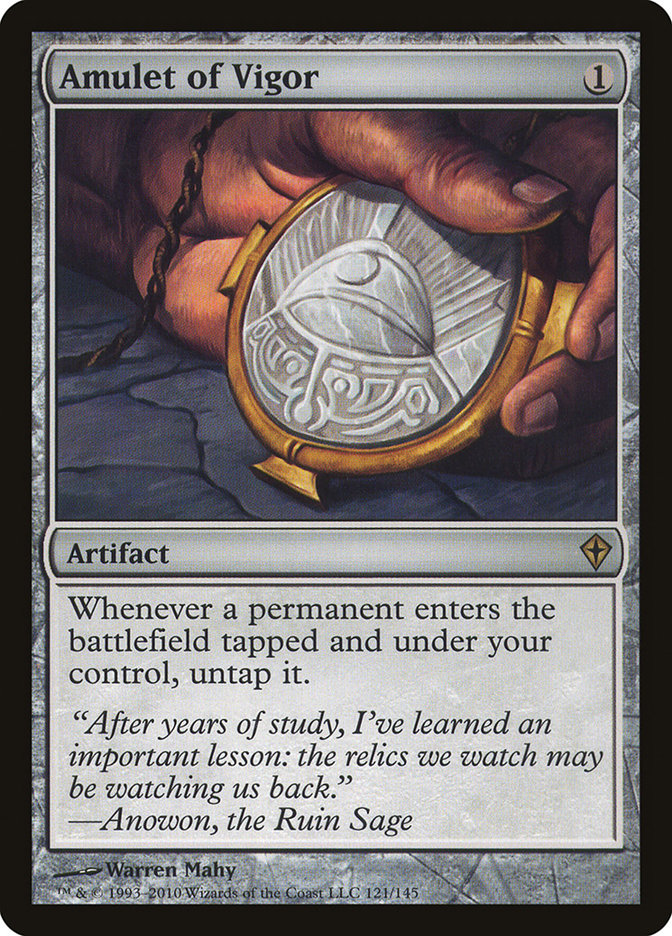 , his own passive ability reveals that this theme starts to kick in at five or more Towns; considering that you won’t necessarily get every Town in your deck onto the battlefield, 6 to 7 Towns, or even more, is probably a safe number.
Card Ratings

Score: 4.5
Comment: If you can’t remove it, you lose (why does this set have so many of these eight- and nine-mana cards…)

Score: 3.0
Comment: A Vehicle-only card. Without Vehicles it’s just a three-mana 4/3 with reach, and the score is for the stats.
Score: 3.0
Comment: A 2/2 body dies easily, but it has a chance to poke the opponent to death with a pile of little spells, and dealing 2 hurts.
If you want to play it, you must pair it with 10 or more noncreature spells. You can use Equipment with Job select, or noncreature spells that make tokens, to stand in for creature spells.

Score: 4.0
Comment: A super strong Bird. Even attacking alone and just playing lands off the top of your library the whole time is great, and the more Birds you have, the stronger it gets. Playing three colors shouldn’t be a problem in a green-based deck.
Score: 3.5
Comment: The cornerstone of white-blue artifacts. To play this archetype you must raise the pick order. Don’t forget that the 1/1 colorless Hero made by Job select also gets his bonus!
Score: 3.0
Comment: Because it only counts permanent cards in your graveyard, it’s possible it can’t kill anything, so when building, watch your self-mill effects and the ratio of permanents to instants/sorceries if you want it at full strength.
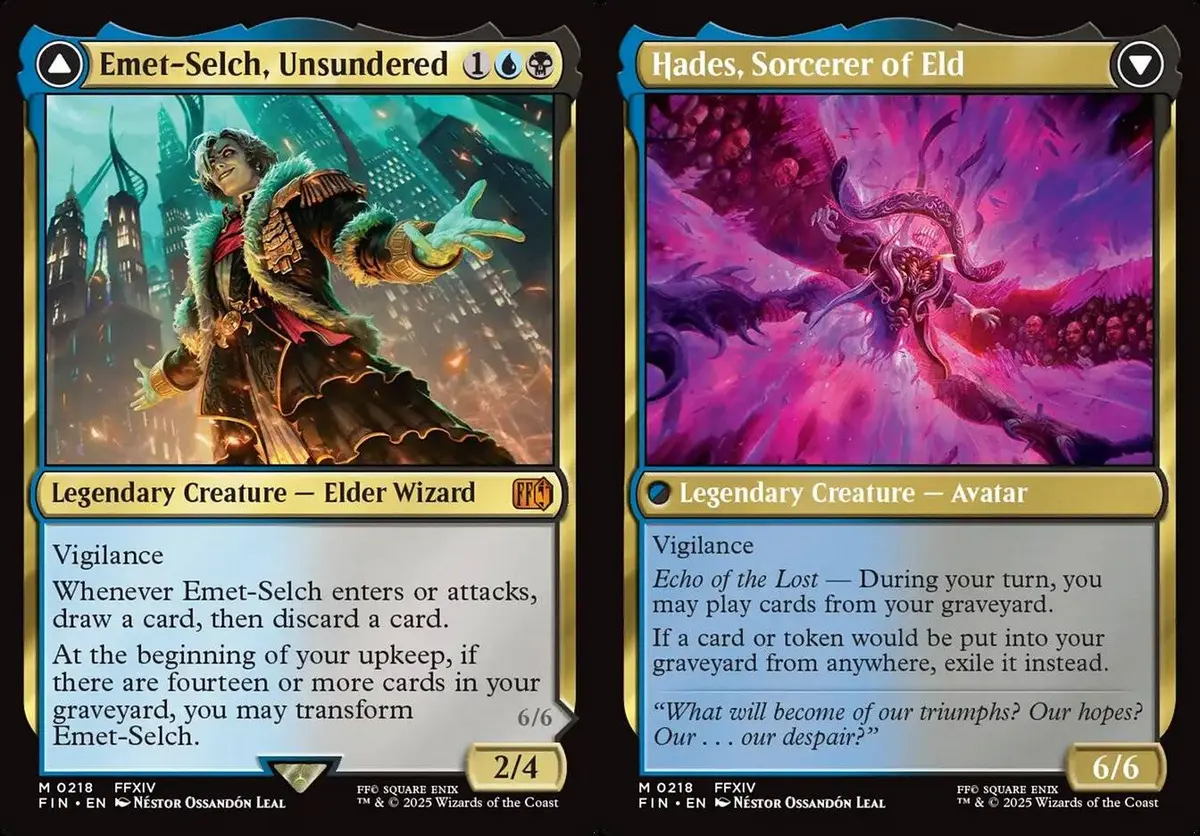
Score: 3.5
Comment: Basically a looter, but in the mid-to-late game it may not get through without Equipment that grants evasion. If it gets to transform, scooping up the whole graveyard to play with is very appealing, but don’t expect too much.
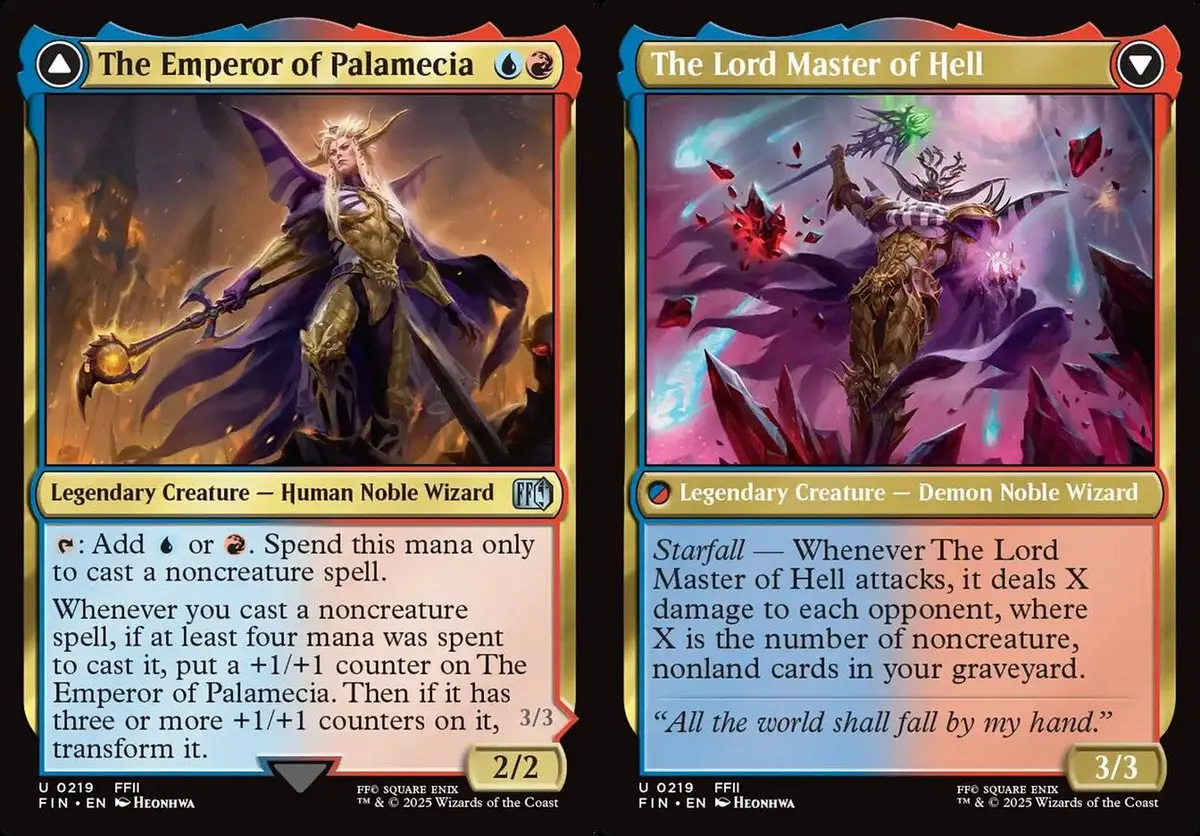
Score: 3.5
Comment: It seems the theme of the blue-red archetype is noncreature spells cast with four or more mana. Besides acting as a mana dork that makes such spells easier to cast, it also grows to join the attack at the same time; if you put 3 or more counters on him, transforming and attacking is very fast. (If you have a way to proactively put counters on him, that speeds the process up too.)
Don’t forget that his transformation doesn’t require exiling him, so he never leaves the battlefield, and those counters all stay on him.
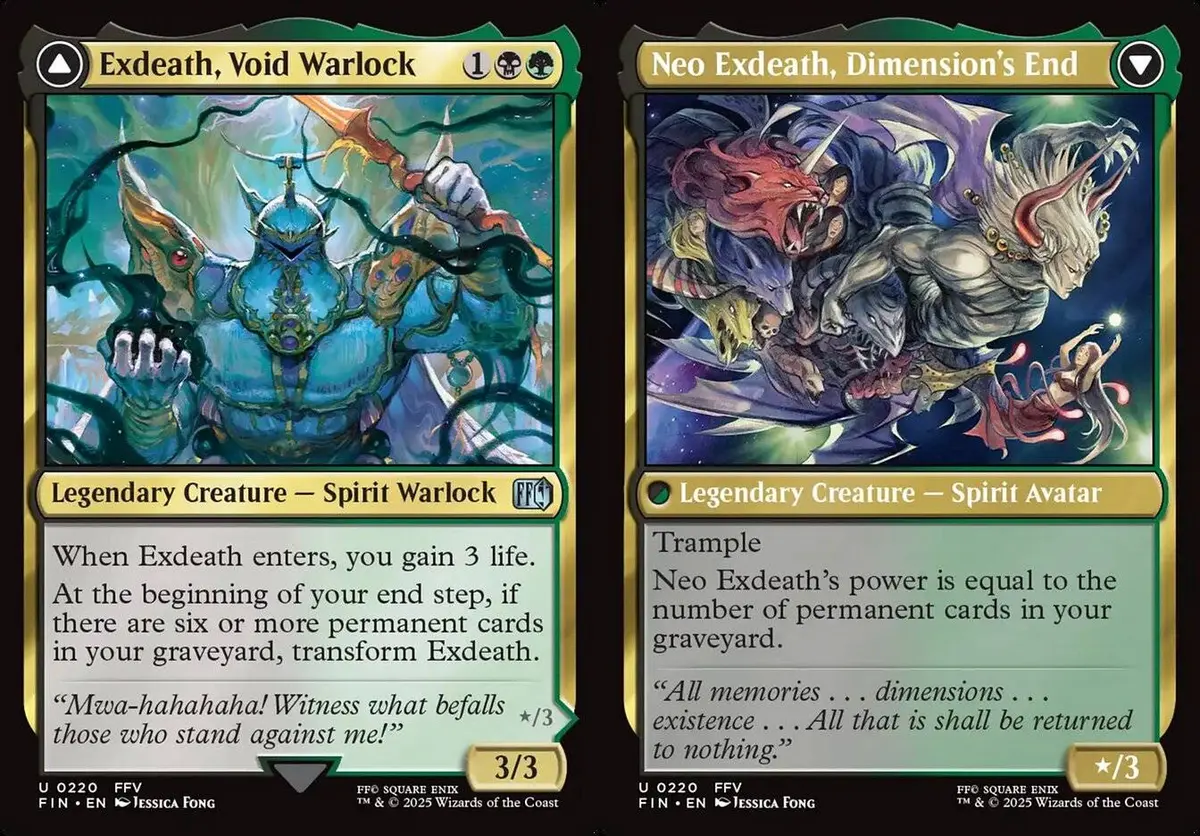
Score: 2.5
Comment: Although it’s an archetype theme card, and it also shows that black-green in FIN Limited cares about interactions with permanent cards in the graveyard, after transforming it’s only a trampler that’s at least 6/3, and without extra toughness it basically can’t survive an attack, so it only gets an average score.
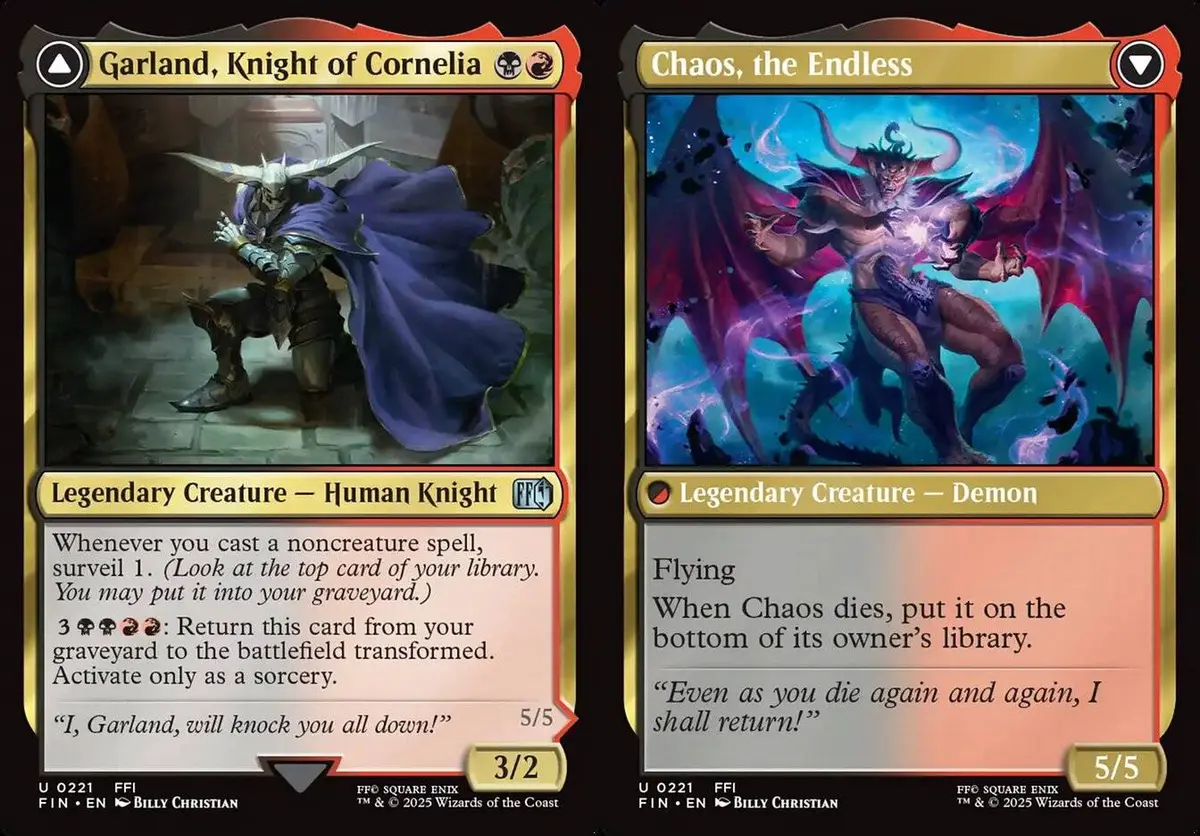
Score: 3.0
Comment: Besides its aggressive two-mana 3/2 stats, the extra surveil 1 on every noncreature spell makes your next draw better; and after several rounds of creature trades, in the very late game you can dig it out of the graveyard for seven mana as a 5/5 Demon, which should perform well in attrition games.
Score: 3.0
Comment: With enough Saga creatures it becomes very strong. If the opponent doesn’t remove it first, they could get crushed by Saga creatures that won’t stay dead.
Score: 3.0
Comment: A 1/1 with double strike is a very good Equipment carrier, and Equipment entering also filters, which is pretty nice. As for Dwarves, there’s no significant tribal theme, so just focus on his interactions with Equipment!
Score: 3.0
Comment: Titan-sized stats, fetches a land when it enters and triggers the +2/+2 and trample landfall ability at the same time; as long as it’s on the battlefield, if you keep playing lands and attacking you should be close to winning. However, it can’t benefit from this itself, so keep an eye on that.

Score: 2.5
Comment: Its 1/4 body is a wall. To make it work you need enough artifacts, so I recommend pairing it with cards that make Treasures or other artifacts.

Score: 3.0
Comment: Gains life and mills as it attacks. If you gain enough life, in the mid-game you can even stay home and not attack, just mill the opponent out? That said, it has little to do with white-blue’s artifact theme, and counts as a good standalone curve creature.
Score: 3.0
Comment: A great land-fetching ramp creature. Besides graveyard hate, its ability occasionally produces artifacts (Food tokens) for you.

Score: 4.5
Comment: As long as Jenova isn’t removed, you keep putting counters and earning cards, and it’s hard for you to lose. Its 1/5 body is also well suited to hanging back to block and slowly winning. If you pair it with a sacrifice engine, eating black’s Mutant Shambling Cie'th to draw three over and over will be disgusting.
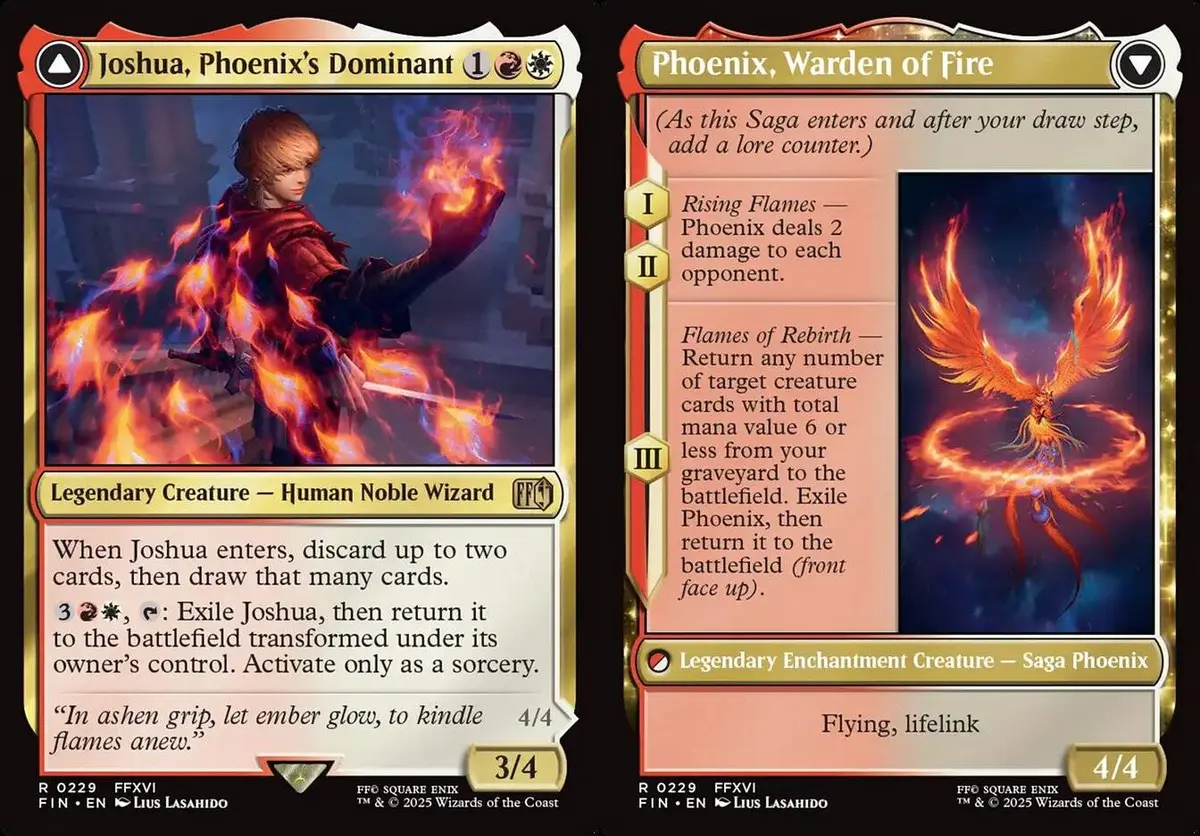
Score: 4.5
Comment: A three-mana 3/4 body isn’t bad, and when it enters it may discard up to two and draw two, which filters your hand and also sets up chapter III after transforming. After transforming, chapters I and II can each hit for 2 and gain 2 (the front face has lifelink); although it can only join combat for one turn, chapter III’s graveyard digging is very powerful, and once it resolves the front face returns to the battlefield again, and you can keep activating the five-mana ability to keep transforming. Extremely strong.
Score: 3.0
Comment: Pair it with a sacrifice engine and some small creatures/artifacts as fodder, or creatures as decoys to join attack and defense, and it will quickly grow and crush the opponent with stats.
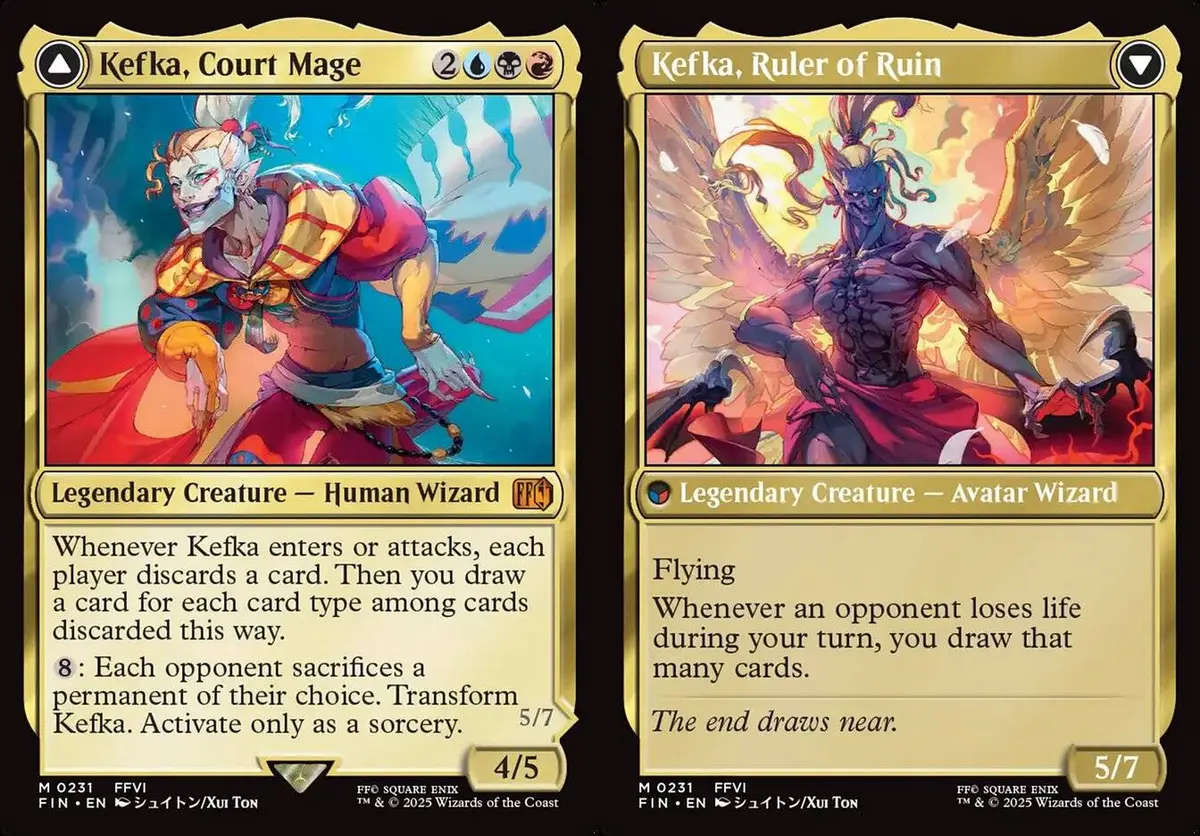
Score: 4.0
Comment: Just attacking continuously as a 4/5 on the front face and widening the hand-size gap between you and the opponent is already great. The eight-mana activated ability basically only eats one of the opponent’s lands, which doesn’t matter, but transforming doesn’t require Kefka to leave the battlefield, so hitting the opponent once draws 5 or even more cards. It’s a powerful card that can win the game by itself if it isn’t removed! However, this draw is mandatory, so don’t get too happy and deck yourself!
Also, three colored mana symbols is a bit restrictive in non-green-based decks. You’ll need some color-fixing, such as Blitzball , to help get your Kefka onto the battlefield, but it’s worth it.
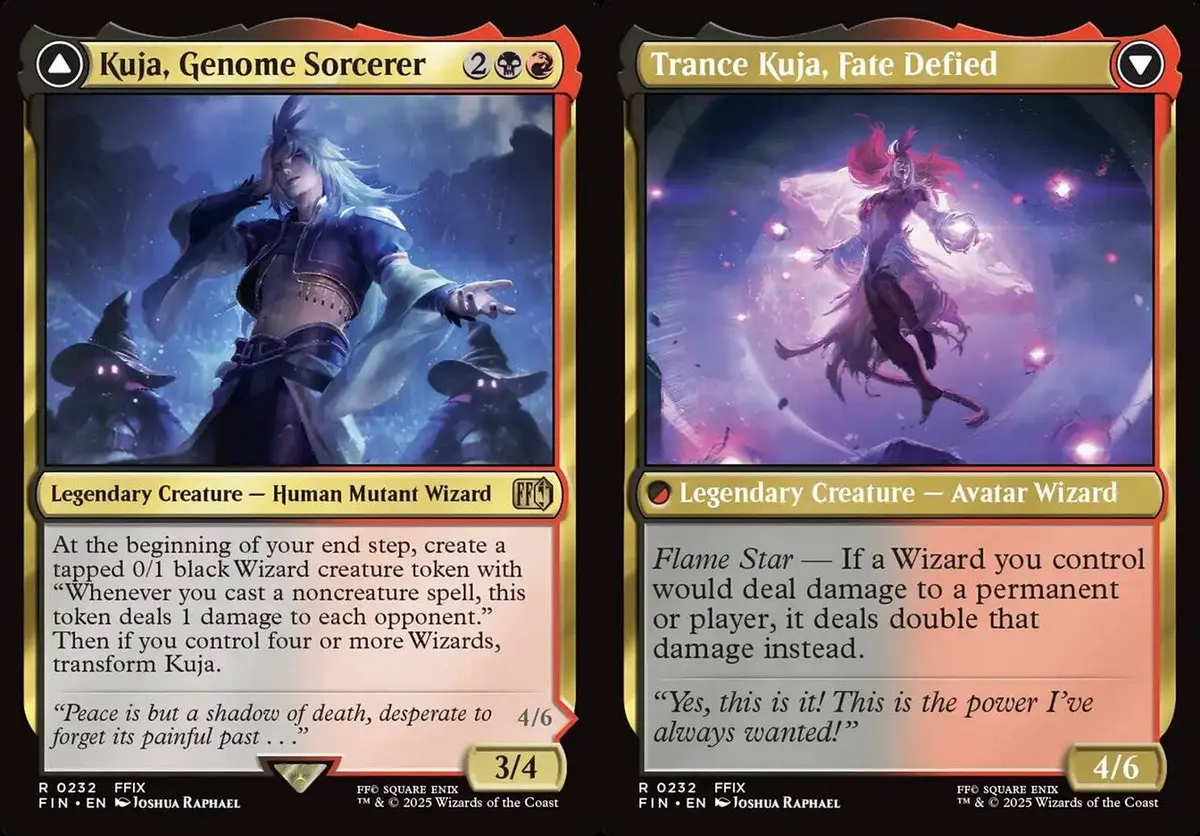
Score: 4.0
Comment: If you already have two Wizard creatures on the battlefield, after Kuja’s enters ability resolves it transforms him right away (Kuja himself is a Wizard too). Once flipped, dealing damage is much easier, and whether by attacking or casting noncreature spells, you should win quickly. To get the most out of Kuja, I recommend putting at least 7 or more Wizard creatures, or cards that make Wizard tokens, in your deck.

Score: 4.0
Comment: First strike plus trample makes Lightning’s Stagger ability very easy to trigger, and tons of damage follows. Protect Lightning and give him some Equipment that adds toughness or evasion, and your offense will be unstoppable!
With Genji Glove
, you have a chance to trigger Lightning’s Stagger again in an extra combat phase, and the damage then would be doubled and doubled again (quadruple)!
If Lightning gains double strike for some reason, then after first-strike damage resolves and Stagger triggers, the second regular combat damage will be doubled, and a second Stagger ability stacks on top. If you have a way to add some burn in your second main phase that turn, that will also deal quadruple damage!
Score: 3.5
Comment: A very strong offensive creature. Connecting not only widens the life gap but also filters. Give him some evasion and protect him, and he has a chance to win the game alone.

Score: 3.0
Comment: Some powerful artifacts can be used again after being removed. If white-blue/blue-black/black-white decks have artifacts like that, it’s probably worth splashing this card.
Score: 3.0
Comment: A seven-mana 8/8 body is very good. The floor is putting at least 2 stun counters on a target nonland permanent when it enters and gaining 2 life, and it gets stronger the more Town cards you have.
Score: 3.0
Comment: The more creatures the stronger, but it can’t pump itself, so you need some self-protection to make sure Rinoa survives until the next attack.
Score: 3.0
Comment: It has to attack to make the 2/2 legendary dog, and personally I find it quite ordinary. It might perform a bit better if you need a blocker.
Score: 3.0
Comment: It covers both of red-green’s axes, landfall and Saga recursion, giving all your Saga creatures an extra life, and with enough Sagas it snowballs terrifyingly. In the mid-to-late game you can also discard a Saga to draw, then use the ability to dig the Saga back up.
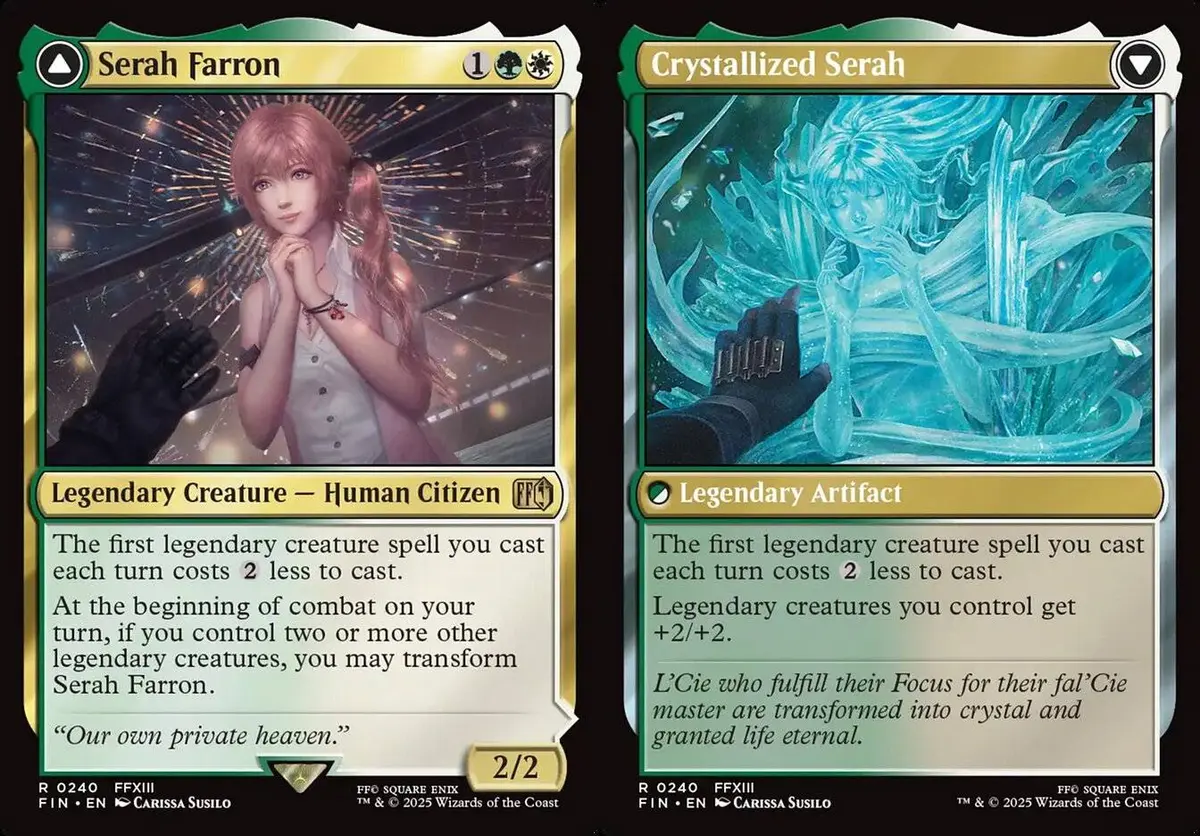
Score: 3.0
Comment: The main accelerator for white-green legends. Because it’s green-based, there’s also a chance to mix in legends of other colors. If you’re afraid of removal, you can first put two other legendary creatures on the battlefield, then cast Serah and transform it in combat to give them +2/+2 right away.
Score: 3.5
Comment: Growing while drawing is too much. When using it, keep an eye on the number of noncreature spells in your deck, and feel free to review the blue-red archetype overview from earlier.

Score: 4.0
Comment: A seven-mana 7/7 flyer that starts earning copies of permanents in your graveyard on enters/attack, which is very strong.

Score: 3.5
Comment: This is what a SeeD should look like! It has double strike when attacking alone, and hitting digs for a permanent of mana value three or less, lands included!
Note: Squall and Lightning work well together! When Lightning attacks alone, Squall can have double strike, and after Lightning gets removed, Squall can hit the opponent to dig him back up… just let you have all the fun

Score: 3.5
Comment: This legend needs you to protect him first, then win by casting lots of noncreature spells, so watch the ratio of creature to noncreature spells when building.
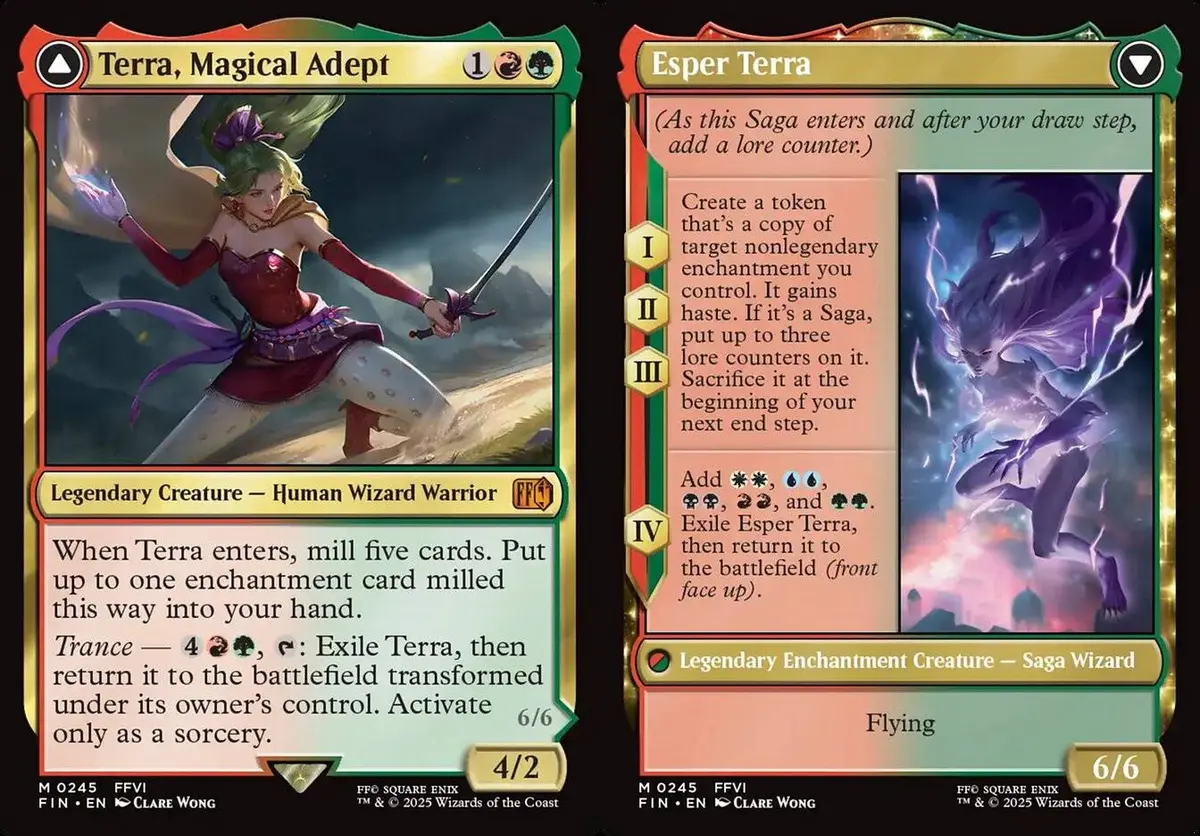
Score: 3.5
Comment: If you don’t have many enchantments in your deck, unless you need the self-mill effect, milling six with Terra is a loss. After transforming, besides being a 6/6 flyer, chapters I to III each let you copy a nonlegendary enchantment, and if it’s a Saga, he can directly earn the chapter I effect plus the effect of any later chapter you choose.
Score: 3.5
Comment: As a creature that taps the opponent’s blockers when attacking and whose stats can grow upward, I think it deserves this score.
Score: 3.0
Comment: It surveils 2 on both enter and attack, making it a solid mainstay on the curve in blue-black, which cares about graveyard size; in the very late game it can also transform for an extra turn, but the activation condition is rather harsh, so don’t expect too much.

Score: 3.0
Comment: Grow him, and then your blue-red spells can be cast efficiently, and continuing to cast noncreature spells also pokes in quite a bit of extra damage.
Score: 2.0
Comment: A guy who can’t do anything without Towns. His ability encourages you to take every Town and play five colors, but a 1/3 body is still easy to remove, and everyone takes the dual Towns, so I don’t really recommend building around him.

Score: 4.0
Comment: A huge bomb for the Saga creature theme. It can gain life and be reused over and over; of course, when using it, watch the number of enchantments in your deck.
Score: 3.0
Comment: A five-mana Act of Treasonthat gives lifelink, with a chance to open up a big life gap in one go; when you give it back you also get an extra Treasure, which should be good as the top of the curve in a more aggressive deck.
Conclusion
Final Fantasy, as a heavyweight IP spanning more than 35 years, is a truly phenomenal product, both in the longevity of the IP and in the historic achievements it has made in the RPG world; its standing there is perhaps comparable to Magic: The Gathering’s place in the TCG (Trading Card Game) world. The Lord of the Rings set is even older, a true elder This crossover can also be seen as a team-up of two great IPs from East and West, and I hope it sparks something different and lets more new players get to know Magic: The Gathering and keep playing.
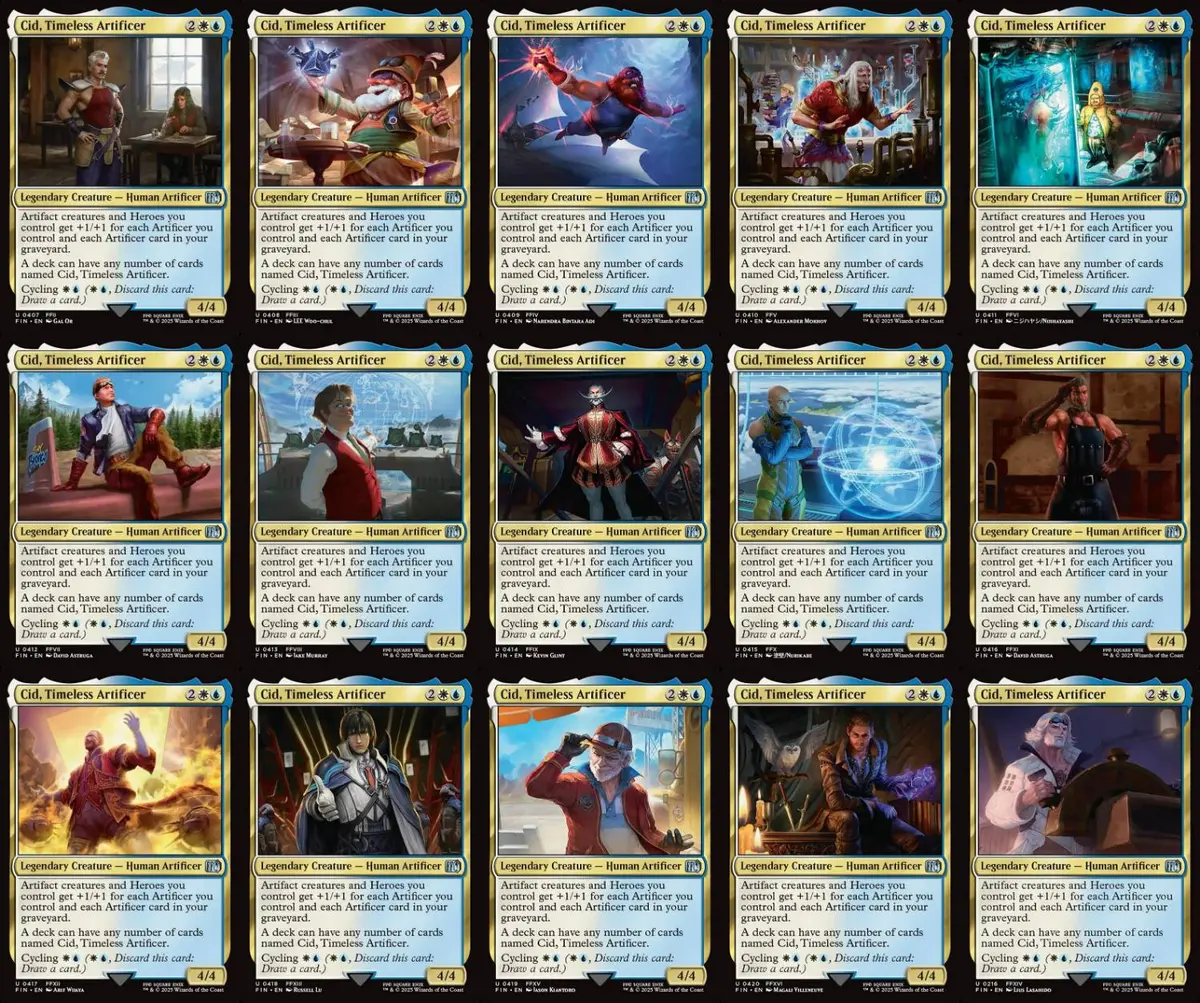
Like Cid, Timeless Artificer, a character who runs through FFII to FFXIV, 15 games in total, and appears in different forms, appearances, and personalities, including as a non-player helper, party member, and villain. Magic also has many legendary creatures and Planeswalkers who appear in different sets in similar ways, clashing and cooperating to drive the story forward; or, as seasons pass, their descendants, heirs, and inheritors of their ideals continue to appear in later stories.
Let’s close with the FFVIII ending theme, Faye Wong’s “Eyes On Me”. The stories of FF and MTG will keep being written, never ending…
- Title
- FINAL FANTASY (FIN) Limited Guide: Multicolor
- Author
- cephille
- Created at
- June 2, 2025
- License
- This work is licensed under CC BY-NC-SA 4.0 .