Complaining Won't Fix a Setback, But Fighting Hard Wins the Title — MIT Round 10 Recap

Note: This article was translated from Chinese by AI and may contain errors. Read the original Chinese version.
Foreword
I’m 許碩恩, and I’m very grateful to Guildmage’s Forum for inviting me to write, giving me the chance to share my experience at this MIT. Besides winning MIT Round 10, I’m probably the current record holder for MIT top 8 heartbreak. Starting from the first round, I’ve played in MIT nine times, losing in the top 8 four of them, and only on the fifth top 8 did I finally earn a Pro Tour invitation. Besides briefly sharing my preparation and the course of the event for MIT Round 10, this article will also talk about what went through my mind during those four top 8 losses and share how I adjusted my mindset for competitive events, in the hope of helping you fellow Spikes.

Preparation
For the past several rounds of the main event, I got in through MITQs run by stores. I remember the Round 10 MITQ happened to fall around the Chiba GP, and with changes in my personal life I had no energy to play any of them. In August, once I confirmed I was free the weekend of the main event, I decided to head north on Saturday and experience playing the LCQ.
After locking in the schedule I occasionally kept an eye on Modern metagame changes, and only started researching after Spider-Man was released. I’m used to collecting information from Twitter (I strongly recommend adding @fireshoes to your list), and three weeks before MIT there happened to be a PT EOE whose metagame I could reference. Plenty of sideboard guides appear after an event like that, which is a big plus for a solo player like me who doesn’t have time to actually practice.
With limited time and resources, settling on a deck early is what gives you enough time to practice. Ideally I start practicing two weeks before the event and stop changing decks once I’ve decided, at the latest one week before. Getting in five to ten MO Leagues, that is 25 to 50 best-of-three matches of practice, already makes me quite satisfied.
Considering cost-effectiveness, I usually pick a deck by three principles: the archetype suits how I play, it sits in a good spot in the metagame, and I’m not missing many physical cards. The decks I initially considered were Esper blink, Goryo, and Affinity. I already owned most of the physical cards for all three and had piloted them, and they all did well at PT EOE.
As for deck type, I know very well that I’m not good at resource-trading games. In midrange or control matchups that drag on I inevitably make mistakes, I often can’t stabilize in an unfavorable position, and it’s hard to beat players who have practiced more. So I choose aggro or combo decks that can proactively create problems for the opponent to solve, pressuring them into mistakes, and ideally end the game quickly to earn extra rest time.
So I ruled out Goryo and Blink directly before actually trying them. For the former, after losing Grief and gaining Quantum Riddler
 , it looked like it had shifted from a combo deck toward a midrange deck. The latter is a midrange deck that gains resources, and on top of that my experience of making the top 8 of MIT Round 8 with White-Black and immediately losing to the same archetype was unpleasant, so naturally I ended up choosing Affinity as my deck.
Deck Adjustments
I thought back to ten years ago, when the first Modern deck I built for the WMCQ was Affinity. The deck now only keeps low-cost artifacts like Memnite , Ornithopter
 , Springleaf Drum
 , Thoughtcast
 , and the Mox Opal
 that cost 900 back then, but the core spirit is unchanged: a high-risk, high-reward glass cannon deck, except the payoffs have changed from Arcbound Ravager
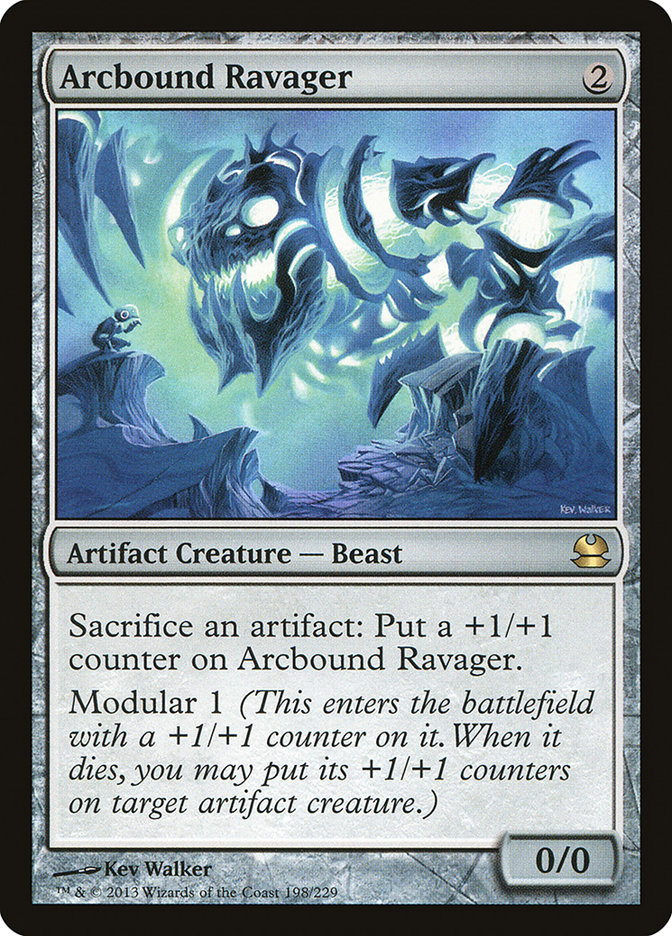 and Cranial Plating
 to the more stable and harder-to-interact-with Pinnacle Emissary
 and Kappa Cannoneer
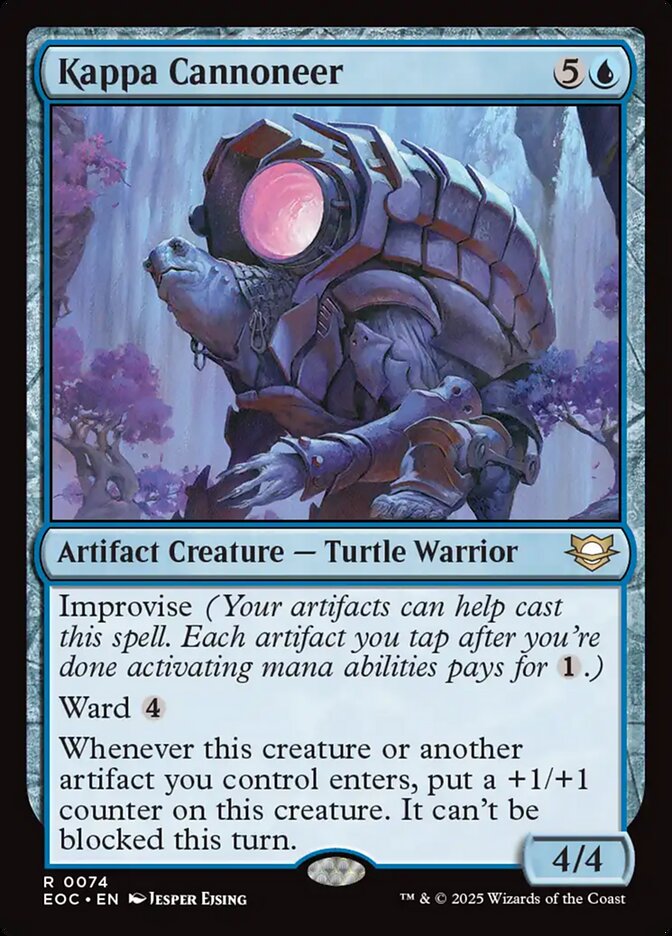 .
The current metagame also has a similarity with ten years ago: every deck brings sideboard cards against Affinity, which indirectly proves that Affinity is currently a glass cannon deck of high enough power. Kappa Cannoneeris a Commander card powerful enough to break into Legacy, and EOE added Pinnacle Emissaryto give the deck nut draws, with the capital to race combo decks, while Urza's Saga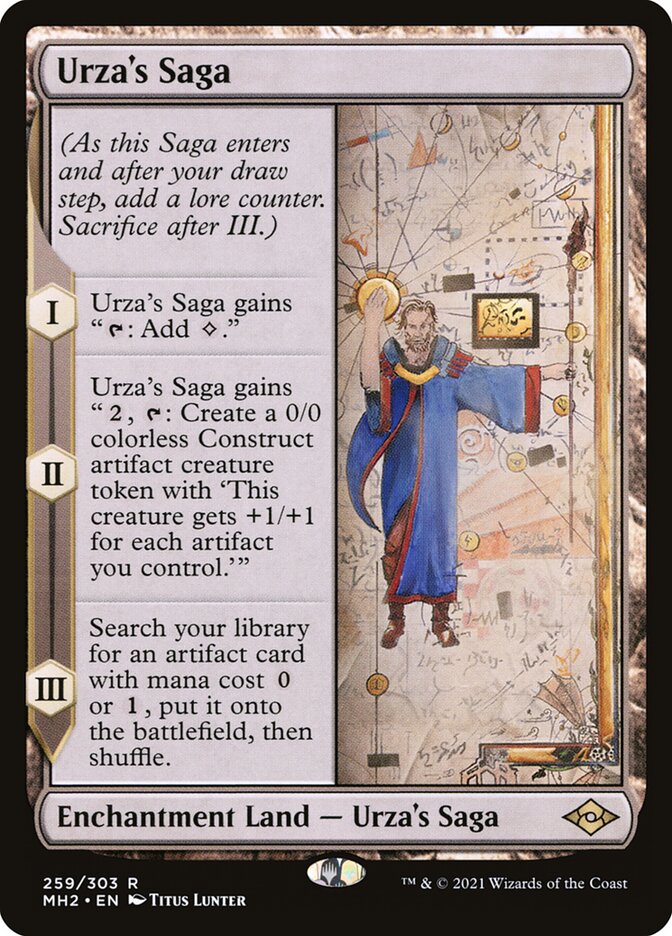 / Thoughtcastlet it fight resource battles against midrange or control decks. In addition, the maindeck can carry zero-cost artifacts that disrupt graveyards and sweep the board, and the land Sink into Stupor // Soporific Springs
 can serve as a universal answer. You could say this environment is Affinity’s glory moment.
Unfortunately, before MIT the format hadn’t evolved to the stage where you could copy a list mindlessly. A little analysis of the PT EOE decklists shows that even professional players hadn’t yet found the best build. The one that drew the most attention was Shuhei Nakamura, who went undefeated on Day 1. The highlight of the Japanese team’s Affinity was the combination of Weapons Manufacturing plus Claws of Gix
 , which performed well on the feature match table, but unfortunately Nakamura lost two win-ins and didn’t make the top 8. This was also the deck most people copied after the event, and in the two weeks that followed, the same 75-card list kept making top 8 in MO Challenges.
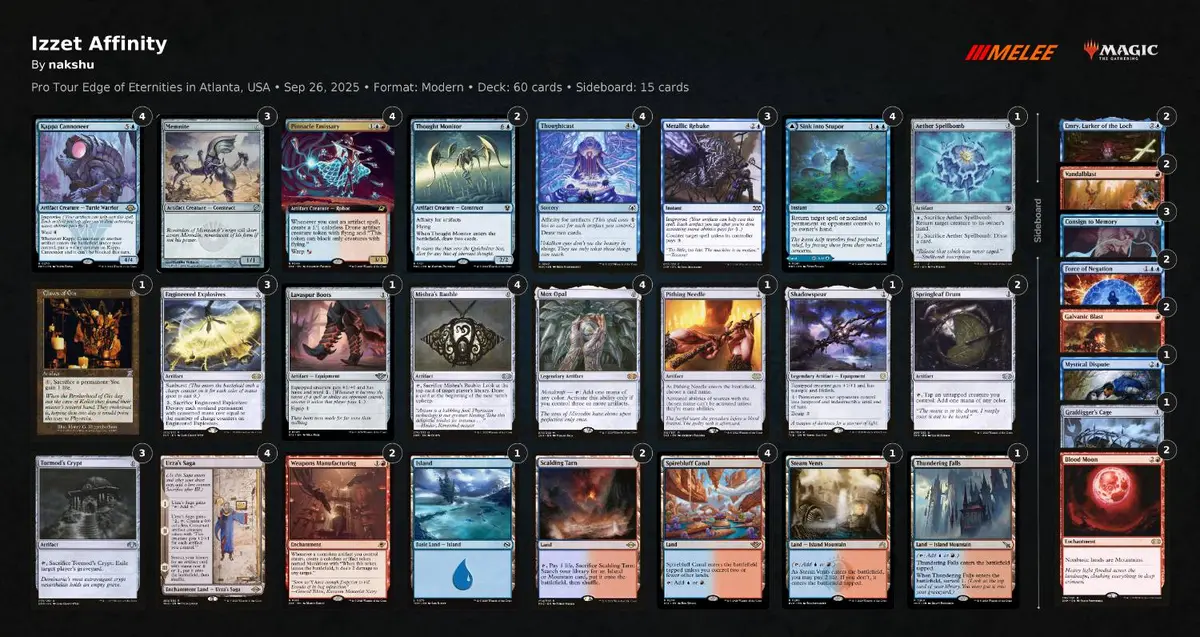
But looking more carefully at the PT EOE constructed decklists, another build of Affinity also did very well. Alex Friedrichsen and David Inglis’s Team Handshake played a full set of Springleaf Drum, Memnite, Ornithopterand moved Metallic Rebuke to the sideboard, maximizing the chance of a nut draw.
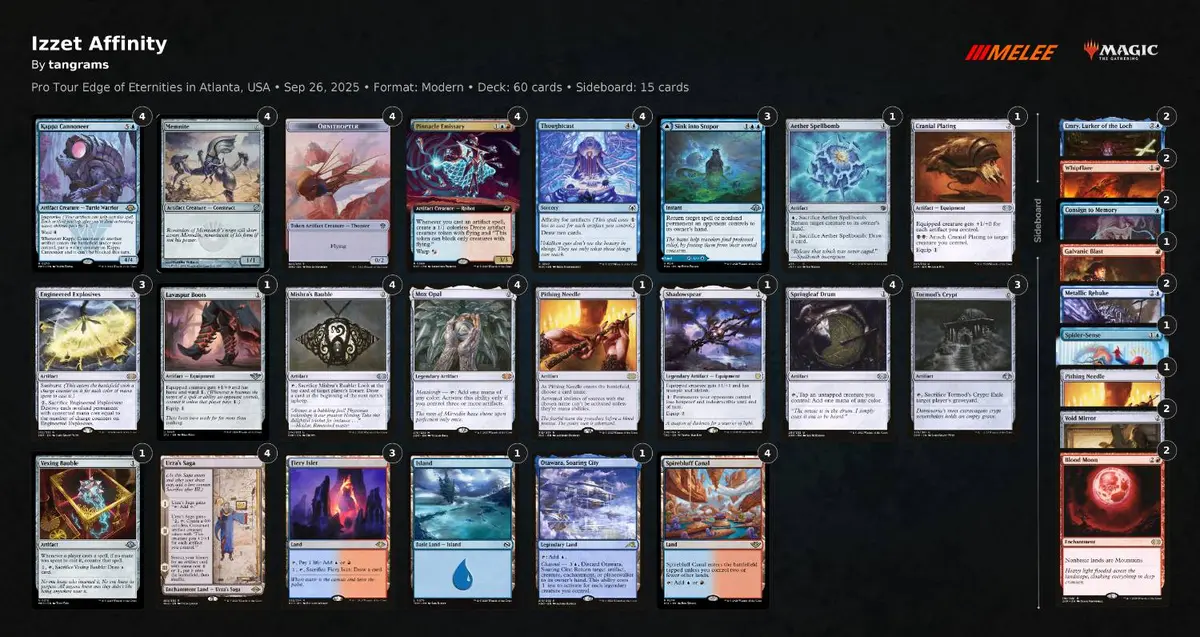
Just by looking, it’s really impossible to confirm which build is better, but a few differences in construction details can be found.
Number of zero-cost artifacts: counting Engineered Explosives and Mox Opal, the Japanese list ran only 18, while Handshake ran 22.
Number of mana sources: the Japanese list has 17 lands (land-fetching lands) + 6 artifacts, while Handshake has 16 lands (card-draw lands) + 8 artifacts.
Number of payoffs: the Japanese list has two more Weapons Manufacturing.
Number of card-draw spells: the Japanese list has two more Thought Monitor .
Simply put, the Japanese build is greedier, using relatively few cheap artifacts to support more payoffs, and with too few artifacts drawn, it has a higher chance of getting stuck with uncastable spells. Handshake’s build is quite conservative: although it has fewer payoffs, it doesn’t get stuck, and the deck has higher consistency.
I started adjusting from Shuhei’s deck. At first I changed the land-fetching land setup into card-draw lands plus fast lands, then tried not playing Springleaf Drumand Memniteat all, bringing Mox Amber plus a maindeck Emry, Lurker of the Loch
 instead, and then tried some odd tech I saw on MO, including Vexing Bauble
 , Expressive Iteration
 , Salvage Titan
 and so on. After three or four MO Leagues of experimenting, my conclusion was: Weapons Manufacturingcan raise the deck’s burst ceiling and helps a lot in midrange matchups, but the Japanese build is really too greedy, too few zero-cost artifacts makes the payoffs easily stuck, and on top of that in post-board games I often have to swap out the useless Tormod's Crypt
 or Engineered Explosives, which makes the deck run clunkier.
Later I found the primer written by Team Handshake (link), which made the sideboarding logic clearer. The build I finally entered started from the Handshake construction, cut down the low-impact Springleaf Drum/ Memnite/ Ornithopter, added the Weapons Manufacturingpackage, and brought Ashiok, Dream Render in the sideboard to give Titan a little respect. By the time the deck was settled it was already Friday night, and I could only squeeze in one more League. In total I played nine MO League matches before the event, with a so-so win rate of 55.5%, so I really didn’t have much confidence.
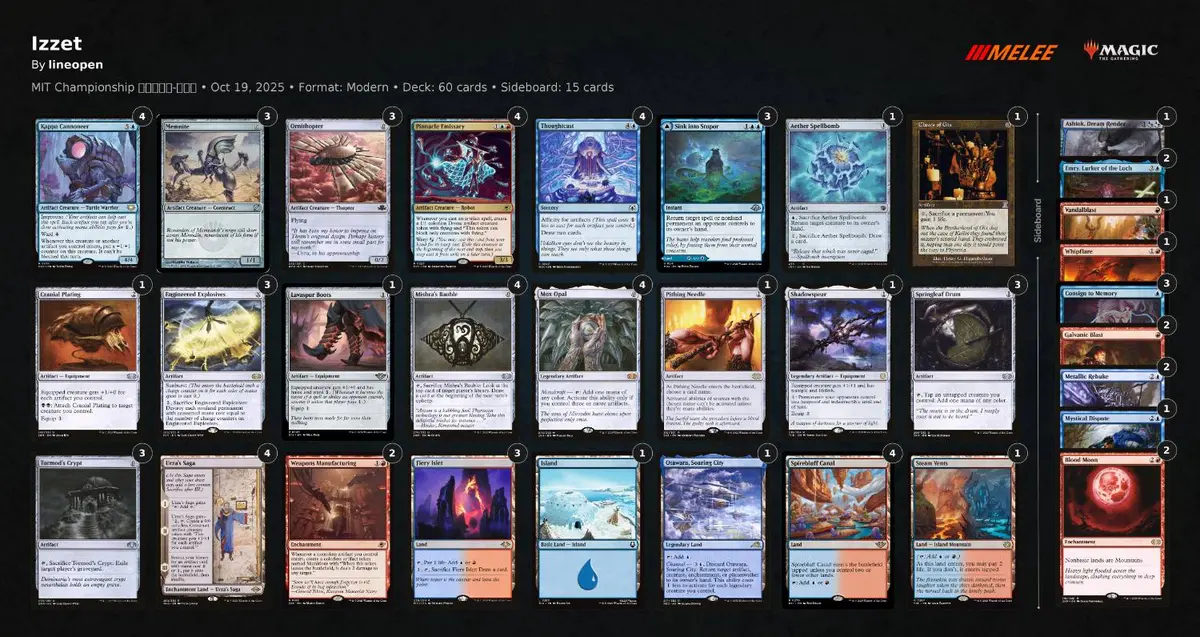
Link to 碩恩’s MIT10 Izzet Affinity decklist
Tournament Report
The following play-by-play is entirely from memory and may differ from what actually happened. Readers who don’t like diaries are advised to skip ahead to the takeaways section.
Saturday LCQ
I left home around 6:30 to take the high-speed rail and arrived at the venue close to 9:30, and the LCQ was already on its fifth round of check-in. After borrowing the cards I was missing, I filled out the decklist, handled the physical cards for a bit, and reminded myself once more not to miss the draw trigger of Mishra's Bauble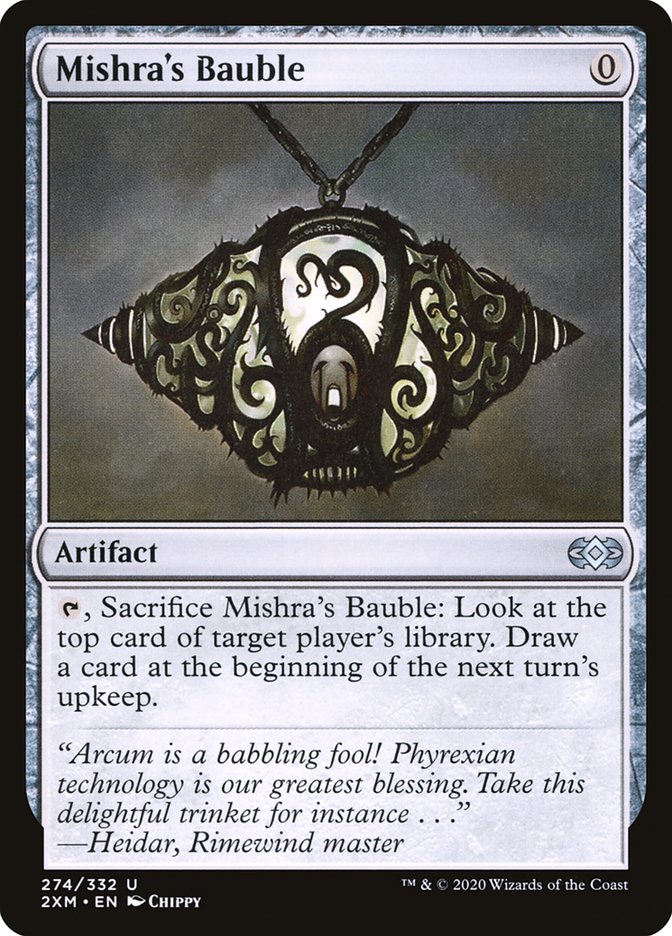 and the growth trigger of Kappa Cannoneer.
R1 Neoform 萃辰 WW
I hadn’t played against Neoform on MO, and in G1 when the opponent played a green flip land I still couldn’t remember what deck it was. Luckily when I drew Pithing Needle
 I remembered and named it correctly, locking down the Griselbrand
 that evolved out next turn so it couldn’t draw cards, and I won by pushing damage through with Kappa. In G2, the opponent took a hit from Sink into Stupor // Soporific Springswhen doing neoform and I killed them first.
R2 Goryo 海貓 WW
I ran into a good friend from Tainan who was also there to qualify. Goryo is a favorable matchup. The three maindeck Tormod's Cryptcan disrupt the graveyard digging, the opponent can usually only answer the board passively, and once Kappa resolves it puts a lot of pressure on, so as long as Affinity isn’t crushed by card advantage it wins. In G1, my opening-hand Pinnacle Emissarywas answered by Solitude , but I could still develop safely afterward. We finished after two games, and with tears in my eyes I personally sent my friend off to sign up for the next LCQ.
R3 Esper blink WW
In G1 I was slightly short on lands but the board was hugely in my favor, and the battlefield was so complicated that I forgot to make a Munitions token, luckily without being punished. In G2 the opponent clearly flooded out and I ground them down slowly.
I was very lucky to qualify by playing just one LCQ. It felt much smoother than practicing on MO: I drew Kappa every game, and on the occasions I misplayed or missed a trigger I didn’t panic. I wandered around the venue in a relaxed mood, left around five o’clock to rest at the hotel, and after dinner I didn’t particularly feel like opening MO to practice. At nine sharp I opened MTGA. This month’s Qualifier Weekend format was sealed with the “Spider + Man” set, Through the Omenpaths. I was happy for a moment seeing a black rare that digs six creatures and an XBB 2/1 lifelinker, but when I saw the whole pool my mood immediately turned to anger. I barely put together a green-black deck splashing red and white with weak creatures and little removal, got eliminated at 3-3 close to midnight, and went to sleep resignedly.
Sunday MIT
It was pouring in the morning. I barely made it to the venue in time to pick up my promo card, and only after rushing through the takeout McDonald’s did I finally settle into the right state of mind. (Some of the game details are omitted because I had no clear memory points or skipped them.)
R1 Yawgmoth combo LW
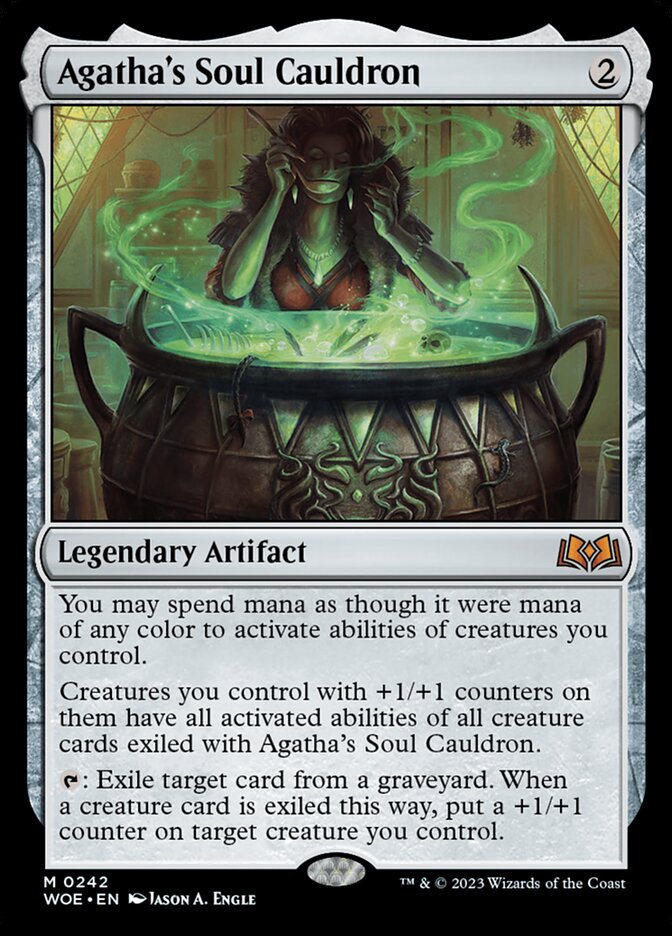
Another matchup I hadn’t faced on MO. In G1 I had no Kappa to give pressure, and Urza's Sagawas answered by the opponent’s Haywire Mite , but I used Sink into Stupor // Soporific Springsto bounce Agatha's Soul Cauldron
 and used Tormod's Cryptto buy time. Late in the game I had Aether Spellbomb
 plus Claws of Gixon board that could eat a few Munitions tokens to answer things, and I thought I was safe, but since I was unfamiliar with the opponent’s combo I didn’t disrupt at the right time. They assembled Agatha’s Soul Cauldron with Walking Ballista
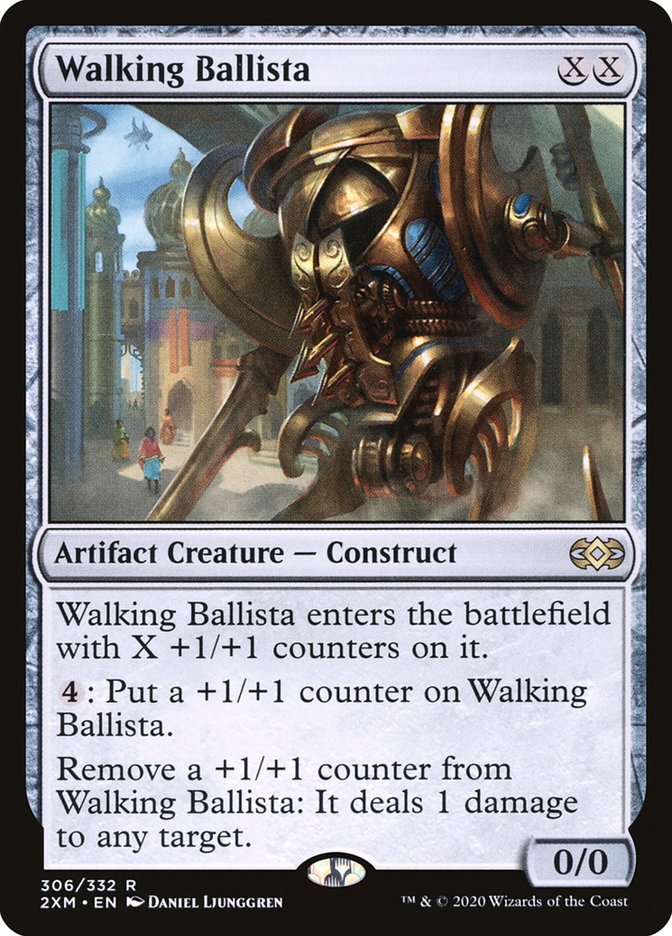 exiled, plus Young Wolf
 and Dredger's Insight
 , for infinite life, and after thinking for a bit I conceded. G2 finished with only eight minutes left, and in G3, I’m not sure whether I was too relaxed and didn’t watch the clock, but in the end it could only be played to a draw.
R2 Eldrazi Ramp 勃毅 WW
I ran into a good friend from Kaohsiung who brings his own desk lamp. His deck was green-based Eldrazi without Karn, the Great Creator , which is a relatively easy type to play against. In G2 I had a nut draw, resolving Kappa on turn two and growing it to 7/7. The opponent didn’t draw a sideboard sweeper on turn three, and on my turn three I grew Kappa to 23/23 with two kinds of tokens and won with a single punch.
R3 Amulet Titan 其寬 LWW
Amulet Titan is faster, hard to disrupt, and has Boseiju, Who Endures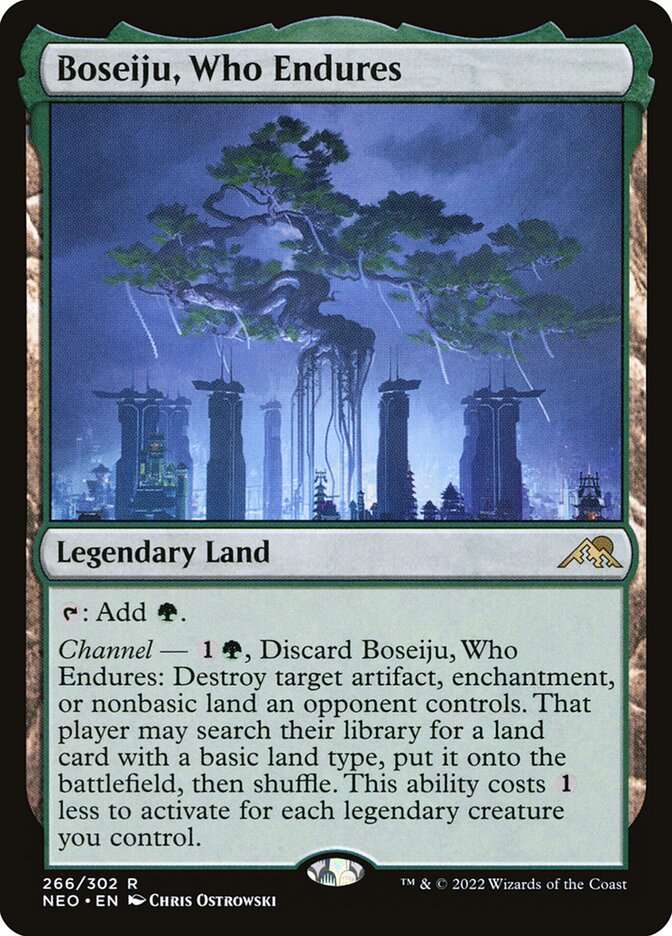 to disrupt me, and on top of that the pilot was 寬麵大大, so it’s an unfavorable matchup for Affinity. After each of us won a game, in the decisive G3 I resolved Kappa first, and when 其寬 played Primeval Titan
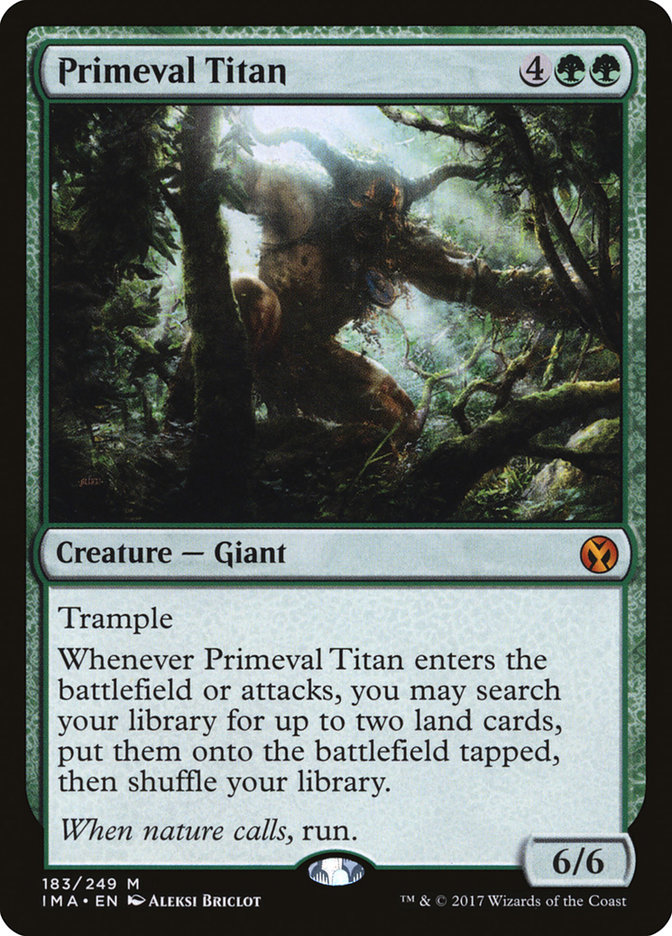 , since his life total was still safe he didn’t directly make six mana to use Boseiju on my Kappa. I topdecked Pinnacle Emissary to make up the number of artifacts I needed, and a single punch of 17 took his life exactly to zero.
R4 Domain Zoo WW
Domain is also a very popular deck on MO, and this is a 50-50 matchup that comes down to who runs smoother. Luckily none of the opponents today set up Leyline of the Guildpact with Scion of Draco
 . In G1 I resolved Kappa smoothly but Doorkeeper Thrull
 shut off its trigger, and luckily the opponent didn’t hit Phlage, Titan of Fire's Fury
 . On turn four, while the opponent was fully tapped out, I used Sink into Stupor // Soporific Springsto bounce Thrull, cast the enchantment on my own turn to make a Munitions, and later used EE to blow up that Munitions and remove Thrull, which let Kappa push damage through and win.
R5 Domain Zoo WW
In G2, after the opponent mulliganed to five they had a 5/5 Territorial Kavu . I was too eager to cast the two Kappas in my hand and didn’t leave enough blockers, leaving too big an opening and getting hit down to five, but luckily I wasn’t punished and still broke through with Kappa.
R6 Goryo SamuelChang WLW
After four wins and a draw I was paired up at the second table against SamuelChang, who wanted revenge at MIT, and seeing his list’s maindeck Pest Control made me a bit afraid. In G1, my turn-one Springleaf Drumgot a menacing Force of Negation
 from SamuelChang, which also let my turn-two Weapons Manufacturingresolve successfully. After topping up my artifact count I resolved Cranial Platingand Kappa. With only one last punch to go, SamuelChang went looking for a surveil land, and after I cut his deck, he surveilled Atraxa, Grand Unifier
 from the top of his library into the graveyard. I saw he had four mana and three cards in hand, and my Sink into Stupor // Soporific Springscouldn’t stop him from digging the graveyard. Just as I was thinking I might get turned around, he showed his hand and said he had no Goryo and conceded, which scared me to death. In G2, after a mulligan I got disrupted, and after Urza’s Saga’s Construct token ate a sweeper I had no resources at all and was killed by two Psychic Frog
 . In G3 I mulliganed to a hand that connected into a turn-one Emry, Lurker of the Lochand could still keep Metallic Rebukefor protection. I countered SamuelChang’s turn-one Solitude, refilled my hand with Mishra’s Bauble, and successively summoned the Pinnacle Emissary and Kappa that Emry had milled. But when I summoned Kappa I tapped too many tokens and left an opening, got hit by Frog down to 8, and luckily drew the insurance Tormod's Cryptto cut off SamuelChang’s hope of digging the graveyard for a counter-punch.
R7 Intentional Draw
After the intentional draw I went to the basement to eat mos and fill my stomach, and when I returned to the venue the standings were posted: I was sixth with five wins and two draws for 17 points. With the lessons of many earlier failures, this time making the top 8 I didn’t feel particularly hyped or nervous, and I was mentally prepared to crash out once more. A few friends also remembered that I’d said not to set up flags, and I thank them for not coming to congratulate me early.
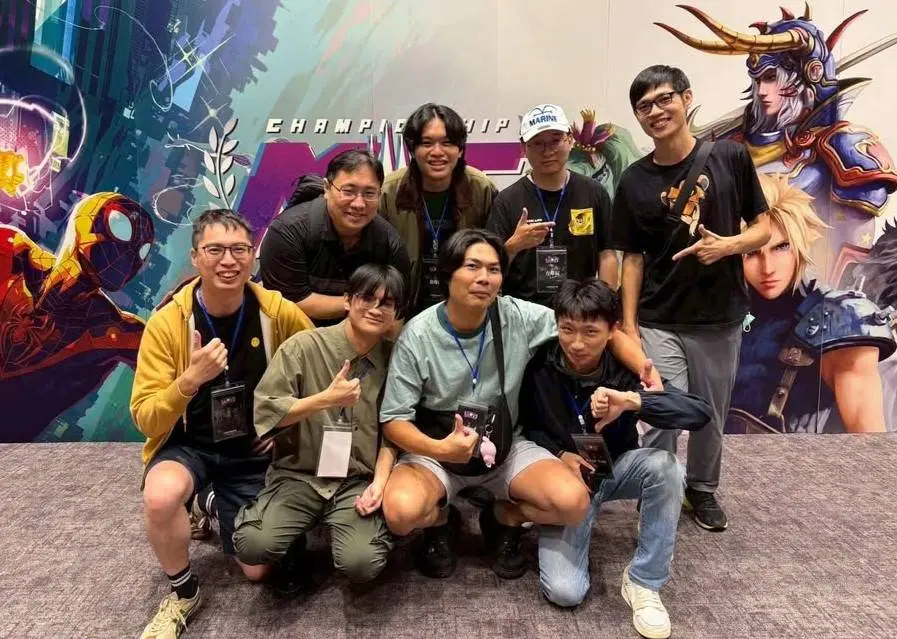
Quarterfinal Blue Goblin Charbelcher 薛書宇 WW
A very popular deck on MO right after the PT ended. Pithing Needle and Tormod’s Crypt can both disrupt the opponent effectively, and the sideboard has enough counterspells to answer, so it’s a rather favorable matchup. In G1, on the draw, I played Urza’s Saga on turn one to ensure I’d have Pithing Needle on board to protect me on the opponent’s turn four. The opponent played Tameshi, Reality Architect on turn three and suspended Lotus Bloom
 on turn four. After the first Lotus Bloom was exiled by my Tormod’s Crypt, they immediately used Fallaji Archaeologist
 to mill into the second Lotus Bloom and dig it back onto the battlefield. Just as I was feeling very uneasy, luckily the opponent ended the turn, clearly not having found a way back to Goblin Charbelcher
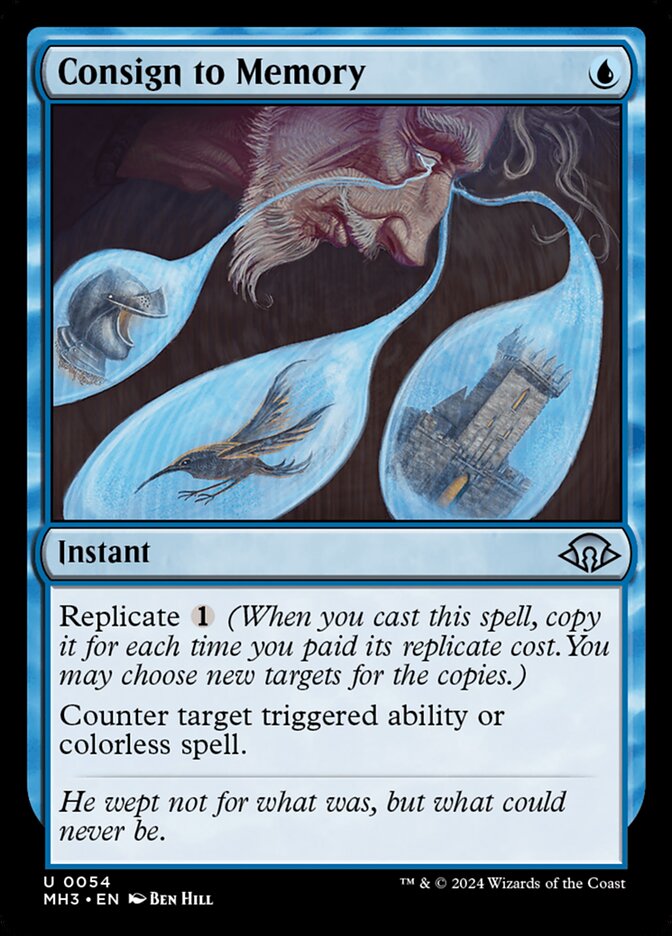
 . I kept three mana open holding a Sink as insurance and slowly pushed through three turns with a Kappa that couldn’t grow to win. In G2 the opponent had no Lotus Bloom in the opening hand, I waited for the opponent to use a counterspell before resolving Kappa, holding Consign to Memory
 in hand, and won very safely. When the opponent conceded, I couldn’t help shouting that I had finally won.
Semifinal Domain Zoo Peter Yeh WW
In both games the opponent never assembled a two-card combo that could pressure me. In G1 I made two big tokens with Urza’s Saga and the opponent happened to have no answer. In G2, after the opponent mulliganed once they kept a one-land hand, while I mulliganed into a hand with a Pinnacle Emissary, two Kappas and an Urza’s Saga, giving me multiple threats. Although I ate two counterspells, I still resolved a Kappa, the opponent stumbled on lands and couldn’t apply any pressure at all, and I developed slowly and won.
Once I was sure of the PT invitation, I actually felt rather calm, resting on the side waiting for the other semifinal to end. The Goryo versus Titan matchup of SamuelChang and 承翰 was truly a battle of gods. In G3 SamuelChang’s Frog nearly KO’d 承翰 again and again, but it was held off for several turns by the super Arboreal Grazer and Bojuka Bog
 . In the end SamuelChang still won, and I was very happy that the finals wouldn’t mean facing Amulet Titan.
Final Goryo SamuelChang WW
In G1, on the play, I mulliganed once and connected into a hand with two lands, Bauble, Springleaf Drum, Pinnacle Emissary, and Kappa Cannoneer. After I played a land and passed, SamuelChang’s Thoughtseize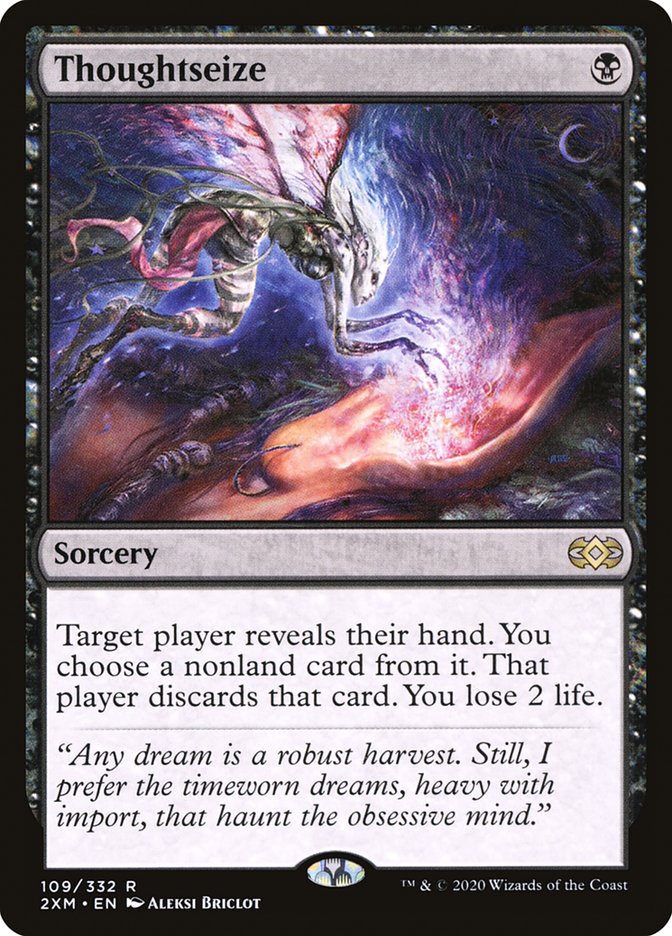 chose to discard Pinnacle Emissary, and on my turn two I topdecked Weapons Manufacturing to make up the artifact count. Although I took a hit from Atraxa, I also made a 12/12 Kappa to counterattack, and after Kappa was answered by Solitude, I topdecked Claws of Gix and ate the Munitions token to win. In G2, although I was first disrupted by Thoughtseize, I could still make Thoughtcast to refill my hand, and with Urza’s Saga producing a Construct token and even pulling out Pithing Needle to lock down Frog, I calculated my mana to resolve Kappa on a turn where I could still keep three mana for the last Sink in hand, which happened to stop SamuelChang’s Wrath of the Skies
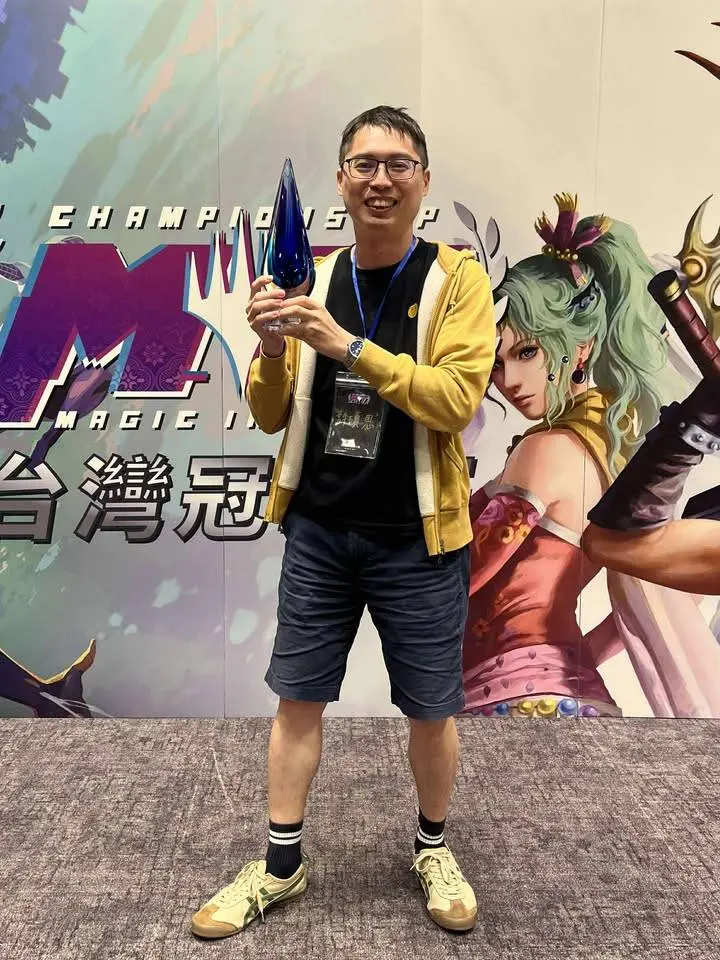
 the following turn, letting me take the title of this MIT round.
Takeaways and Review
Actually, before this event I didn’t have high expectations as in the past, and I never expected to win the title. Perhaps getting Aerith Gainsborough already felt like a win, or maybe I’ve failed enough times, but I stayed in a calm state of mind all day. All I can say is that my luck that day was really smooth, the deck helped a lot, there were a few key topdecks, and I never mulliganed down to five. The pairings were relatively favorable and none of the opponents had their ceiling draws, and the occasional mistakes didn’t affect the result of any game except the first one. At the moment of winning the title I was quite happy, but also calmer than I expected, and actually the moment I won the quarterfinal and broke the curse, I felt more excited.
There is a neuropsychological theory that the pain failure brings to the human brain is far stronger than the satisfaction success brings. My experience in MIT made me feel this argument firsthand: compared with the sense of achievement from winning the title, the frustration from losing in the top 8 four times in the past was disproportionately high. I still remember every failure. The first time, I made the top 8 with Phoenix and was on the play but got beaten by a smoothly drawing Esper control, and afterward I heard that a top 4 finish would have earned a PT invitation, which made it even more sickening. The second time, with Infect against Grixis midrange, it was a relatively favorable matchup but I ran into a strong player, and on top of that I stumbled on lands in the key game. The third time, again with Infect, I ran into my nemesis michaelchen piloting Boros convoke, and I felt I would lose before we even started. The fourth time, with White-Black midrange against the same archetype, I started to clown around and self-destruct as soon as my first draws went poorly. Each time I left Taipei on the high-speed rail my mood was very negative, I blamed everything, and I wondered what the point was of spending my time playing cards. Especially the feeling of having had many chances but not seizing them, with unnecessary expectations dashed creating excessive disappointment; these poorly handled emotions clearly affected my performance on the spot.
All TCGs, including MTG, have a heavier random component than other competitions such as sports, esports, and chess. A player who can maintain a 60 to 70 percent win rate over the long term is considered a top expert, but even so that doesn’t necessarily translate into tournament placements, and over the long run everyone’s experience is losing more than winning. Rationally we know the part we can control is limited, but the brain’s original design makes us care too much about winning and losing. The feeling of losing is so painful that humans involuntarily avoid it, so the brain doesn’t have to bear this unpleasantness: for example, deliberately covering up a mistake out of embarrassment when we notice it, fearing onlookers will see; being overly conservative from fear of losing an advantage; or even giving up on winning early to get rid of the discomfort of a disadvantage sooner. Quite a few people can recognize the effect their mindset has on a match, but overcoming it is very hard and takes enough awareness, experience, and practice.
Since winning and losing can’t be controlled and failure is an unavoidable common experience, then besides not giving up and continuing to try, how do we maximize our chances of winning? I think we need to let go of the obsession with winning and losing and not focus our attention on parts we can’t control, such as complaining about bad pairings, losing the die roll, how smoothly the opponent draws, or how unsmoothly we draw. Instead, focus attention on the parts we can control, including deck choice, practice, and health management beforehand, and then make every decision in the match well, such as mulligans, triggers, attacks and defenses, big-picture judgment, and communicating with the opponent. Accept that you can’t be perfect, but do your best to enjoy the process, improve a little each time, enjoy the match as much as possible, and leave the final outcome to fate.
At least at MIT Round 10, the mindset shift above did bring me a winning result. Besides good luck, I managed my health a bit better, my stamina improved, and I could focus on making every decision well. My emotional swings that day were also small: when things went well I didn’t get overexcited, and after making a mistake I didn’t stay stuck in frustration. Even when I drew the first game because of an error, I could accept the result and steadily continue to the next game. In the all-important quarterfinal, although I was a bit nervous about extending my streak of crashing out, I stayed calm and focused on the present, and I kept that up until the end of the finals.
I believe everyone, like me, has struggled and given up in the process of repeated frustration, may be full of self-doubt, but still enjoys this game and will keep challenging it in the future. Thanks to 佳儒 and 蘋果 who helped find cards, the Tainan friends who shared the victory that night, all the respectable opponents and judges, and all the store owners who keep running events, especially 紙牌屋 Toley and 遊戲平方’s 郭老闆. I feel we are very lucky to live in this era: we can play small events at the card store for promo cards, find strangers to practice with on MO, play MTGA for prize money or boxes, and each year there are three high-level competitive in-person events to play. I hope everyone can keep their own pace and challenge themselves, and someday we can go abroad together to play Pro Tour events.
(End)
- Title
- Complaining Won't Fix a Setback, But Fighting Hard Wins the Title — MIT Round 10 Recap
- Author
- Khó͘ Se̍k-un
- Created at
- November 17, 2025
- License
- This work is licensed under CC BY-NC-SA 4.0 .