HOB Draft Thoughts

Note: This article was translated from Chinese by AI and may contain errors. Read the original Chinese version.
Introduction
I’ve played quite a few online/in-person drafts of this set, and I wrote down these thoughts to organize my own thinking. I’ll approach it from a mono-color angle, first covering the cards worth taking in each color, then how to pick suitable color pairs on that basis. I only cover commons and uncommons, not synergies with rares and above. Since this only discusses the merits and ordering of commons and uncommons, I’ll write first about the mono-colors I think are strong, red and black, with blue, green, and white after.
Draft Thoughts
Red

Top-tier uncommon, a possible first pick, and best in red-black. It turns all your removal spells into board presence. If you can, try not to play it naked on turn 2; only cast it when you’re sure you’ll profit.

Top-tier uncommon, the strongest 5-mana common/uncommon in the whole set, and playing it also gives you an extra blocker.

Top-tier common, but not a first pick. Its strength gives red an endless stream of resources plus combat power. I also consider it the best four-drop in the whole format, and in red-black it can even drive the four-attacker theme; red-white doesn’t make use of the theme but can still play it.

The best instant common burn spell. When playing the attack-and-defense mind game, waiting for the opponent to commit a combat trick and then responding with this can get a 2-for-1, and it can even defend against many 4-mana creatures. I’d want at least 2 copies.

A very ordinary common, just pick it up late. It can make your army bigger and can defend against Crude Bent Blade . It’s very effective if you have multiple sacrifice-based removal spells, and it’s playable only in red-black.
Summary: If you take red in the first pack, you can go red-black or red-green. These two themes share basically the same red cards, and they are all quality, versatile cards. If you pick red Dwarves in the first pack, the path to red-white is narrower. I think the most valuable thing about red is Pinecone Strike, which lets you leave two mana open for an instant-speed play.
Black

Top-tier uncommon, a possible first pick. It’s a strong attacking creature and can also stand back to block.

Top-tier uncommon, a possible first pick. It’s almost a reliable 3/3 with menace, and when the opponent double-blocks you, they also have to watch out for tricks. It works in red-black or black-green.

A common whose play rate and win rate keep getting better. It draws 2 and gives you one chance to attack, and its menace is powerful in aggressive decks. I consider it the best four-drop after Gundabad Opportunist.
The strongest common equipment in the whole set. It can pair with Stir Up Trouble for efficient removal, and can also be used to meet the black-green four-attacker condition. It performs worse against the blue-white recruit theme, because there will be many 1/1s for the opponent to sacrifice.

Personally I think it’s the strongest trick in the whole set, especially combined with black’s many menace creatures, where it can get a one-for-many, and it does well in aggressive color pairs. Once the opponent was at 4 and I played two of these to kill them painfully. Fun level 1000%.

It looks card-neutral, but casting it on three mana doesn’t actually give you a threat, which is totally unacceptable in aggressive color pairs. It can only serve as a support common, and I suggest just 1-2 copies.

A very ordinary common, but given that you must play a creature on turn 2, it has become a quality filler. Its death trigger can handle many 1-toughness creatures, and it can also make up trades.
Summary: If you take black in the first pack, the ideal is to get quality tricks plus menace creatures. I think going black-green with a black base is stronger, but red-black and black-green are both fine, both super strong color pairs. Starting black can even transition into blue-black, where recruit + sacrifice removal + card draw can drag the game out and has a certain strength.
Green

Top-tier uncommon Rabbit that really grows very easily; if you leave it alone it becomes an extra big creature.

I don’t find it very good. The cost is too heavy, and maybe I just don’t know how to use it; on the turn you finish fighting, you may not even be able to get through.

Top-tier common removal. Consciously picking creatures with deathtouch makes it a path-clearing god card.

It should be paired with Elven Raft-Steerer , whose landfall untaps Elves, and it can create an explosive board early. It’s the only way out for blue-green Elves decks.

In limited, the strength of a color is tied to its common creature tricks. This card only protects against removal and handles flyers, and it’s hard to trade up in combat, which is one of the reasons I think green performs worse this time.
Summary: Green is very strong in sealed, but despite its good fundamentals it becomes mediocre in draft: it lacks red-black’s attacking ability, and it lacks white-blue’s removal + resource generation. If you take green in the first pack, you can almost only play black-green. Blue-green Elves has a sluggish win rate, so don’t touch it unless you’re confident. Still, green’s rares and mythics are very strong, and it’s a color that’s hard to get the most out of with only commons and uncommons.
White

Basically a common nobody wants, but in the current format more and more people play 1-2 to counter Crude Bent Blade.

An uncommon whose play rate and win rate keep rising, a versatile good card usable in both red-white and blue-white.

A decent common equipment. In the mid-to-late game, casually equipping it can make a creature worth four mana or more.

The strongest removal in the whole format, but the cost is high, so it almost only goes into slow blue-white, or as a support card in red-white.
Summary: I’ve played red-white Dwarves less, so this is for reference only. I think Dwarves without rare and mythic support lack penetrating power and perform worse. White has quality removal that can stop the aggression of black-green + red-black, which slow blue-white decks need. Unless you took rares and mythics, taking white first has no great advantage, and you can usually pick up bombs passed by others.
Blue
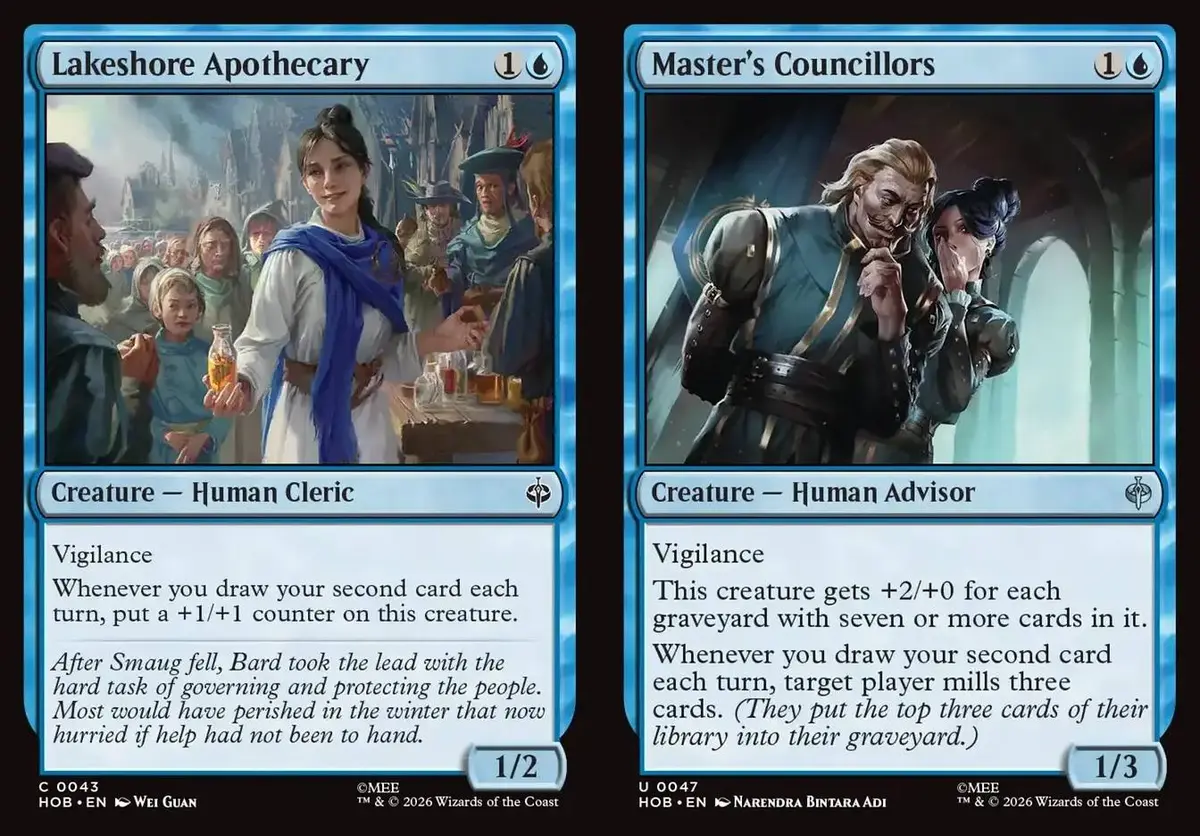
These two cards are the core of the 2-drops. You must play a creature on turn 2, or hold a removal spell in hand, or you pretty much lose in this format.
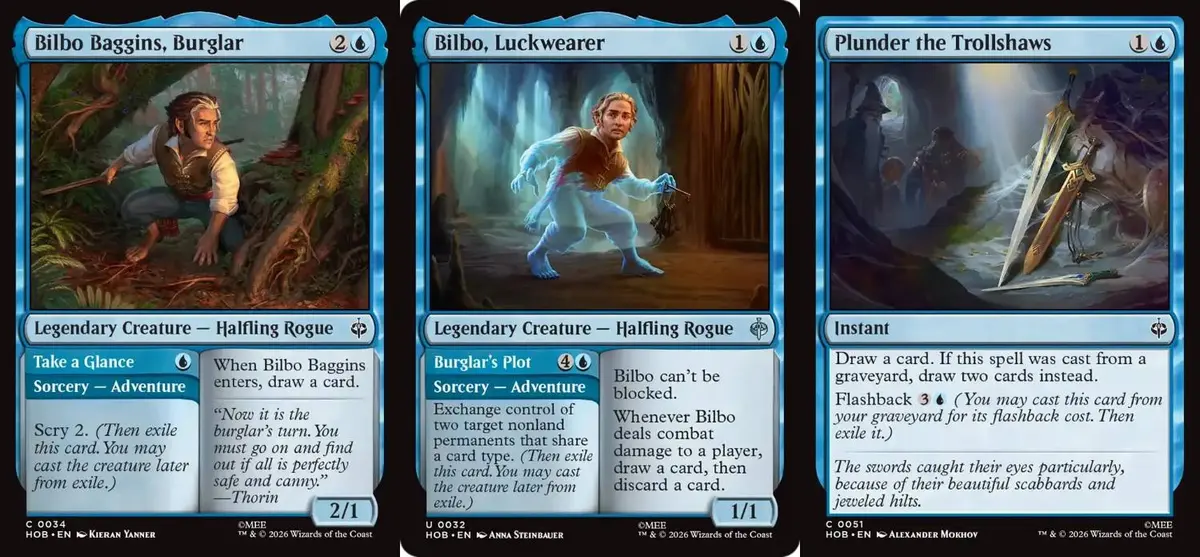
The draw trio: you need creatures plus these draw pieces for the deck to be complete, which is also what makes blue-white hardest to assemble; if two neighbors both play it, you won’t put it together.

While protecting important creatures, note in particular that the second mode prevents all damage dealt by the target creature, so remember to target the opponent’s creature. I’ve seen too many people call it wrong.
Summary: You can play only blue cards and complete the core of the draw-two theme, then mix in any color as support, with blue-white being the most ideal. Blue-green Elves needs a specialized build, and since I haven’t played it I can’t give advice.
Multicolor
Here I only want to comment on gold cards, with one brief conclusion about multicolor cards: don’t play a color pair for the sake of gold cards; build the color pair first and then take the gold cards. Red-white is the exception, though; the Dwarves’ gold cards are all good.

Top-tier common. An army with menace steals a lot of damage, and it’s almost the core of red-black.

A common usable in both black-green and red-black. Giving counters is flexible, and it’s about the strongest 3-mana common, completing the black-green theme and also serving as an aggressive card for red-black.

A card only blue-white will play; you can gauge how many people at the table are playing this color pair by how many of these show up.

The ability is strong, but the cost is too high, and it often doesn’t survive until then.

It wasn’t well regarded at first, but as the format evolved, more and more people play sacrifice strategies, and this card’s play rate and win rate have gradually increased too.

The strongest pairing I’ve seen so far for this card is with Crude Bent Blade, hopping back and forth over and over.
Conclusion
This format is about the mind game of 2-3 mana small creatures and tricks. For creatures costing four or more, try to pick ones with an effect on entering, or with built-in menace or flying; otherwise no matter how good their fundamentals are, they will die, and standing a single big creature back on defense is the worst choice.
Red-black and black-green have the strongest offense, with frighteningly high win rates on the play, while white-blue is one of the few color pairs that can do well on the draw too, and the longer the game drags on the stronger it gets. Red-white and blue-green are more mediocre, and I’d recommend choosing them actively only if you have good bombs.
A few personal thoughts: the strength gap between color pairs is quite large. Red-black’s individual card power crushes the other colors, and although green wants to be about big creatures, they get broken through easily. Tribe-themed play is rigid and easily gets you boxed in during a draft. HOB is a flavorful and very fun format, but in actual play the pace is too fast, and players probably won’t like the feeling of being killed quickly without being able to interact.
- Title
- HOB Draft Thoughts
- Author
- jeffchen
- Created at
- August 21, 2026
- License
- This work is licensed under CC BY-NC-SA 4.0 .