How Does Phasing Work?
Note: This article was translated from Chinese by AI and may contain errors. Read the original Chinese version.
Introduction
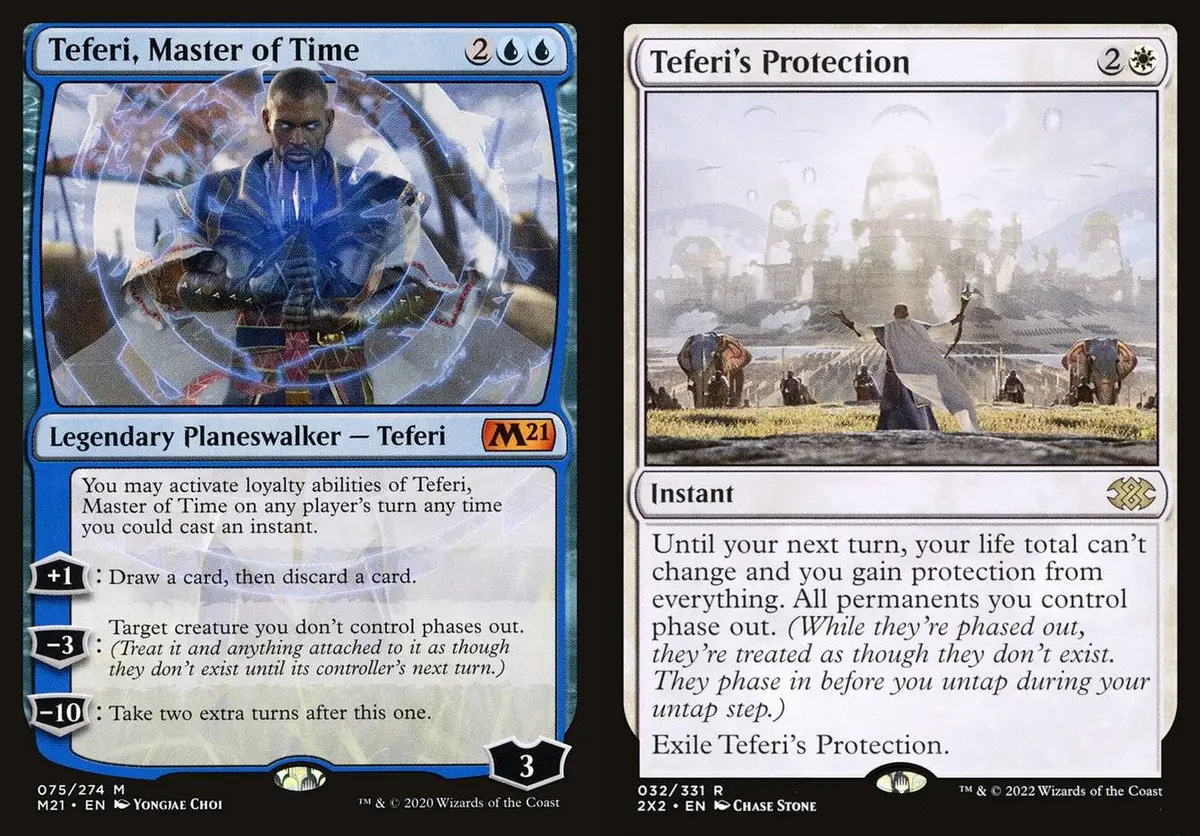
Phases Out is an original-generation mechanic in MTG history, but because its complicated rules easily create confusing situations in games, the official designers once decided to abandon it and use other, more intuitive wording to achieve the effect of temporarily making a permanent disappear from the battlefield. After the Weatherlight set in 1997, phasing fell silent for nearly 20 years. Its next appearance was Teferi’s Protection in Commander 2017, but Commander products are naturally designed with a looser hand, since they don’t affect the official regular competitive formats, and their tolerance for mechanical complexity is relatively high. What truly started a new era for phasing was Teferi, Master of Time, which appeared in Core Set 2021. It meant phasing re-entered the design options for Standard sets, and of course, returning to the public eye along with it was that pile of counterintuitive rules questions. So this time, let’s see what exactly phasing is all about.
What Is Phasing?
Phased out / phased in is a status property of permanents. Normally permanents are all phased in, and when a permanent phases out, it is treated as though it does not exist.
- 110.5. A permanent’s status is its physical state. There are four status categories, each of which has two possible values: tapped/untapped, flipped/unflipped, face up/face down, and phased in/phased out. Each permanent always has exactly one of these values for each of these categories.
- 702.26b If a permanent phases out, its status changes to “phased out.” Rules and effects that specifically mention phased-out permanents aside, the game treats a phased-out permanent as though it does not exist. It doesn’t affect anything else in the game, and nothing affects it. A permanent that phases out is removed from combat.
- 702.26c If a permanent phases in, its status changes to “phased in.” The game once again treats it as though it exists.
Although it is said to be treated as nonexistent, a phased-out permanent hasn’t actually left, so neither phasing out nor phasing in causes zone-change triggered abilities to trigger.
- 702.26d Even though a phased-out permanent is treated as though it’s not on the battlefield or under its controller’s control, phasing events don’t actually cause the permanent to change zones or control. Zone-change triggers don’t trigger when a permanent phases in or out. Tokens continue to exist on the battlefield while phased out. Counters and stickers on a permanent remain while it is phased out. Effects that check the history of a phased-in permanent don’t treat the phasing event as causing it to leave or enter the battlefield or change controllers.
The phasing event mentioned in this rule can simply be understood as a phase-out / phase-in event. Phasing itself will be explained later in this article.
- 702.26e If a continuous effect generated by the resolution of a spell or ability modifies the characteristics or changes the controller of any objects, phased-out permanents won’t be included in the set of affected objects. This includes continuous effects that specifically name the permanent, unless that effect also specifically names the phased-out permanent.
Let’s look at an actual example card with phasing:
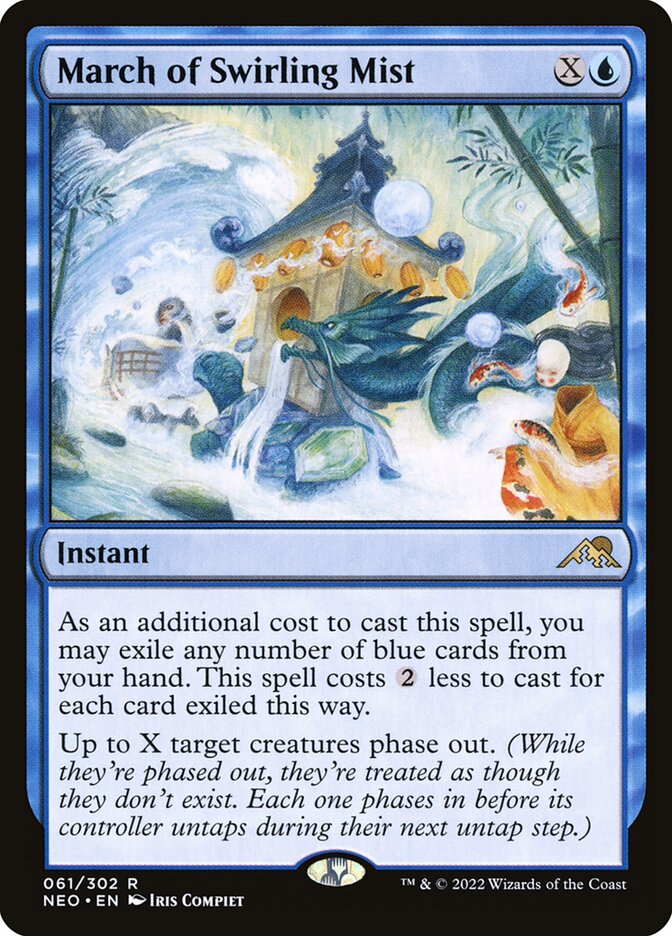
March of Swirling Mist: Up to X target creatures phase out. (They’re treated as though they don’t exist while phased out. Each permanent phases in before its controller untaps during their next untap step.)
March of Swirling Mist will be our model workhorse in the rest of this article. Plain creature phase-out effects will be represented by it (with the card text also simplified to target creature phases out).
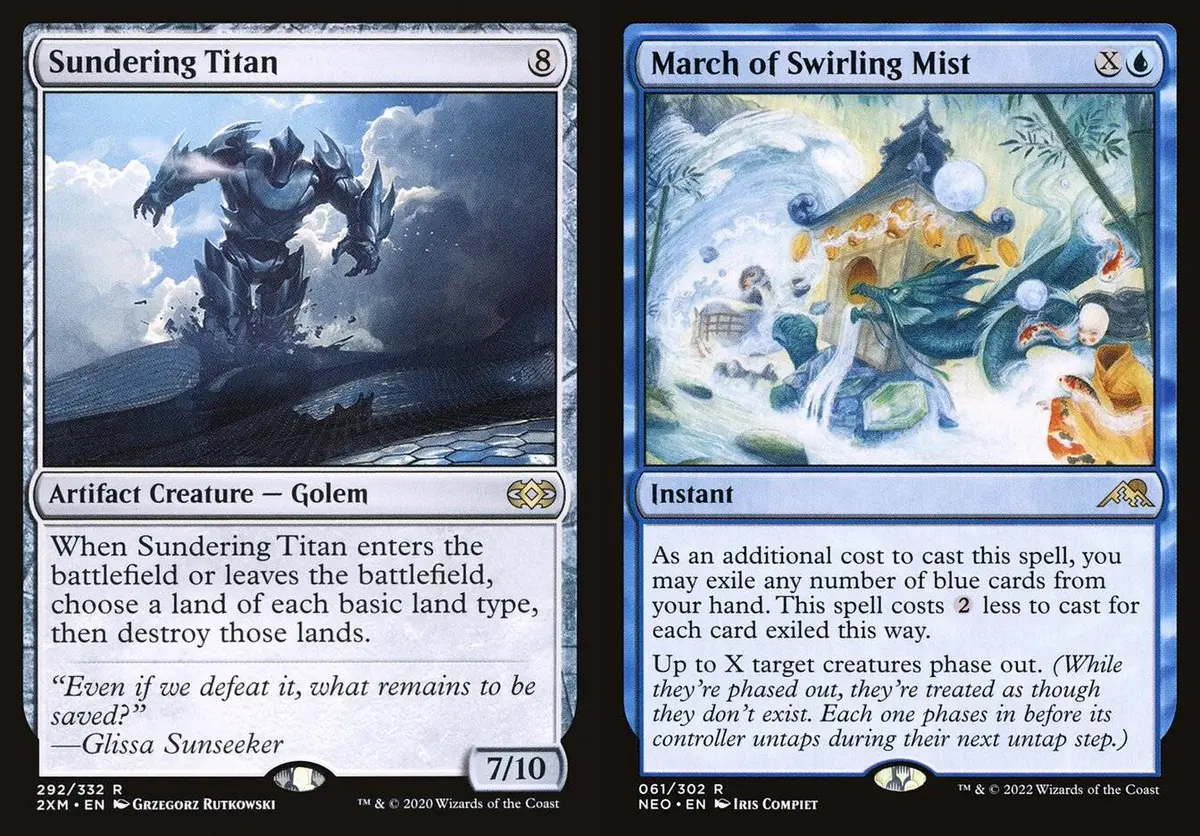
Sundering Titan: When Sundering Titan enters the battlefield or leaves the battlefield, choose a land of each basic land type, then destroy those lands.
March of Swirling Mist: Target creature phases out.
Although Sundering Titan creates triggered abilities when it enters or leaves, phasing doesn’t cause a zone change, so Sundering Titan won’t trigger its own ability when it phases out or in.
By the same reasoning, if you phase out a token, that token can phase in normally and won’t disappear, because it never left.
When Does It Phase In?
Above I mentioned that phased-out permanents can phase in (Phases In), so exactly when do they phase in? The answer is the first action of the untap step. Let’s first look at the exact procedure of the Untap Step:
- 502.1. First, all phased-in permanents with phasing that the active player controls phase out, and all permanents that were phased out while under the active player’s control phase in. This all happens simultaneously. This turn-based action doesn’t use the stack. See rule 702.26, “Phasing.”
- 502.2. Second, if it’s day and the previous turn’s active player didn’t cast any spells during that turn, it becomes night. If it’s night and the previous turn’s active player cast two or more spells during that turn, it becomes day. If it’s neither day nor night, this check doesn’t happen and it’s still neither day nor night. This turn-based action doesn’t use the stack. See rule 728, “Day and Night.”
- 502.3. Third, the active player determines which permanents they control will untap. Then they untap them all simultaneously. This turn-based action doesn’t use the stack. Normally, all of a player’s permanents untap, but effects can keep one or more of a player’s permanents from untapping.
Also, no abilities go on the stack during the untap step and no player gets priority. If the conditions of any triggered ability are met, they wait until just before a player would next receive priority to go on the stack (usually the upkeep step).
For more on the rules of each phase/step in the turn structure, see our earlier article: The Turn Structure Explained
You can see that the highest-priority action in the untap step is to phase in phased-out permanents, followed by day/night changes, and only last untapping permanents. This is also why a phased-out permanent can untap normally when it phases in. If the untap step is skipped for some reason that turn, permanents can’t phase in either, just like you don’t draw a card when your draw step is skipped.
Another key point here is that a permanent that can phase in must have been under the active player’s control when it phased out, regardless of who the permanent’s owner is. Whoever controlled it when it phased out, it phases in during that player’s untap step.
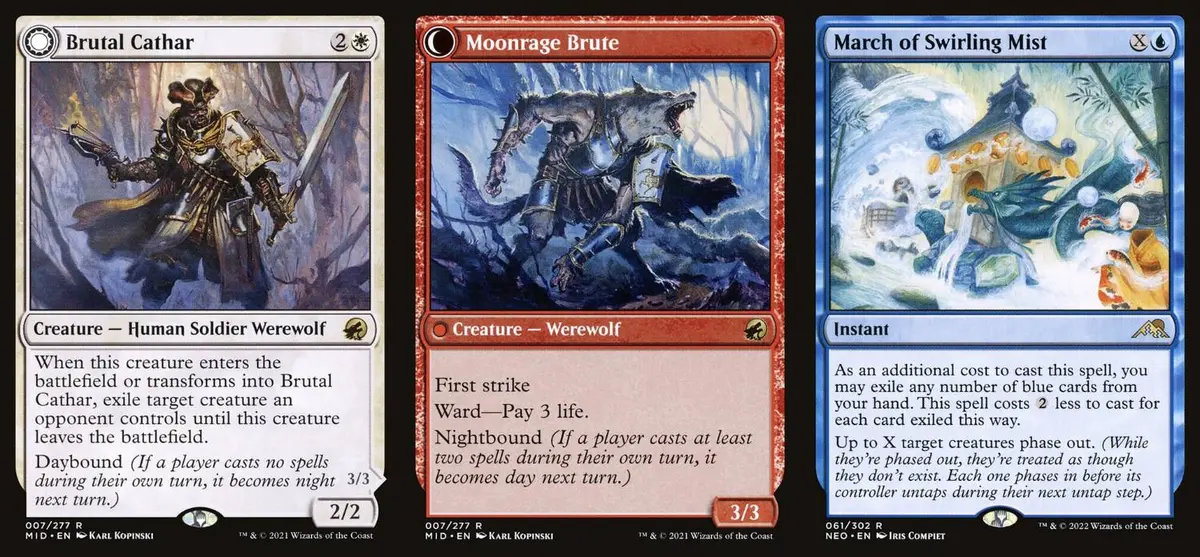
Brutal Cathar: When this creature enters the battlefield or transforms into Brutal Cathar, exile target creature an opponent controls until this creature leaves the battlefield. Daybound.
Moonrage Brute: Nightbound. (The back face of Brutal Cathar)
March of Swirling Mist: Target creature phases out.
Suppose it’s currently the opponent’s turn and it’s night, the next turn is mine, and it has already been determined that it will become day. I have a Moonrage Brute (back face) that was phased out while tapped. When my turn comes, how should this werewolf be handled?
From the turn procedure analysis above, the result is: Moonrage Brute phases in tapped on its back face ⇾ day/night changes, and the werewolf transforms into the front-face Brutal Cathar (the ability for transforming to the front face waits to go on the stack) ⇾ all permanents untap.
Phasing Out and the Phasing Keyword
When quoting the rules earlier, the term phasing appeared many times, so what exactly is it? Phasing is actually a keyword ability, and it could be called the mother of phasing out. Phasing is an application mechanic built on top of phasing out/in. If you look closely at the rule numbers, you’ll find that most of the rules defining phasing out are in fact just subrules under Phasing.
However, Phasing is a very obscure mechanic and probably won’t appear again in the future. Instead, phasing out, as the underlying system, was later played with in all kinds of new applications, so I don’t intend to introduce Phasing much here. Let’s just briefly look at what rules it has.
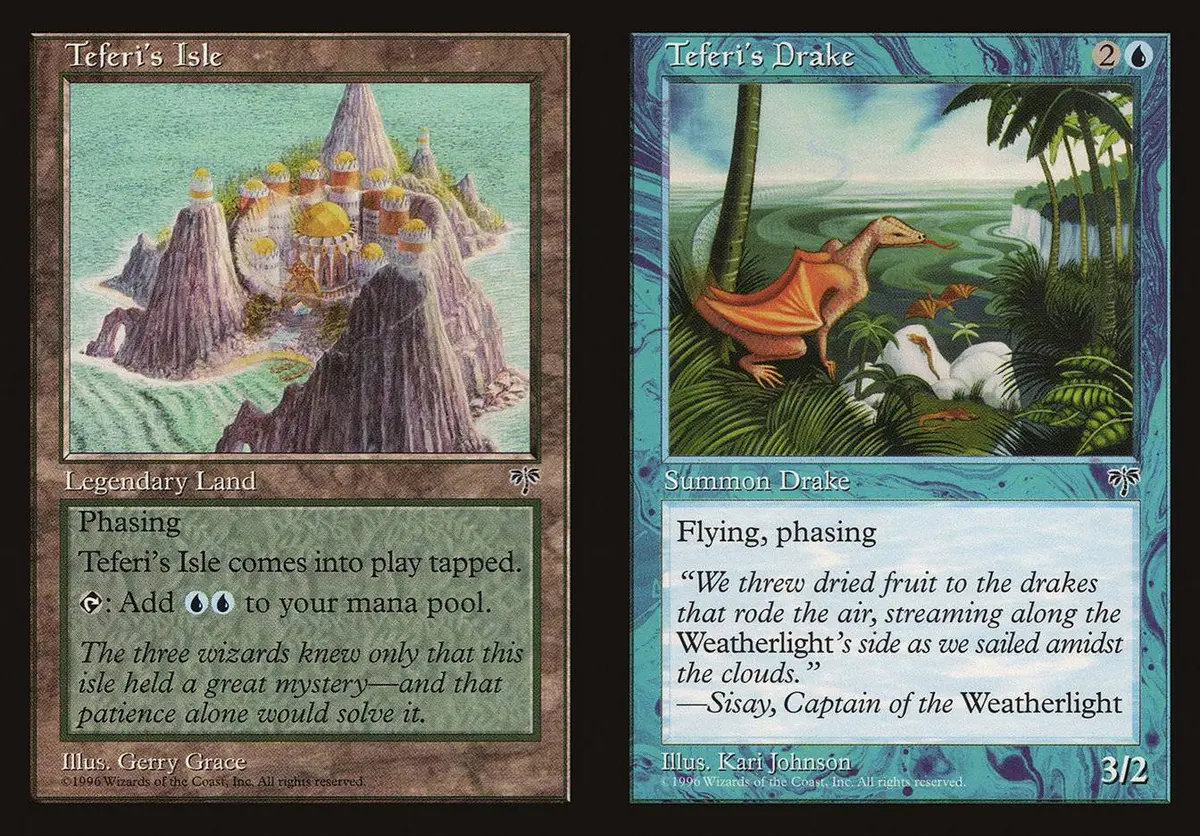
- 702.26a Phasing is a static ability that modifies the rules of the untap step. During each player’s untap step, before the active player untaps their permanents, all phased-in permanents with phasing that player controls “phase out.” Simultaneously, all phased-out permanents that were under that player’s control when they phased out “phase in.”
- 702.26m If an effect causes a player to skip their untap step, no phasing event happens that turn.
- 702.26p Multiple instances of phasing on the same permanent or player are redundant.
Indirect Phasing of Auras and Equipment
Phasing has a famous special case: when a creature with an Aura or Equipment attached to it phases out, those Auras and Equipment phase out along with the creature. This is called phasing out “indirectly,” and the specific rules are as follows:
- 702.26g When a permanent phases out, any Auras, Equipment, and Fortifications attached to it phase out at the same time. This is called phasing out “indirectly.” An Aura, Equipment, or Fortification that phased out indirectly won’t phase in by itself, but instead phases in along with the permanent it’s attached to.
- 702.26h If an object would simultaneously phase out directly and indirectly, it just phases out indirectly.
- 702.26i An Aura, Equipment, or Fortification that phased out directly phases in attached to the object or player it was attached to when it phased out, as long as that object is still in the same zone or that player is still in the game. Otherwise, that Aura, Equipment, or Fortification phases in unattached, and the appropriate state-based actions are performed. (See rules 704.5m and 704.5n.)
- 702.26j Abilities that trigger when a permanent becomes attached or unattached to an object or player don’t trigger when that permanent phases out or in.
PS: Fortification is an extremely obscure subtype and can basically be ignored.
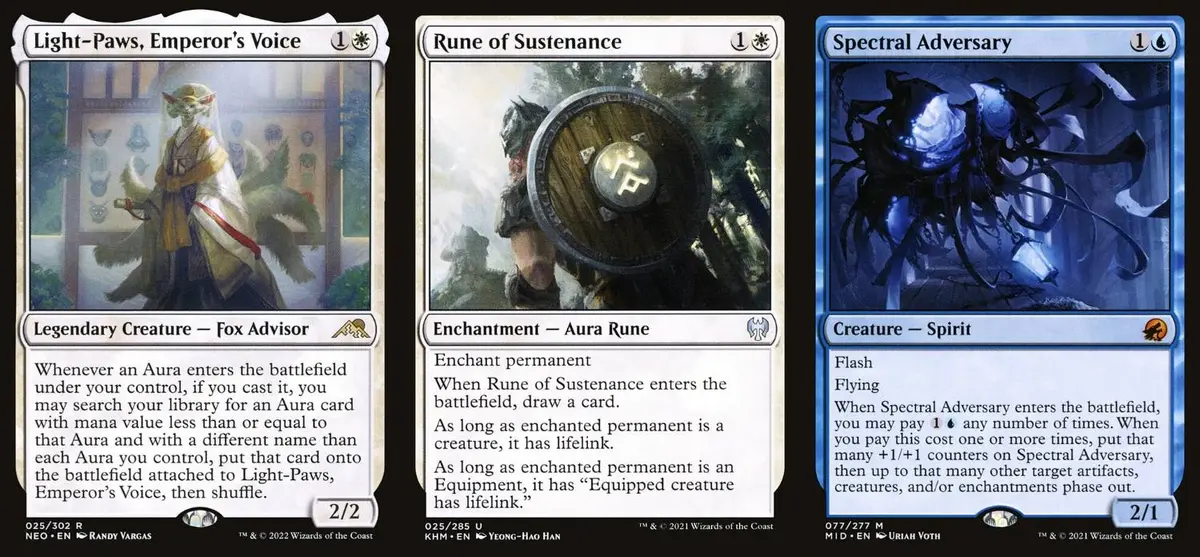
Light-Paws, Emperor’s Voice: A creature enchanted by Auras.
Rune of Sustenance: As long as enchanted permanent is a creature, it has lifelink. (Hereafter, the white rune)
Spectral Adversary: When Spectral Adversary enters the battlefield, you may pay {1}{U} any number of times. When you pay this cost one or more times, put that many +1/+1 counters on Spectral Adversary, then up to that many other target artifacts, creatures, and/or enchantments phase out.
Currently Light-Paws has a white rune attached. If you use Spectral Adversary’s ability to phase out the creature/Aura individually, or both together, the results are as follows:
- Phase out only the white rune:
Light-Paws temporarily loses the lifelink given by the white rune until the white rune phases in. If Light-Paws leaves the battlefield for some reason before the white rune phases in, then when the white rune phases in it will go to the graveyard because it is unattached.
- Phase out only the white rune:
- Phase out only Light-Paws:
The white rune is indirectly phased out along with it, and phases in along with Light-Paws only when Light-Paws phases in.
- Phase out only Light-Paws:
- Phase out both together:
According to rule 702.26h above, the white rune counts as phasing out indirectly, and the handling afterward is the same as case 2.
- Phase out both together:
Phasing and One-Shot Effects
Now let’s get to today’s main event. Without further ado, let’s go straight to the example:
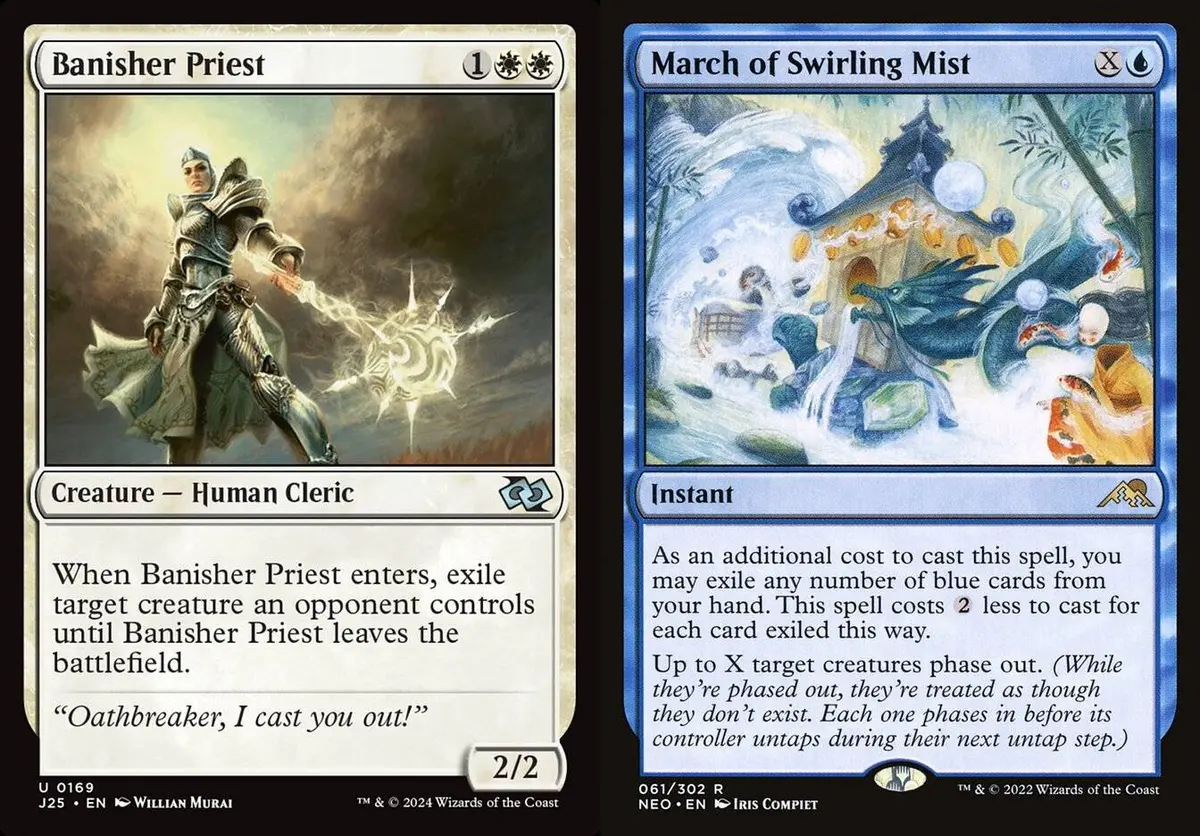
Banisher Priest: When Banisher Priest enters the battlefield, exile target creature an opponent controls until Banisher Priest leaves the battlefield.
March of Swirling Mist: Target creature phases out.
- Banisher Priest’s ETB targets my Grizzly Bears, and in response to the ETB I phase out Banisher Priest first.
- Banisher Priest has already exiled my Grizzly Bears, and then I phase out Banisher Priest.
Can either of these two scenarios prevent Grizzly Bears from being exiled, or successfully rescue it? To answer this question, we first need to analyze how Banisher Priest’s ability works.
- 610.1. A one-shot effect does something just once and doesn’t have a duration. Examples include dealing damage, destroying a permanent, putting a token onto the battlefield, and moving an object from one zone to another.
- 610.3. Some one-shot effects cause an object to change zones “until” a specified event occurs. A second one-shot effect is created immediately after the specified event occurs. The latter effect returns the object to its previous zone.
Banisher Priest’s ability is one of the one-shot effects above. After the ability resolves, it exiles the target creature until Banisher Priest leaves the battlefield. Conversely, as long as Banisher Priest hasn’t left the battlefield, this creature-exiling effect won’t end, and phasing out obviously doesn’t count as leaving the battlefield. So whether it’s scenario 1 or scenario 2, the answer is the same: Grizzly Bears stays exiled.
As a side note, if scenario 1 were changed so that in response to Banisher Priest’s ETB you first remove Banisher Priest with Murder, then when the ETB resolves my Grizzly Bears won’t be exiled, and never leaves at all. This is based on the following rule:
- 610.3b If a triggered ability that’s resolving creates the first one-shot effect described above, which causes an object to change zones, and the specified event has already occurred after that ability triggered but before the one-shot effect would happen, the object doesn’t change zones.
Phasing and Continuous Effects
Now that you understand the one-shot effect example above, let’s look at another scenario that seems to follow the same process but is actually completely different:
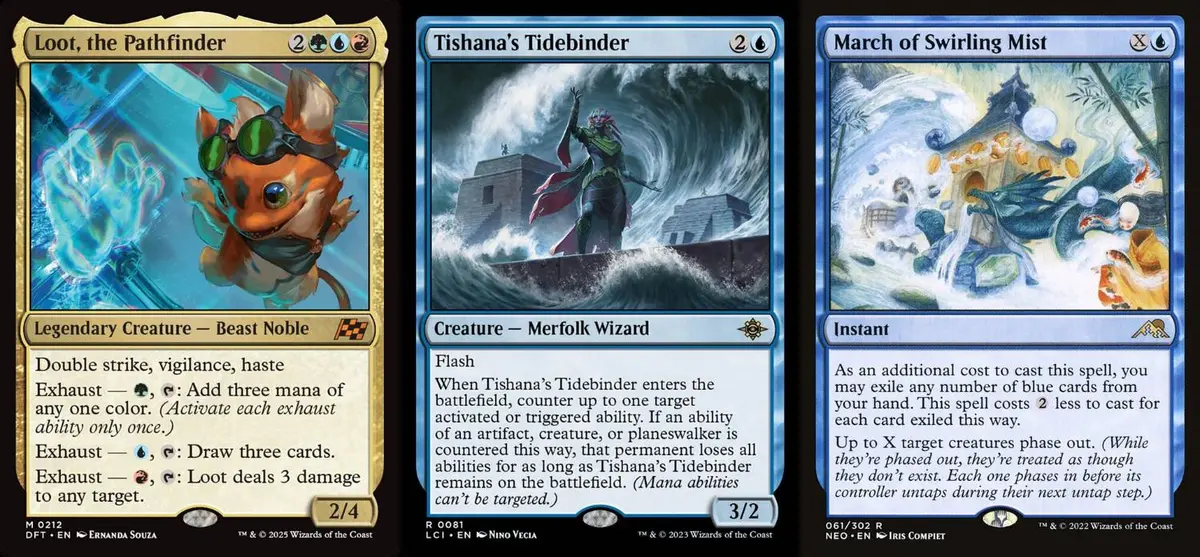
Loot, the Pathfinder: A creature with activated abilities.
Tishana’s Tidebinder: When Tishana’s Tidebinder enters the battlefield, counter up to one target activated or triggered ability. If an ability of an artifact, creature, or planeswalker is countered this way, that permanent loses all abilities for as long as Tishana’s Tidebinder remains on the battlefield. (Hereafter, the Merfolk)
March of Swirling Mist: Target creature phases out.
- Loot has lost all abilities because of the Merfolk, and I phase out Loot.
- Loot has lost all abilities because of the Merfolk, and I phase out the Merfolk.
- Loot’s activated ability is responded to by the Merfolk’s ETB, and before that ETB resolves, I respond by phasing out the Merfolk.
Will any of these three scenarios restore Loot’s abilities? At first glance this looks identical to the Banisher Priest example above, but note that the Merfolk’s wording is a continuous effect, which is different from a one-shot effect.
- 611.1. A continuous effect modifies characteristics of objects, modifies control of objects, or affects players’ abilities to take certain actions or perform certain rules in the game, for a specified duration or indefinitely.
- 611.2b Some continuous effects generated by the resolution of a spell or ability have durations worded using “for as long as.” If the specified duration never begins, the effect does nothing. Similarly, if the effect ended before the moment it would first take effect, and didn’t start again during the resolution of that spell or ability, the effect does nothing. It doesn’t start and immediately end, nor does it last forever.
- 702.26f The duration of a continuous effect that affects a phased-out permanent may expire while that permanent is phased out. If so, the permanent is no longer affected by those continuous effects when it phases in. In particular, an effect with a duration that includes “for as long as” and that tracks the permanent (see rule 611.2b) ends when that permanent phases out, because those effects can no longer see the permanent.
“for as long as” is deliberately kept in its original wording rather than the Chinese translation, because the Chinese translation of this passage isn’t uniform. For example, even for the same “doesn’t untap during its controller’s untap step for as long as you control this creature,” the Chinese texts of Dungeon Geists and Tidebinder Mage are worded differently.
702.26f is the hardest of the phasing rules and also very easy to cause trouble in real play. I personally also feel the rule is not described ideally and is very easy to misread or hard to understand, so let’s break down step by step how to interpret it using this scenario.
There is a permanent (the Merfolk) that has a continuous effect whose duration includes “for as long as” (for as long as Tishana’s Tidebinder remains on the battlefield, that permanent loses all abilities). The object this effect tracks is that permanent (the Merfolk must stay on the battlefield). As long as the Merfolk is on the battlefield, the effect can track its source and keep taking effect (making Loot lose abilities), whereas whether Loot is on the battlefield is not what this effect tracks. At the instant the Merfolk phases out, this continuous effect ends because it can no longer track its source, and even if the Merfolk later phases in, it won’t resume.
Now we can go back and answer the original questions:
- Loot has lost all abilities because of the Merfolk, and I phase out Loot:
After Loot phases in, it still has lost all abilities.
- Loot has lost all abilities because of the Merfolk, and I phase out Loot:
- Loot has lost all abilities because of the Merfolk, and I phase out the Merfolk:
At the instant the Merfolk phases out, Loot’s abilities are restored, and after the Merfolk phases in Loot still has its abilities.
- Loot has lost all abilities because of the Merfolk, and I phase out the Merfolk:
- Loot’s activated ability is responded to by the Merfolk’s ETB, and before that ETB resolves, I respond by phasing out the Merfolk:
Loot doesn’t lose its abilities, and after the Merfolk phases in Loot still has its abilities.
- Loot’s activated ability is responded to by the Merfolk’s ETB, and before that ETB resolves, I respond by phasing out the Merfolk:
PS: Because Loot never left the battlefield, even if it phased out, it remembers which Exhaust abilities it has activated.
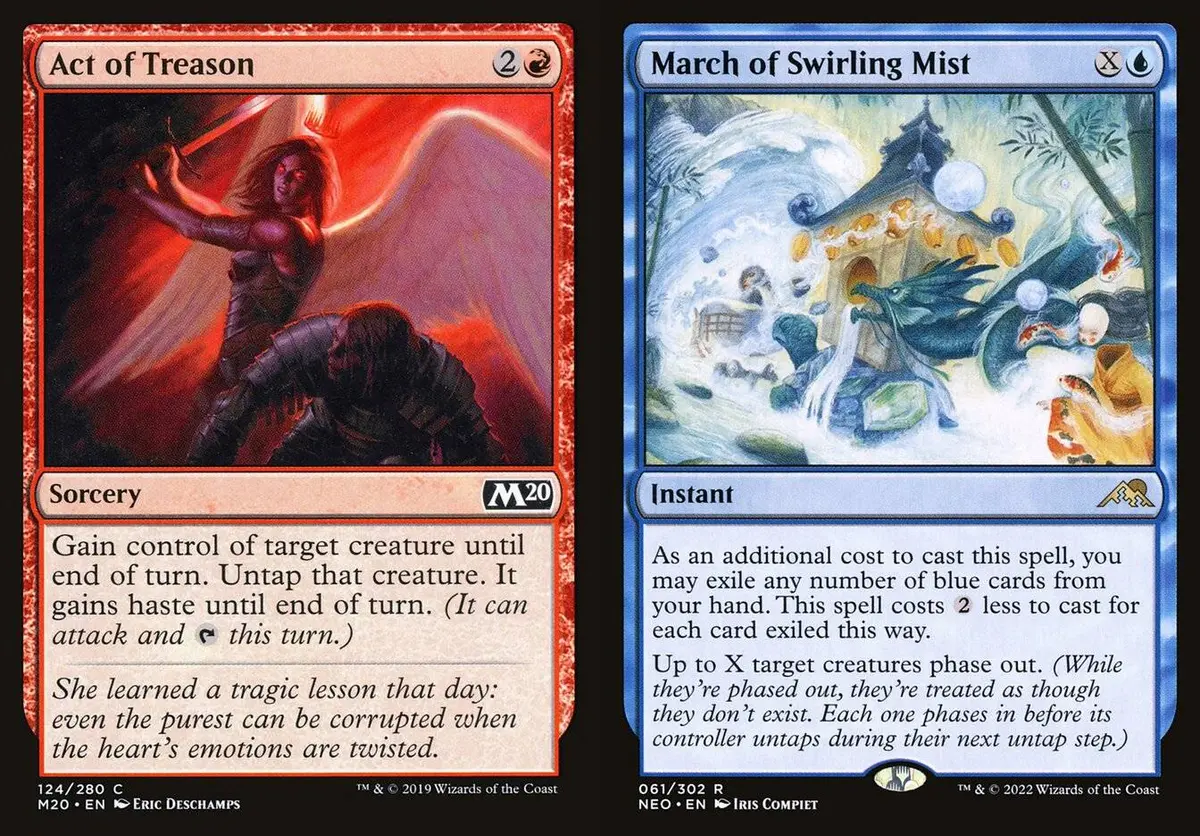
Act of Treason: Gain control of target creature until end of turn. Untap that creature. It gains haste until end of turn.
March of Swirling Mist: Target creature phases out.
Suppose Player A uses Act of Treason to gain control of Player B’s Grizzly Bears and it becomes tapped (perhaps from declaring an attack), then before the end step begins the Grizzly Bears phases out. When, under which player’s control, and tapped or untapped will this Grizzly Bears phase in?
Act of Treason’s change of control is a continuous effect and ends at the end of Player A’s turn, but because the Grizzly Bears is still phased out, it is still not on the battlefield at that point. And the basis for a permanent phasing in is who controlled it when it phased out, not who its owner is. Because the Grizzly Bears phased out under Player A’s control, it won’t phase in when Player B’s turn comes around, and has to wait until Player A’s next untap step to phase in.
- 502.1. (Untap step) First, all phased-in permanents with phasing that the active player controls phase out, and all permanents that were phased out while under the active player’s control phase in.
- 702.26f The duration of a continuous effect that affects a phased-out permanent may expire while that permanent is phased out. If so, the permanent is no longer affected by those continuous effects when it phases in.
When the Grizzly Bears phases in, it will be tapped, because that’s its last record before phasing out. However, by then the continuous effect that changed control has already ended, and control of the Grizzly Bears returns to Player B. At that point we’re only at 502.1 of the untap step, and permanents don’t untap until the game progresses to 502.3 of the untap step.
To summarize: after Player A phases out a tapped Grizzly Bears, it will phase in during Player A’s next untap step, controlled by Player B and still tapped. Without outside interference, it won’t untap until Player B’s own untap step.
Phasing Out Until a Specified Time
If phasing out isn’t specially described, permanents phase in during the untap step, but a few special cases specify that the phased-out permanent can only phase in at a certain specified time:
- 610.4. Some one-shot effects cause a permanent to phase out “until” a specified event occurs. A second one-shot effect is created immediately after the specified event occurs. The latter effect causes the permanent to phase in.
- 610.4a A permanent that phased out this way doesn’t phase in as a result of the turn-based action in a player’s untap step (see rule 502.1). Other effects may still cause it to phase in. If a permanent that phased out this way phases in due to another effect, the second one-shot effect described above won’t happen, even if the permanent phases out again.
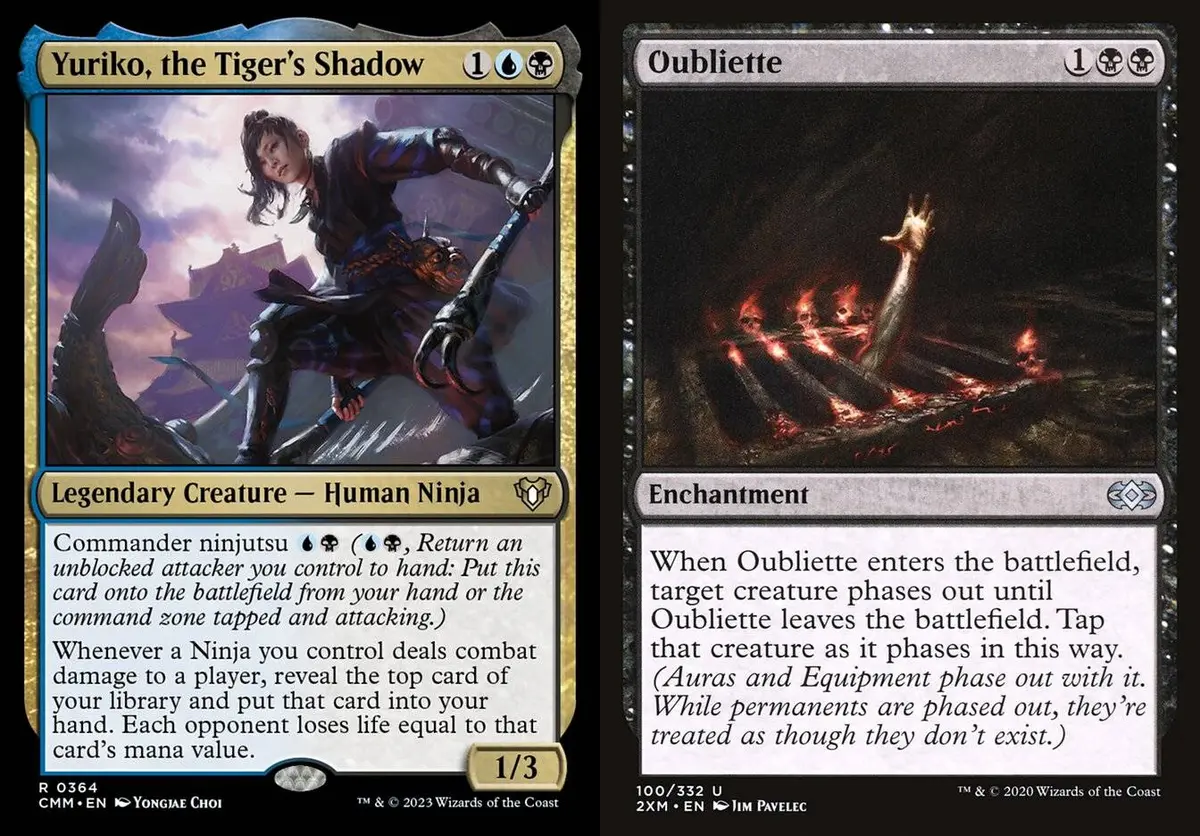
Yuriko, the Tiger’s Shadow: An opponent’s commander.
Oubliette: When Oubliette enters the battlefield, target creature phases out until Oubliette leaves the battlefield. Tap that creature as it phases in this way.
Suppose I use Oubliette to phase out my opponent’s Yuriko, the Tiger’s Shadow. Because phasing out doesn’t cause a zone change, the opponent has no way to return her to the command zone. Worse, Oubliette phases the creature out until Oubliette itself leaves the battlefield, so as long as the opponent can’t remove Oubliette, they have no commander available for the rest of the game.
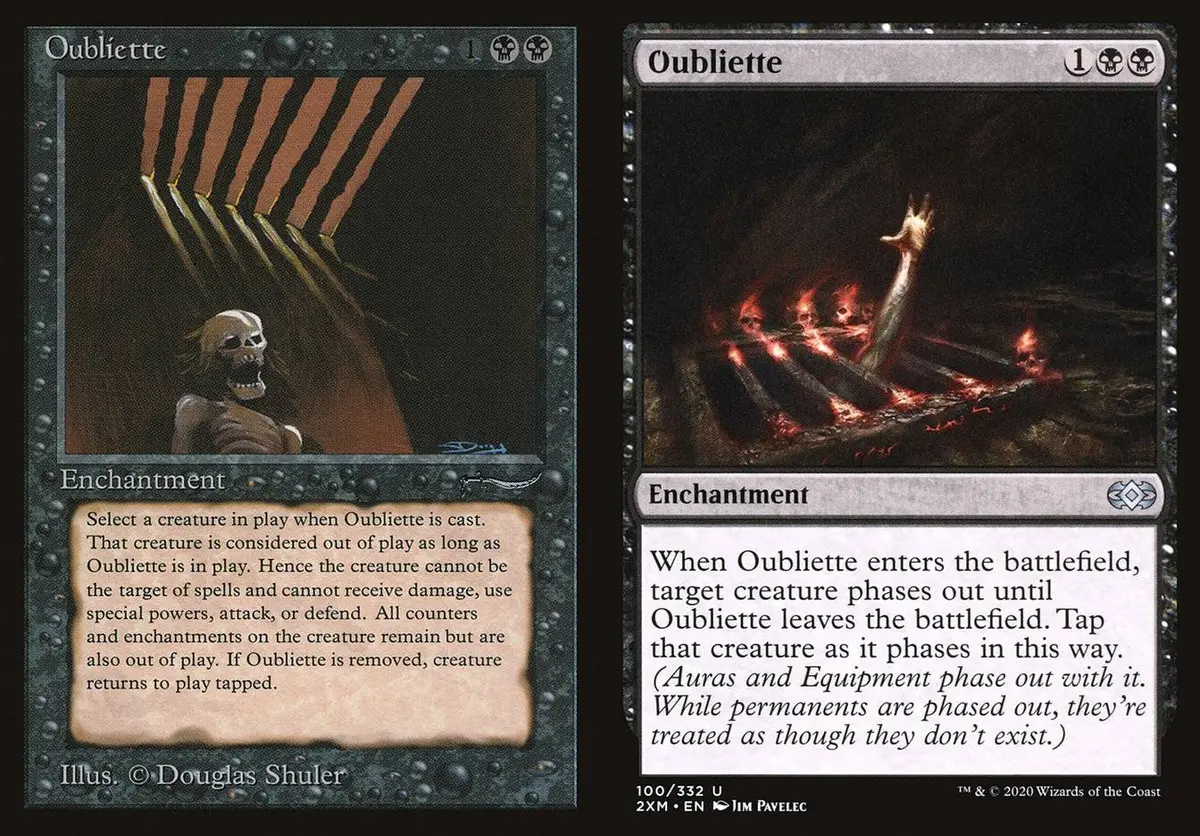
Oubliette trivia
There’s also an interesting history behind Oubliette. This card was born in the Arabian Nights set. In its original design it actually had nothing to do with phasing, which hadn’t been invented yet, so its text was naturally worlds apart from the current version. Only some time after phasing was born did the designers realize that Oubliette’s mode of operation could be equivalent to phasing, so they changed how Oubliette works, which also made it the most ancient phasing card.
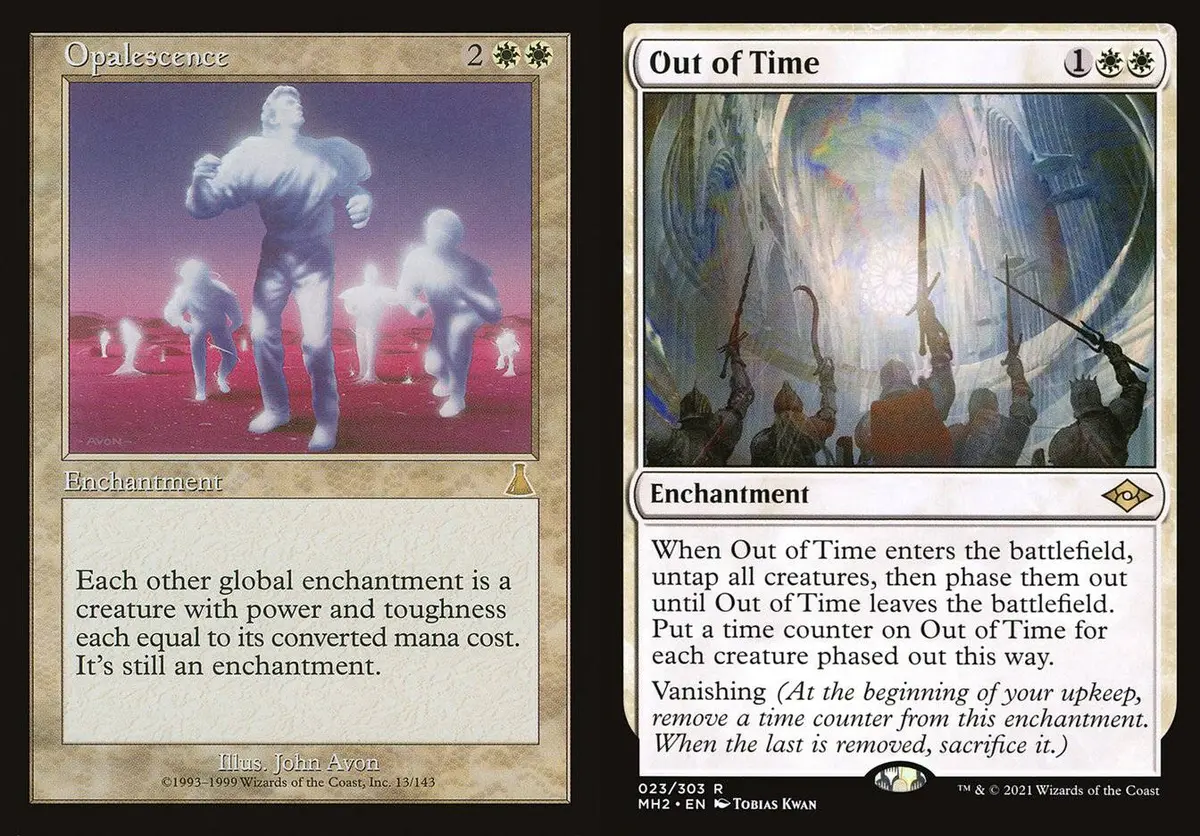
Opalescence: Each other non-Aura enchantment is a creature in addition to its other types and has base power and base toughness each equal to its mana value.
Out of Time: When Out of Time enters the battlefield, untap all creatures, then phase them out until Out of Time leaves the battlefield. Put a time counter on Out of Time for each creature phased out this way.
Vanishing (At the beginning of your upkeep, remove a time counter from this enchantment. When the last is removed, sacrifice it.)
Suppose I have Opalescence on the battlefield and Out of Time enters. Out of Time’s ETB triggers and phases out all creatures, which includes itself, now an enchantment creature. The duration of this phasing is until Out of Time itself leaves the battlefield, but here comes the awkward part… a phased-out Out of Time has no way at all to leave the battlefield, which means this is a sweeper that is harder to recover from than exile.
Some may think of the old card Time and Tide, which can indeed phase phased-out creatures back in. However, Opalescence can only affect enchantments on the battlefield, and once Out of Time has phased out it is no longer affected by Opalescence. It is just an enchantment, not an enchantment creature, so even Time and Tide can’t do anything about it.
Phasing in Multiplayer Games
A brief addendum on the special phasing cases that arise in multiplayer games:
- 702.26k Phased-out permanents owned by a player who leaves the game also leave the game. This doesn’t cause abilities that trigger on zone changes to trigger. See rule 800.4.
- 702.26n In a multiplayer game, once a player leaves the game, the rules of the game may cause phased-out permanents to leave the game or be exiled. (See rules 800.4a and 800.4c.) If a phased-out permanent phased out while under the control of a player who has left the game, that permanent phases in during the next untap step after the start of what would have been that player’s next turn.
When does this 702.26n come into play? Suppose Player A uses Act of Treason on Player B’s Yuriko, the Tiger’s Shadow and then phases it out, but loses the game before Yuriko phases in. Then Yuriko’s phasing-in time shifts to whichever turn would have come after Player A’s turn in the turn order, phasing in when the game goes through an untap step, no matter whose turn it is.
Try It Yourself
Exercise 1
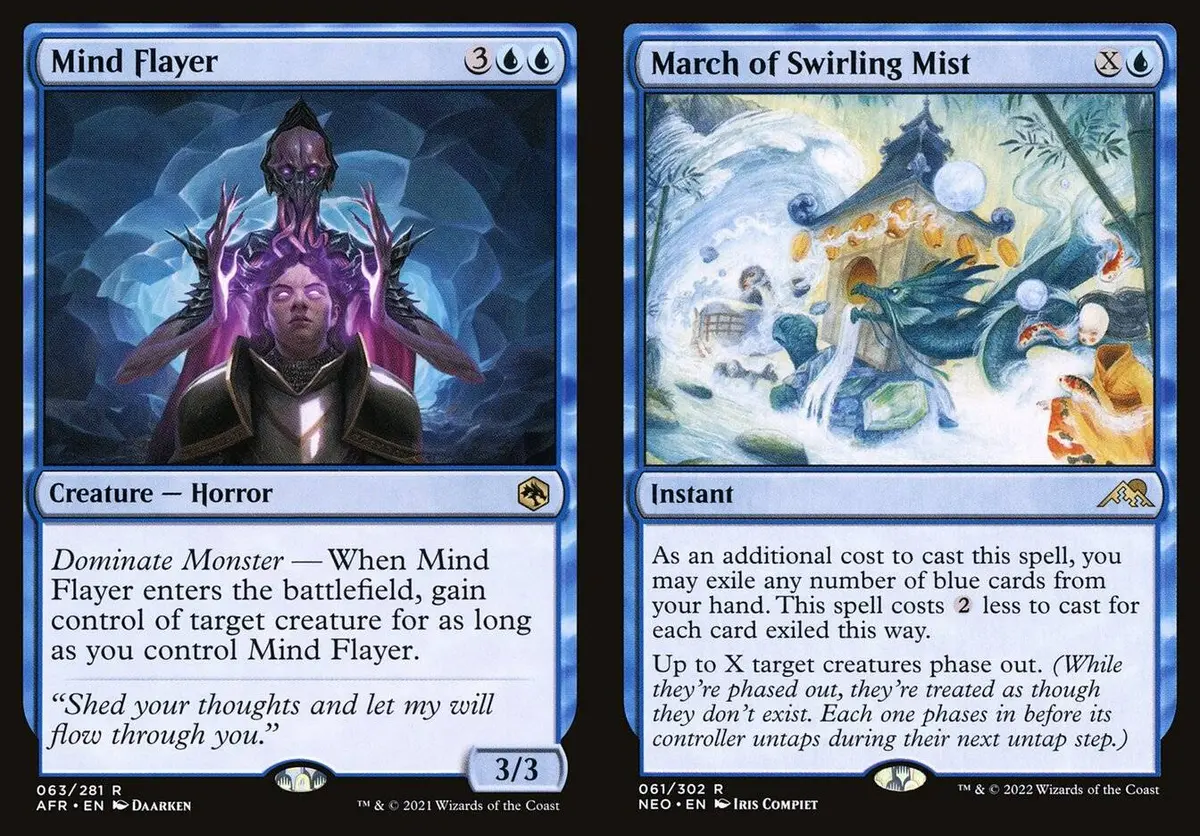
Mind Flayer: When Mind Flayer enters the battlefield, gain control of target creature for as long as you control Mind Flayer.
March of Swirling Mist: Target creature phases out.
Right now Mind Flayer has already stolen a Grizzly Bears:
- Phase out Mind Flayer.
- Phase out the Grizzly Bears.
Exercise 1 answer
- Phase out Mind Flayer:
The Grizzly Bears returns to its owner, and nothing happens when Mind Flayer phases in.
- Phase out Mind Flayer:
- Phase out the Grizzly Bears:
After the Grizzly Bears phases in, it is still under the control of Mind Flayer.
- Phase out the Grizzly Bears:
Exercise 2
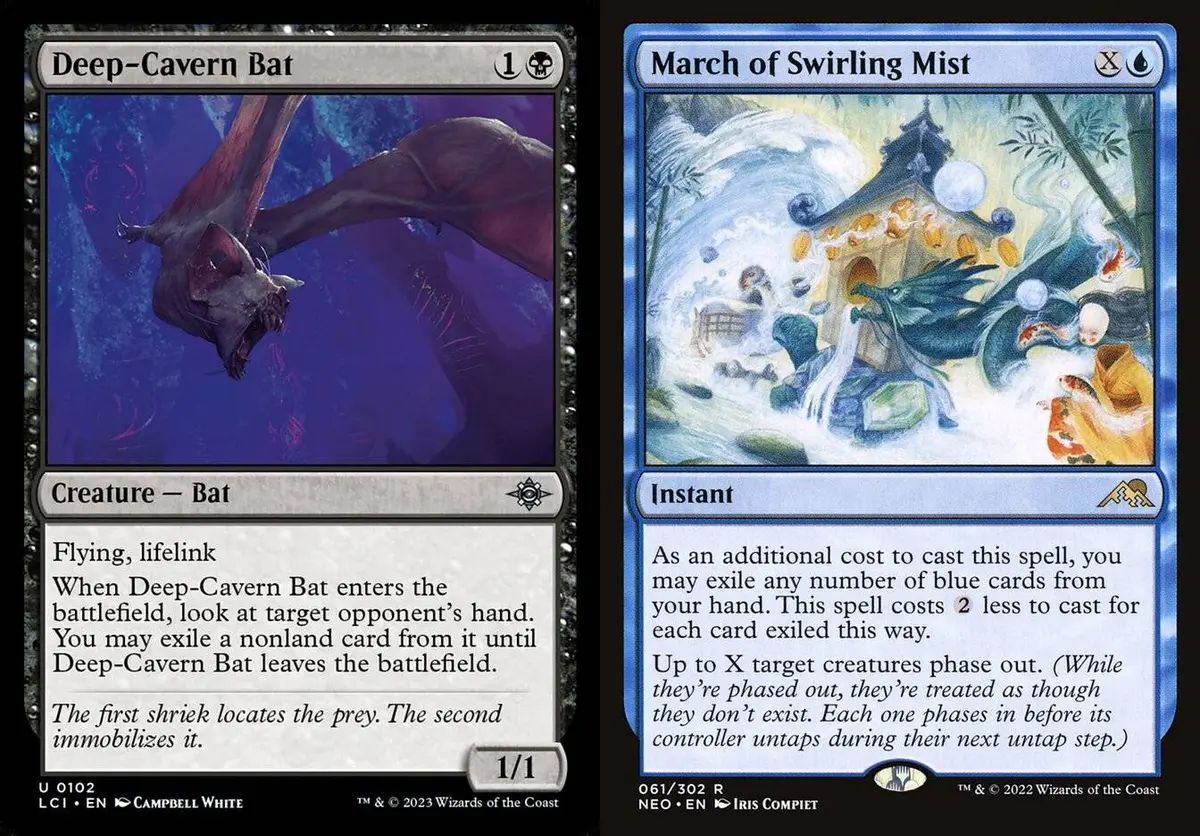
Deep-Cavern Bat: When Deep-Cavern Bat enters the battlefield, look at target opponent’s hand. You may exile a nonland card from it until Deep-Cavern Bat leaves the battlefield.
March of Swirling Mist: Target creature phases out.
- In response to the hand-exiling ETB, phase out Deep-Cavern Bat first.
- Deep-Cavern Bat has already exiled a card from hand, and then I phase it out.
Exercise 2 answer
- In response to the hand-exiling ETB, phase out Deep-Cavern Bat first:
You can still look at the hand and exile a card from it, until Deep-Cavern Bat leaves the battlefield.
- In response to the hand-exiling ETB, phase out Deep-Cavern Bat first:
- Deep-Cavern Bat has already exiled a card from hand, and then I phase it out:
The card is still exiled.
- Deep-Cavern Bat has already exiled a card from hand, and then I phase it out:
Exercise 3
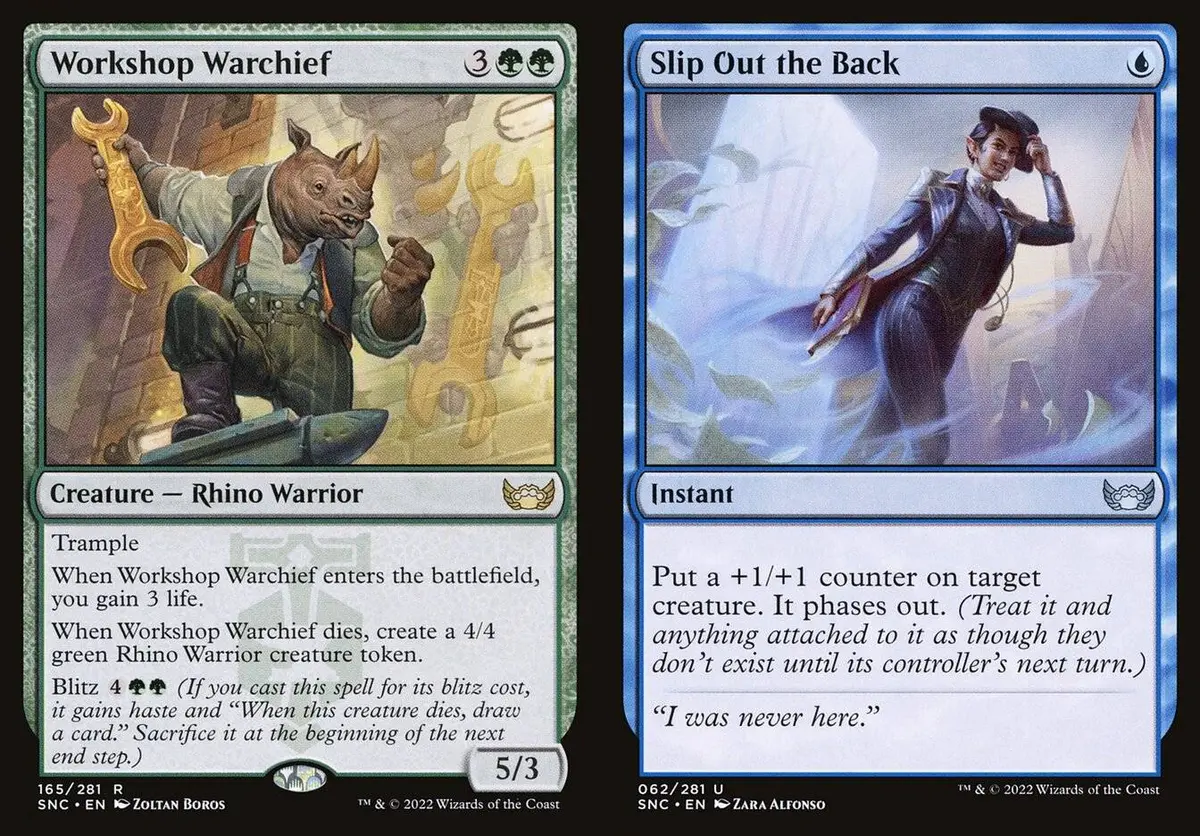
Workshop Warchief: Blitz {4}{G}{G} (If you cast this spell for its blitz cost, it gains haste and “When this creature dies, draw a card.” Sacrifice it at the beginning of the next end step.)
Slip Out the Back: Put a +1/+1 counter on target creature. It phases out.
Suppose I cast Workshop Warchief with blitz and, before the end step, use Slip Out the Back to phase it out. When Workshop Warchief phases in, will it be sacrificed automatically at a later end step? Can I draw a card when it dies?
Exercise 3 answer
A permanent created by casting with its blitz cost comes with a delayed triggered ability “Sacrifice it at the beginning of the next end step”. Note, however, that this triggered ability is not Workshop Warchief’s own ability. Even if you make Workshop Warchief lose all abilities, this sacrifice effect will still trigger. You can think of it as the blitz spell setting a timer for you in the game: once the game reaches the specified moment, this delayed triggered ability triggers, and even if Workshop Warchief has phased out and isn’t on the battlefield at that time, the sacrifice won’t be deferred to trigger again at a later end step. This means you can use phasing to keep your blitzed creature from automatically sacrificing itself.
Furthermore, a permanent cast with blitz additionally gets the ability “When this permanent dies, draw a card”. As long as this permanent has never left the battlefield, it keeps this ability, so when Workshop Warchief phases in, it is still a creature that draws a card when it dies. The blitz ability and Slip Out the Back are cards from the same set, and I believe they caused quite a few judge calls for clarification in Limited at the time.
Conclusion
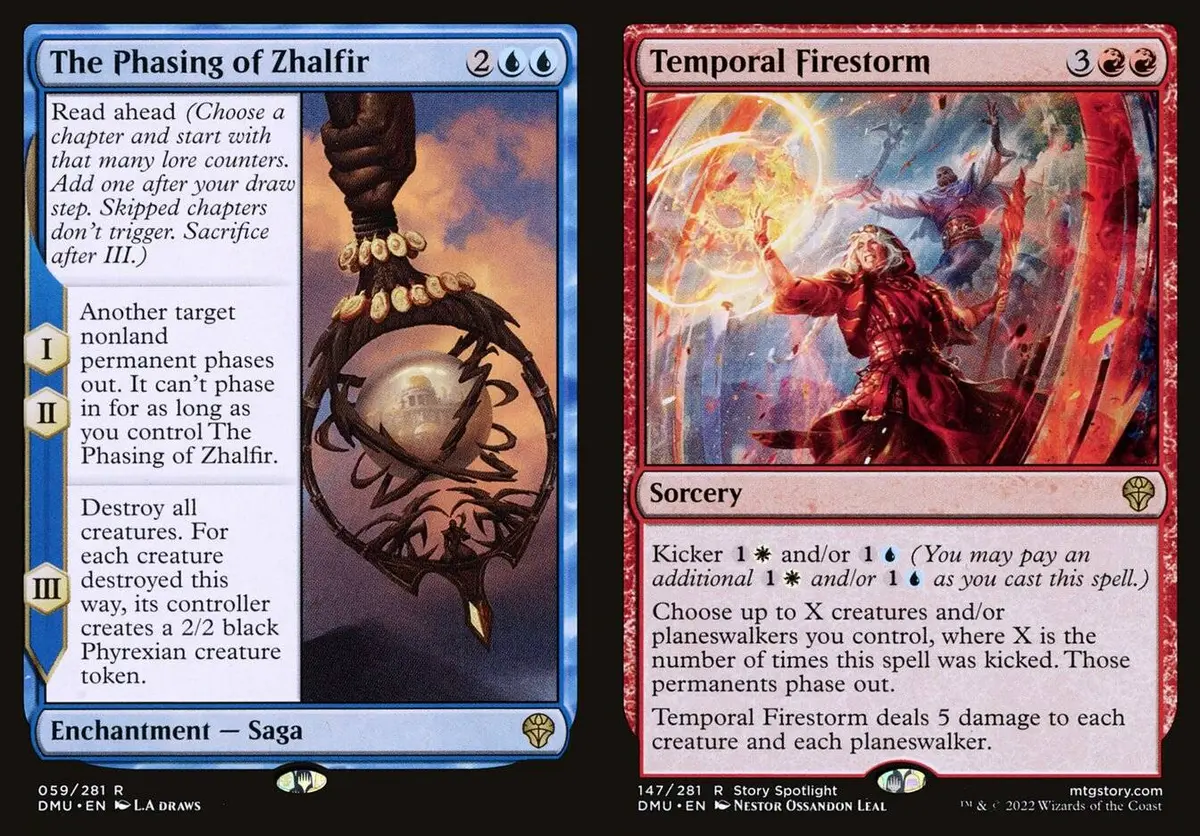
After phasing returned to Standard, during the year and a half from AFR to DMU, Wizards actively used phasing to design all kinds of new cards. Compared with exile-based effects like Cloudshift, phasing can indeed produce somewhat different functional differences, but the various counterintuitive problems it creates have also troubled quite a few people. Perhaps for this reason, after DMU’s The Phasing of Zhalfir & Temporal Firestorm, Wizards hasn’t designed new phasing cards for Standard for the time being (though The Lord of the Rings set did still have a King of the Oathbreakers).
But just as Zhalfir was phased out by Teferi for a long time and then suddenly flew back, we can expect that one day phasing will return to Standard again, and it never hurts to understand what phasing is doing in advance.

- Title
- How Does Phasing Work?
- Author
- Jru
- Created at
- February 26, 2025
- License
- This work is licensed under CC BY-NC-SA 4.0 .