How Does Split Second Work?
Note: This article was translated from Chinese by AI and may contain errors. Read the original Chinese version.
Introduction
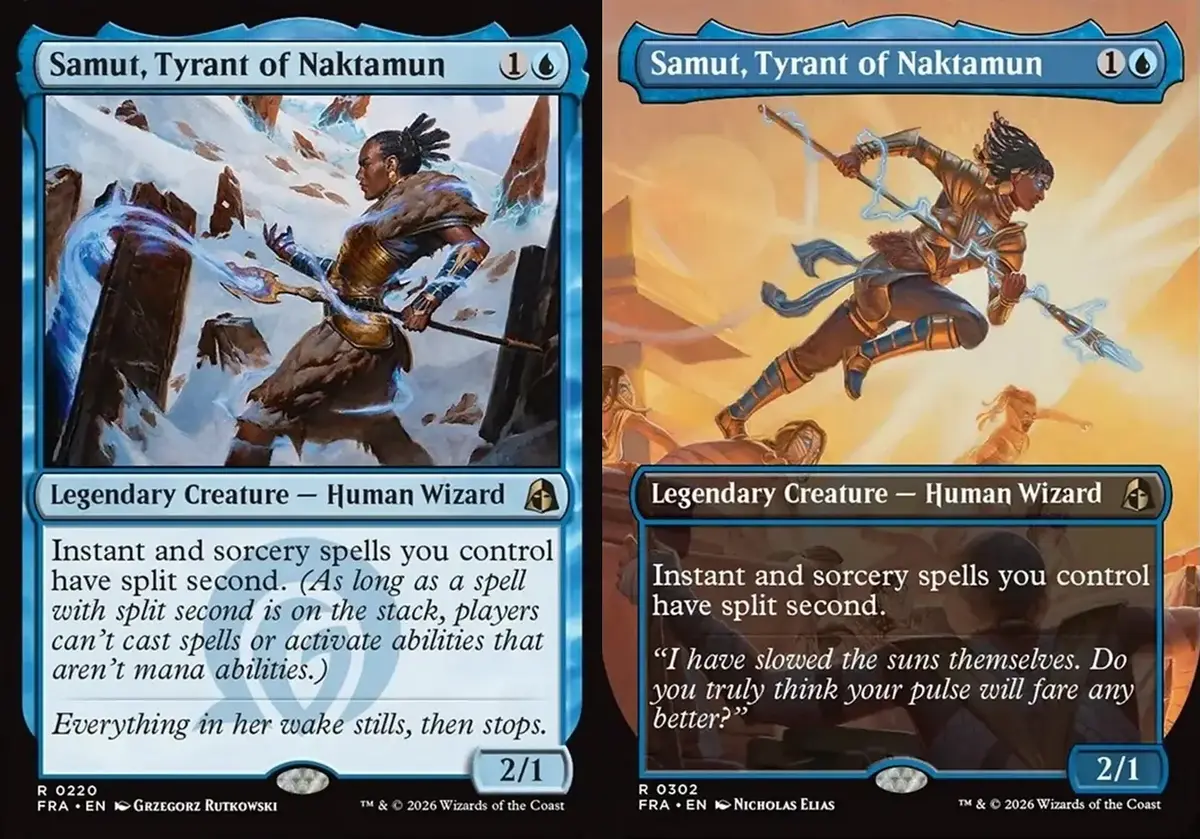
In the Reality Fracture set, a very rule-breaking ancient mechanic, Split Second, has reappeared in Standard along with the new Samut, and it has drawn quite a bit of discussion.
So why is the Split Second mechanic so eye-catching? Let us see exactly what kind of ability Split Second is.
The Definition of Split Second
The rules definition of Split Second reads as follows:
- 702.61a Split second is a static ability that functions only while the spell with split second is on the stack. “Split second” means “As long as this spell is on the stack, players can’t cast other spells or activate abilities that aren’t mana abilities.”
- 702.61b Players can still activate mana abilities and take special actions while a spell with split second is on the stack. Triggered abilities still trigger and are put on the stack as normal while a spell with split second is on the stack.
- 702.61c Multiple instances of split second on the same spell are redundant.
Simply put, while a split second spell is on the stack, players are in a state of “almost” being unable to respond, which makes split second spells extremely hard to interact with, and this is the source of the mechanic’s controversy.
But since we stressed “almost” rather than “completely,” that means there are still some tricks that can get around the split second lockdown and respond to it.
How to Respond to Split Second
First, one point needs to be made clear: although in everyday play you may hear someone say “a split second spell resolves as soon as it is cast,” this is incorrect. The actual principle of split second is that by forbidding you from casting spells and activating abilities that are not mana abilities, it leaves you able to do little more than pass priority and watch it resolve. But there is still a window to respond; as long as your action is not within the range that split second forbids, split second cannot stop you.
As for what split second cannot block, as stated in 702.61b, there are these three kinds:
- Activating mana abilities
- Special actions
- Triggered abilities can trigger and resolve normally
So specifically, how do you use these rules to counter split second? Let us look at some concrete examples:
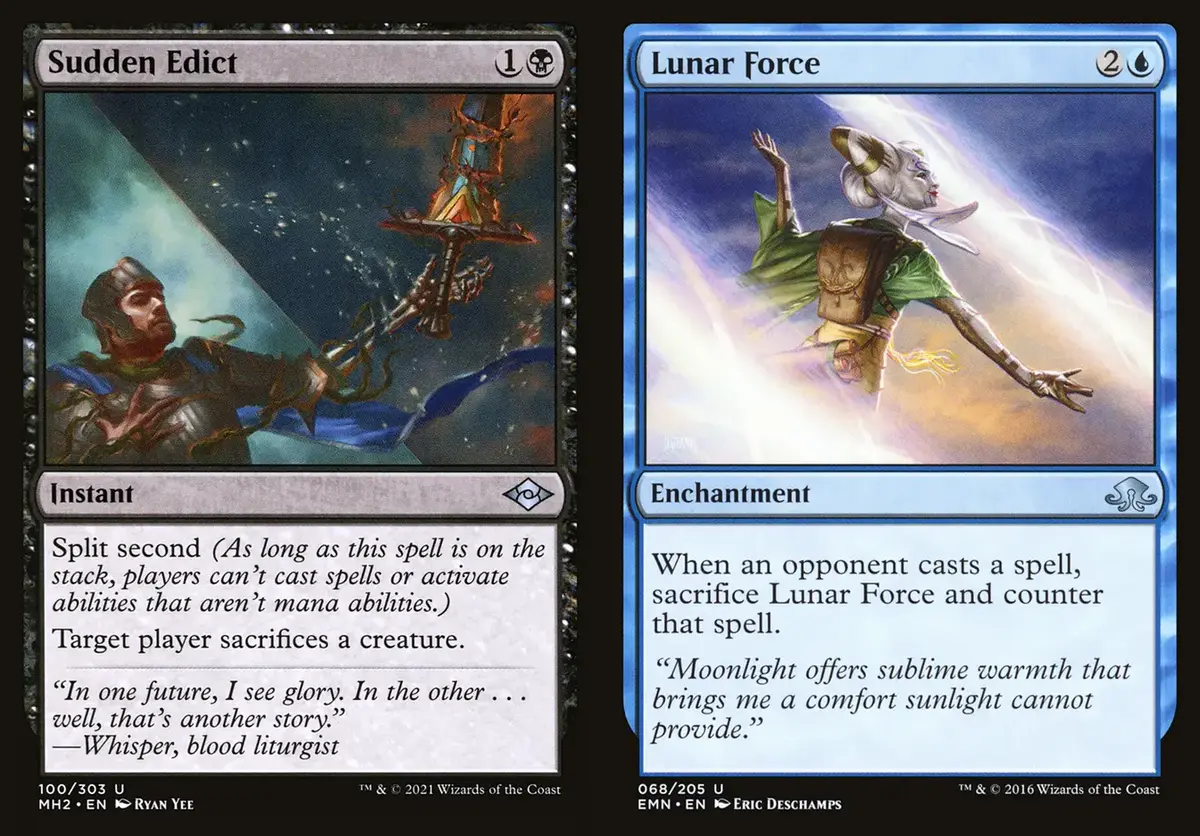
● Sudden Edict:
Split second (As long as this spell is on the stack, players can’t cast spells or activate abilities that aren’t mana abilities.)
Target player sacrifices a creature.
● Lunar Force:
When an opponent casts a spell, sacrifice Lunar Force and counter that spell.
Split second does not stop triggered abilities from triggering, nor does it make a spell uncounterable. Suppose your opponent casts Sudden Edict while you have Lunar Force on the battlefield; even though it has split second, Lunar Force still works normally and counters Sudden Edict.
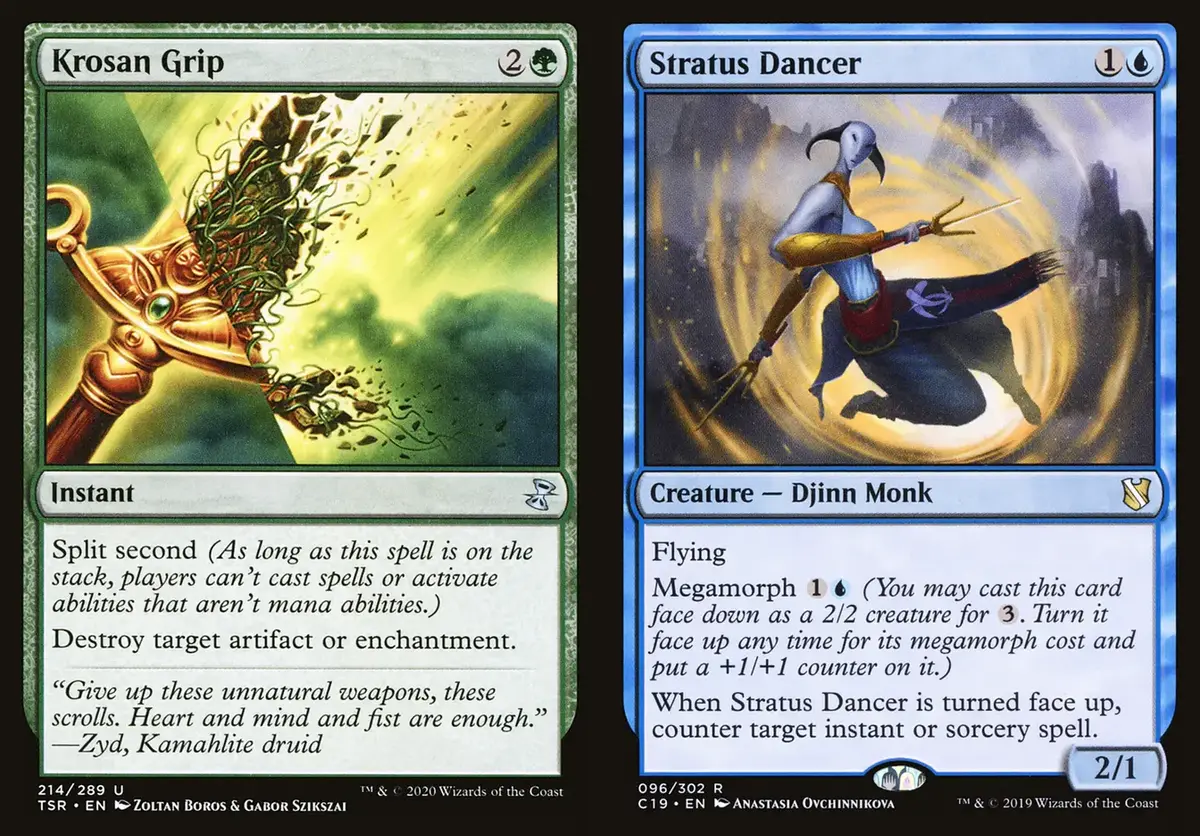
● Krosan Grip:
Split second (As long as this spell is on the stack, players can’t cast spells or activate abilities that aren’t mana abilities.)
Destroy target artifact or enchantment.
● Stratus Dancer:
When Stratus Dancer is turned face up, counter target instant or sorcery spell.
Special actions cover many kinds of behavior; in the context of this topic, the one mainly used is turning a face-down creature face up:
- 116.2b Turning a face-down creature face up is a special action. A player can take this action any time they have priority. See rule 708, “Face-Down Spells and Permanents.”
Since split second does not stop special actions, when your opponent casts Krosan Grip, I can respond by turning a face-down Stratus Dancer face up, and when Stratus Dancer is turned face up it triggers an ability that counters an instant or sorcery spell, which can counter the split second Krosan Grip.
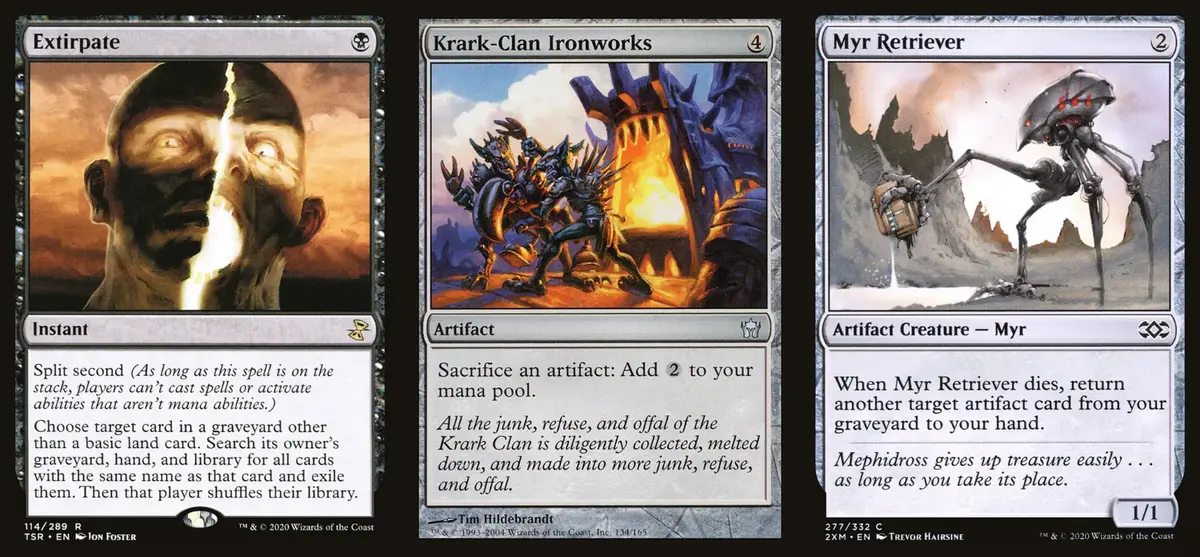
● Extirpate:
Split second (As long as this spell is on the stack, players can’t cast spells or activate abilities that aren’t mana abilities.)
Choose target card in a graveyard other than a basic land card. Search its owner’s graveyard, hand, and library for any number of cards with the same name as that card and exile them. Then that player shuffles their library.
● Krark-Clan Ironworks:
Sacrifice an artifact: Add {C}{C}.
● Myr Retriever:
When Myr Retriever dies, return another target artifact card from your graveyard to your hand.
The scope of split second’s lockdown specifically emphasizes the exception of “abilities that aren’t mana abilities,” which means you can still respond to a split second spell by using a mana ability to produce mana.
Normally, because of split second’s lockdown, you cannot do anything with that mana for the time being, but many mana abilities do not just produce mana; their costs or effects include other actions, and those actions may cause triggered abilities to trigger, which gives some room to maneuver.
For example, your opponent casts Extirpate targeting an artifact card in your graveyard, and you have Ironworks and Myr Retriever on the battlefield. Ironworks’ ability is a mana ability whose activation cost is “Sacrifice an artifact.” You can respond to your opponent’s Extirpate by activating Ironworks’ mana ability, sacrificing Myr Retriever as the cost, which triggers Myr Retriever’s death ability and returns an artifact card from your graveyard, thereby dodging Extirpate.
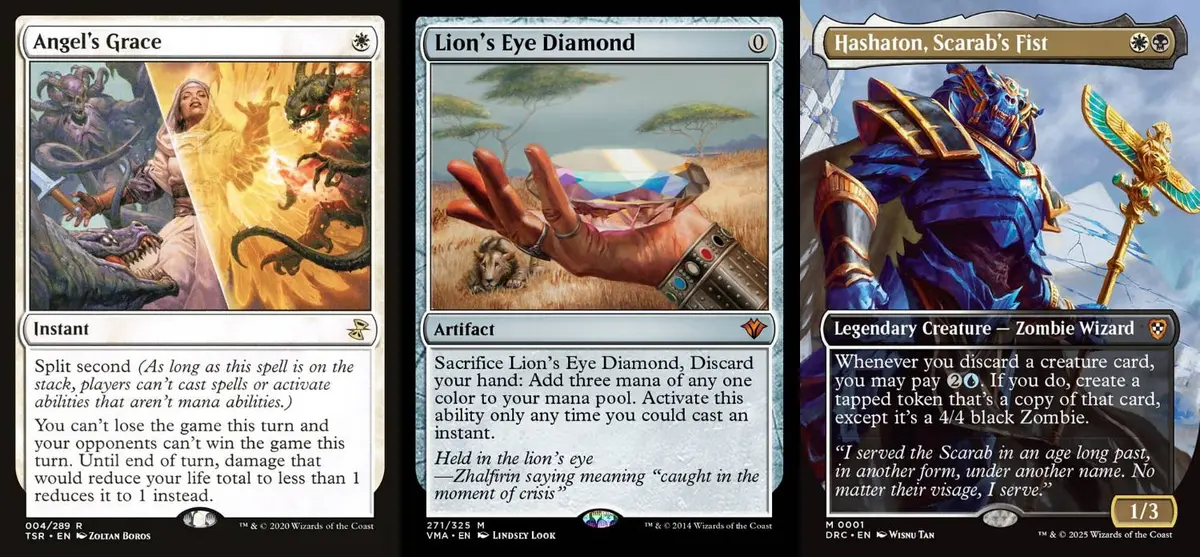
● Angel’s Grace:
Split second (As long as this spell is on the stack, players can’t cast spells or activate abilities that aren’t mana abilities.)
● Lion’s Eye Diamond:
{T}, Discard your hand, Sacrifice Lion’s Eye Diamond: Add three mana of any one color. Activate only as an instant.
● Hashaton, Scarab’s Fist:
Whenever you discard a creature card, you may pay {2}{U}. If you do, create a tapped token that’s a copy of that card, except it’s a 4/4 black Zombie.
This is a way of using the split second rules in reverse, using split second to shield your own combo. First you cast Angel’s Grace (or any split second spell), then you respond to yourself by activating Lion’s Eye Diamond’s mana ability, discarding your hand as a cost. If it contains creature cards, Hashaton’s ability triggers, and after paying the cost you create copies of the discarded creature cards. If you discard multiple creature cards at once, each creature card can be copied once as long as you can pay the cost. Suppose I discard Thassa’s Oracle + Leveler at the same time; then with just their enter-the-battlefield triggers, I can win immediately.
The most crucial point is that from casting Angel’s Grace until Thassa’s Oracle resolves and wins the game, Angel’s Grace stays on the stack waiting to resolve the whole time. This means most of your opponent’s ways to respond are sealed off, and sealed from the moment you announce Angel’s Grace. This shielding ability and suddenness are far harder to deal with than Silence, which only takes effect after it has successfully resolved.
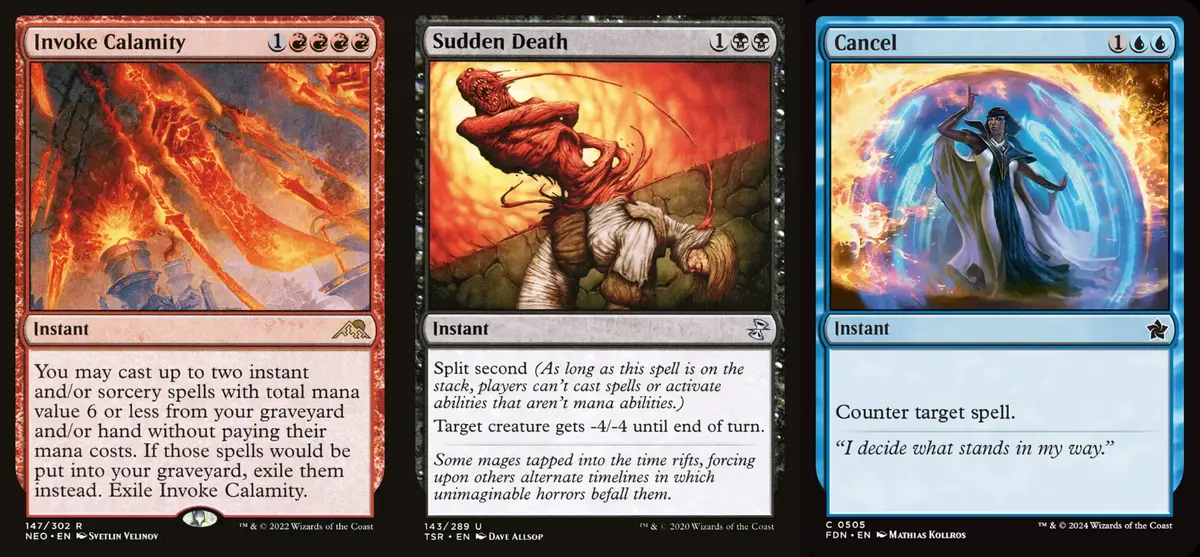
● Invoke Calamity:
You may cast up to two instant and/or sorcery spells with total mana value 6 or less from your graveyard and/or hand without paying their mana costs. If those spells would be put into your graveyard, exile them instead. Exile Invoke Calamity.
● Sudden Death:
Split second (As long as this spell is on the stack, players can’t cast spells or activate abilities that aren’t mana abilities.)
Target creature gets -4/-4 until end of turn.
● Cancel:
Counter target spell.
Suppose my graveyard has both Sudden Death and Cancel. Can I use Invoke Calamity to cast these two instants and do something similar to the previous example, by leaving the split second Sudden Death on the stack so that my opponent cannot respond to my Cancel?
As long as Sudden Death is on the stack, your opponent naturally has a hard time dealing with your Cancel. The problem is that in this case, if you want to cast both cards, Sudden Death cannot be put onto the stack before Cancel.
Although Invoke Calamity’s effect seems at first glance to let you cast two spells at the same time, in the MTG rules there is no true simultaneity in casting spells; there is always an order:
- 608.2f Some spells and abilities include actions to be performed by more than one player and/or on more than one object. In most cases, each such action is processed simultaneously. If the action can’t be processed simultaneously, it’s instead processed considering each affected player or object individually. APNAP order is used as the primary determinant of the order in which to process such actions. Secondarily, if the action is to be performed on both a player and an object they control, or on multiple objects controlled by the same player, the player who controls the resolving spell or ability chooses the relative order in which those actions are performed.
If you choose to cast Cancel first and Sudden Death second, then Sudden Death is on top of the stack, and once Sudden Death resolves, split second’s protection is gone and your opponent can respond to Cancel normally.
What if you do it the other way around and announce Sudden Death first? Once Sudden Death is on the stack first, split second immediately forbids all players from casting spells, which includes the Cancel you were planning to cast for free right after, and in the end your Invoke Calamity has only cast a single Sudden Death. Incidentally, Invoke Calamity’s effect lets you cast up to two spells, so it is perfectly fine to cast just one spell with Invoke Calamity.
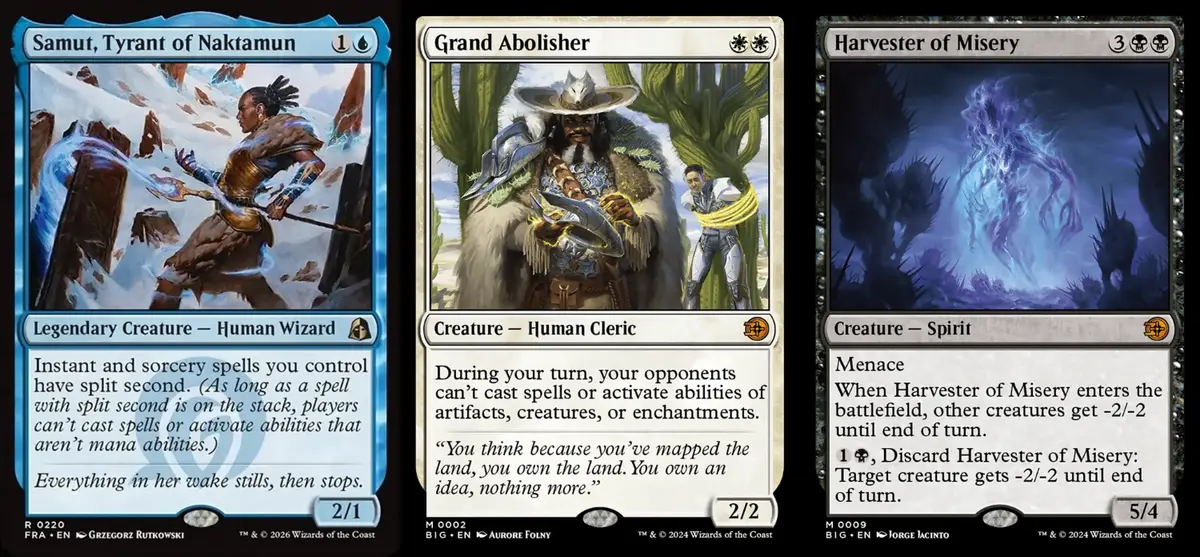
● Samut, Tyrant of Naktamun:
Instant and sorcery spells you control have split second.
● Grand Abolisher:
During your turn, your opponents can’t cast spells or activate abilities of artifacts, creatures, or enchantments.
● Harvester of Misery:
{1}{B}, Discard Harvester of Misery: Target creature gets -2/-2 until end of turn.
Harvester of Misery’s ability, discarding itself to give a target creature -2/-2, is not within Grand Abolisher’s lockdown, so even if your opponent plans to make a play under Grand Abolisher’s cover, you can first use Harvester of Misery to remove Grand Abolisher, and after the seal is lifted, play your other counter-cards.
So can Harvester of Misery use the same principle to deal with a split second spell shielded by Samut?
The answer is that in this situation Harvester of Misery is no different from ordinary instant-speed removal, because once your opponent casts an instant or sorcery spell, split second begins to take effect, and Harvester of Misery’s activated ability is likewise forbidden from being activated.
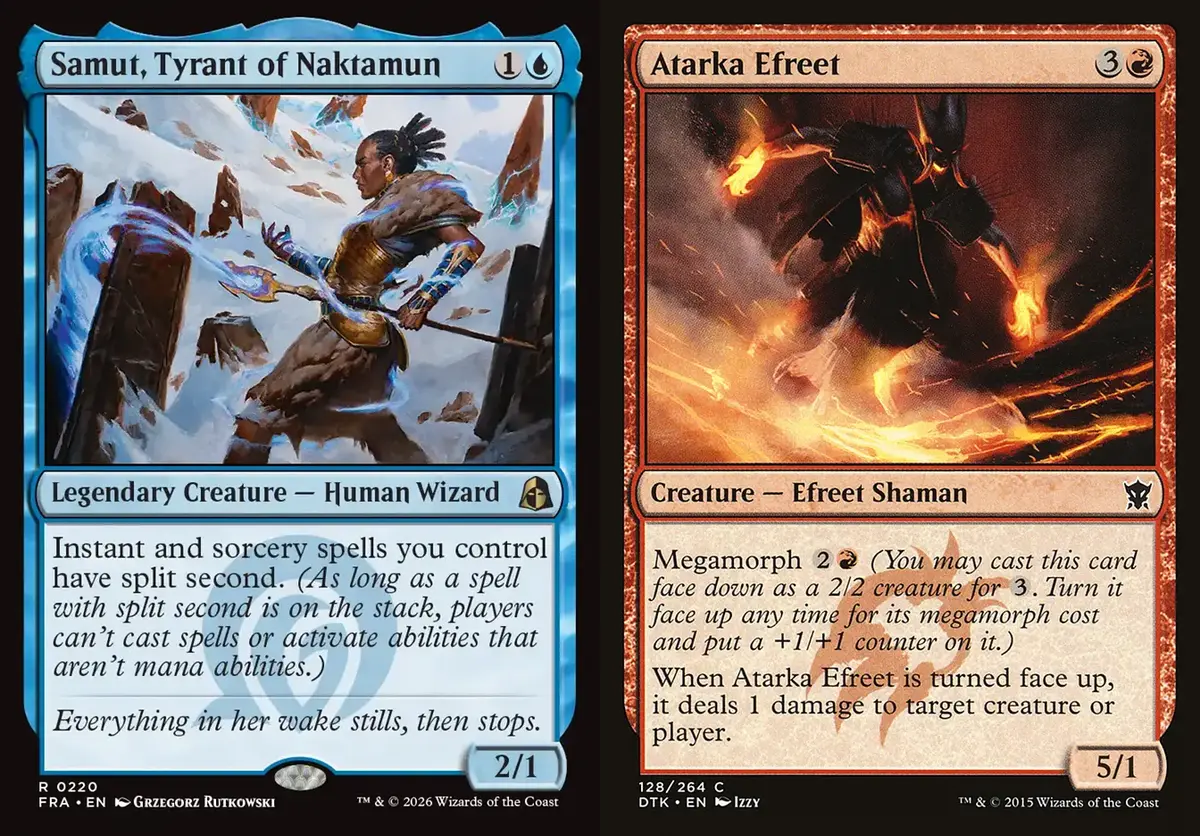
● Samut, Tyrant of Naktamun:
Instant and sorcery spells you control have split second.
● Atarka Efreet:
When Atarka Efreet is turned face up, it deals 1 damage to any target.
Samut must be on the battlefield for the spells on the stack to have split second. Applying the principles from the earlier examples, we can still find some ways to respond.
For example, your opponent casts an instant spell while controlling Samut. You can perform the special action of turning Atarka Efreet face up, and use the triggered ability to kill Samut. Once Samut leaves the battlefield, split second disappears immediately, and afterwards you can respond to your opponent normally by casting Counterspell.
Conclusion
Split second returning to Standard is truly a surprise, but although the new Samut is a big gimmick, I am not too worried it will cause any problems in Standard. After all, in this role there is already a Voice of Victory, and decks that would want to use the new Samut have a fairly high chance of already being in white anyway. Of course the two have different advantage windows, but overall, the trouble it causes is probably at most on par with Voice of Victory, and it does not even come with the stronger offensive and defensive ability that Voice of Victory has.
But put into Legacy, where stack battles are far more intense, being able to serve as fodder for FOW is a considerable plus. Perhaps we can look forward a little to how the new Samut performs in Legacy?

- Title
- How Does Split Second Work?
- Author
- Jru
- Created at
- September 24, 2026
- License
- This work is licensed under CC BY-NC-SA 4.0 .