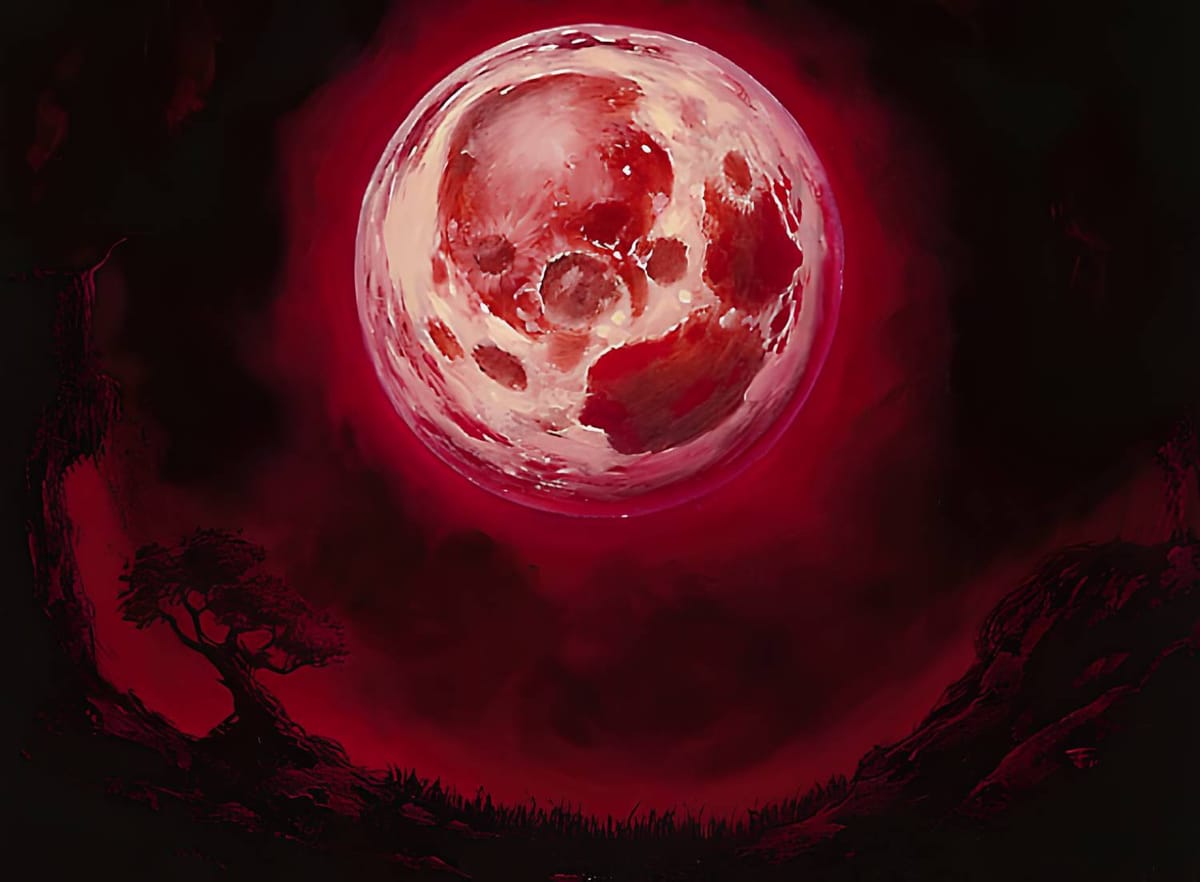
How Blood Moon Went from Urza's Saga's Natural Enemy to Its Teammate
Note: This article was translated from Chinese by AI and may contain errors. Read the original Chinese version.
Introduction
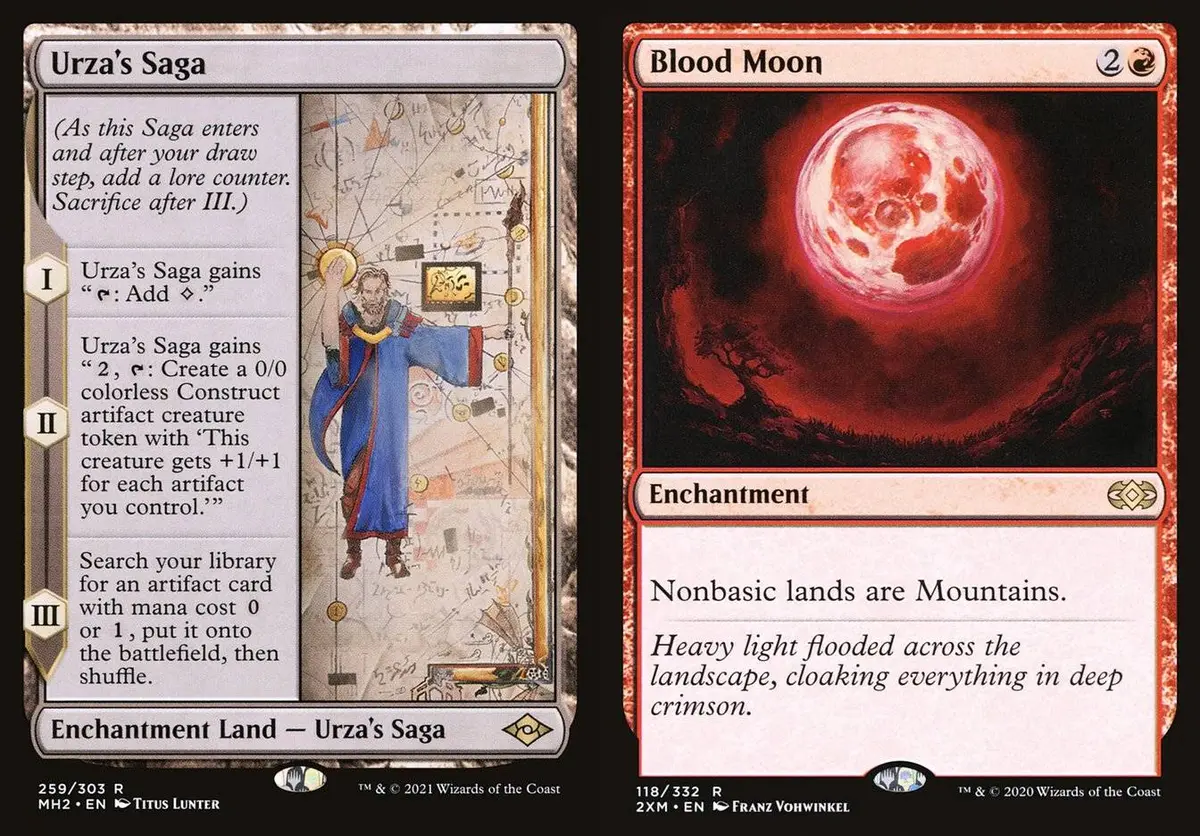
In the past, Blood Moon and other similar effects were famous nemeses of Urza’s Saga: as long as they were on the battlefield, Urza’s Saga would be sacrificed on the spot. We previously wrote an article, “Why Does Urza’s Saga Blow Itself Up”, introducing this phenomenon in a column. (This one could even be called Guildmages’ Forum’s first rules article.)
However, starting with the Final Fantasy (FIN) set, the Saga rules underwent a major change, which overnight turned Blood Moon from the natural enemy of Urza’s Saga into its best teammate. Let us look at exactly which rule was changed to cause such an extreme difference, and what rules interactions appear under the new Saga rules.
Review of the Old Rules
Before explaining the new rules, let us quickly review how Blood Moon affected Urza’s Saga under the old rules. For the full explanation, see our earlier article: Why Does Urza’s Saga Blow Itself Up
- Saga sacrifice condition: the number of lore counters ≥ the final chapter number, and it is not the source of a chapter ability that has triggered but not yet left the stack. This is a state-based action (SBA).
- If a Saga has no chapter abilities, its final chapter number is 0.
- When Blood Moon turns Urza’s Saga into a Mountain, Urza’s Saga loses the abilities it originally had, but does not lose its Enchantment/Saga types.
- Because Urza’s Saga lost its original abilities, it became a Saga with a final chapter number of 0, and since it is not the source of a chapter ability on the stack at that moment, it is sacrificed due to a state-based action (SBA).
What is a state-based action (SBA)? Simply put, it is like a background program of the game that carries out a corresponding result when a specific event occurs. For example, when the game checks that a creature has been dealt lethal damage, that creature dies, and this is handled by SBAs.
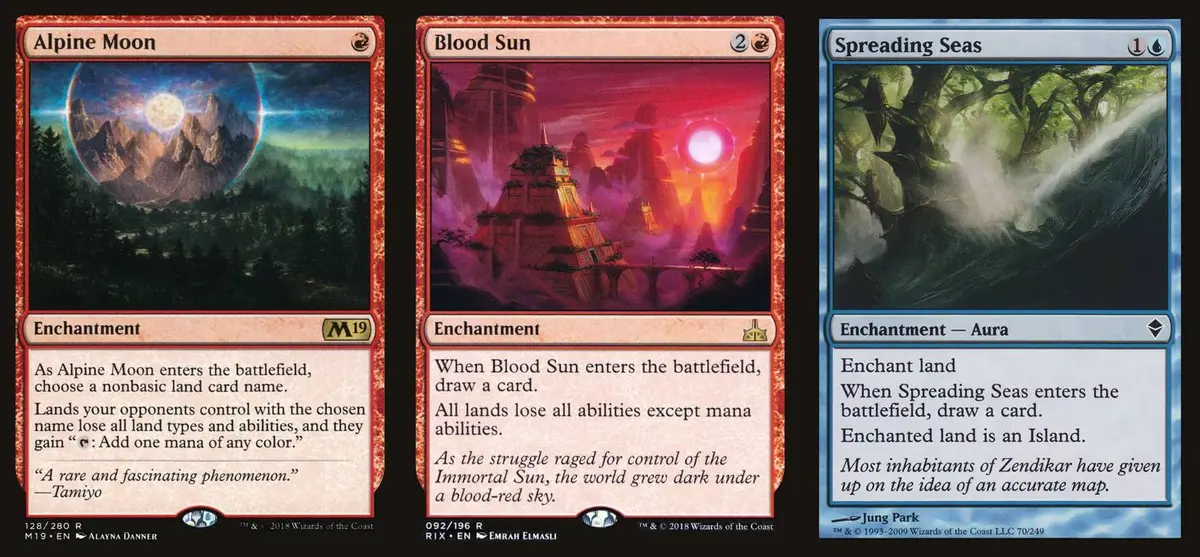
The key to this problem is “making a Saga lose its abilities”. It is normally not easy to make an enchantment lose its abilities, but because Urza’s Saga is also a land, it is easily caught in the crossfire of effects that affect lands. Besides Blood Moon, Alpine Moon, Blood Sun, and Spreading Seas can also make Urza’s Saga blow itself up.
Why Change the Saga Rules?
One of the set’s themed mechanics for FIN is Saga creatures. Being a creature means that the chance of a Saga encountering a lose-abilities situation rises enormously; even looking only at Standard, there is a fair chance of running into Tishana’s Tidebinder, let alone other formats with larger card pools.
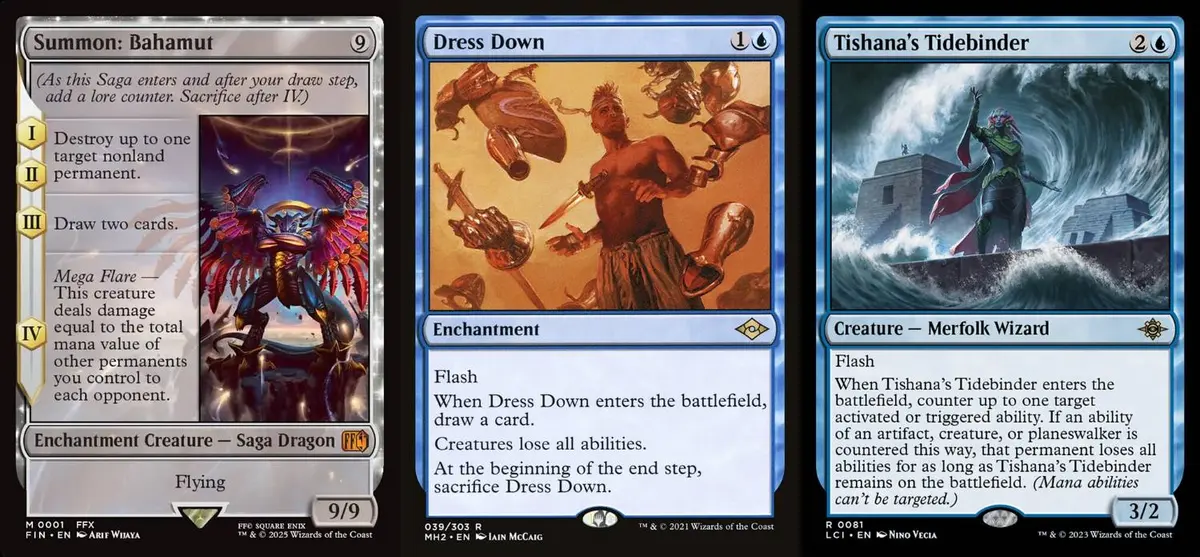
It is already somewhat awkward that the set’s themed mechanic creatures blow themselves up on the spot as soon as they are hit by a lose-abilities effect, but the bigger trouble is the counterintuitive nature of the rule itself.
Even players who play Modern mostly have a certain foundation in understanding the game rules, yet when Urza’s Saga first appeared, the principle behind its interaction with Blood Moon still confused a large number of players (of course, the rules of Blood Moon-type effects are indeed more complicated than ordinary lose-abilities). Now put this rules interaction into a Standard set that will have lots of brand-new players, and the problem is certainly even more serious, so the official side decided to change the rules about a Saga losing its chapter abilities, making this rules problem disappear at its root.
The Current Saga Rules
In fact, this rules change is only a small tweak to the Saga rules. The specific change is as follows:
- If a Saga loses its chapter abilities, it will not be sacrificed due to the state-based action (lore counters ≧ final chapter number), nor will it get lore counters from the turn-based action (at the beginning of the precombat main phase), until it has chapter abilities again.
Under the new rules, when a Saga loses its chapter abilities, it is handled more like an ordinary permanent losing its abilities, and now Sagas no longer blow themselves up from losing abilities. (So why wasn’t it designed this way from the start?)
The Effect of the New Rules on Urza’s Saga
Although this rules change alters the basic rules that Sagas have had since their birth in 2018, from the perspective of real play, the only existing Saga truly affected substantially by this change is actually just Urza’s Saga. However, whether it is Urza’s Saga, or Blood Moon-type effects led by Blood Moon, or even the counter-relationship between the two, they have long been one of the core elements defining the Modern format, so the impact of this rules change cannot be ignored at all.
Let us see what happens under the current rules when Urza’s Saga meets Blood Moon.
● Urza’s Saga:
Chapter I: Urza’s Saga gains “{T}: Add {C}.”
Chapter II: Urza’s Saga gains “{2}, {T}: Create a 0/0 colorless Construct artifact creature token with ‘This creature gets +1/+1 for each artifact you control.’”
● Blood Moon:
Nonbasic lands are Mountains.
First, let us quickly review the rules for effects that turn a land into a certain basic land type:
- 305.7. If an effect sets a land’s subtype to one or more of the basic land types, the land no longer has its old land type. It loses all abilities generated from its rules text, its old land types, and any copiable effects that affect that land, and it gains the mana ability corresponding to the new basic land type. Abilities granted to it by other effects are not removed by this. Changing a land’s subtype doesn’t add or remove any card types (such as creature) or supertypes (such as basic, legendary, and snow) the land may have. If a land gains one or more land types in addition to its own, it keeps its old land types and rules text, and gains the new land types and mana abilities.
Suppose Urza’s Saga has already advanced to Chapter II and has gained the abilities granted by Chapters I and II, and at this point Blood Moon enters and turns Urza’s Saga into a Mountain (losing its original chapter abilities).
We now know that under the new rules, Urza’s Saga will not blow itself up on the spot, but no lore counter will be placed at the start of the main phase either, so is Urza’s Saga now just a Mountain whose only ability is producing red mana?
Here we need to bring back the concept of Layers. Although the effect of Blood Moon involves making an object lose its original abilities, this is not a Layer 6 ability-adding/removing effect, but a special case within the Layer 4 type-changing effects; while the effects of Urza’s Saga’s first two chapters both grant itself an ability, which belongs to the Layer 6 ability-adding/removing effects.
| Layer | Blood Moon | Urza’s Saga |
|---|---|---|
| 4 | Nonbasic lands are Mountains | |
| 6 | Gains the tap-for-colorless-mana ability | |
| 6 | Gains the tap-to-create-a-token ability |
For a complete introduction to Layers, see our earlier article “Layers: How Continuous Effects Interact”.
That is to say, the current Urza’s Saga has the types “Enchantment Land — Mountain / Saga”, has the ability to tap for red/colorless mana, and has the ability to tap to create Construct tokens.
Because it lost its chapter abilities, the time limit of a Saga sacrificing itself after running through its progress bar no longer exists. As long as Urza’s Saga and Blood Moon stay on the battlefield, you can pay each turn to create a new Construct token. Blood Moon no longer counters Urza’s Saga; it even becomes the key to keeping Urza’s Saga alive!
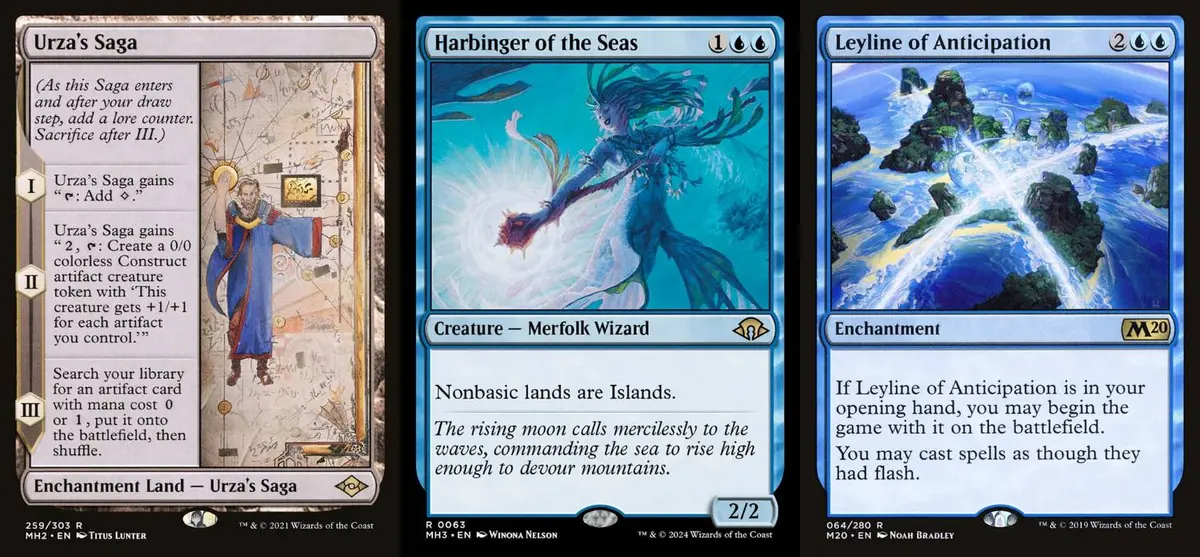
● Urza’s Saga:
Chapter I: Urza’s Saga gains “{T}: Add {C}.”
Chapter II: Urza’s Saga gains “{2}, {T}: Create a 0/0 colorless Construct artifact creature token with ‘This creature gets +1/+1 for each artifact you control.’”
Chapter III: Search your library for an artifact card with mana cost {0} or {1}, put it onto the battlefield, then shuffle.
● Harbinger of the Seas:
Nonbasic lands are Islands. (Called the “blue moon guy” for short)
● Leyline of Anticipation:
You may cast spells as though they had flash.
Let us push the situation to a further extreme and see how to make maximal use of the Saga rules.
Suppose the blue moon guy can enter with flash for some reason (for example, with the help of Leyline of Anticipation). Now Urza’s Saga has advanced to Chapter III, triggered the final chapter’s chapter ability, and it is still on the stack waiting to resolve. Because the condition for the SBA to sacrifice a Saga is “the number of lore counters ≥ the final chapter number, and it is not the source of a chapter ability that has triggered but not yet left the stack”, this Saga will not be sacrificed before the chapter ability resolves. At this point we respond to the ability on the stack by flashing in the blue moon guy. Because the ability is already on the stack, even if Urza’s Saga loses its abilities it does not affect that triggered ability resolving normally, and when it resolves you can still find a qualifying artifact in your library to put onto the battlefield. But from the instant the blue moon guy enters, Urza’s Saga will no longer blow itself up from the SBA, and you can still keep activating the abilities granted by Chapters I and II.
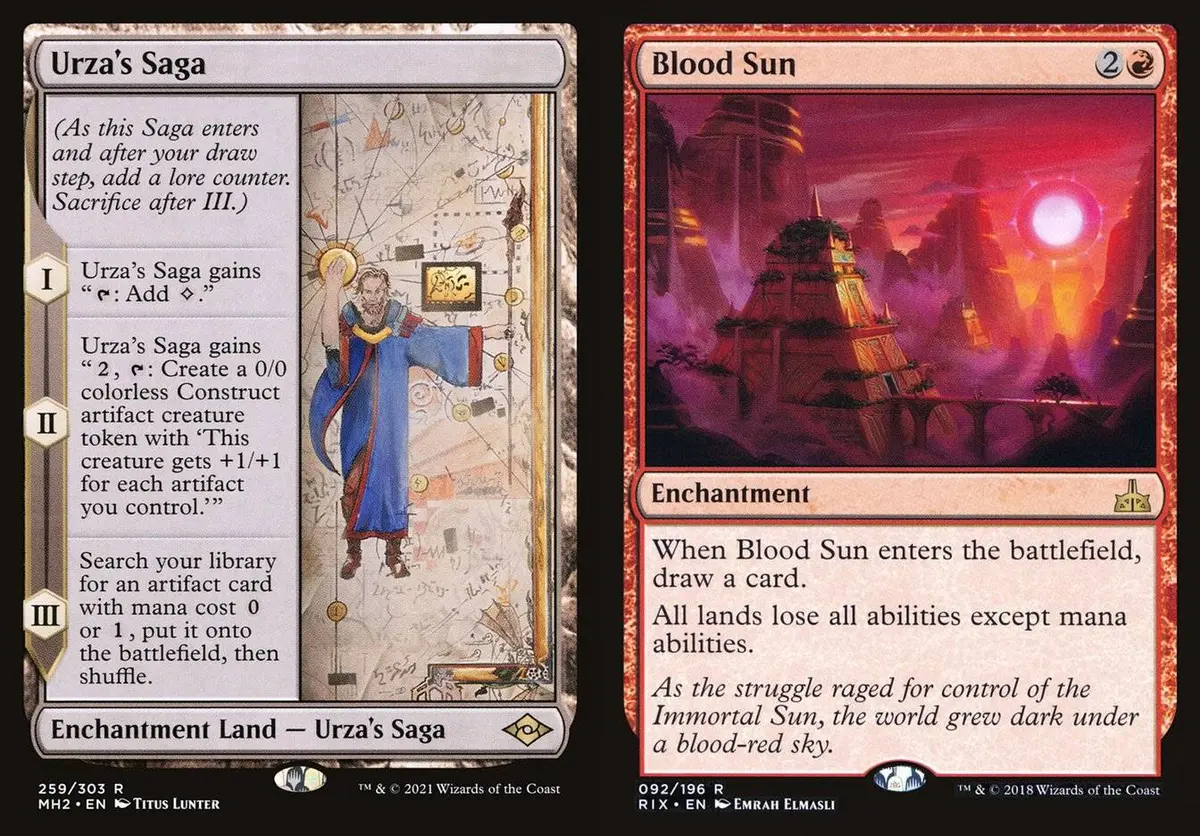
● Urza’s Saga:
Chapter I: Urza’s Saga gains “{T}: Add {C}.”
Chapter II: Urza’s Saga gains “{2}, {T}: Create a 0/0 colorless Construct artifact creature token with ‘This creature gets +1/+1 for each artifact you control.’”
● Blood Sun:
All lands lose all abilities except mana abilities.
Again Urza’s Saga has run to Chapter II, but this time what enters is Blood Sun. Is there any difference from the earlier Blood Moon?
As emphasized before, Blood Moon causing loss of abilities is a special case, whose essence is a type-changing effect acting at Layer 4, but Blood Sun is a straightforward Layer 6 ability-adding/removing effect!
| Layer | Blood Sun | Urza’s Saga |
|---|---|---|
| 6 | Lands lose abilities other than mana abilities | Gains the tap-for-colorless-mana ability |
| 6 | Gains the tap-to-create-a-token ability |
Since both are Layer 6 effects, we then need to compare timestamps. The timestamp order of the two is: the abilities Urza’s Saga Chapter II granted itself come first, and Blood Sun making lands lose abilities other than mana abilities comes after. Urza’s Saga will lose its own chapter abilities and the ability to create Construct tokens; as for the colorless-mana ability granted to itself by Chapter I, because it is a mana ability, Blood Sun does not touch it, so Urza’s Saga can at least still be used to produce mana.
Since the answer here comes from comparing timestamps, could it be the other way around, with Blood Sun’s timestamp first and Urza’s Saga’s Chapter II timestamp later? Normally this is hard to achieve, since if Blood Sun has an earlier timestamp, that means it has been on the battlefield all along, and a Urza’s Saga that lost its chapter abilities could not advance to Chapter II. But it is not completely without a way: for example, in response to your own Urza’s Saga Chapter II trigger, use some instant-speed method to make Blood Sun enter (such as the Leyline of Anticipation in the example above), and then Blood Sun’s timestamp is first and the timestamp of the ability Urza’s Saga Chapter II grants itself is later; or Blood Sun was on the battlefield earlier but temporarily lost its influence on the board because of phasing, and so on. Of course these methods are so fiddly that they have little practical value in real play, but at least they are feasible by the rules.
Conclusion
From the point of view of eliminating non-intuitive rules interactions, the writer thinks the intention of this rules change is good. It is only that after this change, Urza’s Saga suddenly lost its greatest constraint, and the constraint that once existed has even turned into its helper. We can expect a noticeable impact on Modern and older formats in the short term, but whether it will become an unhealthy shock to the environment cannot be judged yet, and we can only leave it to time to verify.

- Title
- How Blood Moon Went from Urza's Saga's Natural Enemy to Its Teammate
- Author
- Jru
- Created at
- June 12, 2025
- License
- This work is licensed under CC BY-NC-SA 4.0 .