
How Beginners Can Improve at Limited: Sealed Deck Edition

Note: This article was translated from Chinese by AI and may contain errors. Read the original Chinese version.
Before We Start
Limited, as the name suggests, is a format with limitations (listening to you speak is like listening to you speak…). To be precise, it refers to two MTG formats: Sealed Deck and Booster Draft. A brief introduction follows:
- Sealed deck: You build a deck of at least 40 cards using 6 booster packs (Note 1) and play matches with it. Every card you don’t use is part of your sideboard, and you can swap cards after game one of each match, following the same sideboarding rules as any format.
- Booster draft: At least 4 and at most 8 players each use 3 booster packs. After the event starts, each player opens the first pack, picks one card from it (Note 2), and passes the rest to the left to the next player, continuing to pass left until every card in the pack has been picked. Then the second pack is opened and drafted the same way, except the passing direction switches to the right; finally the third pack is opened and passed left like the first. Once all the cards in all three packs have been drafted, each player builds a deck of at least 40 cards to play with, and every unused card is your sideboard.
Okay, now that we have covered how these two formats work, let’s move on to the main topic of this article: Sealed deck.
Note 1: Official Limited formats before Murders at Karlov Manor (MKM) all used draft boosters, while from MKM onward they use play boosters.
Note 2: Some special draft sets, such as Double Masters (2XM), instead let you pick two cards at once for the first pick of each pack.
Pre-Game Homework: How Do You Find Limited Information? Using the Outlaws of Thunder Junction Limited Articles on Guildmages’ Forum as an Example

Taking the Outlaws of Thunder Junction (OTJ) Limited format as a starting point, click the “OTJ” tag in the “Tag” menu on Guildmages’ Forum and you can see all the card ratings, initial looks at Limited themes, and mechanic introductions related to this BLB Limited format. Readers interested in earlier Limited formats can click the “Limited” tag to find all Limited-related articles since Wilds of Eldraine (WOE).
For friends who struggle with English, you can also use the Magic: The Gathering Traditional Chinese Card Search site to look up the Chinese translations of every card since Traditional Chinese MTG was discontinued with Dominaria United (DMU) in September 2022. Earlier sets can be found on scryfall, which has the various languages, including the sets that once had Traditional Chinese versions (Note 3).
Note 3: Historically, Traditional Chinese MTG has actually disappeared for the second time now. I wonder whether there is a chance of seeing a third revival of Traditional Chinese?
- Traditional Chinese MTG from Fourth Edition (4ED) in April 1995 through Mirrodin (MRD) in October 2003. Unfortunately, Traditional Chinese cards from this period cannot be looked up on scryfall, but they definitely exist in players’ memories and in their binders.
- Traditional Chinese versions from Magic 2011 (M11) in July 2010 through Streets of New Capenna (SNC) in April 2022.
How Do You Play Sealed? How Do You Build a Deck?

However, taking an OTJ prerelease sealed as an example, even if you diligently read all the information mentioned above before entering the event, once you open all your packs you will immediately face your first challenge: how do you build a Limited deck that can actually fight other people?
After you open six play boosters and remove tokens and art cards, each pack gives you 14 cards usable for building, so six packs give you 84 cards. These are all the resources you have for building your sealed deck. After opening, you may see exciting rares / mythic rares, but please hold on to that joy for now and let’s move on to the deckbuilding steps.
One important piece of information up front: in a 40-card sealed deck, you will usually have 23 nonland cards and 17 lands.
Step 1: Confirm the Cards Available
Step 1.1 Sort the 84 cards you opened into piles by white, blue, black, red, green, multicolor, artifact, and land. Pull out the basic lands from the land pile and put them with the tokens and art cards.
Step 1.2 Line up each pile in order of mana value (Note 4) from lowest to highest, with lower mana value cards toward the top.
Step 1.3 Pull your rares / mythic rares out of each pile and quickly review the ratings and descriptions in the articles under the OTJ tag. If you can’t understand them, you can ask other players or staff in the store.
Step 1.4 Based on the initial evaluation in Step 1.3, pick out at most two or three colors that let you use as many of the highly rated rares / mythic rares as possible.
Note 4: That is the sum of the mana symbols in the upper right corner of each card and any numbers payable with any mana. For example, a red card costing 3RR has a total mana value of 3 + R + R = 5; a multicolor card costing WUBRG also has a total mana value of 5; and what about a multicolor card costing 1UURR? That’s right, its total mana value is still 5!
Step 2: Confirm Your Deck’s Curve
Step 2.1 Split the cards of your chosen two or three color combinations into creatures and noncreatures, and lay them out from lowest to highest mana value, putting cards of the same mana value in the same row.
Step 2.2 Get to know the BREAD theory
This isn’t about bread, but about the five elements of building a Limited deck:- Bomb (B): A powerful card that gets a large amount of value as soon as it resolves, and/or that basically means winning if it isn’t removed within a turn or two of appearing, such as Bonny Pall, Clearcutter.
- Removal (R): As the name suggests, any card that can remove a creature or permanent affecting the board. See this article: The Last Mile Before OTJ Limited: Kill Spells and Removal.
- Evasion (E): Cards with their own flying, unblockability, or other evasive abilities, such as Shepherd of the Clouds, Nimble Brigand after triggering a crime, and Resilient Roadrunner after activating its ability.
- Aggro (A): When your sealed pool lacks the BRE elements above, don’t give up. You can still build an aggressive deck with a proper curve, using steady offense to go for a quick win and avoid the game being dragged into the mid-to-late game where you have to face many of the opponent’s bombs. The deck may use aggressive creatures like Reckless Lackey and Cunning Coyote, paired with combat tricks like Outlaws’ Fury or mass pump spells to deal a lot of damage in the early game.
- Low-value cards (Dud, or Dirt, D) a.k.a. junk cards: Cards that basically aren’t worth playing, or whose cost-to-value ratio is badly out of balance, basically cards you shouldn’t put in your main deck, such as Magebane Lizard; some cards that are only valuable in the sideboard also fall into this category.
In addition, there is one special category that can’t simply be sorted by the BREAD theory above, and that is the combat trick (Trick, T). A combat trick needs a creature on the battlefield and the right timing, usually during the combat phase while your creature is attacking or blocking. Used well, a combat trick often gets you a two-for-one or even more; conversely, in extreme situations such as having no creatures or being unable to fight in combat, a combat trick is useless. Moreover, Limited is basically won mostly by creatures attacking, so learning to use combat tricks well is also an important part of improving at Limited.
Step 2.3 Choose 15 to 17 creature cards
In a typical build, two- and three-drop creatures need to make up the vast majority, about 8 to 10, to make sure your deck can develop smoothly and win by attacking with creatures. Once your two- and three-drop creature curve is filled out, use the remaining 5 to 7 slots for expensive creatures or bombs to ensure your deck’s staying power and winning ability in the mid-to-late game.Step 2.4 Choose 6 to 8 nonland, noncreature cards (mainly removal)
Since Limited still focuses on winning through creature offense and defense, removal is more important than anything else, so when building you should first make sure of the removal count, and only use other things when there is room, or to strengthen a particular theme (for example, Binding Negotiation for the crime theme, or putting a counterspell like Phantom Interference in the sideboard games to stop the opponent’s big plays).Step 2.5 Re-examine the cards chosen in Steps 2.3 and 2.4 and confirm once more that no other card better suited to your curve has been missed. In the next step we will explain how to determine your land count and the stability of your mana.
Step 3: Confirm Your Land Count and Color Fixing
Once you have arranged your deck’s curve, you need to further confirm whether it can actually be carried out in your upcoming games, and proper mana fixing is very important. In this step we explain the 17-land portion of the deck:
Step 3.1 Building a mono-colored deck (e.g., mono-black)
You only need to put in 17 basic Swamps, and your mana count is fine. Of course, if you opened any, you can also use utility lands that produce colorless mana, or dual / multicolor lands that touch black, to get extra value. Just replace as many basic lands as the number you use.Step 3.2 Building a two-color deck (e.g., red-black), calculated by the ratio of mana of each color:
For this land configuration section, the method below is only a basic calculation. To be more precise, you would need some mathematical models to simulate it. Given the author’s limited ability, and since this article aims to give beginners a simple, easy-to-use reference for building mana, more advanced content is left to experts to develop and share.
Basically, you need to calculate the total mana value of each color among the nonland cards in your deck, and adjust the number of basic lands of those two colors by that ratio. For example, if the sum of black mana you use is 25 and red is 20, then the black : red ratio is 55 : 45, and using the table below as a baseline, it is recommended to use 9 basic Swamps and 8 basic Mountains, for the reader’s reference.
| Black % | Red % | Basic Swamps | Basic Mountains |
|---|---|---|---|
| 0 | 100 | 0 | 17 |
| 5 | 95 | 1 | 16 |
| 10 | 90 | 1 | 16 |
| 15 | 85 | 2 | 15 |
| 20 | 80 | 3 | 14 |
| 25 | 75 | 4 | 13 |
| 30 | 70 | 5 | 12 |
| 35 | 65 | 6 | 11 |
| 40 | 60 | 7 | 10 |
| 45 | 55 | 8 | 9 |
| 50 | 50 | 8 to 9 | 8 to 9 |
| 55 | 45 | 9 | 8 |
| 60 | 40 | 10 | 7 |
| 65 | 35 | 11 | 6 |
| 70 | 30 | 12 | 5 |
| 75 | 25 | 13 | 4 |
| 80 | 20 | 14 | 3 |
| 85 | 15 | 15 | 2 |
| 90 | 10 | 16 | 1 |
| 95 | 5 | 16 | 1 |
| 100 | 0 | 17 | 0 |
The land counts in the table above are for reference only, but configuring this way basically won’t leave you too stuck. Finer adjustments are not covered here; of course, you need to substitute the basic lands for the actual color combination you are building. Likewise, if you use some dual lands, you can swap out an equal number of lands of the corresponding colors. One small tip: a land that produces two colors (e.g., a red-black dual land) can basically be counted as 1 basic Swamp + 1 basic Mountain, which means when you use dual lands you free up more room for other utility lands you want to play that can only produce colorless mana (e.g., Sandstorm Verge).
So the supplementary land configuration table for the two-color deck is as follows. It does not consider the case where you open more than 2 of the same dual land in sealed (that’s basically playing Constructed at that point XD), and also, putting more than 2 colorless lands in a two-color deck actually increases the risk of unstable mana, because your color-producing lands are reduced.
| Black % | Red % | Basic Swamps | Basic Mountains | Red-Black Dual Lands | Colorless Utility Lands |
|---|---|---|---|---|---|
| 55 | 45 | 9 | 8 | 0 | 0 |
| 55 | 45 | 8 | 7 | 1 | 1 |
| 55 | 45 | 7 | 6 | 2 | 2 |
Do readers find this part difficult? Don’t worry. Thanks to the sharing from 半退老人 J T 的佛系魔風生活, here is a quick and effective method for your reference:
Add up all the mana values of one color, divide by 2, round up, then +1 = the number of lands of that color.
If the total red mana value in your deck is 15, then 15 divided by 2 = 7.5, rounded up to 8, then +1 = 9 basic Mountains or lands that can produce red. No doubts, it really is that simple!
- Step 3.3 Building a three-color deck (e.g., red-black-blue, a.k.a. Grixis)
Okay, this part is too complicated, so let’s skip it (hey!)Seriously, I’ll still make a table for everyone’s reference, but land configuration for three or more colors is actually a deep field of study. What’s provided here is only the basic configuration method, and players will need to adjust further according to deck design. The table only considers the case where the third color makes up about 15%, mainly because I personally don’t recommend beginners build an even three-color deck in non-three-color sets (Note 5).
| Black % | Red % | Blue % | Basic Swamps | Basic Mountains | Basic Islands |
|---|---|---|---|---|---|
| 55 | 45 | 0 | 9 | 8 | 0 |
| 50 | 45 | 5 | 8 | 8 | 1 |
| 45 | 45 | 10 | 7 | 7 | 3 |
| 45 | 40 | 15 | 7 | 7 | 4 |
To close this step, here is why I don’t recommend beginners build an even three-color deck in non-three-color sets. Since most sets develop around two-color themes, if beginners head straight for three-color or even multicolor decks, you may use up all your deckbuilding time just picking cards and configuring lands; and even so, the deck you build may be far less stable than a two-color deck, directly hurting your Limited experience. If you can, build a two-color deck!
Note 5: Generally speaking, in a non-three-color environment, using a third color is mostly because you want that color’s removal, or a two-color / three-color bomb that touches one of your colors. In that case splashing the third color is a reasonable choice, but be careful not to make the mana base of the original two colors too unstable. The last row of the table above, with blue making up about 15%, roughly corresponds to using 3 to 4 blue cards of the third color in the deck. This is rare in a typical build and may be caused by having too many blue bombs to choose between while the blue cards themselves can’t support the deck’s curve; in that case I would suggest adding one land to play 18 lands and 22 nonlands. If the third-color bomb is strong enough, the payoff of one extra land helping you cast it smoothly still outweighs the penalty of drawing too many lands. Of course, such trade-offs are only my personal suggestion, and readers should still think and test for themselves!
Step 4: Confirm Synergy Between Cards and Themes
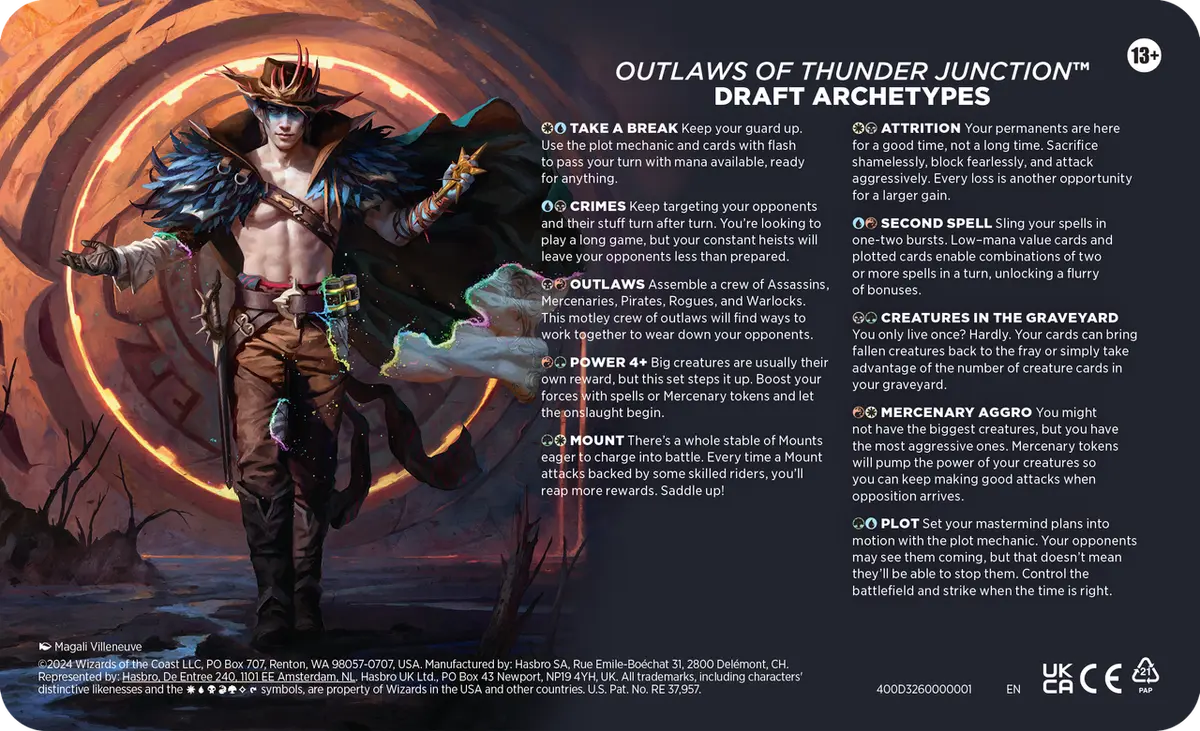
Starting from the ten two-color themes officially provided by Outlaws of Thunder Junction (OTJ), you can see what each color pair cares about, such as blue-black crimes, red-black outlaws, or red-blue second spell. When you enter a particular two-color pair to build, the more cards you choose that are tied to that pair, the stronger your deck’s synergy! This kind of synergy allows individual cards with lower standalone power to reach a 1 + 1 ≥ 2 effect as they amplify one another with other theme cards.
Take blue-black crimes as an example: if your deck has almost no cards that are sources of crimes, then the cards you put in for the crime theme will be much worse; conversely, when your blue-black deck has enough sources of crimes, your crime payoff cards can instantly become the MVPs of the deck!
A. Blue-black crimes build without synergy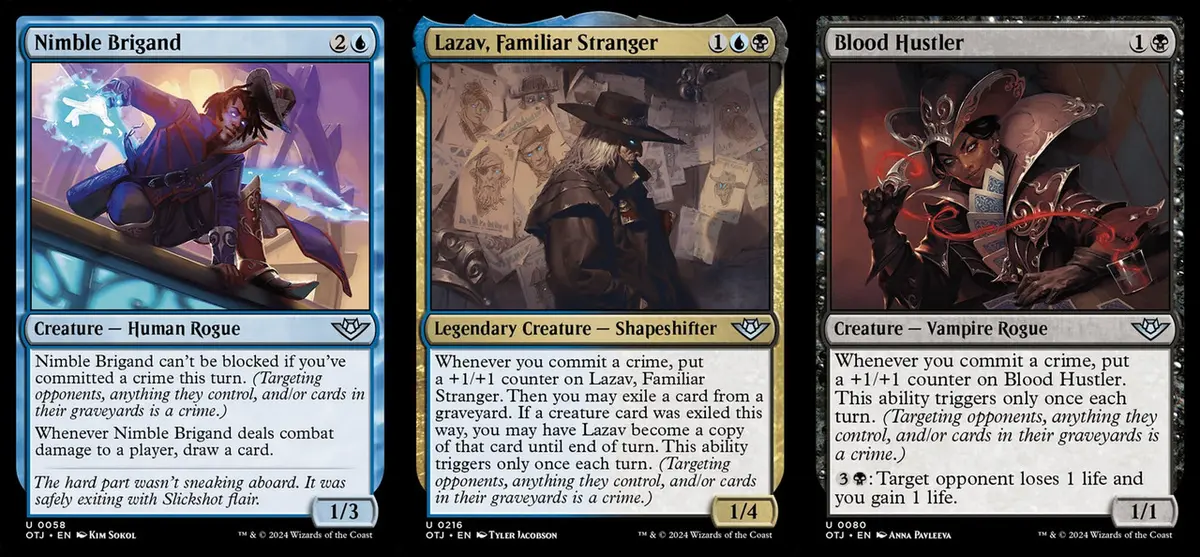
B. Blue-black crimes build with synergy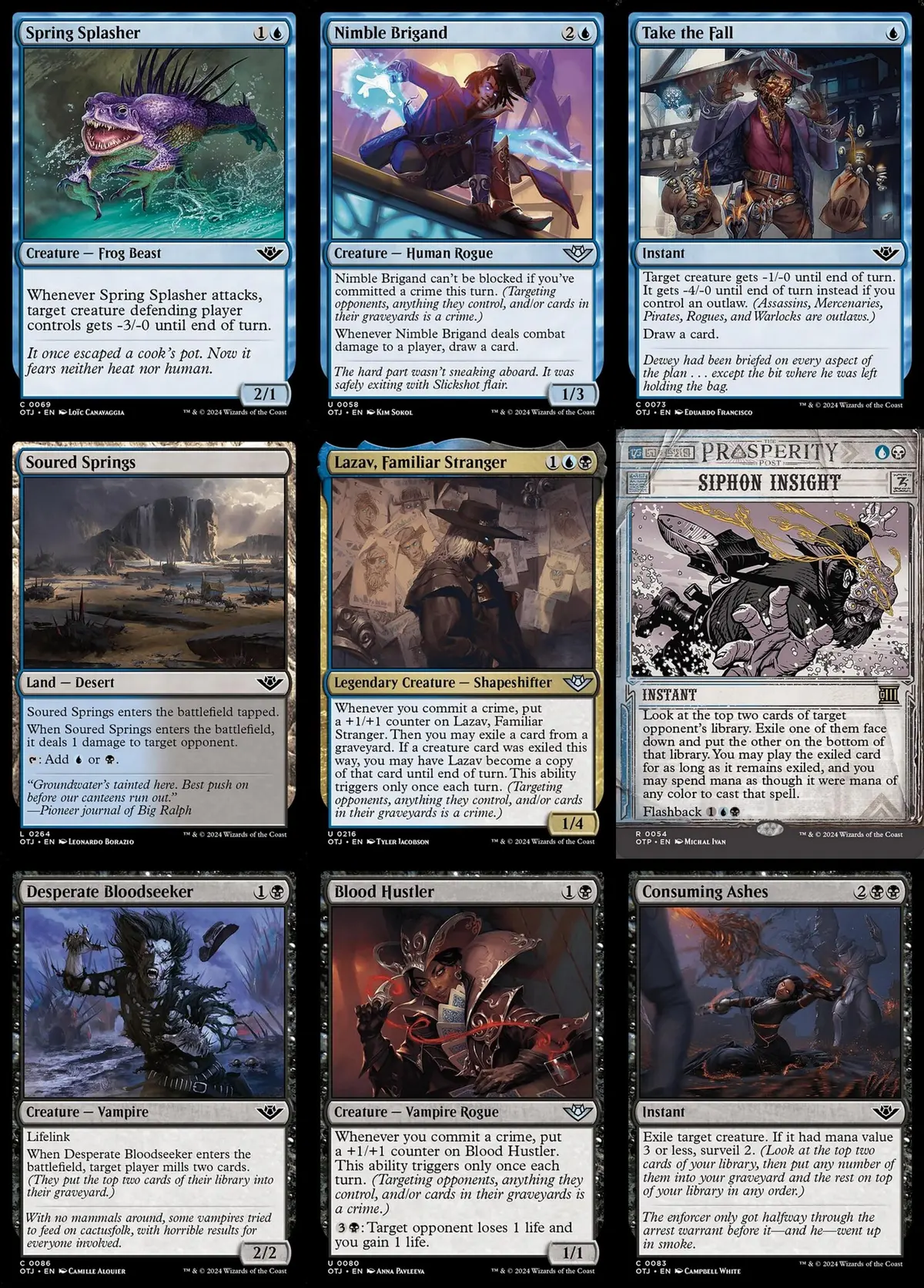
Let’s look at the two images above. In image A there are only crime payoff cards but no crime sources, and in such a build the ability text on these cards is effectively meaningless; they can only be treated as very mediocre bodies and basically aren’t worth playing in your deck. In image B you have both crime payoff cards and twice as many crime source cards. In such a build, your Nimble Brigand can reliably be unblockable and draw cards by dealing combat damage, your Blood Hustler can keep growing, and your Lazav, Familiar Stranger will not only grow but may also become a bomb creature from your graveyard or the opponent’s, delivering a surprise blow to the opponent!
That is the most basic introduction to synergy. In situations like this, where many small things add up and little guys do great deeds, in a sealed format where resources are relatively scarce, the better the synergy in your deck, the higher your overall power will be, by several tiers, compared with decks that have ordinary or even poor synergy!
Synergy is the first snowflake of the snowball of advantage your deck rolls up!
Step 5: Re-examine the Cards You’ve Chosen
In the previous four steps we introduced the four key points of deckbuilding: available cards, curve, mana configuration and fixing stability, and synergy. In this step we won’t do any new checks; instead we go back and review those four key points we have already used, and try asking ourselves the following questions:
- Have I chosen cards that are weaker, or have poorer synergy?
- Next, did I give up cards with greater power or synergy for the sake of the curve? Or is it the other way around?
- Then, is my deck’s mana configuration enough to support my intended game plan?
- Finally, even if my curve and mana configuration are both fine, are there unchosen cards that could increase the deck’s power or synergy?
- Ask yourself questions 1 to 4 again, until you are satisfied with the build or deckbuilding time runs out.
If there are one or more questions you can’t convince yourself on, or have doubts about, boldly make adjustments! Then you can verify in real games whether your changes are better or worse. This process of self-iteration is the process of improving at Limited!
Step 6: Test-Draw the Current Build
After you complete the checks in the first five steps, if you still have a bit of time, you can shuffle your deck and try drawing a few opening hands to think about whether they fit the way you expect games to develop. Given thorough shuffling, if no matter how you draw you end up with many expensive spells stuck in hand, or often get stuck on one color, you may need to reduce the number of expensive spells or readjust the ratio of lands and colors in your deck. Before the match begins these changes are allowed; and even if you realize during a game that your build has such problems, you can make the same adjustments when sideboarding between games.
Step 7: Verification in Real Games, and… Enjoy It
Once you start playing, you will repeatedly verify the results of your first six steps, and while interacting with opponents, observe whether they have combinations you never thought of! You can write them down, as nourishment for your future builds and a stepping stone for exploring the unknown. And when you have a new discovery, don’t hesitate to share it with the friends around you! Trust me, when you are telling people about a card combination you stumbled into in some game, you will feel that this game is really fun!
Wrap-Up
Repeat the seven steps above, keep accumulating sealed experience and enjoying yourself, and record your own discoveries and others’ insights. This is a process of constant refinement and you will never get bored! I hope the rough analysis above can help friends new to MTG gain a further understanding of sealed, and find their own motivation and source for improving!
Let’s enjoy the process, and keep a curious and observant mind, to notice how to find unlimited deckbuilding fun within limited resources!
- Title
- How Beginners Can Improve at Limited: Sealed Deck Edition
- Author
- cephille
- Created at
- July 30, 2024
- License
- This work is licensed under CC BY-NC-SA 4.0 .
Related Articles

I Drafted Alone: Solo Drafting with Reality Fracture (FRA)
October 16, 2026
Article Translation — Reid Duke's "Level One": Choosing Your Deck
August 17, 2026

Article Translation: Reid Duke's "Level One": Sequencing
July 24, 2026
Article Translation: Reid Duke's "Level One": Playing in a Grand Prix: Part I
June 13, 2026