Jeweled Lotus Gets a New Job: Legacy Doubling Cube

Note: This article was translated from Chinese by AI and may contain errors. Read the original Chinese version.
Before We Start
September 23, 2024 will undoubtedly be a day that goes down in MTG history. In the EDH banned list update published that day, Jeweled Lotus, Mana Crypt, Dockside Extortionist, and Nadu, Winged Wisdom were banned. Apart from Nadu, the other three had long been the foundation of the EDH environment, and this banned list is sure to set off an ecosystem catastrophe. Among them, Jeweled Lotus, which came from the Commander Legends set to begin with and whose ability is tied to your commander, has become an utter joke. Although the card is indeed legal in Legacy, what use is it in a format without commanders…?
Actually, there really is one, and it may well be the last job opportunity for Jeweled Lotus after being laid off.
Deck Theme
How to Use Jeweled Lotus
I believe that, more than the deck’s own power level, what readers care about is: with no commander, how exactly can Jeweled Lotus’s ability be put to use? This brings us to the core card of this deck: Doubling Cube
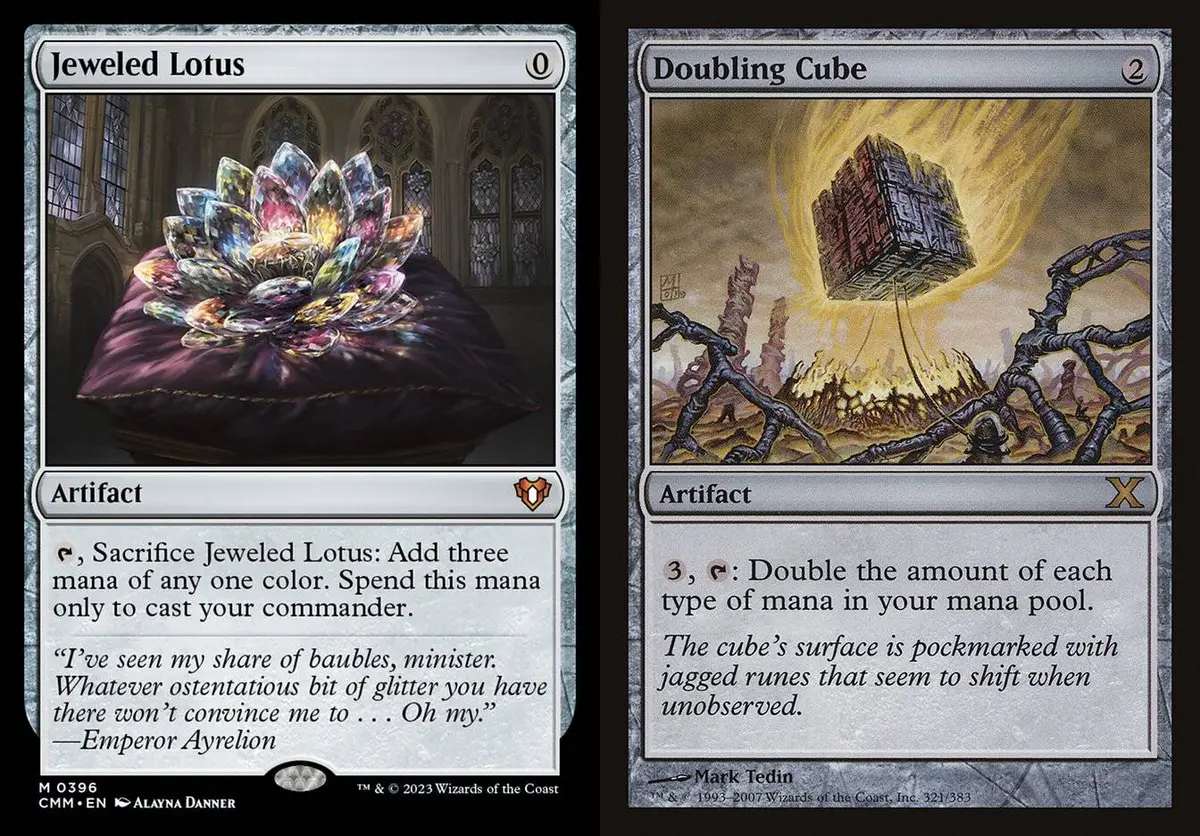
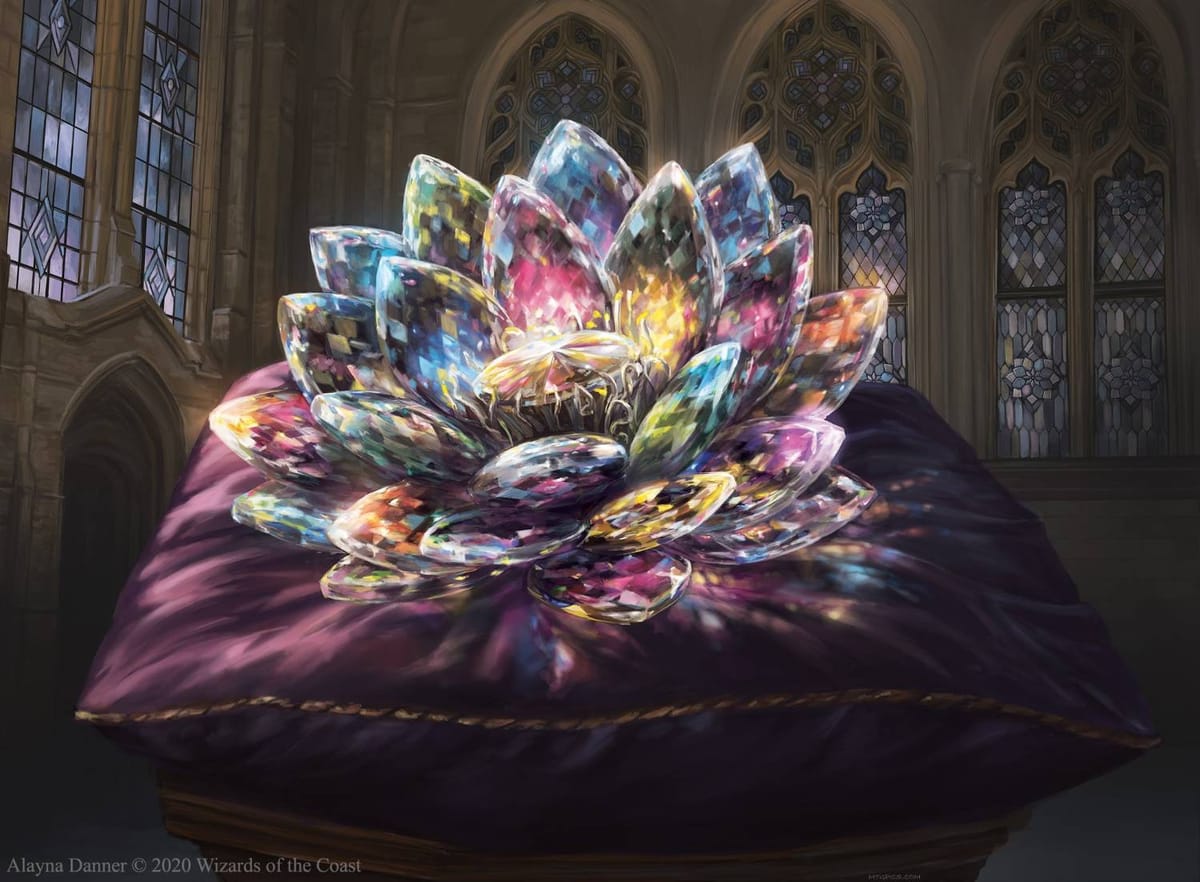
Jeweled Lotus: {T}, Sacrifice Jeweled Lotus: Add three mana of any one color. Spend this mana only to cast your commander.
Doubling Cube: {3}, {T}: Double the amount of each type of mana in your mana pool.
Let us start with Jeweled Lotus. Its ability can produce any mana you like when generating mana, and the colors it can produce are not limited to your commander’s color identity; it only restricts this mana to being spent on casting your commander.
Next, look at Doubling Cube. Its card Q&A has this statement: “Any restrictions on the unspent mana aren’t copied”. Simply put, when you use it to double mana, the restrictions on how that mana can be spent are not copied. Suppose you use Jeweled Lotus to produce three blue mana. That mana itself indeed cannot be used, but the three blue mana produced afterward by Doubling Cube can be used however you like. Through this pairing, you can indirectly play Jeweled Lotus as an ordinary Black Lotus!
Game Plan
From the theme of using Doubling Cube to produce mana above, you can tell this is a deck focused on quickly bursting out a large amount of mana. Specifically, it is a solitaire-style combo deck similar to storm, which rolls out more and more mana through continuous spell chaining and converts that mana into the corresponding winning outlets, which may be a one-hit-kill finisher or a lock that effectively ends the game.
This scene is from chapter 14 of the MTG manga “Destroy All Humans, They Can’t Regenerate”
Deck Introduction
Mana Base
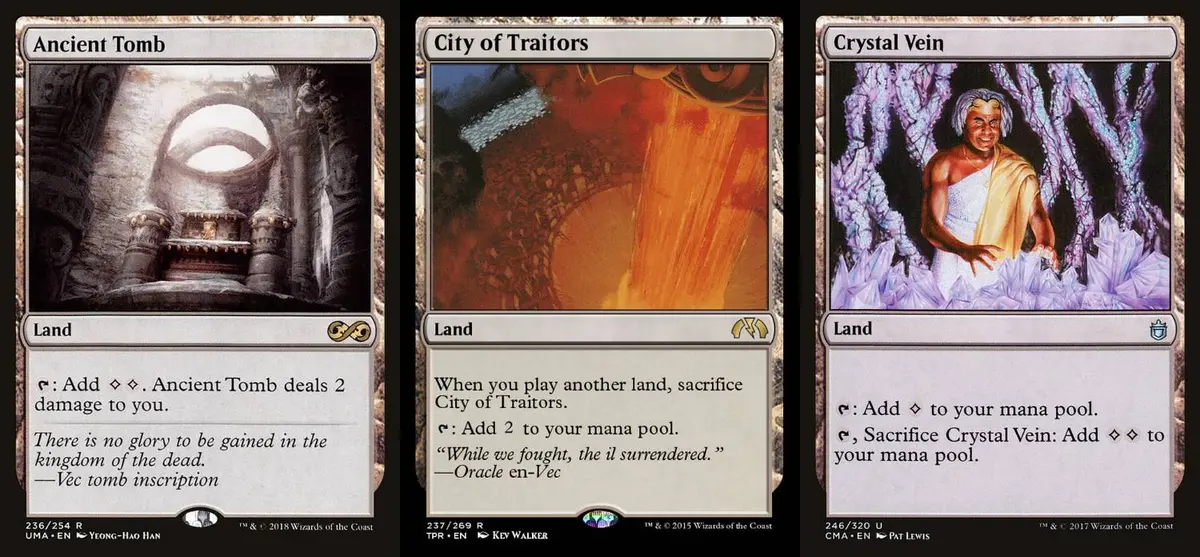
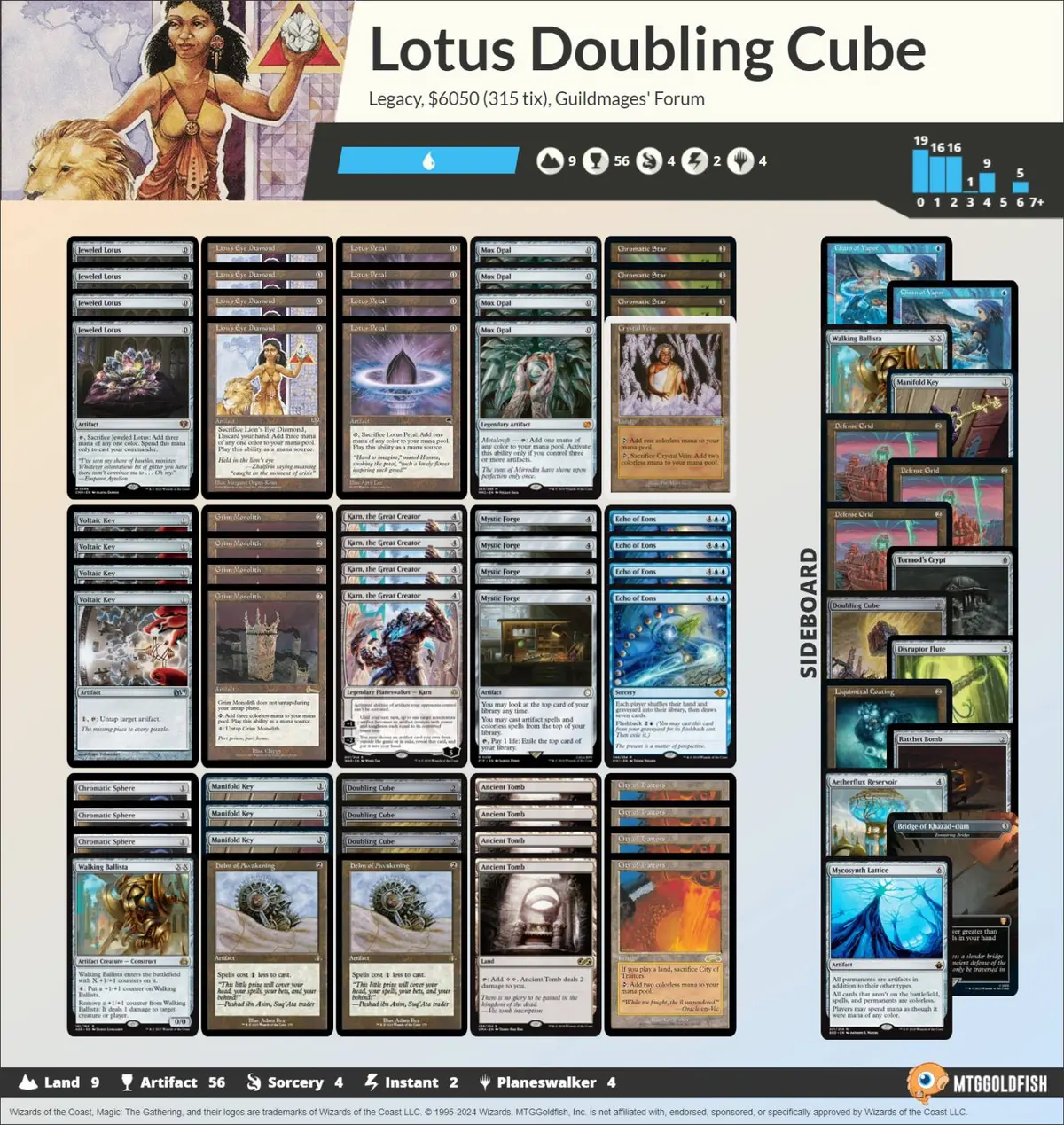
Land configuration: Ancient Tomb × 4, City of Traitors × 4, Crystal Vein × 1
This deck has a huge number of mana-producing artifacts, so it can function normally even with no lands in your opening hand. As a combo deck, its card-filling ability is surely not bad either, and 9 highly efficient mana-producing lands are enough to operate.
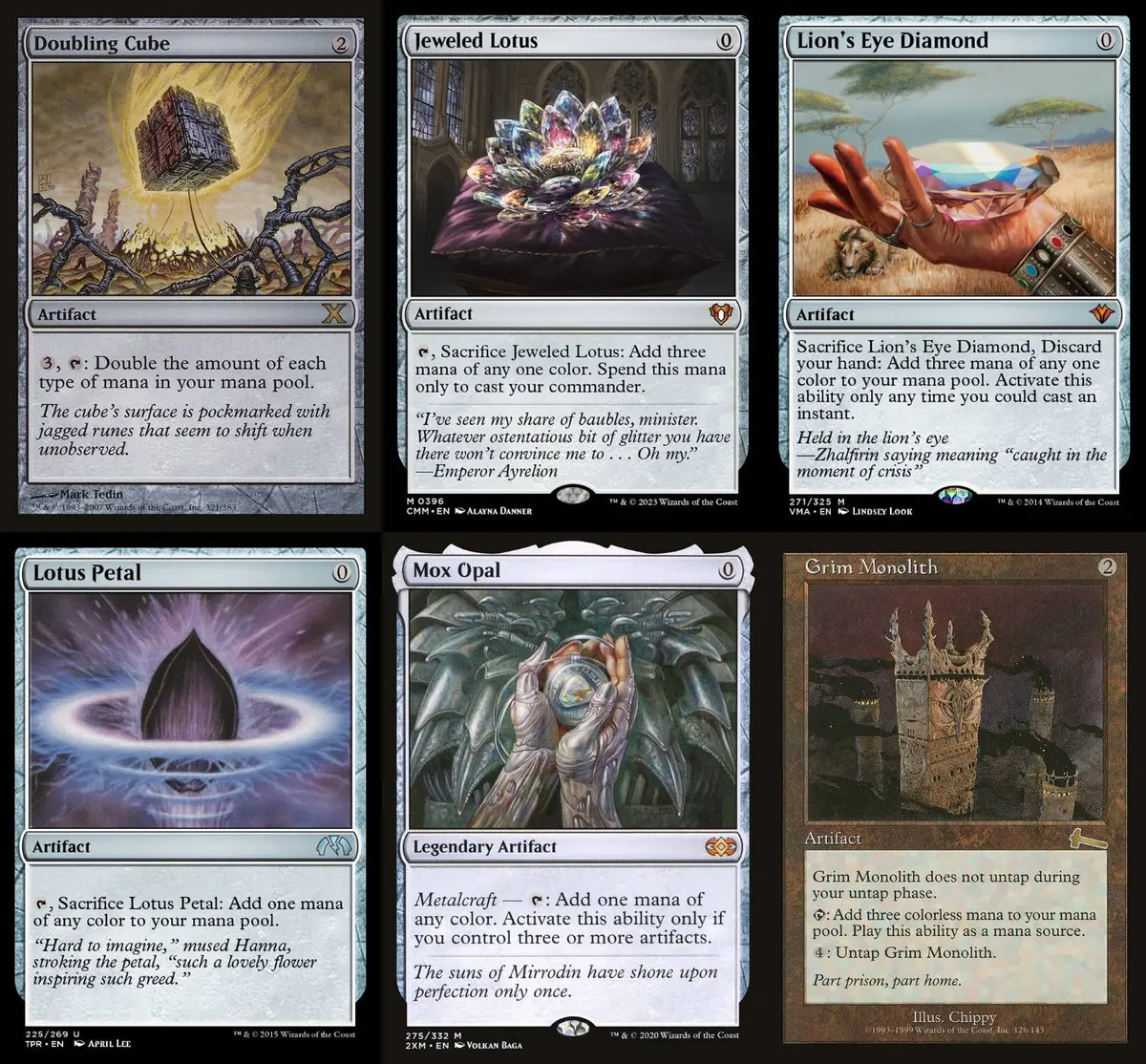
Theme package: Doubling Cube × 3, Jeweled Lotus × 4
Although they are the deck’s mana engine, they are not regular mana sources themselves. Keep one Doubling Cube in the sideboard for Karn, the Great Creator to fetch.
Other regular mana sources: Lion’s Eye Diamond × 4, Lotus Petal × 4, Mox Opal × 4, Grim Monolith × 4
These are all familiar faces for bursting out mana at high speed.
Card Filling and Sustain
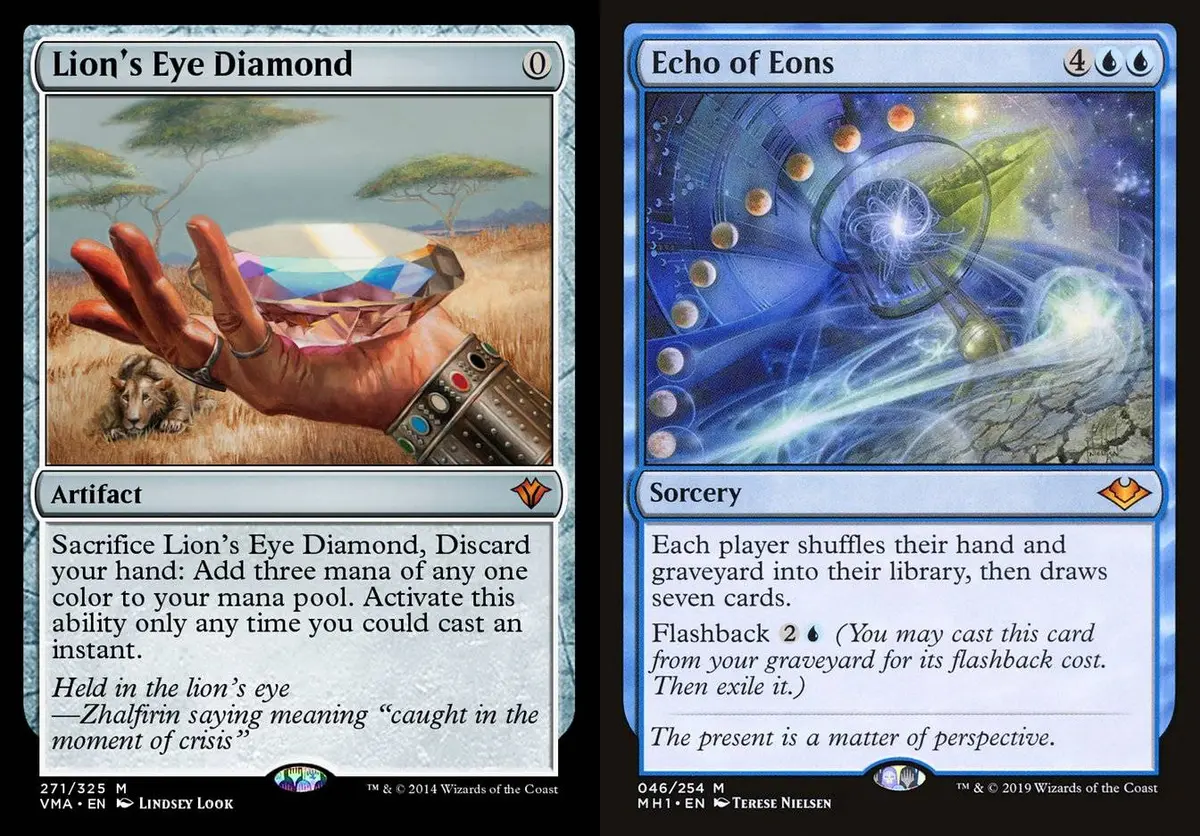
Lion’s Eye Diamond + Echo of Eons is arguably the top pairing among Legacy solitaire-combo decks: first you play out your hand, then Lion’s Eye Diamond discards your whole hand for 3 mana, and those 3 mana are exactly enough to flash back Echo of Eons, refilling your hand to 7 cards and letting you keep chaining spells. This combination also gives you the capital to mulligan aggressively; even mulliganing to 5, as long as your opening hand has them, you can turn your hand back into 7 cards and restart the game as if nothing happened (of course, if you eat a Force of Will, then thanks for playing).
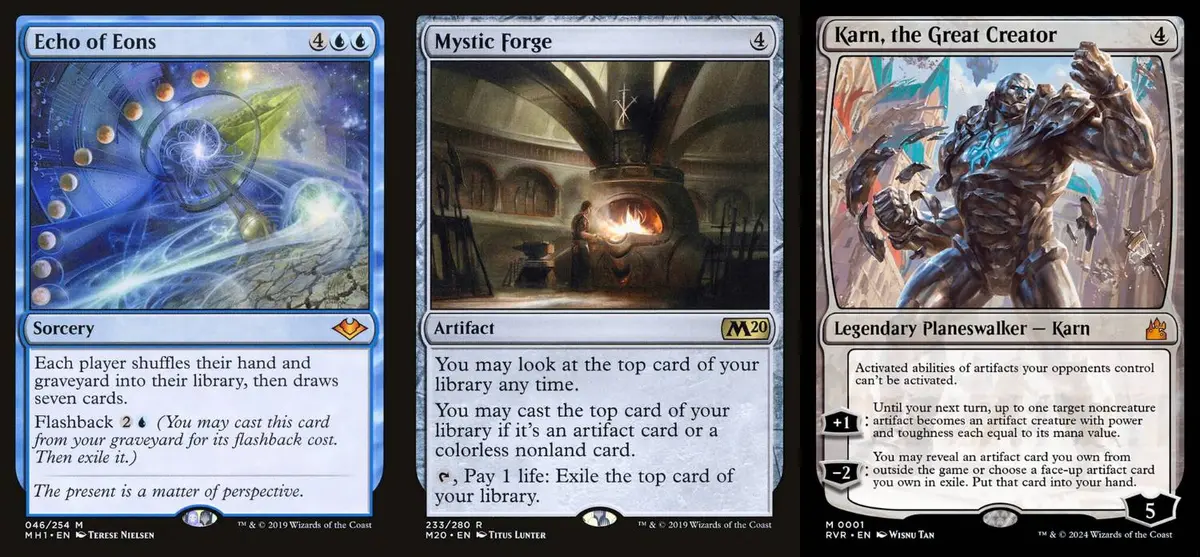
Besides Echo of Eons, Mystic Forge and Karn, the Great Creator are also core card-advantage components of this deck. Once Mystic Forge lands successfully, it can generate resources equivalent to winning the game, because this deck can snowball its mana bigger and bigger in the course of chaining spells, and once the board passes a certain threshold it basically cannot be stopped. Karn, the Great Creator is as usual a universal sideboard toolbox: fetch whatever you lack, find a combo component midway to keep the spells going, find a finisher to end the game once you have enough mana, and find a hate card when the board has a problem to deal with.
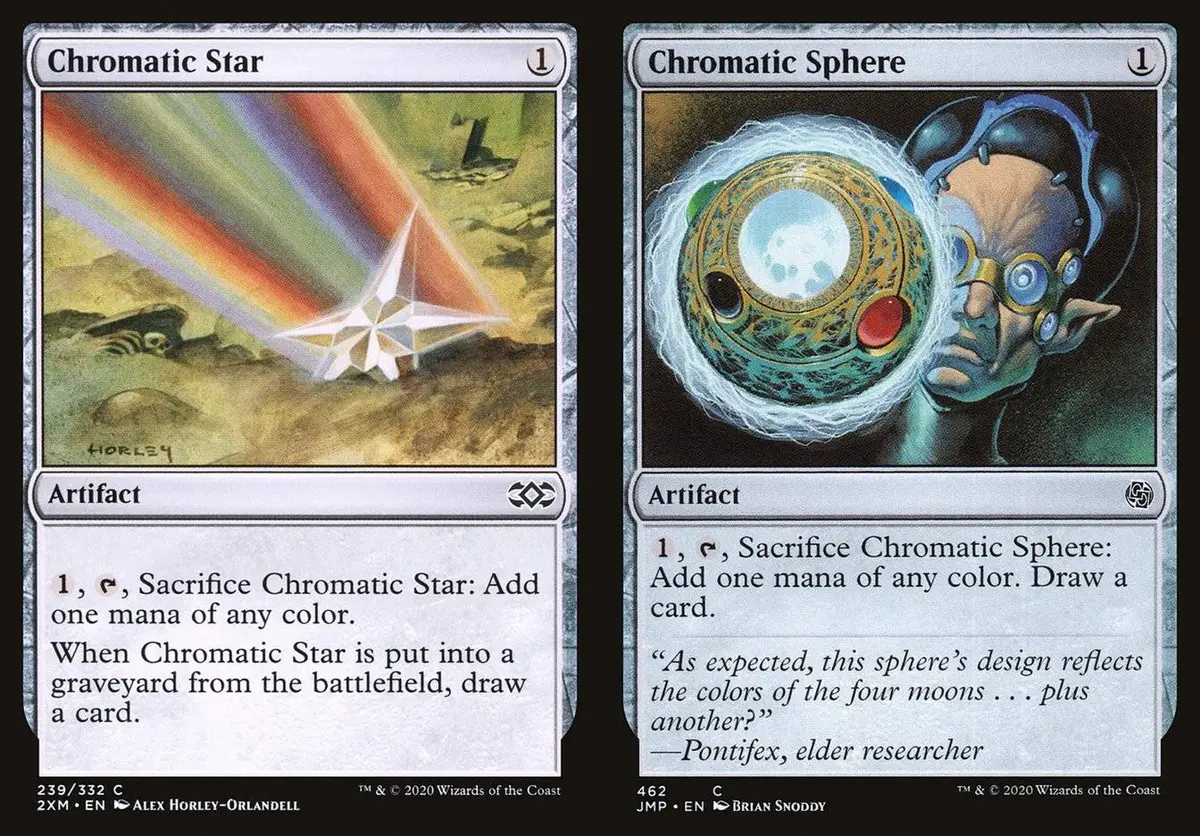
Strictly speaking, Chromatic Star and Chromatic Sphere are only filtering, not card advantage, but even the filtering function should not be underestimated. For example, when you have Mystic Forge and see a card on top of your library that you do not want, you can activate Chromatic Star/Sphere’s ability to draw a card, ensuring your combo turn is not interrupted. In addition, in some extreme situations where you cannot rely on Lion’s Eye Diamond, their color-fixing ability also becomes the key to casting Echo of Eons.
Finishers
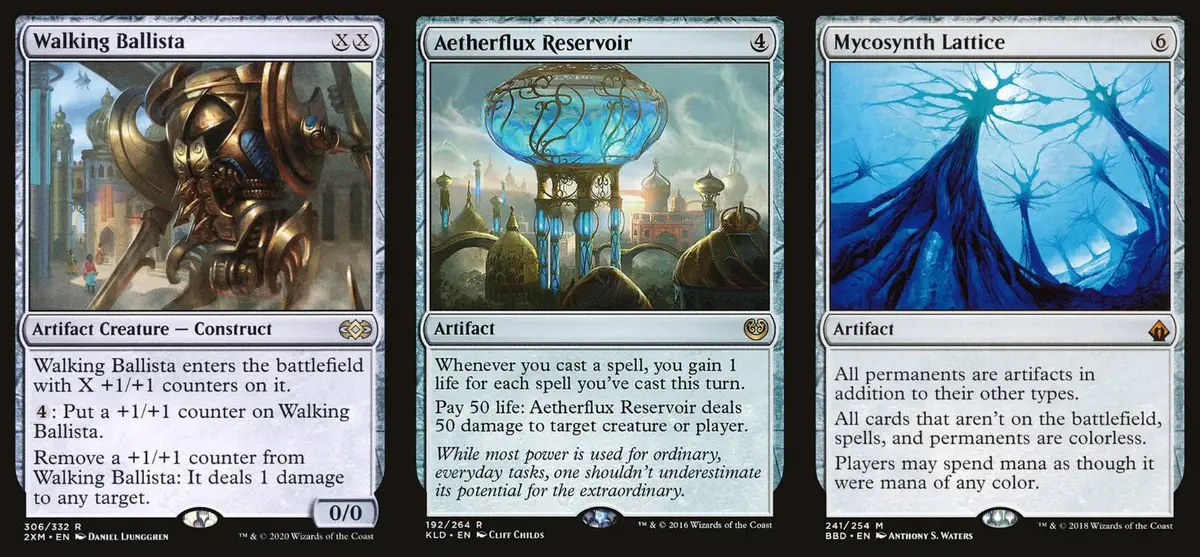
There are three kinds of finishers in total, each suited to winning in different situations. The sideboard has one of each as options for the Karn, the Great Creator toolbox. In addition, there is one Walking Ballista in the main deck, so even if Karn, the Great Creator meets with misfortune, you still have a chance to win.
- Walking Ballista: Plainly turns mana into damage and shoots it out. If you have already accumulated enough mana, you can immediately convert the mana into the winning points.
- Aetherflux Reservoir: Commonly called the water tower, a very storm-style way to win. It can be used when you do not yet have enough mana but are confident in your follow-up spell chaining, and it can also serve as an answer to draw-punisher cards like Sheoldred, the Apocalypse and Orcish Bowmasters, using the water tower’s lifegain to power through their draw-punishing damage and keep drawing seven with Echo of Eons.
- Mycosynth Lattice: A powerful combination banned in Modern in recent times, and also Karn’s most common game-winning lock. It shuts off the activated abilities of all of the opponent’s permanents, including lands, and as long as the opponent cannot answer it right then, the game is basically over.
Other Cards
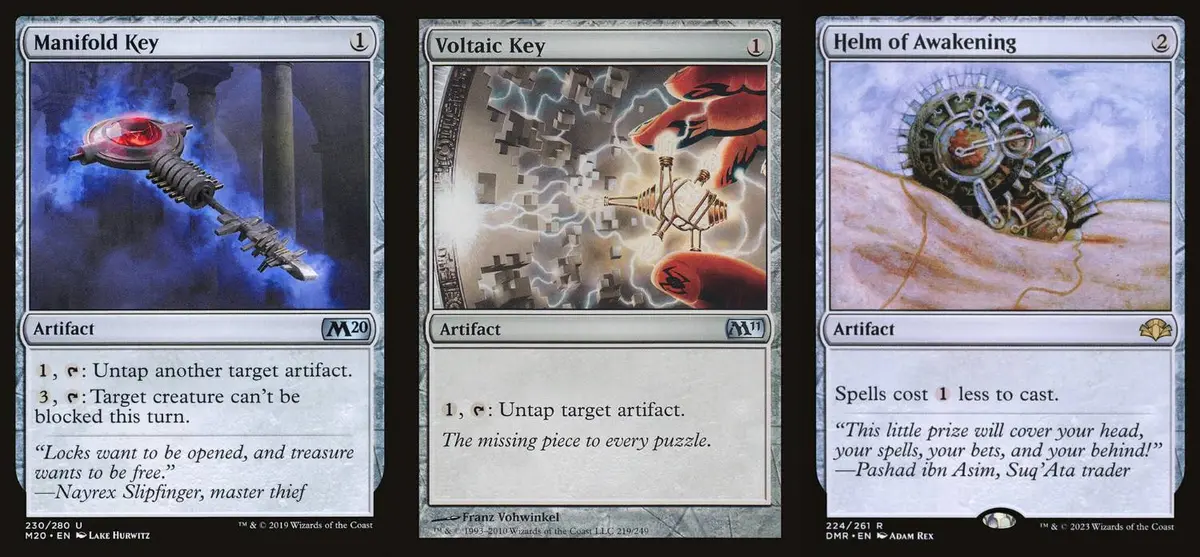
The functions of Manifold Key and Voltaic Key are largely the same in this deck and can roughly be seen as the same card. There are 7 in the main deck, and the remaining 1 is in the sideboard for the Karn toolbox. The keys have many clever uses in this deck, as follows:
- Reset Doubling Cube and Grim Monolith to produce more mana, which also gets around Grim Monolith’s own untap restriction. When you want to gain a lot of mana, keys are an indispensable part.
- Reset Mystic Forge so it can exile the top of your library again if you do not want it.
- Reset Liquimetal Coating and Ratchet Bomb fetched from the sideboard, and activate their abilities again.
Helm of Awakening: A simple and brutal cost-reduction ability. With it on the battlefield, the efficiency of going off can go up another notch.
Sideboard
It is called a sideboard, but most of it is the toolbox for Karn, the Great Creator; very few cards are actually swapped into the deck in post-board games.
- Chain of Vapor: The most efficient bounce-style removal. For a solitaire-style combo deck like this, it is enough to make the component that is jamming your operation temporarily disappear. As long as the opponent has no next turn, it makes no difference whether that thing is in the opponent’s hand or in the graveyard. It can also save your own components on the battlefield depending on the situation.
- Walking Ballista, Aetherflux Reservoir, Mycosynth Lattice: The finisher options described above.
- Doubling Cube, Manifold Key: Put one in the sideboard for Karn to find, increasing the stability of the main game plan.
- Tormod’s Crypt: Answer to graveyard decks.
- Liquimetal Coating: Paired with Karn’s [+1] it can blow up one of your opponent’s lands each turn, or paired with Karn’s static ability it can forcibly lock out the activated abilities of certain permanents for a turn. The land destruction part is not as efficient as Mycosynth Lattice, but it can still put a lot of pressure on the opponent.
- Ratchet Bomb: Artifact-based removal. Although you rarely get to use it, when you really run into some problem that must be removed, you still have to rely on it to save the day.
- Disruptor Flute: Traditionally this slot uses Pithing Needle, but I wanted to give the new card a chance. Although the cost is a bit higher, the disruption is also more comprehensive, and given this deck’s mana snowballing ability it should be acceptable.
- Defense Grid: The key card against counterspells; worth swapping into the main deck against opponents with counterspells.
- Ensnaring Bridge: A classic artifact-based defense. Against opponents who win through creature attacks, as long as this cannot be removed, you are nearly invincible.
The Mana That Jeweled Lotus Cannot Wash Clean
Finally, let me share a small rules tidbit. Some cards let you keep unspent mana that would be lost in your mana pool in some form. If mana produced by Jeweled Lotus is retained through such an effect, although the color of the mana may be changed, the restriction information recorded on it still exists, so this mana can still only be used to cast your commander.
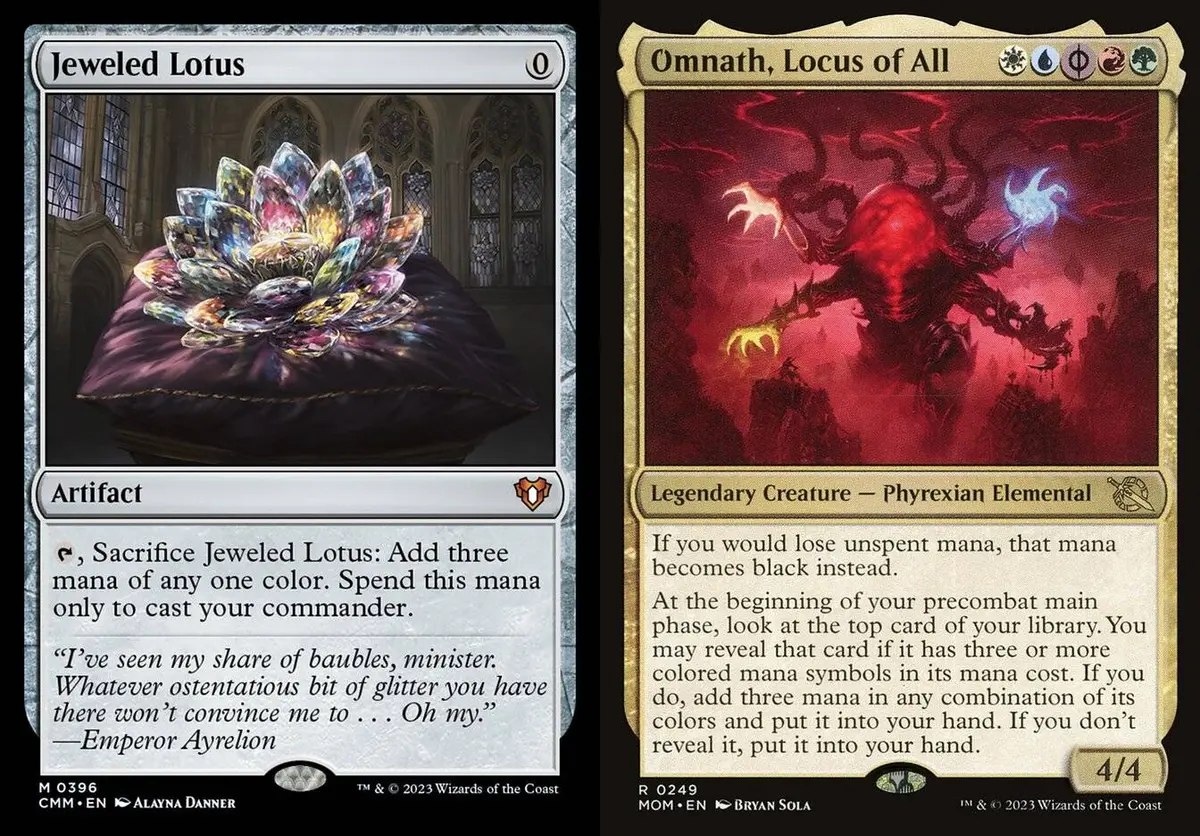
Omnath, Locus of All: If you would lose unspent mana, that mana becomes black instead.
Conclusion
Although this article is posted under the banner of sharing a Legacy deck, we all know full well that it is just mourning the Jeweled Lotus. As for this wave of showy moves with the official bans, I do not know what to say about it either; I only hope that, whatever the format and whatever the set, Wizards will evaluate balance issues a little more when designing new cards in the future.
Here is a joke: in Modern Horizons 3 we specifically designed a Nadu for Commander players, and then it got banned in both Modern and Commander.
- Title
- Jeweled Lotus Gets a New Job: Legacy Doubling Cube
- Author
- Jru
- Created at
- September 24, 2024
- License
- This work is licensed under CC BY-NC-SA 4.0 .