
Article Translation — Reid Duke's "Level One": Aggro Decks

Note: This article was translated from Chinese by AI and may contain errors. Read the original Chinese version.
Note 1: This is a translated article. The actual author is Magic: The Gathering Hall of Fame player and Channel Fireball member Reid Duke, and the copyright belongs to Wizards of the Coast. Although the authors field lists me, in this series I am only the translator, and I would not dare take credit for another’s work.
Note 2: This article and the following articles in the series were produced by translating the original with Gemini 3 Pro and then polishing the result. Every article includes a link to the original, and readers are very welcome to read the original on the official site!
Note 3: Since the original was published more than ten years ago, the translator will, where appropriate, add annotations explaining situations that differ between the original and the time of translation.
Note 4: The first 7 articles already have official Traditional Chinese translations. Before reading this one, we recommend checking the previous article, Article Translation — Reid Duke’s “Level One”: The Full Course & Glossary of Terms.
Note 5: To view articles on the official site that have been translated into Traditional Chinese, remember to change the language preference to “繁體中文” (Traditional Chinese) at the very bottom of the page, then click the article link again.
Article Translation — “Level One”: Aggro Decks
Wizards of the Coast column: Feature
Date: September 29, 2014
Author: Reid Duke
The best defense is a good offense.
It’s time in Level One to start putting together the basic concepts discussed so far and learn how to apply them concretely. That means looking at the big picture, not just the course of a game of Magic, but deck construction as well.
Deck construction matters in limited formats (like sealed) too, but the greater challenge and reward come from constructed. In constructed formats (the most common of which is Standard), the possibilities are nearly endless, because you can build a deck from any cards that are legal in that format and that you can get your hands on. The challenge is to anchor yourself to a specific strategy and make sure every card you choose contributes to that strategy.
The simplest and most common strategy is probably to make use of Tempo, which we discussed last week. By building a fast deck that casts creatures and attacks, you can put your opponent on the back foot right away and win a lot of games along the path of least resistance. We call these Aggro (short for Aggressive) decks.
The Importance of Tempo in Aggro Decks
With an aggro deck, your goal is to seize the initiative and stay ahead all the way, until you win the game or create a big enough advantage that can be converted into victory. Here, tempo is your most important resource, and its importance should override your other considerations. Let’s revisit this from the perspective of the other concepts Level One has covered so far.
For players aiming for a long game, card advantage is the more central concern; but for an aggro deck, you are looking to lay the foundation of victory with your opening seven cards and the draws of the first few turns. Although you shouldn’t pass up chances to draw free cards, you can’t sacrifice tempo for the sake of drawing cards.
Your mana curve should be carefully constructed and kept as low as possible. If you fail to land creatures in the first few turns, you will most likely miss the key window for building an advantage.
Focus on mana efficiency. For every task that needs doing, pick the cheapest option (in terms of mana) you can afford. Ideally, you deploy threats for less than it costs your opponent to answer them, and you answer threats for less than your opponent invested in them. Don’t invest tempo in cards like Sandsteppe Citadel or Abzan Banner, because ideally the game won’t go long enough for the initial investment in those cards to pay off.
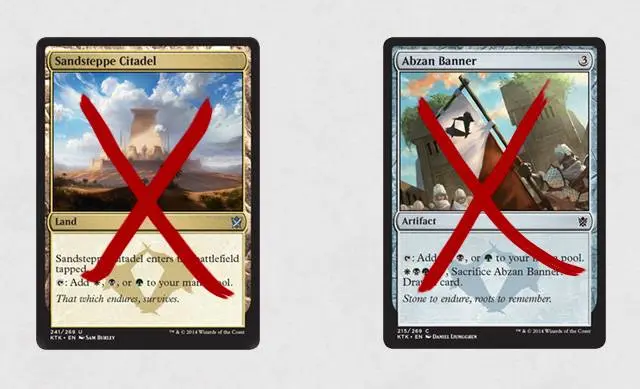
Put your focus on applying threats rather than scrambling to answer your opponent’s plays. The few answers you do include should be dedicated to dealing with the threats that would get in the way of your game plan (such as blockers).
Focus on reducing your opponent’s life total rather than protecting your own.
In short, you should dominate the battlefield early in the game, rather than plan on a long game.
Example 1: WB Aggro
Deck link
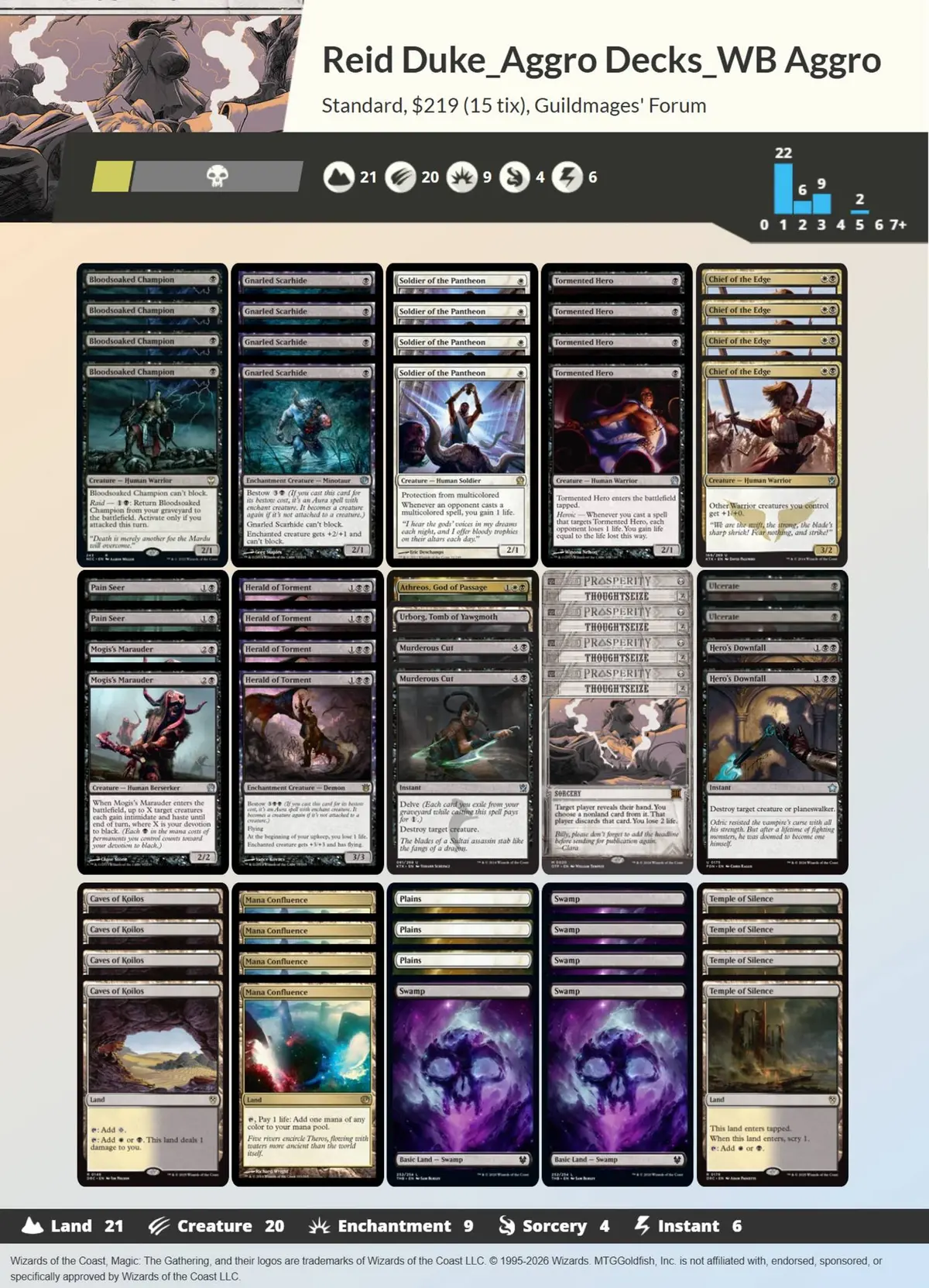
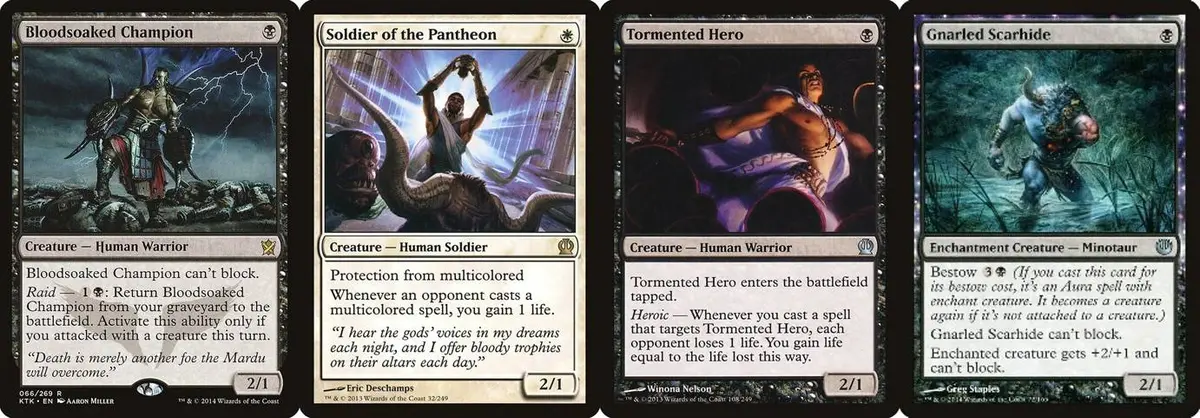
First, look at this deck’s mana curve. The deck has as many as 22 spells that need only one mana! The current Standard environment has five black/white creatures with “one mana, two power,” and this deck runs four of them at full playsets!Note 1 This means you have a very high chance of a strong opening on turn one, and a very good chance of casting two one-mana spells on turn two. Deploying threats as quickly as possible is the core of the tempo strategy of aggro decks.
Also note that no spell costs more than three mana. This means all your means of attack can be fully brought to bear early in the game. This configuration also lets the deck use only 21 lands, which frees up more room for threats.

In terms of card selection, Herald of Torment is a perfect first pick for an aggro deck. It costs only three, so it can come down early and pressure your opponent. However, if you face a land flood, or the game gets bogged down, its Bestow ability becomes the key backup plan. Bestow lets a creature on the battlefield immediately gain flying, bypassing the opponent’s blockers and creating a huge tempo swing. Although most creatures are subject to “Summoning Sickness” when they enter and can’t attack right away, a bestowed Herald of Torment can have an immediate and huge effect on the board! This flexibility to handle different situations is exactly what makes it appealing.
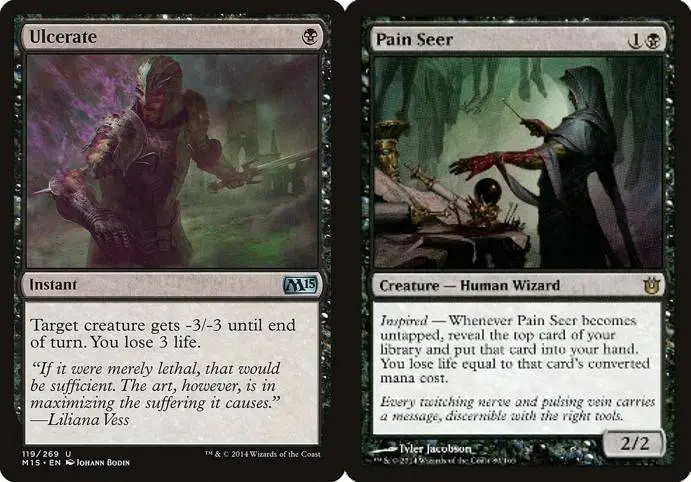
Many of the powerful cards in this deck (such as Herald of Torment, Pain Seer, Thoughtseize, and Ulcerate) will cost you life. In my experience, newer players tend to shy away from this kind of card. However, overcoming this fear of hurting yourself is crucial. After all, an aggro player doesn’t need to care too much about their own life total.
Remember: the best defense is a good offense!
Early in the game, you will be far ahead on tempo, pressing your opponent so hard they struggle to fight back. Even if something changes in the game and the opponent regains the initiative, that few points of life difference usually won’t decide the game. Your goal is to end the game before the opponent casts those expensive powerful cards, not to go toe to toe with them.
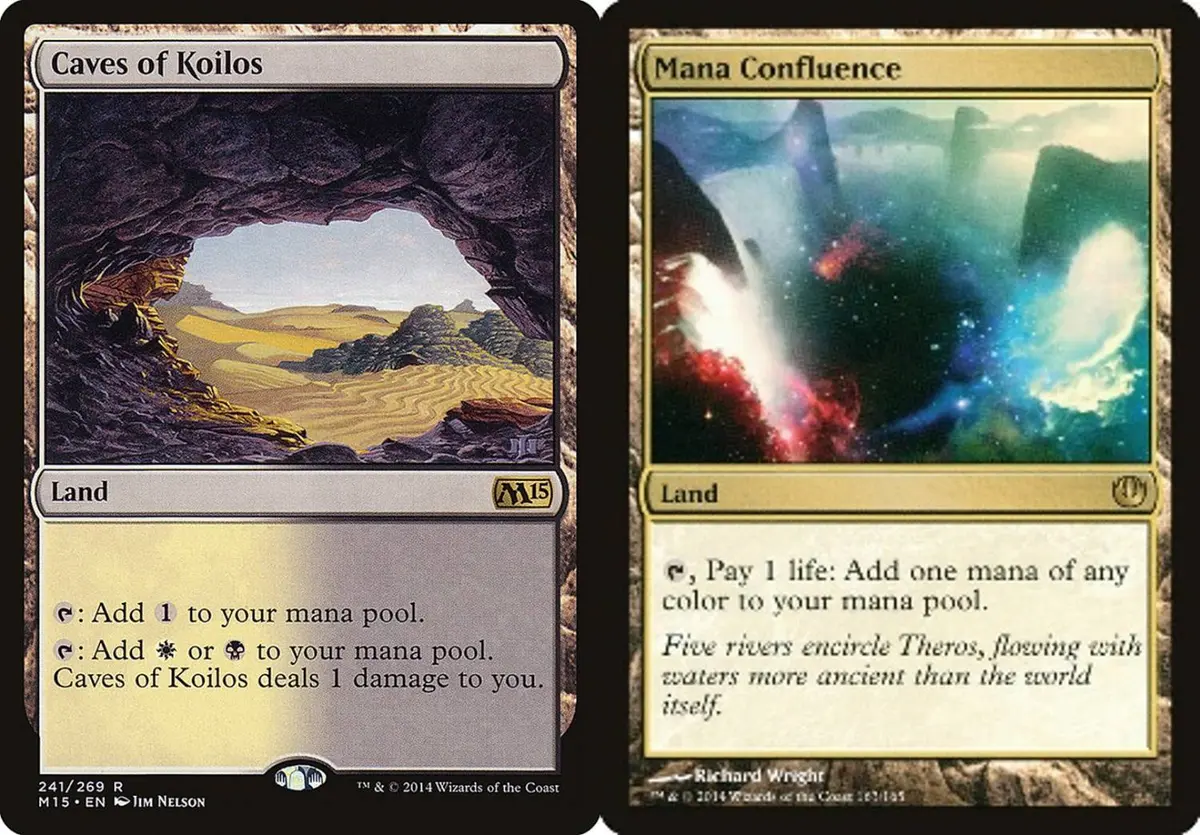
Likewise, a slower black-white deck might prefer Scoured Barrens over Caves of Koilos and Mana Confluence. As an aggro player, though, you must be happy to sacrifice life to maintain tempo. Lands that enter tapped slow you down and interrupt your mana curve, and that cost is unaffordable for an aggro strategy.
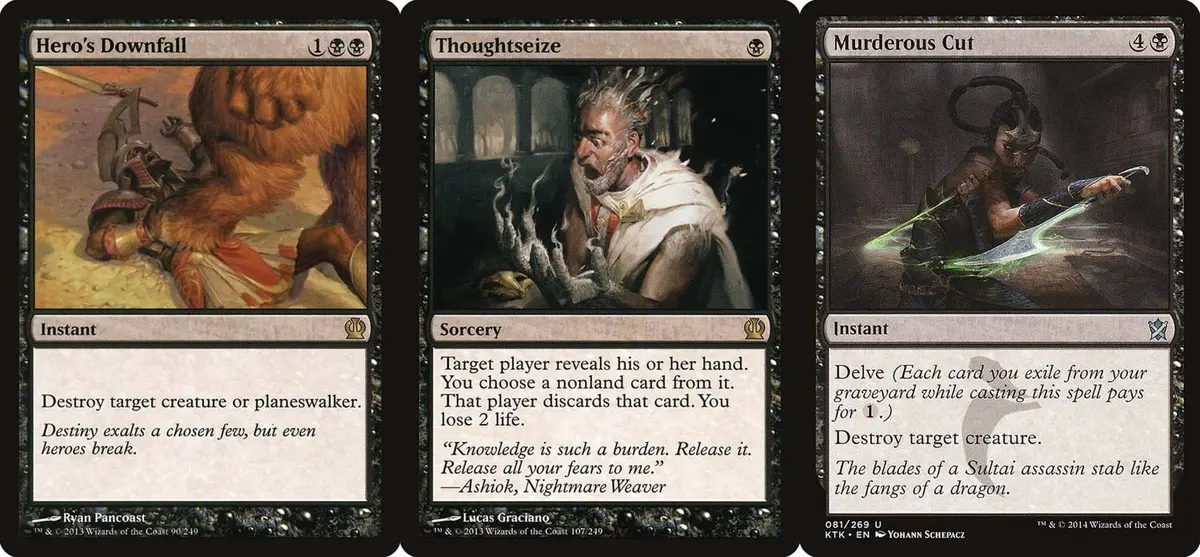
Finally, let’s look at this deck’s answers. Hero’s Downfall is a reliable way to clear out blockers and keep the attack going. Ulcerate and Murderous Cut are situational, and while they have more restrictions on use, their extremely high mana efficiency makes up for it. If you can kill a creature with a one-mana Ulcerate, or a Murderous Cut cast with Delve, and land your own threat in the same turn, the tempo advantage that creates is enough to overwhelm your opponent.
Thoughtseize is also an answer, but in an aggro deck its use is usually to answer your opponent’s answer. After all, the two great natural enemies of aggro are blockers and removal. You can’t remove your opponent’s removal with Hero’s Downfall, but you can discard it with Thoughtseize before they cast it. When the opponent is counting on a high-impact spell like End Hostilities to turn the game around, a well-timed Thoughtseize is especially valuable.
Attacking Your Opponent’s Life Total
The key to constructed formats is making sure the strategy of the entire deck is highly consistent. The essence of an aggro deck (like the WB Aggro above) is that every card exists to reduce the opponent’s life total. You don’t have to count on any single card winning the game by itself; if your Tormented Hero manages to deal 4 to 6 damage before it dies, it has fully done its job. The other cards in the deck will take the baton and move toward the same goal: taking the opponent’s life total from 20 all the way to zero.
Continually applying life-total pressure squeezes the opponent’s options even further. Just as aggro players trade life for tempo, your opponent will usually make similar resource trades. However, when facing a flood of cheap creatures, every time the opponent casts a Thoughtseize or taps Mana Confluence for mana, they will feel it painfully.
In addition, you can use the power of Athreos, God of Passage in ways other decks can hardly match. In a slow deck, the opponent might pay 3 life without a care to make your creature permanently dead. But when you are aggressively attacking the opponent’s life total, that option no longer exists. You put the opponent in a dilemma: give the creature back to you, or just concede? With Athreos, God of Passage, you can convert a tempo or life-total advantage into a card advantage, returning dead creatures to your hand.
Reach
There’s a famous saying in Magic: “All damage except the last point is meaningless.” What it means is that winning at 20 life and winning at 1 life have the same result.
There is some truth to this saying, but in fact, dramatically reducing your opponent’s life total is extremely valuable even if you don’t win right away. As the example of Athreos, God of Passage shows, reducing the opponent’s life total greatly squeezes their choices in the game.
What’s more, when a player’s life total runs low, panic quietly seeps into their decisions. The lower their life, the more likely they are to make unfavorable blocks, and the less willing they are to take bold, risky aggressive lines. The reason the opponent is forced to be so conservative is precisely that they fear your “Reach.”
Aggro decks are built on tempo. They get ahead early and extend that lead as far as possible, trying to convert tempo into a win or a life-total gap. Reach refers to the ability to force through a kill on a low-life opponent even after you’ve lost your initial tempo advantage.
In WB Aggro, your reach comes mainly from Herald of Torment and Mogis’s Marauder. Even if the opponent successfully takes over the ground with big creatures, as long as their life is low enough, drawing Herald of Torment (which creates a flying threat) or Mogis’s Marauder (which grants Intimidate evasion) lets you easily finish the game.
Example 2: Rabble Red
Deck link
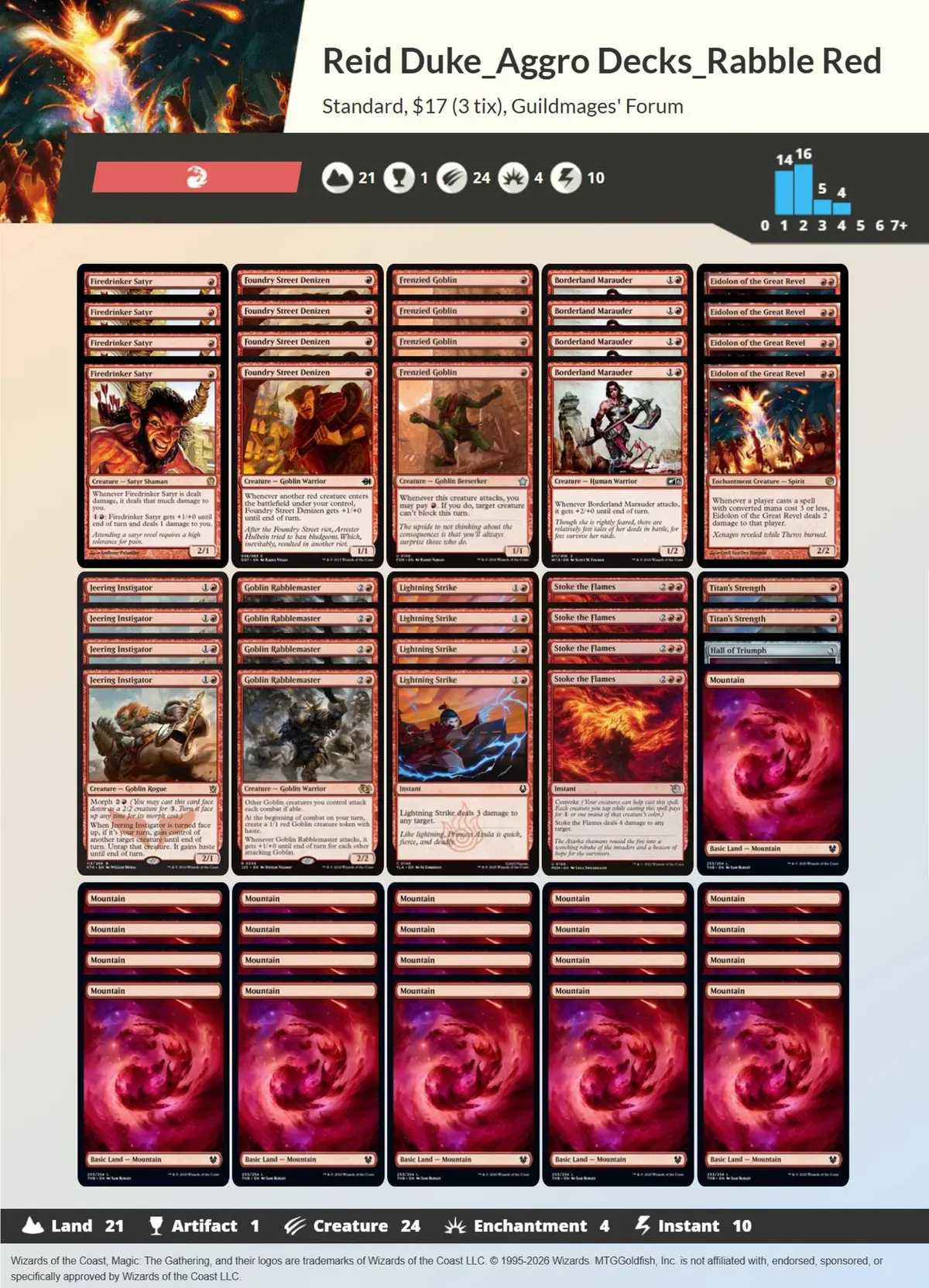
Traditionally, red is the best color for building aggro. Besides having plenty of cheap, aggressive creatures, red’s removal usually comes in the form of “Burn.”
Burn (direct damage) can not only kill blockers but also attack the opponent directly. It is the simplest and most effective source of reach. Against a Rabble Red deck, players must do everything they can to preserve their life total; once life drops to around 7, the game is no longer in their hands. No matter how big their board advantage, a Stoke the Flames followed by a Lightning Strike can turn the tables and kill the opponent in an instant at any time.
Proactive Strategies
Finally, I want to talk about the value of “staying proactive,” a core concept I’ve repeatedly mentioned throughout the Level One series.
Competitive Magic presents a special kind of challenge: you must face a series of unfamiliar players using strategies and card combinations you may never have seen, and it is nearly impossible to prepare thoroughly for every situation.
In big tournaments, the slower your deck is, the greater the risk. The longer the game drags on, the more chances the opponent has to overwhelm you with all sorts of powerful creatures, planeswalkers, or spell combinations. You have to have an answer ready for every powerful card.
Staying proactive, that is, having a fast, aggressive strategy that dominates the game, means you can focus on executing your own game plan rather than scrambling to answer your opponent’s plays. You are absolutely the expert at executing your own plan, but you can hardly predict and respond to every variable in a long game.
The logic is simple: if you can win the game before turn five, you don’t have to worry about any of your opponent’s powerful cards that cost five or more! Burn your opponent out and you don’t have to worry about spells that can’t gain life. Stay aggressive and force your opponent onto the defensive, provided, of course, that they can defend…
Note 1:The fifth option is an old friend from beginner tutorial decks, Loyal Pegasus. The reason for not playing it is also straightforward: the Pegasus’s drawback of being unable to attack alone contradicts the core tempo principle of aggro decks described above. Even if you land the Pegasus on turn one, you still need to land another creature on turn two before the Pegasus can attack on turn three. That is unacceptable for an aggro deck that is looking for an explosive start.
- Title
- Article Translation — Reid Duke's "Level One": Aggro Decks
- Author
- cephille
- Created at
- February 12, 2026
- License
- This work is licensed under CC BY-NC-SA 4.0 .
Related Articles
Article Translation — Reid Duke's "Level One": Choosing Your Deck
August 17, 2026

Article Translation: Reid Duke's "Level One": Sequencing
July 24, 2026
Article Translation: Reid Duke's "Level One": Playing in a Grand Prix: Part I
June 13, 2026
Article Translation — Reid Duke's "Level One": Board Sweepers
April 7, 2026