
Article Translation — Reid Duke's "Level One": Choosing Your Deck

Note: This article was translated from Chinese by AI and may contain errors. Read the original Chinese version.
Note 1: This is a translated article. The actual author is Magic: The Gathering Hall of Fame player and Channel Fireball member Reid Duke, and the copyright of the article belongs to Wizards of the Coast. Although the authors field is marked as me, in this series of articles it is used only to credit me as the translator, as I would not dare take credit from the original author.
Note 2: This article and the following articles in the series were translated from the original using Gemini and Perplexity and then polished. Every article includes a link to the original, and readers are very welcome to read the original on the official website!
Note 3: Since the original was published more than ten years ago, the translator will, where appropriate, add annotations explaining situations that differ from the original at the time of translation.
Article Translation: “Level One”: Choosing Your Deck
Wizards of the Coast column: Feature
Date: June 8, 2015
Author: Reid Duke
As a Magic: The Gathering columnist, guess what question I get asked most often?
“Which deck should I play next weekend?”
And every time someone asks, I always wish I could give some kind of simple and useful answer.
The problem is that choosing a deck is complicated and thorny. It is the question Magic players most often agonize over, even losing sleep. Although there may not be a simple answer, we can still explore together: how should you choose the right deck for a tournament?
Copying Decks and Building Your Own Decks
In some groups, “copying decks” (copying a decklist from the internet) can carry a certain stigma. Among a small group of friends, you can of course set whatever play guidelines you like. But once you step into the world of competitive events, copying decks is the norm; you should be prepared to face it, and even accept it. If anything, building a deck from scratch can be seen as admirable, but copying decks should not be looked down upon.
Copying a decklist with strong tournament results has many advantages. The most direct is that you can at least be sure you are using a deck that has been proven in actual play and already has good tournament results. Just as important, when you adopt a popular deck from the internet, you also inherit the results of thousands of players’ testing and tuning.
Take Mono-Red Aggro in Standard as an example. Countless players brought their own intuition, experience, and judgment into the decklist. They adopted the land count they thought suitable, arranged the main deck structure in the way that best raises win rate, and put the cards they expected to be most helpful in the sideboard. No one can guarantee that a single player’s judgment is entirely correct; but over time, the better-performing versions win more, and the traits of those versions are kept and carried into later Mono-Red decklists. This is precisely Charles Darwin’s “survival of the fittest”!

When you choose a popular deck from the internet, you also save a great deal of time and energy to invest in the other parts of tournament preparation. If you have already decided to play Mono-Red, you can now focus all your effort on tuning the decklist and practicing gameplay.
Building a deck from scratch is an extremely difficult task. Even among world-class players, only a few will attempt it, let alone those who could be called “masters.” A common saying goes: for every good deck idea, there are nine bad ones. Succeeding against such unfavorable odds takes a great deal of creativity, intuition, perseverance, effort, and discipline. Generally speaking, when you try to build your own deck, you will be at a disadvantage.
But that absolutely does not mean you shouldn’t try! First, when you successfully build a good deck from scratch, you gain a significant edge over the whole field. You will have a deck that nobody expected and nobody prepared to face. Your opponents won’t know which cards you might use against them.
More importantly, deck building is one of the best ways to learn and grow as a player. When you handle both deck building and piloting yourself, you develop a deeper understanding of game situations and of what leads to wins and losses.
You don’t need to feel obligated to always create your own deck, especially when the time you can put into preparation is limited. However, building your own deck is very helpful and very rewarding, and I encourage everyone to try it at least once in a while.
A Deck that’s Good for the Metagame
Last week, I talked about the concept of the metagame, in particular which cards and decks you expect your opponents to use. If you can predict the metagame accurately, you have a chance to build, choose, or adjust a deck that precisely targets the opponents you are most likely to face.
When Blue-Black Control is the most popular deck, how great would it be to feel delighted during a match when your opponent plays Temple of Deceit on turn one. Sometimes, when you specifically target certain decks, and those decks have not been specially tuned to beat you, you can turn that into a huge advantage.
However, predicting the metagame is itself full of uncertainty. A field is often quite diverse; you will also frequently misjudge the decks other players actually bring, even if only slightly. Even if your read of the metagame is entirely correct, you still can’t predict who you will actually be paired against in the tournament.
A Deck with Raw Power
If you want to be affected as little as possible by your opponents’ deck choices, you may want to consider a deck with raw power. “Power” is a slightly abstract concept in MTG; it refers to how strong a deck or a card is in itself, setting aside the format and metagame context.
I habitually measure a deck’s raw power with this question: “If I faced an infinite number of games against varied opponents and decks, how well would this deck perform relative to my other options?”
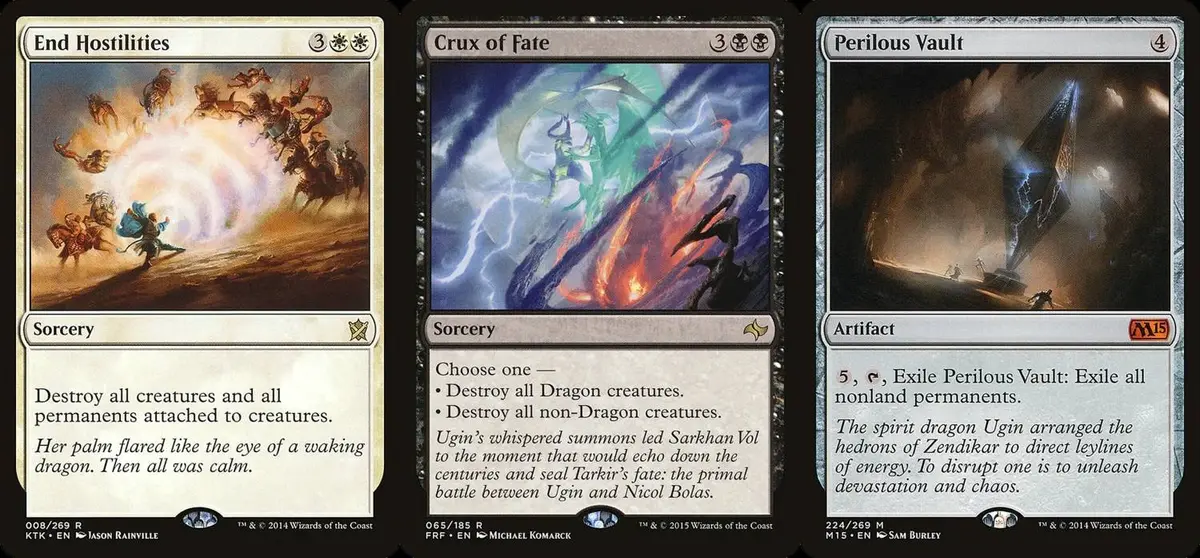
For example, Mono-Green Devotion has very high raw power. It develops quickly and is explosive; if left undisturbed, it can usually overwhelm most opponents with board and resource pressure. However, if too many people in the metagame are playing cards like End Hostilities, Crux of Fate, and Perilous Vault, it can still be a terrible metagame choice.
Sometimes the situation calls for a metagame-oriented choice; at other times it is best to default to a deck with very high raw power. If you can find the intersection of the two, that is the ideal outcome.
A Proactive Game plan
Recall that being proactive means moving toward your own powerful goal rather than merely reacting to what your opponent does. The best example of being proactive is adopting an aggro strategy and trying to win the game as quickly as possible!
Because tournaments are so diverse and full of uncertainty, there is a huge advantage in focusing on your own game plan and knowing that you will probably win if you execute it successfully. Preparing answers for everything your opponent might have is much harder. The longer a game drags on, the easier it is for you to make mistakes.
Even for decks that are otherwise slower and control-oriented, I advocate having a proactive game plan. Dragonlord Ojutai is a great proactive card in a control deck. It helps you turn a small advantage into an insurmountable one, and can end the game quickly when you are ready.

Inevitability
On the other hand, inevitability is also extremely valuable. If the game is extended indefinitely and you will almost certainly win, then you have inevitability.
When you have inevitability, you only need to hold on to win the game. Very often, defending yourself is easier than actually defeating your opponent.
However, the most dangerous situation is when you think you have inevitability but actually don’t. That is why a proactive game plan matters: when something unexpected happens, you will want the ability to actively fight for the win.
Esper Dragons is a successful deck in Standard because it has inevitability against most of the other popular decks in that format. In addition, although it is a slower deck, it can dominate the battlefield with Dragons alone, so it has a sound proactive game plan.
The Nature of Sideboarded Games
One common pitfall for Constructed beginners is underestimating the importance of the sideboard. A deck like Mono-Red can easily be exciting, because its win rate in game one, before sideboards come into play, can be very high. However, only when Abzan and Esper players can bring in large numbers of Drown in Sorrow and Pharika’s Cure after sideboarding will you see the full picture.
How a deck performs in sideboarded games may be an important reason for deciding whether to choose it. Historically, midrange decks benefit most from the sideboard. Their structure is more well-rounded, so they have the greatest flexibility in sideboard adjustments and are not easily targeted precisely by the opponent. Generally speaking, the more extreme your strategy, such as suicide aggro, control decks lacking a proactive game plan, and linear strategies, the more easily it is targeted by sideboards.
Do You Enjoy the Deck?
It may seem strange to raise this factor in a column devoted to strategy, but I absolutely believe it affects your tournament results. When you are having fun and feel passionate about a deck, you perform better. If you force yourself to use a deck you hate or lack confidence in, that will also show.
When using a deck you like, it is easier to concentrate, and you naturally spend more time thinking about the deck. As a result, you are more likely to get inspiration for main deck tweaks or find new sideboard options.
Conversely, when you don’t enjoy using your deck, you may feel helpless and stagnant. You won’t look for ways to improve the deck, and you may also make bad mulligans or in-game decisions simply because you don’t believe the deck can do any more.
Sticking With the Same Deck
This brings us to what I consider the single most important factor in choosing a deck: how well can you play it?
This is necessarily closely related to how much you like the deck, but it is not the only thing. Have you used it in previous tournaments? Did you do well? How much have you practiced? Have you used a similar deck in other formats in the past?
How well you command the deck you choose is usually more important than which deck you actually chose. I would rather play a weaker deck well than play a stronger deck poorly.
I think one of the biggest secrets to success in Constructed is to keep using the same deck across multiple tournaments. You gradually understand it more deeply, improve your piloting, see the reasons you win or lose games, make better sideboard decisions, and become better at swapping cards and improving the whole deck.
Practicing at home certainly brings many gains, but nothing can truly replace being tested under tournament conditions against all kinds of opponents. Predicting the metagame is certainly important, and being prepared for surprises is just as crucial. When you truly master a deck, not only can you adapt faster, but even against a deck you have never faced, you know what to do.
Most importantly, just like building a deck from scratch, truly mastering a deck is one of the best learning opportunities you can find. Building a very deep understanding of a single deck will teach you lessons you can carry over to other decks and other formats.
Over the years, the most successful and fastest-growing periods of my career have been the times when I could stick with the same deck through a series of tournaments. Unless you find that the deck you are using has a fatal flaw, I encourage you to lean toward “sticking with the same one” over “changing repeatedly.”
You don’t need to use the objectively strongest deck to get good results in tournaments, but you must choose a deck that lets you realize your potential as a player. Think carefully, then commit fully, and don’t waver back and forth. Most importantly, don’t forget to enjoy the fun of it.
- Title
- Article Translation — Reid Duke's "Level One": Choosing Your Deck
- Author
- cephille
- Created at
- August 17, 2026
- License
- This work is licensed under CC BY-NC-SA 4.0 .
Related Articles

Article Translation: Reid Duke's "Level One": Sequencing
July 24, 2026

Article Translation: Reid Duke's "Level One": Playing in a Grand Prix: Part I
June 13, 2026

Article Translation — Reid Duke's "Level One": Board Sweepers
April 7, 2026

Article Translation: Reid Duke's "Level One": Midrange Decks
March 25, 2026