
Article Translation — Reid Duke's "Level One": Control Decks

Note: This article was translated from Chinese by AI and may contain errors. Read the original Chinese version.
Note 1: This is a translated article. The actual author is Magic: The Gathering Hall of Fame player and Channel Fireball member Reid Duke, and the copyright of the article belongs to Wizards of the Coast. Although the authors field is marked as me, in this series of articles it is used only to credit me as the translator, as I would not dare take credit from the original author.
Note 2: This article and the following articles in the series were translated from the original by Gemini 3 Pro and then polished. Every article includes a link to the original, and readers are very welcome to read the original on the official website!
Note 3: Since the original was published more than ten years ago, the translator will, where appropriate, add annotations explaining situations that differ from the original at the time of translation.
Article Translation: “Level One”: Control Decks
Wizards of the Coast column: Feature
Date: October 6, 2014
Author: Reid Duke
Magic: The Gathering is a complex game, with many battles to face and many opportunities to gain an advantage. Last week we explored aggro decks, which excel at using tempo to win games. In the world of Constructed, however, there are countless possible strategies, each focused on a different aspect of the game and gaining an advantage by different means.
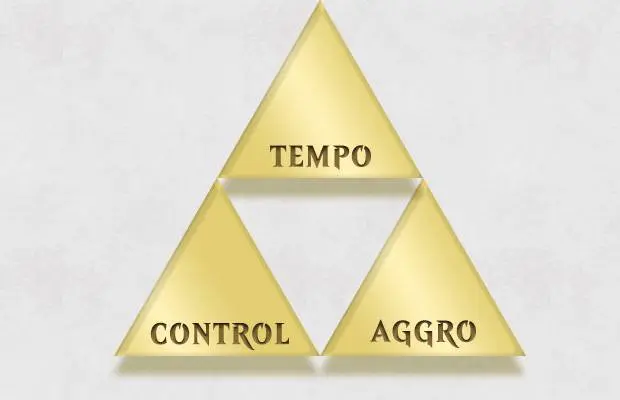
Control decks are the polar opposite of aggro decks. Aggro pursues speed, while control is built for the long game. While the aggro deck is busy executing its own plan to win, the control deck works to hold the opponent in check and win the game later at a suitable moment. We call them “control decks” because their goal is not to kill the opponent quickly but simply to dominate the game. Their first priority is to stop the opponent from executing their game plan. It is a very effective strategy, and especially appeals to players who enjoy long and often more complex games.
Card Advantage in Control Decks
Every Magic deck must take the concept of “tempo” into account when it is built. Aggro decks win the game (or at least gain a huge advantage) through a fast start and a tempo advantage; control decks, by contrast, only need to avoid falling too far behind on tempo and losing. Aggro wants to be ahead on tempo, while control only needs to keep pace. Aggro wins through tempo, and control cares about tempo only as it relates to defending itself.
Control decks, in turn, usually take the lead through card advantage. If a control deck can successfully survive the first few turns and drag the game out, most opponents will run out of resources and have nothing left to go on. On the other hand, once a control deck’s expensive spells and card advantage start working, it grows ever more powerful.
Control decks want as much card advantage as possible, and ideally it should come in the simplest and most direct way. Traditionally, the most favored method is simply casting spells that let you draw extra cards.
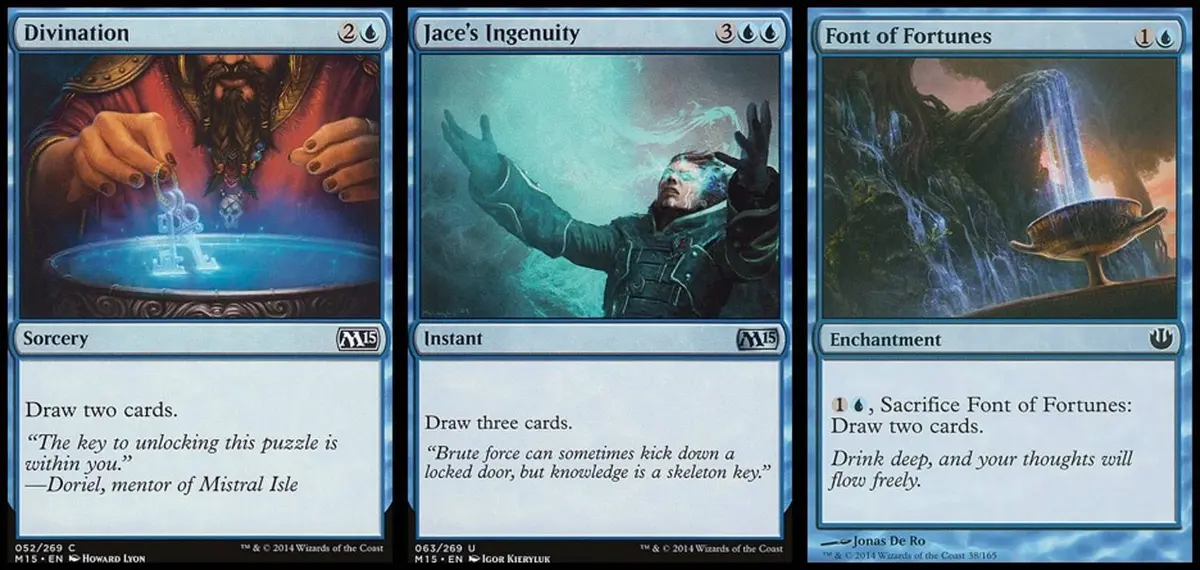
Imagine a game that has gone to turn ten or eleven. Your opponent is playing an aggro deck and is now close to running out of gas. You have weathered the early creature onslaught, and now your opponent can only draw one card from the top of their library each turn. Usually, that card will be a useless land.
You, meanwhile, are playing a control deck with the draw spells described above. By turn eleven you have cast several draw spells, which means you have drawn about 25 cards from your library while your opponent has only 18. That very likely means you have more mana, a fuller hand, and more creatures and spells to commit to the fight. Beating your opponent’s meager one draw per turn is a piece of cake! As long as your deck has enough draw spells, they chain together and you never have to worry about mana flood. Your opponent is buried under an avalanche of card advantage until you find some powerful creature or planeswalker to put them out of their misery!
Inevitability
Your card advantage may come from creatures, spells, planeswalkers, or any other form. However, it must exist, and it must exist in a high enough concentration, or your deck will not function properly.
Control decks are built on the premise of “inevitability.” In the late game, the deck must be powerful enough that its pilot is confident that as long as they can hold the line and stretch the game out indefinitely, they will eventually win.
Achieving inevitability is always the first task of building a control deck. If you successfully withstand your opponent’s early assault but ultimately lose the game to mana flood, then all your earlier effort goes to waste!
“Inevitability” is an important and complex concept, and I will explore it in more depth in the future. For now, understand it this way:
If your deck is powerful enough to guarantee that, once the game goes long, you win a very high percentage of games, then you have “inevitability.”
Make sure you have inevitability by including enough card advantage and powerful cards in your deck.
Example: White-Blue Control
Deck link
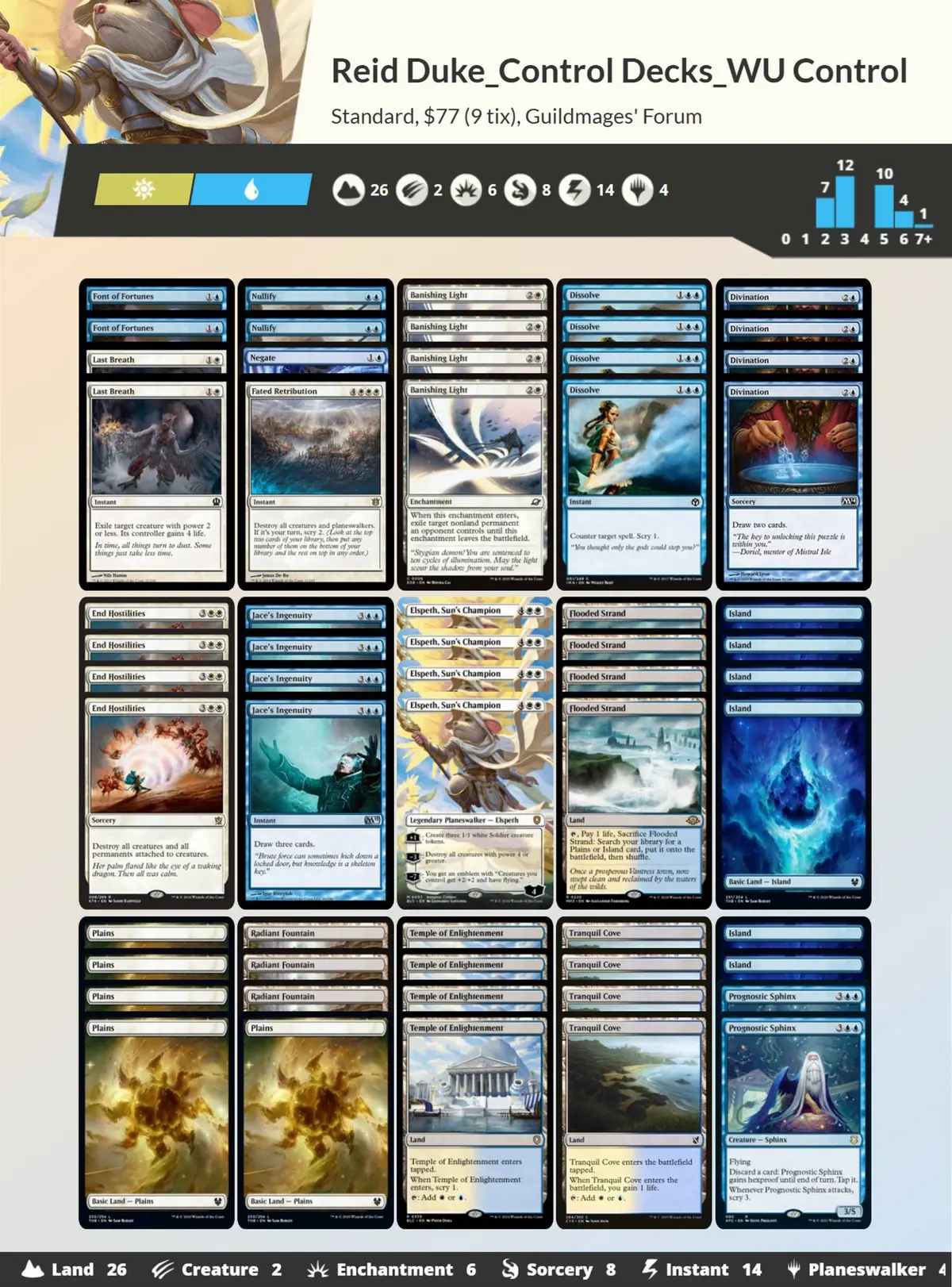
This white-blue deck is a very classic example of a control deck, featuring the most prominent traits of this archetype (a specific strategy with many variants that appears again and again).
Mana in Control Decks
The first thing to notice is the extremely high land count: 26 lands! We have already mentioned that draw spells and powerful cards reduce the risk of mana flood, which gives the deck the room to afford a high land ratio. But why is it so important for control decks to have a high concentration of mana?
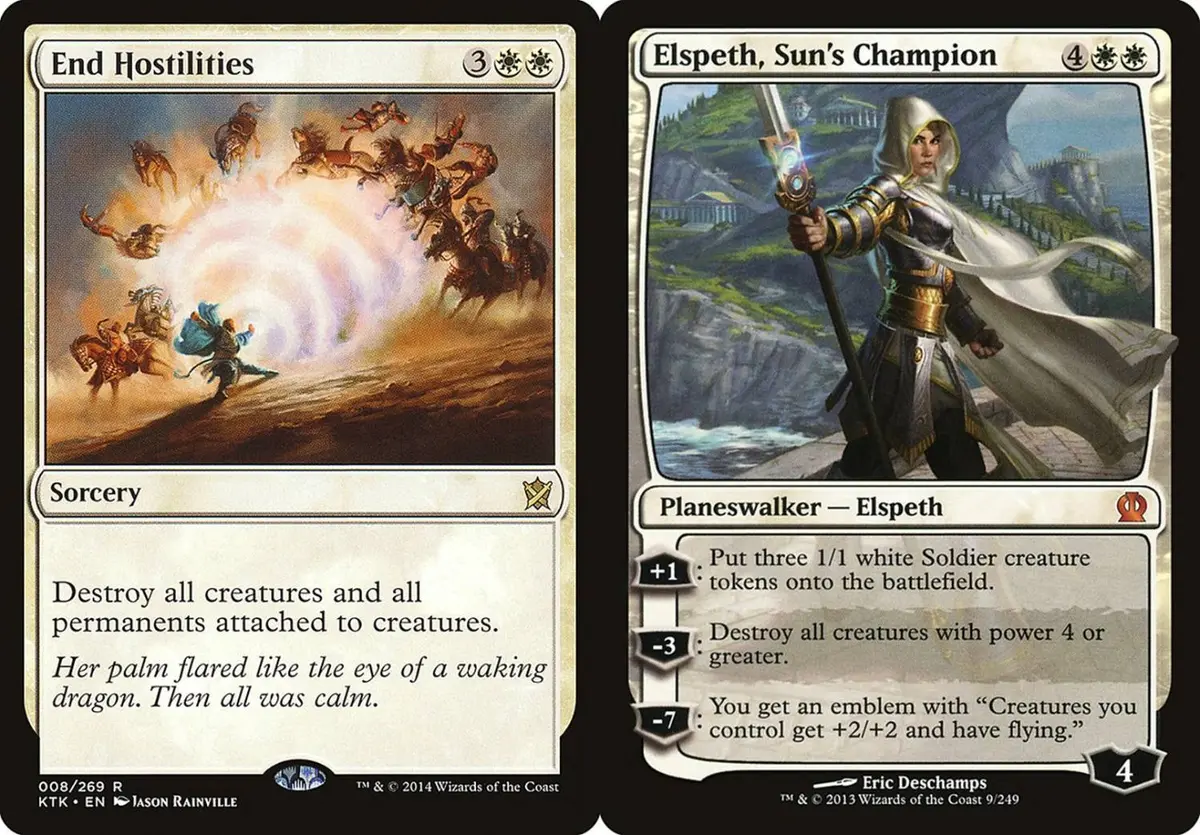
An aggro deck hopes to stop drawing lands after its third or fourth one, but a control deck usually needs to make sure it can reliably make a land drop every turn, all the way through turn six, turn seven, or even longer. Because control decks focus on the late game rather than the early game, they may not have as many cheap plays as other decks and cannot function properly if they miss land drops. On the other hand, they rely on powerful cards such as End Hostilities and Elspeth, Sun’s Champion to catch up on tempo, so when the time is right, having the mana to cast them is crucial.
Creatures in Control Decks
New players may be surprised that a deck would run only two creatures. After all, an aggro deck may run 28 or more, and I have even recommended at least 14 creatures for a Sealed Deck. However, an extremely low creature count is actually common in control decks. As mentioned earlier, control decks focus on defense and card advantage, and seek to win only after firmly “taking control of the game.” A few powerful and reliable win conditions are the most efficient way to carry out this plan.
A low creature count brings two major advantages:
- Virtual Card Advantage: You can make your opponent’s creature removal spells useless. Imagine your opponent holding Murderous Cut or Devouring Light only to find that you have no creatures on the battlefield at all. At most they can use them on the tokens made by Elspeth, Sun’s Champion (which costs you nothing at all and even gains you card advantage), or to tap down Prognostic Sphinx for a turn. Their removal gets stuck in their hand until the end of the game, completely unable to deliver its intended performance.
- Making use of Symmetric EffectsNote 1: In the example, End Hostilities is the core of the deck, and Fated Retribution and the [-3] ability of Elspeth are also powerful tools against threats en masse.
Permission Spells
Finally, this control deck includes a type of card we have not yet discussed in “Level One.” These are “permission spells.”
Meaning: “Reid, may I, may I please cast my spell?”
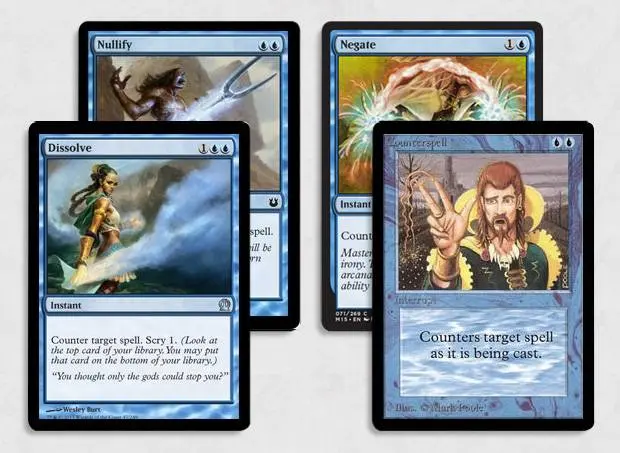
These cards are also called “counterspells” because of their text and in homage to their classic progenitor. (Counterspell itself is too powerful by today’s standards and has not been reprinted for many years.)Note 2
Permission spells are excellent defensive tools because they can snuff out threats before they take shape. Murderous Cut cannot stop the ability that triggers when something like Siege Rhino enters the battlefield, nor can it handle planeswalkers, instants, or sorceries; but Dissolve solves all of these problems at once.
Permission spells fit perfectly with the goal of “inevitability.” When the game reaches the late stage and is going according to plan, holding a Dissolve means your opponent has almost no hope of a comeback.
The only drawback is that permission spells cannot help you come back from behind. Once a creature or planeswalker resolves, you have to find another way. As a result, using them correctly in actual play takes considerable skill. Sometimes, to avoid falling behind, you have to Nullify whatever your opponent plays on turn two (which is the case in those extremely tempo-focused matchups). At other times, you must be extremely patient and save Dissolve for the devastating threats you cannot handle at all.
Mixing permission spells with removal is the ideal configuration, giving you the flexibility to handle all kinds of situations.
Building a Control Deck
When building a control deck, your first goal is “inevitability.” Stuff your deck with enough card advantage and powerful cards that you are confident of winning in the late game. Without that, a control strategy is nothing but empty talk.
Next, focus on early defense. Everything you do is to survive, develop your mana, and accumulate card advantage. Do everything you can to dismantle your opponent’s offense, whether with permission spells, removal, blocking creatures, or other means. As long as it gets you to the moment of showing your late-game dominance, any method is a good method.
Although I have introduced only one example of a control deck, they can take many forms. Blue is the most common control color (and the color of permission spells). Some dominate the battlefield with planeswalkers, some achieve inevitability by recycling resources from the graveyard, and some rely on powerful combos that are hard to break through. Whatever the form, the core of a control deck is the same: card advantage, inevitability, and defense.
The late-game dominance of control decks is often hard to resist. For competitive-level events it is an excellent choice. Precisely because these decks are complex to operate and games are long, if you can practice in advance and truly master it, you will be richly rewarded.
But note that building a control deck presents a special challenge: you must be prepared to handle whatever tricks your opponent may pull out. You need to figure out which strategies you may face and have a plan to thoroughly dismantle them. Do that, and before long your opponent will have no choice but to wave the white flag and beg for mercy.
Note 1: Since control decks run almost no creatures, they can use sweeper spells without hesitation and benefit from “symmetric effects.” Of course, it is not at all “symmetric” for your opponent!
Note 2: Counterspell was finally reprinted in Modern Horizons 2, released in 2021, and is legal in Modern and above; however, the card is still too powerful for the current Standard format.
- Title
- Article Translation — Reid Duke's "Level One": Control Decks
- Author
- cephille
- Created at
- February 21, 2026
- License
- This work is licensed under CC BY-NC-SA 4.0 .
Related Articles

Article Translation — Reid Duke's "Level One": Choosing Your Deck
August 17, 2026

Article Translation: Reid Duke's "Level One": Sequencing
July 24, 2026
Article Translation: Reid Duke's "Level One": Playing in a Grand Prix: Part I
June 13, 2026

Article Translation — Reid Duke's "Level One": Board Sweepers
April 7, 2026