Article Translation: Reid Duke's "Level One": Midrange Decks

Note: This article was translated from Chinese by AI and may contain errors. Read the original Chinese version.
Note 1: This is a translated article. The actual author is Magic: The Gathering Hall of Fame player and Channel Fireball member Reid Duke, and all copyright belongs to Wizards of the Coast. Although the authors field lists me, in this series I serve only as the translator, and I would not dream of taking credit for someone else’s work.
Note 2: This article and the following articles in the series were translated from the original by Gemini 3 Pro and then polished. Each article includes a link to the original, and readers are very welcome to read the original on the official site!
Note 3: Since the original was published more than ten years ago, the translator will, where appropriate, add annotations explaining where the situation at the time of translation differs from the original.
Article Translation: “Level One”: Midrange Decks
Wizards of the Coast column: Feature
Date: October 27, 2014
Author: Reid Duke
Pushing things to the extreme is often a shortcut to learning, but seeking balance is frequently the real key to winning. Aggro decks yearn to attack, while Control decks focus on defending. Between the two lies a third category that is hard to define in a single phrase, which we call “Midrange Decks”. These decks are designed from the start with both offense and defense in mind, which gives them tremendous adaptability no matter what kind of game they face.

Adaptability and Versatility
Ari Lax won Pro Tour Khans of Tarkir with Abzan Midrange. Over thirteen rounds, he defeated control, aggro, burn, other midrange decks, and all manner of other archetypes. The core of his success was “adaptability”: taking the initiative when ahead, staying calm when pressured, and backing it up with excellent sideboard strategy, reading the opponent’s plan and answering it precisely.
Ari Lax’s Abzan Midrange
Decklist link
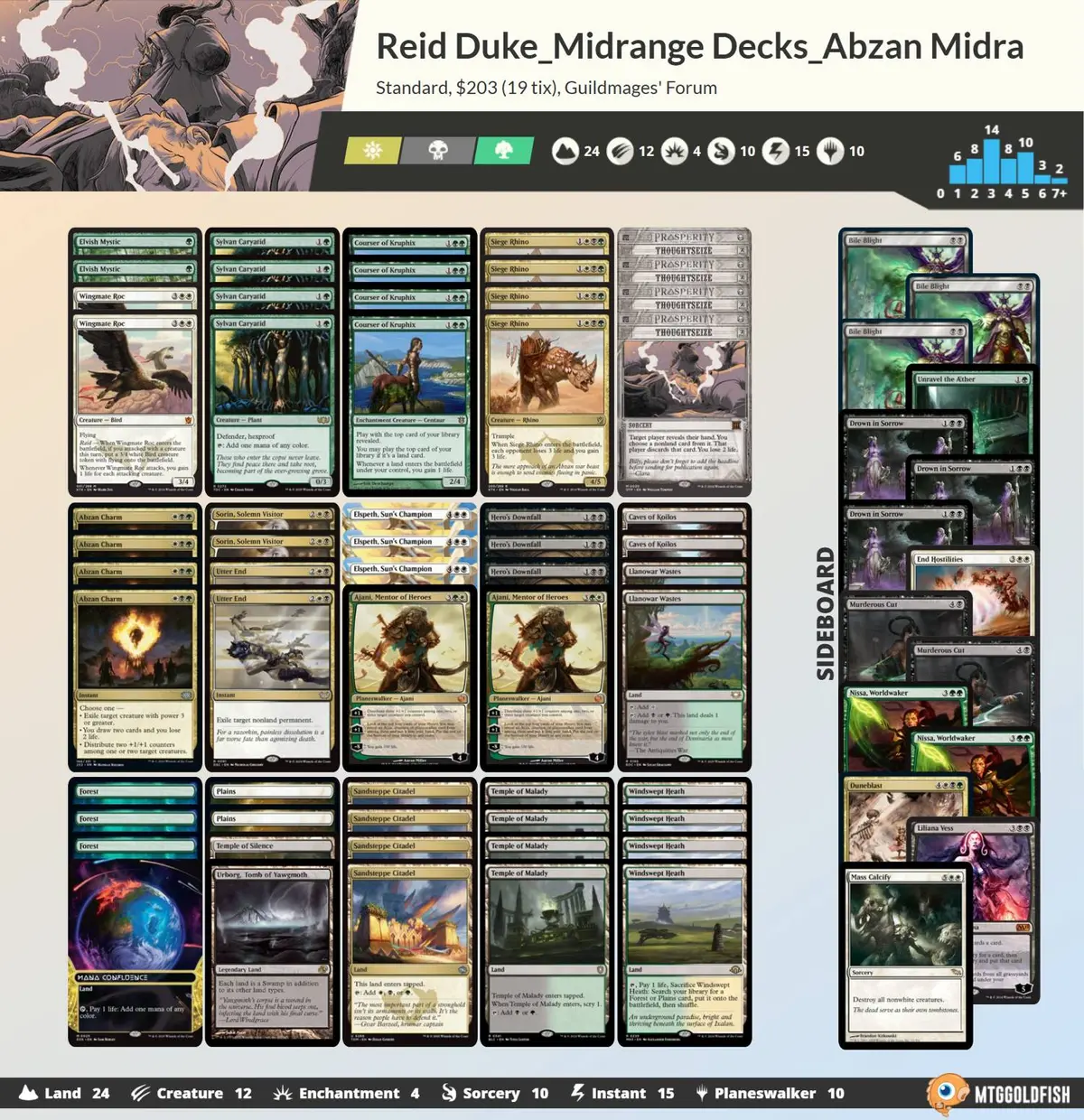
Mr. Lax’s deck looks quite different from the other decksNote 1 we have featured over the past few weeks. It has a healthy number of creatures, but it also emphasizes removal, mana development, and resilient noncreature threats. Its strategy neither rushes to decide the game early nor pursues the absolute late-game inevitability of a control deck, but instead accumulates small advantages and builds toward a winning board state. In short, it is a very balanced deck.
The perfect individual cards for a midrange deck are those that perform well on both offense and defense. Notice that Ari’s deck contains neither a purely aggressive card like Firedrinker Satyr, nor a card like Jace’s Ingenuity that badly sacrifices tempo for a long-term investment. A midrange deck’s adaptability comes from the versatility of each individual card: these cards have a use in every possible situation.
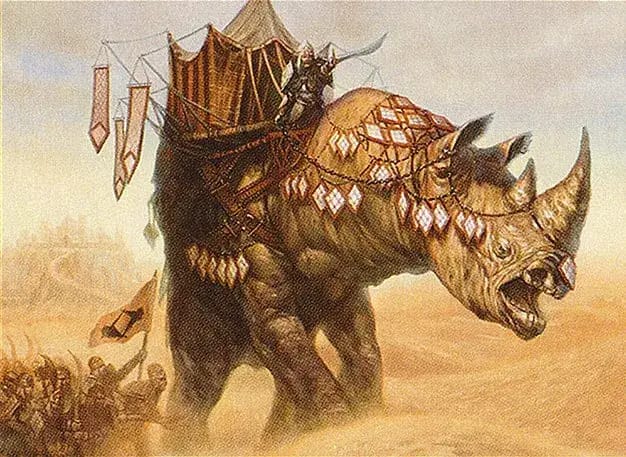
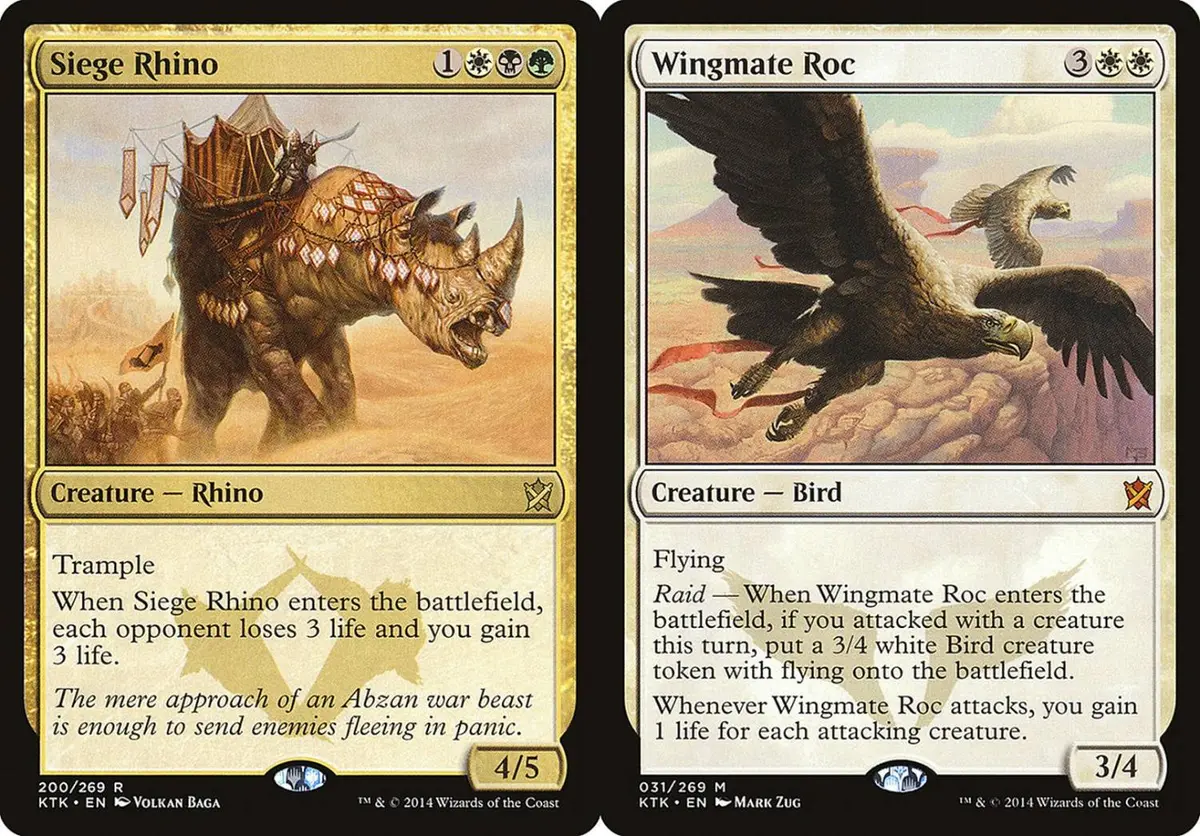
Take Siege Rhino. It is a creature that can deal a lot of damage quickly, and if the opponent cannot deal with it, it can win the game by itself. Yet with its high toughness and life gain, it is also an excellent card for coming back from behind against an opposing creature deck. The moment it lands it stabilizes the board and recovers life, buying you time to cast your later spells, and once the time is right it can switch from defense to offense.
Siege Rhino and Wingmate Roc were carefully chosen: they are both effective finishers and excellent on defense. Beyond that, every creature in the deck has a non-combat ability that is useful once the game goes long. Elvish Mystic and Sylvan Caryatid can block in an emergency, but their main purpose is to serve as extra mana sources and accelerate the deck so it can keep up with the pace of aggro decks. Courser of Kruphix can stay on the battlefield to hold off the opponent’s small creatures and keep generating card advantage in long games, while also providing steady life gain.
Another perfect example of versatility is Abzan Charm. A card with three completely different modes is the best definition of “versatile”! Moreover, one of Abzan Charm’s modes is defensive (exile the opponent’s creature), one is offensive (grow your creatures to deal extra damage, or win a fight against your opponent’s creature), and one is an investment for the late game (draw extra cards). You are never disappointed to draw Abzan Charm, because it is useful in nearly every imaginable situation.
Along these lines, notice how Ari Lax stuffed his deck with removal while avoiding any option that could become a dead card in a particular matchup:
- Thoughtseize: Every deck uses nonland spells, and Thoughtseize is especially good against the noncreature spells of control decks.
- Abzan Charm: Three modes, so you can find the right one for the current situation.
- Hero’s Downfall and Utter End: Even against control decks, you can remove the opponent’s planeswalkers or Banishing Light to free up your own threats.
- Elspeth, Sun’s Champion: It can destroy troublesome creatures like Thundermaw Hellkite, and it is also Abzan’s most powerful way to win the game!
The Sideboard
The greatest strength of a midrange deck is flexibility, so it cannot be fully defined without talking about the sideboard. Midrange decks lack the speed of aggro decks and the late-game power of control decks. However, they excel at exploiting the weaknesses of other decks and finding the best way to handle any situation. Midrange decks often truly shine after sideboarding, because that is when they can refine themselves to perfection for a specific matchup.
In the main deck, we try hard to avoid putting in “dead cards” for particular matchups. In the sideboard, however, we need not sacrifice power for versatility.
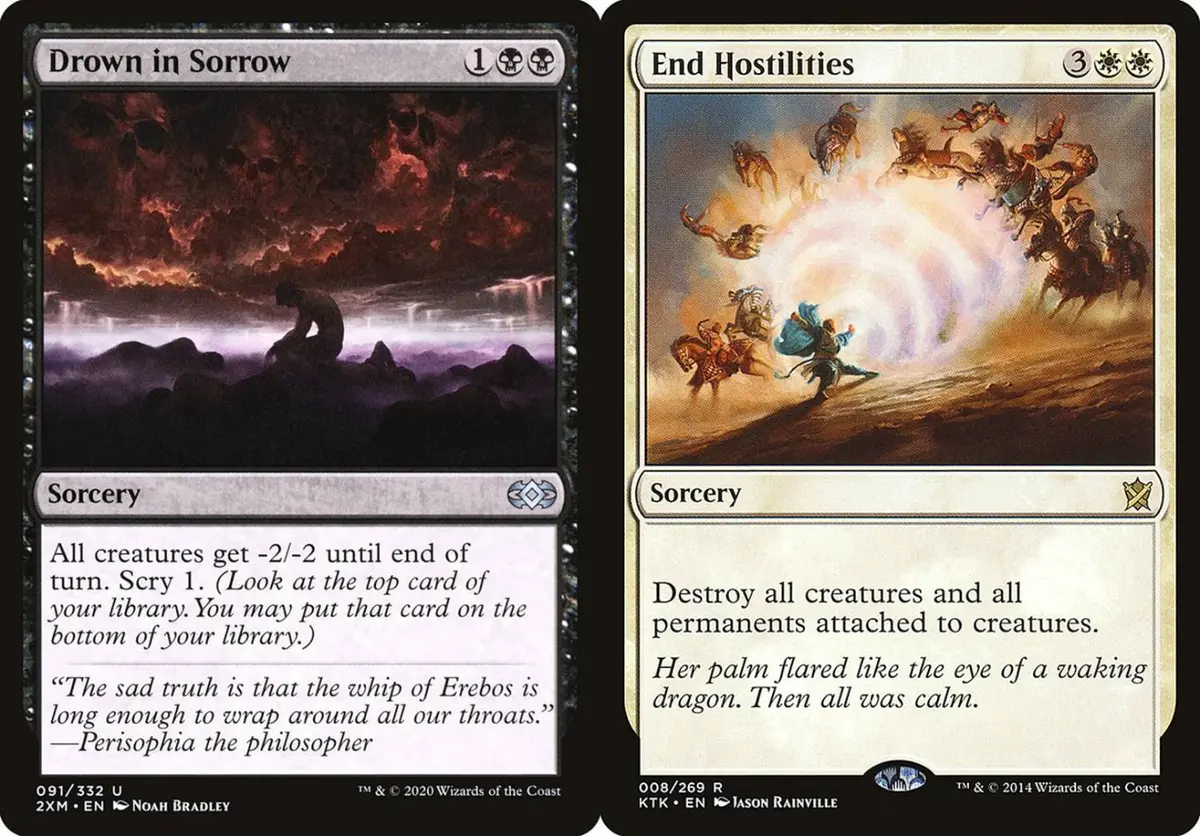
Because midrange decks are well balanced and their strategy is not lopsided, they can bring in almost any kind of sideboard card. Notably, Ari Lax chose to use several cards with “symmetric effects”, such as End Hostilities. Although most creature decks shy away from such cards, Ari knew that in the matchups where he brought it in, the opponent would be devastated by it, even at the price of sacrificing one or two of his own creatures.
However, midrange decks do not only have defensive sideboard cards. With a creature base and the ability to apply life-total pressure, they can also bring in dedicated threats to put particular opponents in trouble.
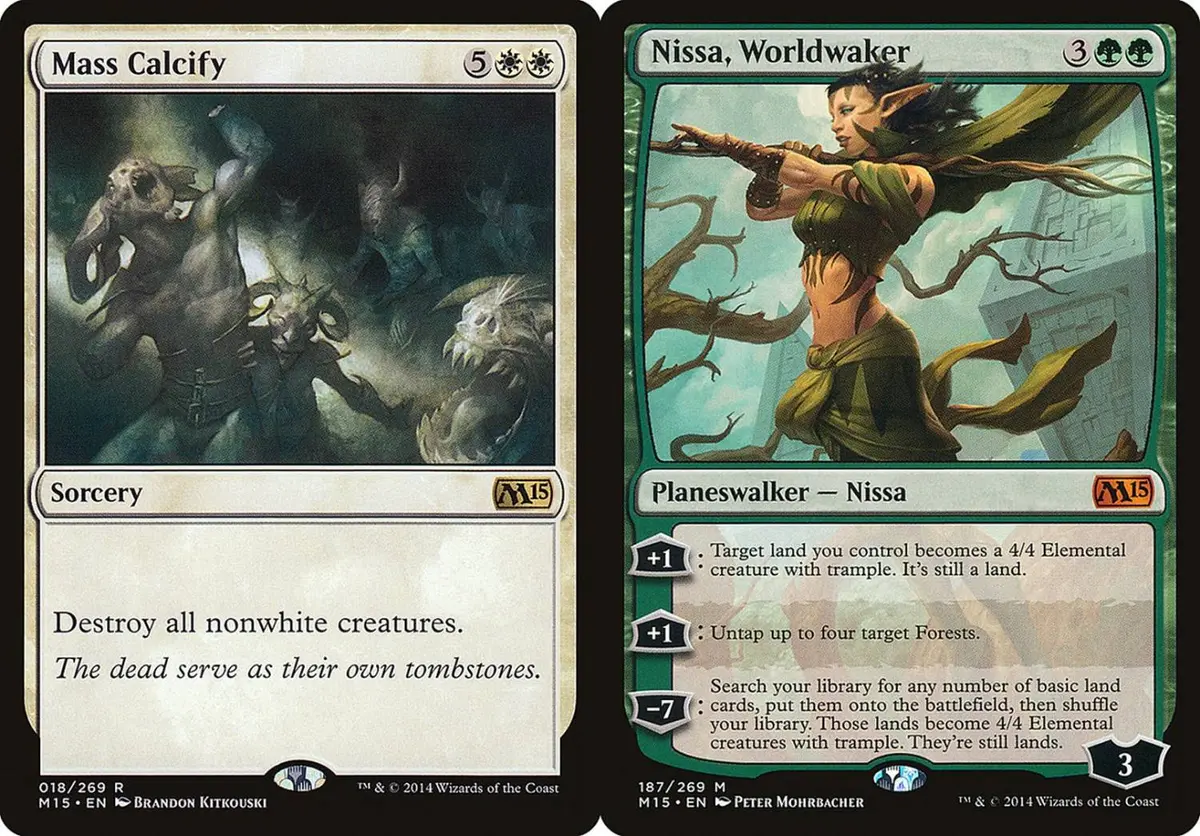
Take Nissa, Worldwaker as an example: it is an extremely effective card against control decks. However, bringing in Nissa in a control mirror often looks clumsy and inefficient. After all, reducing the opponent’s life total is not part of their plan; unless Nissa can somehow take the opponent from 20 to 0 by herself, she does not contribute meaningfully in terms of resource trades. But within an Abzan Midrange shell (with Siege Rhino, Wingmate Roc, and other planeswalkers complementing her), the threat Nissa poses is enough to leave an opposing control deck unable to cope.
Traditionally, midrange decks perform excellently after sideboarding. In fact, their advantage shows on two levels: first, the flexibility of their strategy means they can draw on all the best sideboard cards in their colors; second, the balance of their structure makes it extremely hard for opponents to sideboard against them. The more extreme a strategy, the easier it is to sideboard against; the more balanced a strategy, the harder it is to shake.
Mana and Tempo
As with any deck, the mana curve is crucial for a midrange deck. Following that logic, the argument I made earlier leads to a particular difficulty:
Every deck must have early plays, but it is extremely hard to find low-cost creatures that excel at both offense and defense. If those creatures are too mediocre, they easily lose their impact late in the game. One option is to drop the low-cost creatures and invest in removal spells instead, but that leaves you with a hand full of dead cards against control decks. So the challenge is finding high-quality early plays that are useful in all kinds of matchups and keep their value throughout the whole game.
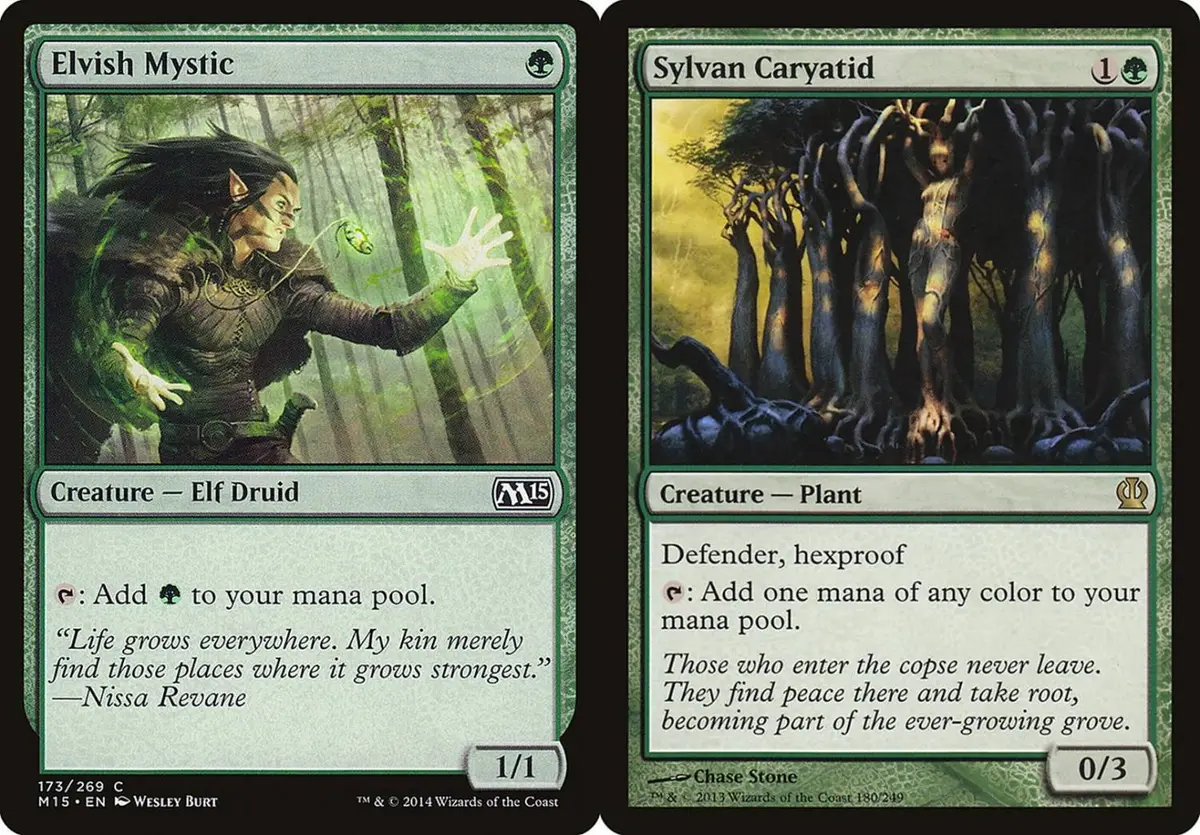
In the Abzan deck, the solution is to use creatures with mana acceleration (Ramp). Beyond meeting the criteria above, they have an additional advantage: they let you run a higher density of powerful expensive spells and slightly reduce your total land count.
Likewise, midrange decks are also well suited to lands that enter tapped, such as the Temples (like Temple of Malady) or the tri-lands (like Sandsteppe Citadel)).
To keep the deck at a high power level, you can choose to convert tempo into an investment in the early turns and focus on developing your mana base. As long as you can ensure the deck runs smoothly, reliably, and efficiently in the midgame, all of this effort is well worth it.
Card Advantage
Card advantage is indispensable for a midrange deck. However, while control decks can use cards like Divination or Jace’s Ingenuity, midrange decks must be more creative. If your goal is to shine in the midgame, giving up developing the board or controlling the game on a key turn just to draw cards is not a wise choice.
Instead, midrange decks need to seek incidental card advantage, meaning card advantage that is generated indirectly or attached to other effects. Courser of Kruphix is a perfect example. On turn three you really do want to add to your creature presence on the board, and as long as the Courser keeps standing, it keeps showing its value. Playing lands directly off the top of your library means you add to your resources on the board without spending any cards from hand; it also means you have a higher chance of drawing nonland cards, easing the risk of mana flood.

We already discussed Abzan Charm earlier. Although putting Divination directly into the deck is not wise, Abzan Charm’s primary function is as a removal spell; an option that can provide card advantage when the situation calls for it is itself extremely valuable.
Finally, on incidental card advantage, we also have planeswalkers. Midrange decks are the best fit for planeswalkers, for three reasons: first, they put enough creatures next to the planeswalker to control the board. Second, even when behind on board, they have plenty of removal to protect their planeswalkers. Third, and perhaps most important, these decks lengthen the game moderately, and so can gain enormous long-term value by activating the planeswalkers’ abilities every turn.
Virtual card advantage also plays a key role in this strategy, and it usually shows up as simply having creatures that are stronger in quality than the opponent’s.
Imagine Abzan Midrange against a red Weenie deck. As the game goes long, the Abzan deck may draw Siege Rhino on any given turn, while the red deck may draw Foundry Street Denizen. Abzan wins virtual card advantage simply through its higher average card quality.
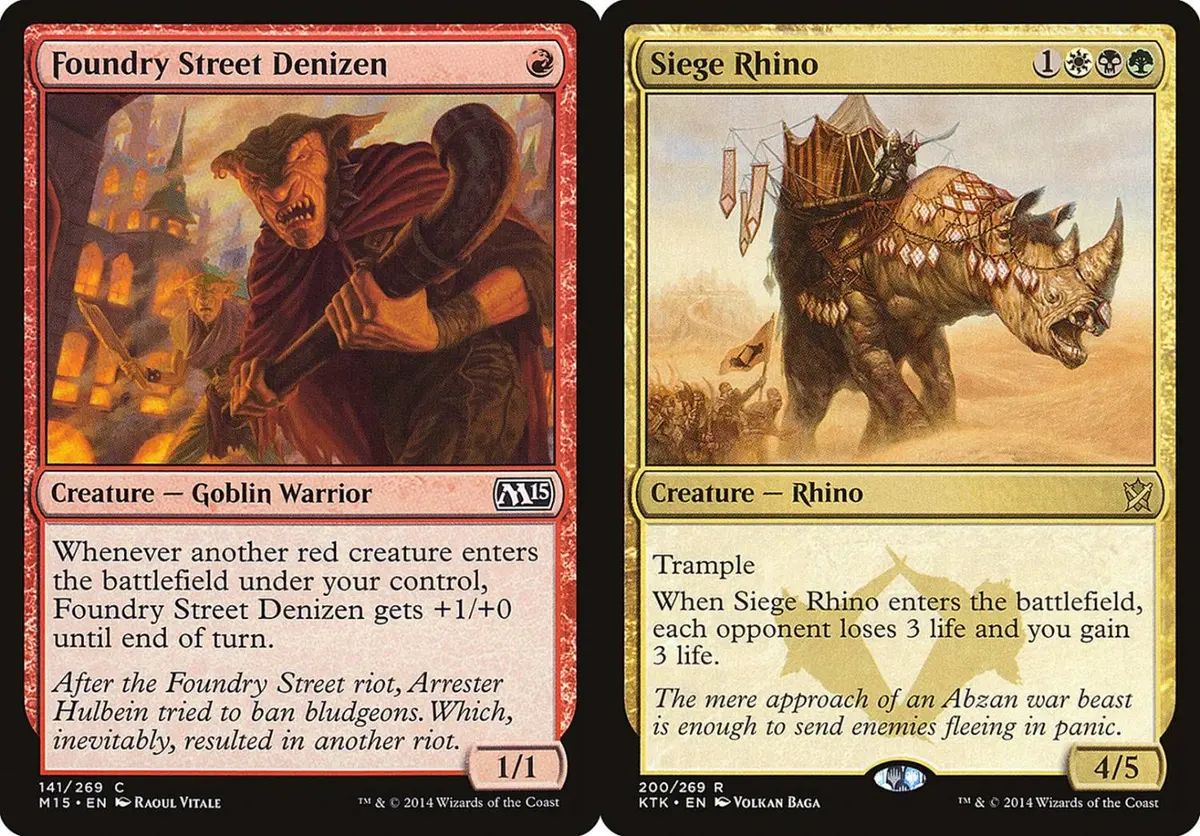
Imagine a Siege Rhino on the battlefield facing a swarm of red small creatures. The red player may decide not to attack, in which case the Abzan player has (at least temporarily) blanked the opponent’s creatures. The red player may also decide to attack and lose a creature just to push through damage, in which case the Abzan player has effectively gained a creature for free. Or the red player may have to use a creature plus a Titan’s Strength or Lightning Strike to trade for the Rhino, in which case the Abzan player has achieved a two-for-one.
The more card advantage you build into your deck’s structure, the more solid your chances of winning.
Ending the Game
The most important difference between a midrange deck and a control deck is that a midrange deck does not (necessarily) have inevitability, meaning it is not guaranteed to win just by surviving long enoughNote 2. Some midrange decks carry a considerable risk of mana flood, and others may struggle against particular cards or combos.
For example, Ari Lax’s Abzan deck struggles against Hornet Queen in game 1 and has to spend multiple cards to get past it. That can be a small problem, but it is by no means a fatal flaw of the deck.
The solution is simple: just win the game!
So far I have emphasized the importance of creature defense in midrange decks. “Siege Rhino stabilizes the board…”, “Wingmate Roc protects your planeswalkers…”. Well, they have another purpose too.
Once you are ready, you turn your creatures and planeswalkers toward the opponent. You can use removal spells to kill the opponent’s blockers, and the game may be over before the opponent realizes what is happening!
Flexibility is the key to midrange decks, and part of that is attacking when the situation calls for it. Ideally, the game splits into two phases: in the first, you defend yourself, develop your mana, and dismantle the opponent’s game plan; in the second, you attack and go straight for the throatNote 3. We call this “Turning the corner”, the turn on which you point everything toward ending the game.
For midrange decks, the ability to turn the corner and end the game quickly is quite critical. Precisely because they lack inevitability, your answer to certain troublesome cards is to win before they show up, or to win quickly once they land. If you are playing Abzan and feel Hornet Queen coming, try to push the opponent’s life low enough that a combination like Siege Rhino with Ajani, Mentor of Heroes can deliver the final blow.
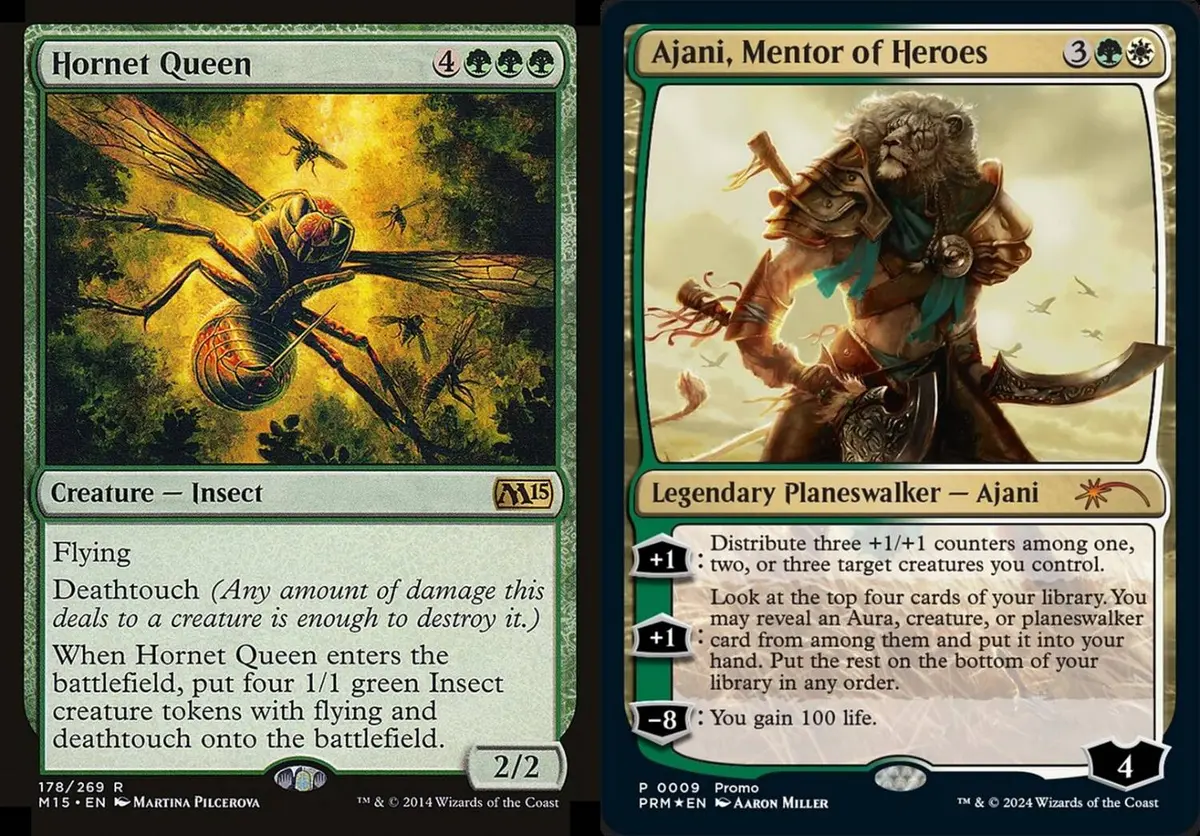
When you pilot a midrange deck, you are never completely hopeless. You have a diverse set of removal to answer most common problems. More importantly, even without the right answer, you have a Plan B: just beat the opponent down!
Note that midrange decks come in all different forms, sizes, and color combinations. Making the top eight alongside Ari Lax was Yuuya Watanabe, who played “Jeskai Midrange” at the time.
Yuuya Watanabe’s Jeskai Wins
Decklist link
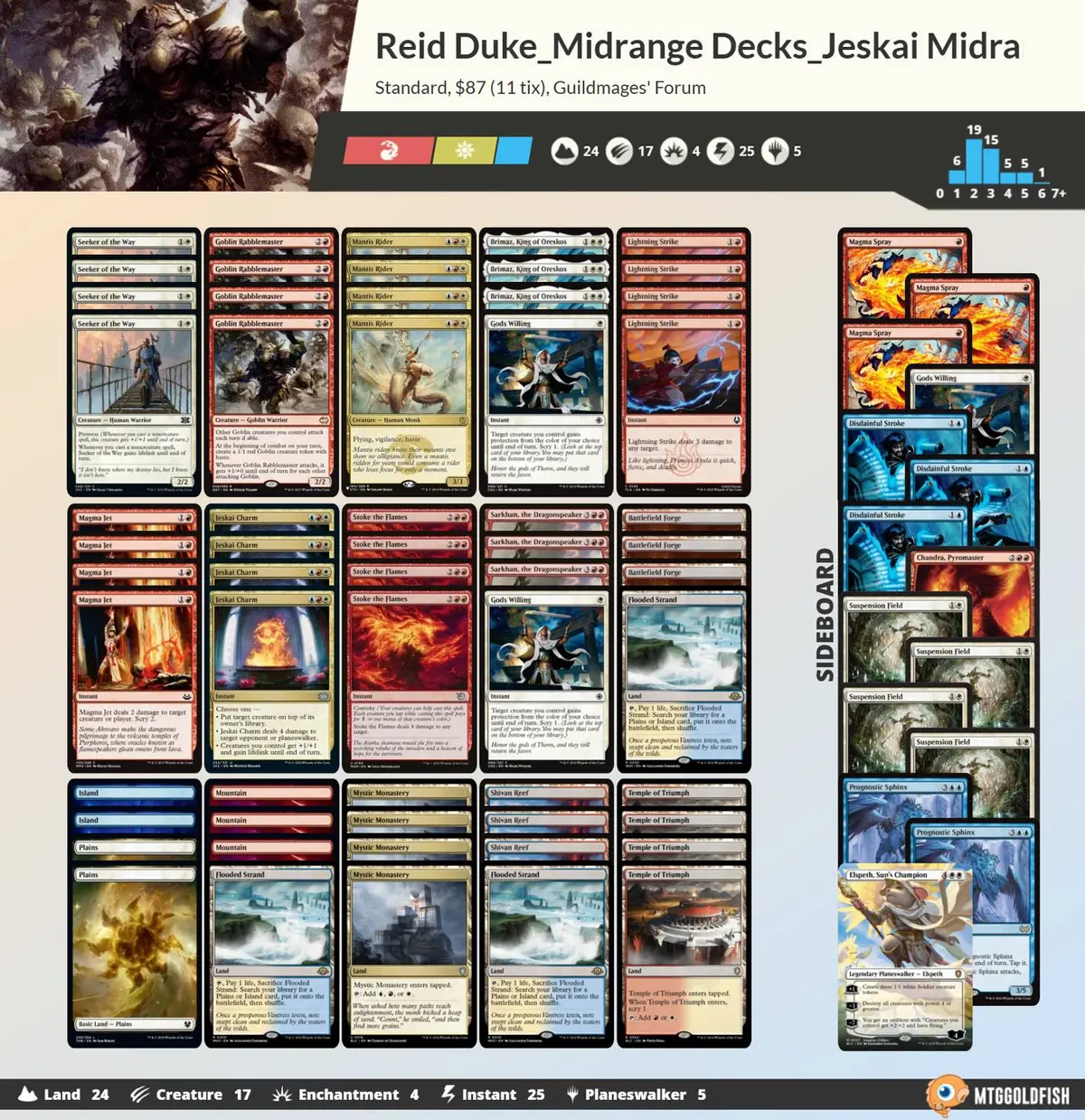
Although they share almost no cards and play out very differently, the principles behind Abzan and Jeskai are basically the same. Like Abzan, this Jeskai deck takes a defensive stance against aggro decks and switches to an offensive stance against slower decks. Like Abzan, it also runs a small number of powerful creatures. And like Abzan, after sideboarding it can tailor itself to a specific matchup and fill whatever role is needed. In its ability to turn the corner it is even better than Abzan: once the time is right, it can end the game quickly with a string of burn spells.
In a Magic tournament, countless strategies clash on the battlefield until a single strongest one reaches the top. Rather than guess which strategy will be the strongest at the moment, choose the more flexible deck and adapt based on what your opponents do. Pick a midrange deck, emphasize balance, and build a good sideboard, and whatever situation you face, you will have a fighting chance against your opponents.
Bonus Section: A New Card Preview from Commander (2014 Edition)
One of the keys to building a successful midrange deck is incidental card advantage, that is, resource advantage built into the structure of the deck. I also mentioned a common difficulty of midrange decks, the lack of early plays, and one possible solution: investing in the early turns with lands that enter tapped.
Following that logic, the card I am previewing today may be too slow for aggro decks, but for midrange or control decks it has great potential to be a game changer. Any deck willing to give up some early tempo in exchange for extra mana and card advantage later is an excellent potential home for this card.

In the short term, Myriad Landscape is worse than a basic land, because it enters tapped and only produces colorless mana. However, for decks that are not very color-hungry early on, that cost may not be too high. In the long run, Myriad Landscape can turn itself into two basic lands, which means you achieve mana acceleration and card advantage without casting any spell from hand. That is exactly the kind of “incidental card advantage” that keeps your deck running smoothly and provides a steady advantage against most opponents.
Functionally, Myriad Landscape is very similar to the old Krosan Verge. Krosan Verge was a format-defining card while it was legal in Standard. Although it has not shown up in top Legacy decks recently, both Krosan Verge and Myriad Landscape have Legacy-level power in certain situations and may deserve more attention from players.
Compared with Krosan Verge, Myriad Landscape has the important ability to search for a basic land of any type. This means any deck that benefits from “lands of the same type” (such as decks built around Cabal Coffers or High Tide) should give it serious consideration. Incidentally, if you have a reason to use snow-covered basic lands (for example, for cards like Skred), it would also be a good choice.
Finding high-value lands like Myriad Landscape can give your midrange deck that final push, helping you stand out in tournaments.
Note 1: That is, the aggro and control decks we shared over the past few weeks.
Note 2: Unlike control decks, midrange cannot gain inevitable victory simply by dragging the game out. Instead, if a midrange deck cannot end the game in time when facing mana flood, or a topdecked game-winning card from the opponent, a winning position can collapse in an instant. To play midrange well, beyond the points mentioned in the article, you must also develop a keen instinct for shifts in the state of the game, and above all do not miss lethal!
Note 3: Reid uses a very classic piece of removal here, Go for the Throat, to describe this situation, which is both precise and fitting for Magic’s flavor!
- Title
- Article Translation: Reid Duke's "Level One": Midrange Decks
- Author
- cephille
- Created at
- March 25, 2026
- License
- This work is licensed under CC BY-NC-SA 4.0 .
Related Articles
Article Translation — Reid Duke's "Level One": Choosing Your Deck
August 17, 2026

Article Translation: Reid Duke's "Level One": Sequencing
July 24, 2026
Article Translation: Reid Duke's "Level One": Playing in a Grand Prix: Part I
June 13, 2026

Article Translation — Reid Duke's "Level One": Board Sweepers
April 7, 2026