
Article Translation: Reid Duke's "Level One": Sequencing

Note: This article was translated from Chinese by AI and may contain errors. Read the original Chinese version.
Note 1: This is a translated article. The actual author is Magic: The Gathering Hall of Fame player and Channel Fireball member Reid Duke, and the copyright belongs to Wizards of the Coast. Although the authors field lists me, in this series I serve only as the translator, and I would not dream of taking credit for his work.
Note 2: This article and the follow-up articles in the series were produced by having Gemini 3 Pro translate the original text and then polishing the result. Each article includes a link to the original, and readers are very welcome to read the original directly on the official site!
Note 3: Since the original was published more than ten years ago, the translator will, where appropriate, add annotations explaining situations that differ from the original at the time of translation.
Article Translation: “Level One”: Sequencing
Wizards column: Feature
Date: February 16, 2015
Author: Reid Duke
We’ve talked a lot about what to do in a game of Magic: The Gathering. However, just as important as what you do is how you do it. “Sequencing” refers to the order and manner in which you take actions during a game. Proper sequencing makes your game as easy as possible, and makes your opponent’s as difficult as possible.
Sometimes, discussing sequencing seems like nitpicking, as if it were a minor detail too small to decide a game. Believe me, nothing could be further from the truth. You can never predict when a seemingly insignificant play will become the key that turns the game around. The best approach is to build good habits and give yourself the greatest chance to gain the advantage that proper sequencing brings.
A Golden Rule
I’ll start with the most valuable concrete piece of advice I can offer other players.
Before taking any action, think through your entire turn.
Untap your permanents, deal with any relevant upkeep effects, draw a card, and then stop. At this point in each of your turns, you should spend ten to twenty seconds thinking about what you’re going to do this turn. Will you play a land? Which one? Will you attack? With which creatures? Will you cast spells? Which spells, and what do you plan to do with them? You need a to-do list in your head before you consider the best order in which to carry it out. This is the key to proper sequencing.
Along the same lines, you should consider any predictable actions by your opponent and how you will react. Suppose at the start of the turn you have a 2/2 creature on the battlefield and Awaken the Bear in hand. Your opponent has an untapped 3/3 creature. If you attack, the opponent’s reaction is one of two: block or don’t block. If the opponent blocks, will you cast Awaken the Bear? If he doesn’t block, will you still cast it? The answers to these questions will help you figure out whether you really want to attack in the first place. This whole line of thought should be completed at the start of the turn, before you’ve made any impulsive plays. Never let yourself get caught in a messy combat step, only to realize you actually would have preferred to keep your mana to cast a creature instead of casting Awaken the Bear!

Thinking through the whole picture at once, rather than playing it by ear one step at a time, helps you avoid many unfavorable predicaments.
Developing this habit will make you a better player. You’ll make fewer mistakes, grasp the state of the game more precisely, and sequence your plays better. You’ll also give away less information to your opponent, because when you pause to think, the opponent can’t know exactly what you’re thinking. If you attack first and then pause to think only when the opponent blocks, they’ll wonder: “Does he have Awaken the Bear in hand?” If you’ve figured it out at the start of the turn, it’s much harder for your opponent to guess what’s in your hand.
As The Art of War puts it: “Be as hard to know as the shadows, and move like thunder.”
One small reminder: be careful not to play too slowly. Slow-play rules and timed rounds are important at competitive events (more details will be covered in later articles). Spending twenty seconds thinking each turn is a good habit, but spending several minutes every turn at a competitive event is far too much. Fortunately, if you take time to think at the start of the turn, once you’ve decided what to do you can act quickly and efficiently.
Types of Actions
Once you’ve decided what you’re going to do this turn, you can start evaluating the best order in which to do it. There are four types of actions that are crucial to understanding proper sequencing; every play you make in a game falls into one or more of the following.
Actions that give you more information: Some actions let you see cards in normally hidden zones, such as your opponent’s hand or the top card of either player’s library. Anything that lets you draw more cards, or that happens when your opponent takes an action, also gives you more information. You have the least information on turn one, because you haven’t drawn many cards, aren’t sure what tools will be available later, and know little about your opponent’s deck and game plan. As the game progresses, the key aspects of the matchup gradually reveal themselves, and the information you have grows with them.
Actions that give your opponent more information: Technically, every play you make falls into this category. When you cast a spell, you not only show your opponent the card, you also reveal the timing and intent of your play, and you have one fewer card in hand. The key is weighing how important different pieces of information are to your opponent. Playing a land on turn three is unlikely to affect your opponent’s decisions; however, casting your bomb creature could completely change your opponent’s decisions. Once you’ve shown Brutal Hordechief, you can never again trick your opponent into using Reach of Shadows on a weaker creature!
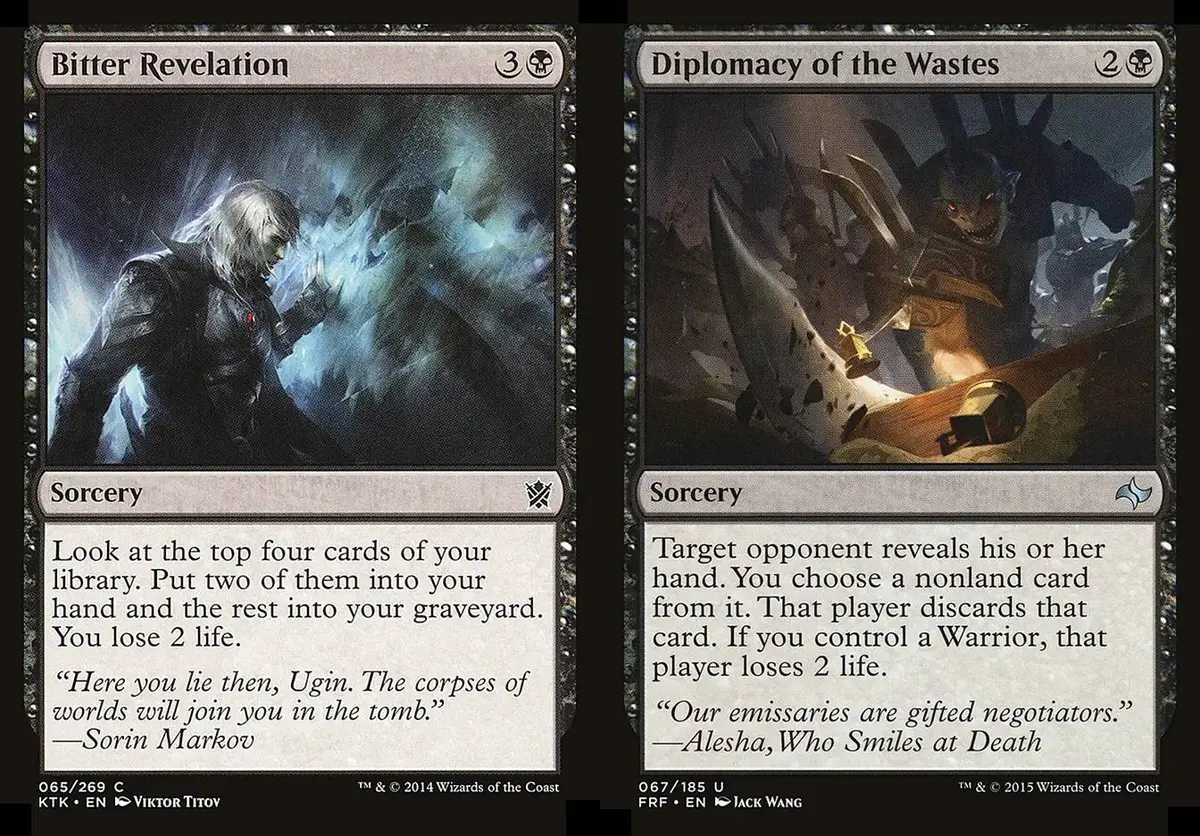
Actions that force you to make a decision: When you attack with a 2/2 into an untapped 3/3, you will soon face the choice of whether to use Awaken the Bear. When you cast Bitter Revelation, you can’t know in advance which four cards you will see, and you must decide on the spot which two to put into your hand.
Actions that force your opponent to make a decision: When you attack with a 2/2 into an untapped 3/3, you force your opponent to decide whether to block. When you cast Rakshasa’s Secret, you force your opponent to decide which two cards to discard.
The key to proper sequencing is this: you want to have as much information as possible when you make your decisions, and you want your opponent to have as little information as possible when making theirs. Therefore, take actions that give you more information and actions that force your opponent to make a decision as early in the turn as possible, and put off actions that give your opponent more information and actions that force you to make a decision as long as you can.
Many cards belong to several categories at once. Bitter Revelation and Diplomacy of the Wastes both give you more information and force you to make a decision. In that case, you should consider both aspects of the card. Should you cast Diplomacy of the Wastes earlier, to gain information for making other decisions? Or should you take other actions first so that you make the wisest decision when you finally see the opponent’s handNote 1? It all depends on the situation at hand.
Example 1
Let’s return to the example involving Awaken the Bear. You’ve untapped and drawn, and you face the following board state:
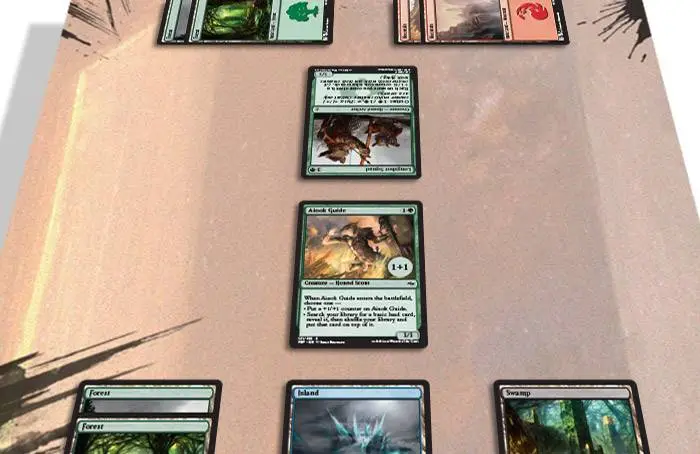
Your hand is a Swamp, Awaken the Bear, and Bitter Revelation, and your opponent has no cards in hand.
Before doing anything, you should think through your entire turn, and any predictable reactions from your opponent (in this case, block or don’t block). Suppose you decide to attack: if the opponent blocks, you cast Awaken the Bear; if not, you don’t. If you don’t cast Awaken the Bear, then you cast Bitter Revelation instead, because you also want to play a land this turn.
Now that you have a list of actions for this turn in your head, it’s time to decide how best to sequence them. The only decision you have left is which cards to choose if you end up casting Bitter Revelation.
Your opponent will face the choice of whether to block with Longshot Squad. And you want your opponent to make this decision with the least information possible.
In this particular situation, obviously you should attack before casting Bitter Revelation, because you need the mana to use Awaken the Bear. However, even if you had seven mana available, you’d still be better off attacking first, partly to hide information before the opponent makes a decision, and partly to gather more information before you make yours. (Before deciding what to take with Bitter Revelation, you will know whether the opponent blocked and whether you have to cast Awaken the Bear.)
Playing your land should be the last thing you do this turn, for several reasons. First, it is an action that gives your opponent more information, so it should not be done before the opponent decides whether to block. Second, Bitter Revelation is an action that gives you more information, so it might change your decision. What if you pick a land that enters tapped? What if you pick Dark Deal and decide not to play a land this turn? Finally, if you cast Bitter Revelation before playing your land, it also preserves the possibility (from the opponent’s point of view) that you picked a land from Bitter Revelation. That likewise hides information from the opponent.
- Attack.
- If the opponent blocks, cast Awaken the Bear.
- If the opponent doesn’t block, cast Bitter Revelation.
- Play your land.
Example 2
Consider a slightly different situation:
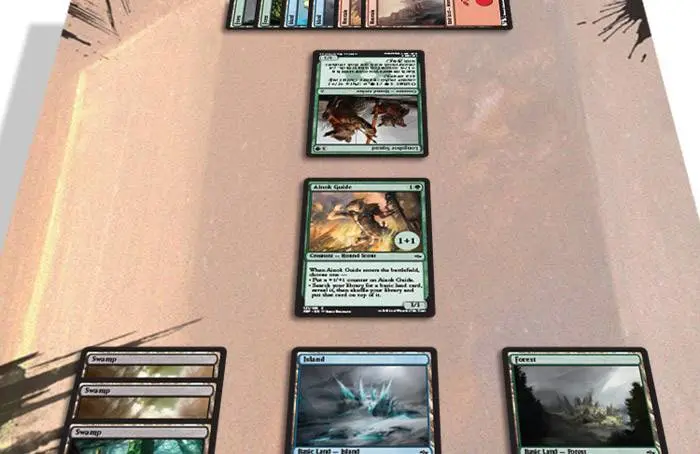
You’ve untapped and drawn, and your hand contains a Forest, Rakshasa’s Secret, Awaken the Bear, and Empty the Pits. Your opponent has three cards in hand.
First, let’s list your actions for this turn. You’ll want to play a land, cast Rakshasa’s Secret, and attack. If the opponent blocks, you want to cast Awaken the Bear; if he doesn’t block, you don’t. So how should you sequence this?
This turn you won’t have any new decisions based on new information. Your goal is to force your opponent to make decisions with as little information as possible. The opponent’s biggest decision will be what to discard to Rakshasa’s Secret, since he has three cards in hand.
- Cast Rakshasa’s Secret.
- Play the Forest.
- Attack.
- If the opponent blocks, cast Awaken the Bear; if the opponent doesn’t block, end your turn.
Acting Before or After Combat
Under normal circumstances, attacking should be the first thing you do in your turnNote 2. If a creature in your hand doesn’t have haste or a similar ability, there’s no reason to cast it before attacking. If your opponent is facing the choice of whether to block or whether to use a removal spell, what you’ve done is no different from giving them more information.
One possible exception is land. As in the example above, sometimes you need to play a land to enable the option of a combat trick, and in that case you should obviously play the land before attacking. If you have no combat trick, your goal is to conceal information for as long as possible.
However, because players sometimes play a land before combat to enable a combat trick, here is the next fact: playing a land before combat is sometimes actually the best way to hide information! If you attack with Ainok Guide before playing your third land, you’re proving that you can’t cast Awaken the Bear. If you attack into a 3/3 creature before playing your fourth land, you’re implying that you might have Awaken the Bear but not Dragonscale Boon.
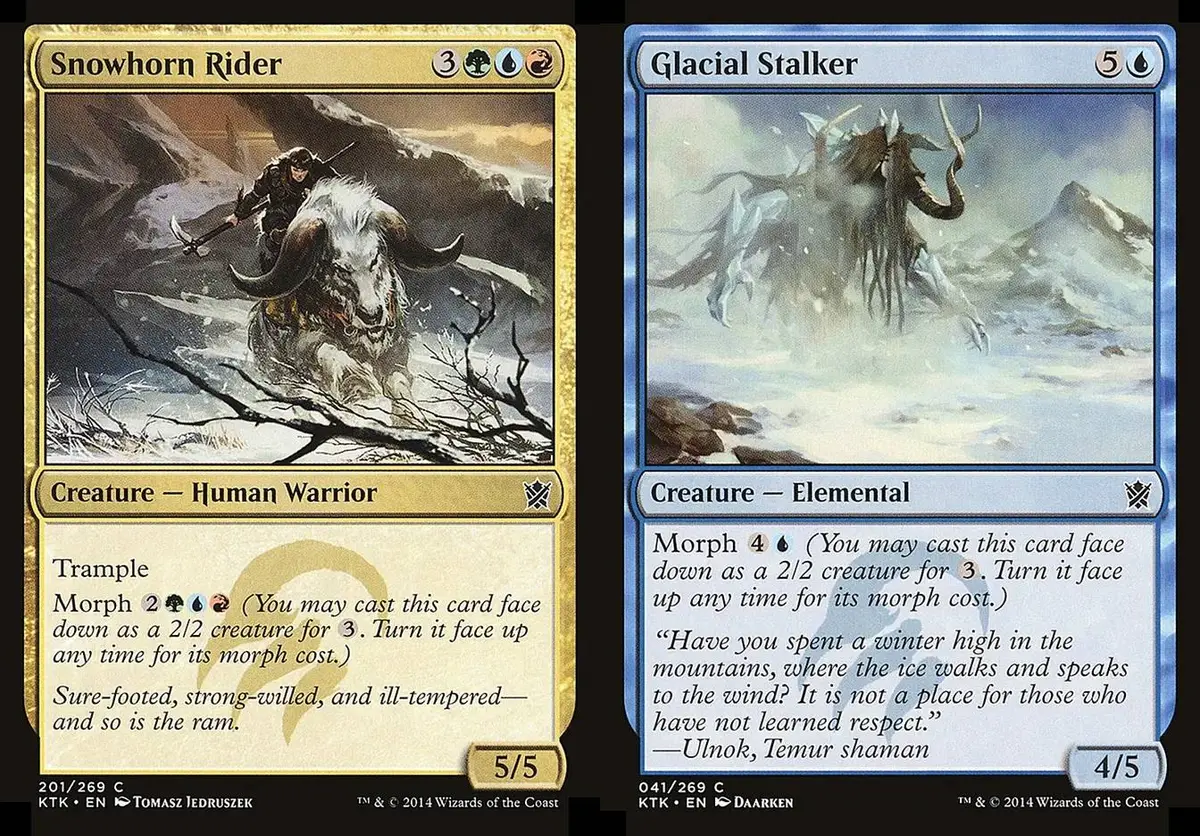
Perhaps the best example comes from morph creatures. If you have four lands on the battlefield and attack another 2/2 creature with a morph creature, you’re implying that you have a spell to cast or that you want to trade creatures. But if you play a fifth land before attacking, the possibilities multiply! Now, from your opponent’s point of view, your morph creature could be Snowhorn Rider, Glacial Stalker, or a dozen different things. By expanding the possible scenarios in combat, you hide information from your opponent.
Playing a land before combat also helps you deal with surprises. You might hold your land to hide information, but if your opponent casts Stubborn Denial on your combat trick, you’ll land yourself in a disaster!
I recommend getting into the habit of playing your land before attacking, especially in Khans of Tarkir LimitedNote 3. On the other hand, you should usually cast most creatures and spells after attacking. However, you’ll be willing to deviate from this principle when the situation calls for it. In Example 1, you might cast Bitter Revelation after combat, and in that case delaying your land drop is definitely best.
The key to proper sequencing is managing information:
- Have the maximum amount of information before making important decisions.
- Hide information from your opponent for as long as possible, especially when you can make him face a difficult decision.
In many of these examples, sequencing may seem trivial, but in Magic: The Gathering the small things add up. If, once in every hundred games, you lead your opponent into a wrong, poorly informed decision, you will become a better player for it. Proper sequencing is absolutely worth the effort.
Note 1: Here we can extend RD’s example using Thoughtseize. In a game where decklists are not public, casting Thoughtseize on turn one to gain more information is always a good decision; however, if you already know your opponent’s deck or game plan (for example, in a sideboard game), holding Thoughtseize until a critical turn lets you disrupt your opponent’s setup much more precisely.
Note 2: What RD means here is that, after the draw step, he generally recommends attacking first. And besides casting creatures with haste, in situations like Example 2, you might also cast a card like Rakshasa’s Secret first in order to gain more information.
Note 3: The special mention of the habit of playing a land before attacking in Khans of Tarkir Limited echoes the previous paragraph, which mentions the presence of creatures with morph in that format. Extending this to the more recent Murders at Karlov Manor (MKM), there are also many creatures with a similar Disguise ability; playing your land first to expand your mana makes it easier to turn such creatures face up and affect the game, and also increases the number of options the opponent must consider, further achieving the effect of confusing them.
- Title
- Article Translation: Reid Duke's "Level One": Sequencing
- Author
- cephille
- Created at
- July 24, 2026
- License
- This work is licensed under CC BY-NC-SA 4.0 .
Related Articles
Article Translation — Reid Duke's "Level One": Choosing Your Deck
August 17, 2026
Article Translation: Reid Duke's "Level One": Playing in a Grand Prix: Part I
June 13, 2026

Article Translation — Reid Duke's "Level One": Board Sweepers
April 7, 2026
Article Translation: Reid Duke's "Level One": Midrange Decks
March 25, 2026