Tale of the Five Elementals: A Brief Review of the MH2 Elementals' Development

Note: This article was translated from Chinese by AI and may contain errors. Read the original Chinese version.
Preface: The Summer of MH2
In Modern Horizons (MH1), released on June 14, 2019, apart from the already-banned Hogaak, Arisen Necropolis, the most-played cards in tournaments today are still Force of Negation (FON) and Force of Vigor (FOV), the counter / removal artifact-enchantment pair, plus Yawgmoth, Thran Physician, which single-handedly brought up a new deck, black-green Yawgmoth. Judging by the effects of the five “Force of ___” cards, they are all fairly defensive instants / flash cards, and they can only be cast for their alternative cost on the opponent’s turn (exiling a card of the same color instead of paying its mana cost); you cannot do this on your own turn. The alternative cost effects of this period were used only as a defensive strategy and had not yet had a big impact on the real tournament meta.
But on June 18, 2021, Modern Horizons 2 (MH2) was released, and this set brought earth-shattering changes to MTG’s Modern and even Legacy formats. Five mythic Elementals that can be actively cast for an alternative cost entered our world. This article focuses on the development of these five Elementals and will not dwell on other MH2 cards.
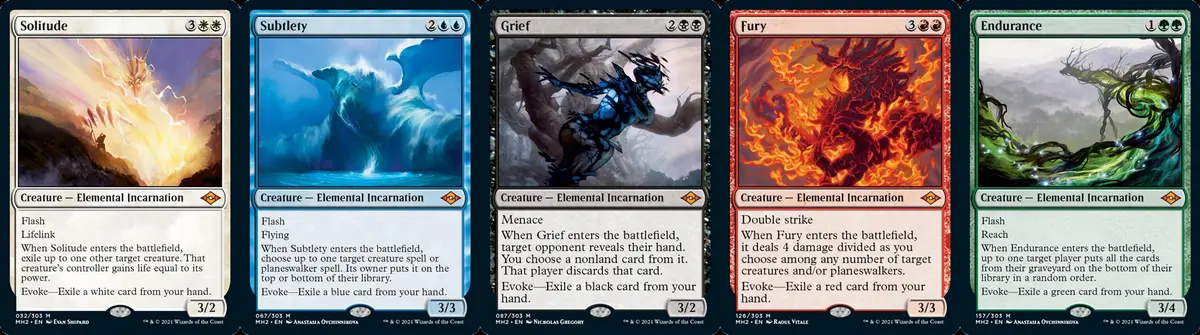
The Five Elementals’ Impact on the Modern Tournament Scene
Although most players who play Modern are surely no strangers to these five Elementals, it is still necessary to let slightly less familiar readers understand how overwhelmingly powerful these five Elementals are:
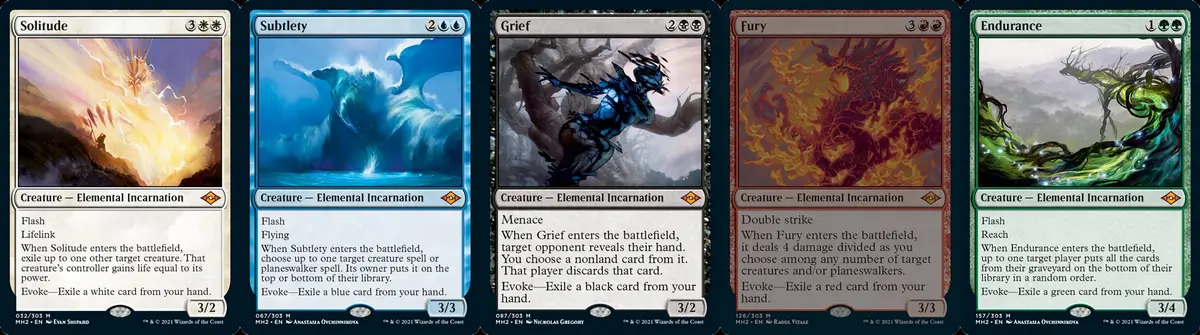
Solitude (White Elemental)
Comes with flash and can be cast for its evoke alternative cost, entering to give a Swords to Plowshares; the body is a white 5-mana flash lifelink 3/2.Subtlety (Blue Elemental)
Comes with flash and can be cast for its evoke alternative cost, entering to put a target creature or planeswalker spell on the top or bottom of its owner’s library; the body is a blue 4-mana flash flying 3/3.Grief (Black Elemental)
Can be cast for its evoke alternative cost, entering to give a Thoughtseize without the 2 life loss; the body is a black 4-mana menace 3/2.Fury (Red Elemental)
Can be cast for its evoke alternative cost, giving a Pyrotechnics that can only divide damage among creatures / planeswalkers; the body is a red 5-mana double strike 3/3.Endurance (Green Elemental)
Comes with flash and can be cast for its evoke alternative cost, entering to put target player’s graveyard on the bottom of their library; the body is a green 3-mana flash reach 3/4.
What is evoke?
Evoke includes both of the following abilities:
- It gives this spell an alternative cost; you may cast this card by paying the cost specified by evoke instead of paying its original mana cost.
- When this permanent enters the battlefield, if its evoke cost was paid, it creates a triggered ability: “Sacrifice this permanent.” This triggered ability goes on the stack and can be responded to; the card is only sacrificed when the ability resolves.
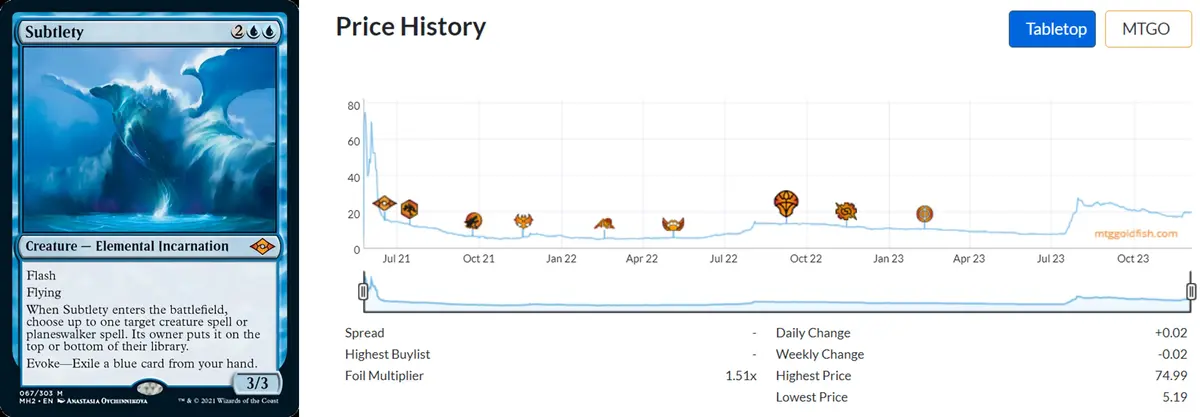
Since MH2 brought these five Elementals, after several iterations, most of the top meta decks in Modern have taken on the shape of the Elementals. Starting from 4c Omnath’s heavy use of the non-black Elementals, followed by Rhinos and Living End, and then to the red-black scam that topped the Pro Tour The Lord of the Rings, the Modern tournament scene has been filled with Elementals of every color, and the blue Elemental, whose price had fallen all the way from its peak after MH2’s release, has likewise rebounded off the bottom as the use of the red and black Elementals surged.
Why Did This Happen?
Let us follow history’s rising tide and look at it from far to near:
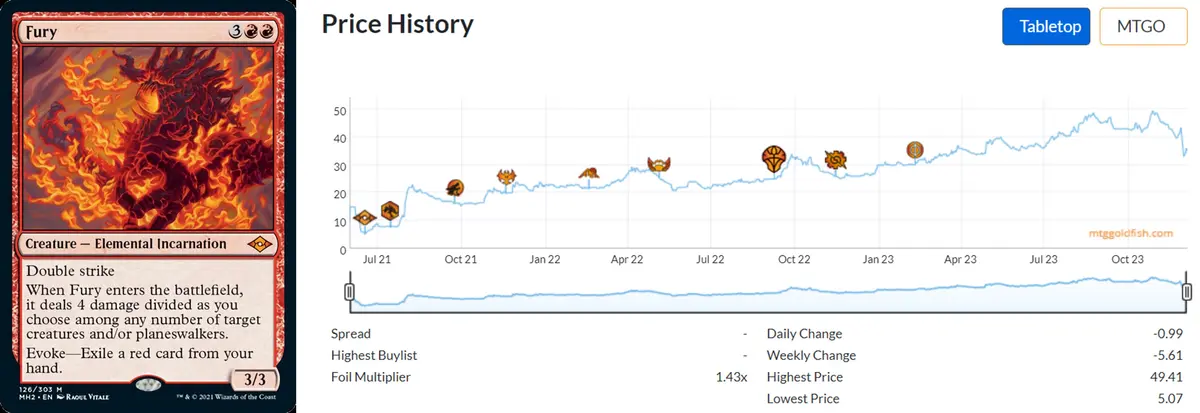
Captured from historical price information on mtggoldfish on December 6, 2023, referring only to paper cards, not counting tix changes on MO.
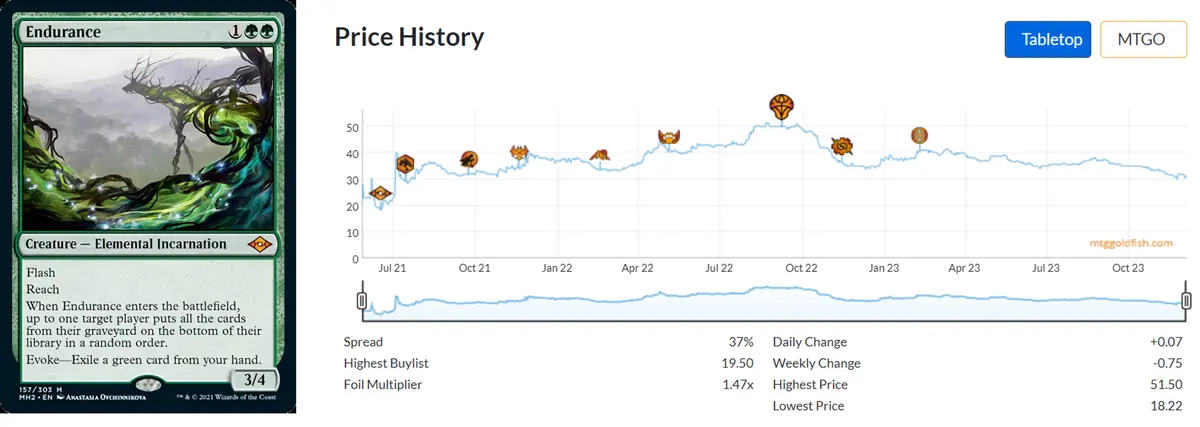
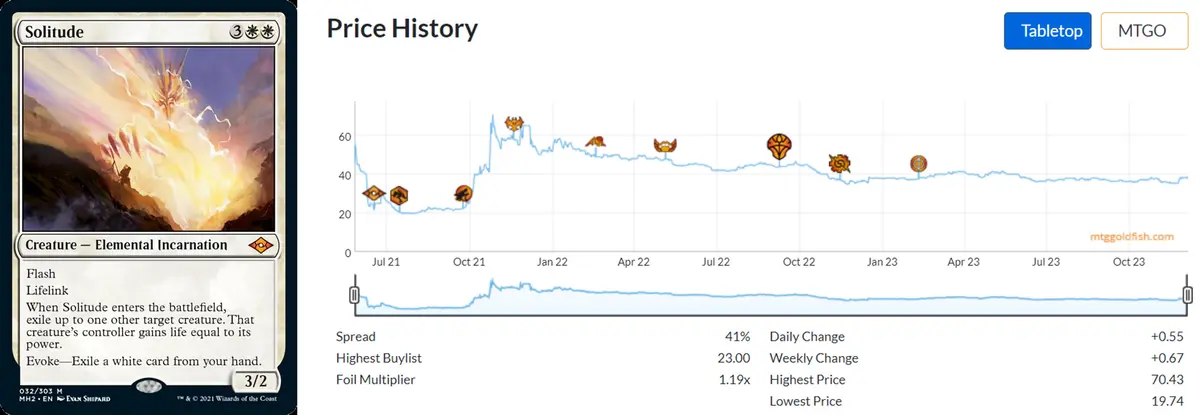
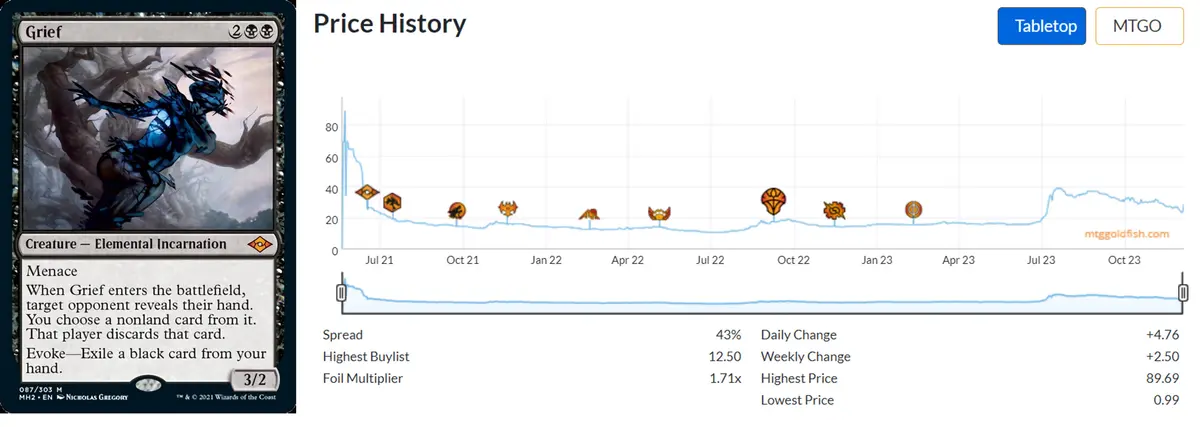
The first to show its talent was the green Elemental, which was widely used as an excellent sideboard card against all kinds of graveyard decks, and to this day it still sees very large and stable play. The white Elemental, as efficient removal, was used as removal + finisher in the white-blue control decks that still existed in the meta at the time; and after DMU brought the wider-ranging Leyline Binding, 4c decks that could painlessly use these two efficient white removal spells occupied the front of the tournament scene for several seasons.
The red Elemental, after MH2’s release, went through the plunge of the blue and black Elementals and the increased use of the green and white ones, and was obscure for a while. At first it was used in decks like Odd Red and other mono-red decks as a supplement to removal and as a mid-to-late-game threat; and scam at the time was still a black-white archetype built around Ephemerate, with no eyes yet on red. Somewhat later, Izzet Murktide began bringing the red Elemental in the sideboard to fight low-cost aggro, and this gradually revealed the red Elemental’s advantage in suppressing aggro decks. The rest of the story everyone knows: red-black scam won the Pro Tour The Lord of the Rings in dominant fashion, and overnight the red and black Elementals became red-hot and became the number one enemy that the meta had to deal with.
Using the black Elemental with Ephemerate to bounce it and take 2 to 3 cards from the opponent’s hand for free is no longer news, but why did it have to wait until the red-black scam deck appeared before it was widely discussed, used, and targeted? I will not introduce deck construction further here; interested readers can see this article: Modern Rakdos Scam: The Overlord of the Modern Environment. Going back to the black Elemental’s function itself: discard. Discard is very annoying in itself, but it usually does not make you lose the game directly just because that card was discarded (except for specially built combo decks, and only if it is discarded precisely enough). And with card power in Modern having broken through the ceiling and fewer and fewer lands being played, every deck’s topdecking ability has risen imperceptibly. Even if at the start the black Elemental made you discard two cards and left a 3/2 menace standing, to actually be killed by it you would have to draw six useless cards in a row; under normal circumstances, a player still has enough time to draw a card that clears the board and counterattacks. However, compared with the original slower black-white play style, red-black scam has, besides the black Elemental, Ragavan, Nimble Pilferer, Dauthi Voidwalker, and Orcish Bowmasters, and even the red Elemental are all early threats that are extremely painful for the opponent when slapped down after you have made them discard two cards with the black Elemental. It is not that the black Elemental itself is strong, but that the red-black scam archetype is strong, which led players to overstate the pain of being hit by a scam and made the black Elemental the prime target of this round of R&B bans.
Finally, the blue Elemental. The blue Elemental and the black Elemental were the top two cards in pre-order price ranking during MH2 pre-orders, but with low usage after release it fell directly from its pedestal and has hovered below $10 ever since. However, after reviewing historical prices and the current environment, I have a bold hypothesis that I would like to share here:
Suppose the pre-order expectation was that decks using the black Elemental, or other planeswalkers like Wrenn and Six, would dominate after MH2’s release and need the blue Elemental as their counter. Looked at this way, that seems to explain why the pre-order price was so frightfully high at the time yet still had trading volume. And this expectation did not come true in the meta more than two years ago, but only materialized after the Pro Tour The Lord of the Rings.
The blue Elemental itself is not a strong enough card, and can even be said to be the weakest of the five Elementals; but its value lies in being currently the only card in Modern that lets you interact with the proactive black and red Elementals when you are on the draw on turn one. FON, Commandeer, and other alternative-cost cards cannot do it, or at least have to take one hit from the Elemental’s ETB effect (for example: Force of Despair). This deserves some further thought: if this value is so important, does it mean MH2 was originally designed to force the Modern environment to speed up to nearly Legacy levels, and the blue Elemental is the foreshadowing the design team planted for it? And looking further ahead, with Modern Horizons 3 (MH3) releasing in 2024, will Modern approach Legacy even more violently, or will the design team learn its lesson and instead print more speed-slowing hate cards? These are indicators worth watching closely in future previews.
Summary: Modern Continues to Evolve, and the Elementals Remain High-Indicator Cards of the Environment
Let us make a table to summarize what was discussed above:
| Item | Effect | Game Plan |
|---|---|---|
| Solitude (White Elemental) | Single-target removal | Passive |
| Subtlety (Blue Elemental) | The only one that can interact with the other Elementals when on the draw on turn one | Passive |
| Grief (Black Elemental) | Discard | Active |
| Fury (Red Elemental) | Clears low-toughness creatures, one-for-many | Active & Passive |
| Endurance (Green Elemental) | Graveyard hate | Passive |
Sharp-eyed readers may have noticed that the passive white, blue, and green Elementals all come with flash, while the active black Elemental does not, and the red Elemental, although it has no flash, has double strike on its own, combining proactive attacking with built-in board clearing and the passive defensive ability of a two-for-one or better so it got banned. Also, judging by the current environment, proactive strategies indeed have the upper hand, constantly trying to resolve threats, and once you run out of counters, the game begins to collapse; this is true not only of the red-black scam that was just hit hard, but also of other tier 1 decks such as Rhinos, Tron, and Hammer. And how long has it been since you saw pure control on top? On the other hand, the sideboard hate cards have also generally gotten worse, and matches are often over quickly when one side cannot counter the opponent’s game plan; the means of countering have also gotten more perverse, with cards like Commandeer widely used in sideboards as a plan-switching trump card for seizing the opponent’s unfair tools.
Finally, please allow me to ramble a bit, composing this ode in memory of Fury, who accompanied our Modern years for two and a half years, in the hope that Modern can return to the era of seriously practicing your plays and earning card advantage but then should The One Ring be banned… on second thought, that still seems impossible:
Ode to Fury: Remembering Modern
The great river flows east, its waves washing away all the heroes of ages past.
Where the meta ends, they say, are the five Elementals of MH2.
Endurance and Solitude, Grief and Subtlety, rolling up a thousand heaps of snow.
Old gives way to new, and Jace, the Mind Sculptor has no takers.
I imagine Fury in those years, when MH2 was released, crouching first and then leaping.
Four damage for zero mana, and amid talk and laughter, the aggro decks were turned to ash.
The Pro Tour One Ring, red-black scam, unrivaled glory.
Wizards broke its word, and in one morning Fury fizzles out.
- Title
- Tale of the Five Elementals: A Brief Review of the MH2 Elementals' Development
- Author
- cephille
- Created at
- December 11, 2023
- License
- This work is licensed under CC BY-NC-SA 4.0 .