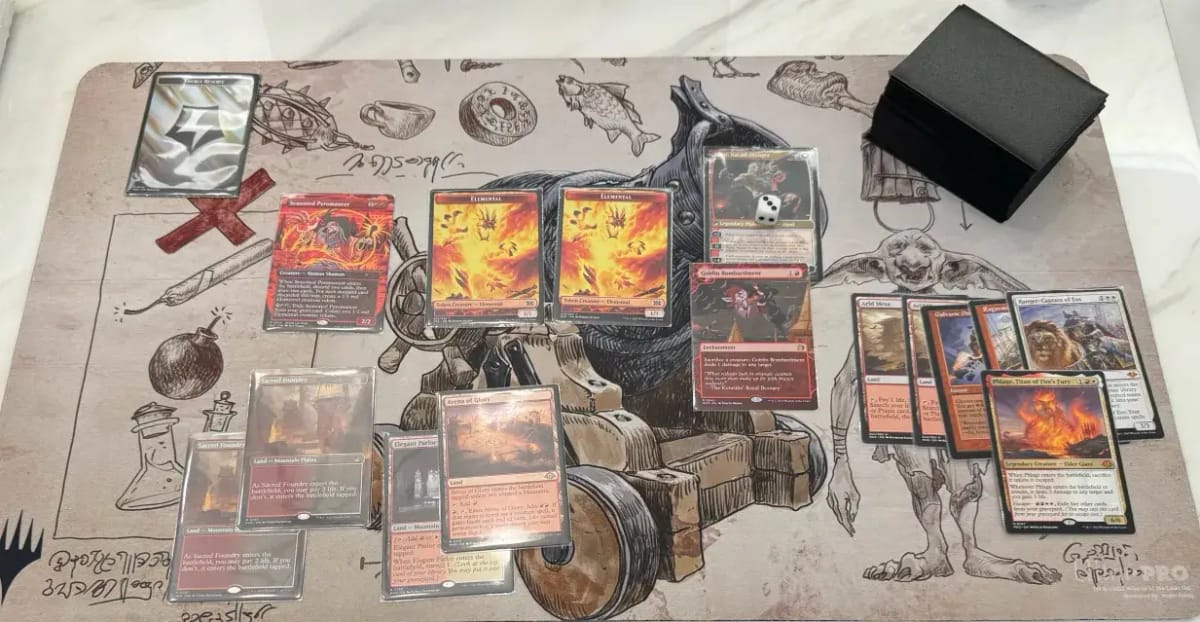
Weihow's Pre-Tournament Preparation and Thoughts on MIT#8

Note: This article was translated from Chinese by AI and may contain errors. Read the original Chinese version.
Introduction
Hi everyone, I am Weihow. I am honored to once again be invited by cephille to share how I prepared for MIT#8. Compared with previous tournaments, this time I spent more time on preparation and practice beforehand, and I am very happy to have finished in fourth place.
Reactions on the day and the luck of the draw are of course important, but I believe solid pre-tournament preparation is also an indispensable part of raising your win rate. This is probably what people mean by “do your best and leave the rest to fate.”
Generally before a big tournament, I first analyze the environment of the event and, based on the cards I currently own and how proficient I am with each deck, choose the deck to play. Once I have decided, I practice a lot to make sure I fully grasp how the deck works and how to handle the matchups before the event.
This article is centered on how I prepared for MIT#8, divided into four parts: Meta Analysis, Deck Selection, Efficient Practice, and Other Preparation, introducing my preparation process in detail.
I. Meta Analysis

During the preparation period, I mainly watch developments in foreign RCs and on MTGO.
Besides looking at the deck distribution of foreign RCs, I also look at the conversion rate from Day 1 to Day 2 (that is, the proportion of a deck that advances from Day 1 to Day 2). I feel the conversion rate reflects the current meta better than the deck distribution, and decks with a higher conversion rate are the targets I will specifically consider.
MTGO has several different events, and the one I mainly look at is the distribution at Challenge level and above. MTGO Challenges are high-level events held regularly every week. The online environment is more flexible than the paper environment, and it is easier to discover some surprising decks. Plus, Challenges are held every week, so the environment usually reflects the latest trends of the current meta even faster than RCs.
After analyzing some of the main events above, I put together a list of decks I am likely to encounter, and correspondingly list some decks I would want to choose myself. These days I spend relatively little time on analyzing the meta. At the start I easily fell into the habit of splitting hairs, feeling I needed to cover every deck so I would not miss anything. But that is not only inefficient, but it also makes it easy to get lost in the big picture by paying too much attention to unusual decks. So I later reminded myself constantly to focus on the big picture and let go of the small stuff: I sort out the few decks I think are the strongest and appear most frequently, and then keep preparing in that direction.
For example, in terms of deck strength before MIT#8, I thought Temur Breach (editor’s note: Underworld Breach was banned on 2025-03-31, and this deck has now disappeared from the meta) should be the strongest, followed by Blink, and then Boros Energy and Eldrazi Ramp about the same.
In terms of how hard the decks are to pilot, I think Temur Breach and Blink are decks with a high ceiling and floor of skill, while Boros Energy and Eldrazi Ramp are relatively simple decks.
With this general direction in mind, I move on to what I find the most agonizing yet most important step: deck selection.
II. Deck Selection
Before an event, you always see lots of decks tailored to the meta, and every deck has a hundred variants. For example, for more ways to counter things, Boros Energy added Consign to Memory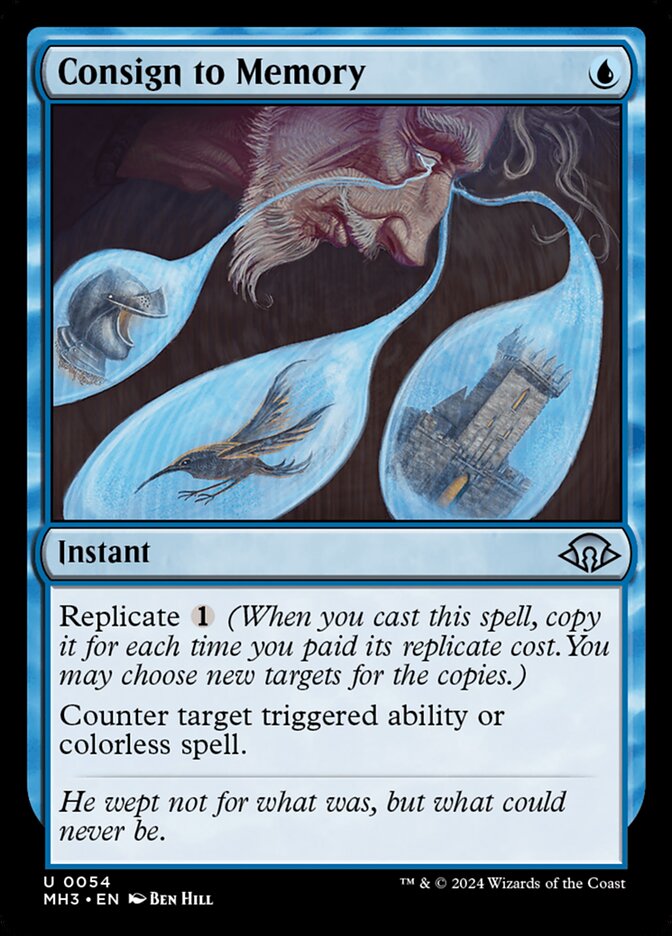 and became Jeskai Energy. Every time I chose a deck in the past, I easily had trouble deciding, with a thousand thoughts in my head, feeling I had many ideas but unable to refine them into a final decision. I would also go through repeated struggles along the way, one moment feeling I could play a certain deck, the next moment rejecting my own decision.
After several rounds of preparation and tournament experience, I summarized a few considerations to help me decide. In choosing, I consider deck strength, my own proficiency, and my playstyle, and secondarily practical issues such as card prices and how easy the cards are to obtain.
For example, before MIT#8, among the several strong decks in the environment at the time, I thought Temur Breach was the strongest deck in the environment. But with expensive cards and extremely high piloting difficulty, this deck was not within my consideration. For Blink, because my grasp of control and heavy decision-making is not that high, and I am a player who likes quick decisions and active aggression, the style of this deck was not the best fit for me, so Blink was also excluded. In my understanding Eldrazi Ramp is about equal in strength to Boros Energy, but I have played Boros Energy many more times than Eldrazi. Finally, considering that I qualified at MITQ#8 with Boros Energy, I ended up choosing the deck I am most familiar with: Boros Energy.
In the past I would agonize over whether the deck I chose was the strongest deck in the environment; but I later came to think that in big tournaments, proficiency often matters more than a deck’s absolute strength (of course, in certain extreme environments, such as when Nadu, Winged Wisdom first came out, that is another matter). That is because the pressure of the environment at a big tournament and the tense atmosphere inevitably increase the error rate. I also found that if the deck I use on the day is not one I am comfortable with, I easily make suboptimal decisions or miss key triggers. When sideboarding, I also fall into a more confused way of thinking, which disrupts my rhythm and weakens my momentum.
Lastly, I add practical considerations. Some decks are not cheap (Temur Breach costs nearly 50,000 NT dollars!!), and some older cards are not that easy to get in Taiwan. I weigh the cost, the difficulty of acquiring the cards, and my existing card inventory, and make a trade-off between how easy the deck is to build and its strength. And Boros Energy happened to be the most economical option among the cards I already had.
Of course, besides the analysis above, I also try different decks on MTGO to get a feel for how different decks play. Feeling how well a deck fits you in actual play is very strong. Next, I will share the practice platforms and methods I commonly use.
III. Efficient Practice
Although I am very familiar with Boros Energy, after the bans of The One Ring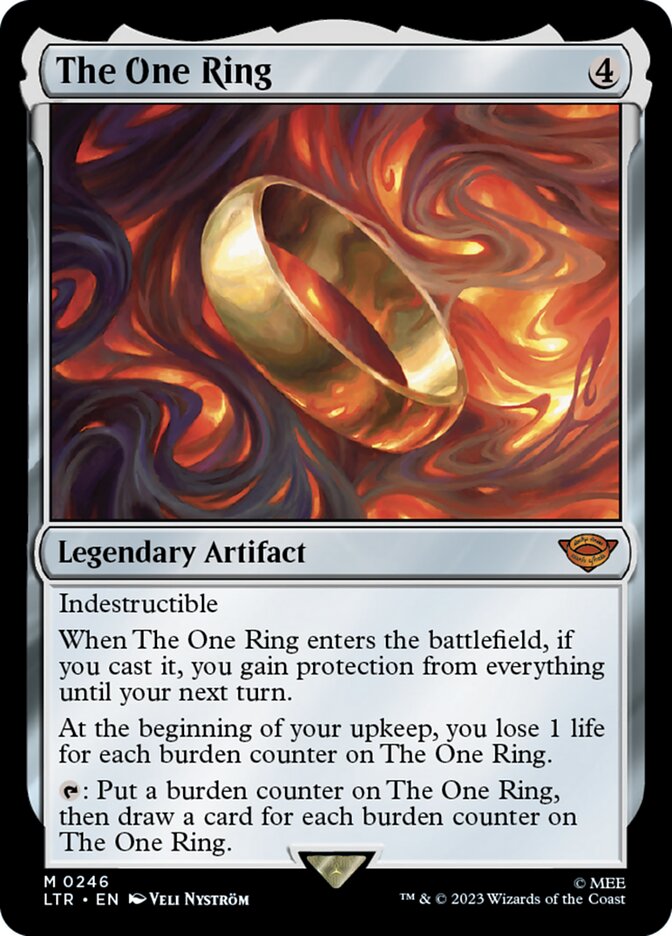 , Amped Raptor
 , and Jegantha, the Wellspring
 before the event, the overall feel of playing it was still very different. At first I thought that as long as I played enough matches, that counted as enough practice, but that is like blindly grinding practice problems before exams as a kid, and after a whole round of grinding not being very clear about what I learned. Below I list some things I pay special attention to when practicing, for everyone’s reference.
Practice matches
Considering time cost and how convenient it is to adjust the deck, I think practicing online is extremely efficient. For Modern and Standard, I practice on MTGO and MTGA respectively. Although MTGO’s interface is not as intuitive as MTGA’s, I highly recommend practicing on MTGO. MTGO spells out every phase trigger clearly, so you run into fewer places where an effect is unclear.
A League on MTGO costs 10 Tix (about 10 US dollars) to enter. If you get three or more wins in five matches, the next League is free. I use this mechanism as motivation and set myself a goal of steadily getting three wins. This goal helps me stay focused and puts appropriate pressure on myself, pursuing better responses and plays in each match. I think to practice efficiently, you need to make sure you treat every game as seriously as an in-person tournament. If I find my thinking is no longer clear and my brain has started slacking off and does not want to think carefully about each play, I let myself rest.
In games, besides the details of play, on MTGO you meet many strong players and deck types that are rarer in the Taiwanese scene, such as players who have done well in MTGO Challenges, or Temur Breach and Amulet Titan, which you rarely run into offline. I sometimes record these special matches, and after playing, review them through the replay while learning from strong players’ lines, which also helps me find room for improvement.
Watching others
Besides actual matches, I also watch professional players’ videos online to learn about key decision choices and fine details of play. The streamer misplacedginger is my mentor for playing Boros Energy. What I remember most is a game where he had Goblin Bombardment and Ajani, Nacatl Pariah // Ajani, Nacatl Avenger
 on the battlefield, and his opponent was also playing Boros Energy with exactly the same board as him. With both sides facing off with the same deck, misplacedginger won through superior play and understanding. There were so many details in the process that they overturned my understanding of Boros Energy. In that moment I felt I had to learn from this person! So everyone can also watch more of the strong players online play, and you can learn many unexpected things. On Reddit and Discord, too, there is a lot of discussion about how to play and build different decks, and I follow it to see whether people have any novel ideas. There are also many paid guides available online. I have not bought any myself, and if you have, you are welcome to share your impressions after using them.
IV. Other Preparation
I am the type of person who gets nervous before a tournament. I do some concrete things to build my confidence, ease my nerves, and help me focus on tournament preparation.
Confirming the deck build
Novel builds often make you eager to try them. Before a tournament, you often hear a lot of discussion about “tech” or new decks. But without a lot of testing of my own and without clear results, I try not to change my build; I focus on the deck’s original strengths and figure out how to play to its strengths and avoid its weaknesses in games. In the past I also frantically fine-tuned my build during tournaments, but later found that doing so often threw me off balance, and many times it backfired by robbing Peter to pay Paul, getting more and more confusing, and making me more and more unsure of myself.
Preparing the sideboard
Based on my meta analysis, I prepare a detailed Sideboard Guide and make sure I am clear on the purpose of every sideboard card. I found this is also a good way to increase my confidence.
Making a Sideboard Guide is like writing a summary. During the process it is easy to discover which matchups you are not familiar enough with, and sometimes a flash of inspiration brings new sideboard ideas. During the tournament, the Sideboard Guide also helps me quickly adjust my sideboard, with the benefit of working both before and during the event.
Summary
The above is my preparation for this MIT#8. Preparation methods vary from person to person, and the one that suits you is the best. I also believe good methods are fluid, and each tournament’s preparation will differ as experience accumulates. If you have different methods, you are welcome to share and discuss them together.
The tournament itself also had its twists and turns. I lost round one to Blink, and my feelings were very complicated, with a sense of having worked hard for a long time only to have things go against my wishes. In round six I lost to Boros Energy, where I missed a trigger that decided the game and lost the key win-and-in match, falling into self-blame and anxiety. Although I won round seven, I needed the two tables ahead of me to draw for a chance to advance. At that moment I actually felt my chances were slim and this MIT#8 was probably over. Unexpectedly there was a turn of events: before long I heard 郭老闆 say that one table had already drawn, and my calm mood began to turn into a mix of nervousness and anticipation. At that time cephille suggested setting a FLAG: if I got in, I would write a Boros Energy article. In the end, two tables actually drew (the power of the article?!), and I slid unexpectedly into the top 8. Later the judge started calling names, and only after confirming they called mine did I really believe I had made the top 8!
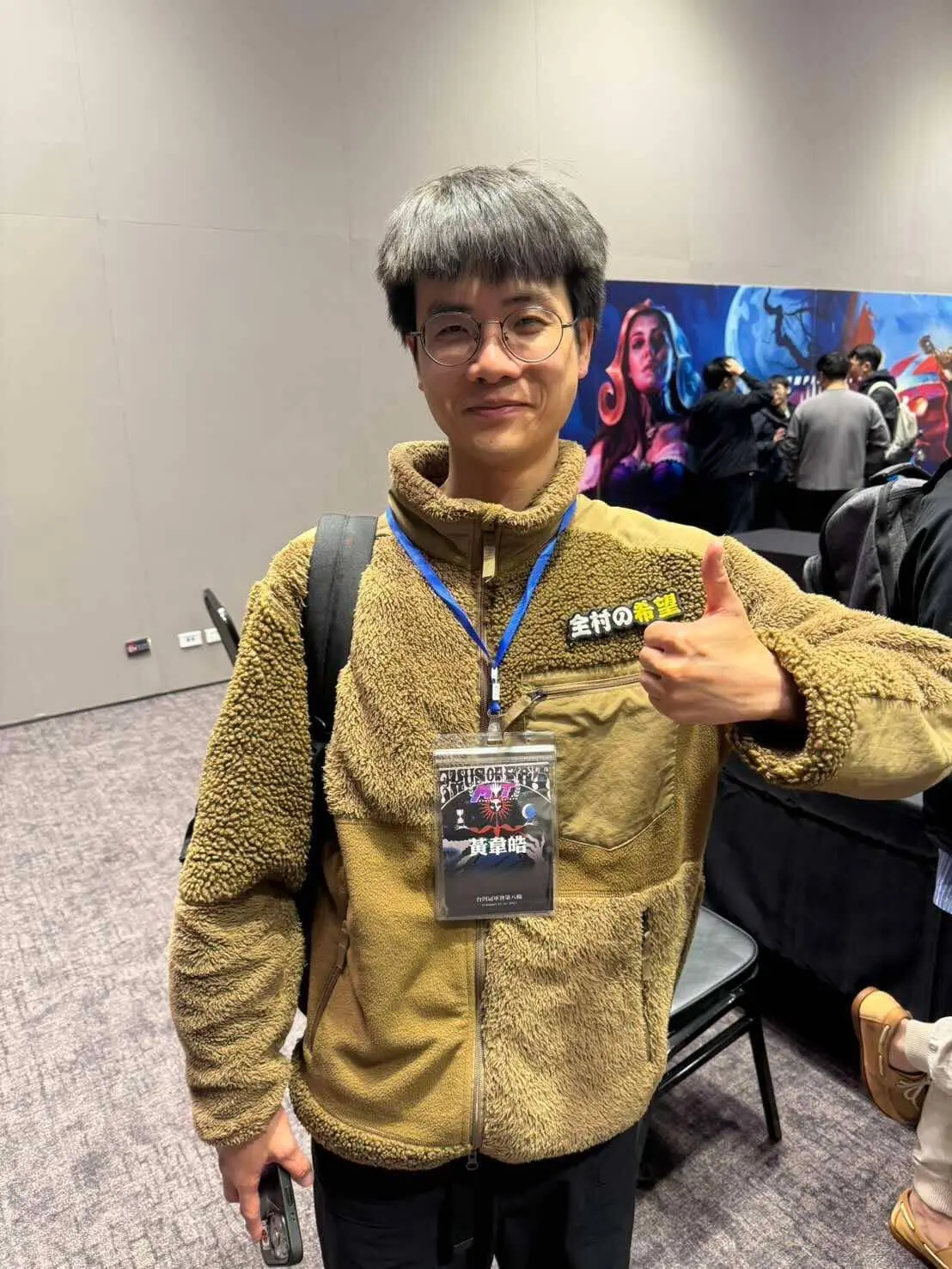
cephille: While waiting for the top 8 list to be announced, our group took this photo of him wearing a “whole village’s hope” name tag (with Velcro on the back so it can be stuck on and pulled off at will, super convenient!). At the time he could not quite manage a smile XD But very soon he was grinning like a child!
Although I unfortunately ended in fourth place, it was still a step closer to my goal of playing in the PT. Looking back after the tournament, I think that during a tournament you should work hard to maintain a positive mindset and focus on the match. Fluctuations at the start easily breed self-doubt, but until the last game is played, the outcome is unknown. Since you have prepared well beforehand, you should take things calmly.
Finally, I would also like to share something with everyone (given the content categories, I really did not know where to put it). When I first started playing, in games I would sometimes run into situations where my opponent and I interpreted a rule or card effect differently. Back then I had no confidence and did not dare to raise my hand to call a judge, and most of the time I just went along with my opponent’s explanation and let the match continue. Looking back, I actually swallowed a lot of losses in silence. I want to encourage everyone: in future tournaments, if you run into a rules question or are unsure about a card effect, do not stay silent just because you are unsure; raising your hand to call a judge and describing the problem clearly not only lets the match proceed fairly and smoothly, it is also respect for yourself and your opponent.
This MIT#8 gave me a lot, and I am very grateful to everyone who has practiced and chatted with me all along. In the future, with more and more events and tournaments to take part in together, I hope we can enjoy this game while achieving better results together!
- Title
- Weihow's Pre-Tournament Preparation and Thoughts on MIT#8
- Author
- Weihow
- Created at
- April 10, 2025
- License
- This work is licensed under CC BY-NC-SA 4.0 .