SamuelChang's MIT #9 Review

Note: This article was translated from Chinese by AI and may contain errors. Read the original Chinese version.
Hi everyone, I’m SamuelChang. I was lucky enough to win MIT 9, so I’d like to share my preparation process and post-tournament review with you.
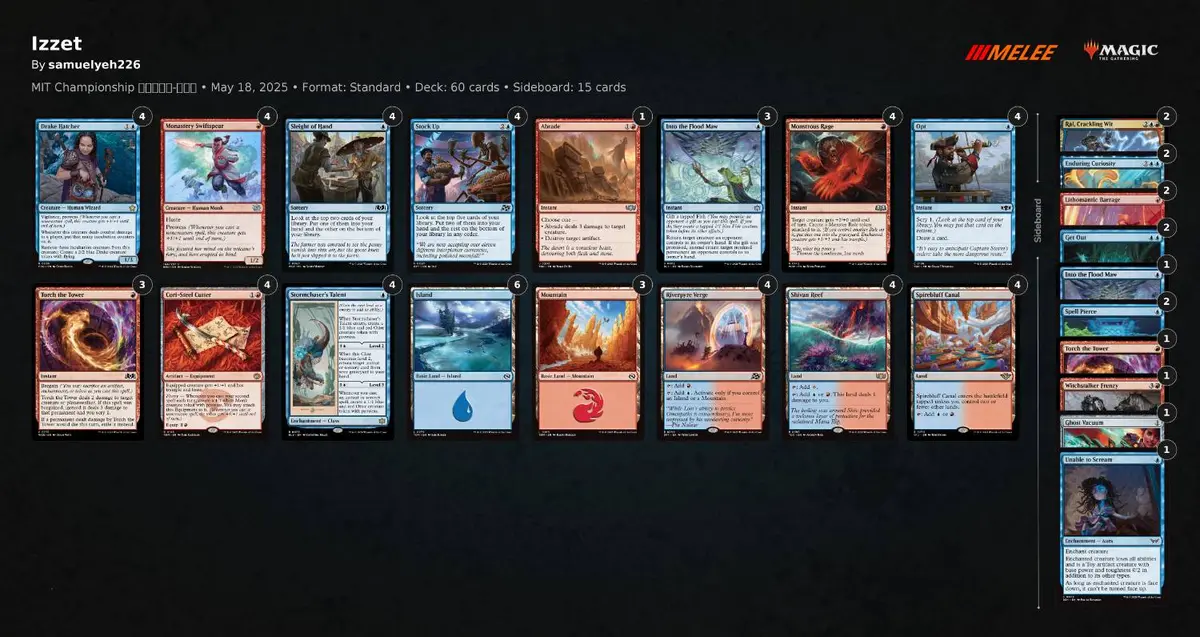
SamuelChang’s Izzet Prowess decklist link
Pre-Tournament Preparation: Gathering Data
High Win Rate Decks at Each RC
I hadn’t played Standard for quite a while before this MIT. After TDM came out, the first deck I noticed was Omniscience.
At first glance this deck really looked “omnipotent”: it has Temporary Lockdown to handle aggro, a combo that looks fairly stable, and even the plan B win condition looks quite reasonable.
Next I noticed Jeskai Control.
The combination of Shiko + Stock Up looks like it can never fall behind in a resource war. It has counterspells, card draw, and Temporary Lockdown, and looks even more well-rounded than Omniscience, fully matching what everyone has always thought a control deck should be.
Then came the first RC (Regional Championship) of the season, the European one, and I think by then everyone knew about a deck that could not be ignored:
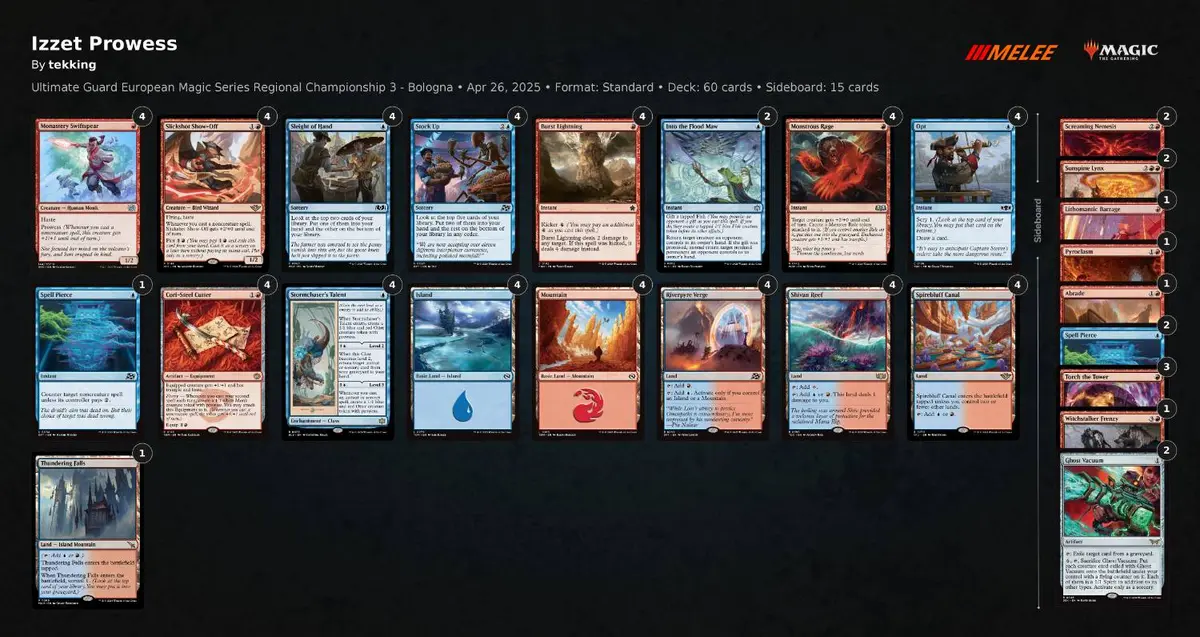
Izzet Prowess (the European RC champion), with nearly every card at Modern power level, outclasses the Standard format. The early pressure of Monastery Swiftspear, Stormchasers’ Talent, and Cori-Steel Cutter, plus the staying power of Stock Up, makes this deck look nearly unbeatable.
As for the following Japan RC, Southeast Asia RC, Brazil RC, and US RC, the decks I paid attention to were these:
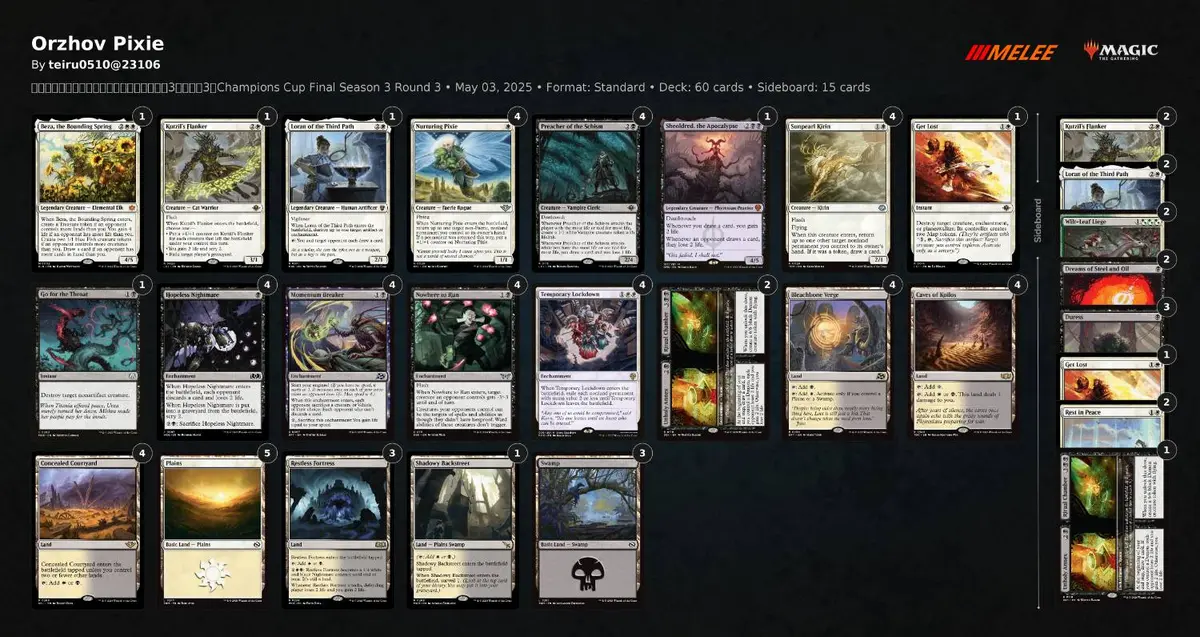
Orzhov Bounce (the Japan RC champion), a consistent game plan, and the newly added Sunpearl Kirin means it can put up a fight without adding blue at all.
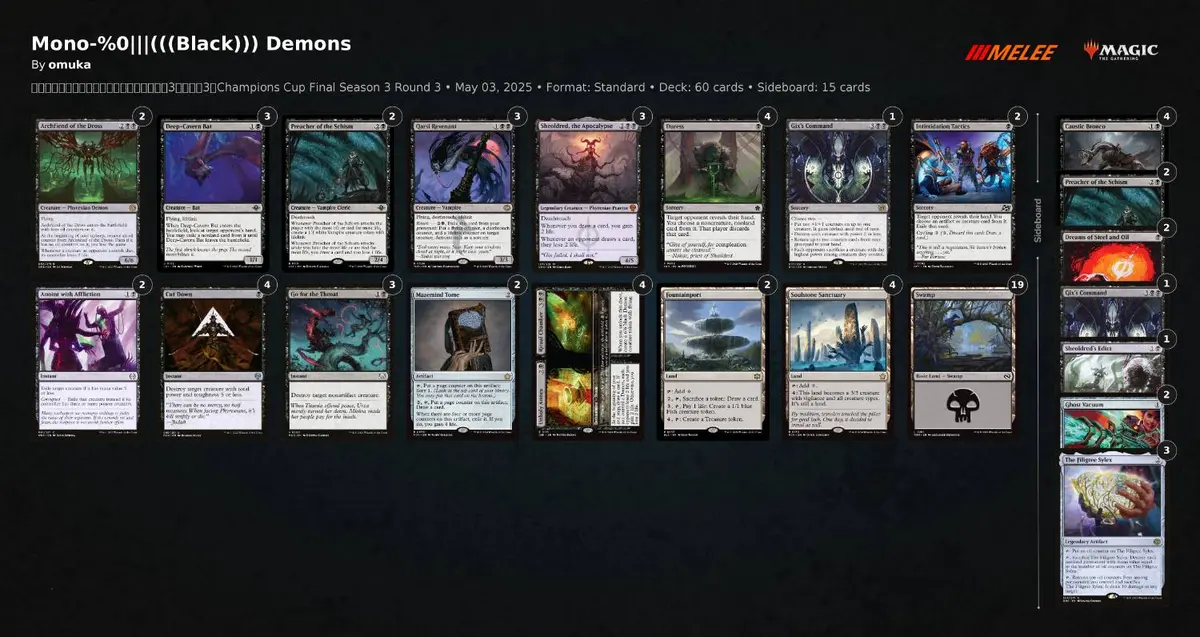
Mono-Black Demons (the Japan RC top 4), the new set’s Qarsi Revenant can be said to be the key to winning against Izzet Prowess builds that don’t main deck one-mana cards that deal 3. The slowdown from four main deck Duress has a good chance of dragging the opponent into a one-for-one battle of card quality.
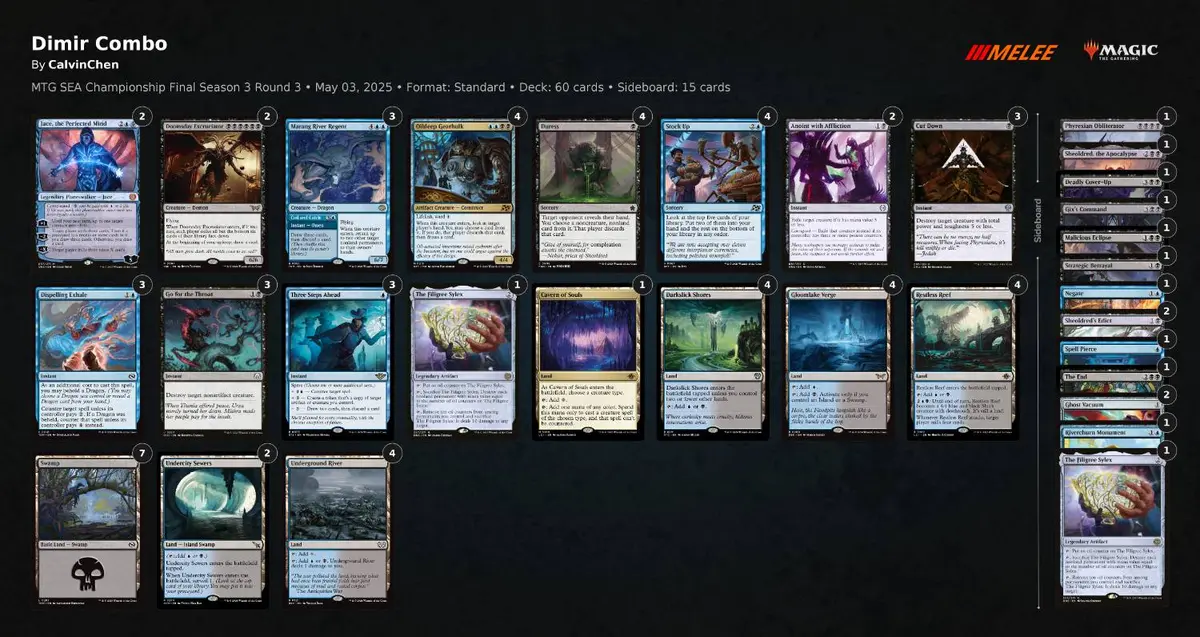
Dimir Demons Combo (the South America RC top 4), tech from last year’s World Championship. A certain master summed it up for me by saying this deck is simply unplayable.
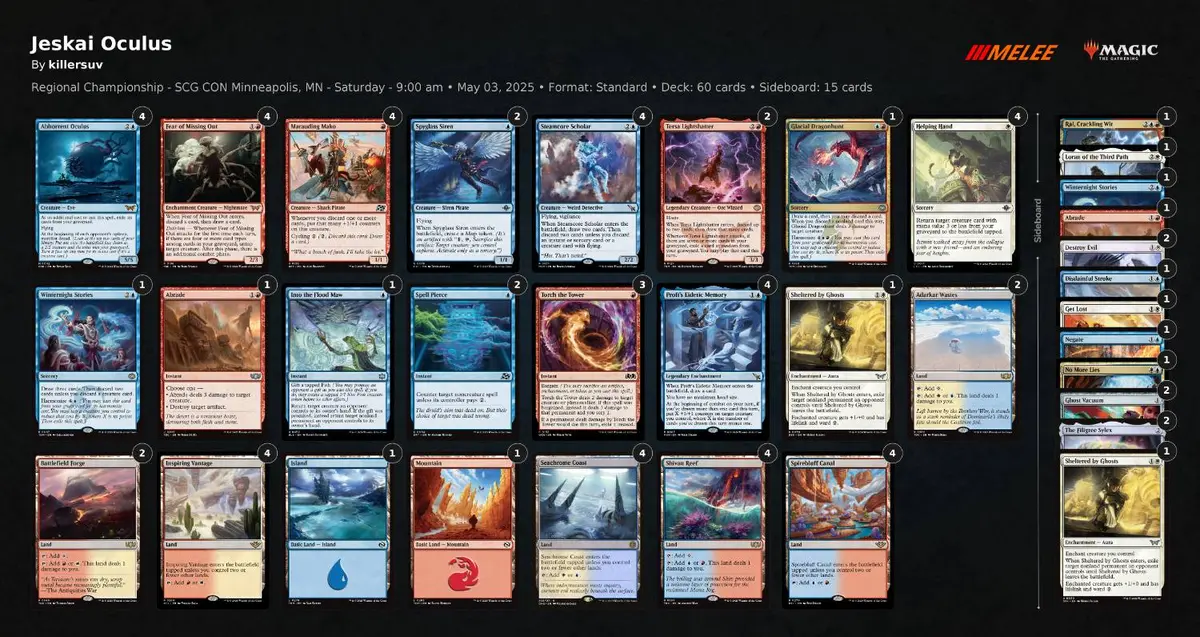
Jeskai Oculus (the US RC runner-up), billed as the strongest deck when your draws go smoothly. Its many 3-toughness creatures mean Izzet Prowess can never catch up once it falls behind on tempo.
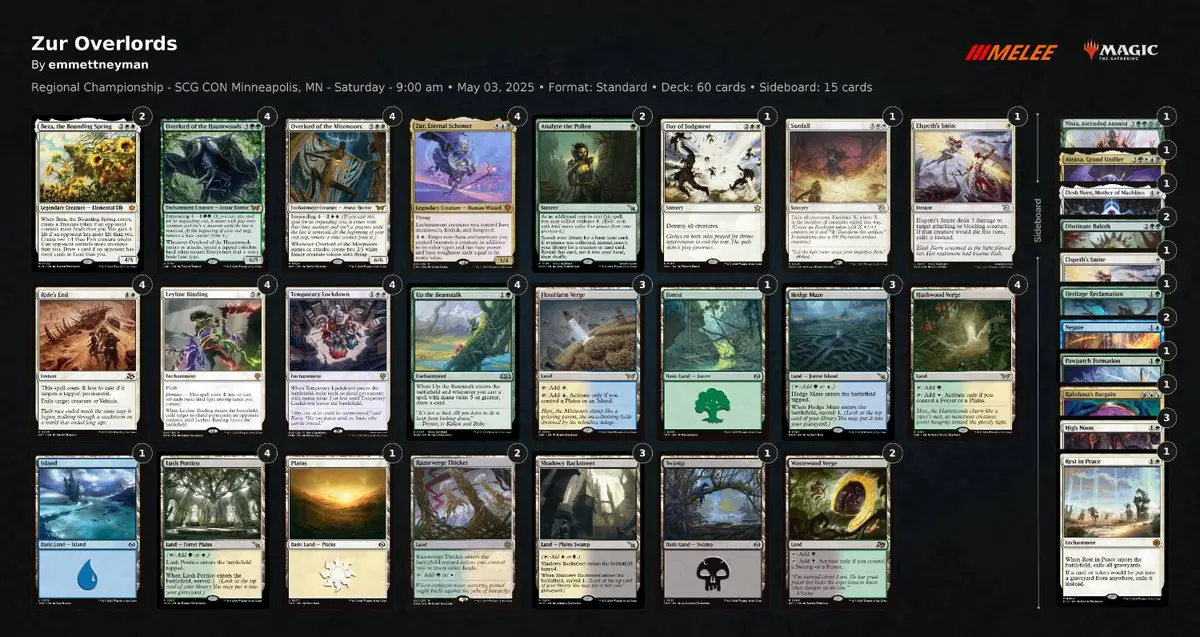
Zur Overlords (the US RC top 16), the overlord of the previous Standard, a deck that got no upgrades at all.
For every deck listed above, except Zur Overlords and Dimir combo, I basically played 1 to 3 BO1 matches on MTGA. There were a few reasons I chose BO1 for practice:
- Time considerations
I wanted to first get a rough feel for what each deck is “roughly” doing and then pick the ones I liked for BO3 practice, but since the decks you most often meet in BO1 are actually red aggro types, the overall help was still quite limited for me personally. - Inconsistent sideboard strategies
There are countless ways to sideboard, and each deck’s game plan against other decks is different. Some decks may be the proactive side in game 1 and play the reactive side after boarding. Because of these factors, I knew that if I chose BO3 for practice, the number of decks I could test would be limited and my understanding of the environment would not be deep enough.
Then came the week before MIT, with two events: the Beijing RC and the Australia/New Zealand RC.
Let’s start with the Australia/New Zealand RC.
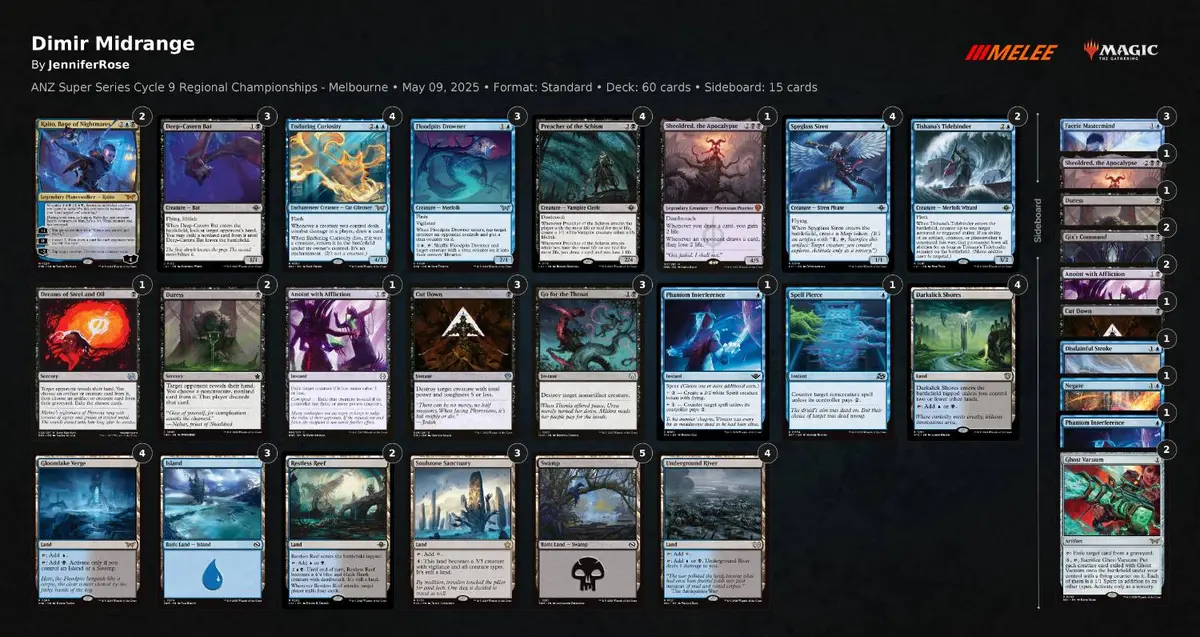
The winning Dimir Midrange came into public view starting the week before the event. Although it also looks like it hardly uses any new cards, apart from a slight disadvantage against Izzet Prowess, it has over a 50% win rate against nearly all other mainstream decks.
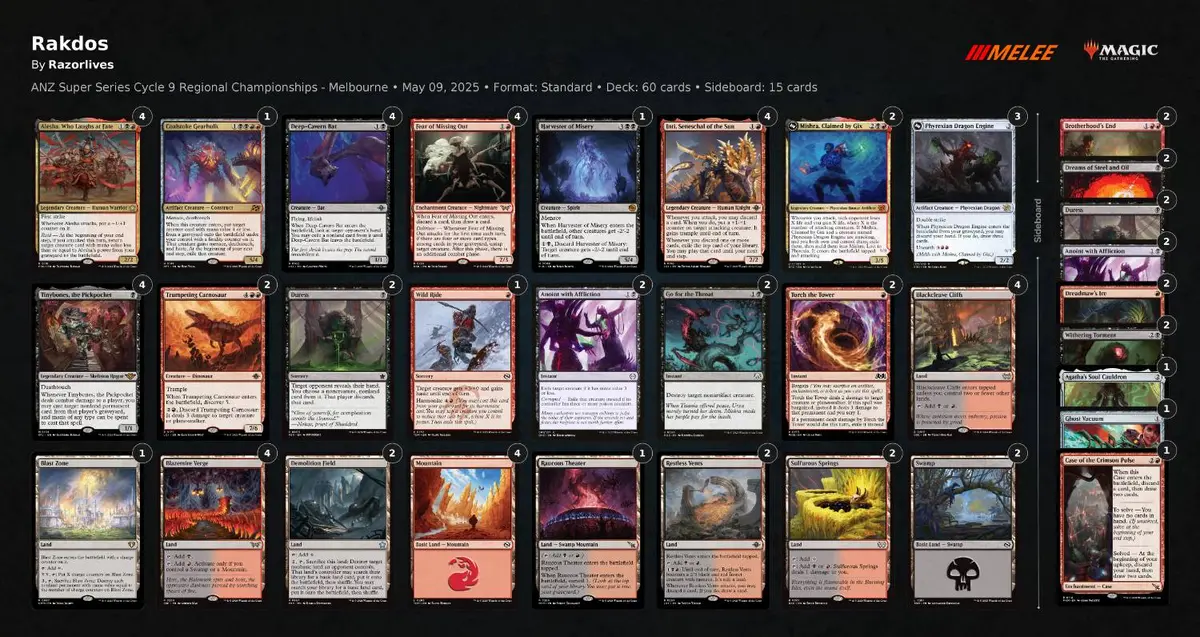
The runner-up Rakdos Midrange was a deck nobody had seen before this event, and the only deck whose matches I watched on stream. My impression after watching was that the runner-up got very lucky and the deck building had good ideas, but I would not consider it at all.
Results of the Beijing RC the Week Before
I’d say this RC was the most important RC to me before MIT. Besides being close in time, I think the Beijing RC is the toughest RC in the world: you must get 7-1-1 or better to qualify for the PT. Although the PT-qualifying ratio might be somewhat higher than at some other regions, given that variance exists, a requirement of losing at most one match is very high.
The top 8 of this RC had quite a few lists that were interesting compared with the Australia/New Zealand RC:
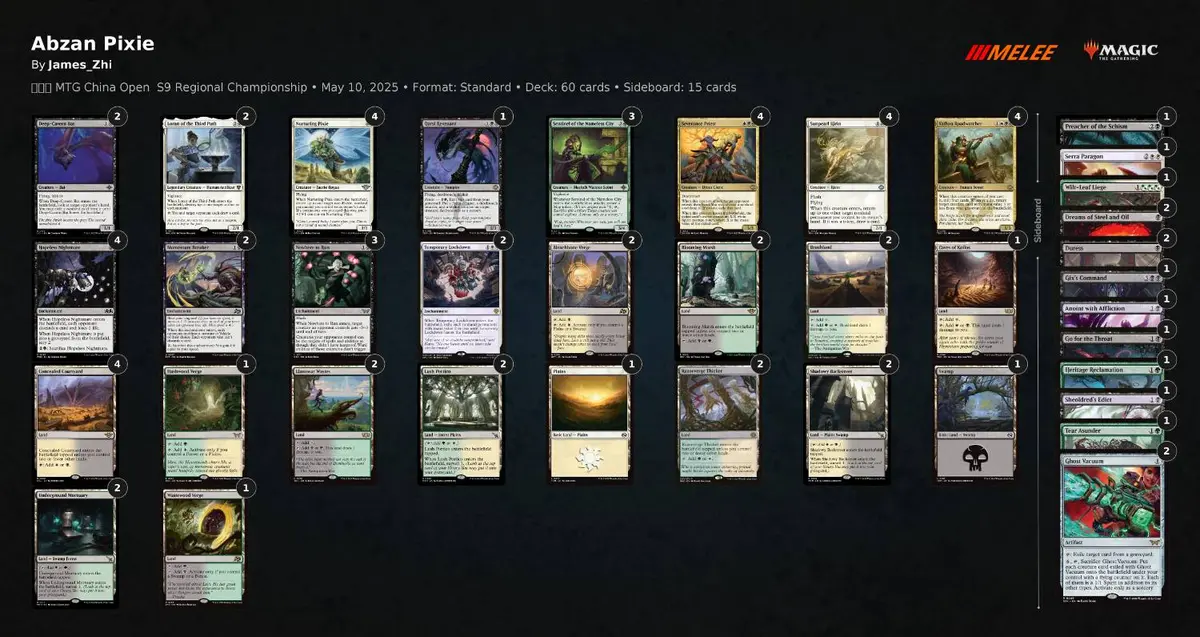
Zhi, Yimin’s Abzan Pixie. At first glance the list looks like it has an advantage against almost every mainstream deck, but as he said himself, Domain Overlords and black-based midrange decks are very hard to play against. The highlight is that for the three-drop it chose Sentinel of the Nameless City rather than the Skirmish Rhino everyone had been playing before.
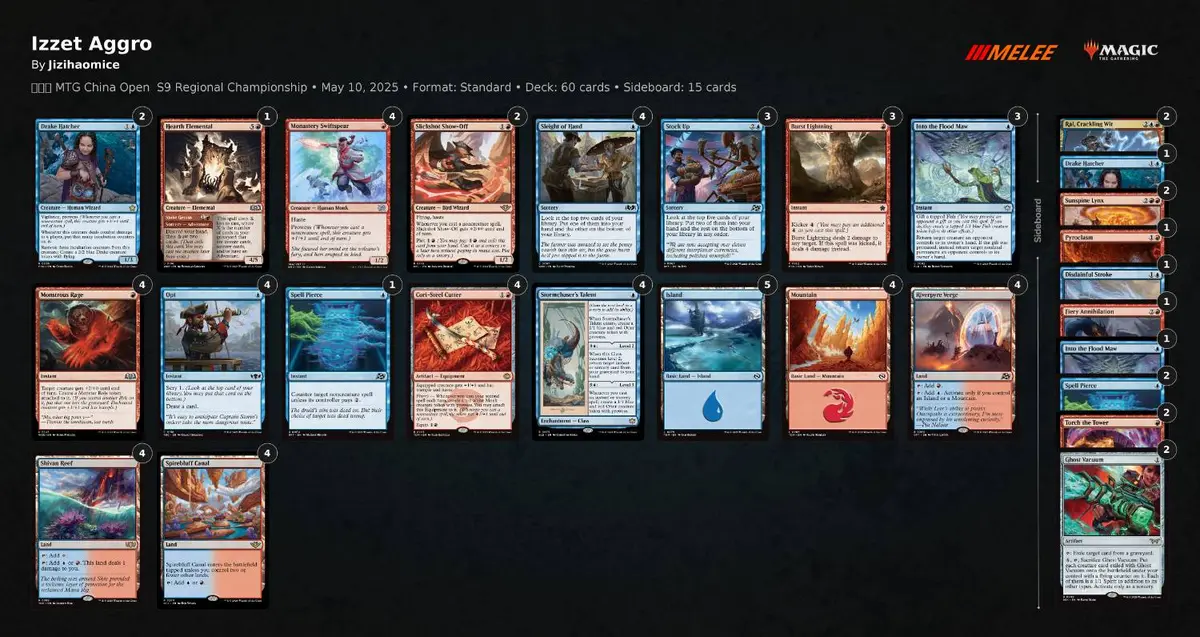
Ji, Zihao’s Izzet Prowess. This main deck is almost the same as the paper Izzet Prowess I played most before the tournament. After the event I also asked him about his thoughts on the sideboard.
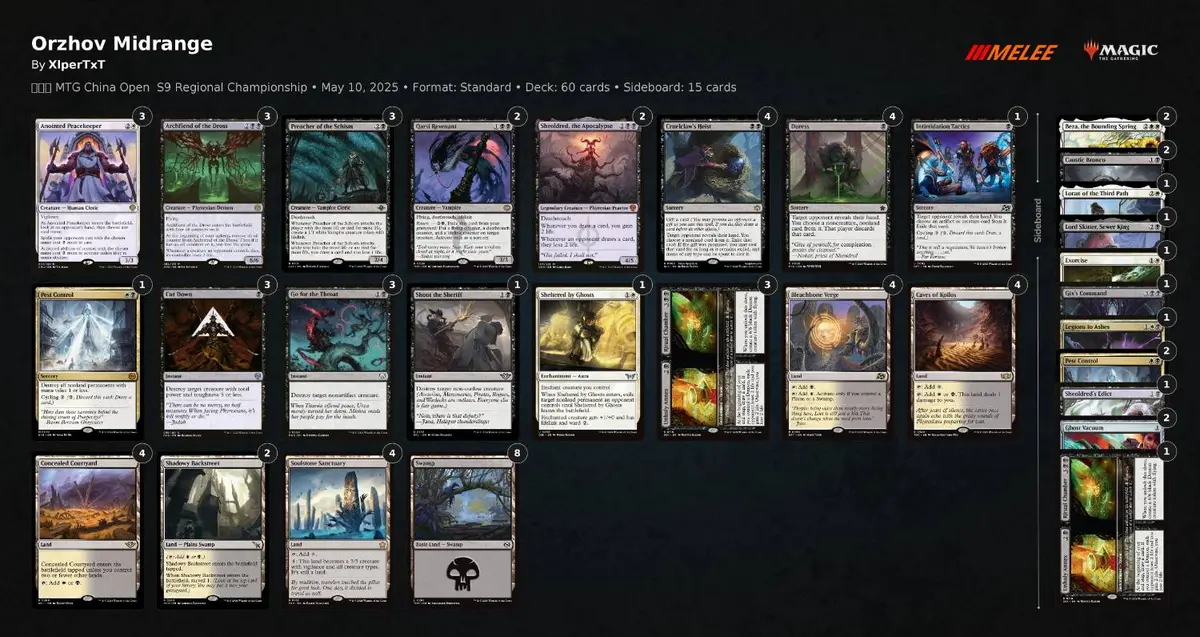
鄒雨桐’s Orzhov Midrange solves mono-black’s problem of dealing with artifacts, and Anointed Peacekeeper can also give it some resistance to Omniscience in game 1.
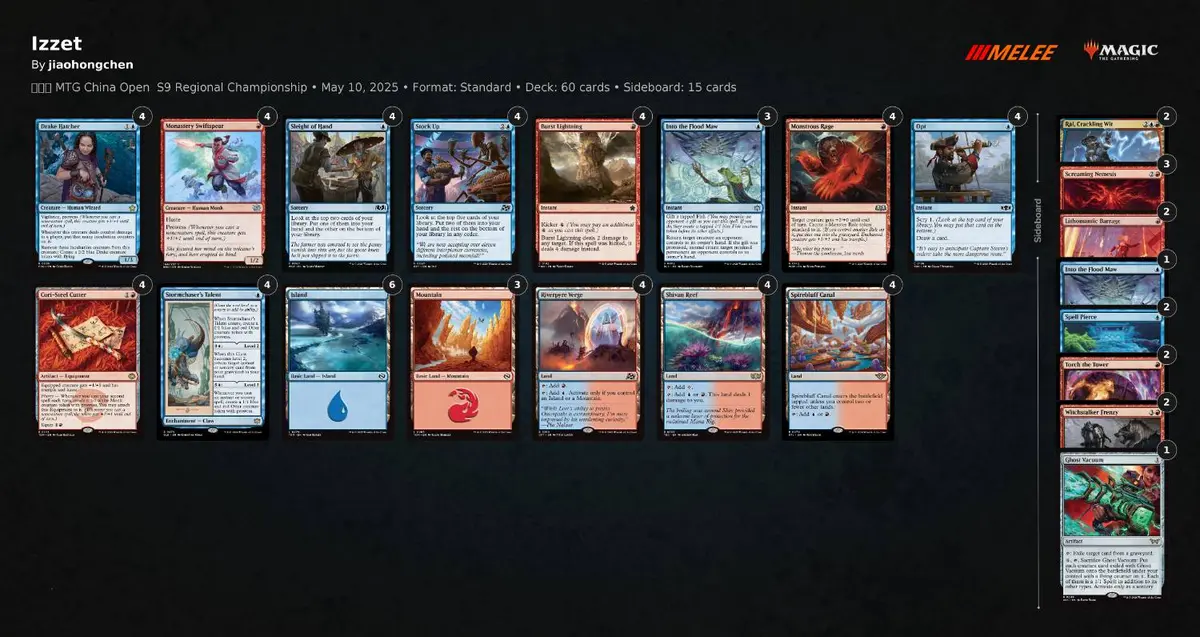
Jiao, hongchen’s Izzet Prowess, with a very interesting-looking sideboard. It completely gave up Slickshot Show-Off, focuses its main deck on the mirror, and its sideboard has a more consistent game plan than the other Izzet Prowess decks I saw.
Information from MO
Besides the various RC lists, MO was also an important source of reference decks. The list that got the most attention three days before the event was as follows:
Izzet Prowess by peter780108
This is the Izzet Prowess deck that won three MO Challenges in a row. You can see the biggest change is that it completely gave up Burst Lightning in the main deck, and you can tell this build is specifically aimed at the mirror. As for the sideboard plan, in my view there was no particular highlight.
Pre-Tournament Preparation: Deck Choice
My logic has always been to “choose a deck with a chance to win the whole thing.” Under that premise, choosing a deck that can make the top 8 and getting to the top 8 with it isn’t hard for me. Basically any deck with the top mainstream share will certainly be fine, but the problem is how to win the championship once you’re in the playoffs. After all, compared with before, I now want to go to Worlds more. If I only wanted to go to the PT, I’d probably just copy a deck the day before the tournament and submit it XD
If you’re interested, you’ll find that apart from MIT8 where I had too much fun, I chose my deck by this logic every other MIT. Just like the Urza’s Saga store championship a while back, where there was nothing for anyone but the champion, my logic for choosing a deck is to pick one that can win the championship, not one that can only make the top 8.
After collecting the data, the next step was to further narrow down the decks to practice. Before the RC results came out, apart from casually building a paper Izzet Prowess deck to mess around with, the first deck I practiced online was Jeskai Control, and in the process I found its advantages to be:
- Simple to pilot, no very complicated calculations; you just need to know how to guard against boards you can’t control
- A rather high win rate against the format’s hottest deck, Izzet Prowess
- I own almost all the cards (?)
But after playing it for a while I found these drawbacks:
- The deck is built toward answering creatures, so against Omniscience you can basically only interact in the sideboard games
After several revisions, trying to add 2 Kutzil’s Flanker to the main deck seemed to successfully improve this matchup, but then I found another problem:
- You simply can’t beat a competent Izzet Prowess player
This is no longer a problem that changing how you play can solve. After thinking about it I figured I probably wouldn’t meet such skilled Izzet Prowess players at MIT, so I set the problem aside for the time being, only to find, after some time, that: - It can’t beat the Dimir Midrange that suddenly popped up
Me at that point: “It’s 2025, and you all still want to play blue-black??????”
In the end, after two BO3 matches, I threw this deck aside.
After giving up Jeskai Control, the next deck I started practicing was Jeskai Oculus. Let me briefly cover the advantages first:
- It’s really strong when your draws go smoothly
- It has a certain advantage against Omniscience, which I consider one of the format’s mainstays, and even a big advantage against Jeskai Control, which might be very popular in Taiwan
- Given a sensible game plan, it’s slightly favored against Izzet Prowess
Then the drawbacks briefly:
- Playing three colors without getting color-screwed is like winning the lottery
- It’s hard to solve the mana flood problem, and the floor is too low
- You may have to spend a lot of time researching the sideboard plan
- It also can’t beat a competent Izzet Prowess player
Taking the pros and cons together, I really felt the return on continuing to invest time in this deck was too low, so after experiencing 2 or 3 bad BO1 matches, I threw this deck aside as well (attached is a photo of a package I mail-ordered, worried that I would have to play Oculus in the end but have no cards, which as of the day of writing this article I still haven’t opened).
The next deck I practiced was Azorius Omniscience. I won’t go over the pros and cons in detail, just a brief summary of my personal impressions:
- It can be said to be almost the most well-rounded deck in the format, but given that, quite a few people probably realize this too, so if you choose this deck you will inevitably face many mirror matches that can’t be changed through deck building. In my view, no matter how you modify this deck, the mirror is 50/50, and even if you have an advantage in play, within the limits of the deck itself the win rate improvement is limited.
- You must carefully control the number of cards in hand, so you aren’t forced to discard certain specific cards while you have Omniscience on the battlefield.
- The matchup against the format’s overlord, Izzet Prowess, is a 50/50, depending on play/draw.
- A flexible sideboard plan: depending on the opponent, you can decide whether to go all in on the combo plan, switch to a midrange plan, or go half and half.
- It can’t beat Dimir Midrange.
This deck can be said to be the one most of my friends practiced and chose, and I even came close at one point to deciding on it, but after playing a few matches I found some problems I couldn’t accept:
- In game 1, as a combo deck, if you’re really unlucky, missing one piece or being unable to keep going will make you lose the entire match outright
- You also basically can’t beat decks that main deck cards aimed at you (for example, I figured maybe someone else would, like me, bring a Jeskai Control that main decks Kutzil’s Flanker)
- When both sides draw about the same number of cards, why does it still feel like I can’t beat a really good Izzet Prowess player…
In the end, I reluctantly threw this deck aside as well, keeping it as a fallback in case I still didn’t know what to play at the very end.
Then I practiced black-based midrange (mono-black/Orzhov) and Orzhov Bounce, and the short conclusions were:
- For black-based midrange to beat Izzet Prowess, the big premise is a good hand that plays on curve at 1-2-3-4, and under that premise this doesn’t give me a reason to choose this deck
- For Orzhov Bounce to beat Izzet Prowess, the big premise is also a good hand, but it’s so hard to play against Omniscience… and in fact it can’t beat a competent Izzet Prowess player either…
- You must main deck 4 Duress; discard effects that aren’t Duress are all terrible
These two decks were the ones I gave up on the fastest. Although I added some small changes of my own along the way, the overall result was still not good enough for me to accept these two decks, and I threw them straight onto the “not considered” side.
Next was Dimir Midrange, which I spent a lot of time on (it’s 2025 and I don’t want to play this either). I tested many versions along the way, such as not main decking Deep-Cavern Bat and playing Duress instead, or main decking 2 Spell Pierce + 3 Tishana’s Tidebinder, or choosing Oildeep Gearhulk as the 4-drop, then going back and forth on the 2-drops, or main decking 2 Gix’s Command… and so on. By the end I discovered something very important:
“IT CAN’T BEAT IZZET PROWESS AT ALL AAAAAAAAAAAAAAAAH!!!!!!!!!!!!!”
No matter how I changed it, how I changed my play, how I worked around it… first, this deck can’t beat an Izzet Prowess deck with very good luck; second, it can’t beat it when both sides have about equal luck; and then, even when I got very lucky I might still not beat it
—— so this deck got thrown aside as well.
Finally, with no other choice, I had to start practicing Izzet Prowess (definitely not because my good friend bet me 100 dollars that I would never play this deck). I played BO1 with nearly every list online that had produced results, and my initial impression at the time was:
“So strong… is this the power of a T0 deck…?”
“Is this the leeway of playing Modern in Standard?”
“Why didn’t I buy 100 copies of Stock Up back then (X”
Friends who have known me for a long time know that I really dislike playing mainstream decks, and I don’t buy the line from Shota Yasooka that you should have a 55% win rate in the mirror. With card power as high as it is now, unless a build has enough little clever touches, the mirror is, in my view, a matchup with a high luck component that can’t be controlled. Unless I personally don’t have time to prepare, I basically don’t bring mainstream decks.
But it seemed the time had come when I had no choice. Luckily, after the Beijing RC I had a chat with Ji, Zihao, the top 4 finisher, and got Jiao, hongchen’s little sideboard tips, and I also exchanged a few words with 小徐, who hadn’t played much Standard, which let me quickly understand Izzet Prowess’s game plan in each matchup and some things to watch out for in a very short time:
- Don’t put more than 1 Disdainful Stroke in the sideboard; it’s too inefficient
- With 3+ four-drops in the sideboard, 21 lands is a must, and of those 21 lands the basic land configuration must be 6 Island and 3 Mountain. Everyone except Jiao, hongchen puts 5 Island and 4 Mountain, which is wrong, because Riverpyre Verge is also a red land when you have no other basic lands. As for why an unstable mana base can still keep this deck winning, it’s purely because too many people play it and the other cards are too strong
- Monastery Swiftspear must be 4 copies. This card is the most important one against Omniscience: it lets you not lose cards to bounce (a token from Stormchasers’ Talent being bounced is a big loss), lets you, after being hit by Temporary Lockdown, bounce the lockdown and go for another burst, and even allows you to bounce the opponent’s lockdown on your main turn so you have enough resources to trigger Cori-Steel Cutter’s ability
- When played correctly, this deck is ahead against almost every deck other than itself, so the focus of adjustments is how to get ahead in the mirror without losing the advantage against the other decks
- Witchstalker Frenzy is much better than Broadside Barrage, because a three-mana spell dealing 5 basically can’t get cheaper, but a four-mana spell dealing 5 can get a discount whether you’re ahead or behind, and when you’re ahead on tempo it even locks up the game directly
- Lithomantic Barrage is too important
With these further insights, a few questions still troubled me:
- After giving up Burst Lightning in the main deck for Torch the Tower, will the win rate against other non-mirror matchups drop? If so, by how much?
- The ratio of Slickshot Show-off to Drake Hatcher in the main deck: in non-mirror matchups, can you tolerate a 1/3 creature for two mana? Would changing the ratio make games you could have won unwinnable?
- Does the main deck really need Spell Pierce?
- I didn’t have a sideboard plan that I felt especially good about; I didn’t think Jiao, hongchen’s plan had a particular advantage against black-based decks and Jeskai Control
I couldn’t verify the first question through lots of practice, but after seeing the MO results I decided to main deck Torch the Tower after all, since seeing Drake Hatcher was too much pressure.
On the second question, because black-based decks actually lack answers to artifacts, the key to the matchup isn’t whether you play Slickshot Show-off or Drake Hatcher, but whether you have Cori-Steel Cutter. In practice, not main decking Slickshot Show-off affects the win rate when on the draw against Omniscience, but in my view that matchup is just play/draw dependent, so don’t main deck the mirror-awful Slickshot Show-off; playing 4 Drake Hatcher is correct (although in game 1 of my top 8 I got killed by the birds, hehe). Also, funnily enough, I ran into cftsoc 2 or 3 times on MTGA, and this cutie was beating me with Izzet running 4 Drake Hatcher before the MO challenge, so I decided to trust him.
The third question is a conclusion I reached after thinking for a while: in my view this card is only somewhat useful on the draw in the mirror in the first 2 or 3 turns, and against Omniscience; the rest of the time drawing it is really bad, and I’m not willing to give up the deck’s overall stability for that small bit of surprise.
Around this time I happened to see Yuta Takahashi’s X post. His sideboard had Enduring Curiosity and Get Out, which I had happened to use before, and an idea popped into my head:
“Why not build a brand-new sideboard plan?”
And so a main deck nearly identical to the MO challenge list (apart from the basic land configuration) and a sideboard completely different from everyone else’s appeared. The fourth question was also solved the night before the decklist submission, after a six-game BO3 win streak on MTGA at Mythic.
Writing this, I suddenly remembered there was another reason I was willing to put the most time into Izzet Prowess: I saw a bunch of strong overseas players who don’t like playing aggro choose this deck, and since they spent so much time and still chose this deck, I couldn’t see any reason to refuse it.
The Tournament
Honestly, there’s nothing that special; if you’re interested, feel free to head over to the FB page 鳥不喇基 and read my blow-by-blow report.
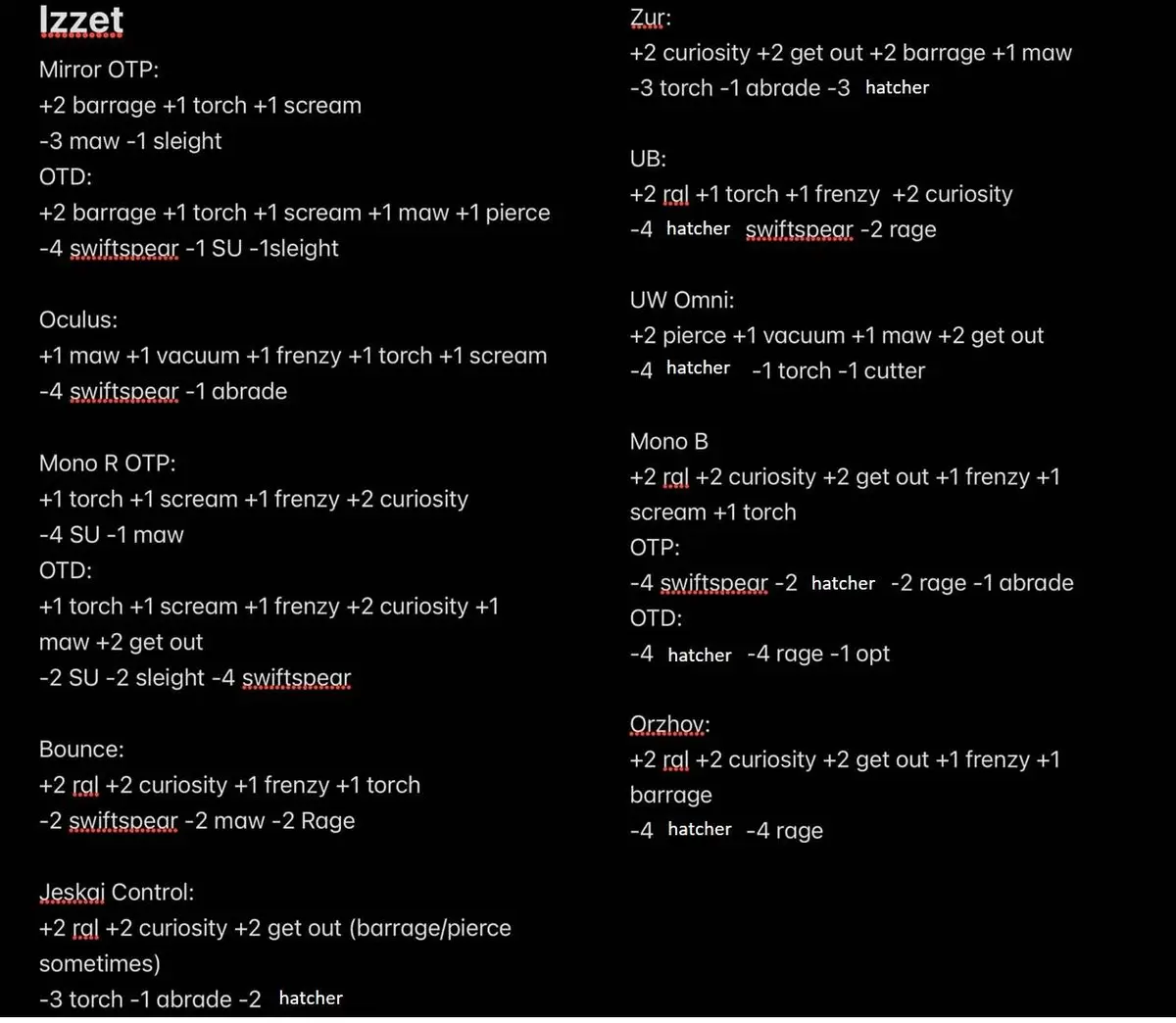
Sideboard Plan
鳥不喇基 has this too, but I’ll include it anyway.
Post-Tournament Review
Some of you may be thinking at this point, you won the championship, so what is there to review? But personally, what I fear most isn’t losing; it’s a version of myself that hasn’t improved after the matches.
As for the outcome of the games themselves, whether luck or non-luck factors carry more weight is, I think, actually the most important thing.
What I think I did poorly this time was a lack of paper practice, but on the other hand, due to real-life factors, I really didn’t have that much time to hang out at the card shop; second, I didn’t play every deck at least once, for example Abzan Pixie and the mono-red that popped up two or three days before decklist submission, or Azorius Control. For the first two, I had no cards for them either in paper or online and really couldn’t free up time for them, so in the end I had to let it go. However, even though I never practiced them at all, my conclusion about this Standard format is not to play three-color tempo decks, and that mono-red can’t beat some of the other non-mainstream decks I expected to meet in the tournament.
The impact of the lack of paper practice was actually quite big. On tournament day, several times I had to slowly count to confirm I already had lethal, and I even mis-calculated lethal in game 3 of the top 8 and game 2 of the finals (although I had a big advantage in both, I really played badly). Besides that, declining stamina was also a factor, so it seems it’s time to spend less time at the card shop and more time at the gym being electrocuted by the coach.
Conclusion
By now you’ll see that if I hadn’t known players from other regions, I could not have reached such a high level of understanding of Izzet Prowess in such a short time, and the vast majority of these people I met at the PT.
Reading this far, you might think: but I don’t know these people and don’t have these resources, then I can’t go play at the PT? And if I can’t go play at the PT, I can’t meet these people, so I can’t get stronger???
It’s fine! Besides the PT, we have other places to play. Besides the Chiba Spotlight at the end of June, the 睿卡杯 to be held in Shanghai in November is also an excellent choice for you!
What are the benefits of going to Shanghai to play?
- You might leave a deep impression on Zhi, Yimin, which gives you a chance to ask him a few small questions before future tournaments
- You might get to meet more players who often get results on MO, or run into PT top 4 and top 8 players, and so on
- You can go see the Freedom Gundam
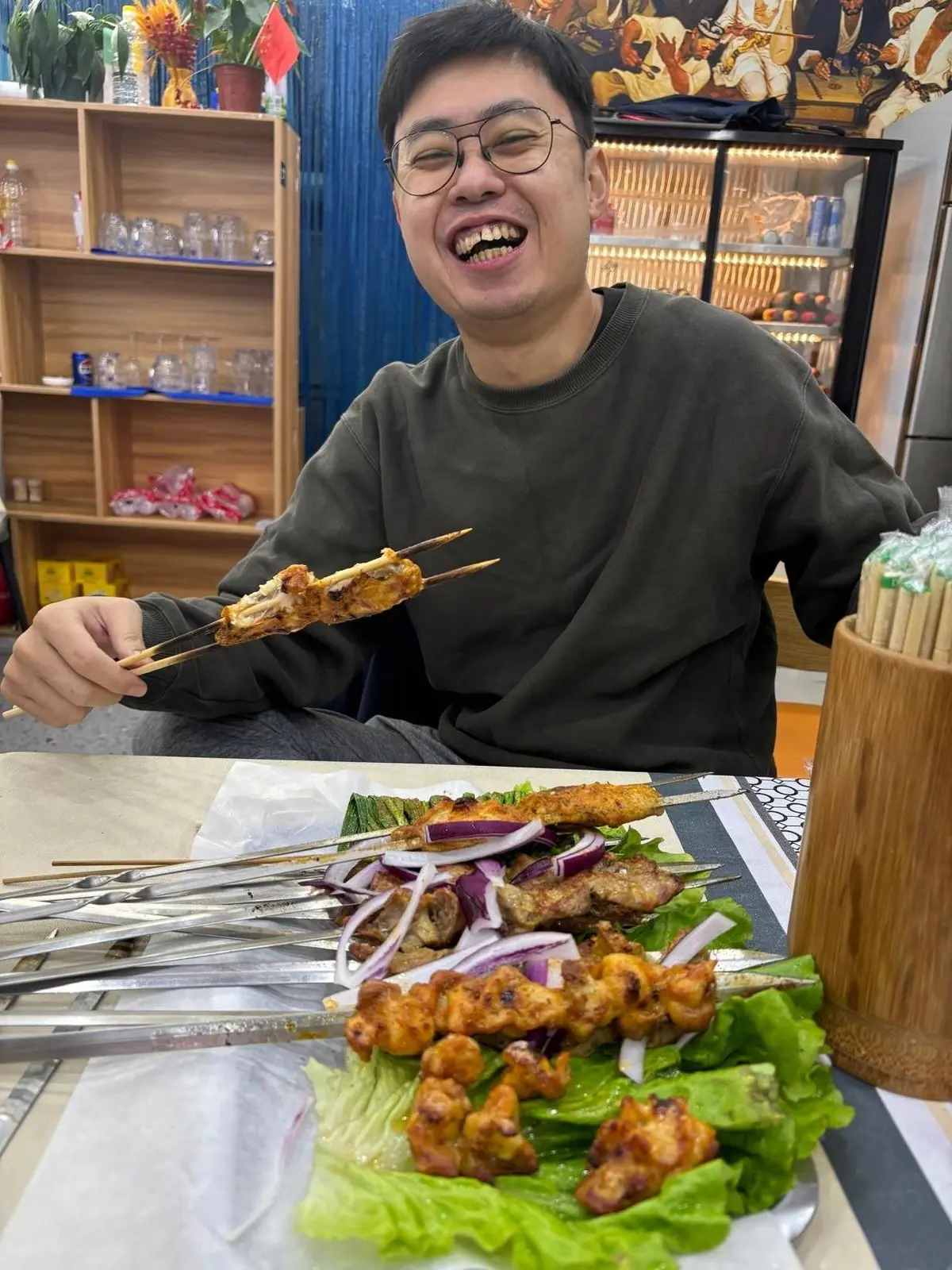
- Most importantly, you can go eat lamb skewers with 小蘇!
Thanks for reading.
- Title
- SamuelChang's MIT #9 Review
- Author
- SamuelChang
- Created at
- October 6, 2025
- License
- This work is licensed under CC BY-NC-SA 4.0 .