sertyple's MIT#9 Tournament Report

Note: This article was translated from Chinese by AI and may contain errors. Read the original Chinese version.
Introduction
Hi everyone, I’m sertyple. I’m honored to have been invited by cephille to share my preparation and tournament journey at MIT#9 here. I’ll walk through it in this order: predicting the metagame → deck choice → practice → tournament stories → conclusion.
Predicting the Metagame
My method was mainly to look at foreign RCs, checking the Top 16 of each major region to predict the deck distribution on the day. You can see Izzet Prowess already making its mark at the European RC, and the trend continued all the way to the Australian RC just before the event. From this I estimated that MIT#9 would be full of Izzet Prowess. Worth noting is that the US RC and the Japan RC builds differ slightly: the split between Slickshot Show-Off vs. Drake Hatcher
 makes quite a noticeable difference, I think, in non-mirror matches. At the time of preparing, I didn’t know which type Taiwan’s Izzet Prowess would lean toward. Either way, I simply estimated Izzet Prowess at roughly 30% of the field, about 20 to 25 copies.

European RC Top 16 distribution
I also figured before the event that Mono-Red and Gruul Delirium would still show up, ready to ambush the midrange and control decks that, to beat Izzet Prowess, add more High Noon to the sideboard and cut quality removal like Anoint with Affliction
 . In the end I was wrong: when it comes to aggro, it’s still Izzet Prowess.
Next up, most of the rest would be midrange. The Orzhov Flicker deck from the Japan RC and the two Dimir/Rakdos midrange decks that took first and second at the Australian RC might bring quite a few players back to the embrace of black-based midrange. The game plans of these midrange types differ a lot, and I wasn’t sure about the ratios of Unholy Annex // Ritual Chamber, Dimir tempo, and Pixie, but because of my deck choice I lumped them into one category.
Finally, I expected a handful of 2 to 5 copies each of decks including Jeskai Oculus, Jeskai Control, Azorius Omniscience, and Zur Overlords. These would each take a small slice of the field’s pie chart. I made a big mistake in this part of the estimate: there were far more Azorius Omniscience decks than I imagined, which made me extremely nervous before and during the tournament… (luckily I dodged them well XD)
Deck Choice
I returned to Standard because, after qualifying for MIT#7, I didn’t want to build Modern, and the prizes at a store championship pulled me back to Standard after 6 years away. The deck that won that prize was Golgari Midrange. I chose it partly out of curiosity about midrange, and partly because after reading the MIT#4 report by Uncle Jund’s Daily Life and a post on the thinking behind Rakdos midrange, I became really interested in that game plan: discard it, kill it, or overwhelm the opponent with quality creatures. I thought Golgari Midrange and I would walk hand in hand into MIT#9, but then something went wrong between us…
In the early MITQ stretch I took Golgari Midrange to every event, but several MITQs in a row I got stuck on lands or mulliganed repeatedly, and several times I went to topdecks against opponents and flooded out at the crucial moment. Golgari Midrange’s share on MTGGoldfish kept shrinking, with Dimir Midrange, Domain, Mono-Red, Temur Otters and others dominating the field at the time, leaving less and less room to survive. I lost more and more confidence in it, and that’s when I couldn’t help turning my eyes to Domain, which had just won the PT. I hurried to borrow cards from the friends around me who seem to own everything, and took my own mutated, red-splashed Domain to Taichung to play Noah’s MITQ. It wasn’t especially smooth, but I was lucky enough to win my first match after switching decks.

Decklist from the Noah's tournament
As the event approached, given the metagame analysis above, I figured my deck had to beat Izzet Prowess and the various black-based midrange decks, so I eliminated Jeskai Control. I eliminated Izzet Prowess because I’d never touched aggro and didn’t have enough practice time before the event to build up experience. Golgari Midrange had a build that really tempted me and tested well, but its win rate against Omniscience was around 50% and its win rate against everything else was unknown, so after much thought I gave it up.
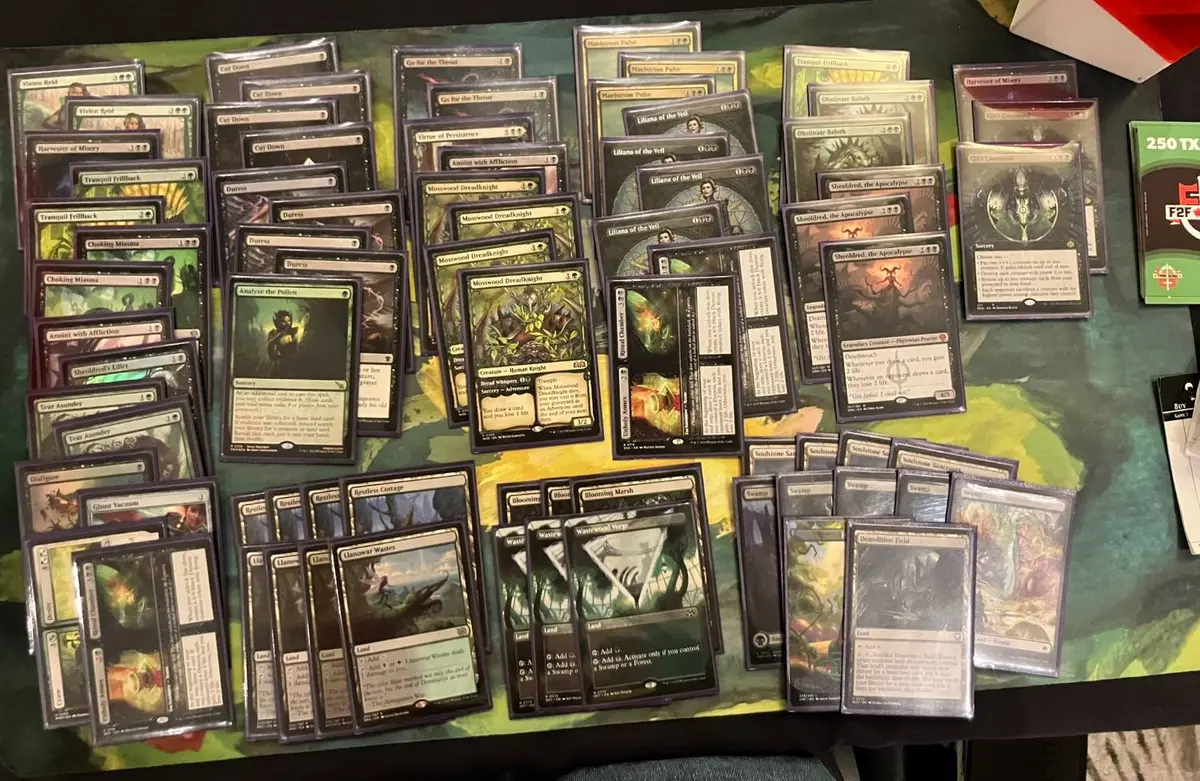
Golgari Midrange by Linden Koot
After looking at the win rates of the various decks, the best choice should really have been Dimir Midrange, but again I was limited by preparation time. After testing the Domain vs. Izzet Prowess matchup many times, I found that Beza, the Bounding Spring and Zur, Eternal Schemer
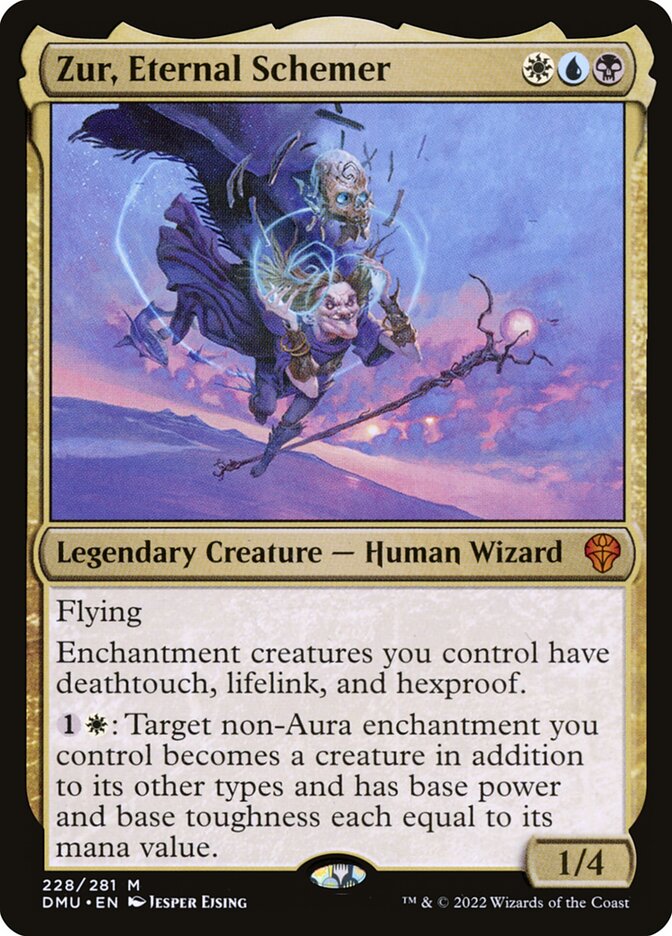 still put a fair amount of pressure on Izzet Prowess. Testing with the list I finally submitted, in games against friends and in my own practice, Domain won the matchup at a fairly high rate, so I finally decided to play Domain at MIT#9.

Win rate table for Domain Zur Overlords (bottom row)
This is the version I took into battle. Some people play one fewer Ride's End and add one Split Up
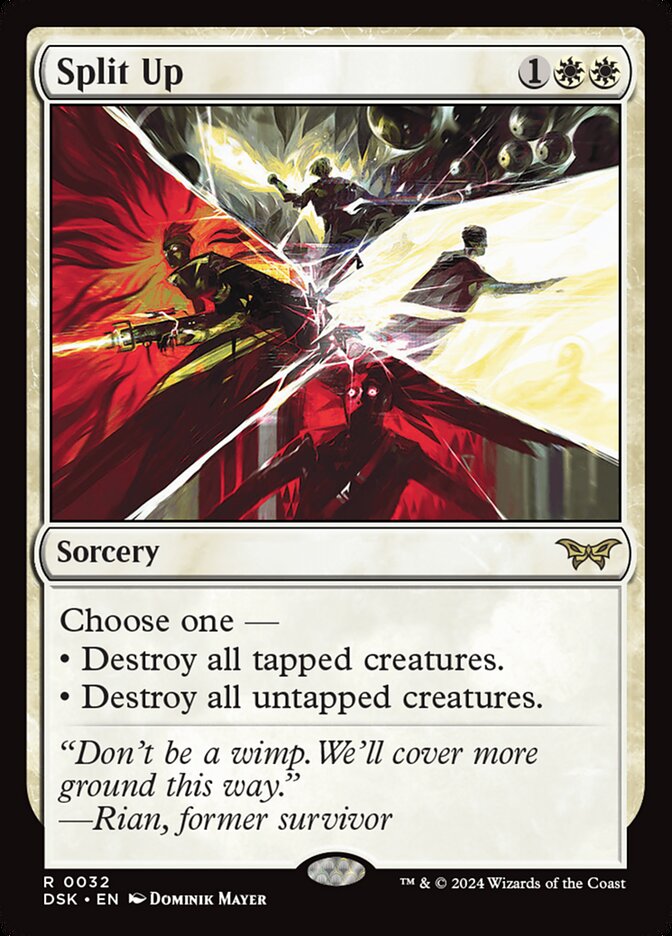 or Temporary Lockdown
 to the main deck, but as I said before, Izzet Prowess puts less pressure on me than pure red does, so I preferred to keep an extra exile effect that hits a single creature for other matchups. Because the main deck has Cavern of Souls
 , I have more breathing room against control decks overall: holding both threats and Caverns until the last moment puts a lot of pressure on the opponent. Also because of Cavern of Souls, my sideboard choices focus on creature threats of the same type, such as Atraxa, Grand Unifier
 and Elesh Norn, Mother of Machines
 , and I dropped non-creature late-game bombs like Nissa, Ascended Animist
 .

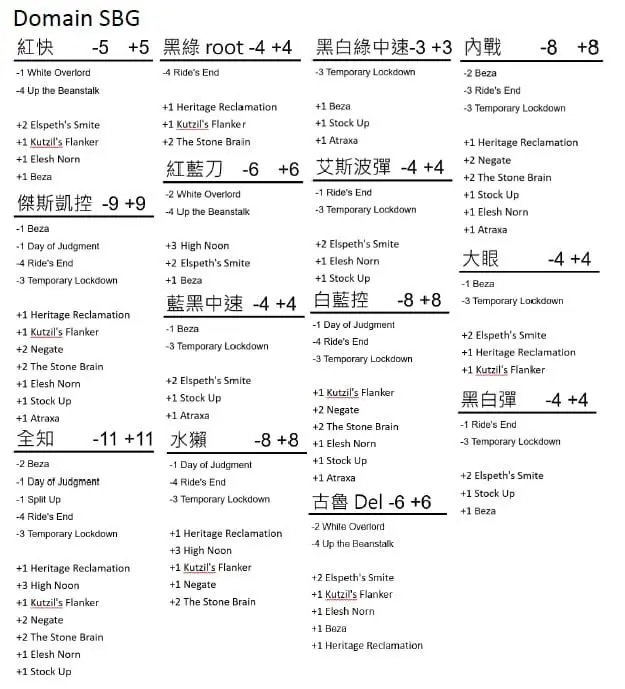
This is the SBG (sideboard guide) I used for this tournament. Putting together an SBG lets you clearly work out the purpose of every sideboard card. During preparation you find you don’t understand some of the decks you might face well enough, and after spotting the problem you can find your own and your opponent’s strengths and weaknesses, which helps a lot in building a plan for each matchup.
Practice
This was my second time preparing for an MIT. Compared to MIT#7, where I did almost no extra studying, this time I followed the weekly practice schedule provided by ClarkShih, and it gave me the reassuring feeling of improving steadily. Each week had a designated goal, plus designated practice games matching that week’s goal, which quickly raised my familiarity with each deck and made my thinking more thorough against different opponents. A habit I think is worth building from this tournament is setting quantifiable goals during preparation: break “practicing” into a schedule table, and check overall practice progress by number of games or hands.
This time I spent a lot of time trying the meta decks on MTGGoldfish, and actually playing them to feel how each deck works was really effective. Using a visual table to record my understanding of each deck type was a very effective way to see the gaps in my learning. However, since I don’t keep an MTGA account, I could only open different moxfield tabs on two screens to practice. Even if I thought through what would differ in a real game at every move, this kind of practice was still time-consuming and not reliable enough. In the weekly discussions with NMT, I learned what everyone thought about each deck, and discussing with each other gave me a deeper understanding of deck types I had never actually played against a real person. That knowledge let me practice a few fewer deck types while still having a baseline for each deck in the environment. Having people to discuss with is really important, and I’m very grateful to everyone in NMT who discussed with me.
For in-person play, there were the weekly Wednesday and Thursday events at ALG & 平方. Thanks to every opponent I faced, who often sparked new thinking, especially the practice session at 平方 right before the tournament, where I lost a favorable matchup and then ran into a deck I’d never seen and found hard to handle. By the way, that ‘Sultai Turtles’ deck was really cool, and it helped my pre-tournament mindset a great deal that day. Thanks again to every opponent I met.
Tournament Stories
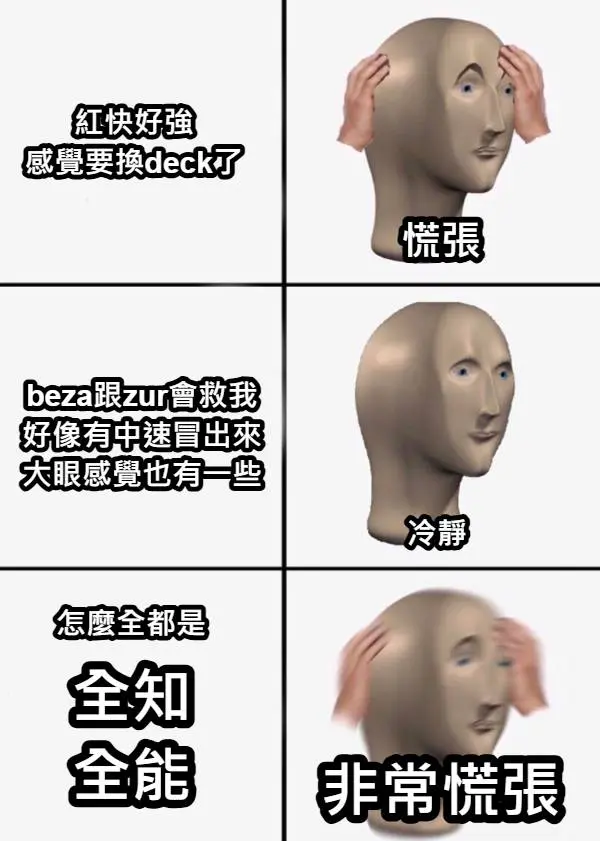
The image below is basically me before the tournament. At the very start of preparation I felt Taiwan must have lots of aggro, and that Domain would get its head bashed in by assorted small red creatures or Monks. Then for a long stretch in the middle I slowly realized that Domain actually isn’t under as much pressure from aggro as it was from the old Mono Red, and there were quite a few Orzhov Midrange, Jeskai Oculus and Jeskai Control decks showing up at events all over. Just as everything was heading in a good direction, I noticed the nightmare matchup, Azorius Omniscience, popping up like bamboo shoots after rain. Asking around, it felt like the more I asked, the fewer Izzet Prowess there were XD. Omniscience showed up in the finals of many Taipei events, so in the end I stepped up to play with a nervous heart.
In round 2 I played against Chiyou. In the post-game review I found that, because of time pressure, I got too aggressive on one key turn: I surveilled a Zur, Eternal SchemerI saw off a surveil land straight into the graveyard, then used Analyze the Pollen to collect evidence by exiling cards from the graveyard, and searched up another Zur directly. In the end I ate a Day of Judgment
 and never recovered. What could have been a draw, or a game 3, turned into a 0-2 loss. In fact, had that game ended in a draw, I might have ended up facing the Omniscience player who was also 3-0-1 later on because of the draw. All I can say is that it turned out fine.
In the Top 8 I played against 蹦蹦. In game 1, we were both one card short of killing each other and locking up the win. I calculated in my head that the chance of 蹦蹦 drawing a removal spell in his draw step was about 22%, while my chance of hitting an answer off the Up the Beanstalk trigger from casting Overlord of the Mistmoors was exactly 25%. I decided to go for this very thin EV, and the result was that neither of us drew it.
Conclusion
Looking back on the whole MIT#9 journey, I think the most important thing was learning to live with uncertainty through the cycle of “ask questions → find answers → improve”. Every misplay, wrong sideboard swap, and missed chance to win during preparation became material for the next adjustment, and it convinced me that solid practice and honest review are always the undefeated formula.
Although there is still a lot I could do better, from predicting the meta before the tournament and getting familiar with the deck, to every play on the day, I believe everyone who takes this competition seriously and puts in the effort will eventually get the result they hope for!
Finally, thanks to 法克 for lending me cards so I could play, to 啟恩 for discussing so much with me, to chennel, and to the people who prepared together with me in NMT: T1BloodMoon, MiohitoKiri5474, XSBeeble, Jru, and cephille. Special thanks to ClarkShih for taking the time to carve out my SBG and for discussing many of my ideas on predicting the field. Thanks also to myself and my deck for the time I seriously put into preparing. I hope to perform well at the upcoming Spotlight Event in Japan and at future PTs too!
- Title
- sertyple's MIT#9 Tournament Report
- Author
- sertyple
- Created at
- June 22, 2025
- License
- This work is licensed under CC BY-NC-SA 4.0 .