World Championship Player Interview: MIT #1 Champion 李俊廷

Note: This article was translated from Chinese by AI and may contain errors. Read the original Chinese version.
Let’s get started!
The 2024 World Championship has come to a close. In 2023, the year Guildmages’ Forum was founded, three players also took the world stage. Let’s go back in time and invite those players to share what they saw and heard back then, and to talk about how Magic and the community have changed over the past year or so.
Q1: First, congratulations to JT for earning a spot at the 2023 World Championship! Let’s go back to the MIT championship floor. How did you feel in the final showdown?
A: Honestly, I didn’t feel much emotional turbulence during the match. I was just focused on playing steadily, one game at a time, and then it was over… Looking back, I really feel lucky.
My opponent in the final was 子睿 (Esper Control). I had played him in the preliminary rounds, so the final was a rematch and I had a better idea of how to handle him. What I remember best is game two of the final: I had Go Blank in hand, and before my draw step a thought suddenly flashed through my mind: “If it’s Thoughtseize, I win!” And when I drew, it really was Thoughtseize. That turn I stripped my opponent’s hand clean.
When closing out the match I thought for a bit longer than usual, and only after confirming my opponent couldn’t turn it around did it feel real: “Ah, I’ve already won.”
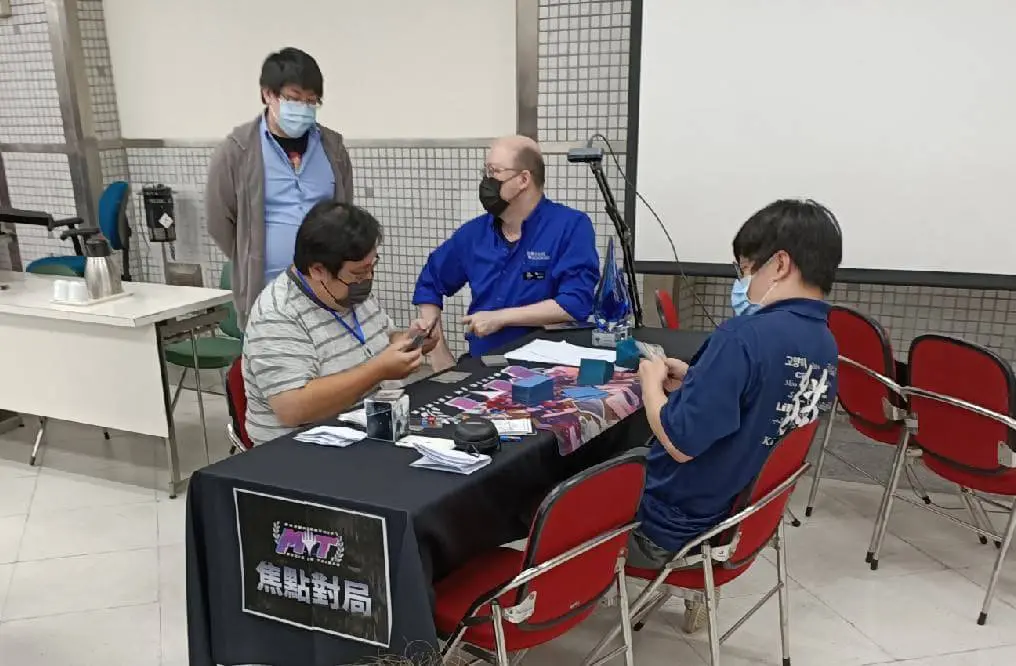
Thanks to JT for sharing this, so that newer players can get a glimpse of the early days of MIT. Pictured is a candid shot of JT playing 子睿.
Q2: What deck did you play back then, and why did you choose it?
A: At the time, MIT was the first big tournament after the pandemic, and also the first large-scale event in a long while since the national team tournaments were cancelled. The format was Pioneer, which was fairly unfamiliar in Taiwan, so I didn’t think there were that many deck choices.
After trying decks like Green Devotion and Azorius Control, I decided to base mine on the Rakdos Midrange list that 平山伶 won the Japan RC with the week before MIT. I ran the main-deck four Thoughtseize plus two Go Blank, which felt comfortable to play. The only change I made was swapping in one Canyon Slough, which reduces the chance of flooding and fills the graveyard for Kroxa. Frank Karsten’s official coverage later noticed this too, which, looking back, is a pretty interesting detail.
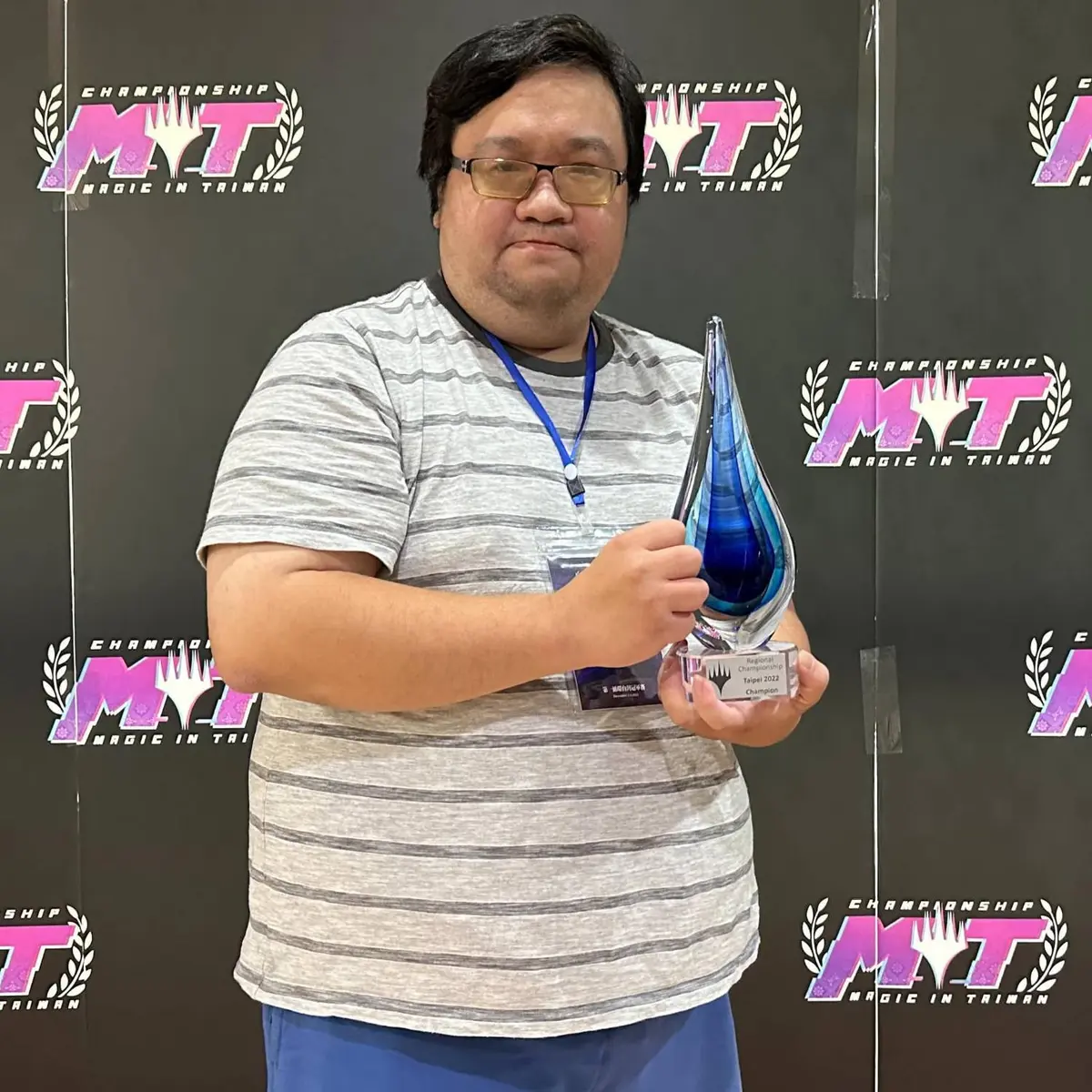
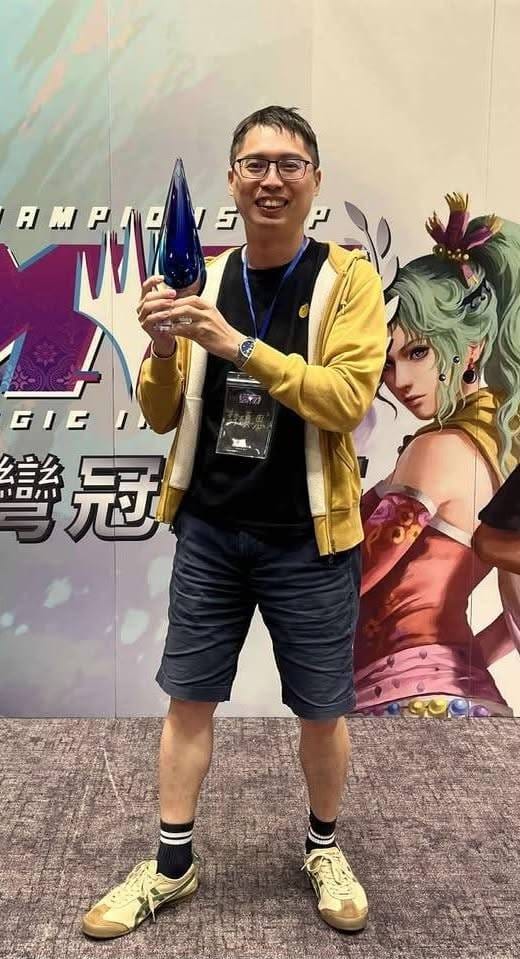
After the hard-fought battle, JT posed with the trophy. He only really relaxed at the dinner with his southern Taiwan friends after the tournament XD
Q3: Every player who improves was first inspired by someone. Do you remember the origin of your Magic journey? How did you first meet the game?
A: In the second year of junior high, during a break, I saw some classmates crowded together making a racket. I went over and found a card game unlike anything I’d seen before, with a style all its own. I borrowed a deck and played a game right then, but back then we were basically all making up stories from the card art, and the games were certainly full of mistakes and bluffing XD
Later, a classmate spent real money and built the infamous Tolarian Academy blue deck. Out of competitiveness, I started researching how to beat it, and that’s how I fell into Magic and gradually couldn’t climb out.
(As for how that classmate fooled JT for two years, to the point that JT didn’t dare visit 童年往事 for a while, please head over to 半退老人 JT 的佛系魔風生活 for the silly details.)
How the Tolarian Academy blue deck works:
Deck link - Tommi Hovi Rome 1998 Pro Tour
- Get Tolarian Academy, Mind over Matter, and low-cost artifacts such as Lotus Petal, Mox Diamond, Voltaic Key, and Mana Vault onto the battlefield.
- Refill your hand with Stroke of Genius, Windfall, or Scroll Rack, and use the discard ability of Mind over Matter to untap Tolarian Academy for blue mana.
- Use Stroke of Genius to draw from your own library, letting the combo of Tolarian Academy and Mind over Matter keep producing huge amounts of blue mana. If your library is running low, cast Time Spiral to shuffle your graveyard back into your library and draw seven new cards. Repeat step 3 until you have enough blue mana to pay for a Stroke of Genius whose X is larger than your opponent’s library (for example: if your opponent’s library has 53 cards, X ≥ 54).
- Cast Stroke of Genius targeting your opponent. When it resolves, they draw from an empty library and lose the game.
This supplement is adapted from the post [MTG 套牌] 大學院深藍 (Academy.dec) - 1998 羅馬 PT 冠軍 on 貓羽的文字日誌’s personal blog on Pixnet (貓羽的文字日誌). Readers who want to learn more about how the deck works and related trivia are welcome to click through for more.
Q4: Is that excitement and emotion still there? Can you talk about how Magic today differs from the past?
A: I still look forward a bit to new set releases. In the past, it was the night before a prerelease or a tournament, and I’d be so nervous and excited I couldn’t sleep.
Now my mood before tournaments is actually fine, much calmer. Maybe it’s because of the internet: new set information is fast and transparent, and the meta is more settled because information flows freely, so there’s less of the surprise of opening a present when you walk into the tournament hall.
With the appearance of all sorts of other TCGs, the number of players has indeed dropped. Back when I went to 國軍英雄館 to play Magic tournaments, we’d often meet people in person: “So you’re that so-and-so from the internet!” Now those people have all become familiar old faces at tournaments, and the atmosphere and feeling are very different.
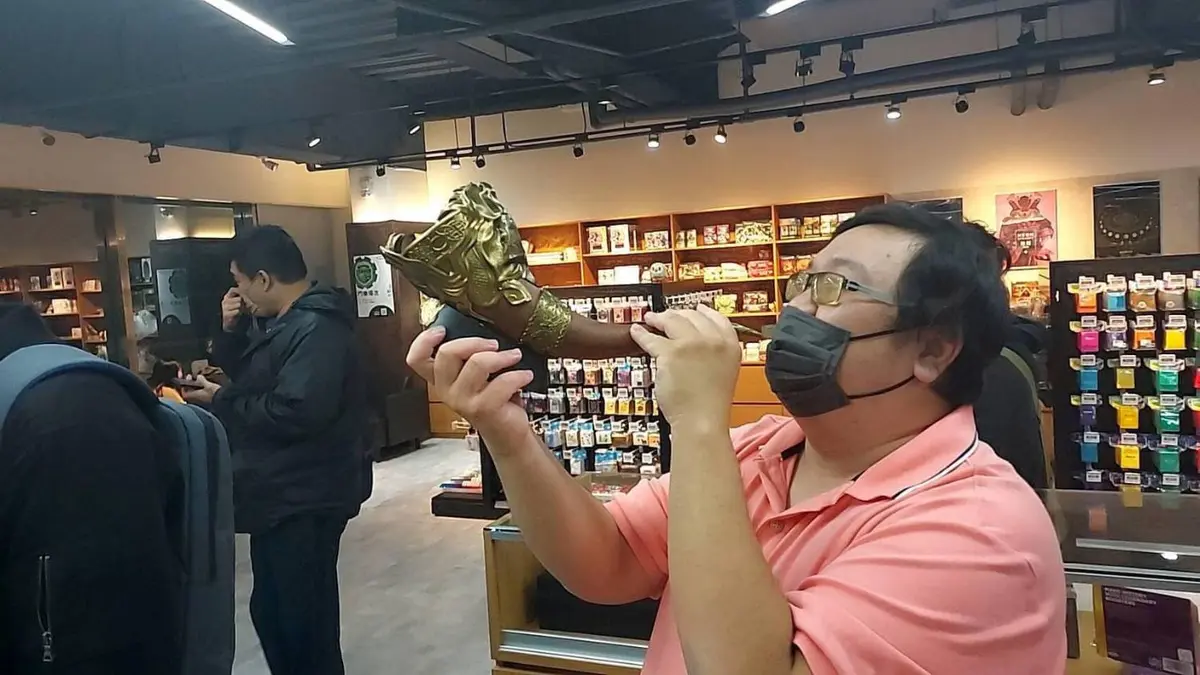
Magic these days occasionally throws out fun prizes and collaborations, and JT still enjoys the game in his own way~
Q5: The drive behind greatness is often purer and more childish than we imagine. Magic is a card game, and cards extend our will and imagination. Put simply, opening packs is just so much fun and so exciting. What is the most important card to you? Please share the bond between you and it.
A: Rising Waters from the Mercadian Masques block is one of my favorite cards, because it let me place high in a tournament for the first time.
It was a Mercadia-era event, and I played mono-blue Rising Waters with a pile of free counterspells (Thwart, Foil, Daze), plus Gush, which returns two Islands to draw cards, to lock the opponent out of mana, and then killed them with really bad creatures. Truly worthy of its reputation as the most “scrub-friendly” format XD
Another card I love is Shadowmage Infiltrator from Odyssey, the card on which Jon Finkel, the player I think is the greatest, was printed as a champion.
Q6: At the 2023 World Championship, Day 1 and Day 2 had three rounds of Wilds of Eldraine draft and four rounds of Standard, respectively. Please share which formats you personally like and are good at, and roughly what your preparation plan was.
A: I personally love draft.
Actually, when I first started playing I preferred constructed. I filed limited formats like draft and sealed under the “luck-heavy” category. But later I read something said by Japanese Hall of Famer Shota Yasooka: “Draft is building a deck that carries out a strategy within limited time and resources.” I was moved by that, so I started practicing seriously and studying how other top players think about drafting, and I fell in love with draft from then on.
To prepare for the World Championship, I decided to start a month-long training plan and trip. Since there aren’t many players in Kaohsiung to prepare with, I first went south to 紙牌屋 in Tainan, where competitive players gather, to play prerelease sealed and drafts. Then I worked out several possible decks and asked the Tainan players to run practice simulations with me. I’m really grateful to Toley, the owner of 紙牌屋, who helped rally people for marathon drafts.
During that time I also discussed and analyzed, together with the MTGA ladder expert 洪誠駿, how the new set affected Standard and the win rates of various decks. I’m really thankful for his data, which helped me a lot in narrowing down decks.
Finally, the week before leaving for the World Championship, I stayed in Taipei for almost a week, visiting Academy Legacy Games and 貓腳印松江店, and also going to CardMaster for Standard weeklies and drafts. The last draft even made me miss my high-speed rail back to Kaohsiung XD.
michaelchen even came to the area near my hotel to practice with me for an entire morning. There is so much to be thankful for. The kindness of Taiwanese players and stores made this training trip incredibly rewarding.
Q7: What type of player do you think you are? What kind of game plan are you better at? Is there a simple but classic turn you can share with readers?
A: I’m not sure how to define my type; I’m probably the “overthinking” type.
I’ve played midrange, control, and combo decks. For the deck I decide to enter with, and the kinds of opponents I might face, I’ll have a certain awareness and amount of practice. If I had to say, I’m the type who thinks through every possible situation.
As for classic games I’ve been through, besides the MIT #1 final mentioned above, with that topdecked Thoughtseize, at a Taipei GP one year I played the future world champion Yuta Takahashi, where I stopped his Juggernaut with Hornet Nest, and Takahashi chose to just scoop; on Day 2 of that GP I got a super strong deck in the draft and beat Nam Sung Wook; and at another Taipei GP, Shards of Alara sealed/draft, on Day 1 I beat players like Lee Shi Tian and Martin Juza in a row, and then on Day 2 in the draft I got thoroughly beaten up by Lee Shi Tian and that event’s champion, Osamu Komuro… There are far too many matches against great players to tell them all, and they’re all important memories burned into my head.
Q8 (question from faintmama): Following on from the last question, has JT gained or lost anything from this overthinking trait?
A: I’ve actually lost quite a bit from it.
Overthinking often makes me hesitant in how I pace my attacks, which is especially noticeable in limited. But in constructed, thinking more is relatively safe: it’s easier to read what cards the opponent might have and play around them instead of falling into their traps.
Back to the last turn of the MIT #1 final: during the long think, I was imagining the possibilities for 子睿’s topdeck, and only acted once I had it figured out.
Q9: I’ve always been curious that competitive players surely have their own particular habits at the table. Could you share something beyond the “cards” themselves? Do you have any near-superstitious habits, or tricks for hinting at things or misleading your opponent?
A: I’m a Christian, so I say a prayer before tournaments (I hear MIT #5 champion David Yeh does too).
As for the rest of the routine, it’s about the same as most players. If I had to name something, I like to place my library sideways. At first it was because I saw 永銘 do it, and then I found it also made drawing smoother and peeking at cards easier XD. After that I always put my library sideways.
When things feel like they’re not going well, I’ll try adjusting where the library sits, and there’s nothing else particularly special. By the way, I used to see 米仔 (任穎津, PT HOU top 4) habitually tap mana for nothing to hint at having a certain card, or arrange his lands to make some kind of announcement, trying to create the feeling of “I might have that card.”
Q10: Competitive events always go through many rounds of preliminaries, with at least a full day of continuous play. A good player needs sound understanding, focus, and plenty of stamina… Which quality do you think made you stand out?
A: I think I do okay in focus and emotional regulation: I’m not easily and seriously affected by losing the previous game, a misplay during a match, or an opponent getting lucky with a topdeck. I try to think calmly and focus on finding a path out of a bad situation, finding the best answer, and turning the game around. In many of my MTGA draft matches, I was able to win from a weaker hand or a worse start. I think many people have the ability to turn games around too, but you have to believe you really can through repeated attempts, and I think playing out losing games to the end is a necessary exercise.
Each game is its own game, and even in a game where I was flooding out, I kept thinking about what draw would turn it around or even things up. When I lost three games in a row to JED at the World Championship, I kept reminding myself to hold up under the pressure, and that’s how I steadied my momentum and won the following games.
It’s a bit like playing baseball: even if you miss a crucial ball, you still have to swing hard in your next at-bat. It’s fine to whiff; the point is to play the important game out properly.
Back to Magic: when you’re frustrated because you keep drawing lands, maybe next it will be your opponent’s turn to flood.
Q11: It’s the player at the table, but the team, family, and friends around a player surely take part too. Was there any support or quarrel in your life that left an impression on you? How was it eventually resolved?
A: Communicating (fighting) with my family has always been the longest mile of my Magic journey.
As a student I had little say, so even when I did well, I couldn’t go abroad to compete. Looking back now, it would have been wonderful if my family had been supportive. I hope any player who qualifies will cherish and seize the opportunity, and I believe it’s a decision you won’t regret.
For me personally, I took an extreme route: “quit after playing” was the condition for going to the 2023 World Championship. Fortunately I went, since I really was betting my whole career, and the final result was indeed satisfying. Although my family still doesn’t approve, at least I did my best to chase my dream and I have a clear conscience.
Q12: Can you name three players who influenced you, and talk about what you learned from them?
A: From my early days, the ones who influenced me most were definitely the senior players at 童年往事, a place full of hidden talents, each of them concealing real skill.
But if I had to say who influenced me the most, apart from some foreign players later on, it would be 邱昌田, 黃永銘, and the owner (the “boss lady”) of 童年往事.
When I was still a fresh rookie, 邱昌田 and 永銘 taught me a lot of technique and things to watch out for in tournaments. 邱昌田 even generously lent me cards to compete with, which helped enormously since I was still a student then, and I’m deeply grateful for his selfless help.
In 永銘 I saw dedication and attitude toward the game. Once, before a Taipei GP, we joined players from Tainan and Kaohsiung to form the “熊庹研討會,” dedicated to studying the Shards of Alara limited format for that GP. I still feel nostalgic thinking about it now. I admire 永銘’s passion, and he still carries that spirit as he stays active at tournaments, which is truly inspiring.
Last is the spiritual compass of all Kaohsiung players, the owner of 童年往事. She was willing to organize Kaohsiung players to travel north for tournaments, and even to form a team to play a GP in Japan. We all believed that as long as the boss lady was around, the Kaohsiung Magic community would never fall apart, and her contribution has had a profound and enormous impact on every Kaohsiung player. Although she has retired now, the seemingly endless marathon drafts on Friday nights at 童年往事, and the prerelease sealed events where we played five matches in a row, are still vivid in my memory, all thanks to the tireless effort of the owner of 童年往事.
If I could add one more, the person who comes to mind is 南霸天 “菜脯” 蔡博仁. He has plenty of colorful anecdotes, but given how self-taught he was at the time, digging into MO and racking up results at major events, his persistence truly earned my admiration. Of course, I wouldn’t especially recommend certain specific plays of his at today’s tournaments, but I’ll share about that another time.
Q13: As a competitive player, what is the most valuable advice you’ve ever received?
A: I forget which senior said it: “Everyone has kept a hand worth less than 60 points, but what matters most is how you play it into an 80.”
Of course, this advice applies perfectly to drafting too.
If anyone can recognize the true identity of this senior, please contact Guildmages’ Forum. The super quest to find them starts now~
Q14: This is a game with great depth, but also relatively hard to pick up. If you had to briefly introduce the charm of Magic, how would you describe it to a newcomer?
A: I’d tell newcomers: “The water in this pit is deep, are you sure you want to step in XD?”
Just kidding. I’d say it’s a world of pure logic. If you like deep thinking, like putting down creatures to bite people, like casting spells, or like games with exciting interaction, then you really should come experience the charm of Magic!
Q15: One year after the World Championship, we understand you’re in a semi-retired state, but you’ve kept following the development of Magic in Taiwan. Compared with a year ago, has your way of looking at the game changed at all?
A: I think I’m now like the Watcher in Marvel: I like observing where MTG is heading, and only occasionally step into a tournament. Of course, if there’s a good opportunity, I’d still like to visit big overseas events (such as MagicCon).
My mindset leans more toward experiencing and observing, but I still enjoy the feelings and rewards this game gives me.
Q16: We all love Magic and have a deep passion for it, but we’ve also felt some disappointment. If possible, is there anything you’d like to try to change, whether in the game itself or in the community? Also, how do you think we can get more new players into the game?
A: Frankly, compared with the lively community in Taipei over the past six months, the south seems rather stagnant. Sometimes I do envy the players in the north, who still have a team spirit and have dazzling mid- and new-generation players, such as SamuelChang and 尚峰, whose hard work has clearly paid off.
As for the few young players in the south who still have the passion and want to dive into competitive events, we currently keep in touch by showing basic care. We’re all waiting for an opportunity that lets the south regain a healthy competitive atmosphere in Magic.
Editor’s note: During our discussion we mentioned that Magic is a game with real depth and difficulty. Besides JT’s sharing, we also recalled our own experiences. While exploring constructed, we slowly built a habit of discussing things with friends around us, naturally entering each other’s lives and becoming people who support one another. We sincerely hope more people will form deeper bonds through this “difficult” game.
Q17: Last of all, how would you describe what Magic means to you?
A: As I wrote on the MIT past-champions board: MTG is an experience I can never forget and nothing can replace.
The people I met and friends I made through this game, the golden words I’ve seen, heard, and spoken, the scenes that still make me smile knowingly when I think back, the unforgettable matches, the silly things I’ve done, the classic topdecks…
Every night, sometimes playful and sometimes fully serious, made me the better person I am now.
Thank you, Magic, and thank you to all the players and stores. Because of Magic, we can gather.
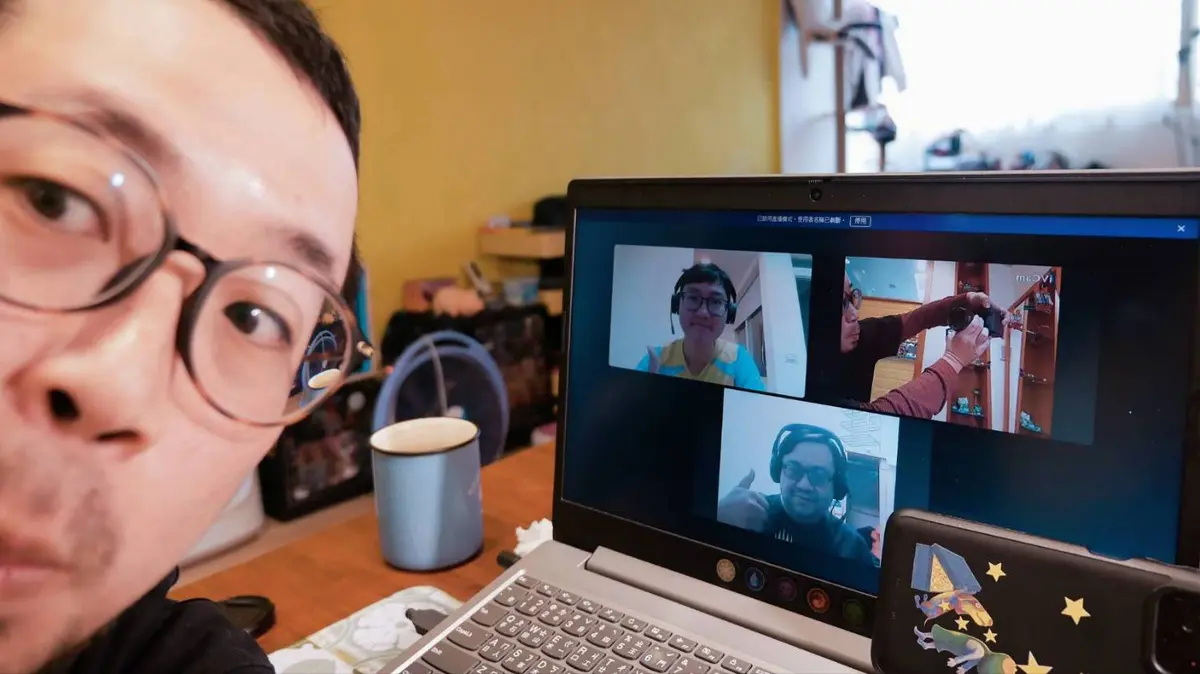
The internet generation has its own perks: it’s so easy to gather now.
See you next issue.
- Title
- World Championship Player Interview: MIT #1 Champion 李俊廷
- Author
- faintmama, cephille
- Created at
- January 24, 2025
- License
- This work is licensed under CC BY-NC-SA 4.0 .
Related Articles
World Championship Player Interview: MIT Round 12 Champion, Second Interview with SamuelChang
November 5, 2026
World Championship Player Interview: MIT Round 11 Champion Lee Shi Tian
November 5, 2026
World Championship Player Interview: MIT Season 10 Champion 許碩恩
November 5, 2026
Interview — Dominaria Library
March 1, 2026