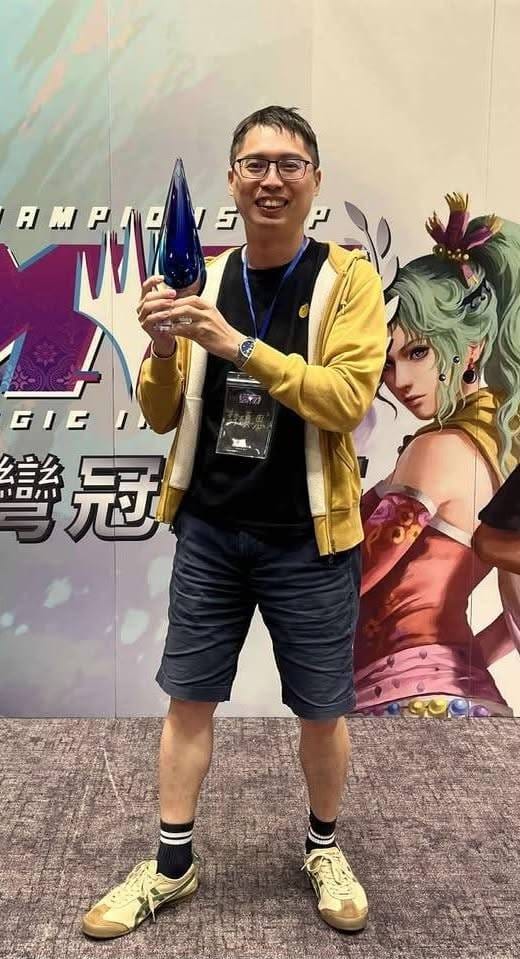
World Championship Player Interview: MIT Season 10 Champion 許碩恩

Note: This article was translated from Chinese by AI and may contain errors. Read the original Chinese version.
Let’s get started!
For this interview, we invited 許碩恩, the MIT Season 10 champion. Many thanks to 碩恩 for accepting our interview! Before winning Season 10, 碩恩 had already made MIT’s top 8 five times, a very distinguished record!Note 1
Q1: Before we begin, congratulations on qualifying for the 2026 World Championship through MIT! Let’s go back to the MIT Season 10 final. How did you feel in that final deciding match?
A: I had made top 8 many times before but always lost there, so the top 8 match was actually where I felt most tense, and after passing it things felt easier. At top 4, I didn’t yet know that SamuelChang’s qualification would be passed down, and just felt my chances of going to the PT (Pro Tour) had gone up, so I kept playing. After that I wasn’t especially nervous, and my focus held up pretty well all day. I felt the deck backed me up that day, and I drew pretty well too. When I got the title, it wasn’t that it felt unreal, but it somehow wasn’t the happiest moment of my day. I think the happiest moment was right when I got past the top 8, since I had really been stuck at top 8 too many times before.
This time felt like a dream come true to me. From before MIT even started, in the national team selection tournaments, WMCQ… several times I was stuck one win short of the threshold to go, and this time I could finally go to a PT.
Q2: What deck did you play, and why did you choose it?
A: I played Izzet Affinity. It benefited from the unban of Mox Opal, and the then recently released EOE also gave the deck many cards to strengthen it. When playing a format like Modern, I want to pick a deck that is sharp enough and proactive enough to overrun the opponent in one go. A so-called proactive deck is one whose game plan is strong enough that even if the opponent knows what you’ll do, it’s hard to answer. Affinity is that kind of deck. At the time the meta hadn’t found the best Affinity build, and I referenced data from the previous PT EOE, and also looked at high win rate stats on X, to understand how Affinity actually performs and whether it has clearly bad matchups. After observing, I felt Affinity had no particularly bad matchups. Even if it did, as long as you can get a god draw, it’s still hard for the other side to beat you. Another reason is that I had played the previous version of AffinityNote 2 before Mox Opal was banned, and had collected four Mox Opals, so I was very happy to be able to bring them out again.
For more details on the deck and matches, readers are welcome to see the article 碩恩 wrote: A Moment of Setback Brings Complaints, but Those Who Fight Take the Title — MIT Season 10 Recap
Q3: Let’s go back further in time. When you first got into MTG, was there any important turning point that made you willing to commit to it all the way until now?
A: I got into it during Exodus. It should have been 1998? I was still in elementary school. Back then I wasn’t really playing competitively, I just thought it was fun and used my New Year’s red envelope money to open packs. I also ran into things like having a rare swapped away from me for a Scaled WurmNote 3. In junior high there was a bookstore near my home that sold Magic, and during summer vacation I’d play with the university students from National Chung Cheng University at the store, one of whom was 吳佳霖 Note 4. We might play two or three matches a day, mostly four people doing booster draft, all just for fun. Afterward I played on and off, roughly through high school. By the middle of university I played less, and only came back once I entered the workforce and had more free time. I started taking tournaments more seriously around the time of the WMCQ, and after that I went to card stores to play tournaments more often.
I remember the first time I went to the 2014 Taipei GPNote 5, I made the prize money, and an experience like that hooks you and makes you want to keep playing. Another part comes from feeling that you can beat others. For instance, in junior high I could occasionally win drafts against university students, and I’d feel I was great. Thinking about it now it’s a rather Ah Q mentality, but it’s precisely those feelings of accomplishment that make you want to keep playing.
This game is also very complex and deep. Every time a set comes out now, we also have to spend a lot of time adjusting. Concepts I was familiar with before have also become very different because the current meta is different. The same goes for draft details; there are now websites like 17Lands where you can look at data, and our way of preparing is different from before. The reason this game is fun is that it always has new things, letting you handle the challenges it throws at you in different ways.
Q4: Please share your thoughts on competing at PT SOS this year. After facing the world’s top MTG players, are there any players or stories that left an impression and that you’d like to share with readers?
A: When I went to Las Vegas this time, I actually wasn’t very used to the local environment. MagicCon was great, but there was far less to eat at the PT venue than I imagined, kind of shabby. I didn’t face any particularly famous pros in my matches, and I also dropped on day 1 at 3-5. Still, the strength of the opponents I faced was roughly about the same as the people who often make top 8 at MIT in Taiwan. There may have been stronger ones, I just couldn’t really tell. Actually the pressure wasn’t as big as I imagined; once you roughly know the opponent’s level, you know they won’t make many mistakes, and you just execute your own game plan well. In the draft I also saw opponents build very creative decks. The pressure before going was actually greater; I always felt I hadn’t prepared enough, but on arriving I felt it was okay.
What left more of an impression was where I misplayed and which step, handled differently, might have won me the game. Often you realize the problem right after the match. The biggest enemy is still yourself. Actually playing a PT is much like playing a tournament in Taiwan as usual; what matters is still whether you’re in good form that day, whether you’ve prepared enough, and not being affected by the atmosphere to make plays you wouldn’t normally make. Everyone who has played a PT will say: “Just do what you normally do.” Don’t deliberately change your habits just because it’s a PT. For example, this time I was still somewhat affected by the atmosphere, feeling as if a crowd of people were watching from behind. In fact nobody is watching you, but you feel that kind of pressure.
The source of pressure may be fear of making mistakes, or embarrassment at having your errors noticed. At such an event, that feeling is magnified even more. Because you have many expectations of yourself, like going 3-0 in the day 1 draft and winning two or three more in Constructed, which gives you a big chance of ranking high on day 2, maybe even making the top 8 or getting on a feature table… Looking back after the tournament, these thoughts may all make you more prone to mistakes. If I get another chance to go to a PT, I believe I can adjust better.
Q5: The driving force behind greatness is often purer and more childish than we imagine. What is the most important card to you? Please share your bond and story with it.
A: Since I started taking tournaments seriously at 30, up to now, over these ten years the card that left a deeper impression is still Mox Opal. Back then 900 NT dollars for one was already considered very expensive, and now the price has skyrocketed. At that time I built the previous version of Affinity together with 一刀 and 仕峰 and started taking it to tournaments. Later there was a period when Affinity wasn’t great, but Hardened Scales, which also uses Mox Opal, could still play, and it accompanied me for a long time before it got banned. This tournament I also relied on it; the card that helped me win the most matches is probably Mox Opal.

Q6: Please share with readers which format you personally like and are good at.
A: I like playing Limited. I think Limited and Constructed require different things. Although each time a new set comes out you still need time to get familiar with card effects and interactions, some fundamentals carry over once you’ve practiced them.
In Limited, because everyone’s cards aren’t strong enough, you run into more different situations that sharpen different aspects of your fundamentals. For example, plain creature combat: when to attack, when to defend, who has what resources, what kind of deck the opponent might have, and so on; the situations are all different. You don’t necessarily get to practice this in Constructed. In Constructed, an archetype against different decks often has about the same things to do.
What’s a pity is that many people often feel that “what you open decides your fate that day.” I know some friends skip an MITQ if it’s sealed, fearing they’ll open terribly and be unable to recover. That can indeed happen. But I think people always remember bad experiences more easily, and this feeling is partly exaggerated. Every format can indeed produce lower-competitiveness pools, but in theory everyone’s chance of getting a bad pool is about the same. And since the switch to Play Boosters, everyone has a higher chance of opening strong cards or bombs than before. Even if you might open a worse pool, it’s unlikely to be a situation where you can’t win at all.
Limited is indeed complex, and it’s unlikely you could figure it out in a short time. You have to play many times and see enough pools to know how to build. You also have to actually experience it to know what problems building a certain way will run into. It really has too many decision points, but you can build your ideal deck, and that is exactly what makes it fun.
Q7: What type of player do you think you are? What kind of game plan are you better at?
A: I used to feel I leaned a bit more aggressive, and in Limited I also liked going a faster route. I don’t much like playing control; that style of slowly gaining a bit of advantage each turn, accumulating resources, and finally letting the opponent do nothing makes me miserable. I prefer aggro, proactively throwing problems at the opponent and seeing whether they can solve them. As for midrange, I don’t actually think I play it very well. If I really had to pick control, it would have to be one whose plan is very simple, such as the Standard four-color control from a while back: play Tablet of Discovery, survive until the seven-mana finisher, and almost every game goes like that. That kind of thing I can still play. But control that is too subtle and too demanding on brain capacity, I’m not so good at.
I tend to pick relatively simple and direct decks, such as ones with a proactive game plan, or aggro that throws problems at the opponent. Combo is also fine, but compared with Combo I feel I’m still better at aggro. Combos with lots of triggered abilities like Grinding Station, I try to avoid. It’s not that I lack the cards or don’t know how to play it. The reason I don’t pick it is that it has too many triggers; this kind of deck demands a lot of practice time, and after practicing online and switching to paper, it’s very easy to miss quite a few triggers. Decks whose play is too complicated like this, I try to avoid.
If I really have to play Combo, I’d pick a relatively simple one, like Splinter Twin, or a combo-carrying control deck like Gifts Ungiven Storm. When I played Legacy online in the past, I also played a small combo like Dark Depths plus Thespian’s Stage, and I quite liked that feeling of “suddenly making something that kills the opponent.” Of course it still has its complexity, but you don’t have to handle too many things every turn. As long as it’s simple enough, I can probably accept it. Very complex decks with lots of triggers like Grinding Station or Krark-Clan Ironworks, I tend not to touch.
I think when choosing a deck, not challenging difficult things is of course not great. But sometimes after trying, you learn where your limit is. Don’t force yourself to adapt to something unfamiliar in a very short time; the cost, price, and risk are all higher that way. Playing a style you’re familiar with is a very good strategy.
Q8: We’ve always been curious that competitive players surely have their own particular habits at the table. Can you share something beyond “cards”? Do you have any near-superstitious habits?
A: I’m not very superstitious, but I try to keep the number of times I cut the opponent’s deck on tournament day fixed. Sometimes it’s four, sometimes seven, usually depending on how many I cut in the first match that day, and after that it stays fixed. It’s more of a sense of ritual, helping me stay in the same state all day. Also, before each match starts, I take out my things and set up the table. A fixed routine lets me be more composed and helps me get into the zone faster. At the start of each game, there may still be many thoughts lingering in your mind that you’re not aware of, such as having played this opponent before, whether the experience was good, how many times you’ve lost to them, or whether they were once unfriendly. These external factors all get in the way of concentrating on the match. If a fixed routine can reduce the interference and let you calm down quickly, it helps a lot with the match.
Q9: Competitive-level events always go through multiple rounds of qualifying, at least a full day of continuous play. Which trait do you think makes you stand out?
A: I think the most important thing is remembering to drink water, eat, recover stamina, and not play on an empty stomach. Everyone probably knows what I’ve said above, but in long tournaments, the allocation of stamina, hydration, and focus is similar to pacing in a marathon. After finishing a match, I rest on my own off to the side or go to the bathroom, and don’t spend much time watching what others are playing.
Before each match starts, a fixed set of preparation moves can also help me get into the zone faster. Not being on an empty stomach lowers the resistance to getting into the zone, and this is one of the reasons I like playing faster decks. If every match goes right up to time, there’s simply no time to rest. But if matches end in around 20 minutes, you get a lot more rest time than others. You don’t necessarily need to do anything during rest, but at least you can eat a bit of chocolate or bread to replenish calories, and some protein or fruit. The point is to replenish energy and keep your state as focused as possible.
MIT isn’t especially long compared with GPs abroad, and you can get through it by gritting it out, but I still pay special attention to whether I’ve eaten, and try not to tough it out. Many players, as they get older, should understand what I mean: our stamina really isn’t what it used to be.
Q10: Though the player is the one standing on the stage, the team, family, and friends around the player surely take part as well. Have you had any memorable support in life, or arguments caused by playing cards? How did you eventually resolve them?
A: As far as the tournaments themselves go, there haven’t been any problems. We’re all adults, and even if family wanted to interfere, they wouldn’t interfere much. Everyone has their own interests, as long as it doesn’t go too far. What has more of an impact is actually that playing online is so convenient now, you can draft on MTGA or MO. But the problem is that playing online costs money, and spending money affects a person’s mood.
For example, when playing on the weekend, if I play for a while and get upset, family or friends will ask: “Why do you play a game until you get angry?” When I play terribly and have also burned 6,000 gems, I get really upset and make a sour face. I think people want to play this game precisely because it’s fun and stirs emotions. If you felt nothing at all, you probably wouldn’t find it fun. But you still have to practice not letting those emotions affect those around you.
Some cards are really absurdly strong, but when you use them yourself, you feel great. So you can only persuade yourself: “everyone’s chance of opening strong cards and bad cards is the same.” That’s also what’s fun about MTG: it stirs your mood, and also brings out many irrational emotions, even ones you weren’t aware of at the time. If you can become aware, you know this game reflects our irrational and vulnerable sides. After slowly overcoming these problems, a person improves more and can better face their own weaknesses.
Q11: Can you name a few players who influenced you, and tell us what you learned from them?
A: I want to talk about 永銘. About ten years ago, when I had just started taking tournaments seriously, I often ran into 永銘. He was a regular winner of tournaments and really impressive. I think his hometown is in the south, so I’d run into him more often when he came back. Just standing by watching him play, you could feel the gap. 永銘 represents the previous generation before mine, players who often had the chance to play PTs. That includes 多樂明 (連建宏), Boss 郭, and 黃皓善, among others.
When you sit across from them, you feel how unfathomable they are; you keep guessing whether they have a trick in hand. Sometimes he really is bluffing you, but sometimes you go all in and he really does have it. For me, being able to play against players of this higher caliber, or to go out to tournaments together, was itself a precious experience. 永銘 and the others were also very willing to share experience and encourage younger players. Those experiences are important to me. The most precious thing is that they had already been through crucial moments many times. You learn from this that even such strong players run into similar problems. Even when they hit these problems, they could still show great form, making you feel you couldn’t beat them.
Back when I was still a rookie, people often said: “Don’t be afraid. Even if there are a hundred people at the venue today, you only need to face six who are unluckier than you.” Anyway, you only need to beat six people, and it’s actually not as hard as you think.
A time I remember 永銘 especially well was around 2015 when I went to the Hong Kong GP to play Limited, and in the last round I faced him. That time he used a build I’d never seen, a bit like a flash-style play, which included the card Bounding Krasis. Although I knew about it, I hadn’t played around that situation at all, and got killed. After the game, 永銘 was still willing to agree to a draw with me. Although we already knew each other, you can feel that a player like 永銘, who is deeply invested in competition, also enjoys the game. At certain moments, people don’t weigh winning and losing so heavily, but rather whether it was worth it this time, and whether you made friends.
That was also my first time playing a GP abroad. Quite a few people from Taiwan went then, and everyone encouraged each other, helped look at each other’s Limited decks, and followed each other’s results. The memories from those years were really great. It’s a pity that now everyone’s drive to go abroad for GPs isn’t as strong as before. For one thing, everyone has less and less time; for another, spending so much money to go abroad, you’d always hope for a corresponding experience. The official promos still need to be handed out better so that more people are willing to go.
Q12: We’d like to learn more about whether your feelings about this game have differed, from when you first encountered Magic up to the time of this interview. As a veteran player, do you think recent changes in gameplay and competitive events differ from before?
A: I think everyone’s feelings are probably about the same. I actually don’t mind Wizards doing crossover collaborations bringing other IPs in. But now you clearly feel that the company’s decisions and the products it puts out are not only to make the game fun, but also to earn more money and make the overall profit structure look better. It’s of course fine for a company to make money, but when players want to enjoy the game well within such a framework, it indeed becomes harder. The most obvious example is that this year has seven sets.
Earlier Limited formats, like HOB, many people felt weren’t very fun. The next set, FRA, was more fun, but six weeks later when we go to Worlds, we have to switch to playing Star Trek (TRK). These arrangements surely have marketing purposes. Constantly putting out supplemental products and many Commander products is to serve players who want new cards for Commander. However, this also affects the main sets, or makes you open some cards you don’t much want in Collector Boosters. For players like us who simply like playing Limited or tournaments, it has a bit of a counter-effect.
But there’s nothing we can do; if we want to keep playing, we have to accept these. It looks like next year will be a bit better, with only six sets, at least not so outrageous. The power level of Standard now is probably close to the power level of Modern we used to play. And today’s Modern is like Legacy used to be. The interaction complexity and the pacing of the game are both different. Even though MIT has only three events a year, continuing to keep up with the metagame and still qualifying in all of them is already no small burden for everyone. It’s very different from the old feeling of playing casually and coming back to catch up on the meta every once in a while.
For those with time, it’s of course still fun. But it’s indeed more tiring, and the speed everyone has to keep up with is also harder.
Q13: With the rapid development of AI (artificial intelligence) in recent years, what do you think AI’s impact on Magic is? Has it, to some extent, changed how you prepare for tournaments?
A: Basically I don’t believe AI can change my current way of preparing, or replace what I’ve already learned. The main reason is that this game is too complex and has too many variables. Even for Limited, where there are big-data databases like 17Lands, picking cards by following the data won’t necessarily produce a truly strong deck. Because there are too many interactions, situations, and variables between cards. This game changes too fast and the data is complex. Every set has a different speed, sometimes fast, sometimes slow.
For example, in HOB the red-black pair is very strong, but put into FRA it’s hard to say. One main reason is that removal in the set is bad, while red-black has a stable curve, many options, and decent long-game resources, which made the win rate so unbalanced. It’s the result of many factors adding up, not a single cause. Before these cards have been actually tested, few people can foresee the real speed of the format. It takes a period of testing before everyone knows: “so this format is this fast” or “so this slow.”
Trying to use big data to predict these things is essentially trying to hold more information than others. But I think that’s still not really possible at present. My understanding of AI is: garbage in, garbage out. If you don’t feed it high-quality data, the quality of what it produces won’t be very good. And to be at the front of the meta, you have to think one step ahead of others to have an advantage. If even AI knows something, it’s no longer a secret. So I still tend to find data myself and do my own research, and the quality of the output should still be better and more trustworthy than what AI gives.
Q14: This is a game with great depth but also relatively hard to pick up. If you were to briefly introduce the charm of Magic: The Gathering, how would you describe it to a newcomer?
A: Those who like it will like it a lot. If someone gets hooked, they’ll experience the charm themselves. So I wouldn’t particularly say anything to newcomers. If they can gain some special experiences along the way, or understand how tournament experience affects them, that would be more worth sharing.
If I want newcomers to find this game fun, it’s probably: “Don’t give up.” Because what’s fun differs for everyone, but if you keep playing, you can see different things. If you’re willing, you can play for years. Just look at me, I’ve played for so long. It won’t bore you either; if you’re willing to spend time, it always has new things for you to play with. And you also have a chance to meet opponents and teammates really worth playing with.
Magic: The Gathering is very much like real life, with ups and downs. Most of the time it’s full of setbacks, effort doesn’t necessarily get rewarded, and success takes luck. Although you may not reach the goals you originally set, those who commit sincerely will surely understand themselves better, keep growing, and experience unique experiences.
Q15: Last of all, how would you describe what Magic: The Gathering is to you?
A: Magic: The Gathering has taken up a large part of my life and let me experience many different things. Since adolescence, I’ve used this game to connect with people, go to tournaments, and travel abroad. If not for tournaments, I might not have experienced these feelings and situations. This process may have made me a bit stronger, and also seems to have left some results behind. But I believe anyone who works hard long enough and has good enough luck has a chance. When I actually won the title, I didn’t feel it represented any special status; instead I felt fortunate to have had this experience. I’m also glad I didn’t quit and kept playing until now, and I feel like in the future I can still see more things.
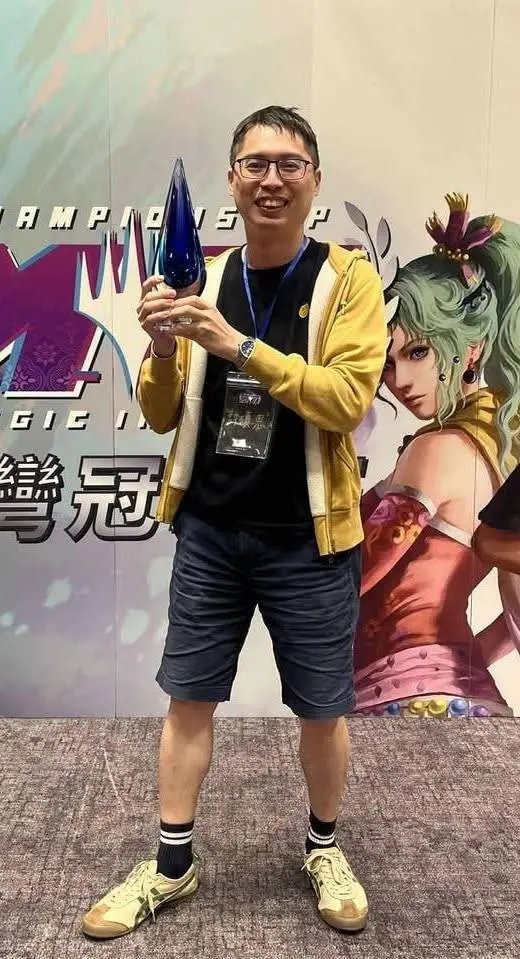
The teardrop-shaped MIT champion trophy, the result of countless efforts coming together
Note 1:In the just-concluded MIT Season 13, 碩恩 once again broke into the top 8 with his familiar artifact Affinity, making it even harder for anyone to overtake his all-time record.
Note 2:The previous version of Affinity mainly used more low-cost artifact creatures, its main plan being to equip creatures with Cranial Plating, supplemented by the package ability of Arcbound Ravager, a fast-aggro line that breaks the sky with one punch. The new version also uses Arcbound Ravager, but its main plan shifted to using Pinnacle Emissary and lots of zero-cost artifacts to rapidly assemble a Kappa Cannoneer all-out attack, and using sacrifice engines like Ravager to eat the large number of Munitions tokens created by Weapons Manufacturing to win with direct damage.
Note 3:This is one of the classic cases from early Magic of old-timers fleecing newcomers. The most commonly heard scenario is a veteran swapping a newcomer’s Birds of Paradise for a common Scaled Wurm.
Note 4:That is the currently active Level 1 judge 吳佳霖. At MIT main events, and even many large events abroad, you can see him diligently enforcing the rules.
Note 5:The 2014 Taipei GP was M15 Limited, with strong Limited cards of that year such as Triplicate Spirits and Nightfire Giant.
- Title
- World Championship Player Interview: MIT Season 10 Champion 許碩恩
- Author
- cephille
- Created at
- November 5, 2026
- Updated at
- November 5, 2026
- License
- This work is licensed under CC BY-NC-SA 4.0 .
Related Articles
World Championship Player Interview: MIT Round 12 Champion, Second Interview with SamuelChang
November 5, 2026
World Championship Player Interview: MIT Round 11 Champion Lee Shi Tian
November 5, 2026
Interview — Dominaria Library
March 1, 2026
World Championship Player Interview: MIT Round 9 Champion Samuel Yeh
December 2, 2025