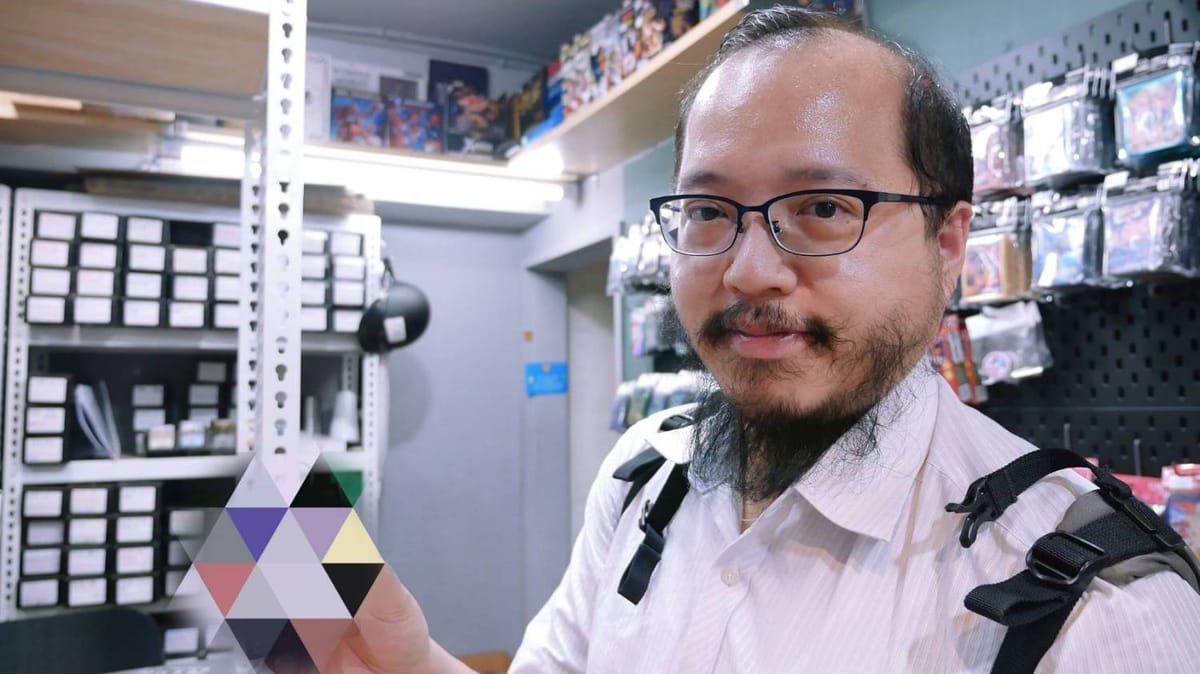
Worlds Player Interview — MIT Season 4 Champion 陳柏宏 (蹦蹦)
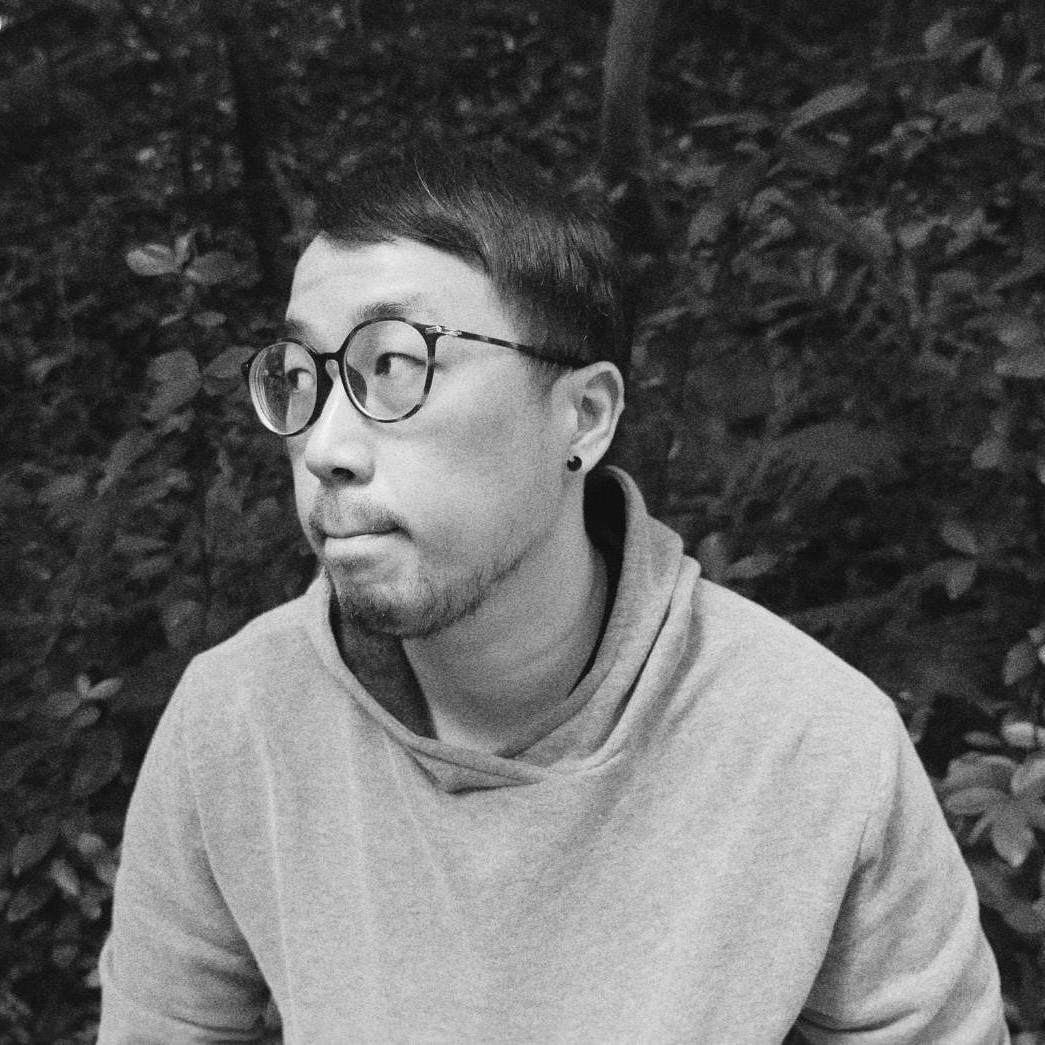
Note: This article was translated from Chinese by AI and may contain errors. Read the original Chinese version.
Let’s get started!
Before I ever met 蹦蹦 in person, I was already a lurking fan of his. The Jund Uncle’s Daily Life page is full of middle-aged-guy everyday jokes, and while being fun it also reveals the player’s values and charm. Let’s see what sparks fly when one uncle talks with another!
A spoiler up front: this was certainly going to be a fun exchange, because… we cracked packs.
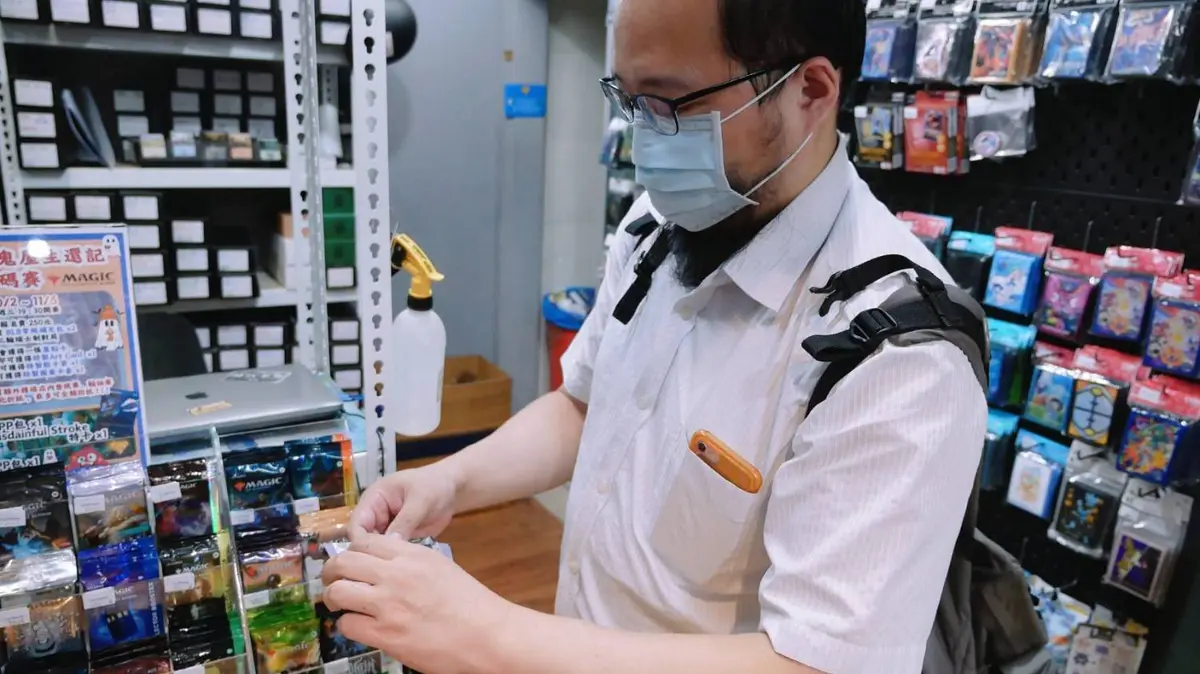
Late at night, both uncles were a little tired… so we came to CardMaster to recharge our spirits. As for what we ended up opening? Let us keep you in suspense for now and move on to a few interview questions first.
Q1: First, congratulations on qualifying for this year’s Worlds! Let’s go back to the scene of the MIT Season 4 finals. How did you feel in the final showdown?
A: As I remember it, Season 4 had more players than the first three seasons. My preliminary record was five wins and two draws, and it was my first time making the MIT Top 8, so every game was played very tensely.
Facing Rakdos Sacrifice in the Top 8, and even in the finals against the Lotus Field deck, I lost game one both times, so the pressure was really high… But I had prepared for both matchups before the event and had a rough idea of how to handle games two and three.
My semifinal opponent was also a CardMaster player, 冰諦, whose deck that day was White-Blue Control. All I could do was strip his hand and deploy threats as fast as possible, which is the basic way a midrange deck plays against control, since a long game would work against me.
In the deciding game three of the finals, my opponent zhi-mao mulliganed twice and I mulliganed once. My hand had three lands, a Go Blank, an Archfiend of the Dross, and something else… I’ve kind of forgotten XD. But zhi-mao still ended up drawing Lotus Field , then Thespian’s Stage showed up one after another, and Niv-Mizzet, Parun too. I topdecked a removal spell and dealt with Niv-Mizzet, Parun, and I was honestly quite emotional at that moment.
On the last turn, my opponent zhi-mao did calculations in his head for a very long time. If he could deal just one more point of damage to me, that day’s champion would have been him; the margin between winning and losing was tiny. Only when zhi-mao reached out his hand and reluctantly conceded did I finally put down the heavy stone in my heart.
It was a very good, very precious experience. We played until the Breeze Center was about to close, and I hurried out to get home as soon as possible to do the dishes.
Q2: What deck did you play, and why did you choose it?
A: Rakdos Midrange. There was one unusual thing, though: most Rakdos Midrange players at the time played Sheoldred, the Apocalypse in the four-drop slot, but after testing it myself, I felt Archfiend of the Dross suited the Rakdos Midrange approach very well and closed games faster, so I chose the creature commonly known as the 466. I did once lose a game in a past big tournament to the drawback of Archfiend of the Dross XD. At the time I got cut off for two turns by a White-Blue Lotus Field deck, which is kind of a funny story.
In the last few seasons of MIT and MITQ, I played this Rakdos Midrange deck every time. It’s more familiar to me and fits me well.
Q3: How did you first come across Magic: The Gathering?
A: I think it was around high school when a classmate dragged me in to play. As I remember, the environment then was the Tempest block. But by the time of Apocalypse, I was starting university and didn’t have anyone around to play with, so I stopped touching the game for a while. I only came back during Innistrad, first playing EDH with old friends, and then slowly moving toward competitive play, up to now.
Along the way I met a lot of good friends. When I stepped into Modern, Thoughtseize was still a card worth over two thousand NT dollars, and I saw some decks put four of them in the sideboard… and thought, maybe I shouldn’t play this deck for now. Blue Tron was my first Modern deck, because it doesn’t need to hunt for dual lands and is cheaper XD. Then I personally opened a foil Tarmogoyf, the whole shop cheered, and that started me down the path of Jund Uncle (?).
Sometimes I go back and look at the first post on Jund Uncle’s Daily Life to recall my state of mind back then Himmel the Hero would definitely have done the same.
Q4: The driving force behind greatness is often purer and more childish than you’d imagine. Magic: The Gathering is a card game, and cards extend our will and imagination; simply put, cracking packs is just so much fun and so exciting. What is the single most important card to you? Please share your bond with it.
A: It should be Tarmogoyf! Once the king of Modern card prices. When Modern Masters came out, I opened a foil Tarmogoyf. Packs back then didn’t have a guaranteed foil yet, so I was really happy and excited. Together with Liliana of the Veil and Dark Confidant, it should count as the origin point of my becoming Jund Uncle.
Later I upgraded to the Future Sight version of foil Tarmogoyf, and then during the Theros era I opened four foil Thoughtseize on my own, which is another story…
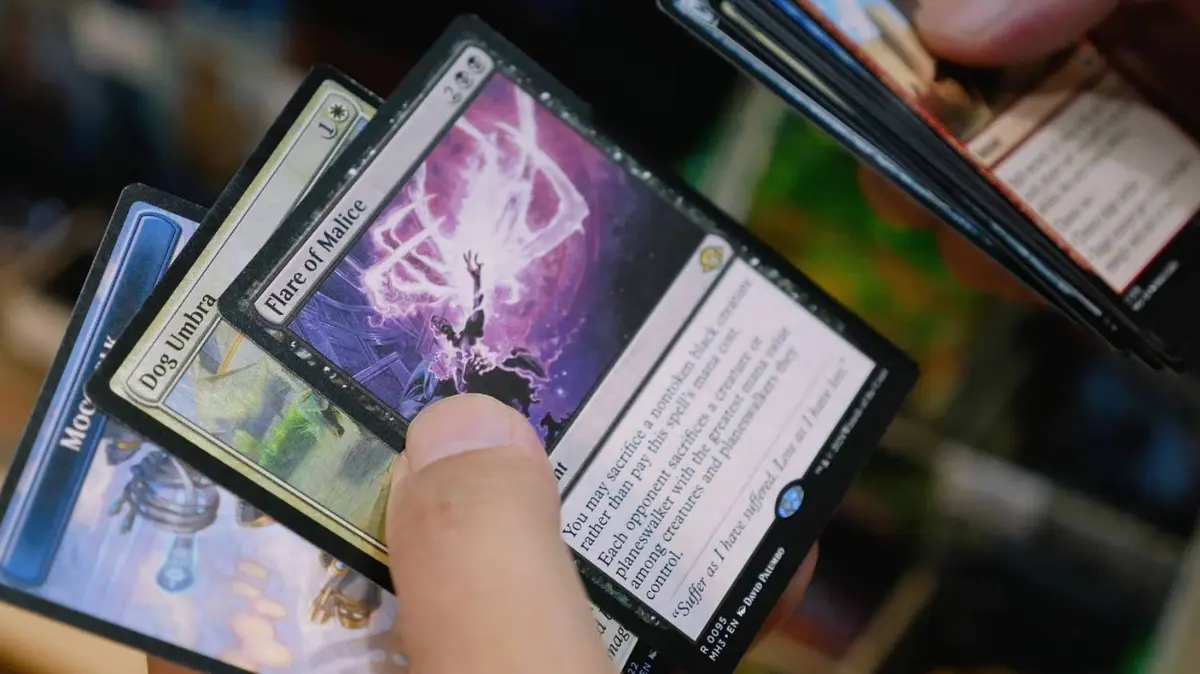
During the interview’s halftime break, we went back to the CardMaster scene and opened Flare of Malice
worthy of the name Jund Uncle! 蹦蹦 murmured in a low voice: “Great, it doesn’t count as junk…”
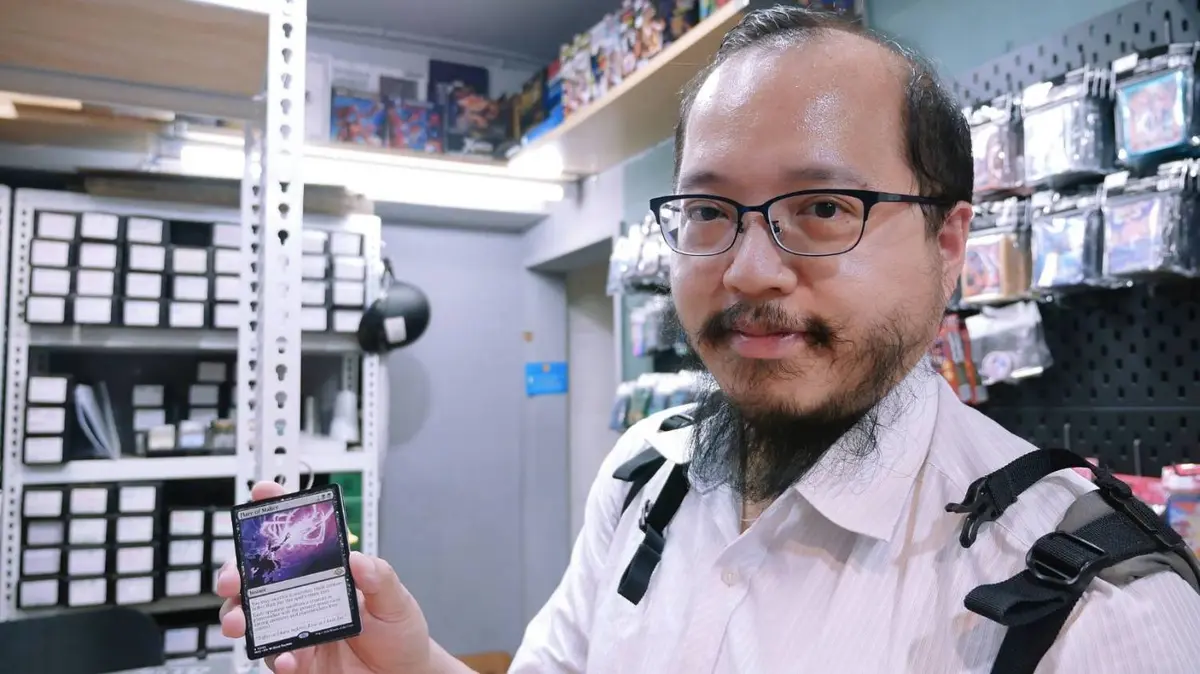
Quick, take the photo already, I want to open the next pack. (Scripted line)
Q5: Can you talk about how Magic: The Gathering today differs from the past?
A: Starting with gameplay, I feel creatures are too strong now, while the boost to sorceries and instants isn’t that large. Say the opponent casts something and you don’t deal with it for a turn or two, and you may be about to lose. In Modern, there is a lot you can do for zero mana now, so the overall pace has sped up too.
As for the broader environment, Taiwanese players are still lucky in some ways. If you look at some Southeast Asian countries, you’ll find that qualifying events aren’t easy to attend; or in the US, a small tournament may take a one- or two-hour drive to reach, and for big ones like an RC, you may even have to fly to another state. Our opportunities are really plentiful and relatively convenient; at least for competitive-level players, the chances to practice are definitely not few.
Q6: On Day 1 and Day 2 of Worlds, there will be three rounds of Duskmourn draft and four rounds of Standard respectively. Please share with readers which format you personally like and are good at, and how you prepared this time.
A: My favorite format is probably still Modern, which actually has nothing to do with what’s being played at this Worlds XD. For me, Modern has plenty of card power and many deck types, and having played it for a long time I’ve built up some insight.
As for Worlds, I’ve prepared for draft and Standard mainly on MTGA, especially draft, where I’ve played relatively little, but I still haven’t decided which Standard deck to play, which is a headache… Fortunately 承翰, SamuelChang, and David Yeh gave me quite a lot of advice during preparation, and recently I’ve finally started to see a bit of a direction for the deck.
Editor’s note: 蹦蹦 often used the Modern format as an example during the interview. After actual verification this time, he really is “an uncle who likes playing Modern Jund.” Readers, be sure to visit Jund Uncle’s Daily Life to experience the fun and the addictive charm.
Q7: What type of player do you consider yourself? Which kind of game plan are you better at? Is there a simple but classic turn you can share with readers?
A: I consider myself a midrange player. Because I’ve played Pioneer and Modern for a long time, I’m used to decks that can strip the opponent’s hand. Learning the information in the opponent’s hand first and then starting to formulate the later game plan is very important to me.
Also, midrange is the control deck against aggro and the aggro deck against control, so it’s a deck with two facets, which is one reason I like it.
Q8: I’ve always been curious that competitive players surely have their own particular habits when playing. Can you share something beyond the “cards”? Any nearly superstitious habits?
A: If my next match is on table three and I happen to know how the previous match went, I try to sit on the side of the previous match’s winner; or with clothing, I’ll keep wearing the winning T-shirt as I head to various card shops to compete.
Q9: Competitive-level events always go through multiple preliminary rounds, at least a whole day of continuous matches. A great player needs the right mindset, focused spirit, and plenty of stamina… What trait made you stand out this time?
A: I was actually quite lucky on the day I won: I avoided all the Gruul Vehicles decks in the field (a matchup that’s not so easy for Rakdos Midrange). Luck was more on my side, and the rest was doing my best to seize the games where I had the advantage.
The amount of practice is also something I consider crucial. Before MIT Season 4, a few CardMaster players invited me to practice intensively together, and those two weeks were really important for the tournament. There is a huge difference between having practiced and not having practiced, and I really want to thank the comrades who practiced with me.
Practice never lies.
Q10: It’s the player who stands on the stage, but the team, family, and friends around the player surely take part too. Were there any impressive moments of support or arguments in your life, and how did you resolve them in the end?
A: Mainly, my wife is quite supportive, which is very important, since playing MIT or MITQ is often a whole-day affair, and going to Chicago earlier even took a week. Of course, couples inevitably have friction, and I still occasionally hear her nagging, but generally things are fine, and we have our own sort of tacit understanding.
On one day of the weekend I might go out to a tournament, and the other day my wife goes out to relax. Of course, we also go out with the kids together, so it isn’t the same pattern every week.
Q11: Can you name a few players who have influenced you, and say what you learned from them?
A: From abroad, it’s Reid Duke, a player who is extremely good at Jund, with excellent results, sportsmanship, and character; his skill and his physical and mental state are all worth studying.
David Yeh, the three-kid dad of the Magic scene, aka 約力昂大叔, is a player I’ve known for a long time, and I’m really happy we could go to Worlds together. He’s a dad like me, so we can exchange ideas on all kinds of levels.
SamuelChang aka 鳥不喇基, founder of 及殺隊, is a player with a lot of ideas, and I learned a great many concepts from him.
永銘大大, a very skilled veteran player I’ve known for a long time, whom I also often ask for playing tips.
And 瓜瓜, the owner of CardMaster, the card shop I frequent, a very nice person, who went there today too.
Q12: As a competitive player, how do you balance family, work, and time for practice and tournaments? How do you divide your time among the three?
A: On weeknights when I’m free, I pick one or two days to play weekly events for practice, usually Thursday Modern, though I can only play two rounds before I have to go home to do the dishes.
On weekends when I’m free I look for MITQs, mostly showing up at Taipei events. Back when I kept failing to qualify, I went to 貓腳印桃園店 a few times XD.
In the two weeks before the main MIT event I practice a bit more intensively, mostly playing at CardMaster. Honestly, compared to many young people, my recent amount of practice isn’t actually that much. I think I’ve simply been playing for a longer time, so I’ve accumulated some experience… though I actually also had a very long gap in the middle XD.
On the work side, I keep work and leisure fairly separate, with little influence on each other. I normally work at the Ministry of Labor, handling international affairs-related business. If I had to say, it’s my English ability that has made reading cards easier for me all along.
When I play MITQs, I occasionally also bust out in the Top 8 or even the preliminaries XD. At those times I vent my feelings on my fan page Jund Uncle’s Daily Life and give everyone a laugh, and then I can keep playing afterward. It’s a way of keeping myself balanced.
Q13: This is a card game with great depth but also relatively hard to pick up. If you were to briefly introduce the charm of Magic: The Gathering, how would you describe it to a newcomer?
A: In this game you can do things on your opponent’s turn, which most other TCGs can’t do, and the stack in Magic is very interesting; once you cross the learning threshold there is a great deal of fun and all kinds of situations.
Some people may be able to endure loneliness and defeat, but I think playing with friends is the best way to enjoy this game. Having someone to study and improve with regularly is far better than being alone at a card shop.
Q14: Finally, how would you describe what Magic: The Gathering is to you?
A: It let me meet many people and many friends. People who play Magic tend to be on the older side XD, so the frequency of hanging out suits uncles cherishing uncles, and it’s a natural, important form of entertainment in life.
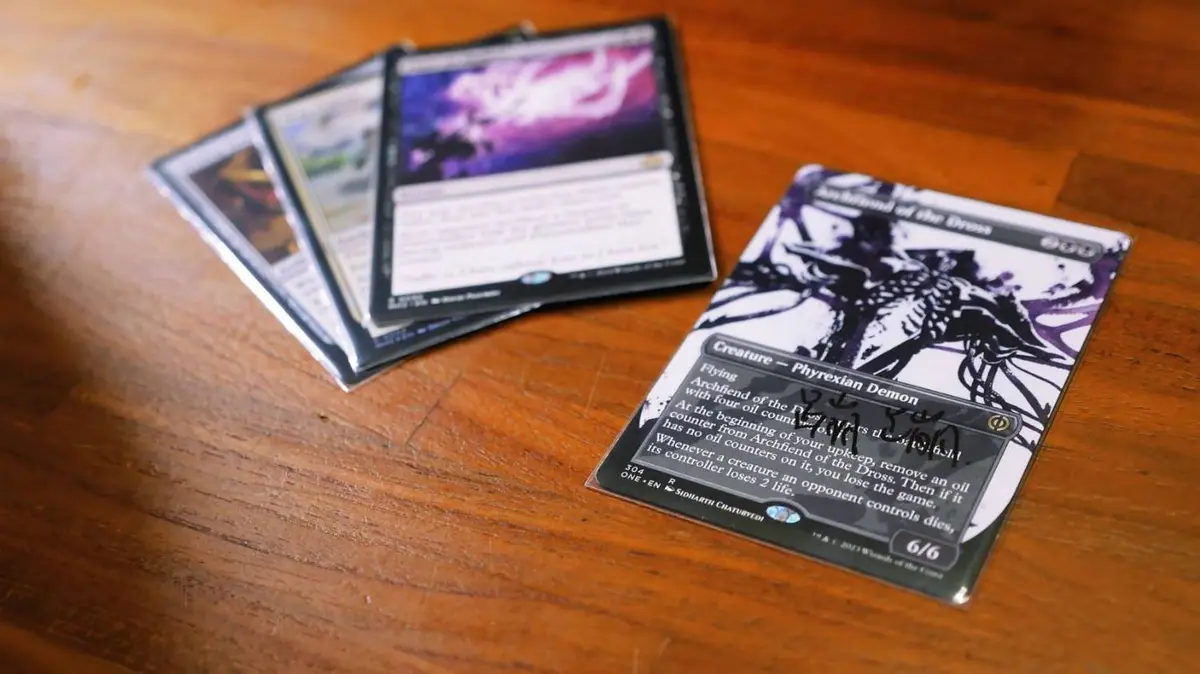
Thank you to 蹦蹦 for the signed Archfiend of the Dross, a single card that quite represents 蹦蹦’s Magic career. I will treasure it
self-indulgently.
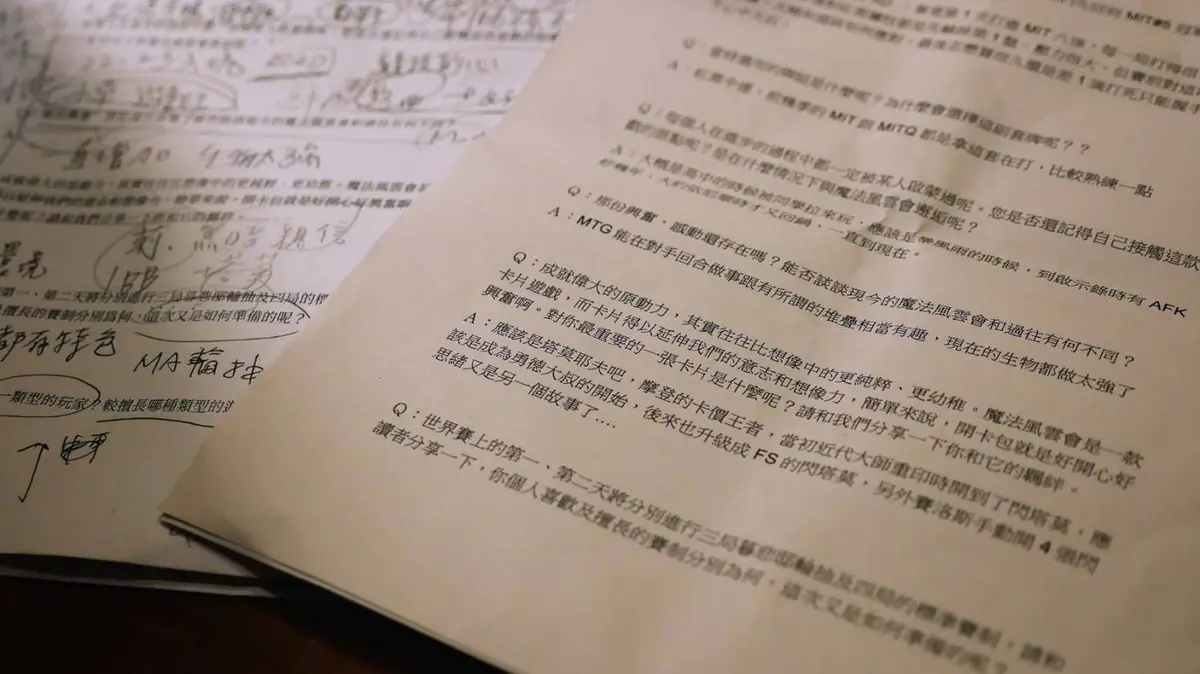
Thanks also to 蹦蹦 for making time for the interview, and even preparing answer outlines in advance
cheat sheet. Together with the Forum’s notes, that became this article. Interviews with the Season 5 and Season 6 champions will follow over the next two days, so readers, please keep following!
#TheCardTowerIsReallyScary
#BigBroIsSoPowerful
#GoodLuckAtWorlds
- Title
- Worlds Player Interview — MIT Season 4 Champion 陳柏宏 (蹦蹦)
- Author
- faintmama
- Created at
- October 14, 2024
- License
- This work is licensed under CC BY-NC-SA 4.0 .
Related Articles
World Championship Player Interview: MIT Round 12 Champion, Second Interview with SamuelChang
November 5, 2026
World Championship Player Interview: MIT Round 11 Champion Lee Shi Tian
November 5, 2026
World Championship Player Interview: MIT Season 10 Champion 許碩恩
November 5, 2026
Interview — Dominaria Library
March 1, 2026