Marvel Super Heroes (MSH) Limited Introduction — Multicolor

Note: This article was translated from Chinese by AI and may contain errors. Read the original Chinese version.
The Marvel Super Heroes (MSH) Limited introduction — Multicolor. Prerelease events will be held on June 19, 2026, with the official release one week later on June 26, 2026. Want to know more about Limited card ratings and recommendations? Then check out this series of MSH Limited introductions!
- For an introduction to the mechanics, see this article: Marvel Super Heroes Mechanics Explained
Color Pair Themes
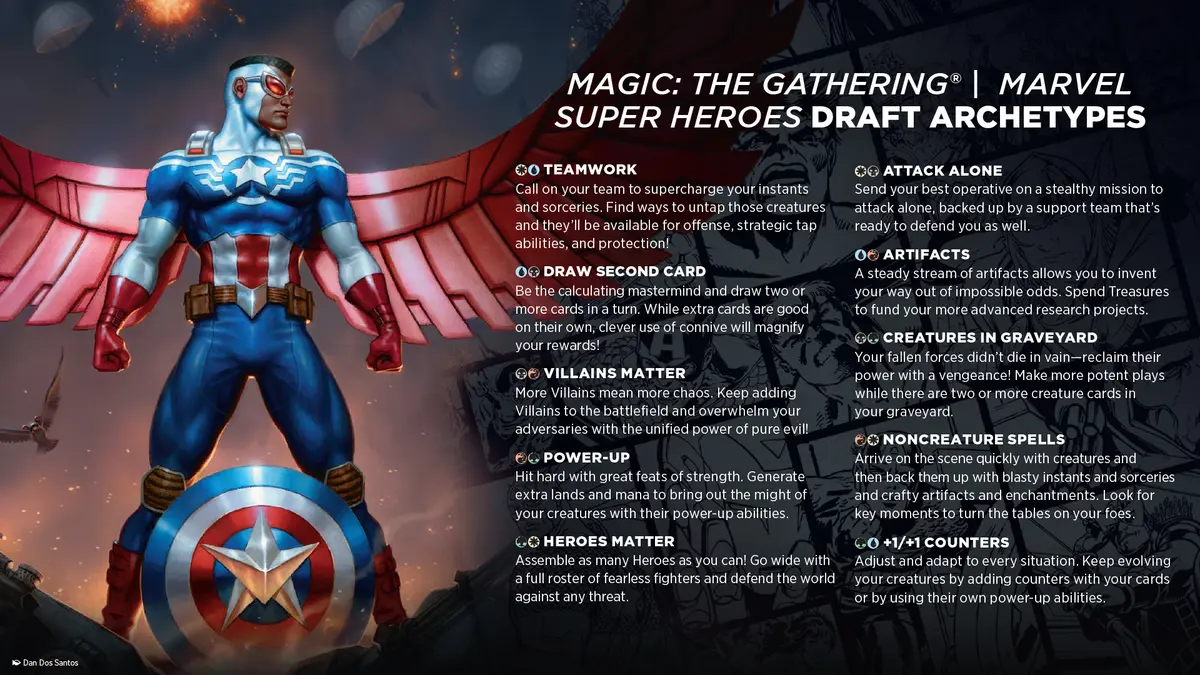
Blue-White Teamwork
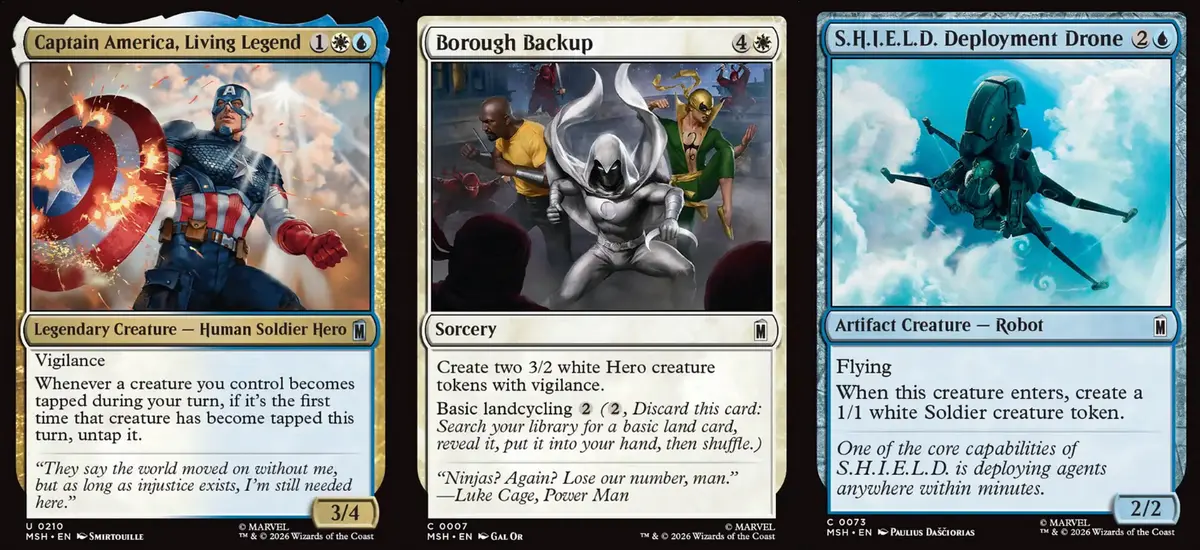
Teamwork doesn’t just make dreams work, it can also double the power of your spells! The core of the White-Blue deck is the perfect combination of spells with the “Teamwork” ability and creatures that can tap. Captain America, Living Legend leads your creatures to victory with steadfast resolve. Add spells and creatures that make tokens, such as Borough Backup
 and S.H.I.E.L.D. Deployment Drone
 , to fully support your Blue-White deck!
Blue-Black Draw the Second Card
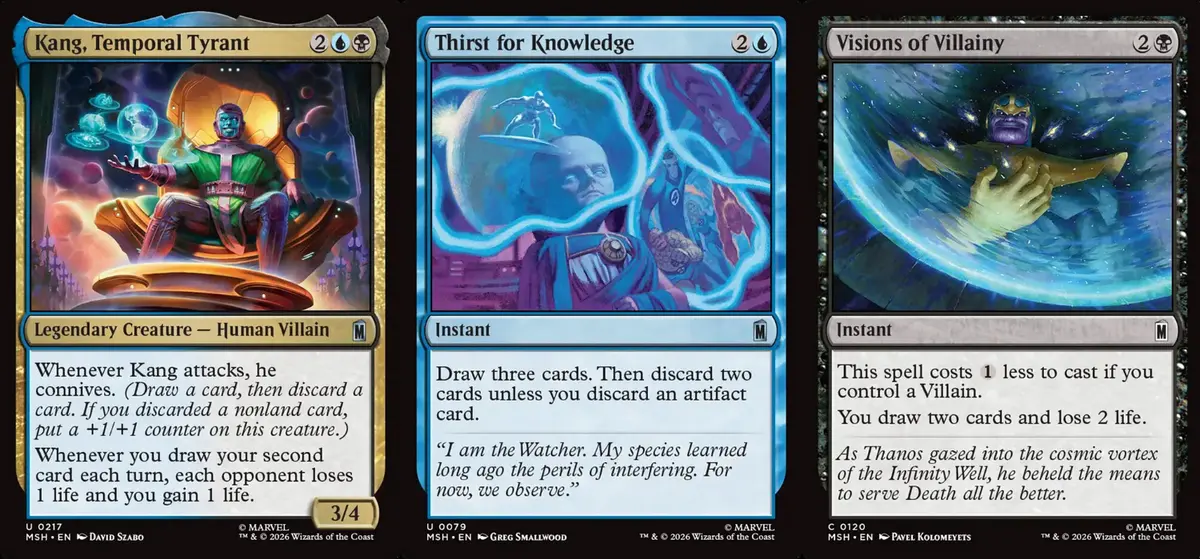
Use this Blue-Black deck to control the flow of time and the tempo of the game! Kang, Temporal Tyrant and his companions place great value on the effect of “drawing two cards in a single turn”. It is recommended to add low-cost card-draw spells and creatures with Connive to support them. Don’t forget that you can also trigger these abilities on your opponent’s turn, so instants like Thirst for Knowledge
 and Visions of Villainy
 will be especially impactful.
Red-Black Rise of the Villains
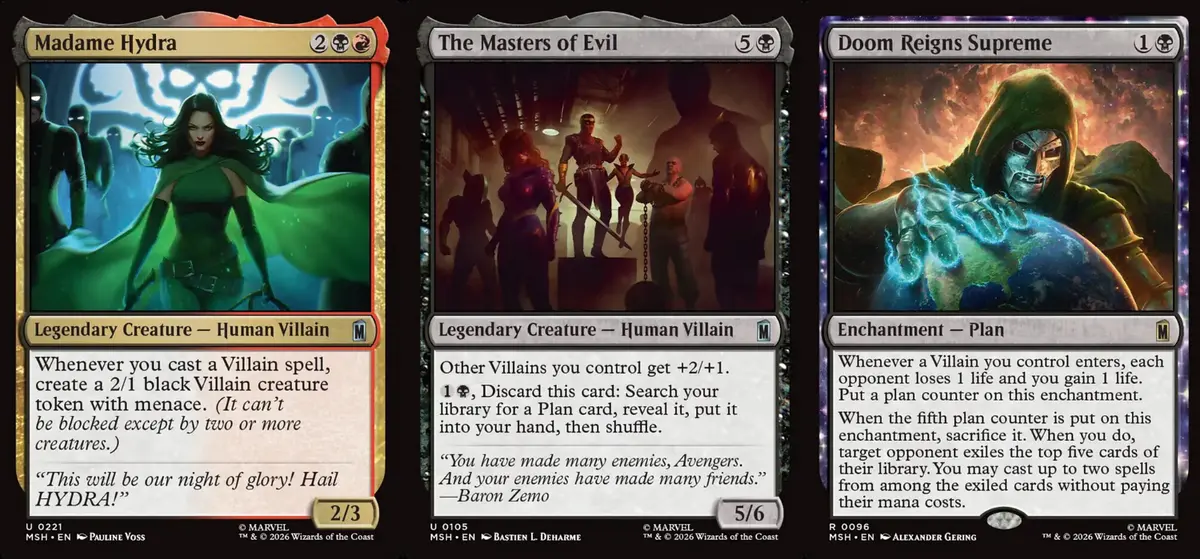
Lead a horde of villains to carry out your evil plans! Use Madame Hydra and other powerful creatures to produce an endless stream of Villain tokens. The set also includes several black “Plan” enchantments. If you open multiple copies of The Masters of Evil
 and a few exciting Plan cards, you can build a perfectly sinister deck and use it to power up strong spells like Doom Reigns Supreme
 !
Red-Green Power-up
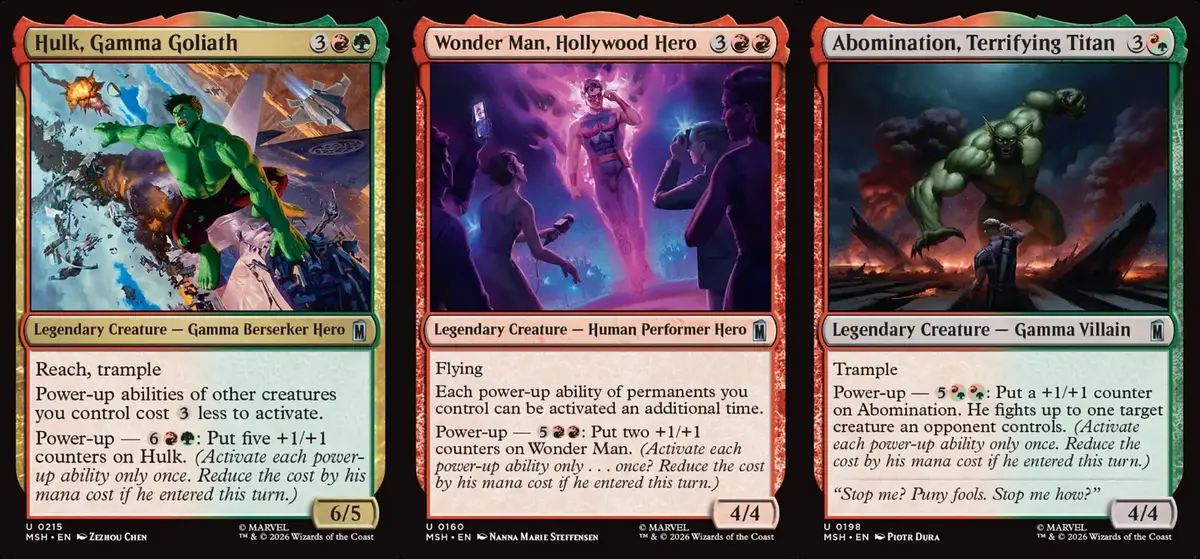
Some deck styles call for shrewd plans, precise calculation, and masterful play… Red-Green is not that kind of deck. Use Hulk, Gamma Goliath and other creatures with the “Power-up” ability to smash your opponent’s blockers directly! Want to double your creatures’ crushing power? Wonder Man, Hollywood Hero
 keeps the spotlight forever on the best creature in your deck!
White-Green Heroes Assemble
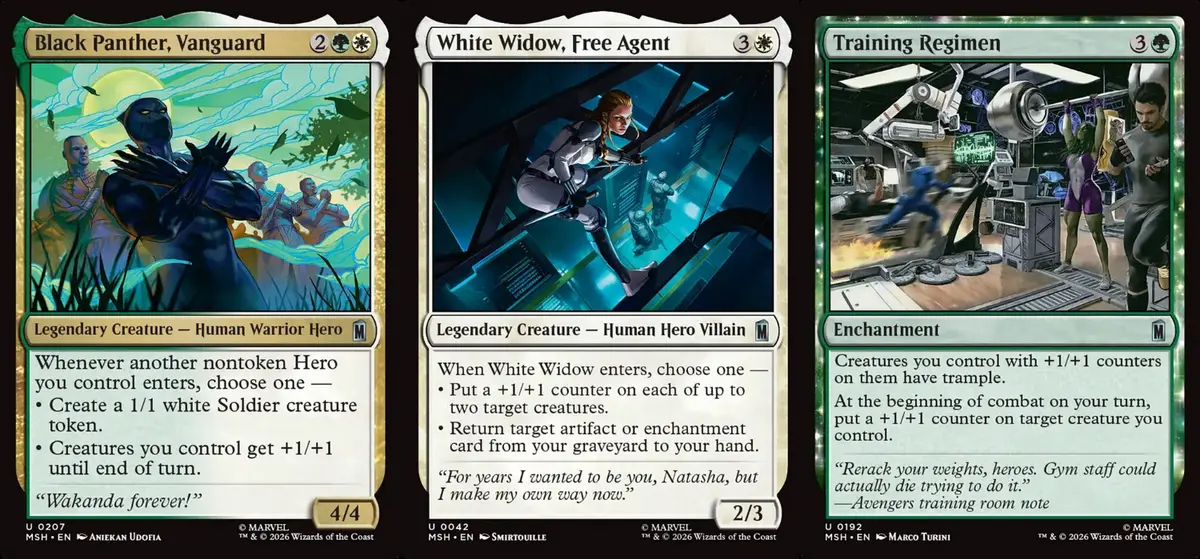
Gather heroes from all across the Marvel universe and fill your battlefield! The Green-White deck shares several key white cards with the Blue-White Teamwork deck. Use white cards that create “Hero” tokens to repeatedly trigger the abilities of Black Panther, Vanguard and Wakandan Royal Guard
 . Once you’ve built up a huge roster of heroes, use White Widow, Free Agent
 and Training Regimen
 to boost their power and launch an all-out assault to win the game!
White-Black Lone Wolf Mission
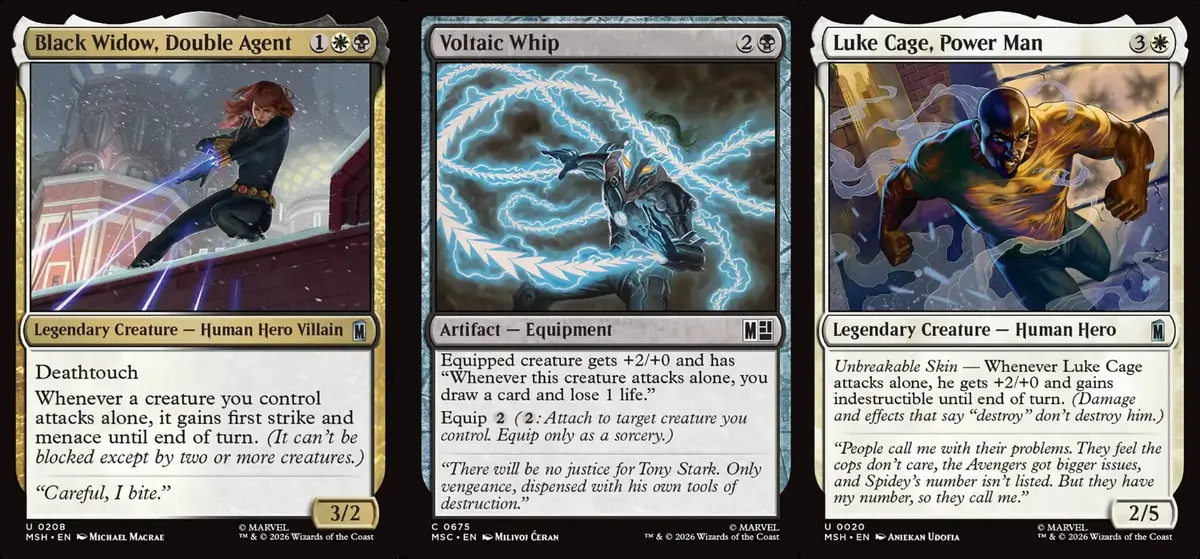
Use a range of creatures, Equipment, and more cards to fully support your lone-wolf agent! When a creature attacks alone, Black Widow, Double Agent and Voltaic Whip
 both bring you rich rewards. All you need is to find the right super hero for the mission, such as Luke Cage, Power Man
 .
Red-Blue Artifact Army
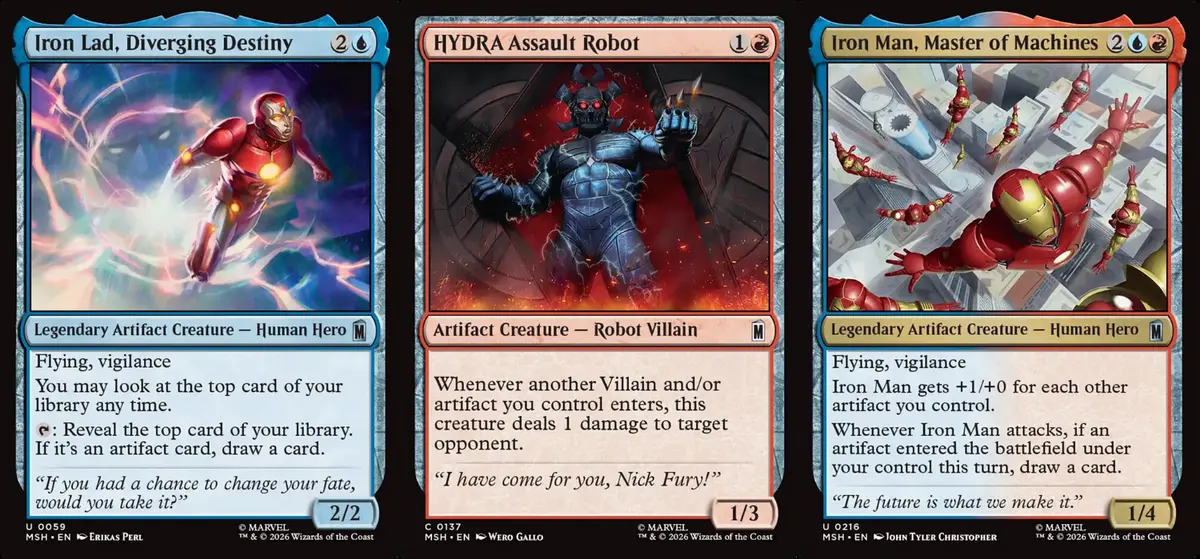
Build the world’s greatest inventions and arm your creatures! Put a high density of artifacts in your deck to power up Iron Lad, Diverging Destiny and HYDRA Assault Robot
 . This archetype places great value on the number of artifacts you’ve accumulated, even if their effects are negligible. Whether it’s Treasures, Clues, or Robot Villain tokens, they all add to the power of Iron Man, Master of Machines
 !
Black-Green Creatures in the Graveyard
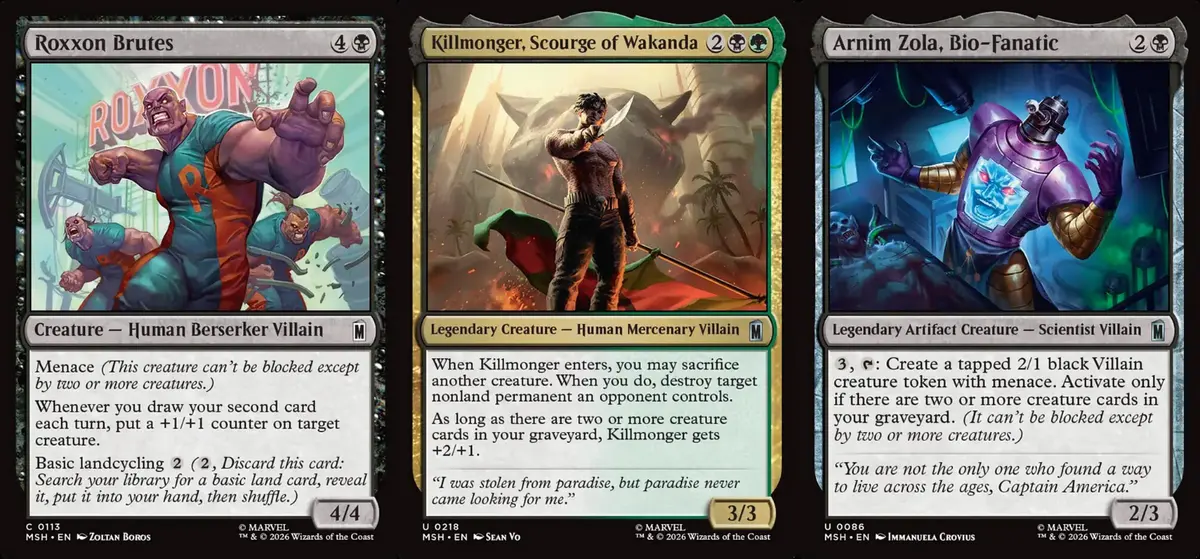
Turn your creatures’ deaths into fuel for your deck! Several cards check whether your graveyard contains “two or more creature cards”. Early in the game, use “Mill” effects or creatures with “Cycling”, such as Roxxon Brutes , to meet the condition quickly. Once you’ve put two creatures into your graveyard, cards like Killmonger, Scourge of Wakanda
 and Arnim Zola, Bio-Fanatic
 can win you the game all on their own!
Red-White Noncreature Spells
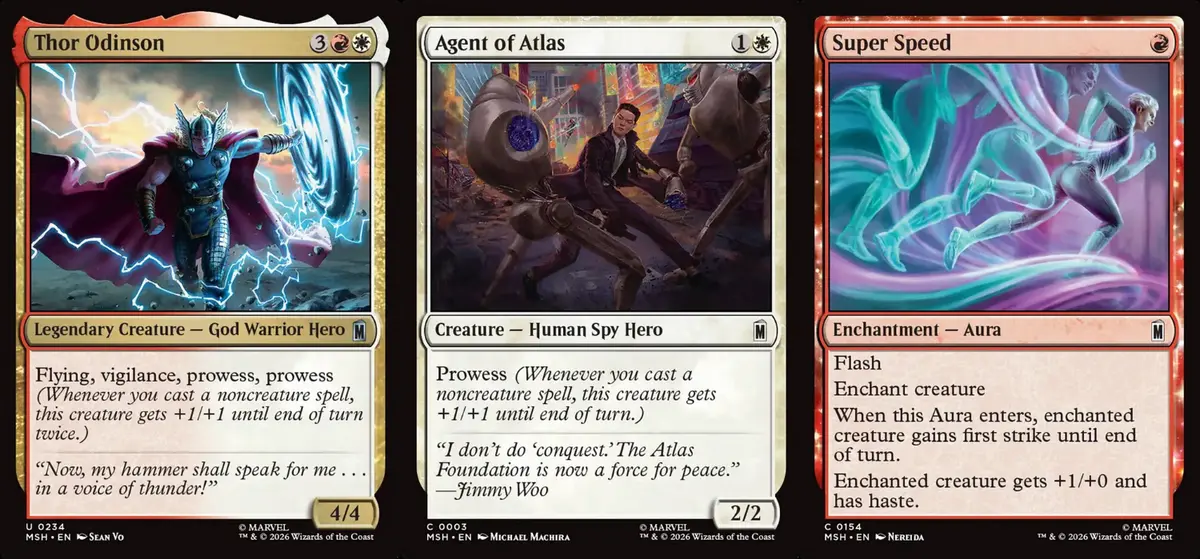
Cast a series of noncreature spells to prove your deck’s worth! Creatures with “Prowess” like Agent of Atlas and Thor Odinson
 can swell into game-winning behemoths with just a few spells. This archetype needs more low-mana-value cards than a typical deck, so when drafting, pay close attention to multiples of cards like Super Speed
 and Vibranium Energy Daggers
 .
Green-Blue +1/+1 Counters
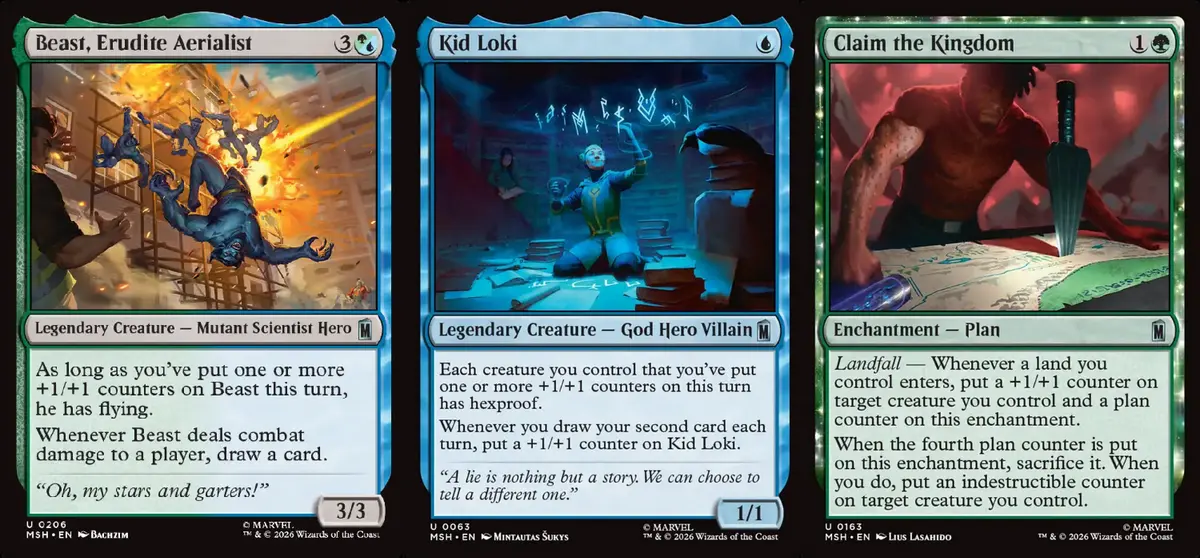
Grow your creatures big and crush your opponent from on high! Use instants, sorceries, and other support effects to turn creatures with trample like Beast, Erudite Aerialist into titanic threats. Be sure to include protection in the deck to guard your counter-laden creatures. At the critical moment, Kid Loki
 can grant your creature “Hexproof”, while Claim the Kingdom
 can give your strongest creature permanent protection through an “Indestructible” counter.
Ratings

Score: 3.0
Comment: A 4-mana 4/4 trampler is a solid but unspectacular curve creature. Power-up gives extra late-game value by turning it into a 5/5 and making it fight, so it’s more than simple curve filler. The 7-mana activation cost seems high, but if you view it as a 7-mana 5/5 trampler that fights on entering, it isn’t bad. More importantly, it can also come down first as a 4-mana curve creature, and the flexibility of paying in installments makes it perform better in actual games than a purely late-game card.

Score: 3.5
Comment: A 3-mana 4/4 vigilance is an excellent body, already a strong curve creature even without using its copy ability. The ability to copy an artifact, non-Aura enchantment, or land has a high ceiling, and if there’s a powerful permanent on the battlefield it can bring extra value.

Score: 3.5
Comment: A persistent threat similar to Urabrask's Forge . It needs some time to warm up, but as long as the game drags on, making ever-larger hasty Alien tokens each turn creates very strong pressure. Also, this card’s tokens aren’t sacrificed at end of turn, so its long-term ceiling is higher. But it costs 4 and has a heavy color requirement, so casting it on time is much harder, and the tokens it makes must attack, so they can’t be used for defense when you’re behind.

Score: 3.5
Comment: The base body of a 3-mana 2/2 is ordinary, but in the Green-Blue +1/+1 counters theme it’s a powerful engine. When attacking, paying 1 more puts a +1/+1 counter, and its second ability additionally makes a 1/1 Insect token. If the deck has other ways to place counters, then even if it’s inconvenient to attack with, it can keep generating creatures every turn with the theme cards and quickly build up the board. The downside is that the body is small and easily removed, and attacking to activate it carries some risk. Overall, though, it’s still a key creature that Green-Blue decks badly want.

Score: 3.5
Comment: A 3-mana 4/3 is already a pressuring attacking body, and it returns all your attacking creatures to hand when they die, making attack trades very favorable, especially suited to proactive Black-Red attacking decks. If the opponent blocks, they often only deal with your creature temporarily; if they don’t block, they take a lot of damage. However, returning to hand still requires spending mana to recast, so tempo-wise it’s not completely free, and Ares himself must attack every turn, so without menace or first strike he can also be handled by a big creature or a double block. Overall a strong core for Black-Red aggressive decks, but it prefers aggressive, ahead-on-board decks.

Score: 3.0
Comment: A resource card for the Red-Blue artifact theme. Chapter I can refill lots of cards when you have multiple artifacts, but since the opponent also draws a card, you usually need to draw at least 2 to come out slightly ahead, and 3 or more to be clearly valuable. Chapter II reduces the cost of artifact spells, which is explosive with a high artifact density. Chapter III is more of a finisher dealing extra damage, which can hit the opponent but not creatures, so its impact is limited. Overall, it has a decent ceiling in a Red-Blue deck with a high enough artifact count.

Score: 3.5
Comment: The 2-mana 1/1 body is very fragile, but every time you draw a card it can put a +1/+1 counter, including your normal draw each turn, so as long as it survives it gradually grows, and it works well with the Green-Blue draw and +1/+1 counter themes. The second ability converts accumulated counters into 1/1 Insect tokens, letting it keep some value late in the game or against removal. However, it doesn’t affect the board immediately when it enters, and needs time to grow.

Score: 3.0
Comment: A Saga for the Red-Black Villain theme. Chapter I makes two 2/1 menace Villain tokens, providing decent offensive pressure and supporting later chapters. Chapter II deals 2 damage to each non-Villain creature and to each opponent, which in the ideal case approaches a one-sided sweep, but in practice depends heavily on the matchup and board, has limited effect on medium and large creatures, and weakens if the opponent also has Villains. Chapter III makes Treasures based on the number of Villains, providing burst or supporting expensive cards, but you need an outlet in hand to really convert it into an advantage. Overall it’s good when the Red-Black Villain density is high enough, but it depends too much on the build and board and isn’t a reliable bomb.
Score: 3.0
Comment: The base body of a 4-mana 3/3 is weak, and as a multicolor creature it’s quite poor if it doesn’t trigger card draw. However, it draws whenever it deals combat damage to a player, so the opponent can’t just ignore it. If you’ve put a +1/+1 counter on it, it also gains flying, making the draw trigger easier and working well with the Green-Blue +1/+1 counter theme. The problem is that it doesn’t place counters itself, and the counter must be on itself for flying, so the support requirements are not low. Overall it’s a threat with a ceiling in the Green-Blue theme, but the floor is low.
Score: 3.5
Comment: A top uncommon for the White-Green Hero theme. The 4-mana 4/4 body is solid, and afterwards, whenever another nontoken Hero enters, you can choose either to make a 1/1 Soldier or give the whole team +1/+1 until end of turn, depending on the board. The former keeps developing the board, and the latter turns your existing board into a powerful attack, which fits White-Green Hero and go-wide strategies very well. Overall it’s a core card that White-Green Hero decks badly want, but it needs a high enough density of Hero creatures to support it.
Score: 3.0
Comment: A key creature for the White-Black theme. A 3-mana 3/2 deathtouch is already a decent combat body, and if it attacks alone, it has first strike, deathtouch, and menace all at once, so almost no creature can comfortably deal with it in combat. It can also give first strike and menace to other creatures attacking alone, making other powerful creatures more likely to get through and avoid trades. However, it is still very afraid of removal and doesn’t generate cards when it enters, so its strength is built mainly on theme synergy.

Score: 2.5
Comment: A 3-mana 2/3 is an ordinary body, and both entering and activating require paying extra resources. Sacrificing an artifact or discarding is not a small cost in Limited, and in the vast majority of cases you’ll use Connive to meet the discard trigger. Without spare artifact tokens, low-value cards to discard, or graveyard synergies, this card easily ends up as an ordinary body with an expensive deal-2 effect.
Score: 3.0
Comment: An important card for the White-Blue Teamwork theme. It is a three-mana 3/4 vigilance, so the body is already quite solid, and its ability untaps your creatures after the first time each is tapped on your turn, so it works well with Teamwork costs. Even without many Teamwork cards, it can untap creatures after attacking, effectively giving them vigilance, which makes the deck more flexible on both offense and defense.

Score: 3.0
Comment: A decent disruptive card. When it enters, you can look at the opponent’s hand and temporarily exile a nonland card or a creature, effectively disrupting the opponent’s tempo and handling the most troublesome threat on the board. It has deathtouch and lifelink itself, so its trading ability is not bad. However, the three-mana 2/2 body is weak, and the exile effect ends once it leaves the battlefield, so it isn’t reliable removal.

Score: 4.5
Comment: A high-power bomb. Chapter I deals with the opponent’s most troublesome threat as soon as it enters, so this card isn’t just a slow card. Chapters II and III only make the opponent lose life, but they keep building pressure. The real power is in Chapter IV, which creates a 16/16 flying, trample Galactus, the Planet Devourer, which the opponent usually can’t survive without an answer. Although the Saga warms up slowly, the card by itself adds up to 20 points of pressure, plus the removal effect on entering, making it a bomb well worth taking early.

Score: 4.0
Comment: This is a very strong tempo and resource core for Red-White. It can start attacking the turn it comes down, and attacking doesn’t cost you defensive tempo, so it’s hard for the opponent to deal with it through ordinary creature trades. Most importantly, as long as it keeps attacking, it keeps refilling your hand, so aggressive decks like Red-White don’t easily run out of resources late in the game. With enough Heroes, the attacking pressure rises even more noticeably. Even if you don’t specifically build around it, it’s already a strong card well worth taking first when you’re in the right colors.

Score: 2.5
Comment: This is a reliable, playable curve card. Flash lets it stay flexible, so you don’t have to commit it to the battlefield on your own turn, and being unblockable makes it suited to steadily stealing damage. However, a three-mana 2/2 doesn’t exert much pressure, and it has no card advantage or removal. On its own it’s just a small threat that deals steady damage.
Score: 4.0
Comment: An important card for the Red-Green Power-up theme. As a five-mana 6/5 reach trampler, the body is already quite solid, providing a lot of board pressure in the mid to late game, and it isn’t easily punched through by flyers. Its most important value is reducing the activation cost of other Power-up creatures, making it easier for Red-Green to convert spare mana into real threats late in the game. It also has a very high growth ceiling itself, and once it grows large, it’s hard for the opponent to handle with ordinary blockers.
Score: 3.0
Comment: A core card for the Red-Blue artifact theme. It has flying and vigilance, which means that as long as its power is supported by artifacts it becomes a hard-to-handle aerial threat, and it can stay back to defend after attacking. This card depends most on the deck’s artifact density. If the deck can reliably get artifacts onto the battlefield, it’s not just a damage source but also keeps generating resources, so Red-Blue doesn’t easily run out of cards in the mid to late game. The downside is that without artifact support the body is weak and applies insufficient pressure on its own, but in a well-formed Red-Blue artifact deck it’s a high-priority card.
Score: 3.0
Comment: A mid-game value card usable in Blue-Black. When it can attack successfully, it slowly improves the quality of your hand and also accumulates some life-total advantage, giving decent late-game value if the game goes long. However, it has no evasion or vigilance, and attacking costs you defensive tempo. If you’re behind on board with no room to attack, it’s fairly ordinary.
Score: 3.0
Comment: A good trade-style card in Black-Green. Its greatest strength is turning a spare small creature on the board into one very clean removal, handling the opponent’s key creature or another troublesome permanent, which is very flexible in Limited. Once the graveyard condition is met late in the game, it becomes a 5/4 itself with decent attacking pressure. But this card needs creatures to sacrifice, otherwise the body is just a four-mana 3/3, which isn’t strong enough on its own.
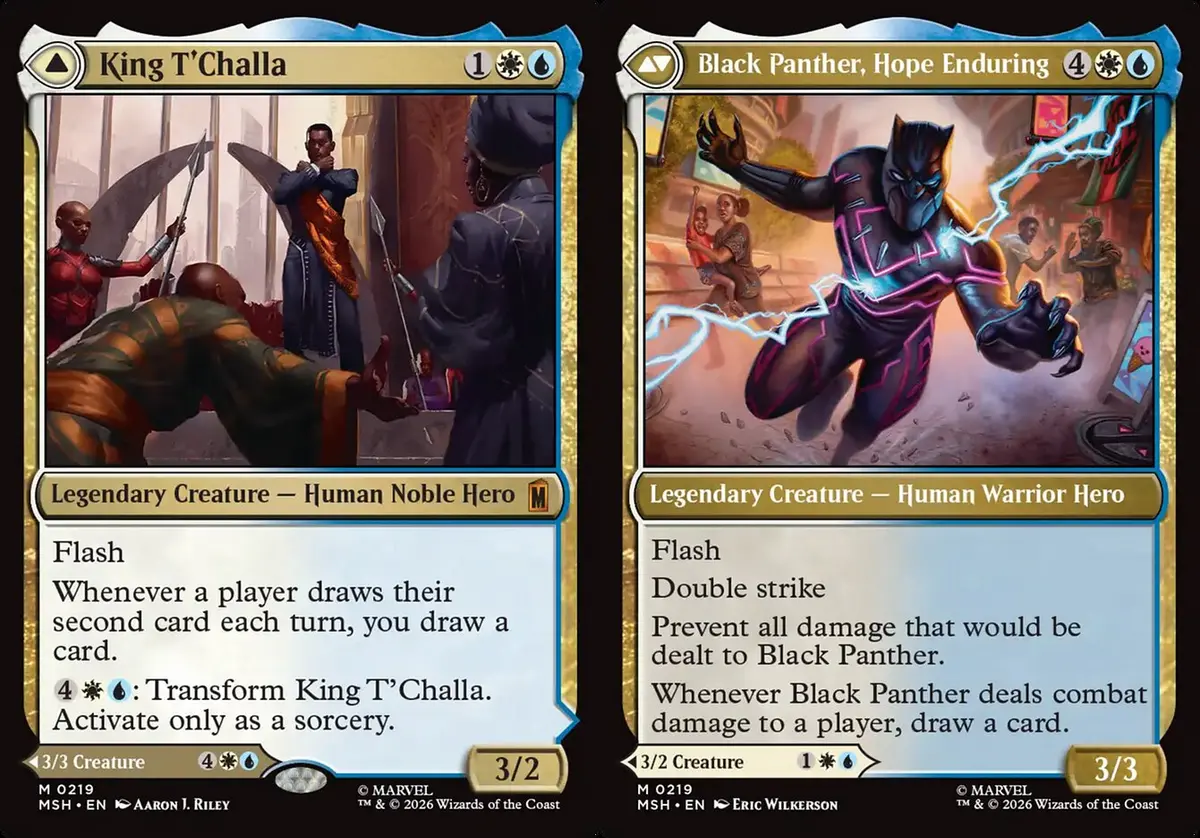
Score: 4.0
Comment: A high-value card for White-Blue. The front face’s body isn’t outstanding, but flash makes it easy to find a time to come down, and as long as you or the opponent draws a second card in the same turn, it starts generating resources. This makes it easy to pull ahead in White-Blue decks with card draw, looting, or tempo interactions. After transforming into Black Panther late in the game, it becomes a threat that is very hard to handle through combat, and once it starts hitting players it keeps drawing cards. The downside is that the front face needs a draw-two effect to be especially strong, and the transform cost is also heavy, but overall the ceiling is very high (of course, you can also just cast the back face directly late in the game).

Score: 2.5
Comment: In a long game it can slowly widen the life-total gap through Extort, and it can also make some high-toughness creatures into attacking threats. However, the body’s offense is unreliable: paying 2 life to have a creature deal damage using its toughness looks explosive, but without evasion it’s easily blocked. Overall it’s more of a playable utility card, suited to slow White-Black decks or decks with lots of high-toughness synergy, but not strong enough to make people eagerly put it in the main deck.
Score: 3.5
Comment: A key card for the Red-Black Villain theme. As long as the deck’s Villain density is high enough, this card turns every later Villain spell into extra board presence, making it easy for Red-Black to build a wave of pressure in the midgame. The tokens it produces have menace, which also fits Red-Black’s direction of attacking continuously and being hard to block. The downside is that the four-mana 2/3 body is weak, usually has no immediate impact that turn, and looks very ordinary if there aren’t enough Villains afterward.

Score: 3.0
Comment: A decent value card in White-Blue. A three-mana 3/3 flyer is already an acceptable aerial threat, and if it can reuse creatures or artifacts with enter effects when attacking, it slowly builds an advantage. If the deck has enough Equipment, it can also turn later Equipment into a source of card draw, raising its ceiling. However, this card needs other support to be especially strong, and on its own it’s more of a solid flyer. Also, if there aren’t many Equipment in the set, its card-draw ability can’t reliably be used.

Score: 3.0
Comment: A value card in Green-Blue that needs support. The bare three-mana 2/2 body is weak, and without reliably triggering card draw its impact on the board isn’t noticeable enough. However, if the deck has enough artifacts, or can reliably draw a second card, it provides both resources and great offensive pressure.

Score: 3.5
Comment: A very flexible mid-to-late-game card in Red-Black. Its cost can adjust to the stage of the game, so it doesn’t get stuck in hand early and becomes a weighty threat late. The several effects attached on entering aren’t explosive individually, but combined on one card they’re very practical: you can loot, deal extra damage, deal with tokens, or force the opponent to sacrifice a creature in the right board state. The downside is that it has no truly reliable hard removal and the modes have a limited ceiling, so it isn’t bomb level, but overall it’s a quality card Red-Black badly wants in the main deck.

Score: 2.5
Comment: This card’s ceiling depends on how many artifact abilities in the deck are worth copying. It’s strong when copying card draw, token creation, damage, or other high-value triggers, but if it’s only copying ordinary small effects, it isn’t worth paying 2 life. The two-mana 2/2 body is acceptable and at least doesn’t get stuck in hand too easily, but it applies no pressure and doesn’t generate cards by itself. Overall it’s more of a utility card that needs specific support. It can make the main deck in a deck with a high enough artifact ability density, otherwise it’s mostly just ordinary curve filler.

Score: 3.0
Comment: A playable card in Black-Green. The three-mana 3/4 deathtouch body is not bad in combat, effectively blocking ground creatures and making the opponent reluctant to attack carelessly. However, the card’s theme synergy depends on the density of deathtouch creatures, and if the deck doesn’t have many good deathtouch creatures, it’s hard to reliably get its later effects going. The Ward cost looks heavy, but in Limited it usually only needs to be dealt with once, so the opponent can still handle it directly when needed. Overall it’s more of an ordinary playable than a key card for Black-Green.

Score: 2.5
Comment: This is a playable but unreliable curve card. The three-mana 2/2 body is weak and doesn’t pressure the board much. The upside is that when the opponent targets it with removal, it may become hard to deal with because we can change the target. However, it doesn’t copy spells, and if there’s no suitable new target on the battlefield, or the removal can still handle it after it grows, this ability won’t necessarily save it.

Score: 3.0
Comment: A very practical flexible card. A three-mana 3/2 with flash, vigilance, and reach has a body and abilities that don’t lose out, performing decently on both offense and defense. It can also save an important creature at a critical moment, making the opponent’s removal or combat trades less comfortable.

Score: 2.5
Comment: This is more of a flexible utility removal. Four-mana flash lets it enter on the opponent’s turn or during combat, pinning down one of the opponent’s important creatures, and a 1/4 body isn’t too easily handled by small damage. However, its own offense is very poor, and it’s only creature-based removal: once it leaves, the opponent’s creature regains its function.

Score: 3.5
Comment: This card’s four-mana 4/4 flying body is already a very good aerial threat, with a certain quality from the body alone. Its restriction on flying creatures can be very strong in some matchups, making it hard for the opponent’s flyers to attack and defend normally, but this effect depends somewhat on the environment and the opponent’s deck, so it won’t necessarily work in every match. The later ability to give creatures flying also needs spells that target creatures to go with it, otherwise it’s just extra value.

Score: 4.5
Comment: This is a very powerful bomb in Red-White. If Chapter I can steal two creatures, it can usually swing the board instantly, turning the advantage the opponent had built directly into your attacking resources. Chapter II can turn the stolen creatures into one huge attack, and Chapter III can use the creatures on the battlefield to deal with the opponent’s remaining threats, which often leaves the opponent unable to get back on their feet. The downsides are that it needs suitable targets on the opponent’s side and the control isn’t permanent, but in most normal games, this card’s impact on the board comes very close to deciding the game.

Score: 3.0
Comment: This card’s strength depends heavily on whether there are good targets on the battlefield or in the graveyard. The base body of a four-mana 3/5 can defend reasonably well, but isn’t proactive enough. When it’s strong, it can copy the best creature on the battlefield, or use a powerful card that already died in the graveyard, turning itself into a threatening mid-to-late-game card. The problem is it only transforms in your first main phase, so on the turn it comes down it usually can’t take effect immediately, and if there’s no target worth copying, it’s just an ordinary defensive creature. Overall the ceiling is good, but the reliability isn’t enough.

Score: 2.5
Comment: You basically can’t treat Power-up on this card as an ability you can use reliably in Limited, so the evaluation mainly rests on the body. A three-mana 4/4 deathtouch lifelink body is extremely strong, and as long as you can cast it on time, it puts great pressure on the opponent on both offense and defense. However, the red-white-black three-color cost is too hard to hit reliably, and many decks would have their mana base affected by it, or even have it stuck in hand. Overall it’s a card with very high power but also very high casting risk, to consider only with enough color fixing.
Score: 3.0
Comment: This is a usable mid-to-late-game threat in Red-White. A five-mana 4/4 flying vigilance is already solid, able to keep pressuring in the air while retaining defensive ability. Double prowess gives it great burst when paired with noncreature spells, making it hard for the opponent to block safely.

Score: 3.0
Comment: This is a high-risk but high-pressure mid-game threat. Discarding a card early for a three-mana 5/5 is not a small cost in Limited, but if you can land it on time on turn three, the opponent basically has to respond immediately, or the board easily gets crushed by the 5/5 body. The Ward cost makes the opponent spend extra resources even with removal, basically offsetting the cost of discarding a card from hand when casting it.

Score: 2.5
Comment: This is basically a four-mana 4/4 curve creature, with a solid body but nothing especially outstanding. The nicer part is that the Equipment it leaves behind doesn’t disappear along with the creature and can keep being attached to other creatures, giving a bit more board utility in the mid to late game. If the deck has artifact or Equipment synergies, the rating rises slightly. On its own, though, it has no evasion, no removal on entering, and no card draw, so it is mainly a card that steadily fills the curve.

Score: 3.5
Comment: This is more of a mid-to-late-game bomb. It does almost nothing early, but when the game drags into the mid to late stage, it can put the best artifact creature from your library or graveyard directly onto the battlefield, and uses extra +1/+1 counters to make up for the downside of the extra two mana. When X is big enough it can also grant haste, giving it a chance to affect the board immediately. However, this card depends heavily on the quality of artifact creatures in the deck, and easily gets stuck in hand early, so it only shows its strength very late in the game.

Score: 2.0
Comment: This card’s own power is low. A three-mana 1/3 flyer doesn’t apply enough pressure, the attack bonus it gives other creatures needs other creatures on the battlefield to work, and the bonus is small, so it can rarely truly change the game. Although the artifact creature and Hero types have some synergy value in specific decks, its body is too weak, and at most it fills out the curve.

Score: 2.5
Comment: This card mainly gains value through Equipment and graveyard recursion, but there aren’t many Equipment in the set, so you can’t reliably expect it to become a big threat. Without Equipment the body is just a two-mana 2/2, and even with vigilance and menace the board pressure is limited. After attaching an Equipment its power goes up, but its toughness is still low, so it’s easily dealt with in combat. Its advantage is that it can come back from the graveyard late in the game, giving the deck a bit more staying power in attrition games.

Score: 4.0
Comment: This is a powerful creature-combat bomb in Red-Green. On entering it has a chance to directly fight and kill one of the opponent’s creatures, and since damage doesn’t easily accumulate on it, it’s hard for ordinary creatures to trade with it in combat. The opponent usually needs to deal 5 or more damage at once, or use hard kill, exile, or -X/-X removal, to handle it relatively cleanly. The downside is it has no evasion and still dies to hard removal, but once the game enters creature combat, it puts huge pressure on the opponent.

Score: 0.0
Comment: This card has trouble delivering reliable value in Limited. Although it looks like a board wipe, both sides can replay creatures from hand, and the exiled creatures eventually return to hand, so it doesn’t necessarily truly solve the opponent’s board. The seven-mana cost is very high, yet it needs specific hands or deck structures to easily come out ahead. Overall it’s more of a Constructed or special combo card, and most normal Limited decks won’t want to play it.
Conclusion
This set gathers heroes and villains from all across the Marvel universe in a big brawl, on a scale that is huge even compared with past collaboration sets. I look forward to this Limited season letting newcomers, veterans, and attracted fans all play to their hearts’ content.
- Title
- Marvel Super Heroes (MSH) Limited Introduction — Multicolor
- Author
- ClarkShih
- Created at
- June 15, 2026
- Updated at
- June 15, 2026
- License
- This work is licensed under CC BY-NC-SA 4.0 .