Modern's Mana Magician - Amulet Titan

Note: This article was translated from Chinese by AI and may contain errors. Read the original Chinese version.
I. Introduction
Hi everyone, I’m Egavas. In Cycle 5 of the 2023-2024 season’s Magic in Taiwan (MIT) championship, I was lucky enough to make the prize-money top 16 with Amulet Titan. As an evergreen Modern deck, Amulet Titan has always held a place in the metagame. However, the deck’s high play complexity and the “land toolbox” effect brought by Primeval Titan have long made it one of the hardest decks in Modern to pick up. That is why Amulet Titan needs a lot of study and practice, and I hope this article gives friends in the Traditional Chinese community more understanding of, and interest in, this deck.
The main reference for this article is the nearly 100,000-word, 100-page Ultimate Titan Guide, colloquially called the Titan Bible, written by Dominic Harvey (also known as Dom Harvey), a top 4 finisher at Pro Tour: Lord of the Rings. I’ve added some of my own understanding and views of the metagame, and I’ll attach links to some other information in the article.
If you like the following deck traits, Amulet Titan may be the deck for you:
- High play difficulty
- Proactive game plan
- Big-mana deck
- Combo-like deck
Ready?
When nature calls, Run.
II. A Brief Look at the Current Metagame
Here is the Amulet Titan decklist I used this time.
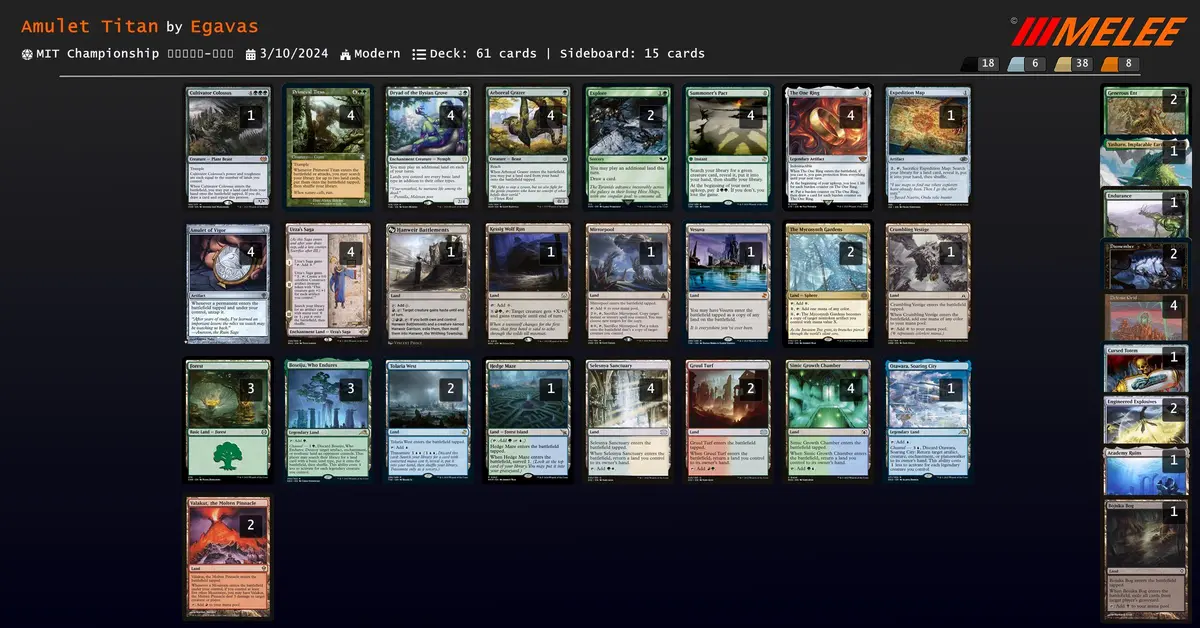
Since the release of The Lord of the Rings: Tales of Middle-earth, the arrival of The One Ring (hereafter “the Ring”) has strengthened many decks, and the biggest beneficiary is Amulet Titan. Amulet Titan used to have two core problems: insufficient card refill and not enough survivability when behind. Both are solved by the Ring alone. And as a big-mana deck, the Ring’s rather clunky 4-mana curve has no impact at all in a Titan deck, which also helped Dom Harvey reach the top 4 at #PTLTR.
After Fury was banned, the Rakdos Evoke decks, one of Amulet Titan’s big nemeses, dropped off sharply, and Titan’s share of the metagame gradually rose. Although Temur Rhinos, the king of the post-Fury era, is a slightly unfavorable matchup for Amulet Titan, after Leyline of the Guildpact appeared, Leyline Rhinos came into everyone’s view. Because Tishana’s Tidebinder and Flame of Anor have become less common, Amulet Titan is slightly favored against Leyline Rhinos, making Amulet Titan one of the metagame’s small winners.
III. Build Introduction
1. Fixed Slots
Amulet Titan has a lot of freedom, with many flexible slots. Basically, they can all be adjusted according to how smooth the pilot feels and changes in the metagame. Below are the fixed slots that cannot be changed in a Titan build:
| Creatures (12) | Artifacts (9) | Instants (4) | Lands (26) |
|---|---|---|---|
| 4 Arboreal Grazer | 4 Amulet of Vigor | 4 Summoner’s Pact | 4 Urza’s Saga |
| 4 Dryad of the Ilysian Grove | 1 Expedition Map | 4 Simic Growth Chamber | |
| 4 Primeval Titan | 4 The One Ring | 5 green-edged bounce lands Note 1 Note 2 | |
| 2 Forest | |||
| 2 Boseiju, Who Endures | |||
| 2 Tolaria West | |||
| 1 The Mycosynth Gardens | |||
| 2 Valakut, the Molten Pinnacle | |||
| 1 Vesuva | |||
| 2 haste lands + pump lands Note 3 |
Note 1:The lands from the original Ravnica block that tap for two mana of two colors and have to return a land you control to hand when they enter are what we call bounce lands. Counting Simic Growth Chamber, there are 10 of them. For convenience, from here on I’ll refer to them as “XX bounce land.” For example, Simic Growth Chamber is called the “blue-green bounce land.”
Note 2:In most cases Amulet Titan is a mono-green deck with a tiny splash of blue (because of Tolaria West). So besides the 4 necessary blue-green bounce lands, the remaining 5 bounce land slots just need to touch green. You usually choose based on your sideboard or flex slot cards. For example, in this MIT my build had a Yasharn, Implacable Earth in the sideboard, so I chose to play 4 of the green-white bounce land.
Note 3:Haste lands and pump lands have two different schools: the “Hanweir Battlements package” and the “Slayers’ Stronghold
+ Sunhome, Fortress of the Legion” combination. We’ll discuss them in detail later.
2. Flex Slots
The remaining flex slots usually involve the following choices:
- Lands must reach 32+. I personally think 33 is safer, but there are also quite a few 32-land builds
- A 10th or 11th bounce land. I think at least 10 bounce lands is safer
- Lands that enter able to tap for green must reach 7+. The usual choices are a 3rd Forest, a 3rd Boseiju, Who Endures, 1-3 Crumbling Vestige, or 1-2 shock lands
- 1 Cultivator Colossus I think is very close to a fixed slot; many matchups can be turned around by this one card
- Besides Dryad of the Ilysian Grove, most builds have 1-3 extra land-drop effects, basically chosen from Azusa, Lost but Seeking, Spelunking, and Explore
- A 2nd or 3rd The Mycosynth Gardens, though I personally feel two at most is enough
- More utility lands, such as Mirrorpool, Hedge Maze, Otawara, Soaring City, and so on
For details, please refer to the decklist I used in this MIT above. I’m quite satisfied with this list. The only thing I deliberated over for a while before the tournament was 2 Explore versus 1 Azusa, Lost but Seeking + 1 Spelunking. In the end I still chose the 2 Explore, which filter better.
IV. Game Plan
As mentioned in the introduction, Amulet Titan’s play difficulty is in the top tier of the Modern metagame. Here is a brief introduction to how the deck operates:
1. Ramping and Bouncing
First, the deck’s primary goal is to summon Primeval Titan (hereafter “Titan”), so how to reach 6 mana is the main early-game objective. Amulet of Vigor (hereafter “Amulet”) untaps lands that enter tapped, so you can do bounce land untaps → tap for mana → bounce itself back to hand, getting two mana from one land drop. Similarly, with two Amulets you can do bounce land untaps → tap for mana → untaps again → tap for mana again → finally bounces itself back to hand, and so on. There are a few things to note:
If a bounce land bounces itself, the extra mana you get from the extra land drop this turn cannot carry over to the next turn. So, when conditions allow, early on try to have the bounce land bounce other lands, steadily increasing your mana each turn
Because bounce lands are the main source of ramping in this deck, and one bounce land can produce mana across multiple land drops, in most cases, as long as an Amulet is still on the battlefield, you’ll try to keep a bounce land in hand
To quickly calculate how much mana you can produce this turn, the deck has 5 ways to make extra land drops, and the changes with the number of Amulets are as follows (source; everything below assumes a bounce land in hand):
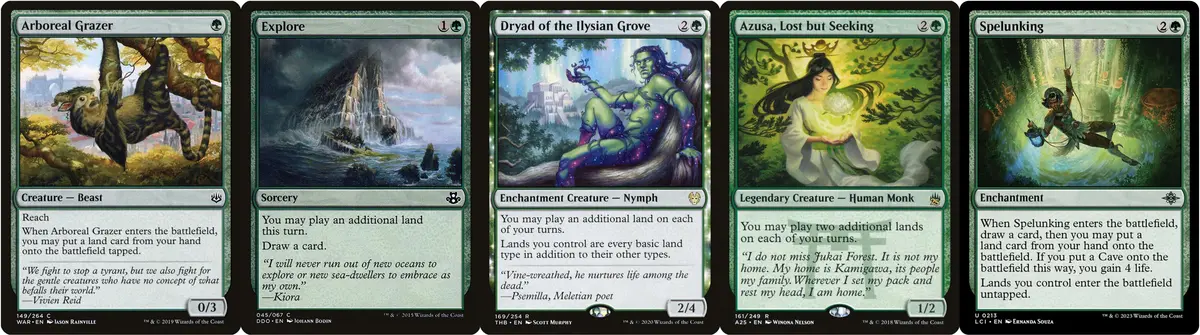
| Number of Amulets on the battlefield: | 1 | 2 | 3 | 4 |
|---|---|---|---|---|
| Arboreal Grazer | +1 mana | +3 mana | +5 mana | +7 mana |
| Explore | ±0 mana | +2 mana | +4 mana | +6 mana |
| Dryad of the Ilysian Grove | -1 mana | +1 mana | +3 mana | +5 mana |
| Azusa, Lost but Seeking | +1 mana | +5 mana | +9 mana | +13 mana |
| Spelunking | -1 mana | +1 mana | +3 mana | +5 mana |
2. Ways to Win
This deck has two main ways to win: Titan attack damage and Dryad Valakut. Here is how the two work:
Titan attack damage
With an Amulet on the battlefield, Titan fetches a haste land plus a land that produces the mana to activate the haste land, which gives Titan haste immediately, then attacks and fetches two more lands.
With multiple Amulets, you can even use “Tolaria West → Summoner’s Pact” or “Mirrorpool + bounce land” to make multiple hasty Titans for burst damageDryad Valakut
Dryad of the Ilysian Grove (hereafter “Dryad”) gives all lands you control every basic land type, letting any land satisfy the check for Valakut, the Molten Pinnacle (hereafter “Valakut”). When Valakut enters together with other lands (usually from a Titan trigger), it can check simultaneously and deal massive damage. Even without Titan, the extra land drop from Dryad combined with bounce lands is 6 damage per turn, which is still considerable.
V. Deck Tips and Rules
1. Choosing Haste Lands and Pump Lands
First, haste lands and pump lands serve different purposes, so why say they are tied together? Looked at separately, the burst damage of Sunhome, Fortress of the Legion is better than that of Kessig Wolf Run. However, builds whose haste land is not Slayers’ Stronghold will not have the red-white bounce land, and so cannot copy it with Vesuva to activate Sunhome, Fortress of the Legion. That is why the choice of these two groups of lands is tied together.
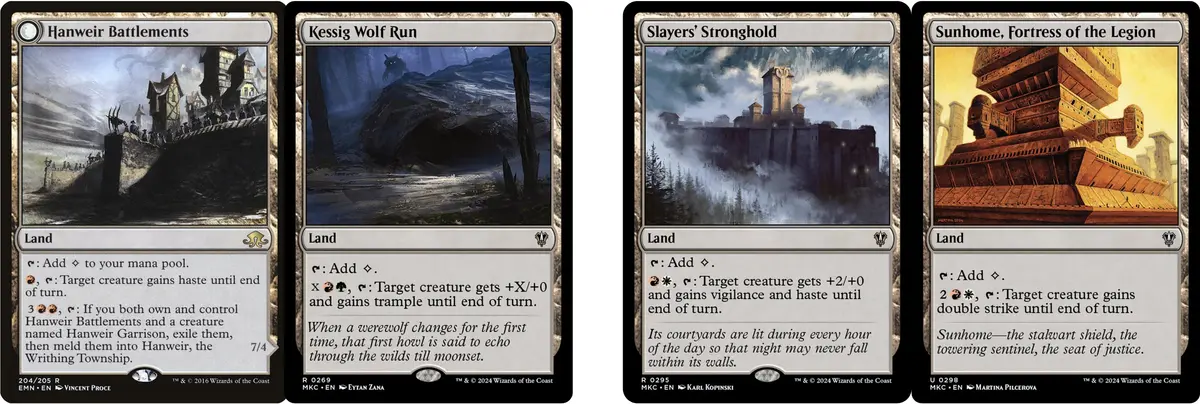
Here is a simple table analyzing the pros and cons of these two configurations:
| Hanweir Battlements package (usually includes Mirrorpool) | Slayers’ Stronghold + Sunhome, Fortress of the Legion | |
|---|---|---|
| Pros | Better in long games; components are useful even when they show up alone | Higher burst ceiling; wins faster |
| Cons | Lower burst damage; often needs multiple bursts | Worse in long games; more likely to run out of steam after the burst is disrupted |
The traditional Amulet Titan build is based on the Slayers’ Stronghold + Sunhome, Fortress of the Legion combination. However, the land used to pay for the Stronghold-Sunhome combination is the red-white bounce land. By contrast, the Valakut, the Molten Pinnacle that Hanweir Battlements is usually paired with ties in better with the Dryad Valakut game plan, and combined with not needing to bounce a bounce land to hand, it makes Hanweir Battlements more stable in long games, and it has gradually become the mainstream configuration today.
Advanced: The Titan Kill Formula and the “Hanweir Battlements Package”
Friends reading this far may wonder why I described Hanweir Battlements as a “package” above. First we need to mention the core goal of “haste lands and pump lands” in a Titan deck: dealing 20 or more damage given two Amulets. So any setup that can kill after getting a two-Amulet Titan is a viable choice.
Here is a detailed introduction to the Titan formulas (note: all scenarios assume two Amulets on the battlefield, Titan and its enter-the-battlefield trigger resolving successfully, and none of the needed lands in hand):
Stronghold-Sunhome:
Titan enters and fetches “Slayers’ Stronghold + red-white bounce land”
→ untap and activate Stronghold twice on Titan (Titan is now 10 power), bounce any non-red-white bounce land to hand
→ Titan attacks, trigger fetches “Sunhome, Fortress of the Legion + Vesuva (entering as a copy of the red-white bounce land)”
→ finally activate Sunhome to give Titan double strikeNote 4
=20 damageBattlements + Mirrorpool + finisher land
Common finisher lands are Kessig Wolf Run and Oran-Rief, the Vastwood. The first half is the same for both, using Mirrorpool to make two Titans, and only the lands fetched after attacking differ:
Titan enters and fetches “any bounce land + Mirrorpool”
→ untap and tap for mana, then untap again, and use Mirrorpool to copy a Titan
→ Titan enters and fetches “Valakut, the Molten Pinnacle + Hanweir Battlements”
→ the two untaps give the two Titans haste respectively
Wolf Run version
→ the first Titan fetches “two bounce lands”, the two untaps produce 8 mana, bounce any two lands to hand
→ the second Titan fetches “Kessig Wolf Run + red-green bounce land”
→ the first untap produces 3 mana, the second untap gives one of the Titans +11/+0
=23 damage
Oran-Rief version
→ the first Titan fetches “Oran-Rief, the Vastwood + any land”
→ untap, activate Oran-Rief twice (each Titan is now 8 power)
→ the second Titan fetches “Vesuva (entering as a copy of Oran-Rief) + any land”
→ untap, activate Oran-Rief twice (each Titan is now 10 power)
=20 damage
From the examples above you can see Hanweir Battlements can work with many finisher lands (plus some rarer, more complex ones like Echoing Deeps), but basically all need Mirrorpool. The advantage of the Battlements package is that every component land is useful when it shows up alone, and the two-Titan kill formula requires the opponent to have more precise answers, which is why it became the mainstream today.
Note 4:Triggers must be ordered on resolution: first untap the red-white bounce land (Vesuva) twice to get red red white white
2. Dryad, Valakut, and Cultivator Colossus
Amulet Titan’s second line is Valakut. As Hanweir Battlements usage has risen, fast-kill combo-style Amulet Titan builds have gradually decreased, and Valakut has become increasingly important in the deck. There are a few points to note with this interaction:
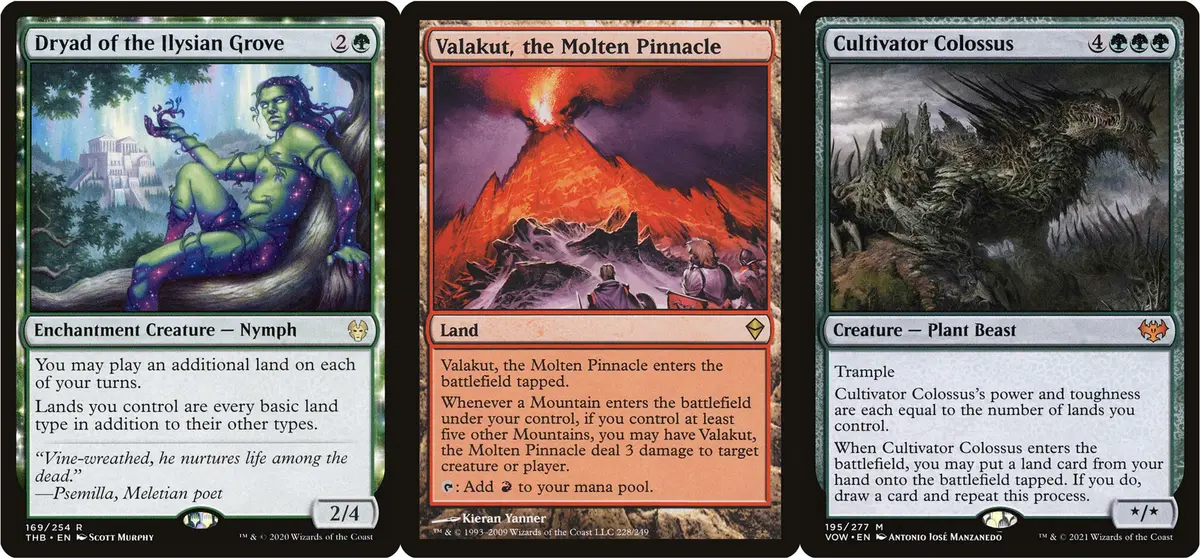
Valakut’s trigger check is a two-stage check: when Valakut or another land enters, if you control 5 other Mountains (that is, 6 or more lands in total), Valakut’s ability goes on the stack and you must choose a target first, and when the ability resolves it checks again for the “5 other Mountains” condition, dealing damage only if it is met. In other words, if the opponent responds by removing the Dryad, the condition fails and no damage is dealt. So in many situations where you expect the opponent to be able to remove the Dryad, you’ll generally try to make two Dryads as a precaution.
Cultivator Colossus’s enter-the-battlefield lands are put onto the battlefield one at a time, not together: Cultivator Colossus (hereafter “Colossus”)‘s ability is special, because its “repeat” wording is contained within a single ability, so there is no point at which anything can respond until all the repeating is done, and everything triggers only after all of it is complete (for example Orcish Bowmasters, bounce land returns, Amulet untaps). The same applies when a Dryad and Valakut are on the battlefield.
Cultivator Colossus and Valakut checks: the triggered abilities from lands put onto the battlefield by Colossus go on the stack together, but Valakut checks right when each land enters. For example:
- If you already have a Valakut and a Dryad on the battlefield and Colossus puts 7 lands onto the battlefield
→ there will only be 3 Valakut triggers, because only starting from the 5th land put on by Colossus does the Valakut check condition (another 5 Mountains) get met
- If you already have a Valakut and a Dryad on the battlefield and Colossus puts 7 lands onto the battlefield
VI. Matchup Tips and Sideboard Choices
Next, let’s talk about the matchup key points and sideboard choices for several common decks in the current metagame. Amulet Titan is a deck with a very proactive game plan, and the problems Titan has to face are mainly of three kinds:
Blood Moon effects:
These are effects like Blood Moon that make lands lose their abilities. There are three common ones in the metagame, ranked from highest to lowest threat level: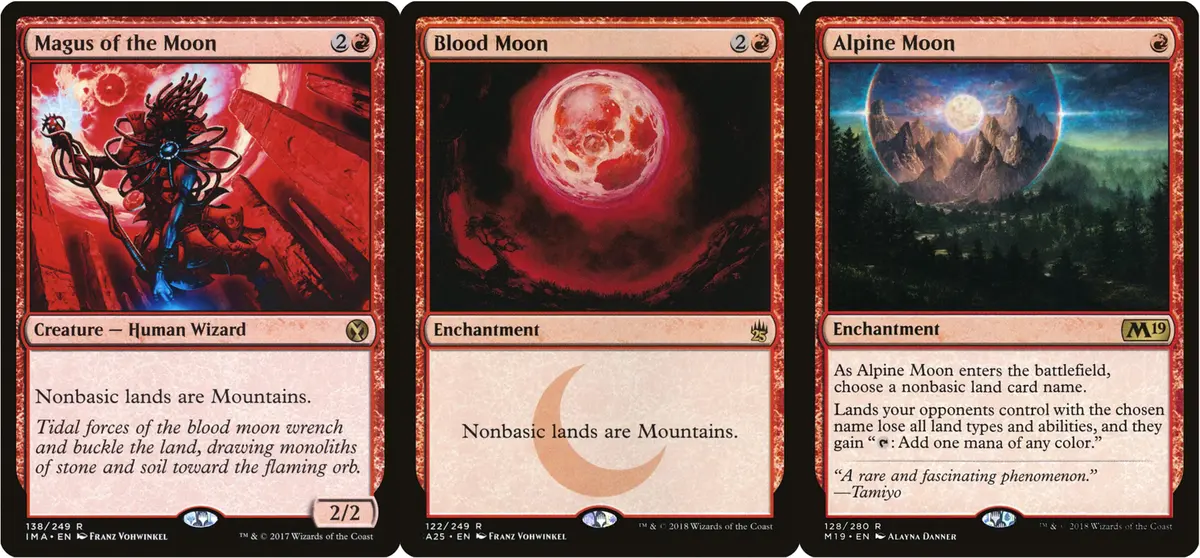
Since Amulet Titan already plays Boseiju, Who Endures in the main deck, Magus of the Moon, as the only non-enchantment among them, definitely requires sideboard cards to deal with, and is the most troublesome threat.
- Common Titan answers: Boseiju, Who Endures, Force of Vigor, Tear Asunder, Dismember
Stopping Titan from resolving:
There are three common threats in the metagame: Counterspell, Subtlety, and Tishana’s Tidebinder. The most troublesome is Subtlety, because with its alternative casting it can still be cast even if the opponent has no mana, which makes it harder to defend against.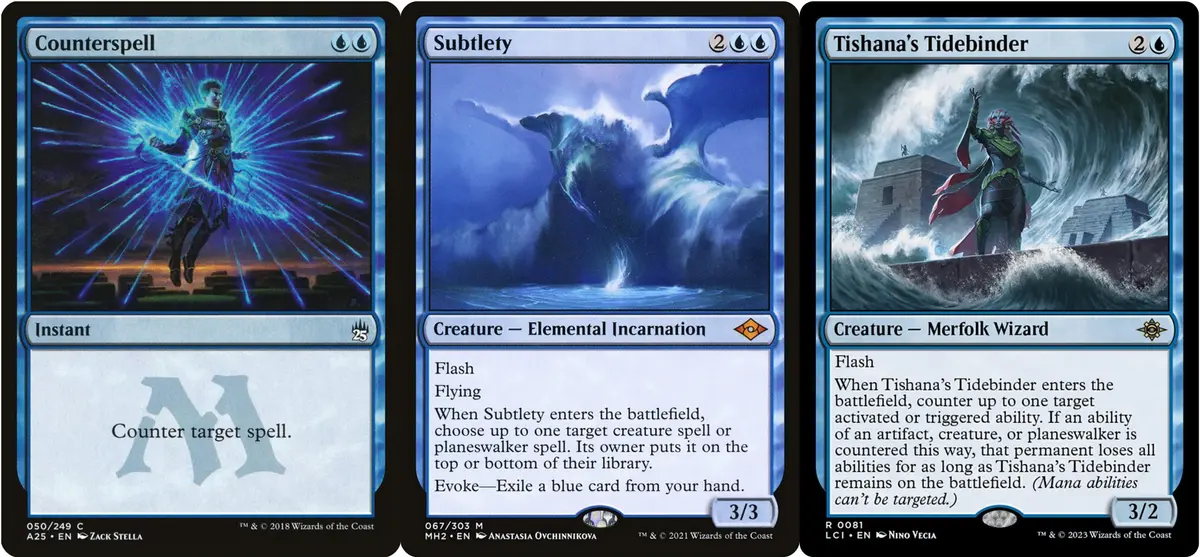
Few decks in the current metagame run Counterspell (basically only a few Izzet Murktide decks or Azorius control decks), so Cavern of Souls, the best card against Counterspell, shows up less in the current metagame, and I didn’t run it in my final MIT build either.
- Common Titan answers: Counterspell, Defense Grid
Removing Amulet
Without Amulet, Amulet Titan’s game plan and speed are greatly disrupted, so removing Amulet is also a problem we need to face. Also, since most cards in the metagame that remove Amulet (an artifact) can also deal with Urza’s Saga (an enchantment) at the same time, in matchups against that kind of sideboard we often play down Urza’s Saga as well.Here is a brief overview of the common ways to remove Amulet in the metagame:
Can also remove Urza’s Saga:
Boseiju, Who Endures, Pick Your Poison, Haywire Mite, Force of Vigor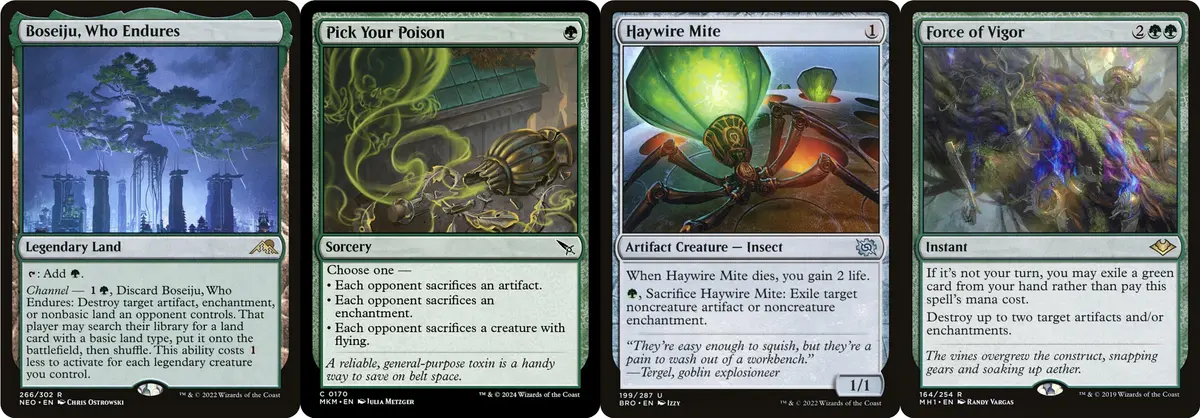
Cannot also remove Urza’s Saga:
Engineered Explosives, Prismatic Ending, Molten Collapse, Brotherhood’s End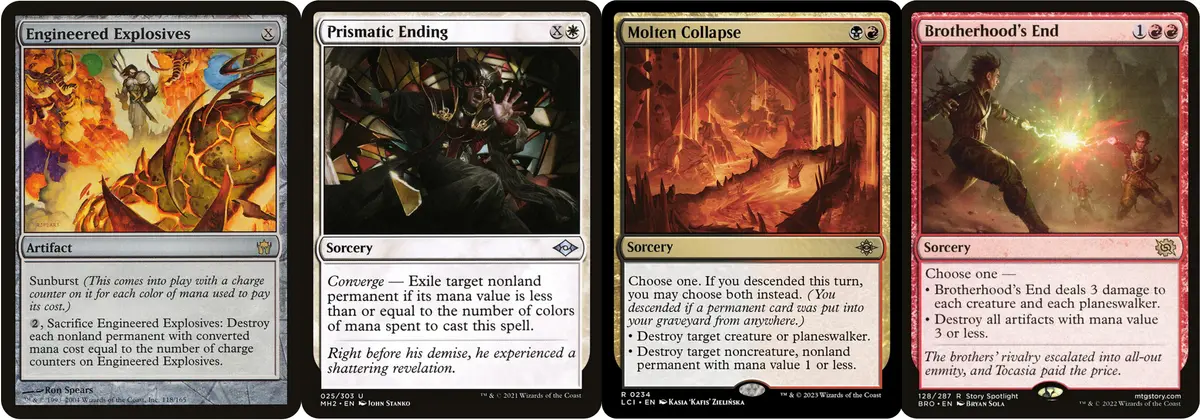
- Common Titan answers: there are usually no specific cards to answer it (in my MIT list I used Academy Ruins, but it’s not a common sideboard card), so in sideboarded games you often hold back extra Amulets without playing them, or go for win conditions that don’t need Amulet.
Threats faster and more proactive than Titan:
For example, a turn 1 Grief with Ephemerate or Not Dead After All, or Rhinos cascading on curve into Crashing Footfalls. For this kind of threat, you adjust the number of answers in the sideboard according to how much of it is in the metagame.
VII. My Thoughts on the Post-Rhino Era and Modern Horizons 3
With Violent Outburst banned, the Rhino decks that were Modern’s former overlord have nearly disappeared, replaced by the resurgence of Rakdos Evoke decks, and at the same time, Titan decks have received boosts:
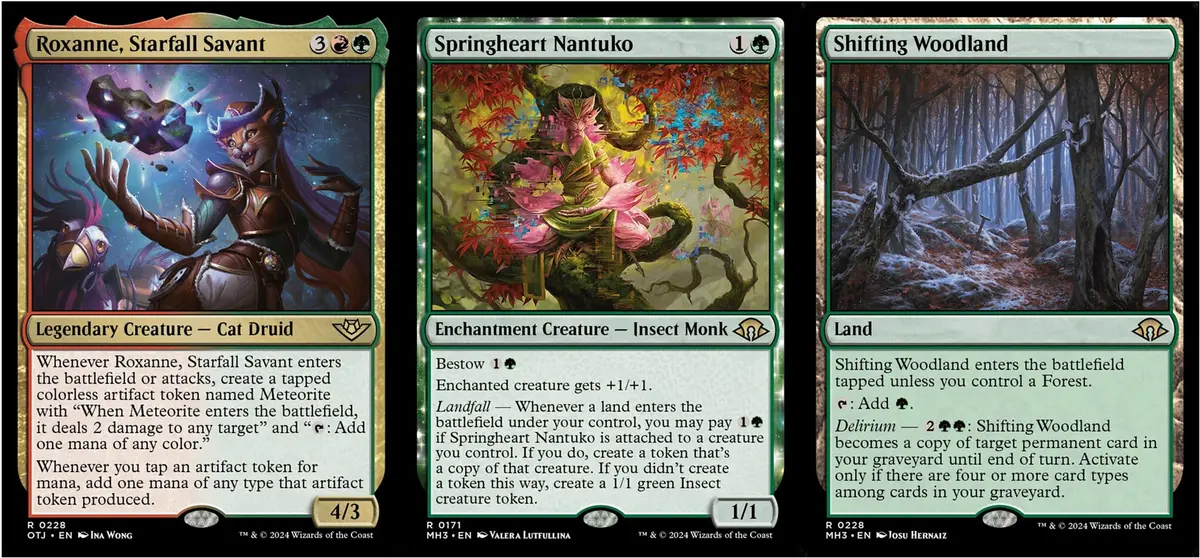
Roxanne, Starfall Savant
Roxanne is a very big boost for Titan’s sideboard, and at the same time solves some of the difficulties Titan decks have in sideboarded games against Blood Moon effects:
The best answer to Magus of the Moon: Titan decks used to answer Magus of the Moon mostly with instants and sorceries (such as Dismember, Firespout, and so on). However, Titan is not a deck with strong filtering, and as a combo-style deck, even in sideboarded games it often keeps hands with no answers. Roxanne is a card that can be found by Summoner’s Pact, and is also red-green (green only needs a single colored mana), and the Meteorites she makes can also better deal with a Blood Moon effect that may show up again next turn, which makes her without doubt the best answer to Magus of the Moon.
High midrange value: besides dealing with Magus of the Moon, Roxanne’s midrange value is also very good. She deals two damage to any target on entering and on each attack, which is great both for clearing the board and for racing damage. More importantly, Roxanne’s Meteorite also has a ramp effect, and it enters tapped, so it triggers Amulet, fitting the deck’s theme very well.
Modern Horizons 3
As an important marker of Modern’s metagame turnover in recent years, Modern Horizons 3 undoubtedly made a huge splash, bringing another big change to the entire Modern metagame, and several cards gradually came into Titan players’ view during the preview period:
Springheart Nantuko
Although Modern Horizons 3 has not officially joined tournament play as of writing, I’m quite confident this card will make it into Titan decks. Its synergy with Titan decks is too good, so here is a brief introduction:
Value of hard-casting early: although it’s not the main point, hard-casting it early in a Titan deck is equivalent to making at least one 1/1 each turn afterward, which is also a decent threat against some decks that struggle to deal with tokens.
Very many combo interactions: the card’s core value is in bestow, and it performs outstandingly when attached to any creature in current Titan decks:
With Arboreal Grazer:
One Amulet on the battlefield, bounce land in hand → infinite Arboreal Grazers
Two Amulets on the battlefield, bounce land in hand → infinite Arboreal Grazers, infinite mana
With Dryad of the Ilysian Grove:
One Amulet on the battlefield, bounce land in hand → infinite Dryads
Two Amulets on the battlefield, bounce land in hand → infinite Dryads, infinite mana
Amulet on the battlefield, bounce land in hand, Valakut on the battlefield with more than 5 lands → infinite Dryads, infinite damage
With Primeval Titan:
Amulet on the battlefield → equivalent to as many Titans as the number of bounce lands plus green-source lands in the library
Shifting Woodland
As a utility land, being able to copy a Titan, Amulet, or Dryad in the graveyard is all quite good. The only slightly troublesome thing is that Amulet Titan is not a deck that easily turns on delirium, and Titan decks’ land construction is actually very tight right now, so I think it can be put on the watch list.
VIII. Afterword
I really procrastinated on this article for quite a while xD. I’ve been writing on and off since MIT#5 ended, and in the meantime Modern saw quite a few changes. Amulet Titan really is a very interesting deck: hard, but also strong. Since the Modern Horizons sets began hitting Modern, many traditional classic decks have slowly left tournament play as their power fell short, but Amulet Titan has always found a place. I think in an eternal format like Modern, a deck like this is without doubt worth practicing and studying, and I hope this article can serve as a starting point that sparks more discussion among Titan-interested players in the Chinese-speaking community.
- Title
- Modern's Mana Magician - Amulet Titan
- Author
- Egavas
- Created at
- June 13, 2024
- License
- This work is licensed under CC BY-NC-SA 4.0 .