A Doctor's Guide to Switching Careers and Becoming a Chef

Note: This article was translated from Chinese by AI and may contain errors. Read the original Chinese version.
I. Introduction
Hi everyone, I’m T1BloodMoon, someone who only knows how to play combo. Ever since Yawgmoth, Thran Physician (hereafter the Doctor) debuted in MH1, I’ve been building this black-green Doctor deck, back when it was a version running a full four Geralf’s Messenger. When MH2 added Grist, the Hunger Tide (hereafter “Grist”), it fixed this deck’s weakness against creature removal and planeswalkers, and for a time it jumped into the upper tier of the MTGGoldfish meta. In between, through the heyday of the Heliod-Ballista deck, I built Aether Vial Doctor versions to fit the environment, as well as a two-card infinite Squirrel combo with Scurry Oak + Ivy Lane Denizen. And now, in WOE, the arrival of Agatha’s Soul Cauldron has brought the Doctor all kinds of new lines, and here I’ll walk you through some of the combos I’m currently using.
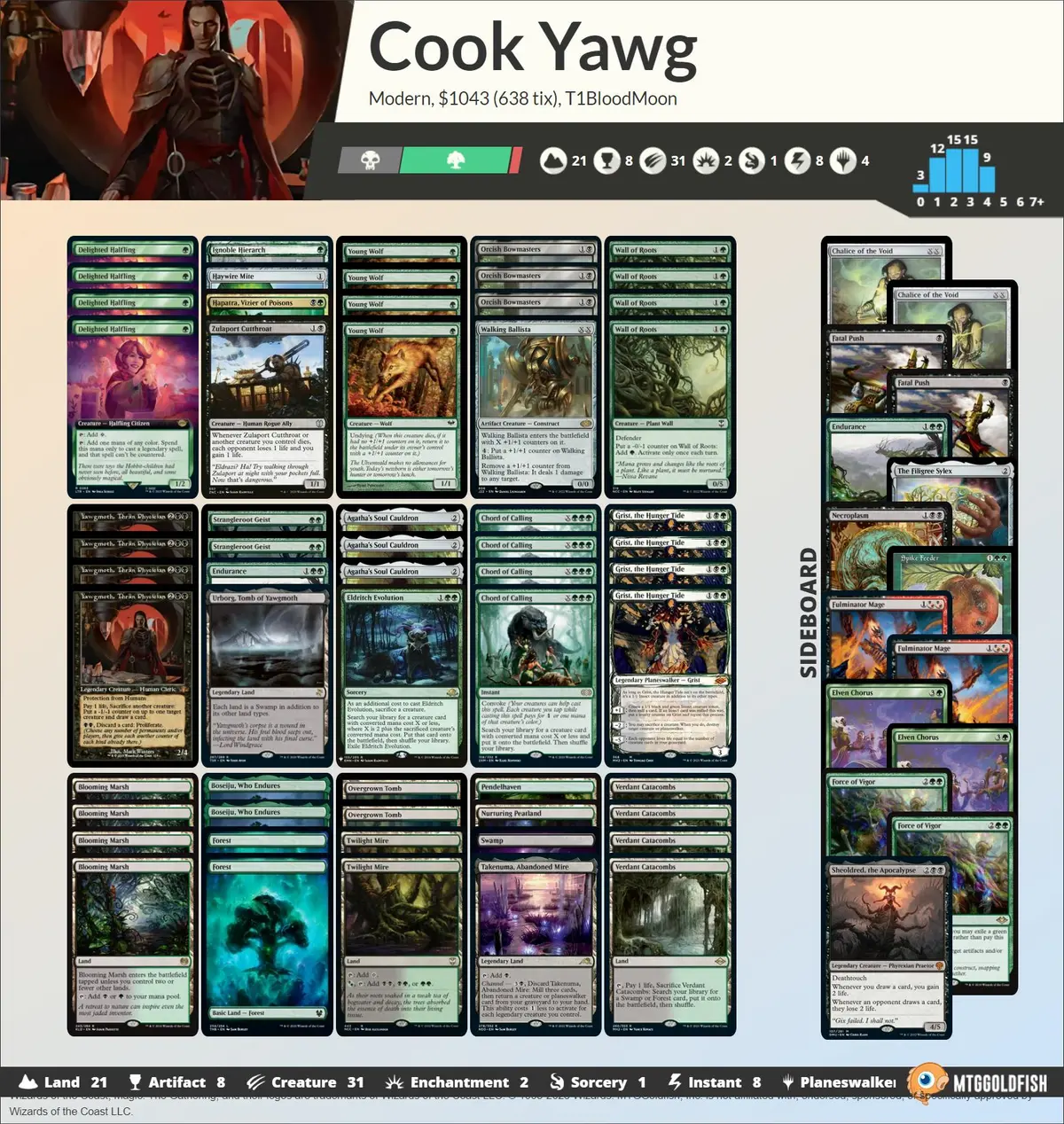
First, here is the list I’ve been using recently, adapted from overseas lists and tweaked for the Taiwan environment:
II. Introducing the Cauldron
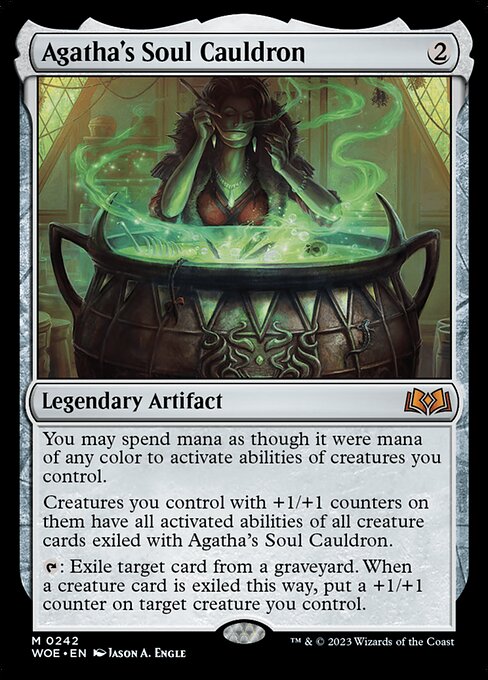
Agatha’s Soul Cauldron (hereafter “the Cauldron”) is a new legendary artifact from WOE. Creatures you control with +1/+1 counters on them have all activated abilities of creatures exiled with the Cauldron, and its tap ability lets you exile a card from any graveyard; furthermore, if the exiled card is a creature card, you put a +1/+1 counter on target creature you control. There are a few points to note:
- You can pick from either player’s graveyard, and it doesn’t have to be a creature card. So when the opponent has something like Wrenn and Six or Dreadhorde Arcanist, you can respond by eating whatever they are targeting.
- When you eat a creature card, if you control a creature, you must put a +1/+1 counter. Be careful, because this might give an undying creature (Young Wolf or Strangleroot Geist) a counter, in which case it can no longer do the trade.
- It’s legendary, so make good use of Delighted Halfling to keep it from being countered.
III. Introducing the Creatures With Activated Abilities the Cauldron Eats
1. Main Target Creatures
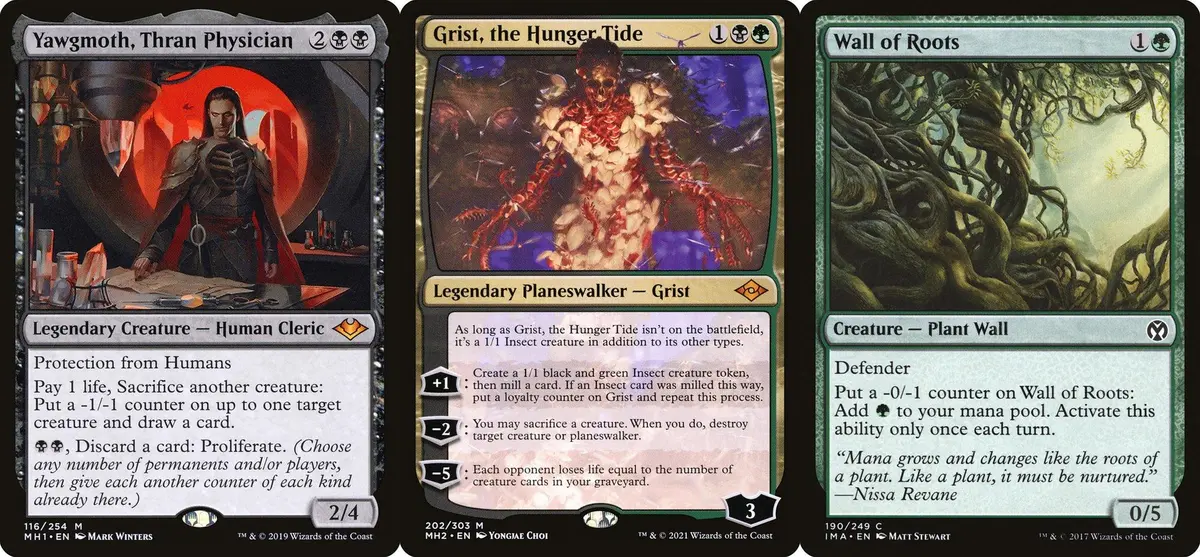
The Doctor is the key card of most of this deck’s combos. If the Cauldron can eat it, the undying creatures themselves can hold the Doctor’s activated ability as long as they carry a counter. The benefit is that two undying creatures can sacrifice each other in turn to dodge removal (the whole combo’s flow and result are covered later).
Grist counts as an extra 1/1 Insect creature in every zone other than the battlefield, which also means it can’t be countered by Force of Negation, and naturally it can be eaten by the Cauldron too, giving creatures with +1/+1 counters the planeswalker ability. It also works with undying creatures coming back to produce many Insects on the board.
I write about Wall of Roots separately from the mana creatures for two main reasons. First, its mana ability ignores summoning sickness and can be activated right away. Second, the counter it puts on is -0/-1, which lets an undying creature with toughness 1 kill itself directly and then come back, which plays a crucial role in the combos mentioned later.
2. Mana Creatures
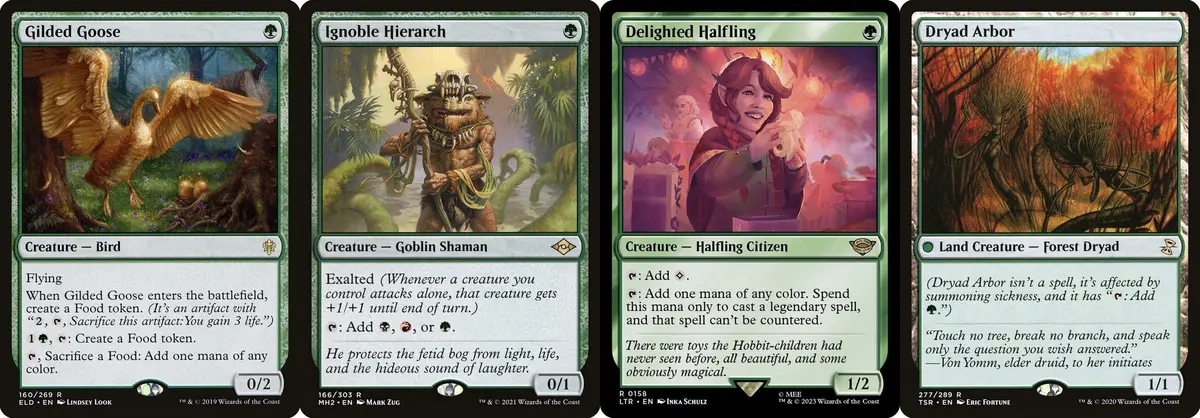
These four are the mana creatures the Modern Doctor deck currently plays. The mainstream build is four Delighted Halfling plus zero to two Ignoble Hierarch or Gilded Goose. Halfling’s addition keeps the Doctor, Grist, and the Cauldron from being countered, which is a big help to the Doctor deck. In addition, Dryad Arbor, as a land or creature that can also produce mana, I’m filing here too. If any of these four get eaten by the Cauldron, every one of your creatures with a +1/+1 counter gains mana-producing ability.
3. Utility Creatures
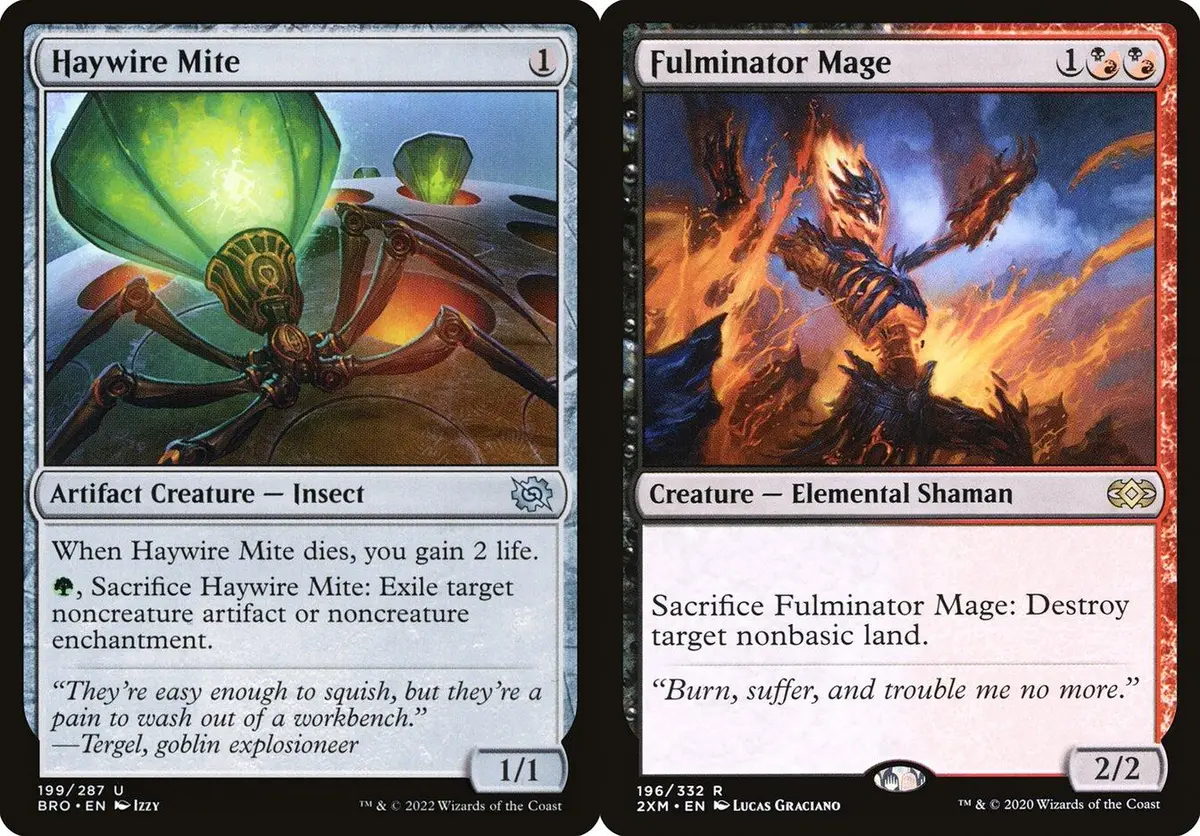
Haywire Mite, the commonly used creature against artifacts and enchantments these days, can also be fetched onto the battlefield with Chord of Calling in the Doctor deck. If it’s eaten by the Cauldron, each of your creatures with a +1/+1 counter can sacrifice itself to exile a noncreature artifact or enchantment. Good targets right now include the common Urza’s Saga or Kaldra Compleat, which the Doctor has a hard time handling, as well as the various artifacts and enchantments that graveyard hate relies on.
Fulminator Mage can cause a certain amount of disruption against decks that play lands, like Green Tron or Amulet Titan, slowing the opponent’s tempo so your own development toward the endgame goes more smoothly. Likewise, once the Cauldron eats it, you can sacrifice creatures with +1/+1 counters to blow up lands.
When using these two, note that because the creature itself is sacrificed, even an undying creature can’t keep using it forever. I recommend working with Grist, calling an Insect to put a counter on it and then sacrificing it, which is the play that loses the least resources.
4. Utility Creatures That Can Serve as Endgame Plays
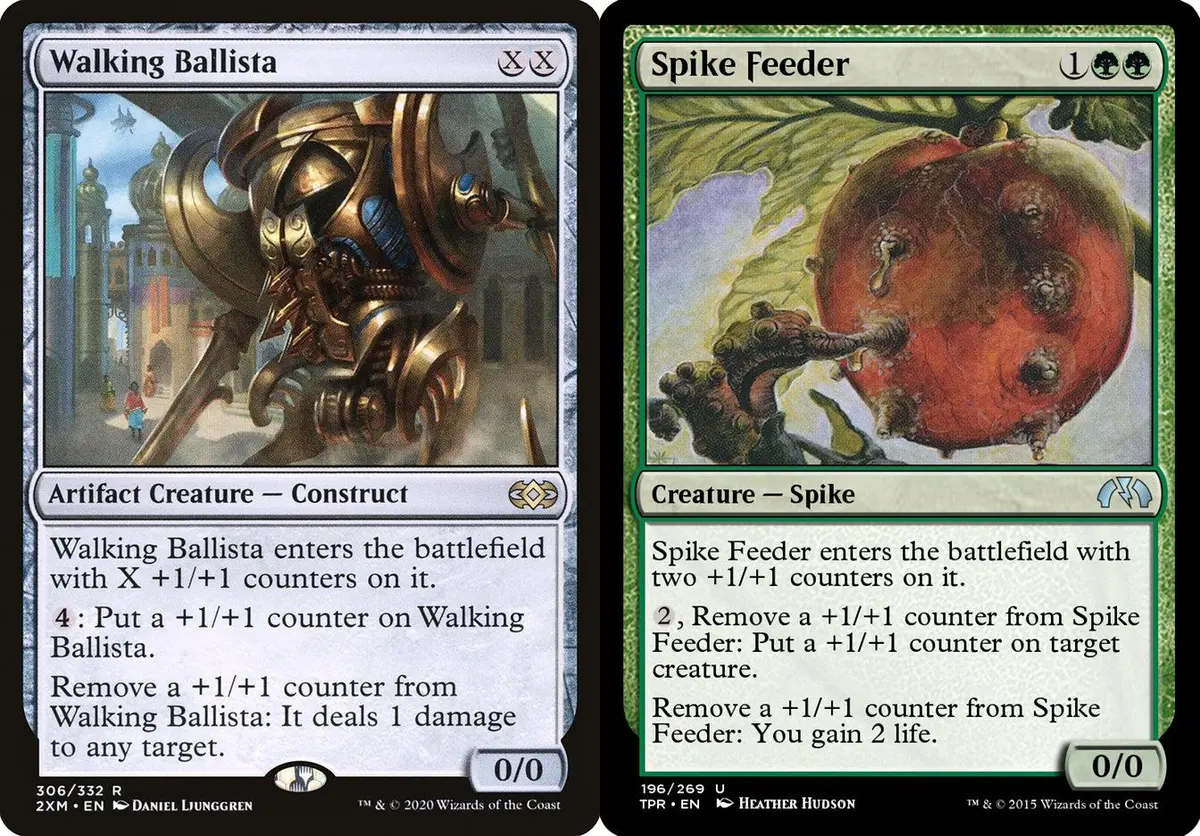
With the Cauldron added this time, I put Walking Ballista in the main deck and Spike Feeder in the sideboard. Once the Cauldron eats either one, together with the Doctor setup you can ping for 1 an unlimited number of times or gain infinite life; the whole process is covered later.
5. And of Course, the Opponent’s Creatures
As another deck that makes heavy use of the Cauldron, the Hardened Scales deck has a few creatures that are relatively useful to the Doctor, such as Hangarback Walker’s counter-adding or Zabaz, the Glimmerwasp’s flying granting. Also, in a mirror match, the opponent’s creatures can help you complete your combo too, so eat them if you can (of course, you can also stop the opponent’s undying creature from coming back by eating it while its trigger is on the stack).
IV. The Most Commonly Used Combos
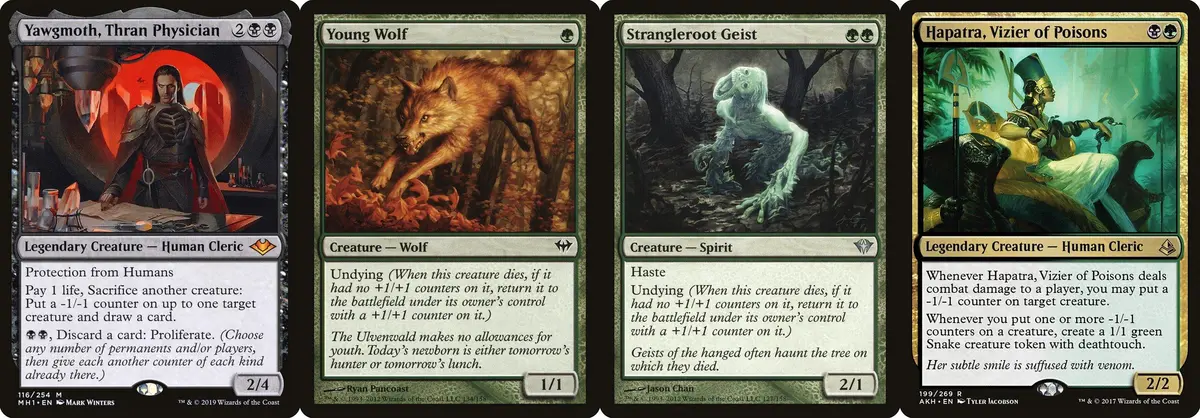
First, I want to mention the main end goal of the Doctor deck. The mainstream build is currently four Doctors + four Young Wolf + 0-2 Strangleroot Geist. These two are chosen because they are currently the cheapest undying creatures in green (to work with Wall of Roots and the mostly-green mana base). The game goal is to have two undying creatures + the Doctor on the battlefield, and if you succeed, you can pull off the combo through the following sequence:
- Pay 1 life, sacrifice undying creature A, put a -1/-1 counter on up to one target creature (a reminder that the Doctor’s ability doesn’t require a target and can be left with no target), draw a card
- Pay 1 life, sacrifice undying creature B, put a -1/-1 counter on undying creature A, which has a +1/+1 counter, draw a card; undying creature B returns with a +1/+1 counter, and the +1/+1 and -1/-1 counters on undying creature A cancel out
- Pay 1 life, sacrifice undying creature A, put a -1/-1 counter on undying creature B, which has a +1/+1 counter, draw a card; undying creature A returns with a +1/+1 counter, and the +1/+1 and -1/-1 counters on undying creature B cancel out
Steps 2 and 3 above form a loop that loses 1 life and draws a card each time. In Modern that’s already an outrageous way to draw cards. Add drain creatures like Zulaport Cutthroat or Blood Artist, and each iteration lets you draw a card without losing life yourself while the opponent loses a life, for a lethal finish.
Let me also mention the use of Hapatra, Vizier of Poisons in this deck. She herself can count as one of the two undying creatures mentioned earlier. Moreover, if the opponent has creatures, you don’t need the undying creature to come back: she alone can run the loop of losing 1 life, drawing a card, and placing a counter. Here’s a walkthrough:
- Pay 1 life, sacrifice an undying creature, put a -1/-1 counter on a target creature, draw a card; the undying creature returns with a +1/+1 counter, and because the Doctor’s ability put a -1/-1 counter, Hapatra’s ability triggers and creates a 1/1 Snake. Then pay 1 life, sacrifice the Snake, target the undying creature with the +1/+1 counter, draw a card; the undying creature’s counters cancel out, and the -1/-1 counter triggers Hapatra’s ability to create a 1/1 Snake. Pay 1 life, sacrifice the undying creature, target any creature (you can target the opponent’s creature or a Snake to continue the loop), draw a card; the undying creature returns with a +1/+1 counter, Hapatra creates a Snake, and the loop repeats this way.
- When the opponent has creatures, you can pay 1 life, sacrifice any creature, target the opponent’s creature with a -1/-1 counter, draw a card; because a -1/-1 counter was placed, Hapatra’s ability triggers and creates a 1/1 Snake. Then pay 1 life, sacrifice the Snake, target the opponent’s creature, draw a card, and the -1/-1 counter triggers Hapatra’s ability to create a 1/1 Snake. Keep paying 1 life, sacrificing the Snake, targeting the opponent’s creature, drawing a card, and creating a Snake, looping until the opponent has no creatures left (but note that your own life total is still going down!).
V. New Combos Enabled by Adding the Cauldron
To make things easier to explain, anything inside quotation marks 「」 is a creature that has been eaten by the Cauldron, for example 「Grist」 + undying creature (Young Wolf or Strangleroot Geist)
1. 「Doctor」 + Two Undying Creatures
The pre-Cauldron combo was two undying creatures + the Doctor for the lose-1-draw-1 loop, and with a drain creature it’s an immediate endgame. Now, if the Cauldron eats the Doctor, the undying creatures themselves are the Doctor, so the original loop can be achieved just the same.
2. 「Grist」 + Two Undying Creatures + 「Doctor」/Doctor
When Grist is eaten, your creatures with counters are planeswalkers that can [+1], milling a card and calling an Insect. With two undying creatures plus the Doctor on the battlefield or in the Cauldron, every time you bring back an undying creature with a counter you can activate a [+1], and thus can achieve multiple Insects, but when doing it be careful not to push your life total too low.
3. 「Wall of Roots」 + One Undying Creature
Let’s look at Wall of Roots’ ability (put a -0/-1 counter to add one green mana). The undying creatures used in the current Doctor build are Young Wolf and Strangleroot Geist, which both happen to have base toughness 1. So you can first put a -0/-1, then remove the +1/+1 (how to remove it is covered later) to kill it, bring it back, and loop infinitely. The key point is that this works even ignoring summoning sickness, and the two combos mentioned below can both use Wall of Roots as the endgame play.
4. 「Ballista」 + One Undying Creature + 「Doctor or Wall of Roots」/Doctor/Cutthroat/Artist
Removing a +1/+1 counter from Ballista pings any target for 1, then sacrificing the undying creature brings it back. With the Doctor on the battlefield or in the Cauldron, you can achieve a loop of lose 1, draw 1, ping 1; with Wall of Roots in the Cauldron you can ping infinitely. Alternatively, if there’s no Doctor or Wall of Roots in the Cauldron and no Doctor on the battlefield but you have a drain creature, you instead remove a counter and ping yourself to achieve infinite deaths followed by returns, draining the opponent out.
5. 「Spike Feeder」 + One Undying Creature + 「Doctor or Wall of Roots」/Doctor/Cutthroat/Artist
Removing a +1/+1 counter from Spike Feeder gains 2 life, then sacrificing the undying creature brings it back. With the Doctor on the battlefield or in the Cauldron, you can achieve a loop of draw 1, gain 1; with a drain creature on the battlefield, the infinite deaths let you drain the opponent out. With Wall of Roots in the Cauldron you can directly achieve infinite life, and some decks will just concede when facing infinite life.
Note: In combos 4 and 5 with Ballista and Spike Feeder, remember the order is to first put Wall of Roots’ or 「Wall of Roots」’ -0/-1 and then remove the +1/+1. The Cauldron’s condition is that only creatures with +1/+1 counters have the activated abilities of the creatures it ate, so if you remove the +1/+1 counter first, you won’t be able to activate Wall of Roots’ -0/-1 add-one-green ability. Pay special attention to this.
VI. Conclusion
In fact, during the preview period, friends around me thought the Cauldron was ridiculous in the Doctor deck, but my initial evaluation of the card was poor. I kept wondering how I’d get things into the graveyard for it to eat, which felt like a hassle. In actual use I regretted it immediately, going from one copy at the start to now owning a full playset and running three in the deck. A friend of mine said that, setting aside how much power the Cauldron brings to the Doctor deck, it brings the Doctor deck a lot of fun, and I feel the same way. The Cauldron is truly a very fun card, and I’m also looking forward to what new combos will appear in the future. If anyone has better Cauldron synergies, you’re welcome to share them with me.
- Title
- A Doctor's Guide to Switching Careers and Becoming a Chef
- Author
- T1BloodMoon
- Created at
- September 28, 2023
- License
- This work is licensed under CC BY-NC-SA 4.0 .