One-Mana Wrath: Draw Extra and Miracles Come to You

Note: This article was translated from Chinese by AI and may contain errors. Read the original Chinese version.
Where Does Magic Get a One-Mana Wrath?
Let me report that there really is one, and its name is Terminus.

Magic is so much fun (I’m not so sure what the opponents think).
Hello everyone, I am a player on my second attempt at Modern, faintmama. I often write boring articles on my own fan page lately, and readers are welcome to stop by Faintmama’s TCG Lab after reading this one.
I have not played competitively for long. This is my second season in Modern, and I would not claim to fully understand the current environment, but I have one stubborn principle: no matter what, I want to enter with a homebrew deck. After all kinds of challenges and restarts, I finally cleared the RCQ threshold this time, which is why this article exists.
Without further ado, here is the decklist. The deck concept is Jeskai Energy Miracles Control, and the next section will break down the details.
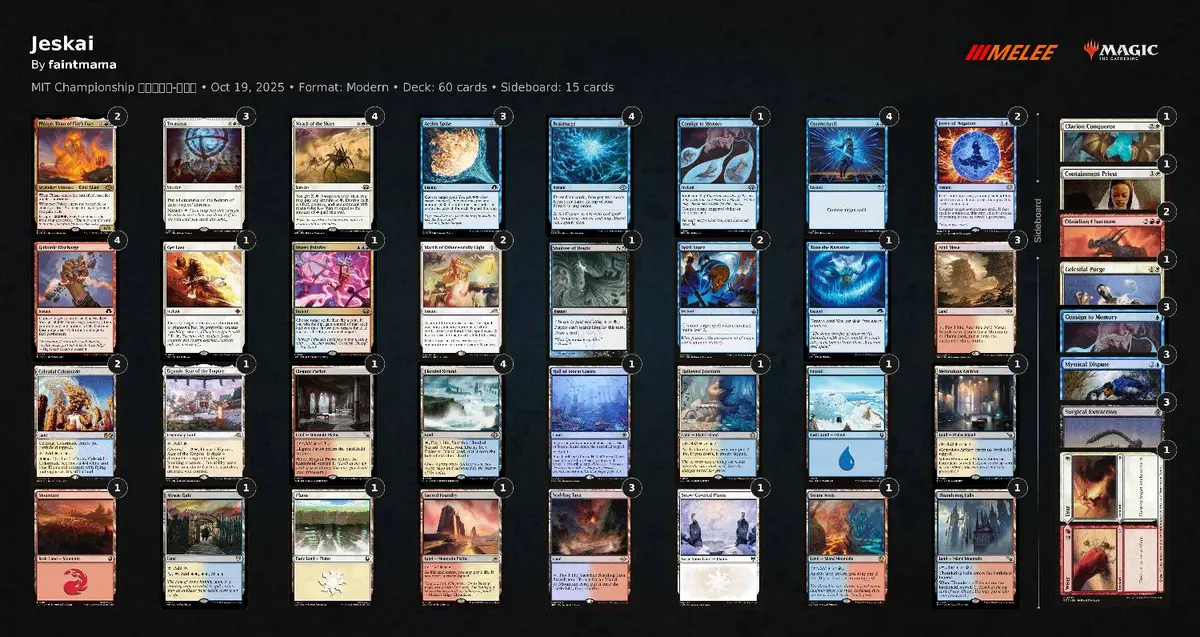
I must tell everyone, though, that this was my first Regional Championship with open decklists. My performance at the main event was not especially outstanding, but I won two rounds in a single day at the Last Chance Qualifier (LCQ), which did not require open decklists. You could say this is a version suited to Qualifiers that was not tuned for open decklists.
I was extremely busy during the Round 10 MITQ period and could only attend one Qualifier. That was on June 1, and the tournament report is here. Let me take the chance to share the prototype of this deck with readers: it originally mixed in Urza’s Saga and Karn, the Great Creator, which proves I really poured a lot of affection into this deck and also had a lot of crooked ideas XD. But before summer properly began, I had already cut Urza’s Saga and Karn, the Great Creator. The reason: dreams are grand, but reality is harsh. A control deck needs a sturdier mana base and ways to survive.
Anyway, by then I had already settled on a control route built around Terminus, fine-tuning the tricks in the build as the environment shifted. As I understand it, a Modern control deck has the following key concepts:
- Counterspells and removal that precisely answer most threats in the environment. Range and efficiency are the two things that need the most attention.
- Win-condition cards that can resolve when the opportunity arises. Their cost should be as low as possible and the threat as large as possible, and it is even better if they can be reused after a sweeper.
- For the specific matchup, an opening hand that interacts strongly in the first three turns, while playing around the opponent’s win conditions and not burning your counters and removal too early. This relies on the pilot’s correct understanding and corresponding courage.
- Control decks actually hide an aggressive side, and in some ways are very similar to aggro: both go all out to squeeze through the gaps to victory. The difference is that aggro plans to take 20 life, while control first strives to survive and waits for an opening that overturns the board.
- If we can withstand aggro (yes, I am talking about Izzet Prowess) and can also break up combos (any pairing where one plus one is far greater than two counts as a combo in my view), then we are on the right track.
So How Exactly Do We Win?
I have droned on about dry fundamentals long enough, so let’s talk about the powerful individual cards in the build instead! Let me share which win plans I ended up using after cutting Urza’s Saga and Karn, the Great Creator.
Two Celestial Colonnade: Once the board is under control, assess the situation and start attacking. If the opponent still has resources, I usually hold back 2-4 mana before activating the ability that turns it into a creature. The reason for using manlands is that they dodge my own Terminus and Wrath of the Skies.
One Hall of Storm Giants: Once the board is under control, assess the situation and start attacking. If the opponent still has resources, I likewise wait until I can hold mana back before activating the ability that turns it into a creature. Compared with Celestial Colonnade, Hall of Storm Giants is a blue-producing land that can plausibly enter untapped early, and once activated it is a 7/7 creature with ward 3, but its drawback is how clunky the activation is. In Modern, Celestial Colonnade is still the more viable manland for attacking.
Two Phlage, Titan of Fire’s Fury: Its enter-the-battlefield ability can be seen as a single Lightning Helix, which clears the board and relieves life pressure, making it a key card against current aggro decks (yes, I am talking about Izzet Prowess). Thanks to escape, it does not hurt you as much as your opponent when facing a sweeper, and if it can stand and hit a couple of times, you have more or less won. My friends ZHAN and Jeff both strongly recommended I run two on the same day, which was absolutely the biggest key to me reaching the main event.
One Invert Polarity: A three-mana true counterspell. If you win the coin flip, you gain control of that spell; otherwise it is simply countered. When you control the board, even using it on the opponent’s one-mana spell is aggressive and far more than a simple trade down. Once, against Boros Energy, I stole a Ragavan, Nimble Pilferer on an empty board (looks like my hands are the nimble ones), and the opponent was forced to spend a Thraben Charm to deal with the permanent they had cast themselves, or else they would be killed by their own little monkey.

I have loved this card since the Limited format of Modern Horizons 3. Its flavor text is hilarious: “Scrawly! I told you not to mess around… oh, that went through. Good job, Scrawly.” It really resembles the scrappy process of building a homebrew deck.
Those are the win plans I chose to commit to. Before the event, I practiced most often against my friend ZHAN’s Izzet Prowess. Without being baptized by fights against the mainstream aggro decks, it is hard to build a viable homebrew control deck. During practice, to fix the problem of getting my head bashed in over and over, I chose in the final stage to add red and boldly commit to the white, blue and red energy cards from Modern Horizons 3, to raise the range and consistency of Galvanic Discharge and Wrath of the Skies.
I believe that in this Jeskai Energy Miracles Control, the main deck has room for only these six proactive cards. Since I feel the current Modern is a format overrun with combos (as I said earlier, there are too many pairings where one plus one is far greater than two), sometimes taking an opposing creature’s enter-the-battlefield trigger is about all it takes for me to concede, so the deck urgently needs a sufficiently dense and versatile set of counterspells.
What If I Don’t Open the Hand With This and That?
Modern has extremely high tempo tension, and you need a hand that can lead you to victory before you start playing: interactive counters and removal for the first three turns, a proactive win-plan card (you stabilize but win too slowly, and sometimes lose to the opponent’s topdecks), at least two lands, and also… wait, who is lucky enough to assemble every component every single game?
So in a control deck, card-selection and card-draw spells that you can resolve when the opportunity arises are very important. Besides the proactive cards mentioned above, I also included four Brainsurge to widen the resource gap. Putting two cards from your hand on top of the library in any order also interacts wonderfully with our deck theme: three Terminus. If you draw extra, miracles come to you and while Orcish Bowmasters is fading out, we had better draw a ton .

My friend ZHAN calls it “big Brainstorm”, so I say it that way too XD.
Brainsurge can put a Terminus you drew, or a Terminus you were already holding, back on top of the library, and then a one-mana sweeper will be waiting for you to use. Incidentally, if the first card you draw during the opponent’s turn is Terminus, you can cast it in that situation too, so it is even a one-mana sweeper you can cast at instant speed XD.
And compared with a Terminus placed first on top of the library, a Terminus placed second from the top is sometimes even more powerful and sneaky . Since your opponent sees the signal that you drew your topdeck and did not cast Terminus for one mana, they will very likely slam down more creatures and attack aggressively on their own turn. When that happens, remember to hold back your smile, because you and I both know the opponent’s board collapses next turn. Of course, the premise of laying a mine like this is that your life total is still healthy enough.
As for why only three Terminus instead of four? Because the current environment is overrun with combos, and it is no longer the situation of two months ago when Boros Energy dominated. I still want to play a Miracles deck, but there are always parts of the build where I have to compromise.
For sweepers, I chose to add four Wrath of the Skies to the main deck.
The reason is that some matchups need to be very aggressive to win. For example, if the opponent plays a deck that develops the board quickly like Affinity, a punctual Wrath of the Skies backed by spare energy counters might make the opponent choose to concede. Since it can crush the opponent’s morale as early as turn two, I think it is worth trying.
Side note: with the escort of many white, blue and red energy cards, this build sometimes accumulates anywhere from 3 to 8 energy counters. So in the mid to late stage of a match, Wrath of the Skies can also be seen as a two-mana one-for-all removal with an extremely high range ceiling.
The Jeskai Energy System… What Kind of Monster Is That?
The Jeskai Energy System is the Jeskai Energy System XD. It all goes back to the Modern Horizons 3 set itself. When I decided to touch red, I always felt the cards on the table could not stably accumulate enough energy counters. In that case, why not look through every CU card in Modern Horizons 3 again, though I might not find anything…
And what do you know, there really was a new discovery! A soft counterspell called Aether Spike came into view.

Ding! You never thought this weird spike existed, did you.
Compared with Counterspell, the advantage of Aether Spike is that it requires a bit less color commitment. In range it can likewise respond to any spell, but you must pay the corresponding energy counters, and it counters only if the opponent cannot pay the matching mana. The condition is somewhat strict, but in the high-tempo, mana-tight Modern format, the two energy counters you gain handle most early situations smoothly. Later on, energy counters accumulated by other cards can raise its range, or Aether Spike can even be a component that fills in what Wrath of the Skies needs… At this point, Jeskai Energy Miracles Control also begins to show pairings where one plus one is slightly more than two. Of course, this requires the pilot to know every detail in the deck and keep a clear head during the match to find the little path to victory.
Besides four Wrath of the Skies and three Aether Spike, the spells in this deck related to energy counters include four Galvanic Discharge and one Tune the Narrative. Clever pairings can come up among these four cards, causing the opponent to misjudge unexpectedly as they develop.
Of course, running many soft counterspells carries risk too: if you fail to accumulate spare energy counters in the late game, Aether Spike becomes a dead card. Even so, I ultimately chose to run three Aether Spike, using it up early in the match whenever possible, and I remain optimistic about its interaction with the other spells. I once considered swapping some for No More Lies, but since the sideboard had three Surgical Extraction aimed at the environment, I left it as it was and was not shaken by pre-event build anxiety.
The remaining cards should not need excessive elaboration, except for one Shadow of Doubt. Shadow of Doubt is a card that stops the opponent from fetching lands (they still have to pay the 1 life, heh heh). Not only does it have the effect of land destruction to get ahead on tempo, but in some matchups it can also stop the opponent from searching their library for combo pieces. Most importantly, after punishing the opponent you can draw a card. As the old line goes, if you draw extra, miracles come to you…

Sorry to ZHAN for this one; this card nearly gave him a fear of fetching lands
but I am very happy to practice with you, wink.
However, in the open-decklist main event, the benefit of Shadow of Doubt dropped sharply. Noticing this also gave me some new experience.
As for Terminus, sometimes you draw it by accident XD. So Jeskai Energy Miracles Control is a deck you need not give up on until the very last moment, and it is very suitable for impatient players to temper their minds just kidding, please don’t try it lightly; you will probably just make both sides impatient XD .
Sideboard Strategy
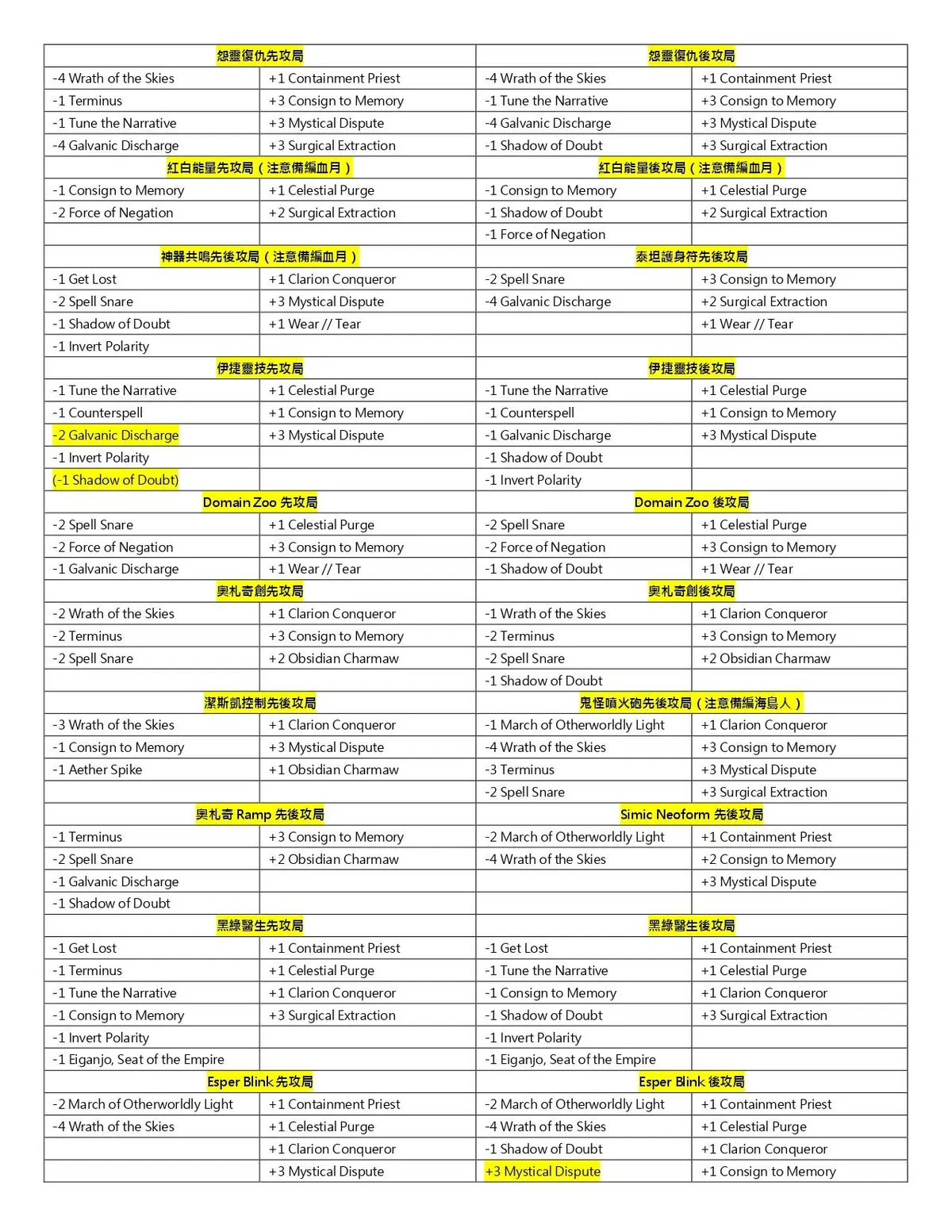
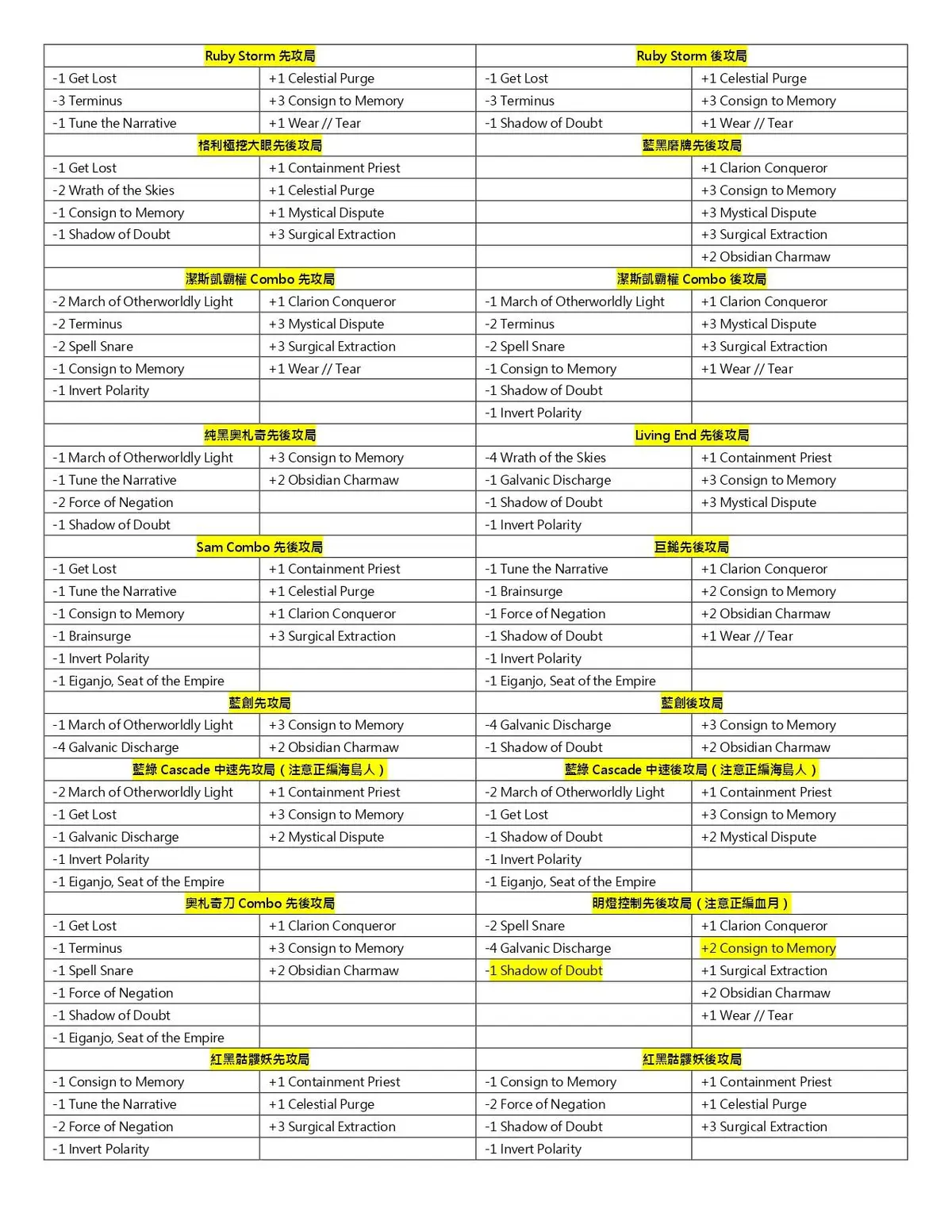
The sideboard leaves less room for creativity. In the age of big data, the efficient answers to the mainstream are basically all transparent and public, and what players decide is mostly the number of copies.
For this Jeskai Energy Miracles Control, only three points need a brief explanation:
- Three Mystical Dispute are for dealing with Quantum Riddler. This guy does a two-mana job yet slips past the guard of Spell Snare, so I think it needs close watching. Incidentally, I believe Quantum Riddler is the core reason for the big change in the Modern environment over the past two months. It made the two-drops of blue-based combo decks much sturdier, and the position of Boros Energy fell as a result.
- Three Surgical Extraction are because I like to heavily punish decks that use the graveyard. Besides that, Surgical Extraction is also this deck’s win card against certain combo builds. For example, against Goblin Charbelcher, you happily slap it on them, and you may even have mana left to protect the spell, gaining a slight upper hand in a critical, mana-tight exchange.
- The three creatures Containment Priest, Clarion Conqueror and Obsidian Charmaw easily stand and win games on their own in games two and three. Since the opponent will not see many of our creatures in game one, they will very likely board out some number of removal and burn spells, which gives our key creatures a slight psychological advantage.
I will leave the rest to the sideboard plan table to speak for itself. I could not practice at a card shop, but I set aside time to sort out my thoughts properly in the week before the event. In the real matches, though, not a single game followed the sideboard plan exactly…
Why I Chose Jeskai Energy Miracles Control
Simple: because “miracle” is my favorite ability.
When I first tried Modern last September, the first deck I played was Mono-Red Burn, and I mixed in one Thunderous Wrath. In one round at the old CardMaster, I actually flipped it, burned out the opponent’s life total, and unexpectedly set off a burst of laughter. The victim was 小唐 of 幻想遊戲世界 (he came back and beat me down in the next two games that day XD; the miracle did not happen again and again).
小唐 and I are not exactly in the same community, but when we met occasionally afterward, he asked me with a smile more than once: “Still playing Miracles?” We even ran into each other and had breakfast together before the Round 10 championship XD.
It was this special bond that made me want to keep playing a Miracles deck in Modern. In the end I built this homebrew Jeskai Energy Miracles Control and also cleared the Last Chance Qualifier (LCQ) threshold, fulfilling a milestone wish from a year since I fell into this big pit and earning my first experience in an open-decklist event.
I was probably the least diligent player in the whole venue; in the final week before the event I did not even touch Magic. I feel lucky to have this ending. That said, although my practice time this season was very limited, the love I have poured into the deck over the past year is second to none, and that is probably the biggest reason I got this far.
For the half month before the event, I kept thinking my deck could not properly target the current environment, because I firmly refused to give up the pairing of Terminus and Brainsurge. To me this is the origin of why I like Modern, and once I give it up, there seems to be no reason to keep forcing myself to play.
What happened afterward was extremely lucky. No one expected the Modern metagame to shift so dramatically. To stop Izzet Prowess, Domain Zoo finally returned to the top spot after a long time, and Jeskai Energy Miracles Control unexpectedly became a barely reasonable competitive choice. For the detailed report of the two main-event days, please head over to Faintmama’s TCG Lab, and I will not elaborate here.
Proud of my decklist, though it fares better when decklists are not open. With this I want to tell all players: every one of you who has worked hard looks cool, and those who have never put in effort have no right to criticize.
I really enjoyed this whole journey. It all began with miracles and ended with miracles. Thank you to the readers who made it this far, and I wish you a wonderful grand adventure in the world of Magic too.
- Title
- One-Mana Wrath: Draw Extra and Miracles Come to You
- Author
- faintmama
- Created at
- October 29, 2025
- License
- This work is licensed under CC BY-NC-SA 4.0 .