
A Few Personal Thoughts on Introducing New Players to MTG
Note: This article was translated from Chinese by AI and may contain errors. Read the original Chinese version.
Before We Start
For a game to keep running over the long term, new blood is indispensable. However, after 30 years of accumulation, MTG’s content is so vast that a newcomer can’t possibly figure it out by casually searching online. There must be a guide to lead this precious new blood into what MTG is, and the direction the guide takes largely determines what kind of play experience this newcomer will have, and whether they can take root and flourish in the MTG community or die before they are born.
Based on my experience guiding new players in recent years, I’d like to share some personal thoughts.
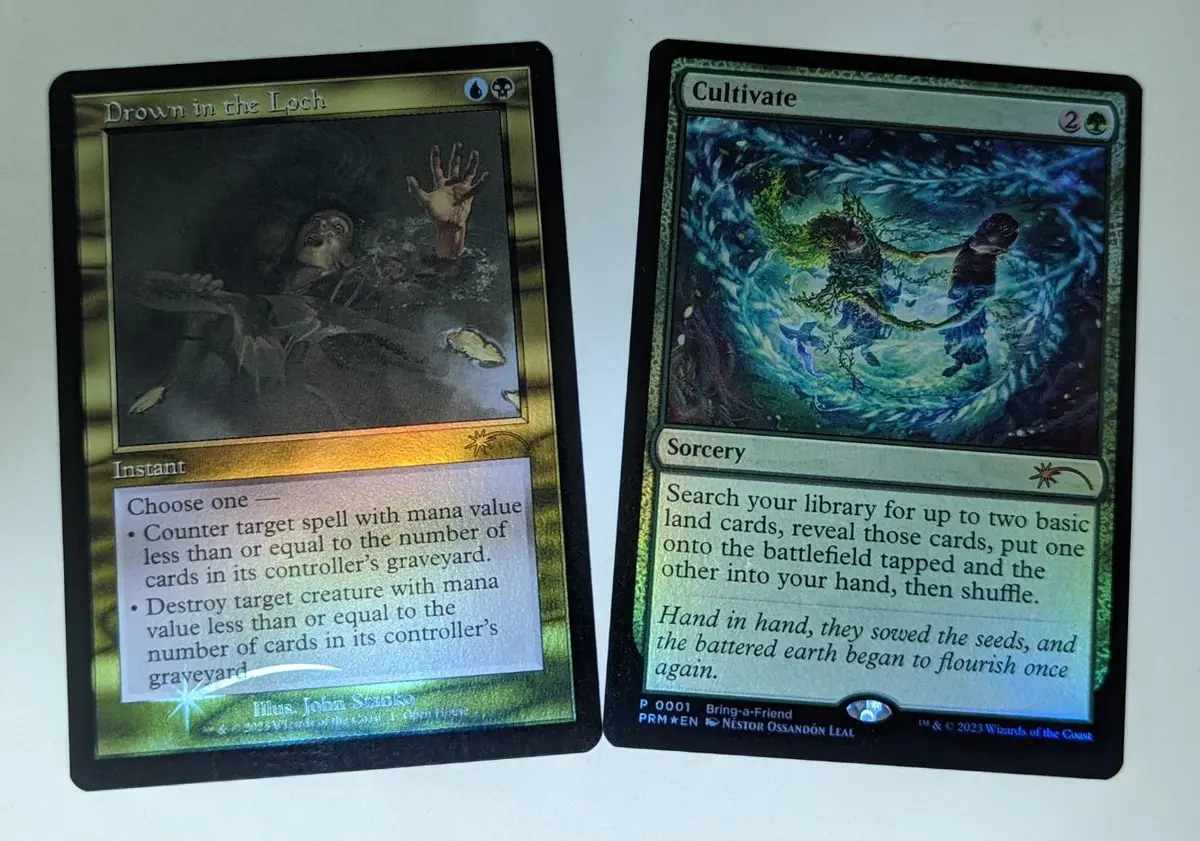
Which Format Should You Choose?
Limited
First, in my view, draft is without question not suitable to recommend to newcomers. The skill barrier of draft is even higher than entering constructed formats; you need a certain level of understanding of the card pool, the rules, and game simulation to have the bare minimum ticket of entry. If you let an almost brand-new player join a draft, during the pick step this newcomer will most likely be in a state of “Who am I? Where am I? Which card is useful?”, and the garbled signals caused by the newcomer’s aimless picks may also make other veterans’ play experience worse.
As for sealed, it is indeed fine in a relaxed environment with little competitive pressure, such as a prerelease, but the cost of a single sealed entry is simply too high. Unless supporting measures like a league extend the deck’s lifespan, it’s hard to expect a newcomer to accumulate enough experience through sealed. Also, whether a sealed event can successfully run anywhere other than prereleases is usually a problem as well, so my answer still leads to constructed formats.
Constructed
The first condition for playing a game is having people to play with. In reality, if the newcomer’s environment only has players of one format, then naturally there is no choice… But if we relax the conditions, so that players can be found in every format, or when building a player circle from scratch, my answer is still the “Standard” format. Readers who see this passage surely disagree a thousand different ways, but since you’ve already clicked into this article, let’s see how I analyze the pros and cons and how I deal with the drawbacks.
The Pros and Cons of Choosing Standard
First, let’s see what the advantages of choosing Standard are:
Advantages
- A relatively small card pool
The Standard card pool is relatively small, which helps newcomers understand the game environment sooner. - A slower game pace
Compared with other formats, Standard’s pace is slower on average, leaving more room to put creative ideas into practice, from building to playing, while there are also more decision points that newcomers can easily understand, giving a more suitable pace of steps for building up play skills. - The most solid training of fundamentals
Standard is ultimately the format with the simplest and clearest play logic. If you can’t even understand a Standard match, you’ll usually play even worse in other formats. - Relatively cheaper deck cost (learning cost)
If you’ve started looking up the price of Sheoldred, the Apocalypse, please hold on. I know this point may sound at odds with reality at first, and this interesting topic will be fully unpacked in a later section. - MTGA support
Currently, the only paper format that MTGA can fully reproduce is exactly Standard. Although MTGA has many things people complain about, for the rules-learning stage MTGA really is a good supporting tool.
However, what often makes a veteran refuse to recommend Standard to newcomers is not the lack of advantages but the difficulty of accepting the disadvantages, and how to overcome these disadvantages is also the core idea this article hopes to convey. I’ll explain my solutions together in a later section; first, let’s see what arguments there currently are about the disadvantages~
Disadvantages
- High-frequency environment turnover
It’s actually hard to say whether this is a pro or a con. Some people find a more dynamic environment fun, while others find it too draining to keep up with. But for newcomers, I think the environment changes are nothing to worry much about, because for a newcomer the pace at which their understanding of the game changes is definitely much greater than the environment changes. - Cards rotate out
Well… it means what it says, no explanation needed, right?
Rotation will inevitably happen, though Wizards has now decided to extend the Standard season to three years, so the impact is smaller than with Standard in the past. - Many super-expensive individual cards on meta decklists
This seems to contradict the advantage above, but in fact it doesn’t conflict and has a solution. - Relatively frequent ban list changes
This is probably the biggest resistance to promoting the Standard format, though it is not without countermeasures either.
What Should You Offer a Newcomer?
Recommending Standard to newcomers is not about locking them into Standard and treating other formats as a plague from then on, but about using Standard as a tool to explore the world of MTG.
Veterans each have their own views on MTG, but these views aren’t necessarily suitable to copy directly onto others. Much of the play knowledge veterans take for granted is uncharted territory for newcomers. Newcomers need a period of trying many things and exploring the game modes they love, and just handing them a top-tier meta decklist to copy can’t accomplish this.
Of course, the goal of playing is still to win, and nobody likes losing; veterans who provide meta decklists mostly have this in mind. But in the vast majority of cases these decklists, in cost or in play, are very unfriendly to newcomers. An expensive cost means an overly heavy learning cost and loses the chance to try many things; too high a difficulty in play merely sets up a hurdle the newcomer can’t clear; and if the cards they spent a lot of money on get banned soon after, they may well quit the game for good.
My Answer Is:
If you ask a newcomer to build a Standard deck out of thin air, they will either fail to build one or build something terrible. They always need an example decklist, but meta decklists are often unsuitable for newcomers in both cost and play difficulty. So when a newcomer asks me how to build a deck, I always customize a decklist that fits the newcomer’s expectations. This is the questionnaire I like to use:
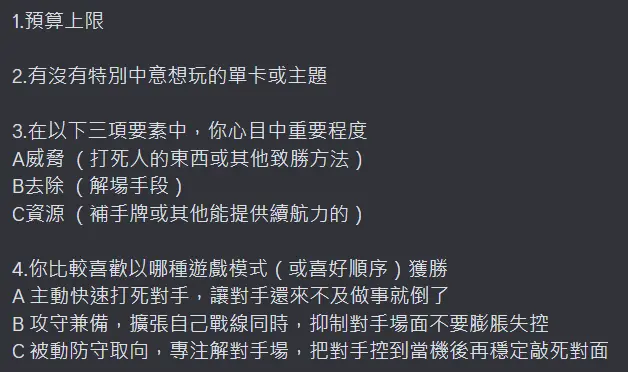
Newcomers mostly don’t even know what they want to play. They may have only a vague impression of the color pie, and don’t know what themes or cards in the environment are fun, and this questionnaire helps clarify at the start what kind of play mode this newcomer is hoping for. Of course, this questionnaire is not the whole basis of my deck recommendations; it is just an entry point to help me understand this newcomer. Afterward I keep refining the recommended options based on the earlier answers, until I find the play mode this newcomer likes.
Something to note at this point: when building a deck for a newcomer, there are several points that aren’t overly emphasized in ordinary deck building:
Control the cost
This is the most important part of risk control. Cost equals learning cost. If the cost is too high, and the deck built doesn’t suit the newcomer, or runs into the ban list, the newcomer may lose heart about MTG after this single shock. Conversely, if the cost can be pushed as low as possible, even if the deck really doesn’t meet the newcomer’s expectations in the end, it may only be the cost of a steak dinner and a movie, which is relatively easier to let go of. But controlling cost doesn’t mean ignoring power; a deck without some strength usually isn’t fun to play. Luckily, today’s Standard has no shortage of cheap, powerful cards, and many mainstream archetypes actually have budget builds, and this is where a veteran’s deck-building skill is tested. From my hands-on experience, building a playable deck within $30 USD is usually not a problem.Pay attention to deck complexity
This is another point often overlooked when building for newcomers. Newcomers have almost no play experience, and a deck with overly difficult decision points is beyond their control; no matter how good the value, it’s useless if the newcomer can’t pilot it. So when building decks for newcomers I pick builds that are more intuitive to play, and sometimes sacrifice some power appropriately to account for complexity.Prefer decks with plenty of room to expand and a play spectrum that isn’t extreme
When choosing a deck category, I try to avoid decks with overly closed themes. I hope the deck still has plenty of room to evolve, for reasons explained below, and the materials of a closed theme usually also mean fewer options, which indirectly makes it hard to keep the cost down.
As for choosing a play spectrum that isn’t extreme, roughly it means I try to choose midrange-based decks. Not choosing control or tempo should be easy to understand, since making a newcomer pilot those is basically setting them up. So why don’t I list aggro, which is simple to play and high in payoff, as a priority? Mainly because I want newcomers to have more chances to try many things. In what I’ve seen and heard, newcomers who lock into aggro as soon as they start do get off to a smooth start, but after a while they tend to become rigid in deck building or play mindset, and the situation of struggling to transition to other types of decks later is more pronounced, so I’d like newcomers to experience a variety of things for a while first and find the style that truly suits them.Let the newcomer know the upgrade path
From the points above you can vaguely see one piece of information: this deck is quite likely some kind of unfinished deck, and that understanding is correct. Perhaps to save money, perhaps to avoid too much complexity, the initial decklist I give newcomers usually isn’t in its final form. This has several purposes:
1 Controlling the budget ensures flexibility in choices, so if the newcomer is unhappy with this deck they can cut their losses in time.
2 Collecting materials in stages lowers the one-time building barrier, which has an especially pronounced effect on newcomers.
3 Giving a few suggestions for improvement lets newcomers perfect the deck according to their own preferences, and this process itself can cultivate affection for the deck and even for the game. Choosing decks with plenty of room to expand is also for this purpose.
Let’s go back to the Standard disadvantages mentioned earlier. How does this deck-building philosophy address them? In summary it is just two words: cheap & flexible!
The deck’s building cost is low, so whether they dislike it, it rotates out, or it gets banned, the loss is relatively affordable, and at the same time the deck’s choices of materials are highly flexible, so it’s unlikely that the whole deck is paralyzed because one card leaves Standard.
In addition, this process of building with special restrictions for newcomers is also a kind of training for my own deck-building ability, and from time to time I find fresh building inspiration in it.
Conclusion
Finally, let me add one supporting measure I personally use. This trick is basically pure self-sacrifice, so readers can just take it as a story.
After going back and forth with a newcomer and building a decklist, I’ll take most of the cheap, useful pieces (such as Go for the Throat) out of my own bulk stock and give them to the newcomer out of my own pocket. Counting by cost and by number of cards, these add up to about half. With half of it already done, the newcomer is also more motivated to find shops to collect the remaining pieces.
Looking only at money spent over the whole process, I’m undoubtedly at a loss (though with an oversupply of bulk it may not be a real impact), but I hope the local environment where I live can have a healthier space for playing and interacting, and I’m willing to pay for that. Shops usually won’t treat you badly when they see you willing to give like this, and in fact it creates a win-win situation.
For a game to run over the long term, the arrival of new blood is an indispensable part. My method is only a story for reference; different communities have different methods, and my method also has geographical limitations, but I hope that readers who have read this article will have a bit more patience when facing newcomers in the future, and gradually guide them into this wonderful and profound world of MTG.

- Title
- A Few Personal Thoughts on Introducing New Players to MTG
- Author
- Jru
- Created at
- October 5, 2023
- License
- This work is licensed under CC BY-NC-SA 4.0 .
Related Articles

I Drafted Alone: Solo Drafting with Reality Fracture (FRA)
October 16, 2026
Article Translation — Reid Duke's "Level One": Choosing Your Deck
August 17, 2026

Article Translation: Reid Duke's "Level One": Sequencing
July 24, 2026
Article Translation: Reid Duke's "Level One": Playing in a Grand Prix: Part I
June 13, 2026