cephille's Outlaws of Thunder Junction Limited Analysis (Written Before PT OTJ)

Note: This article was translated from Chinese by AI and may contain errors. Read the original Chinese version.
Q&A With Myself Before PT OTJ
Why does white have so many removal spells?
From the article The Last Mile Before Outlaws of Thunder Junction Limited - Kill Spells and Answers compiled by Egavas, you can see that among OTJ + OTP, white has at least 5 exile-effect answers: Path to Exile, Journey to Nowhere, Mystical Tether, Lassoed by the Law, and Leyline Binding. Even excluding the costly Path to Exile, there are 4.
If you add all the other kinds of answers, white is undoubtedly the color with the most and most complete removal, with as many as 10 in mono-white alone. Considering the multicolor cards,
- Splashing green adds 1 more exile answer, Buried in the Garden;
- Splashing blue adds even more, 3 exile answers: Assimilation Aegis, Detention Sphere, and Fractured Identity;
- Splashing black gives 2, Vanishing Verse and Anguished Unmaking, whose restrictions and costs are both heavy, so they are not so good compared with other colors, or even mono-white;
- Splashing red, Ride Down is even narrower in use and less attractive than the answers above.
Such a lopsided ratio made me wonder: why on earth design so many answers for white? Isn’t that too unfair? But after reviewing the OTJ Limited articles we have published on the Guildmages’ Forum, I seem to have sensed something.
White has no obvious bombs.
However, without flashy bombs, is white a weak color? No! Quite the opposite! I think white is the strongest color of this set, because of the most comprehensive answers above, paired with white’s quality curve of creatures. If you take a middling white deck, or a white-X two-color deck, with quality removal, it will be more stable than many decks of other color pairs that have bombs. When the opponent can’t draw a bomb or doesn’t have one at all, you can drive them to despair just by running over them with creatures + answers/tricks. And even if the opponent plays an overwhelming bomb like Rakdos, the Muscle or even Oko, Thief of Crowns, as long as you can suppress them with an exile answer in time, you won’t fall too far behind, which is almost impossible for color pairs that don’t touch white. So my little Q&A conclusion is:
Although white has no obvious bombs, it has very high-quality answers plus good curve creatures. A middling white-based deck can handle more situations than color pairs without white, and is also more resilient.
Why is toughness 7 a huge threshold?
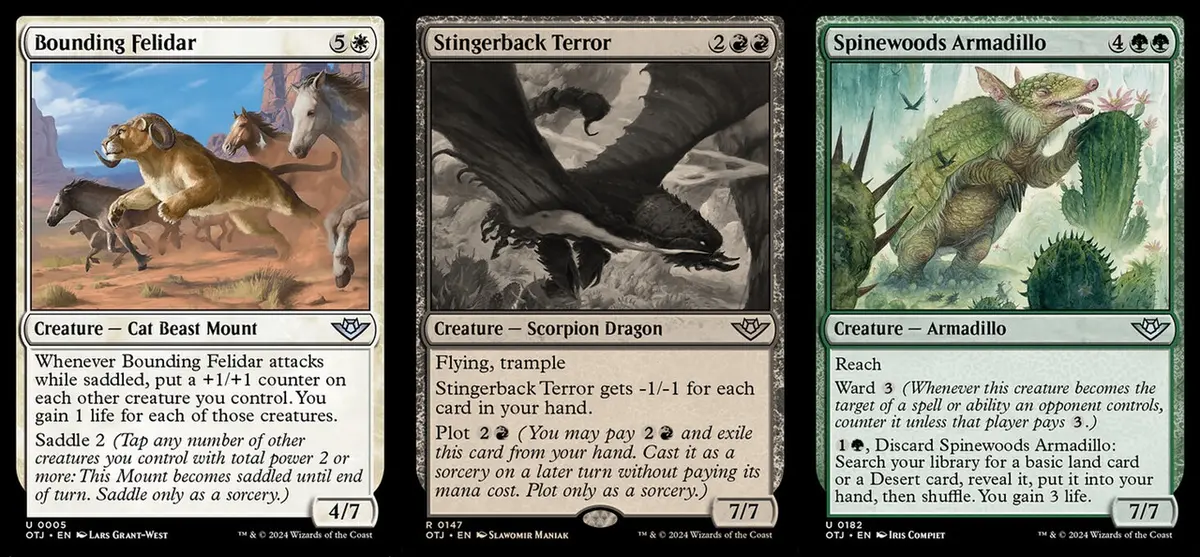
If you use advanced search on Scryfall, select OTJ and BIG creatures, and add the condition toughness greater than or equal to 7, you will find these three creatures. However, red’s Stingerback Terror usually can’t reach 7 toughness most of the time, so we can mainly focus on the two big-butt creatures in white and green: Bounding Felidar and Spinewoods Armadillo.
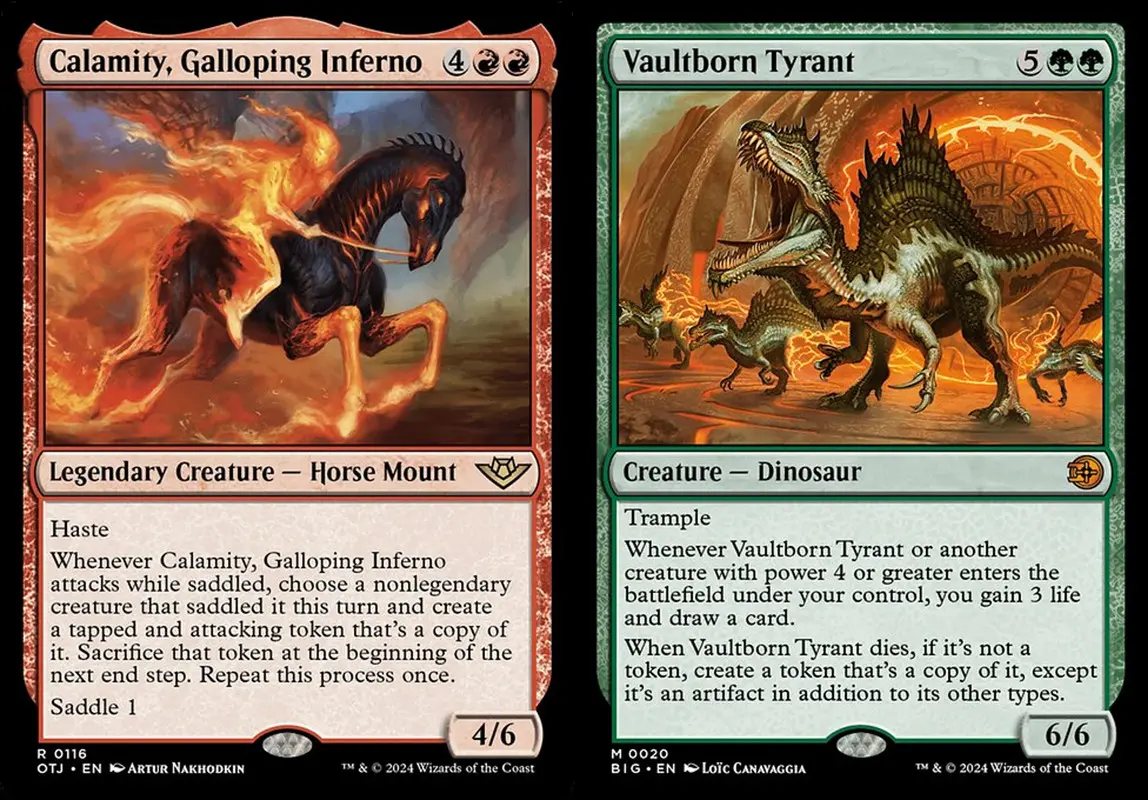
If you narrow the range to toughness exactly 6, these two appear: Calamity, Galloping Inferno and BIG’s Vaultborn Tyrant.
And when we narrow the range down to toughness exactly 5, the 16 creature cards that appear are basically mostly bomb-level, or excellent blockers that can hold off the next tier of bombs. Then, sharp-eyed readers will notice here that
- There are no mono-black creatures with toughness 5 or more, which is super sad;
- Green has the most uncommon-or-lower creatures with toughness 5 or more, 6 in total (including one common, Cactarantula), followed by white and red with 3 each, and blue also has 2 uncommons.
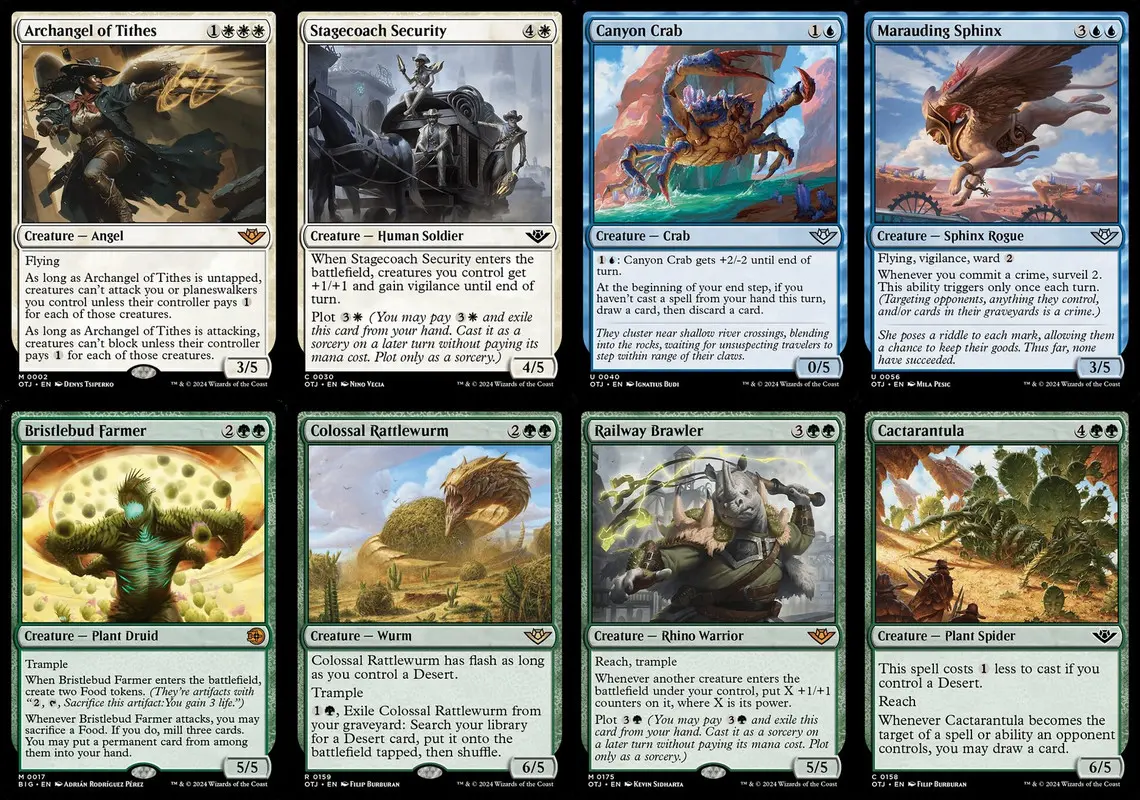
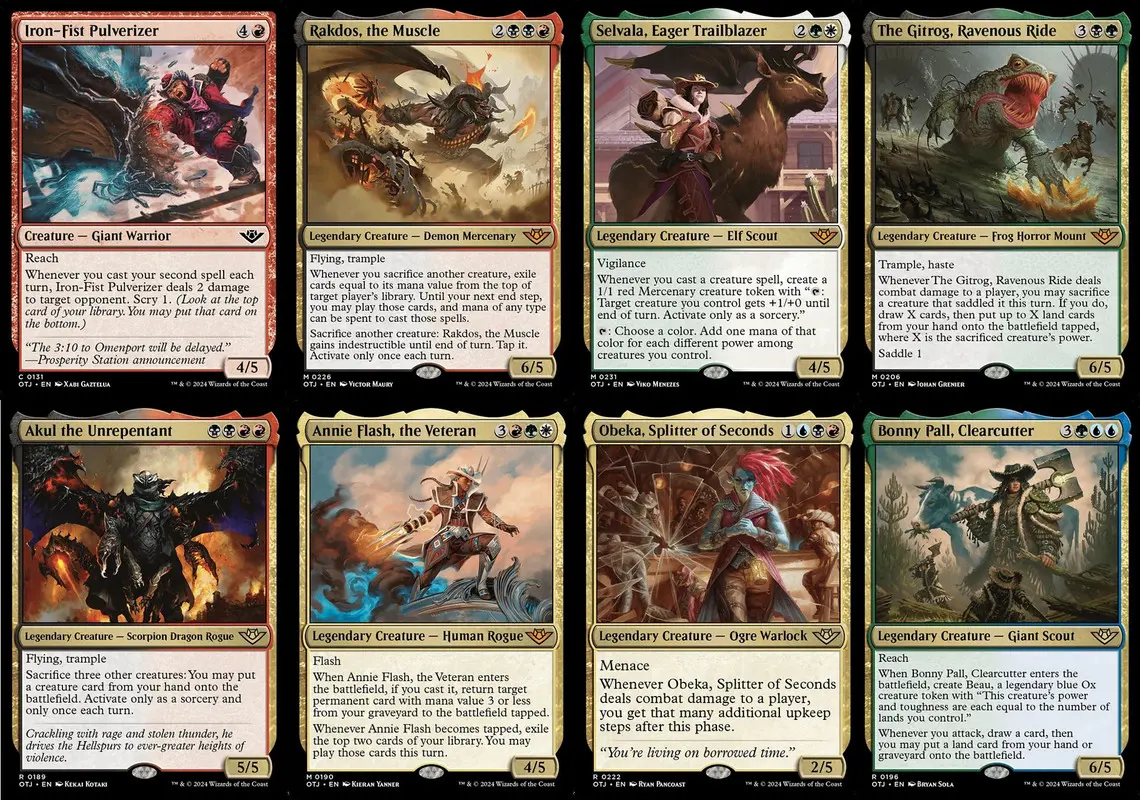
After reviewing the information above, we can see that green-white takes the largest number of high-toughness creatures, including one of the highest-toughness creatures in Limited, at 7, on each side. We can tentatively conclude that green-white is quite good at defense.
However, this is not good news for red, which relies on dealing damage. From the article The Last Mile Before Outlaws of Thunder Junction Limited - Kill Spells and Answers compiled by Egavas, apart from spells that deal X damage (which need quite high costs), red can hardly deal with a 7-toughness green or white creature with a single removal spell, and the bulkiest Trick Shot can only deal 6 damage.
Why did red print a one-mana haste first-strike Zoro?

The conclusion first: I don’t know the answer to this part yet XD
Although Reckless Lackey is an over-the-top one-drop with multiple abilities, its appearance in OTJ Limited puzzles me. What kind of color pair would need an aggro creature like this? And how should it be paired to be strong? First strike and haste mean its survival rate on attack goes up, but even with +2/+2 it’s just a 3/4. Setting aside the toughness-5 creatures mentioned above, against the countless toughness-4 creatures in this set, such as white’s one-drop Armored Armadillo, it can’t get through, and that’s already assuming its performance after being pumped!
So I’m still not optimistic about this card’s performance in Limited, and I also think the vast majority of red-based aggro decks will be stopped by properly built white-based decks. White-based decks have more fliers to hit back in the mid-to-late game, while red can only rely on Iron Fist Pulverizer or rare-and-above dragons to hold up the air defense. If you want to go faster, this set’s tricks, compared with the previous MKM Limited, are actually not strong enough, and I can’t yet see a good build for going wide with a bunch of small fry and using tricks to maximize aggro’s payoff.
A Few Limited Suggestions
Green-White Mounts is a fake Limited archetype, but that doesn’t change the fact that it may be the best Limited color pair
When I saw in the OTJ Limited previews that the WhiteGreen Limited archetype was Mounts, I was truly stunned. After playing Limited, however, my conclusion became:
Yes, Green-White Mounts really is a fake Limited archetype, and Mounts are not limited to Green-White either. But that doesn’t matter. Green-White doesn’t need any theme to build around at all. As long as you build, as I mentioned earlier, a Limited deck with an excellent creature curve and enough answers (yes! just like the basic requirement of every Limited format), your Green-White will be strong enough and hard to beat.
Still, I should mention that, as Sam Black wrote in his initial strategy for OTJ Limited, the green-white legend Miriam, Herd Whisperer really is an overly excellent payoff card. In Green-White you easily open or pick up Mount creatures, and sometimes even Vehicles like Mobile Homestead or Luxurious Locomotive, and the snowball effect of slamming Miriam early is terrifying. If you can’t stop it, the game will end in three or four turns or tip so far out of balance that it’s hard to come back.
Therefore, Green-White, which combines size and answers in one, is also a fairly fierce aggressive color pair, and most of the key cards don’t even need rares!
Red-White is not an aggro color pair
How does the RedWhite color pair, which is usually designated as the aggro pair in Limited, perform in OTJ Limited? From my personal experience in several Limited events, Red-White really is not the announced Mercenary aggro color pair; on the contrary, Red-White can even play very controlling!
Here I’ll explain why in my understanding Red-White is not an aggro color pair. You can actually see hints from the Red-White uncommon Form a Posse, which is a trap card, and more precisely, this card is not meant for the so-called “aggro”. Two specified colors plus X creates X 1/1 red Mercenaries. What! No haste!? Know that when you do this at four or five mana, the 2-3 Mercenaries you create really don’t do much. Against the trampling fatties or fliers the opponent slams on turn four or five, these little Mercenaries have no answer at all, and you’ve tapped out too!

The strong OTJ Red-White color pair as I understand it makes good use of the excellent answers in both red and white, a sufficient creature curve, and then in the midgame white’s fliers and red’s highly destructive dragons (Stingerback Terror and Terror of the Peaks, provided of course that you open them). The game often goes like this: after a few rounds of trades early on, you hold the ground and win by attacking with fliers, and if you happen to have made Mercenaries, using them to pump the fliers can speed up this process; and during all this you hold a few instant-speed kills or exile answers, and the feeling of controlling while attacking is great.
Here I have to mention my favorite card again, the Divine Cow, aka Holy Cow~. This card is really strong! A three-mana flash that gains 2 life basically lets the opponent’s early attack go for nothing for a turn, and scry 1 makes your next draw better. Not to mention Red-White has many ways to use it repeatedly:
- On turn four, Nurturing Pixie returns Holy Cow to hand and then flash it in again;
- Holy Cow saddles Calamity, Galloping Inferno and attacks, copying twice;
- Getaway Glamer blinks Holy Cow and kills another of the opponent’s fatties;
- Retrieve it with Shepherd of the Clouds or put it directly onto the battlefield (out of jokes…)
- If you play green, you can also use Holy Cow to repeatedly saddle Rambling Possum and return it to hand to cast it again!
Two or three Holy Cows, a quality creature curve, and answers, and you’ll fall in love with this somewhat controlling Red-White color pair!
Black may be the weakest color
I’m not trying to hate on black, but this really is my honest feeling after these several games. When I face a normal Green-White deck, my black creatures are too weak and can only chump block or give away their heads when attacking, and my board quickly collapses, while the opponent may have used only one answer or trick to get a two-for-one or even more, which I simply cannot accept.
And for the RedBlack Outlaws theme, compared with Red-White, Red-Black’s ability to create Mercenaries is even stronger when using At Knifepoint and Brimstone Roundup together. However, until their Mercenaries/Outlaws can reach three power, they can hardly take a real part in combat, which makes cards like Outlaws’ Fury and even Great Train Heist more important in Red-Black. And a Red-Black deck that wants to win through no-room-to-breathe kills relies heavily on cards like Rakish Crew and Vial Smasher, Gleeful Grenadier. And when you can’t get enough Red-Black payoff cards, please note that their creature quality really is poor. BlackGreen has green’s quality bodies + graveyard usage to make up for it; BlueBlack can defend (blue has quite a few toughness-4 creatures and enough fliers) while committing crimes and playing for the very late game; but Red-Black’s bodies are really unfavorable for attack-and-defense battles.
Incidentally, the BlackGreen color pair also has a powerful combo: on turn two you can discard Spinewoods Armadillo to find a land and gain 3 life, then pair it with a graveyard recursion spell like Badlands Revival or Back for More to bring the Armadillo back to the battlefield, which is super sturdy! With Reanimate you can even, on turn three, pay 4 life, find a land to hand, and put a 7/7 with reach and ward 3 onto the battlefield (Note 1)
Note 1:This is also the only build where I would be more inclined to put in Reanimate, since the life-loss side effect is otherwise still too big; and if you want to dig up the opponent’s bomb, you would first have to be hit once by the opponent’s enters ability, and then happen to have a hard removal spell that can deal with it in hand along with Reanimate, with your life total still enough to pay, which is too unrealistic.
Don’t build around three-specified-color legendary permanents
Setting aside power level, when you build around a legendary card requiring three specified colors, it means you depend more on mana fixing, and the risk of color screw rises with it. In a draft I recommend against going this way even more. As Sam Black wrote in his initial strategy for OTJ Limited, fixing means you will need Deserts, and the payoff of Deserts themselves always makes other players start taking Deserts at relatively high pick numbers, which also means it gets even harder for you to take a multicolor-bomb color group! Overall, these three-specified-color legendary permanents perform relatively mediocrely in Limited, so when there are many other two-color or even mono-color single cards that can replace them, don’t play them.
A few other color pairs I didn’t test
I haven’t actually tried the five color pairs of Blue-White, Blue-Green, Blue-Red, Red-Green, and Black-White, so the predictions above may not be very accurate. My personal guesses are as follows:
BlueWhite may be the better color pair against Green-White: fliers, counterspells, and bounce are all very troublesome factors for green, and Blue-White can also use white’s quality removal. However, rather than control, Blue-White is more of a midrange deck that does things on the opponent’s turn. The uncommon legend Jem Lightfoote, Sky Explorer lets you pass with mana up and keep earning cards, which would be a very good payoff for the color pair.
BlueGreen has weaker answers, and needs strong enough green creatures + blue fliers to constitute a reason to enter Blue-Green. Of course, opening a Bonny Pall, Clearcutter or Oko, Thief of Crowns yourself is the biggest reason to play Blue-Green! Blue-Green having so many shameless big bombs printed is probably also meant to make up for this color pair’s weak non-bomb cards.
RedBlue’s answers have shorter range, but with blue’s soft answers it is easy to get two-for-ones, and then one or two small fliers, or Resilient Roadrunner aka Beep Beep, finish the game! It may need stable crime sources like Spring Splasher or Deadeye Duelist, paired with blue’s Nimble Brigand, Duelist of the Mind, and so on to draw while fighting and tip the scales of victory to your side! OTP’s Repulse would be a high-pick good card for this color pair!
RedGreen has very good creature quality across the board, and with the four-power payoff theme plus something like saddling Drover Grizzly to give the whole team trample after attacking, it would play out very fast! Maybe Red-Green is the color pair with the highest single-turn burst damage in this set! Usually you get a Red-Green themed bomb or key card in the first few picks, then take 1-2 ramp spells, 4 to 5 big five- and six-mana creatures, and everything else is best four-power-or-more creatures, protection, and removal. On turn two Bristlepack Sentry holds off a hit, and on turn three equipping a piece of Equipment or playing a four-power creature lets you happily clock the opponent!
BlackWhite’s sacrifice theme is a bit delicate in this set. Among the payoff cards, whether Ruthless Lawbringer’s sacrifice removal or Unscrupulous Contractor’s sacrifice to pay 2 life and draw 2, neither is too pleasant to use. You still have to go back to using Black-White’s most advantageous answers to make up for the problem of weak Black-White creatures.
Summary
For me personally, OTJ Limited is the highest-power, most bomb-heavy Limited format I have played, partly “thanks to” the regular booster configuration and partly the huge impact of the many over-spec single cards in BIG on the Limited environment. This article is some questions I thought about after two weekends of sealed and draft, and some Limited takeaways, shared here with everyone. Written before PT OTJ, it is also meant as a small prediction, so just treat it as entertainment, and if I’m wrong anywhere, feel free to comment and discuss with me. Thank you.
- Title
- cephille's Outlaws of Thunder Junction Limited Analysis (Written Before PT OTJ)
- Author
- cephille
- Created at
- April 23, 2024
- License
- This work is licensed under CC BY-NC-SA 4.0 .
Related Articles
Outlaws of Thunder Junction (OTJ) Limited Primer — Breaking News (OTP)
April 12, 2024
Outlaws of Thunder Junction (OTJ) Limited Introduction: The Big Score (BIG) & Special Guests (SPG)
April 12, 2024
Outlaws of Thunder Junction (OTJ) Limited Guide — Black
April 12, 2024
Outlaws of Thunder Junction (OTJ) Limited Introduction: Green
April 12, 2024