
A Quick Guide to the Pioneer Format

Note: This article was translated from Chinese by AI and may contain errors. Read the original Chinese version.
This article was originally published on the Bahamut Magic: The Gathering forum and is republished on Guildmages’ Forum with the original author’s permission. Although it is a repost, the deck types have been updated to match the latest MTGGoldfish Pioneer metagame, so anyone who has read it before is very welcome to read it again.
Foreword
Hello, fellow planeswalkers. Thanks to the many qualifier events at home and abroad in recent years, the paper Magic community has become lively again. Pioneer, the format Wizards has been pushing hard and which has now been revived for over a year, has been the main event of three seasons of the MIT qualifiers in Taiwan. Whether you are a new player interested in getting into Magic or a veteran who has played other formats and wants a change of flavor, I believe Pioneer is a great choice for both, for the following reasons:
1. Moderate cost
The average price of a Pioneer deck is roughly $200 to $400, which is much friendlier than Modern, where decks often run over a thousand dollars, and is quite close to the cost of Standard today.
2. Stable metagame
Pioneer is an eternal format, so it isn’t affected by rotation like Standard. It also isn’t shaken up by sets like Modern Horizons (MH1) and Modern Horizons 2 (MH2), which are strong enough to affect the whole format and reshuffle the metagame as they did in Modern. The only things that currently affect Pioneer are newly released Standard sets.
3. A card pool of moderate depth
Following on from the previous point, since Pioneer is an eternal format, players may worry that the card pool is so deep that it will be hard to get familiar with the cards. The Pioneer card pool starts with Return to Ravnica (RTR) from 2012, and because the metagame is stable, the number of cards you really need to know is not as large as in Modern, so I think this is not much of a concern.
For these reasons, I highly recommend that anyone who wants to get into Magic start directly with Pioneer. As a Pioneer ambassador, I’m going to write a quick guide to the current Pioneer metagame so that both new and old players can get a first understanding of the common decks before jumping in.
Mono-Green Devotion
Cost: Medium (around $400)
Difficulty: Medium-high
Practice needed: Medium
The first deck to introduce is the pillar of Pioneer: Mono-Green Devotion.
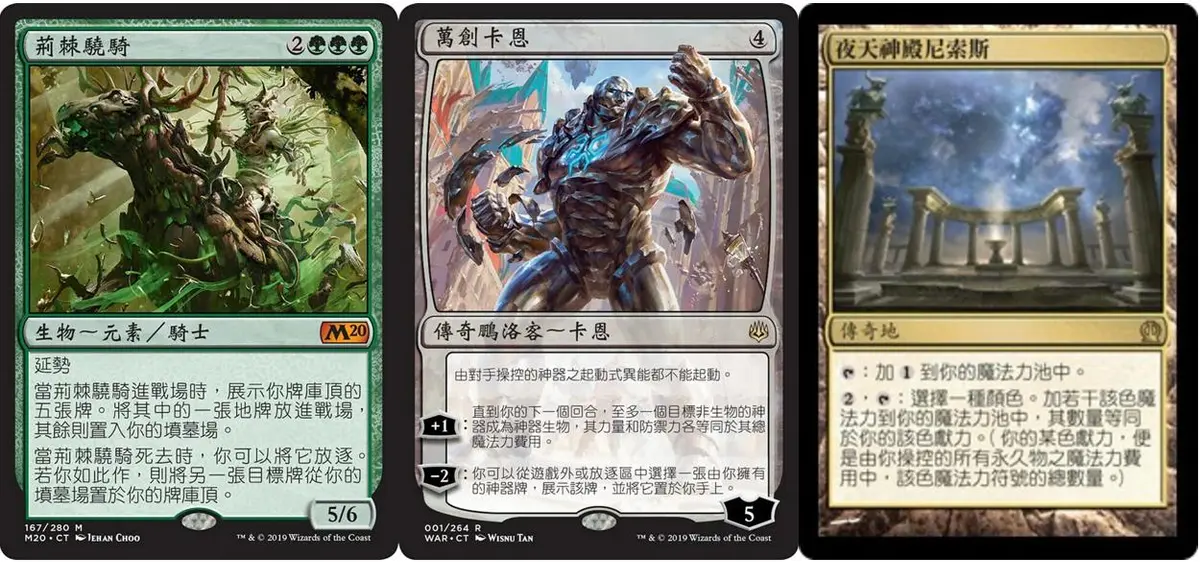
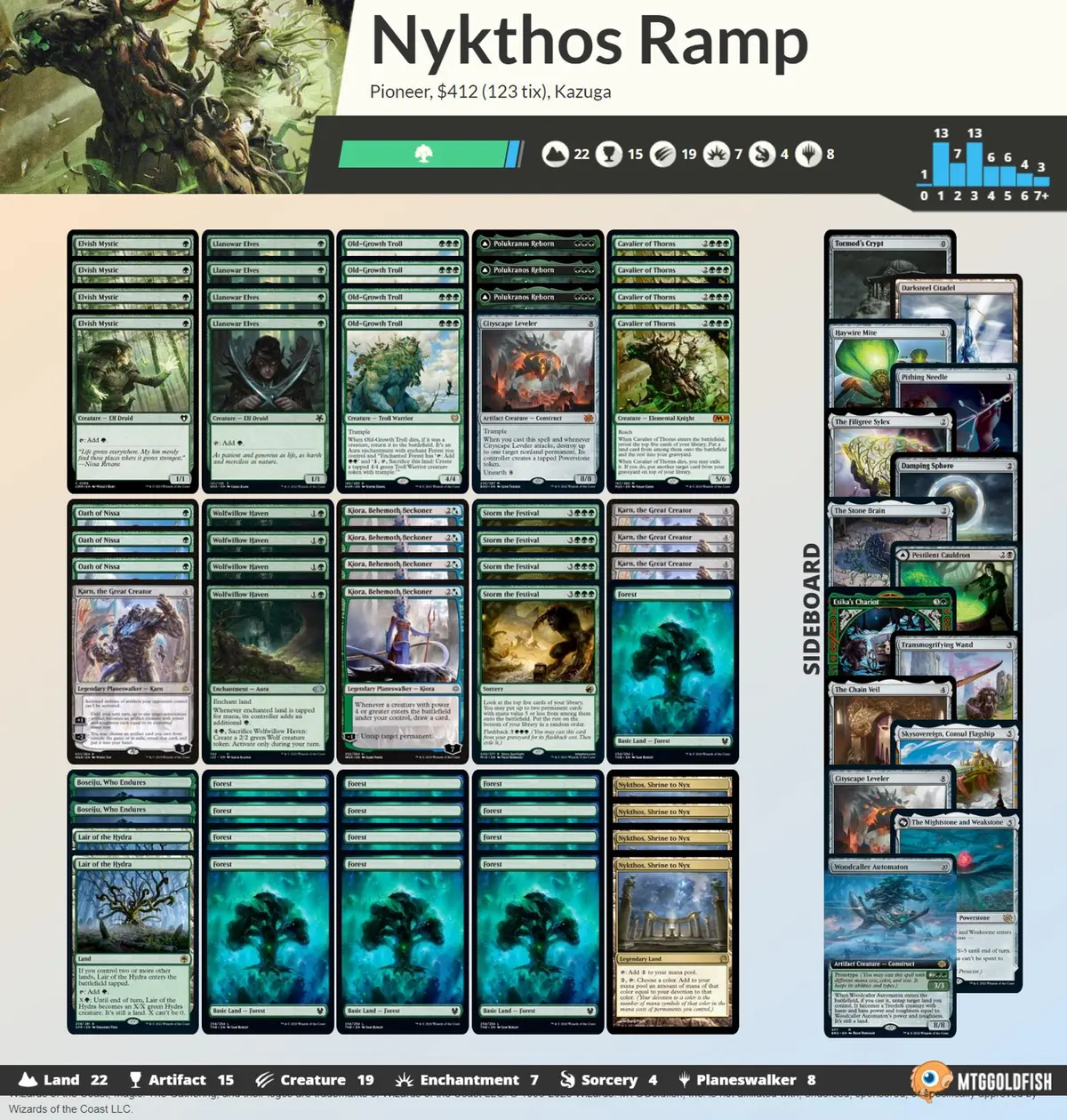
Mono-Green Devotion relies on cheap ramp spells (Llanowar Elves, Elvish Mystic, Wolfwillow Haven) to quickly bring out Karn, the Great Creator and Cavalier of Thorns (the green Cavalier), and pairs them with the land Nykthos, Shrine to Nyx to produce enormous amounts of mana and expand its advantage at great speed within a turn or two. Once it starts sprinting, nobody can stop it.
The deck’s strength comes from green’s unique fast ramp, the creatures’ excellent bodies, Nykthos’s burst of mana, and above all Karn’s ability to fetch cards from the sideboard, which lets the deck reliably find the answers it needs in all kinds of matchups. Mono-Green’s win rate is currently quite high (>50%), and it is one of the most popular decks abroad as well.
In addition, with Karn, the Great Creator and Kiora, Behemoth Beckoner, the deck can build a terrifying combo that produces infinite mana and empties the opponent’s library.
Combo step by step
The sideboard now carries The Chain Veil, whose purpose is to bring the devotion needed to start the combo down to 10. The exact play is as follows:
- First, you need Nykthos, 10 green devotion, a Karn on the battlefield that hasn’t activated yet, a total of two Kioras between the graveyard and the battlefield, another Karn in the graveyard, and 10 mana.
- Activate Karn’s [-2] ability to fetch The Chain Veil from the sideboard, cast The Chain Veil and activate it once (2 mana left).
- Activate Kiora’s [-1] ability once to untap Nykthos, then pay two mana to produce 10 more mana (10 mana left).
- Activate Karn’s [-2] again to fetch Pestilent Cauldron, and cast its back face Restorative Burst to retrieve Karn and Kiora (5 mana left).
- Cast the Kiora in hand, sacrificing the original one to the legend rule, then activate Kiora’s [-1] twice, untapping Nykthos twice and producing mana each time in response to your own ability (18 mana left).
- Cast the Karn in hand, activate [-2] twice to fetch the exiled Pestilent Cauldron and The Stone Brain from the sideboard, cast and activate The Stone Brain naming any card of the opponent’s, and cast the back face of Pestilent Cauldron to retrieve Karn and Kiora.
- Repeat steps 5 and 6 and you will find you get more and more mana, while the opponent has no library and no hand. Then pass the turn so the opponent enters their draw step, and they lose by drawing from an empty library.
Mono-Green Devotion sample deck
Rakdos Midrange
Cost: High (around $600)
Difficulty: High
Practice needed: Medium
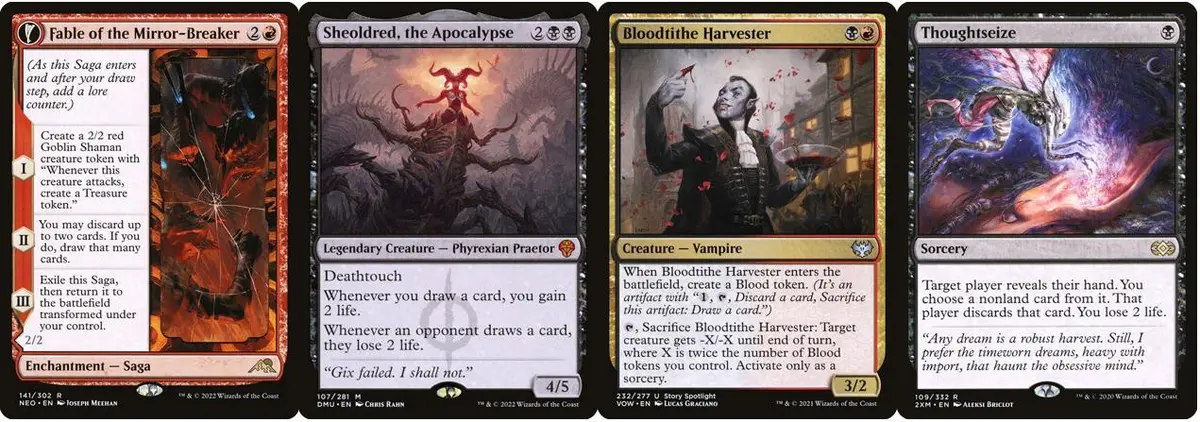
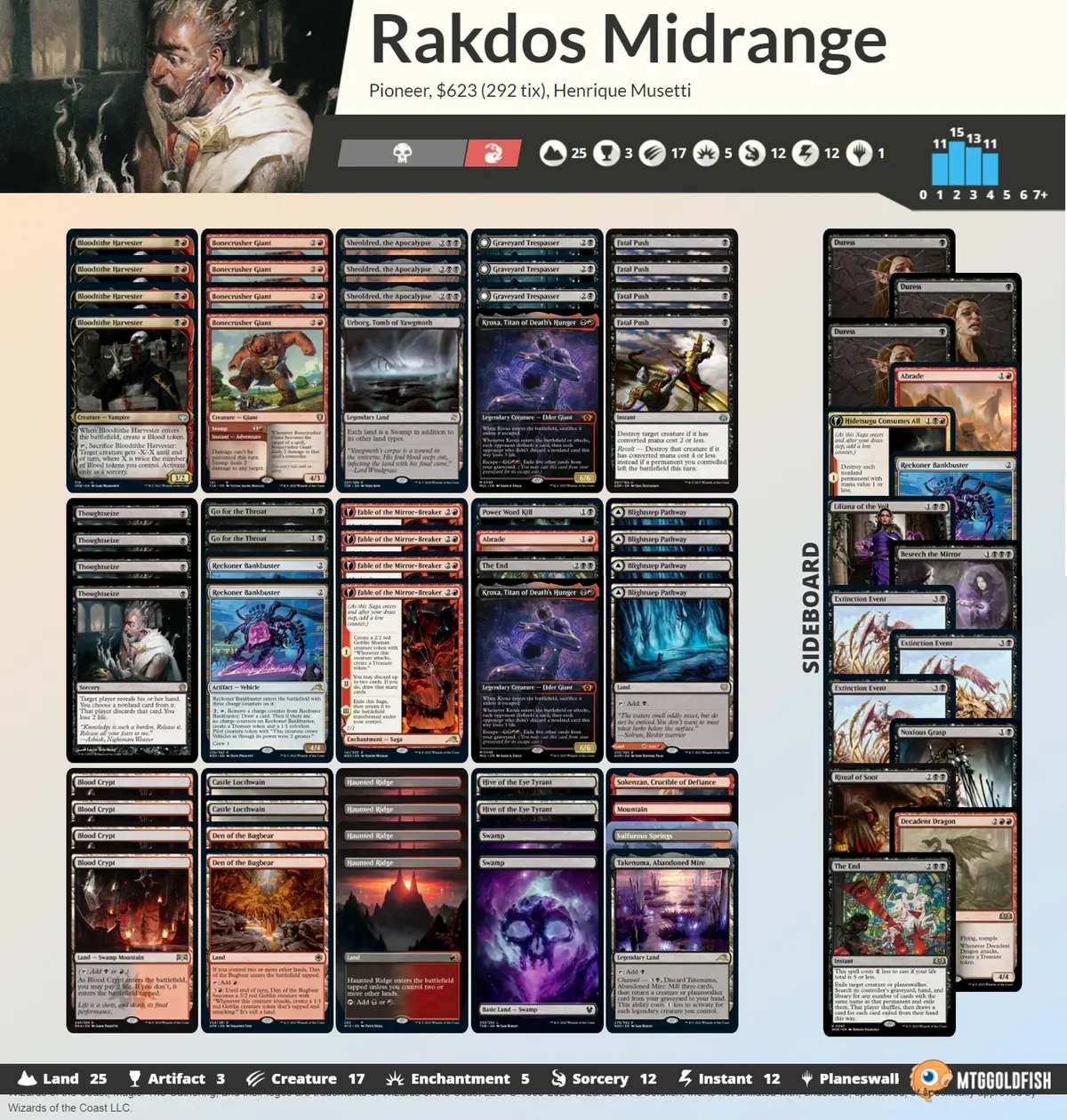
Rakdos Midrange has topped the usage charts for a long time thanks to its powerful individual cards and high consistency, and could be called the goalkeeper of Pioneer. The deck’s curve is quite linear, with many cards that can get a two-for-one. With cheap spot removal, discard disruption, and high-quality creatures with big damage output, it puts considerable pressure on the opponent’s board and life total. The deck looks simple, but it actually has many fine details, including when to use removal and discard and when to attack and develop the board. It is a deck that requires a certain level of understanding of the metagame and a fair amount of practice to pilot.
Although the difficulty is high, I still recommend this deck personally. Its basic operation isn’t hard to understand and its game goal is clear. The hard part is how to handle different matchups, but that can be mastered gradually through study and practice.
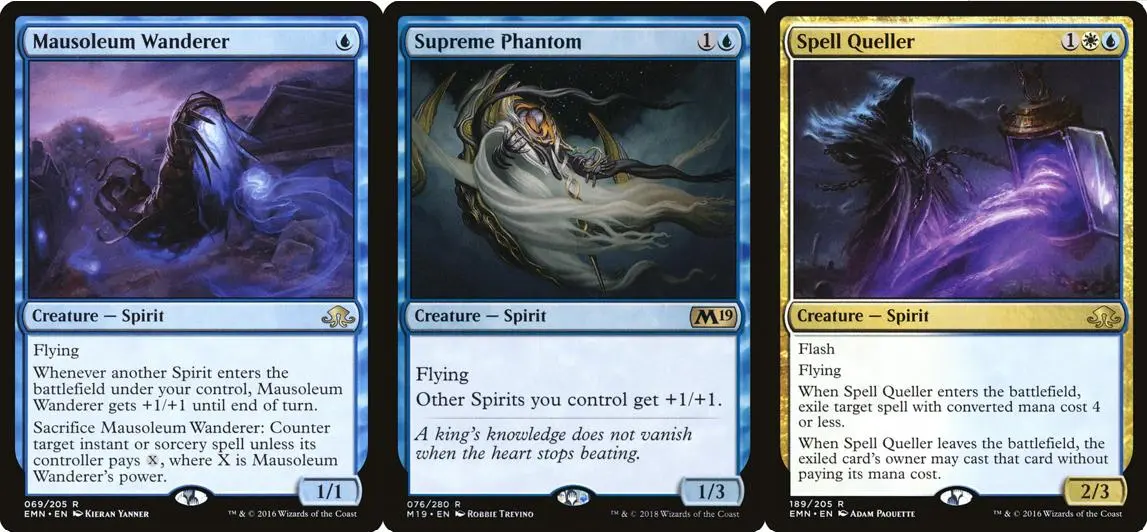
Azorius Spirits
Cost: Low (around $200-250)
Difficulty: High
Practice needed: High
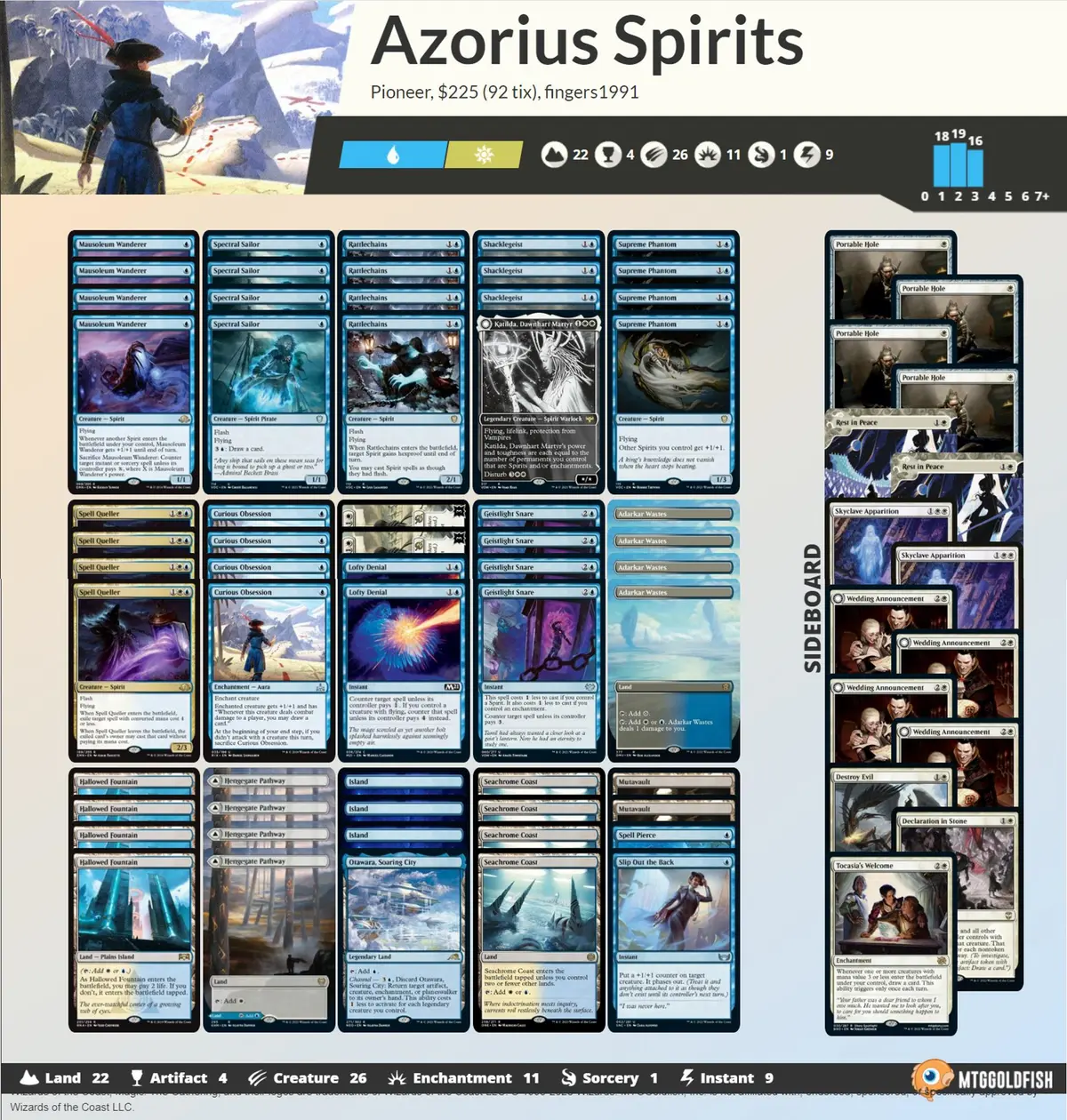
A tempo deck that uses cheap counterspells and Spirit creatures with flying and flash to attack while holding the opponent’s plays in check. The deck is almost entirely flying creatures, with a number of counterspells and Spell Queller to restrain the opponent’s tempo and combos, following the principle of counter it if they do something, drop a creature if they don’t, and constantly wearing down the opponent’s life total with fliers. The Spirit creatures themselves are very fragile, so choosing between countering the opponent’s spells and protecting your creatures is a major test for the player piloting this deck, and one wrong decision can lead to a collapse.
Lotus Field Combo
Cost: Low (around $200)
Difficulty: Extremely high
Practice needed: Extremely high
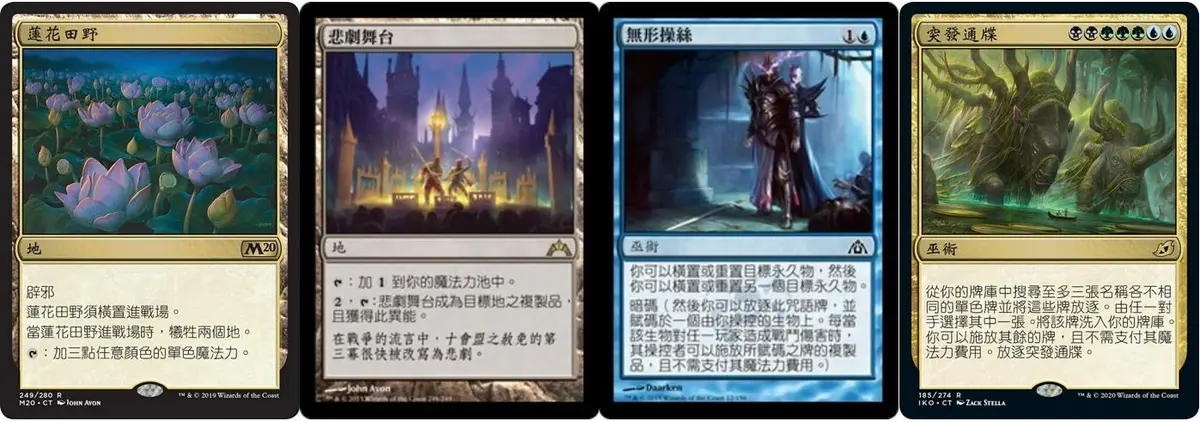
Lotus Field Combo is probably the hardest deck to pilot in Pioneer. Its combo concept is to produce a huge amount of mana in a single turn, keep casting card-filtering spells, find the combo pieces needed, and assemble a winning condition that same turn.
The deck relies mainly on Lotus Field producing lots of mana from a single land, has Thespian’s Stage copy a second Lotus Field, then uses Hidden Strings to untap both Lotus Fields for a burst of mana, casts Emergent Ultimatum to find the pieces it needs, and wins after a further series of combo plays.
Besides the combo pieces, the deck is full of card filtering, land fetching, tutors, and spells that reset lands, all aimed at winning the game as fast as possible before the opponent kills you.
There are two main versions of how Lotus Field wins; here is a simpler explanation:
- Chandra version:
Needs three Bala Ged Recovery and Chandra, Hope’s Beacon to complete the combo.
Simply put, Chandra’s triggered ability makes Bala Ged Recovery get copied one extra time (two in total). You then retrieve the other two Bala Ged Recovery from the graveyard, use Chandra’s own loyalty ability [-5] to hit the opponent for five, and then use the two copies of Bala Ged Recovery to retrieve Bala Ged Recovery and Chandra respectively, repeating this until the opponent is dead. - Approach of the Second Sun version:
Needs Mastermind’s Acquisition and this tutor spell to complete the combo.
First use Mastermind’s Acquisition to find Approach of the Second Sun from the sideboard and cast Approach of the Second Sun, then find Approach of the Second Sun from the library by some means (another tutor, two copies of Reckless Impulse, and so on) and cast it again to win the game.
Also worth noting: if you have seven mana on the battlefield, you don’t have to cast Approach of the Second Sun twice in the same turn. Gaining seven life first should be plenty… right?
The combos above are easier to pull off with Omniscience (no need to pay mana), but it isn’t required. You can work out how much mana the current situation needs to get there.
This combo has a great many tedious steps and details, and there are many lines of play, so it is a deck that needs a lot of practice to stay familiar with. For that reason I don’t recommend it to beginners, although if you think Lotus Field is cool and have the will to learn, feel free to give it a try.
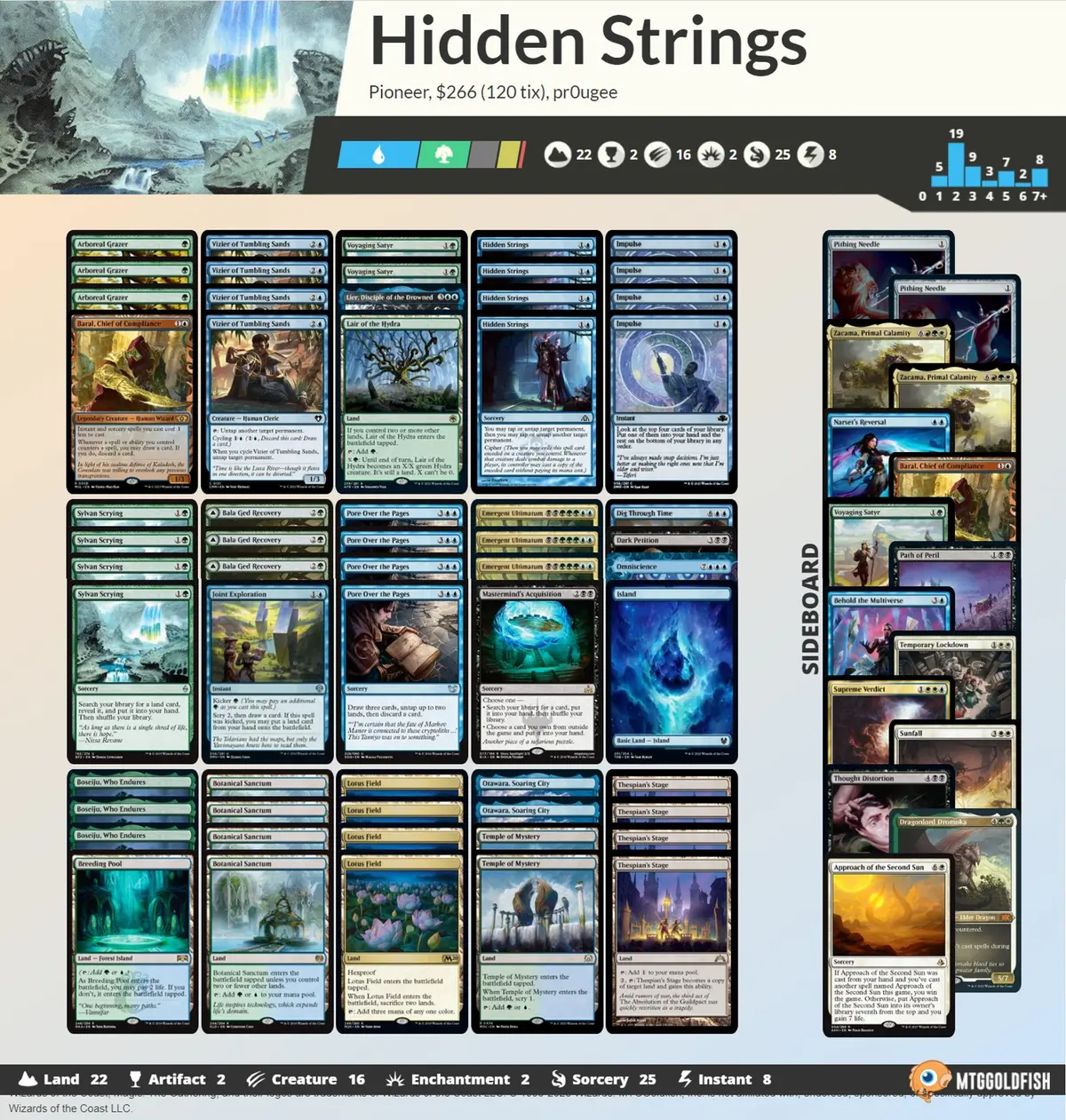
Lotus Field Combo sample deck (Chandra version)
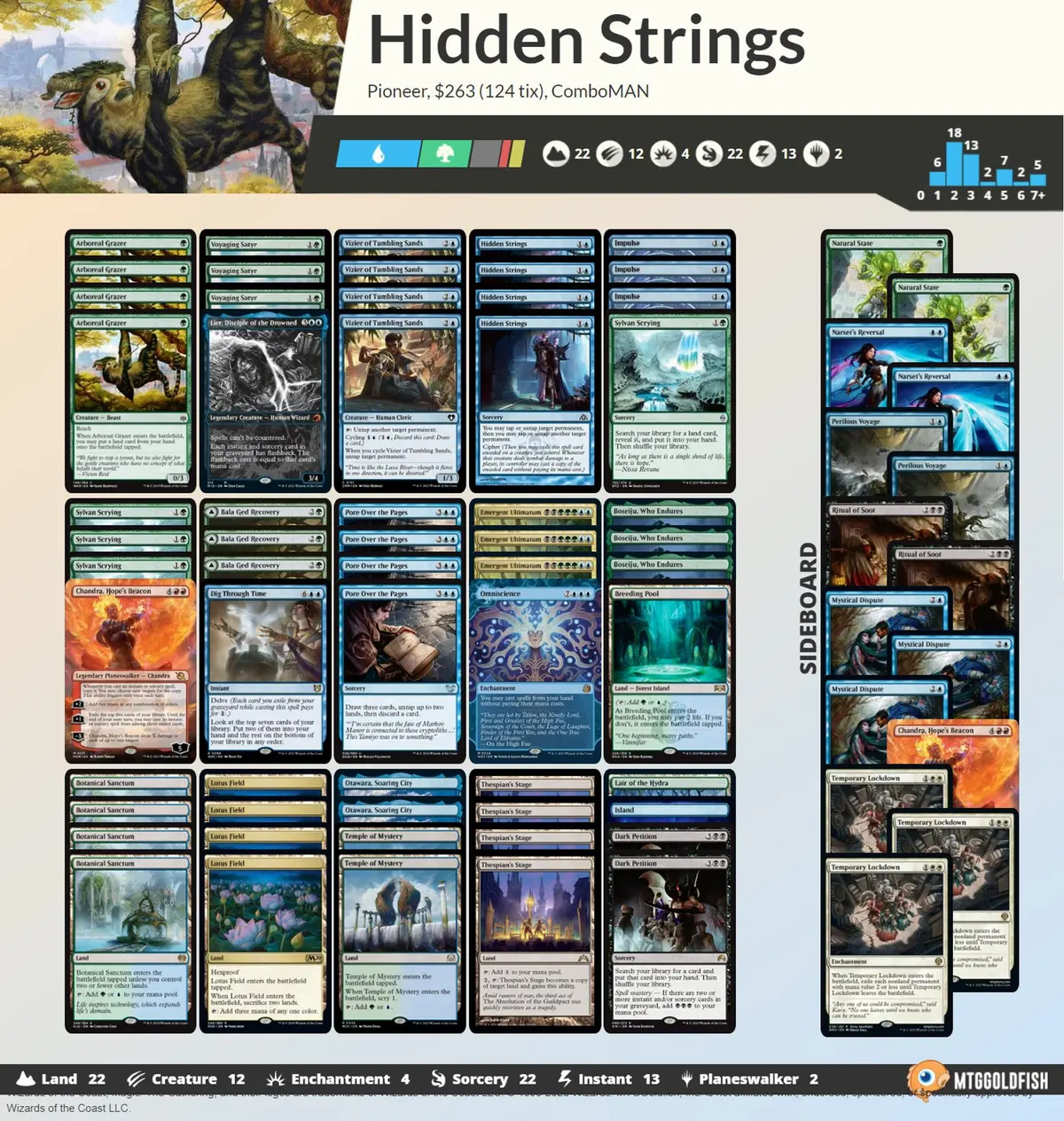
Lotus Field Combo sample deck (Approach of the Second Sun version)
Rakdos Sacrifice
Cost: Medium (around $400)
Difficulty: Extremely high
Practice needed: High
Rakdos Sacrifice is a rather special deck in Pioneer. It is a lot of fun to play, but also especially hard to pilot.
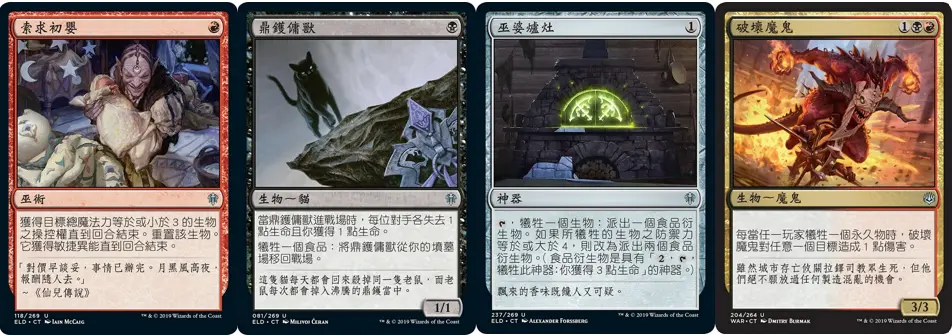
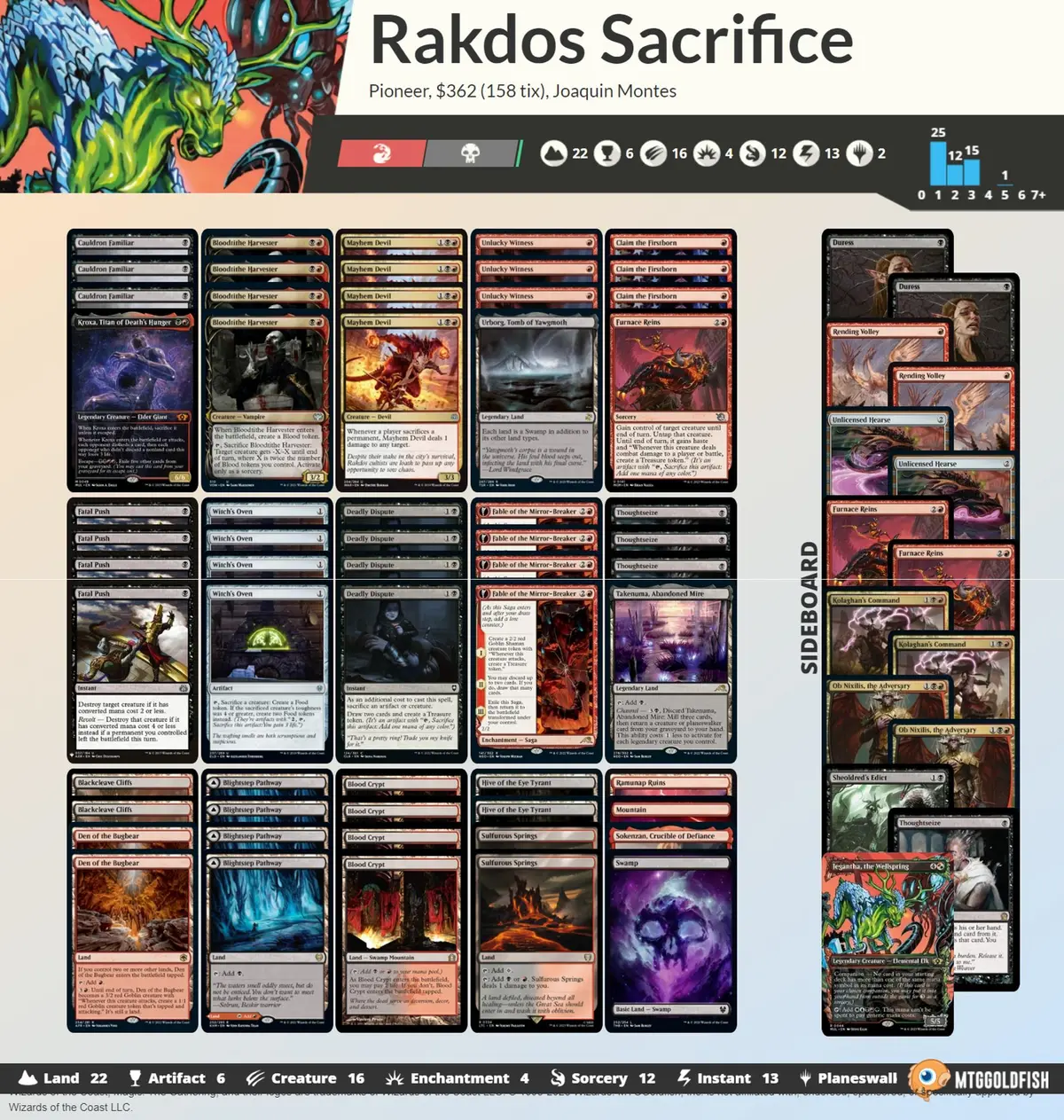
The deck packs in many spells and permanents that trigger sacrifice abilities, such as the Witch's Oven and Cauldron Familiar combo, Treasure and Blood tokens, and so on, and pairs them with its core card Mayhem Devil to clear the board and steal life, grinding the opponent down bit by bit to win.
However, since the deck’s curve is very low and its land count is close to an aggro deck’s (around 22), you often see Sacrifice players operating on just 3-4 lands, so how to use mana most efficiently and make the Devil deal damage to the “right target” at the “right time” is a major challenge for Sacrifice players.
Rakdos Sacrifice’s strength is that it easily wins favorable matchups (such as White Aggro and Rakdos Midrange), but it has poor resistance in unfavorable ones (such as Mono-Green Devotion and 5c Fires of Invention).
Because the deck is rated rather high in difficulty for piloting, game sense, and damage calculation, I don’t recommend beginners start the format with it. But if you are good at math, or confident in your ability to learn and adapt, you can choose this deck.
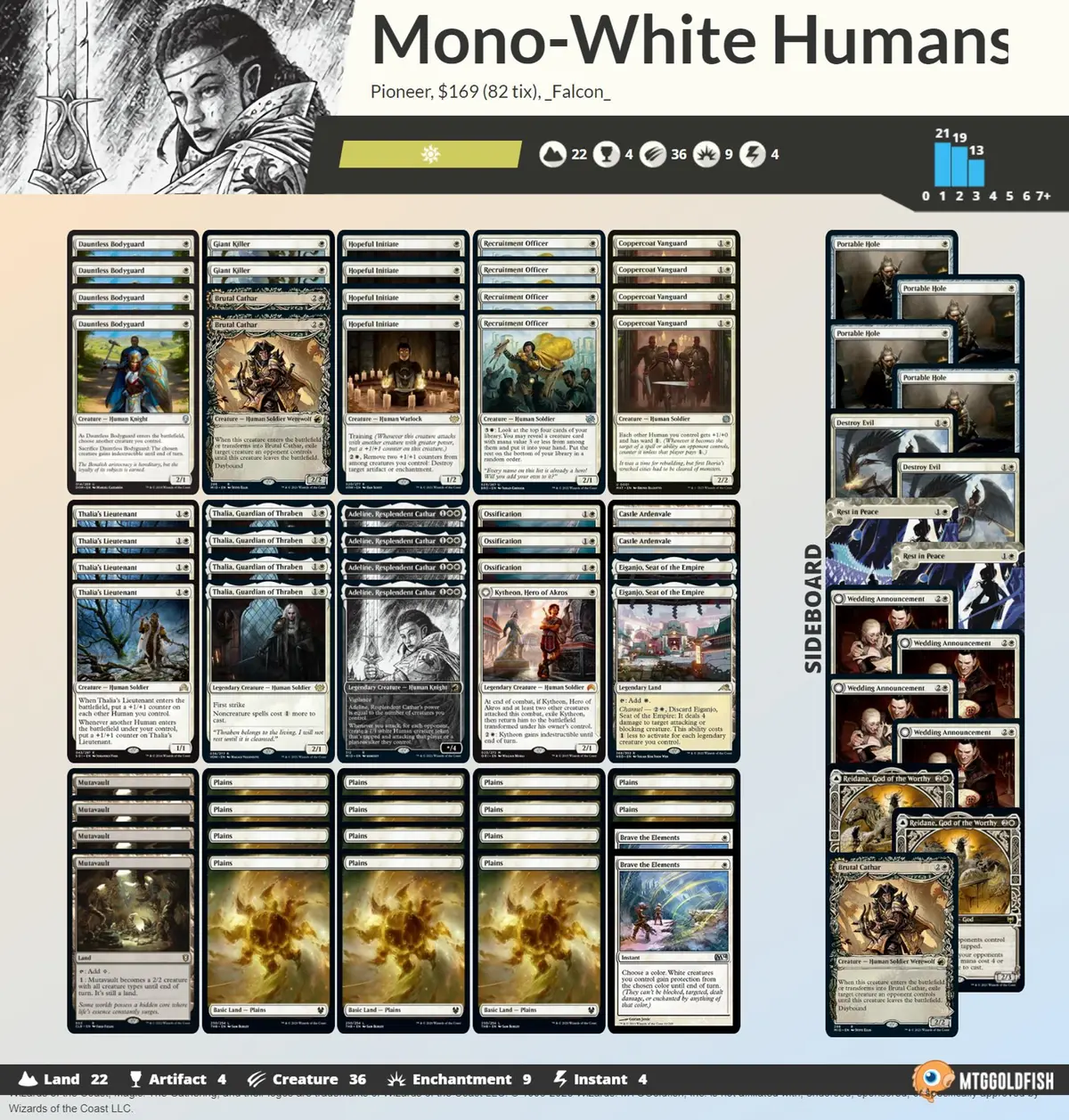
Mono-White Humans
Cost: Low (under $200)
Difficulty: Low
Practice needed: Low
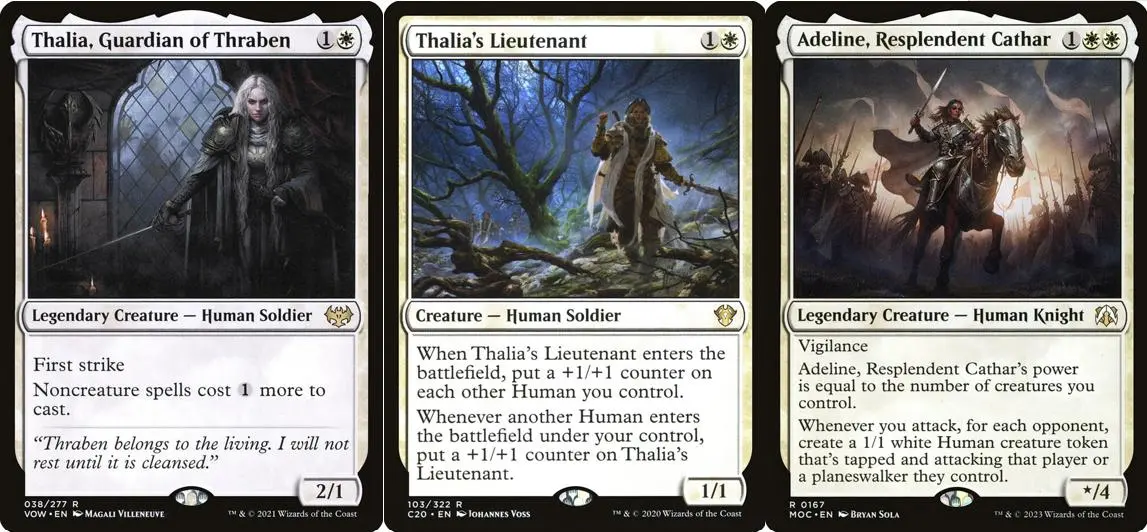
A very straightforward aggro deck with an extremely low curve. All of its 20-plus creatures cost three mana or less, letting it flood the board quickly in the early game and finish the opponent fast by using Lieutenant’s counters (adding power and toughness) and Thalia to throw off the opponent’s tempo. This deck also needs little practice; you simply maximize damage. Against decks with sweepers, however, you have to think carefully about how many creatures to play and in what order.
It is a deck I highly recommend to beginners: it is cheap, and it gives you plenty of practice in the all-important skill of damage calculation.
Izzet Phoenix
Cost: Low (around $200)
Difficulty: Extremely high
Practice needed: High
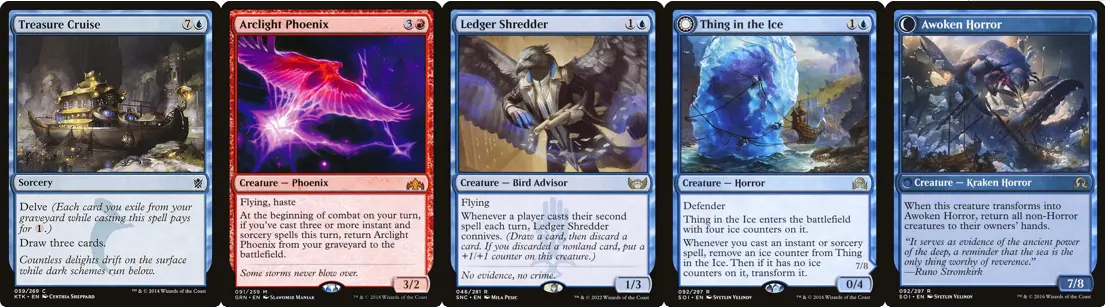
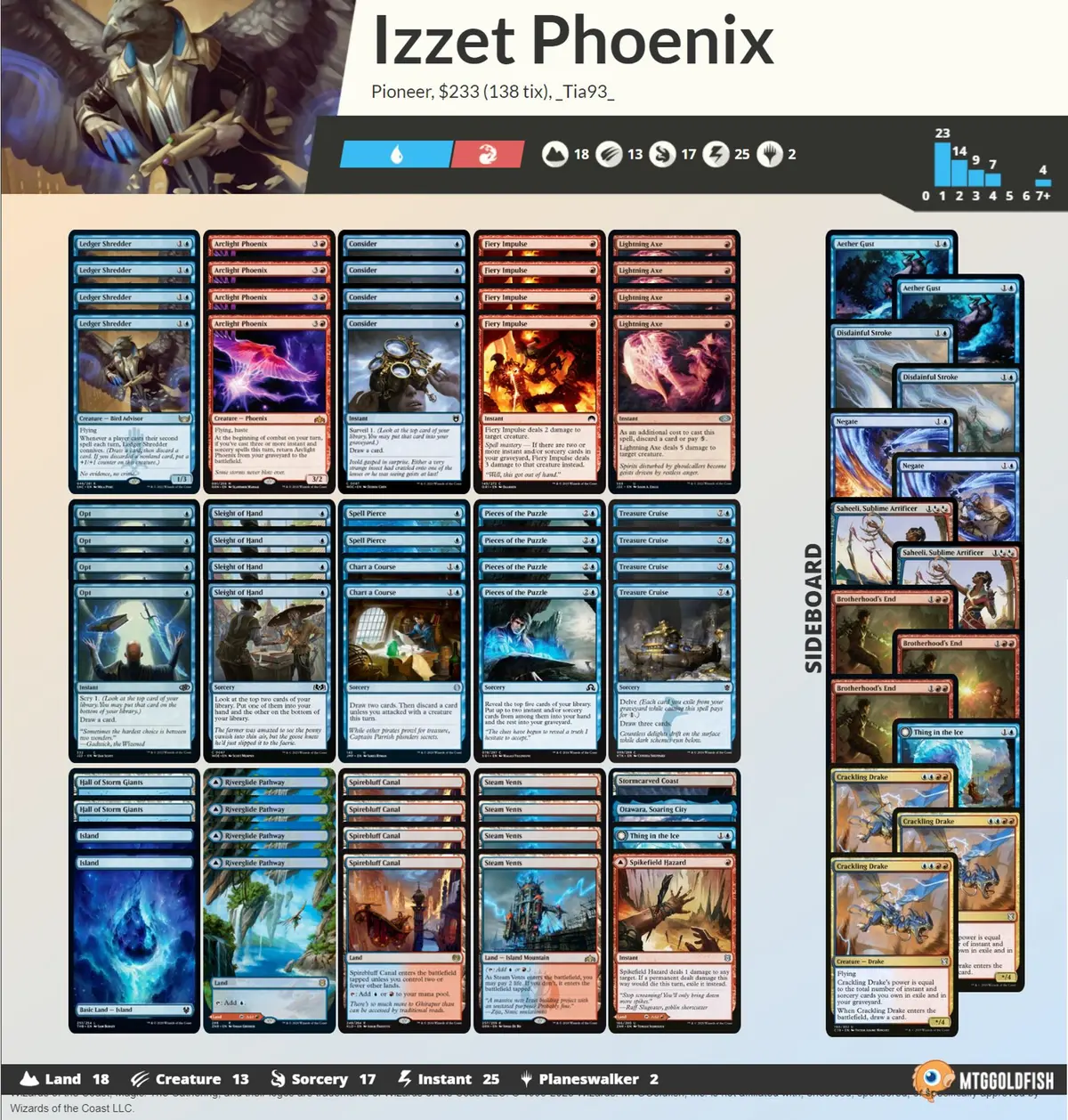
Phoenix is one of the hardest-to-pilot decks among the blue-red color pairs. There are versions that play Thing in the Ice or Ledger Shredder, but what they have in common is getting multiple Phoenixes into the graveyard as much as possible by discarding or self-milling, then casting three instants/sorceries in one turn so the Phoenixes can rise from the graveyard during combat and attack/block.
There are three reasons I say Phoenix is hard (there may be more, but these are the three I can think of right now):
- How to use Opt and Consider: both cards let you look at the top card of your library, and whether to keep it depends heavily on the matchup.
- Controlling the size of your graveyard: this is closely tied to when to use Treasure Cruise. Mindlessly stacking the graveyard won’t win you the game.
- Sideboard strategy: Phoenix easily gets targeted by graveyard hate in sideboard games, and the game plan changes drastically as a result.
The deck’s strength is a decent win rate against Sacrifice and Spirits; its weakness is that it is hard to pick up and very afraid of graveyard hate. Once again I don’t recommend it to beginners, but if you have a special affection for Phoenix and are willing to spend time practicing, it can also be a good choice.
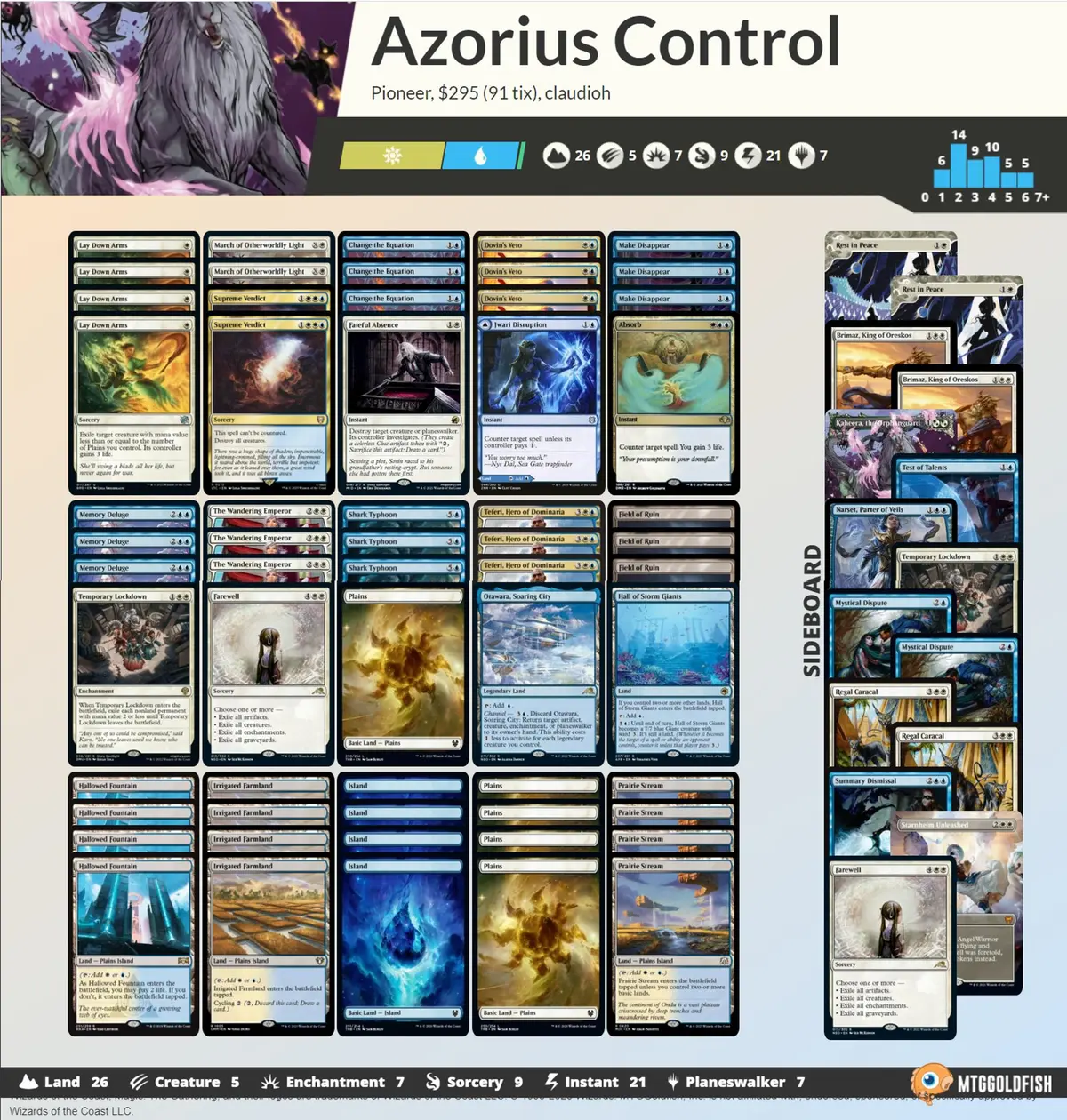
Azorius Control
Cost: Medium (around $400)
Difficulty: Medium
Practice needed: Medium
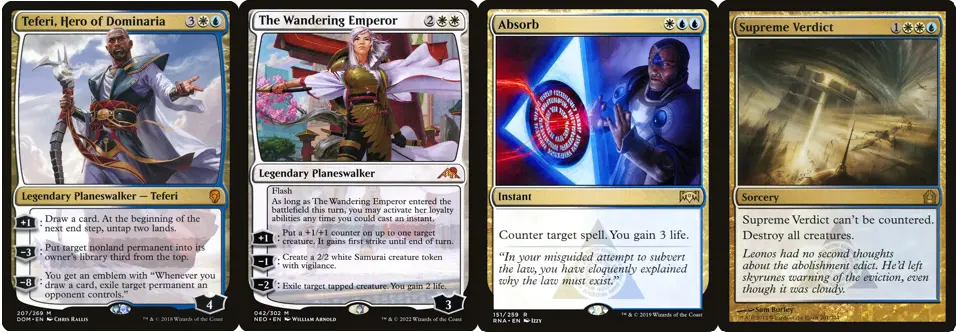
This is probably one of the most annoying decks in the Pioneer metagame. Azorius Control is full of disruption and board wipes, relying on a number of spot removal spells, sweepers, and counterspells to stop the opponent’s game plan and drag the game out until it can resolve Teferi, Hero of Dominaria or The Wandering Emperor as its finisher, creating a huge resource gap that wears the opponent down mentally or simply wins.
Azorius Control has a fairly high margin for error. It can use counterspells to fight most threats and has plenty of ways to end the game. As long as you protect your life total and land your big finisher, you can win.
Abzan Greasefang
Cost: Medium (around $400)
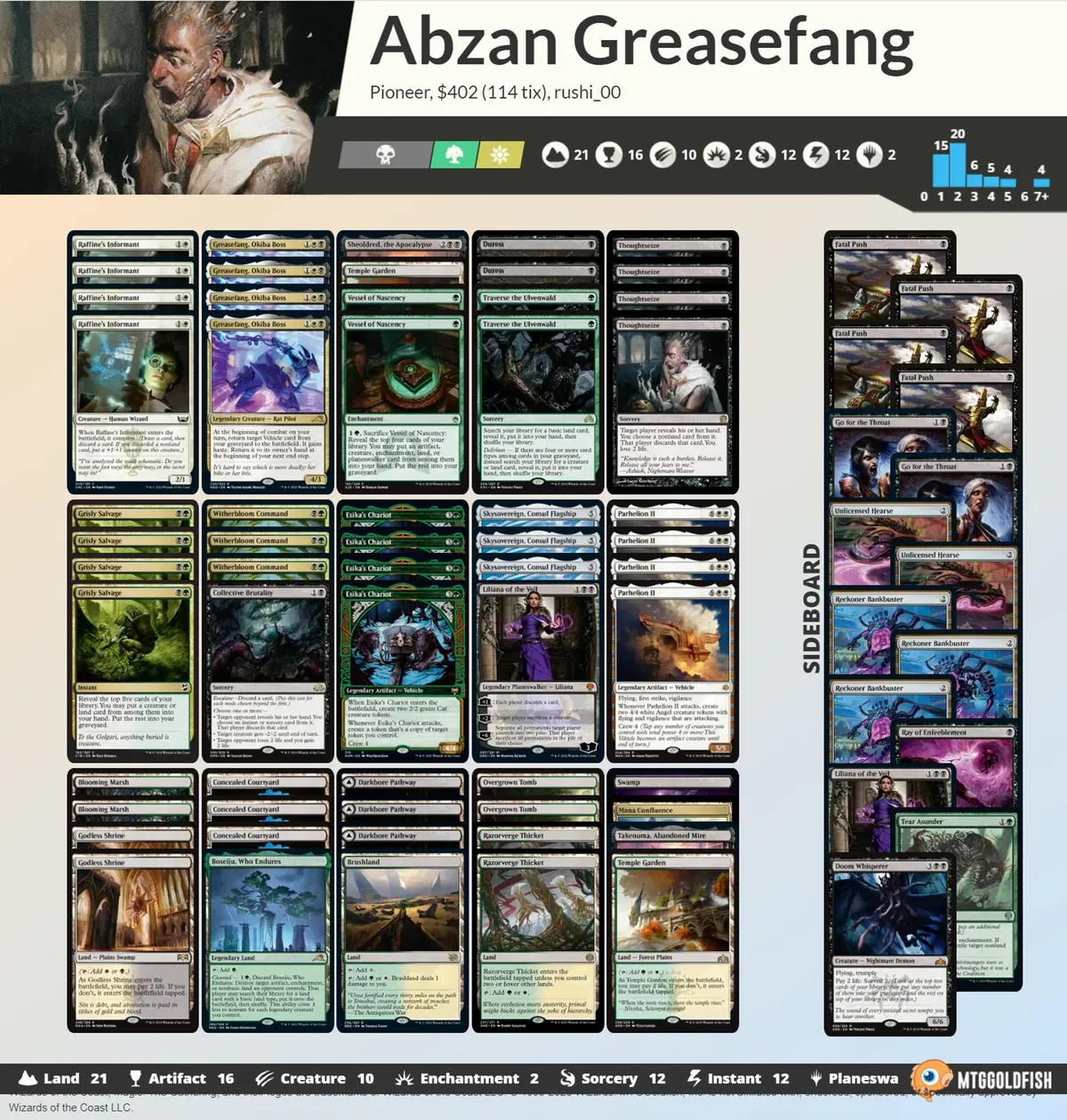
Difficulty: Low
Practice needed: Low
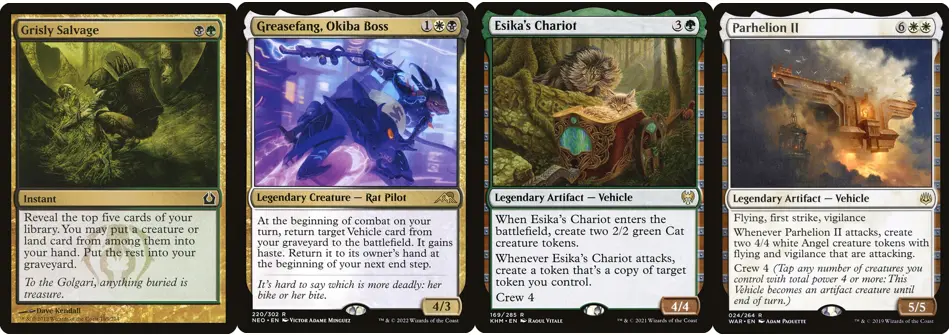
A self-mill combo deck with an easy-to-understand game plan. It relies on discard creatures or self-mill spells in the library to put Vehicle cards into the graveyard (Parhelion II, Esika’s Chariot, or Skysovereign, Consul Flagship), then uses the combat trigger of Greasefang, Okiba Boss to pull a Vehicle back onto the battlefield with haste and trigger its attack ability. The maximum damage in a single turn is 13 (Parhelion II as a 5/5 plus the two 4/4 Angels created by attacking).
If you don’t want to think and find practicing decks too much of a hassle, you can pick this deck. It is simple and brutal.
Indomitable Creativity (Izzet/Temur Indomitable Creativity)
Cost: Medium (around $400)
Difficulty: Medium
Practice needed: Medium
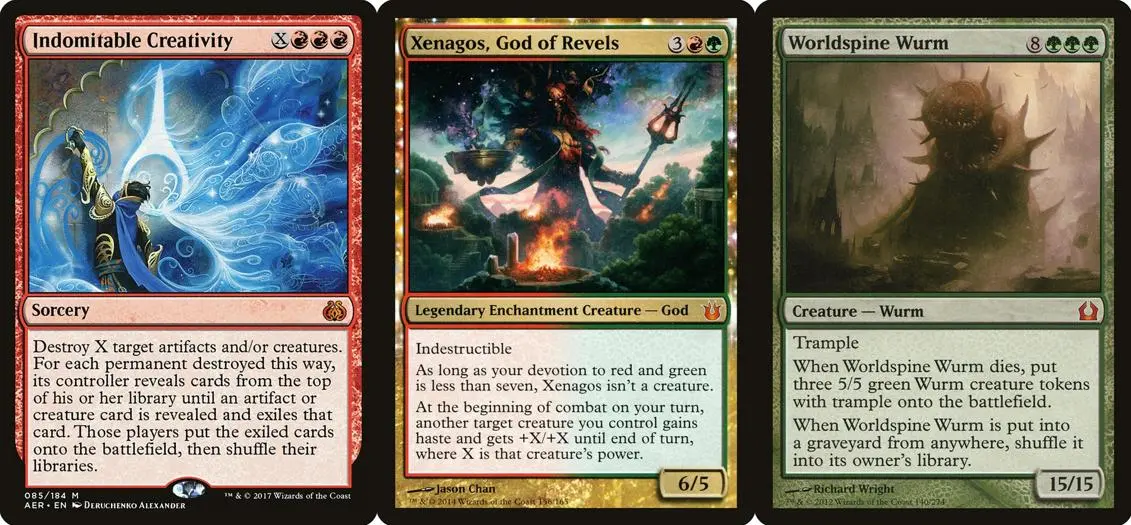
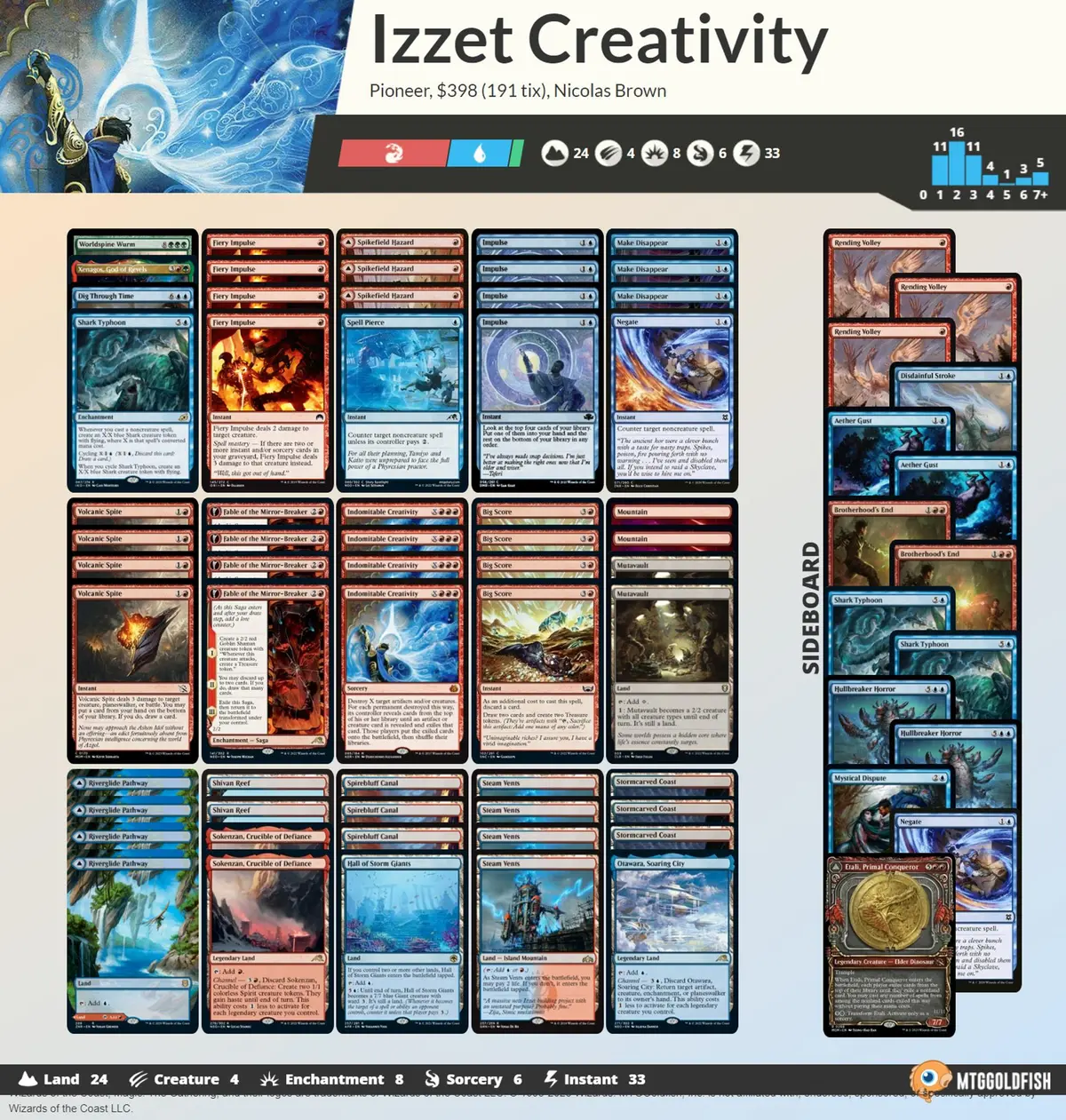
Indomitable Creativity actually comes in many versions. Here I’ll introduce the Worldspine Wurm version, which is currently the most common and has a higher win rate. After Magic Hall of Fame player Reid Duke won a Pro Tour with this deck, it became popular.
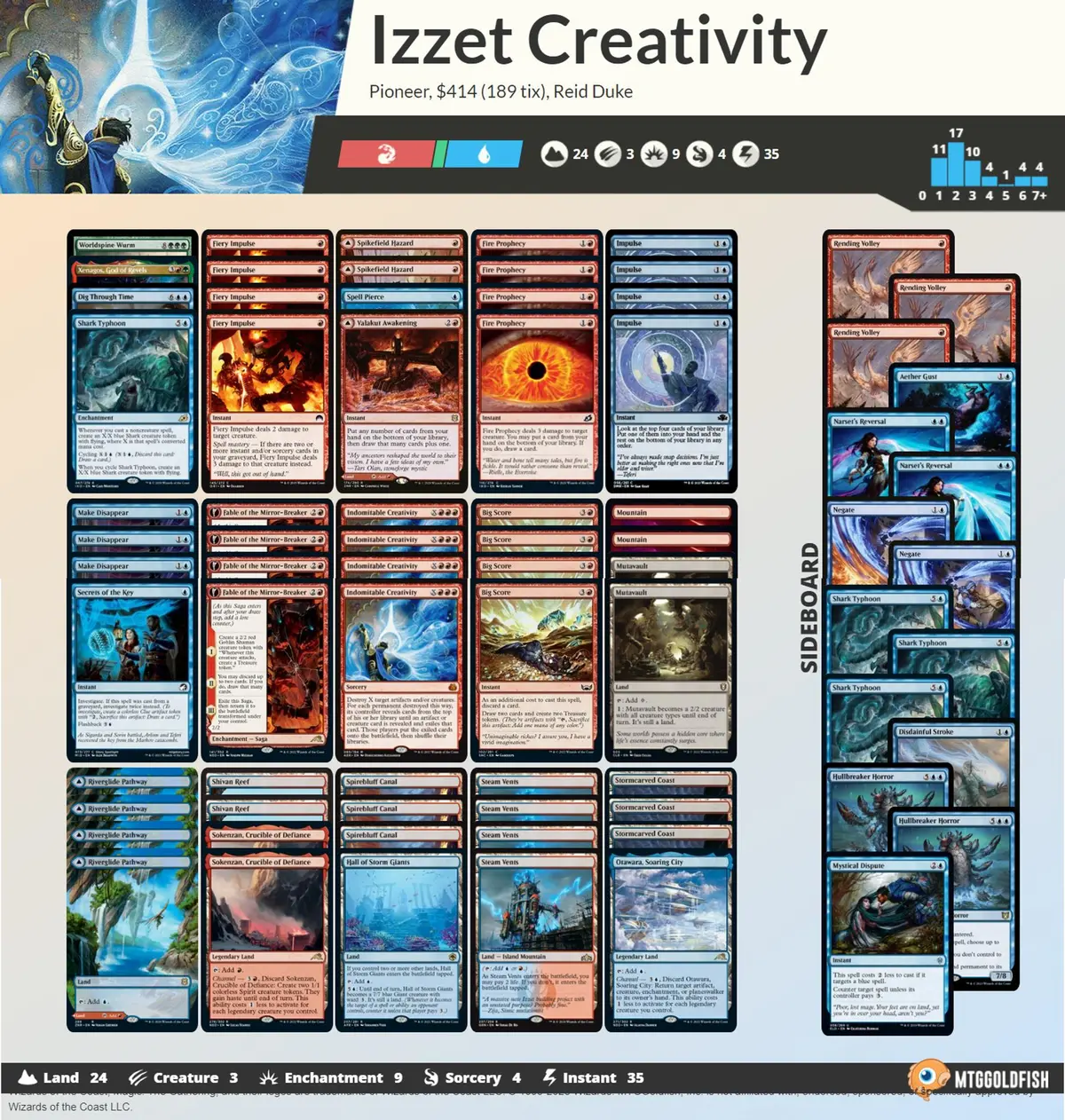
The deck’s game plan is easy to understand. In your precombat main phase, use Indomitable Creativity to destroy two of your own artifacts/creatures, revealing the only two creatures in the deck, Worldspine Wurm and Xenagos, God of Revels (the red-green god). Then you enter combat, where Xenagos gives the Wurm double power and toughness and haste, letting it attack the opponent for 30 trample damage and win the game.
The deck itself has cards that produce Treasure artifacts, such as Fable of the Mirror-Breaker and Big Score, and is full of cheap burn spells to ease early pressure, along with a few counterspells to deal with threats that burn can’t handle.
Indomitable Creativity sample deck
5c Fires Of Invention
Cost: High (around $600)
Difficulty: Low
Practice needed: Medium
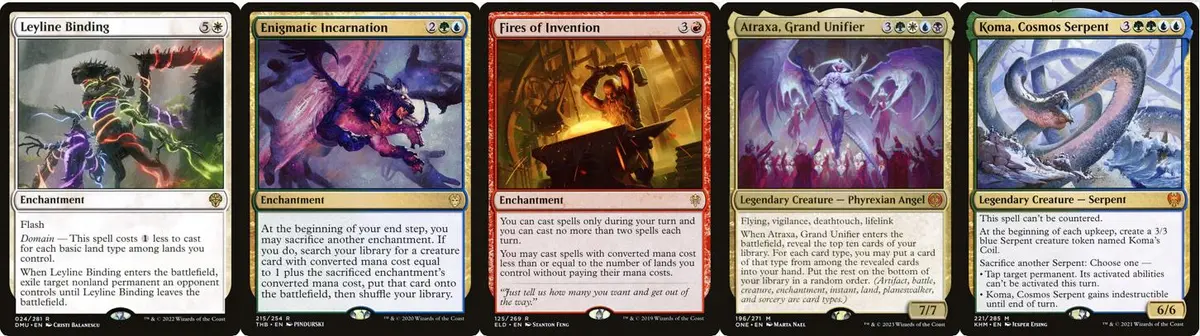
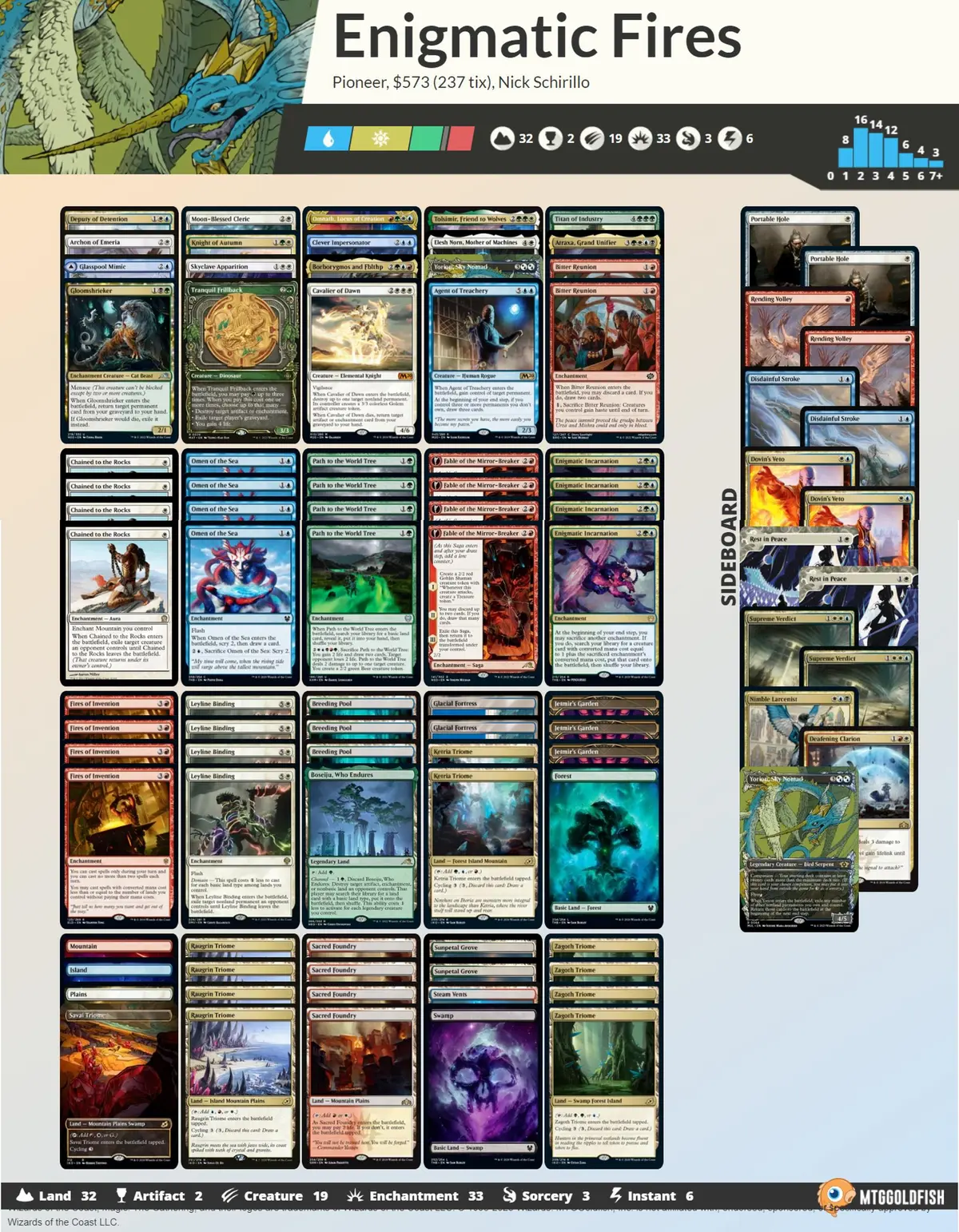
This deck has two ways to win. One is to rely on Fires of Invention, which lets you cast two spells for free each turn in the mid to late game, to keep up constant pressure on the opponent. The other is to use Enigmatic Incarnation as a gacha machine to find big creatures from the library, creating a resource gap or a board the opponent can’t handle.
Enigmatic Incarnation’s effect lets you sacrifice another enchantment at the end step and search your library for a creature with mana value one greater than the sacrificed enchantment, putting it onto the battlefield. The most common combo is to hold the board with Leyline Binding early, then sacrifice it with Enigmatic Incarnation to fetch a 7-mana fatty from the library. Common choices include Atraxa, Grand Unifier (card advantage), Koma, Cosmos Serpent (board presence), and Agent of Treachery (removal). By sacrificing one removal permanent you can bring a 7-mana threat into play at a 4-mana pace, which must be a very good trade. Another advantage is the flexible slots: you can pick which creature at 4, 5, or 7 mana you want to cast and fetch with Enigmatic Incarnation, so you can build different counter-strategies depending on the metagame.
In the third round of the MIT Championship in June 2023, this deck had a high usage of 7 copies, and it is a popular choice for many players in Japan. Personally, I think this is because the metagame has made Rakdos colors more likely to show up (there were already a lot of Rakdos Midrange players in Taiwan, and Rakdos Sacrifice had a very high win rate in June). This deck is nearly an automatic win against decks with no enchantment removal at all (Rakdos), and it also performs well against decks that don’t run counterspells, which is why it was picked.
5c Fires of Invention sample deck
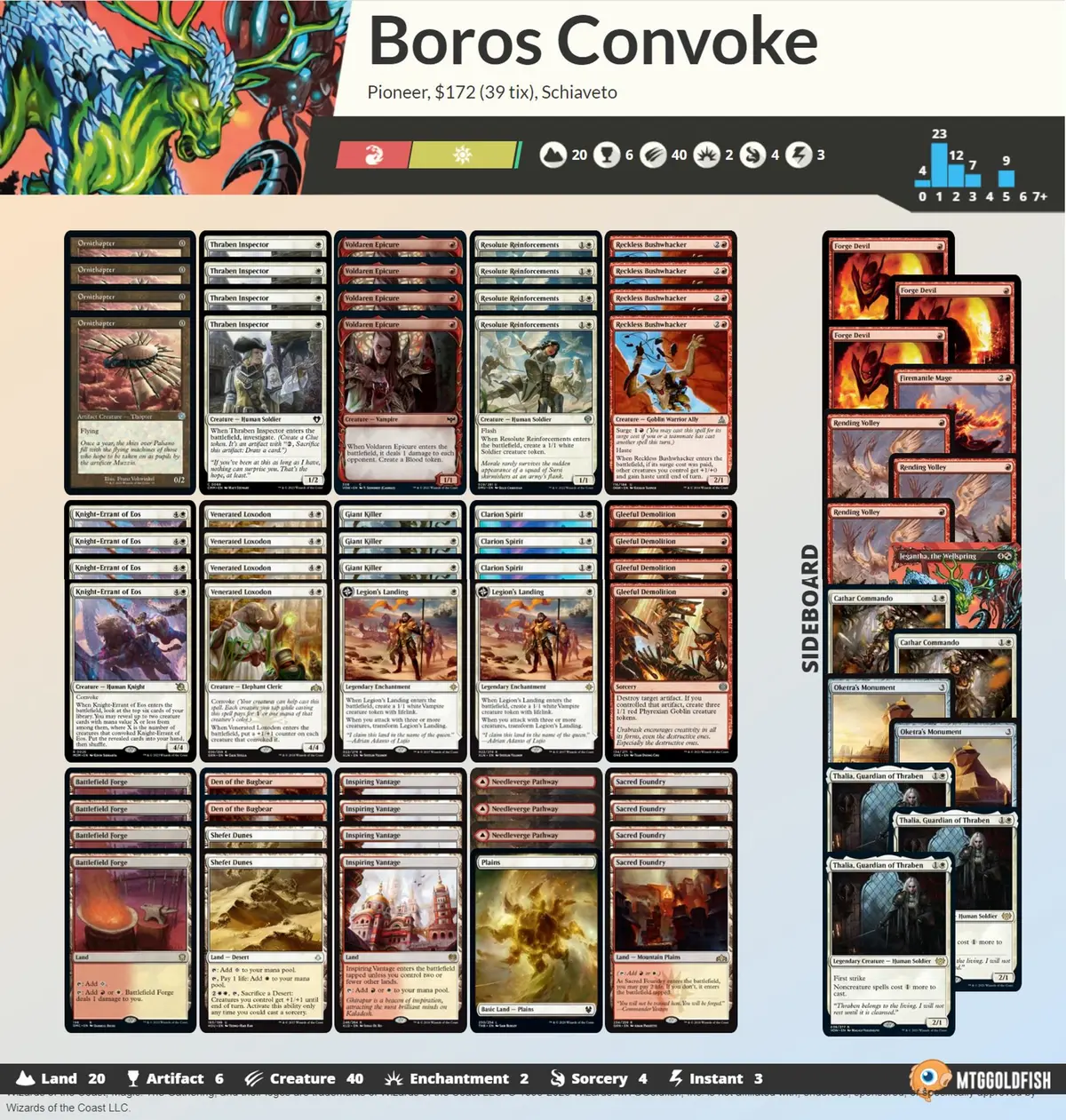
Boros Convoke
Cost: Low (around $200)
Difficulty: Low
Practice needed: Medium
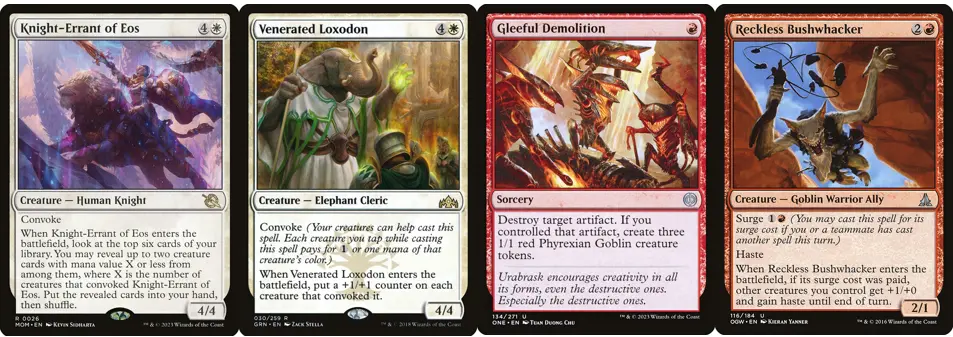
An aggro deck that became popular after Knight-Errant of Eos came out in the MOM set. It is the ultimate aggro deck, a rabid dog that kills you if you can’t hold it off, but in return it needs a player with a fair amount of lifespan to pilot it.
The deck has two game plans. The first is to use 0-drop and 1-drop creatures and Gleeful Demolition early on to produce a large number of creatures, and then go all in with a big attack alongside Reckless Bushwhacker. The second relies on developing the board over the first two turns, then having enough creatures that the Knight or Venerated Loxodon can convoke in, drawing cards and buffing creatures before continuing to attack. Either way, you need enough creatures on the battlefield so that the deck can finish the opponent quickly.
The deck’s strength is that if things go smoothly, nobody can stop you. Its weakness is that it depends heavily on the opening hand. If the tempo gets stuck for even one turn and gives the opponent a chance to set up blocks, you may lose, so you can’t mulligan too many times, and you need a fair amount of practice to confirm the opening hand you need in each matchup.
Personally I highly recommend this deck to both new and veteran players. The cost is average, the strength is decent, and you can enjoy the thrill of a rabid dog punching the old master to death.
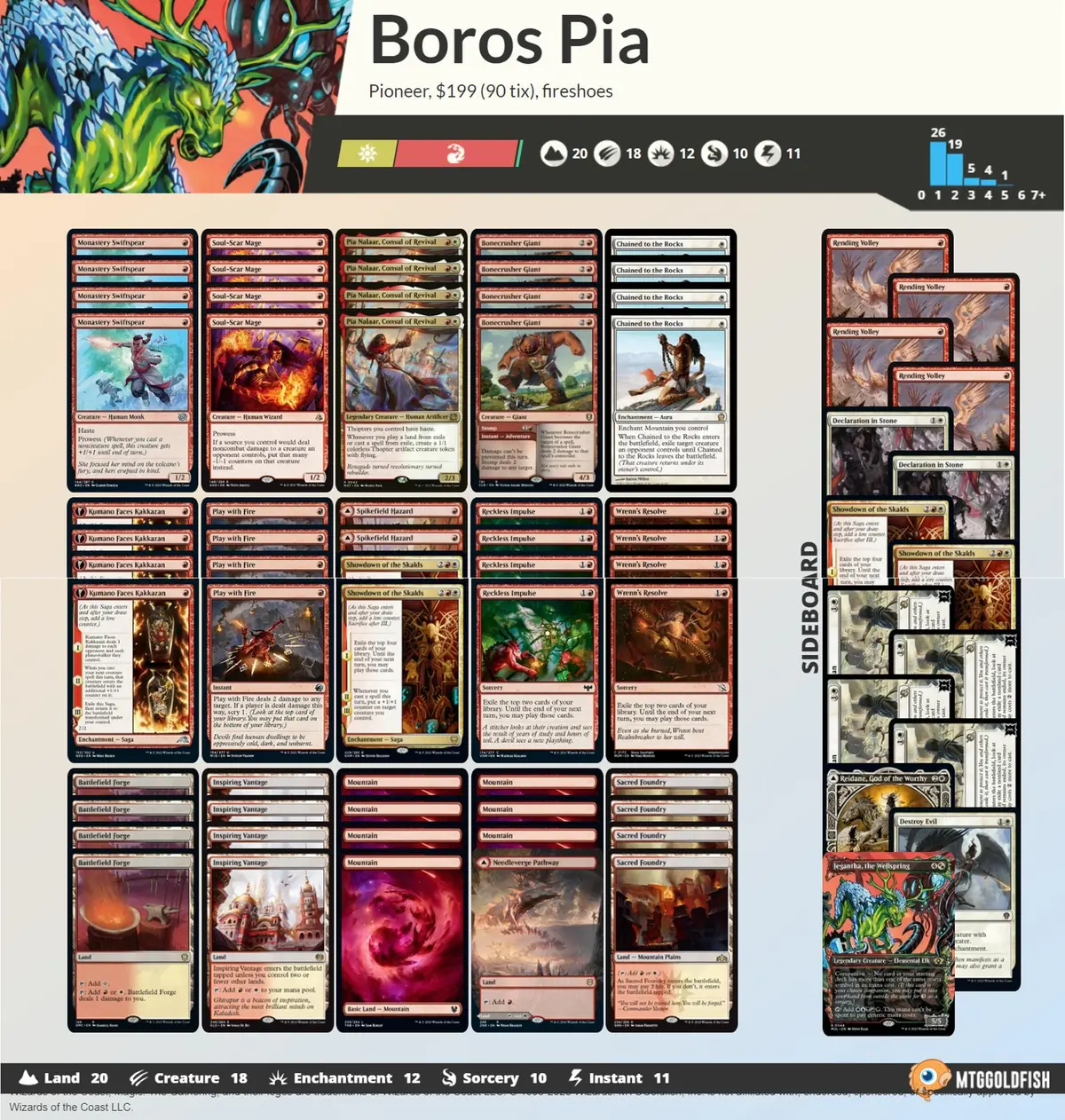
Boros Pia
Cost: Low (around $200)
Difficulty: Medium
Practice needed: Low
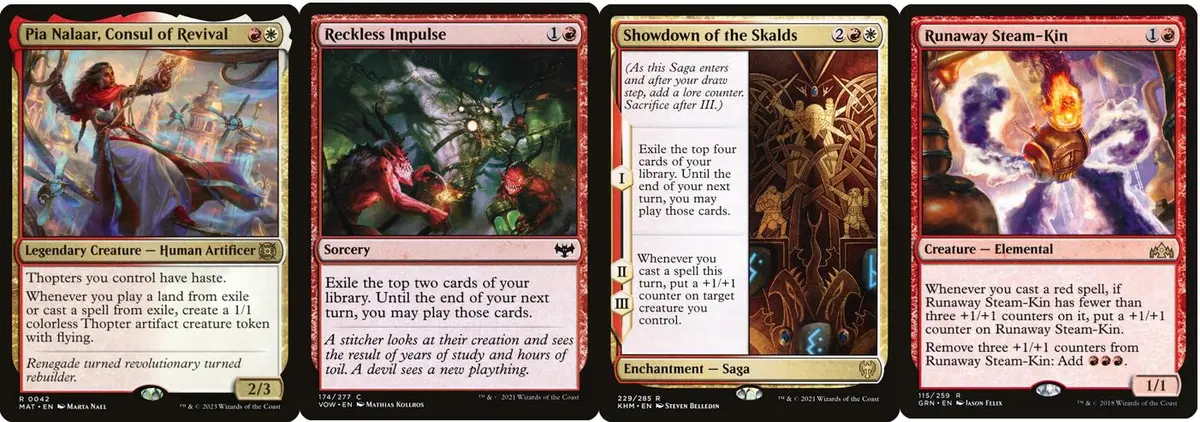
It became popular after the MAT set introduced the card Pia Nalaar, Consul of Revival. In terms of speed it is an aggro deck leaning a little toward midrange. When things go smoothly it can build a huge board while generating resources so that its offense never lets up. Let’s talk about how it works.
The deck’s core card Pia makes a 1/1 colorless Thopter token whenever you play a land from exile or cast a spell from exile, so you see it paired with cards like Reckless Impulse and Showdown of the Skalds, which exile cards from the top of the library to generate card advantage, squeezing the most value out of Pia’s ability and flooding the board.
The deck also includes cheap creatures often seen in red aggro decks, such as Soul-Scar Mage and Monastery Swiftspear. Besides stealing as much life as possible in the early and mid game, the deck’s ability to cast multiple noncreature spells in one turn gives their prowess ability high value.
Worth mentioning is that newer versions include Runaway Steam-Kin, which can work with chapters II and III of Showdown to put +1/+1 counters on itself, then remove three +1/+1 counters to produce 3 red mana for a follow-up. If the situation allows, you can use Steam-Kin’s ability to cast more than 10 spells in one turn, and may even get a kill from it (I’ve been killed this way).
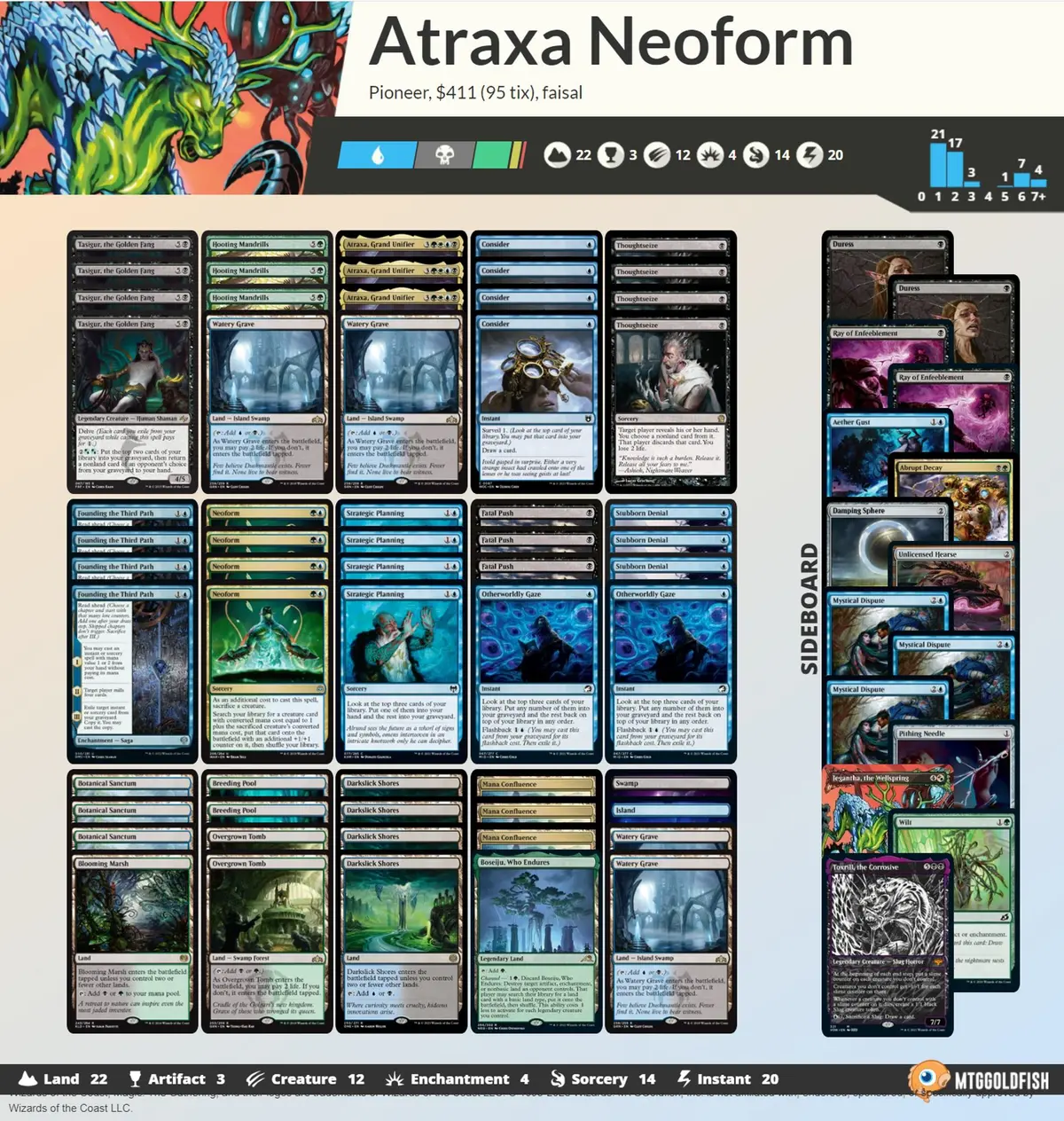
Sultai Neoform
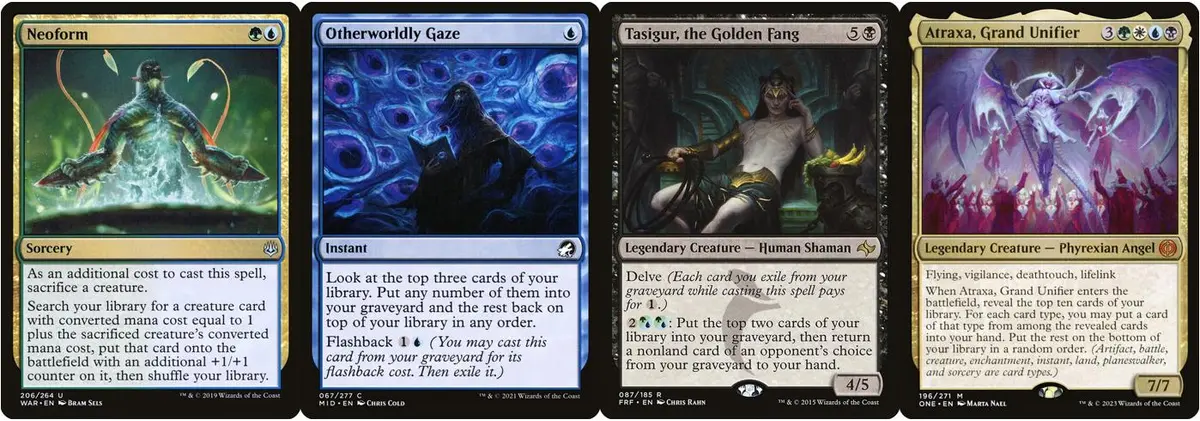
Cost: Medium (around $400)
Difficulty: Medium
Practice needed: Low
A deck that began to appear after the ONE set introduced the big sister, Atraxa, Grand Unifier.
The deck’s game plan is simple and clear: it is all about using the graveyard. Early on it uses cards like “Otherworldly Gaze” that stack up the graveyard, plus delve, to cheaply bring out 6-drop creatures such as Tasigur, the Golden Fang or Hooting Mandrills. It then sacrifices one of the two as the additional cost to cast Neoform, jumping Atraxa out of the library, using its enter-the-battlefield ability to gain lots of card advantage, and closing out the game with Atraxa’s excellent body.
Executing this plan isn’t hard, but the timing of the combo takes some practice, including discarding cards, using counterspells, and thinking ahead about the cards Atraxa will draw you so you leave mana for follow-ups. These are all fine details of this deck. And even if you can’t pull off the Neoform combo, you can slowly beat the opponent to death with Tasigur or Hooting Mandrills.
The deck’s strength is a very good win rate against decks that struggle to deal with Atraxa (Greasefang, Boros Convoke, and so on); its weakness is that it has a hard time getting going when hit by graveyard hate.
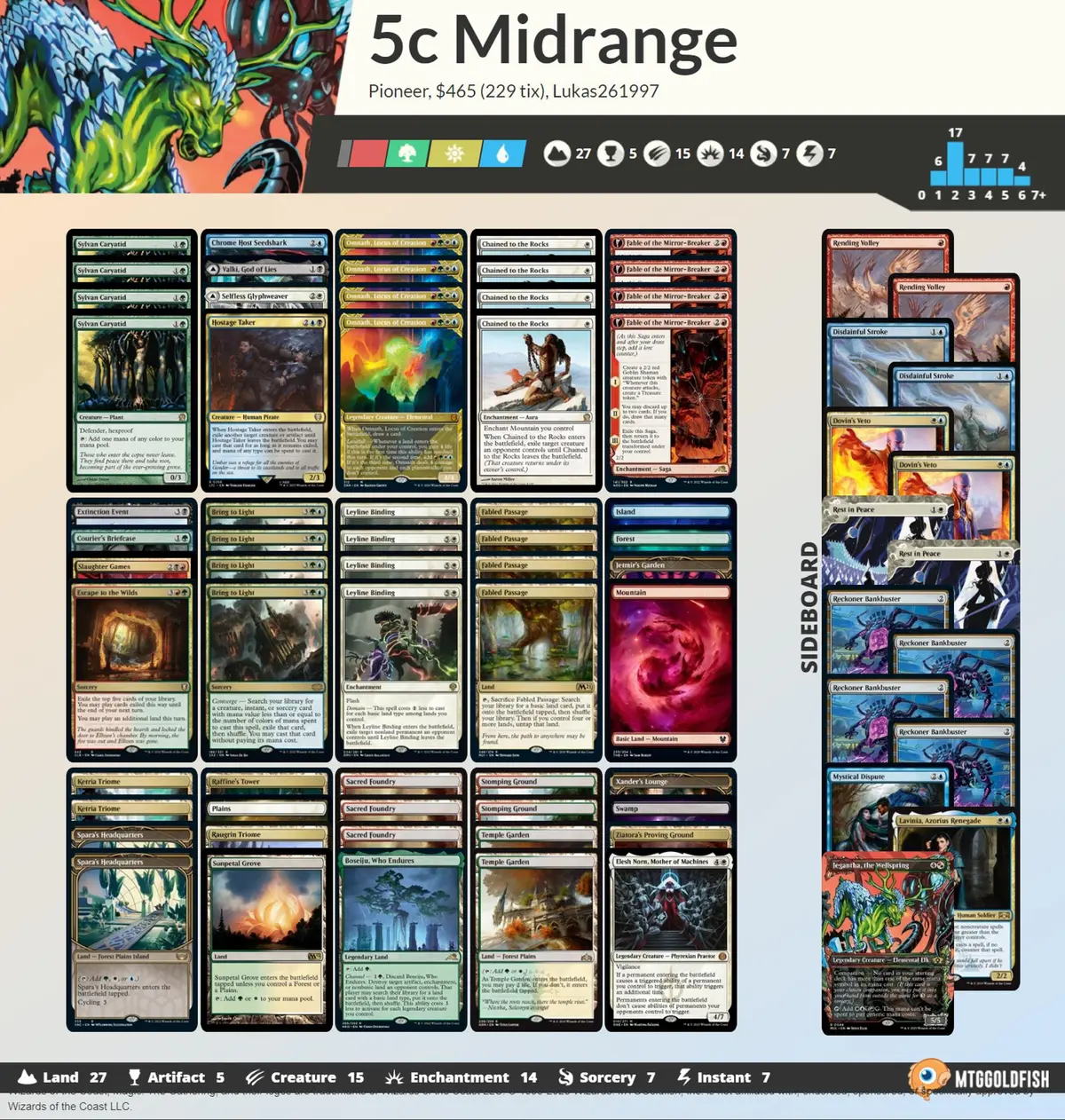
5c Midrange
Cost: Medium-high (around $500)
Difficulty: Medium
Practice needed: Medium
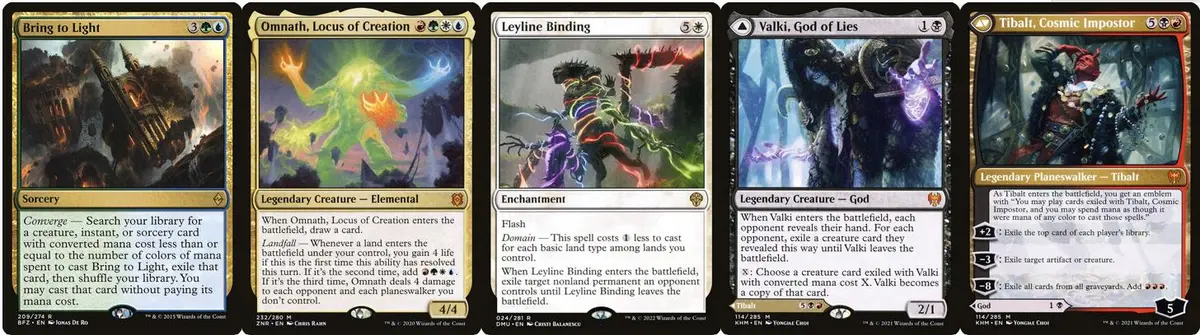
Like 5c Fires of Invention, this is a five-color deck with a similar tempo, but it works in a completely different way. 5c Bring to Light is a slower midrange deck that needs to play out to turns 4-5. It mainly relies on Sylvan Caryatid or the Treasure tokens produced by the Goblin Shaman tokens from Fable of the Mirror-Breaker attacking to ramp, and casts Bring to Light as soon as possible to find the spells the matchup needs from the library.
Let’s first talk about how Bring to Light works. It requires the player to pay its base cost ({3}{G}{U}), and depending on how many colors of mana you used to pay the cost, it determines what mana value of card you can find and cast for free (EX: if you spent 3 colors, you can find a card with mana value 3; with 5 colors you can find a 5-drop).
With such powerful tutoring, the deck plays only one copy of every key card except Omnath, Locus of Creation. After all, if we count Bring to Light, those single copies effectively become five copies because Bring to Light can fetch them. The one we most often find this way is Valki, God of Lies, and then we use the modal double-faced card rules to cast its back face, the planeswalker Tibalt, Cosmic Impostor, for free. Its powerful card advantage effect gives a huge resource gap in the early and mid game, and that is how the deck wins.
Because the deck needs to tutor with 4-5 colors, it has the hidden worries of being slow and having a higher early-game death rate, but it can get through that with the excellent removal of Chained to the Rocks and Leyline Binding. If you want to try a five-color deck in Pioneer, this is the one I’d recommend. Although five colors are harder than two or three and carry the risk of color screw (unlike Modern, you can’t adjust your land colors through fetch lands), the deck isn’t actually that hard to pilot and is intuitive: basically, you play whatever you draw.
Conclusion
Overall, I think the Pioneer metagame is fairly balanced right now. Deck usage isn’t distributed to an outrageous degree, there is diversity, and new tech shows up in the meta every week. It can’t be denied that, by the numbers, some decks do have higher win rates (Mono-Green, Sacrifice, Spirits, and so on), but I think this is something every card game goes through. In every period there will be a so-called answer of the format, but these answers aren’t without ways to beat them. Precisely because they are seen as the answer, they get researched for weaknesses, targeted by sideboards, run into unfavorable matchups, and sometimes can’t complete their game plan as hoped.
I myself have won foreign qualifiers with decks other than those above, and that too took a certain amount of practice, matchup research, and careful thought about sideboard choices before I finally succeeded. That thrilling process of brainstorming was a very special experience for me and is what drives me to keep playing. Anyway, I hope the fun of your games isn’t worn down by the meta, and I wish you all find your own joy in this diverse environment after entering Pioneer.
- Title
- A Quick Guide to the Pioneer Format
- Author
- Enki
- Created at
- September 21, 2023
- License
- This work is licensed under CC BY-NC-SA 4.0 .