Pioneer Meta Inspection: preMIT #4

Note: This article was translated from Chinese by AI and may contain errors. Read the original Chinese version.
Before We Start
This week’s meta inspection is a roundup of RC data.
Besides the European and Canadian RCs covered in the previous post, this time we’re adding the results of the Australia/New Zealand RC, and we’ll consolidate the data after going through the Australia/New Zealand results.
The Benefits of Open List
Some players may be playing in an open list event for the first time (me, for example), or simply want to understand the advantages open list brings, so before we begin, let’s talk about how exactly an open list event differs from an ordinary one.
The main point is that when mulliganing we know what deck the opponent is playing. For example, if we know the opponent is on aggro, we can keep a hand with plenty of removal, and if we know the opponent is playing combo, we switch to keeping hands with discard and more board pressure. That way you don’t keep the wrong hand, get wrecked in game 1, and then have to claw back two games.
Take Pioneer Rakdos Midrange as an example. In one of my earlier articles, Something About Rakdos Midrange, I mentioned that against slower decks such as combo and control we lean toward playing faster to avoid dragging the game out, while against aggro we have to find a way to stall into the late game and win on board/resource advantage.
Or here’s an example from a friend. In a previous MIT he played Mono-Green and was in the last-round pairing, sitting at the fourth or fifth table (I forget which). After looking at the decklist he saw his opponent was on Mono-White Humans with four copies of protection spells. Considering Mono-Green has a hard time in that matchup (turn 1 a 2/1, turn 2 Thalia, turn 3 Adeline, Resplendent Cathar, turn 4 Thalia’s Lieutenant + Brave the Elements, all pushed in response before blockers by throwing Brave the Elements for protection from green), he intentionally drew with his opponent. He knew a draw might not get him into the top 8, but it was better than playing on, getting crushed and crashing out, with no chance to gamble on making top 8.
This is also why many Pioneer Rakdos builds main deck a bit of everything, such as an extra Unlicensed Hearse or Extinction Event. In a matchup where they aren’t good, if you draw one you just count it as a mulligan to six; at worst you feed it to Fable of the Mirror-Breaker or Bloodtithe Harvester to filter a card, and if the rest of the hand is really bad you just mulligan.
Pioneer is also a format that rewards answers: many things basically can’t be left for more than two turns. For example, letting Sheoldred, the Apocalypse sit for two turns plus taking a hit equals a life difference of at least 10 (4 damage from the body + 4 from two of your draw steps + 2 from the opponent’s draw steps gaining life). The more games with an open decklist, the more preparation you can do.
And the current Pioneer meta is a very standard rock-paper-scissors where each deck beats one and loses to another (big green beats Rakdos, Rakdos midrange beats control, control beats big green, and so on, although control is rarer now). Many times, by the time you sit down, look at the decklist, roll the die, and mulligan, the game is already decided (not counting very unlucky situations like falling into a two-land trap), so understanding the format and your deck is extremely important.
How I Prepare for MIT #4
My tournament preparation goes roughly like this:
- Narrow down the deck choices
I only pick decks I’ve played and know how to operate - Predict the metagame
Based on my understanding of the format, figure out which decks are comfortable to play, and treat two or three decks as imaginary enemies - Choose the deck build
Build the list according to the predicted metagame: which targeted cards can go straight into the main deck to catch the meta, and what sideboard cards to put in for matchups the main deck doesn’t handle - Playtest
Finally, playtesting, adjusting the sideboard plan as I test
Taking this MIT #4 as an example, here is my situation:
- Narrowing down the deck choices:
- Rakdos Midrange is the deck I’ve played the longest. I started playing it in the Magic Arena (MA) Explorer format almost a year ago, and I’ve practiced it the most
- Rakdos Sacrifice is also a deck I’ve practiced a bit in MA Explorer
- I built Gruul Vehicles on MA too, but playing it just felt off, and I tend to miscalculate lethal
- Predicting the metagame
Barring surprises, the metagame will be mostly Rakdos Midrange, Sacrifice, Phoenix, big green, and red-white aggro (Convoke, Heroic, Pia), mixed with Greasefang, control, Gruul, Lotus Field combo, and Rona combo. We’ll analyze this part in more depth at the end
Basically at this point only one deck choice remains: Rakdos Midrange
Sacrifice is very hard against Phoenix (the data on mtgdecks shows only a 36% win rate), and I haven’t had much time to practice; Gruul I keep miscalculating lethal with, so I’m not considering it - Choosing the deck build
Then adjust the build for the metagame, possibly moving some targeted cards (such as Unlicensed Hearse for graveyard hate) into the main deck - Playtesting
Finally, I spent a whole day testing over the weekend. The build is settled now, but I’m still fine-tuning
Still waiting for my decklist? Dream on. Wait until the decklist submission deadline at 09:00 on 11/4 has passed
ANZ Super Series Cycle 4: Reginal Championship
The Australia/New Zealand RC ended last weekend with 156 players, eight rounds followed by a single-elimination top 8.
As usual, let’s start with the deck stats. Usage percentages are all rounded to one decimal place, so the sum may not be 100%, and only decks with more than 5 copies are listed.
| Archetype | Deck Count | % of Field |
|---|---|---|
| Rakdos Midrange | 25 | 16.0% |
| Mono-White Humans | 16 | 10.3% |
| Izzet Phoenix | 14 | 9.0% |
| Mono-Green Devotion | 14 | 9.0% |
| Boros Convoke | 10 | 6.4% |
| Abzan Greasefang | 10 | 6.4% |
| Rakdos Sacrifice | 9 | 5.8% |
| Lotus Field Combo | 7 | 4.5% |
| Azorius Spirits | 6 | 3.8% |
| Azorius Control | 5 | 3.2% |
| Boros Heroic | 5 | 3.2% |
| Others | 35 | 22.4% |
The metagame as a whole leans toward aggro, so how to withstand board pressure will be the focus of the matchups.
Next, the top ten cards by usage:
| Card | Copies | Decks | |
|---|---|---|---|
| 1 | Thoughtseize | 208 | 34% |
| 2 | Fatal Push | 193 | 33% |
| 3 | Fable of the Mirror-Breaker | 181 | 30% |
| 4 | Bloodtithe Harvester | 143 | 30% |
| 5 | Bonecrusher Giant | 116 | 20% |
| 6 | Duress | 114 | 31% |
| 7 | Portable Hole | 102 | 19% |
| 8 | Rending Volley | 101 | 28% |
| 9 | Thalia, Guardian of Thraben | 94 | 17% |
| 10 | Sheoldred, the Apocalypse | 92 | 25% |
As always, Thoughtseize, Fatal Push, and Fable of the Mirror-Breaker take the top three spots in usage.
The top 8 decks, with records taken from the Swiss rounds:
| Rank | Player | Decklist | Record |
|---|---|---|---|
| 1 | Brett Girvan | Boros Heroic | 6-0-2 |
| 2 | Josh Bradbury | Abzan Greasefang | 6-1-1 |
| 4 | James Larsen-Scott | Lotus Field Combo | 7-0-1 |
| 4 | Matthew Giudes | Rakdos Midrange | 6-1-1 |
| 8 | Jose Gabriel Hilario | Boros Convoke | 6-1-1 |
| 8 | Dillon Kikkawa | Gruul Vehicles | 7-1 |
| 8 | Y0ungsterDenis | Rakdos Midrange | 6-0-2 |
| 8 | WilM16 | Boros Convoke | 6-2-1 |
Compared with the other three RCs that have already finished, this top 8 is made up of a surprisingly large number of aggro decks.
Boros Heroic
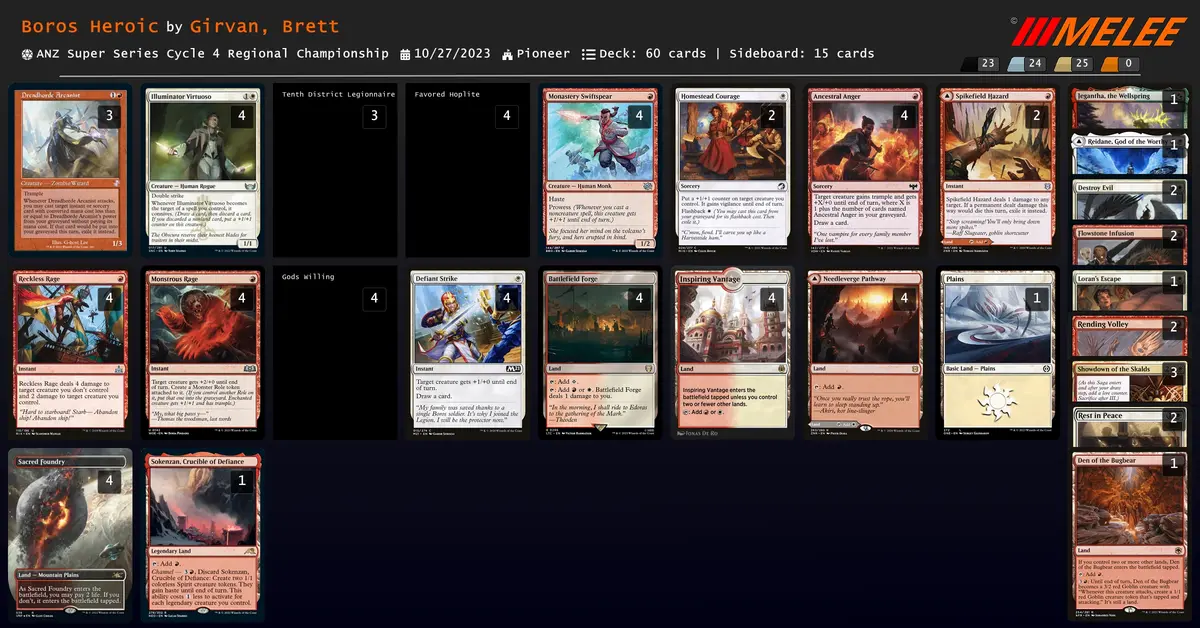
Heroic is doing pretty well in the current metagame. Basically you have to respect the Illuminator Virtuoso that comes down on turn 2 on schedule and kill it, or you could easily get killed on turn 3.
Abzan Greasefang
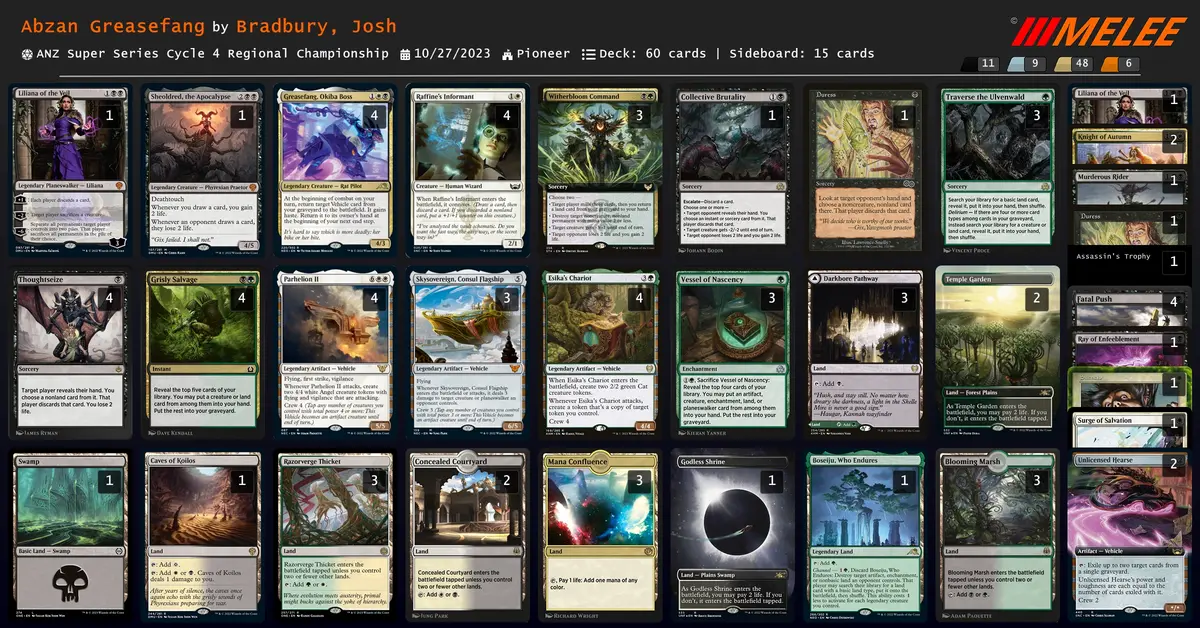
The overall Greasefang build hasn’t changed much either. This list main decks one each of Collective Brutality, Duress, Sheoldred, the Apocalypse, and Liliana of the Veil, presumably to keep open the possibility of playing it as Abzan Midrange.
Lotus Field Combo
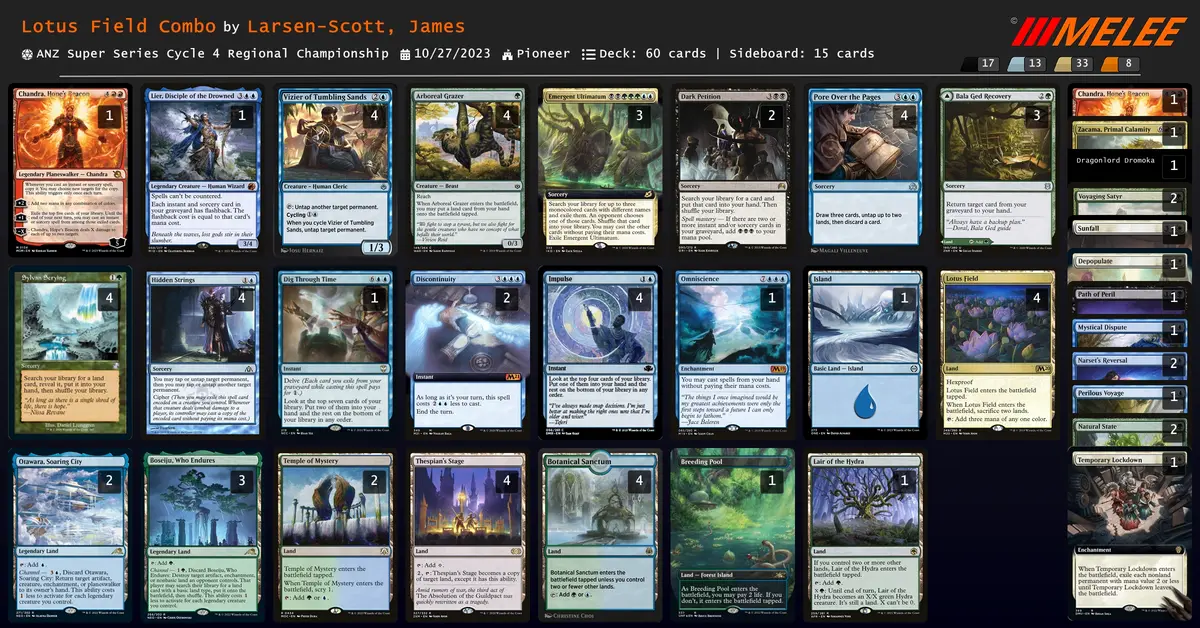
This Lotus Field list is much like the European champion’s list, but it chose to play one fewer Discontinuity in favor of Dig Through Time, presumably to find more resources in the mid-to-late game.
Rakdos Midrange
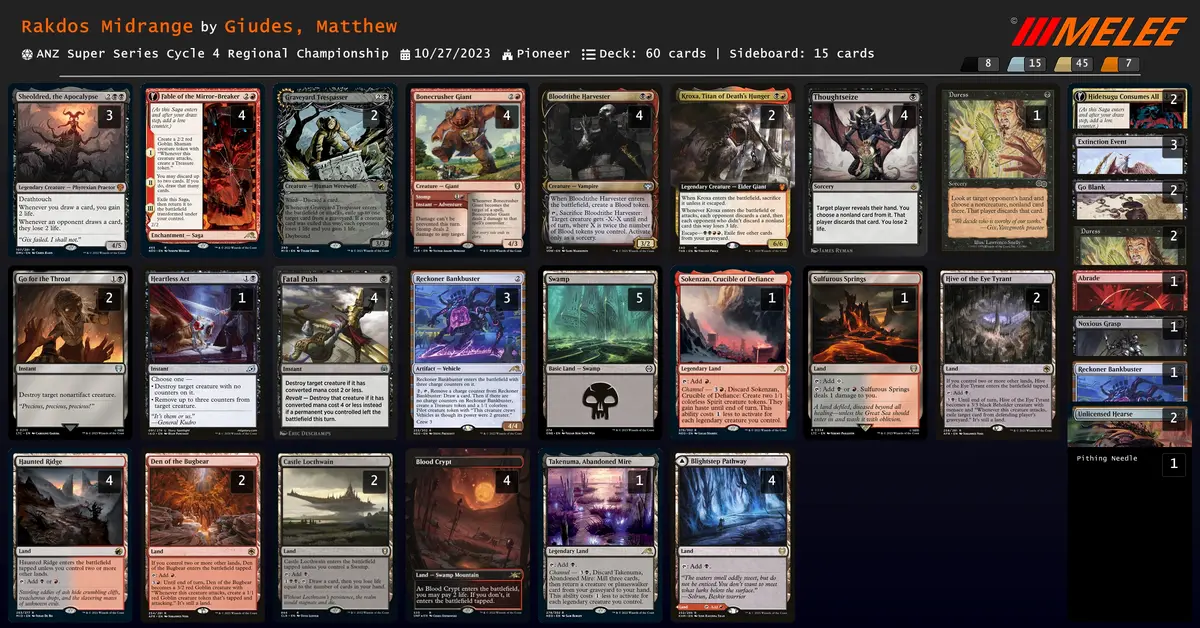
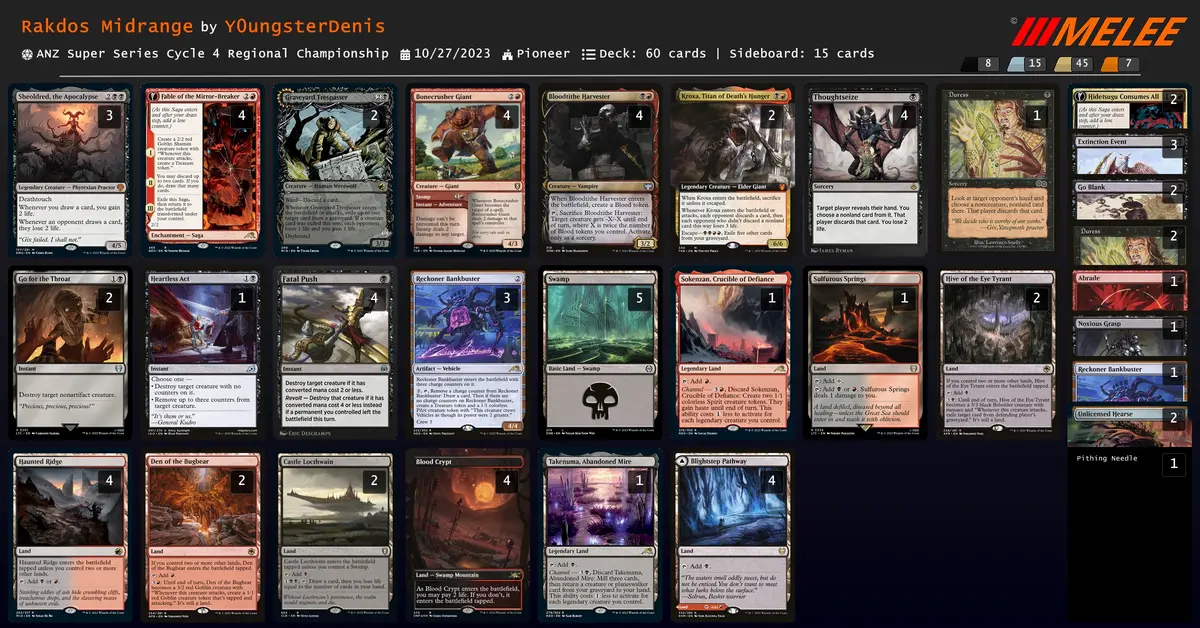
I’d guess Australians and New Zealanders don’t like Mono-Green Devotion as much and fewer people play it, so quite a few Rakdos players chose not to play Misery’s Shadow, and instead ran more mirror-advantage cards.
However, the Taiwan metagame should have quite a bit of Mono-Green Devotion and Sacrifice, so personally I’d still play it just in case.
Boros Convoke
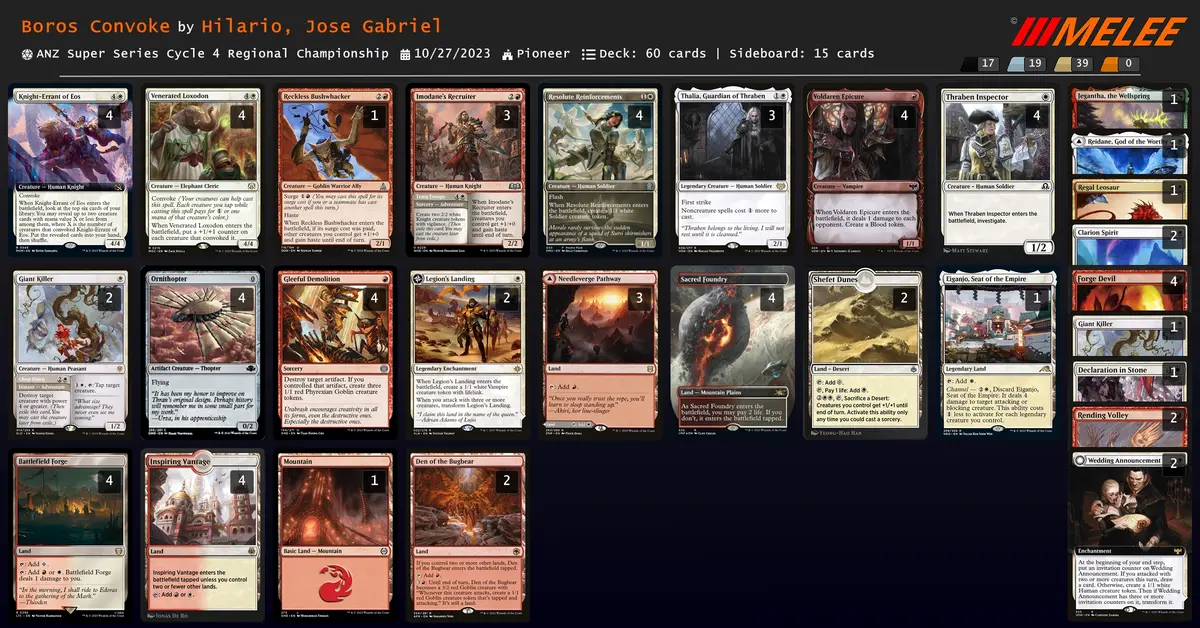
Convoke also hasn’t changed much from before, but this build seems to be going for a higher ceiling, trying to see if it can make three creatures on turn 1 and throw down Ornithopter and Reckless Bushwhacker on turn 2 for nine damage, so it still has one Reckless Bushwhacker. It also chose Thalia, Guardian of Thraben over Clarion Spirit, presumably to delay the opponent’s sweepers; buying one extra turn almost certainly lets it kill control.
It also plays two Giant Killer, presumably to target decks with bigger creatures. This build can be called a version tuned very specifically to the tournament environment.
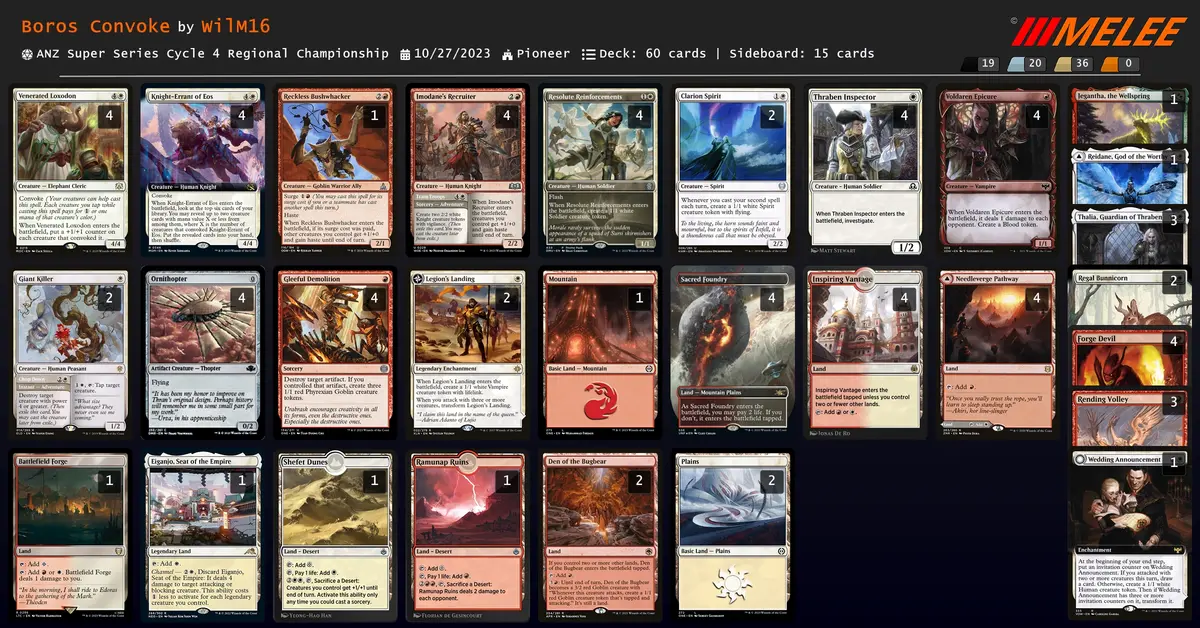
The other top 8 build is more common, with the targeted cards almost all in the sideboard.
Gruul Vehicles
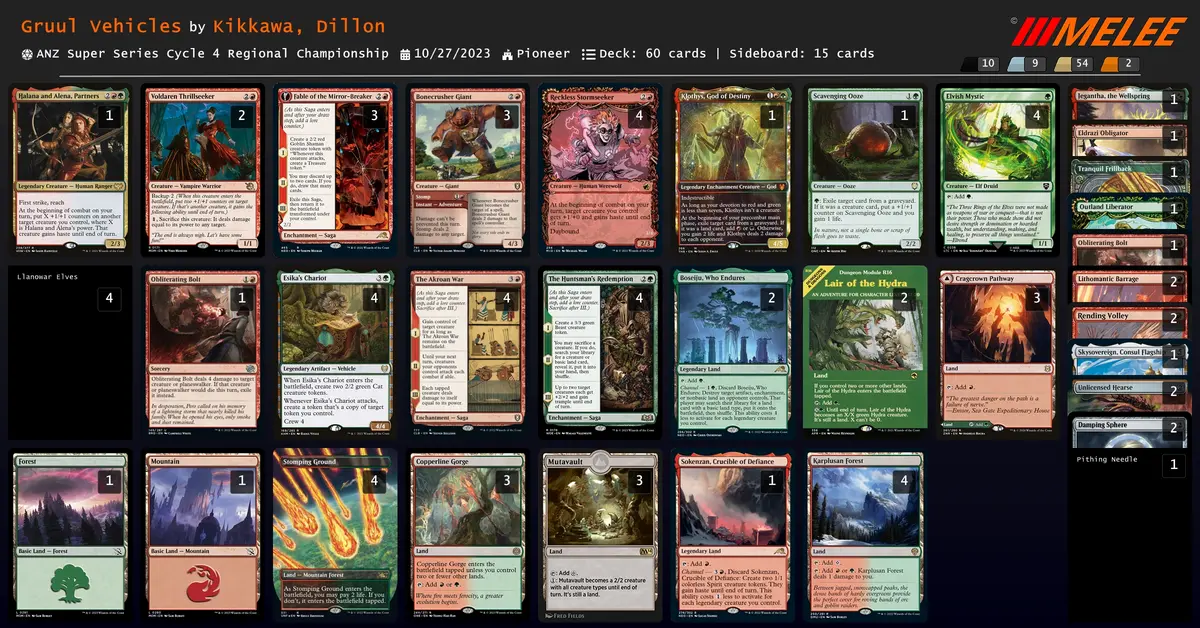
It seems I haven’t mentioned how Gruul Vehicles changed after WOE.

In short, it gained a new Saga. This Saga is very important in current builds: it makes a 3/3 on entering without losing tempo, chapter II lets you sacrifice a creature to search your library for any creature card and put it in your hand, and chapter III gives up to two creatures +2/+2 and trample until end of turn.
Because of its toolbox nature, you can lower the count of many creatures that you’d usually only use once (for example, Voldaren Thrillseeker, where usually once you find one the opponent is about to die). You no longer need to run two, three, or even four copies just to draw it, and drawing duplicates no longer hurts your tempo; at the same time you can main deck a single copy of cards that are only useful in certain matchups and simply search for them when needed.
By the same logic, it can also greatly reduce the number of creatures in the sideboard: for some targeted creatures, one copy for the Saga to find is enough, freeing more sideboard space for noncreature cards such as Damping Sphere.
This build is also rather special: it plays only four Esika’s Chariot (so where’s the vehicle element, I ask?) but plays 11 Sagas, which looks like an attempt to keep a high resource level while applying pressure.
Dragon Shield Cup MTG China Open S4 Regional Championship
The China RC ran at the same time as the Australia/New Zealand one and also ended last weekend.
There were 215 players, with a top 8 taken after eight Swiss rounds on Day 1, going into single elimination on Day 2.
As usual, deck stats first. Usage percentages are all rounded to one decimal place, so the sum may not be 100%, and only decks with more than 5 copies are listed.
| Archetype | Deck Count | % of Field |
|---|---|---|
| Rakdos Midrange | 30 | 14.0% |
| Izzet Phoenix | 22 | 10.2% |
| Lotus Field Combo | 19 | 8.8% |
| Mono-Green Devotion | 17 | 7.9% |
| Rona Lukka Combo | 14 | 6.5% |
| Boros Convoke | 12 | 5.6% |
| Azorius Control | 10 | 4.7% |
| Enigmatic Fires | 9 | 4.2% |
| Azorius Spirits | 8 | 3.7% |
| Abzan Greasefang | 8 | 3.7% |
| Boros Heroic | 7 | 3.3% |
| Mono-White Humans | 6 | 2.8% |
| Rakdos Sacrifice | 6 | 2.8% |
| Gruul Vehicles | 6 | 2.8% |
| Atarka Red | 5 | 2.3% |
| Omnath to Light | 5 | 2.3% |
| Others | 32 | 14.9% |
Overall the proportions look fairly normal, but there was somewhat less Sacrifice and Mono-Green Devotion, and Rona Lukka Combo has been trending upward since the European RC.
Next, the single-card usage:
| Card | Copies | Decks | |
|---|---|---|---|
| 1 | Fatal Push | 252 | 33% |
| 2 | Thoughtseize | 236 | 29% |
| 3 | Fable of the Mirror-Breaker | 232 | 27% |
| 4 | Bloodtithe Harvester | 156 | 18% |
| 5 | Elvish Mystic | 153 | 19% |
| 6 | Bonecrusher Giant | 152 | 20% |
| 7 | Llanowar Elves | 150 | 19% |
| 8 | Rending Volley | 146 | 30% |
| 9 | Duress | 135 | 26% |
| 10 | Sheoldred, the Apocalypse | 130 | 23% |
Still the same old faces.
The top 8 decks are as follows, with records taken from the Swiss rounds:
| Rank | Player | Decklist | Record |
|---|---|---|---|
| 1 | Fu Yu | Rakdos Sacrifice | 7-1-0 |
| 2 | 徐 堉程 | Rakdos Midrange | 6-1-1 |
| 4 | 于 音 | Waste Not | 6-0-2 |
| 4 | 望洋 曾 | Boros Convoke | 6-0-2 |
| 8 | Chengyi Wei | Izzet Phoenix | 6-0-2 |
| 8 | CptNixon | Izzet Phoenix | 6-0-2 |
| 8 | Hongtao Zhang | Rona Lukka Combo | 6-1-1 |
| 8 | Beenew | Abzan Greasefang | 7-1-0 |
Rakdos Sacrifice
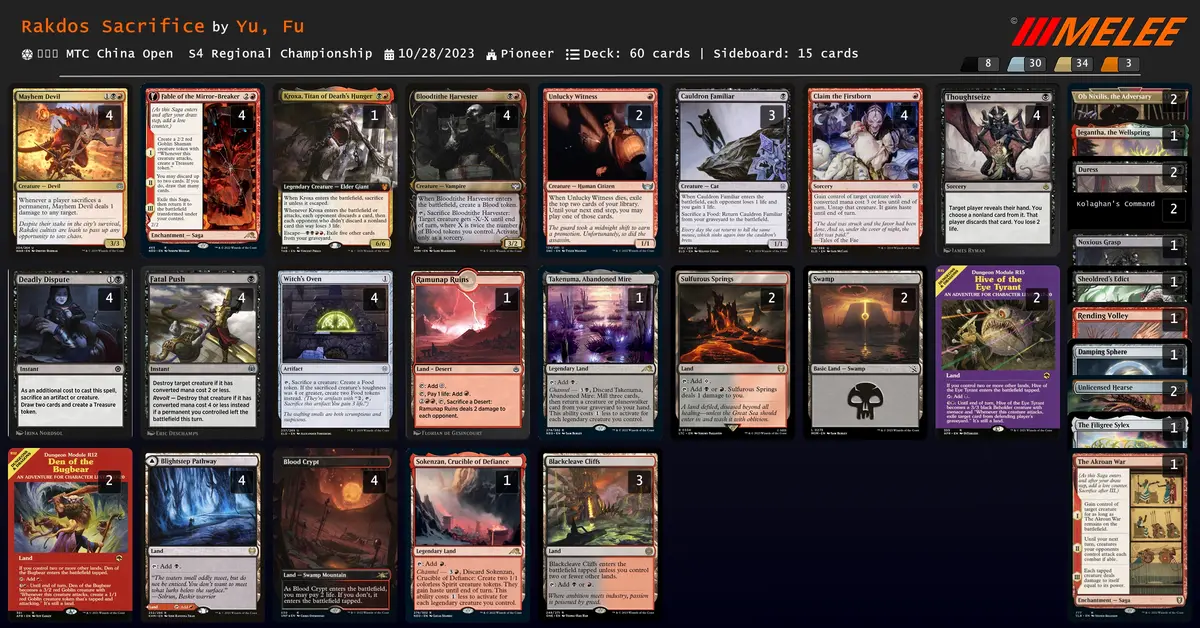
Sacrifice looks the same as ever, but the sideboard’s removal slot is The Akroan War, presumably to avoid stealing something that then has nothing to do; at least it can attack/block one more time before you figure out what to do.
Rakdos Midrange
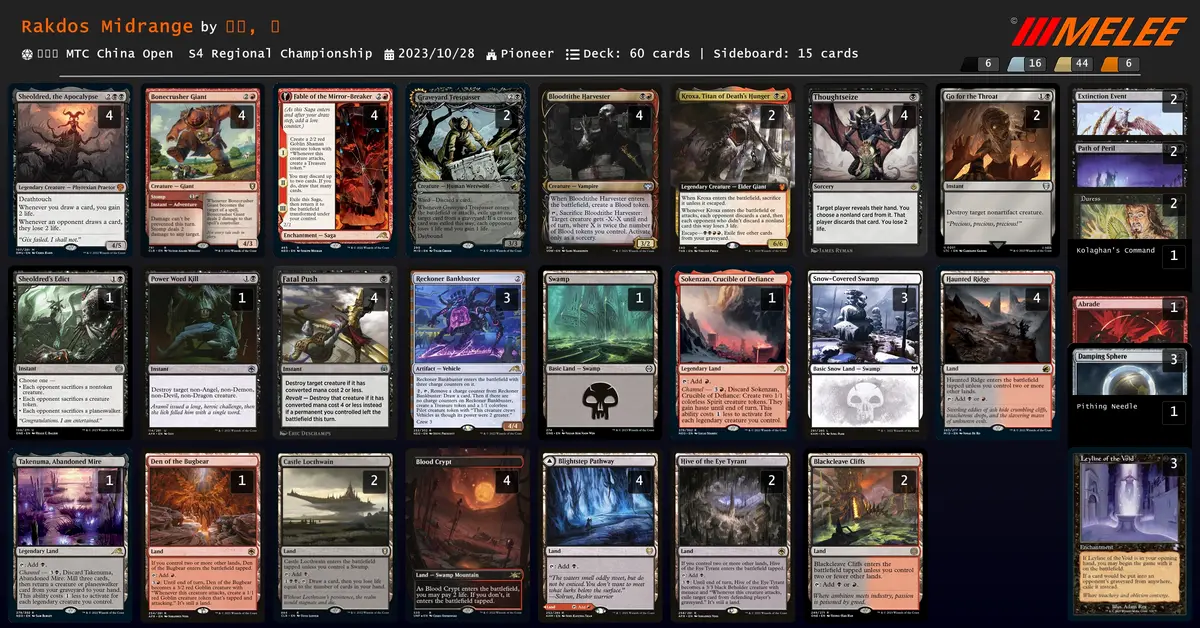
This midrange build chose to play a fourth Sheoldred, and its sideboard has three Damping Sphere and three Leyline of the Void, so it probably really hates Phoenix (although looking at its pairings, it never met one).
Waste Not
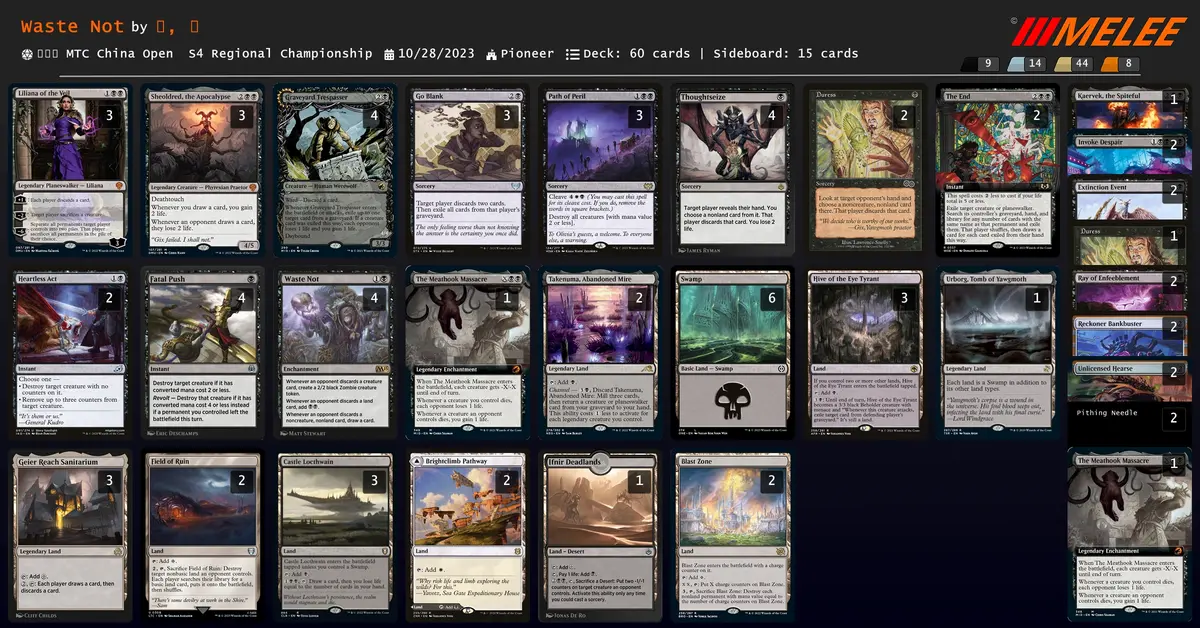
This Waste Not deck actually started 6-0, which surprised me a lot.

Let me explain for those who don’t know what this deck does. In short, whenever the opponent discards, you get a corresponding effect: discarding a creature makes a 2/2 Zombie, discarding a land adds two black mana, and anything else draws you a card. This strengthens the old discard effect, which was a one-for-one that didn’t gain any resources.
So besides the standard four Thoughtseize, the deck also plays two Duress, three Go Blank, three Liliana of the Veil, and other discard effects.
Basically you can think of it as pure-black hand control, or something a bit like Modern’s 8-Rack, a deck that gains value from lots of discard.
The two extra black-white double-faced lands are there so that Path of Peril can be cast with cleave to clear some boards (for example, a board blown wide open by Mono-Green Devotion).
Boros Convoke
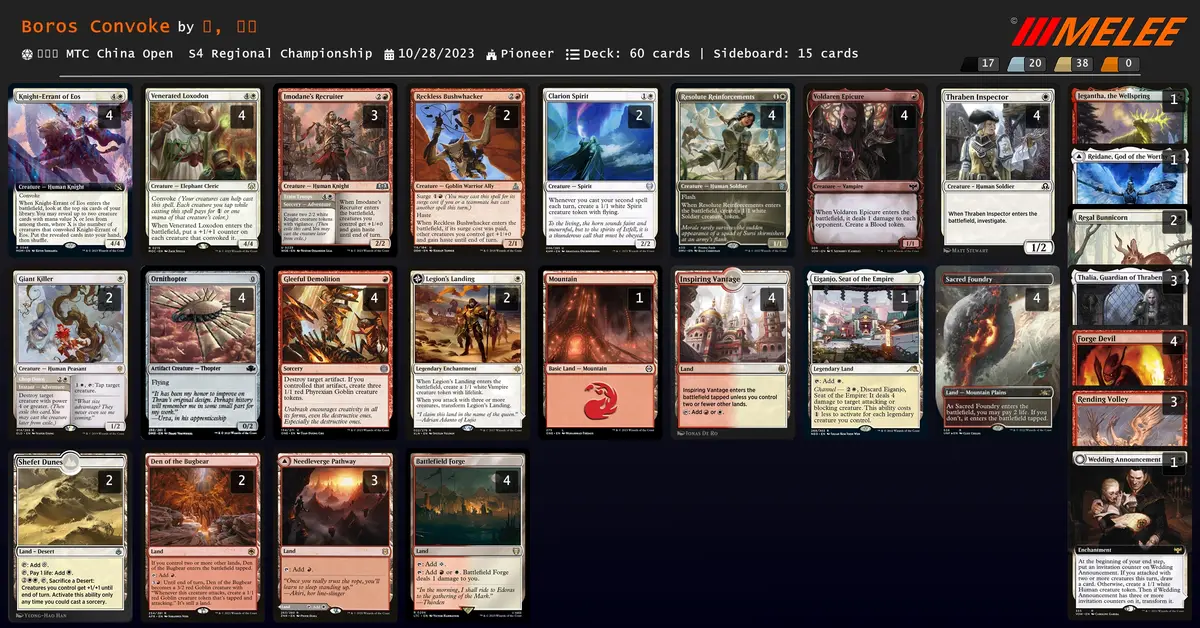
A very standard Convoke build.
Izzet Phoenix
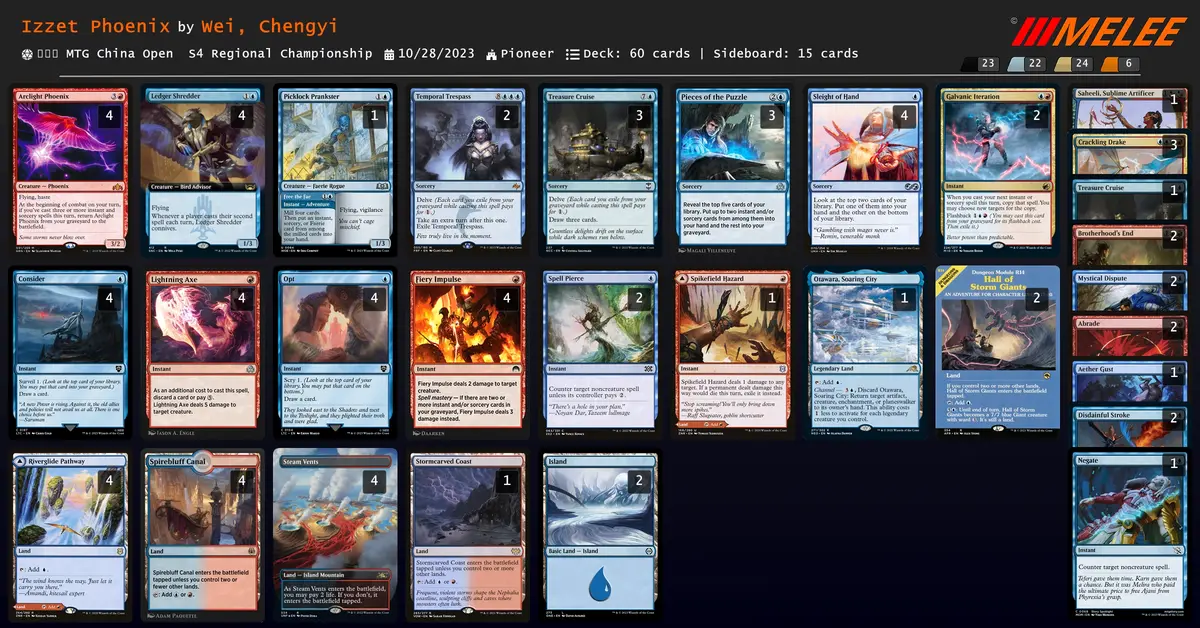
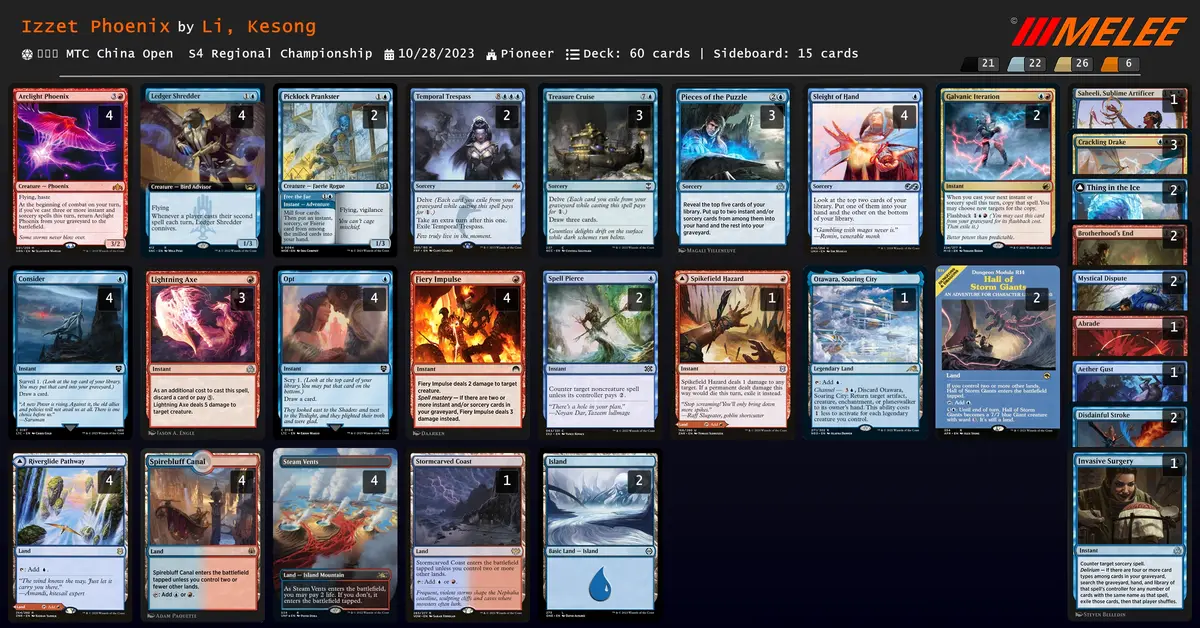
The two lists look about 87% alike. The thing to note is that they now play extra Picklock Prankster, while Chart a Course is almost no longer played by anyone.
Rona Lukka Combo
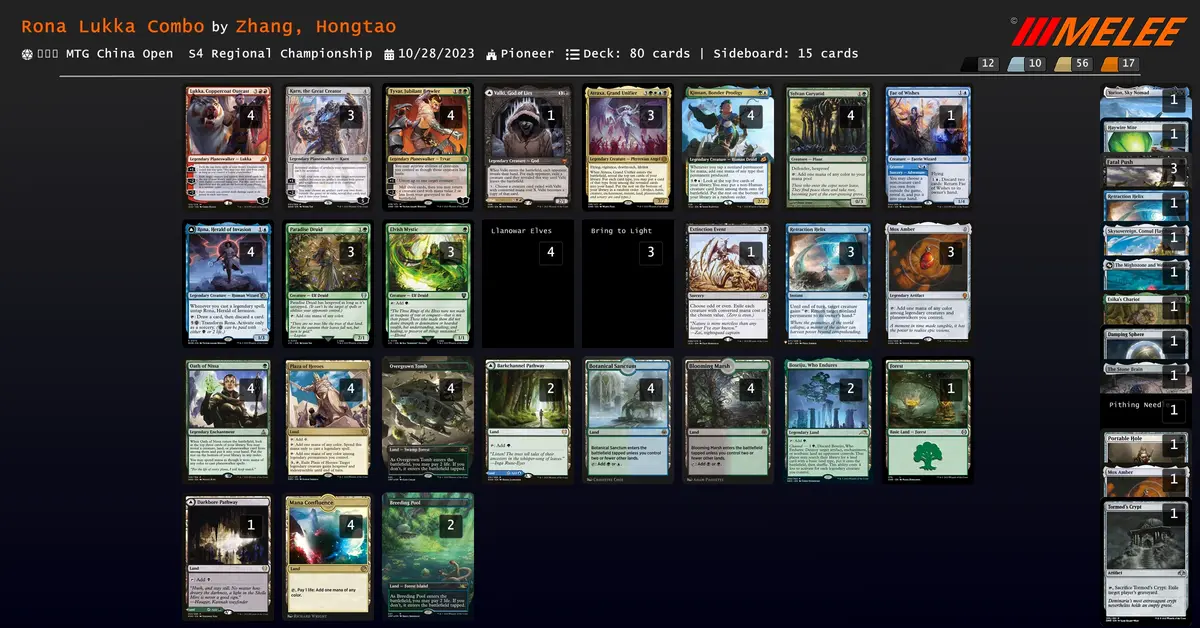
It’s much like the earlier European RC list, and you can find the details in that article.
However, this deck chose to play more removal to resist aggro, and plays neither sweepers nor discard.
Abzan Greasefang
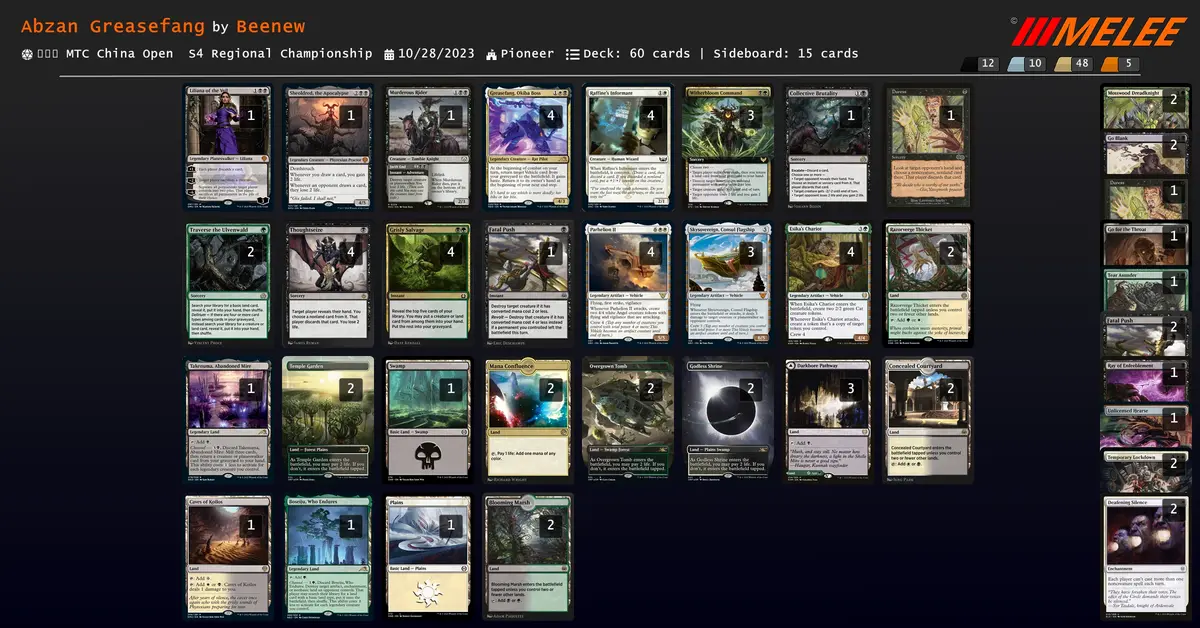
A standard Greasefang build, but the sideboard has two copies of the new Adventure card Mosswood Dreadknight, presumably for the resource war in post-board games; and two Deafening Silence, presumably for Phoenix.
Consolidated RC Data So Far
First, let’s tally the total number of top 8 decks:
| Archetype | Deck Count | % of Data |
|---|---|---|
| Rakdos Midrange | 5 | 15.6% |
| Abzan Greasefang | 3 | 9.4% |
| Lotus Field Combo | 3 | 9.4% |
| Boros Convoke | 3 | 9.4% |
| Gruul Vehicles | 3 | 9.4% |
| Rakdos Sacrifice | 3 | 9.4% |
| Izzet Phoenix | 3 | 9.4% |
| Boros Heroic | 2 | 6.2% |
| Rona Lukka Combo | 2 | 6.2% |
| Enigmatic Fires | 2 | 6.2% |
| Waste Not | 1 | 3.1% |
| UW Control | 1 | 3.1% |
| Mono-Green Devotion | 1 | 3.1% |
From the stats we can see that among all top 8 decks, Rakdos Midrange still takes first place in count.
This shows Rakdos Midrange is still performing quite well in the current meta. Its excellent individual card value, plus cheap disruption/removal like Thoughtseize and Fatal Push, also gives it some mulligan flexibility. In games with an open decklist it’s really comfortable: you know what to watch out for, and which cards don’t matter and can be fed to Fable/Bloodtithe Harvester to filter resources.
Because of this, there’s quite a bit of Mono-Green Devotion and Enigmatic Fires in the tournament field too, as the best counters to Rakdos Midrange in the meta still see plenty of play.
Meanwhile, aggro decks like Mono-White Humans and Convoke are good choices for breaking through Mono-Green Devotion and Enigmatic Fires; you just have to bash their heads in before their boards grow.
But in some ways these two decks are very afraid of Rakdos Midrange/Sacrifice. As decks with almost no way to refill their hands, they’re easily stopped from running smoothly by repeated discard and spot removal. At the same time, Rakdos Midrange has sweepers in the sideboard games, Sacrifice has the Witch’s Oven and Cauldron Familiar combo to reduce damage, and once a key creature (Sheoldred or Mayhem Devil) stands up, it’s basically a slow death.
So Pioneer feels a bit like rock-paper-scissors, plus Phoenix, which has returned to the top tables for various reasons recently, control and Indomitable Creativity that are about to vanish from the tournament scene, Greasefang that gets caught in the crossfire, Spirits ground into the dirt by Phoenix, and so on.
The main reason for Phoenix’s return is the WOE support. The combination of Sleight of Hand and Picklock Prankster is just too powerful, but because of that there’s more graveyard hate in the metagame, and Greasefang and Neoform decks get caught in the crossfire.
Also, Phoenix’s rising numbers further squeeze the survival space of Spirits and Indomitable Creativity. Indomitable Creativity is easy to understand: it’s simply too slow. As for Spirits, they interfere with the board too little. Setting aside Thing in the Ice flipping to bounce all non-Horror creatures and hitting back, even if Phoenix trades with you, after a while it can crawl back onto the battlefield, not to mention that those eight burn spells can burn through almost every Spirit.
Control hasn’t performed well recently. I personally think the main reason is that the metagame is too varied with too many threats, and control has almost no energy left to handle every situation.
MIT #4 Metagame Analysis
Phoenix, Mono-White Humans, and Convoke Should Be the Most Common
Phoenix has always been a very popular deck in Taiwan. Even though it didn’t perform well in the metagame for a while, quite a few players still chose it for MITQs, so I believe that after getting stronger, many players will dig their dusty Phoenix out.
Mono-White Humans and Convoke are comparatively easy decks to play. In a tournament of at least seven rounds as far as the eye can see, choosing a deck that doesn’t require racking your brain and has shorter games is more comfortable.
I estimate 30 to 40 copies here, or even more.
Mono-Green Devotion, Rakdos Midrange, Rakdos Sacrifice, and Gruul Vehicles Won’t Be Rare
Further down should be Mono-Green Devotion, Rakdos Midrange, and Rakdos Sacrifice. As the most consistently performing decks in the metagame, quite a few people will still choose to play them.
But there are a few reasons why the numbers won’t be too large:
- Mono-Green Devotion mostly relies on the right hand (the draw) most of the time, so players who don’t like topdeck wars (like me) won’t choose it
- Rakdos decks are really expensive, and the practice required is high
- They have clearly unfavorable matchups
Gruul Vehicles has performed well recently, and with the toolbox Saga it can fit the tournament environment better, so the number played should be higher than at MIT #3.
Based on the points above, I estimate around 25 copies here.
Heroic, Control, Lotus Field Combo, Spirits, Rona Combo, and Enigmatic Fires Will Show Up Sporadically but Not in Large Numbers
Finally, there are the decks that have sporadically made the top 8 in tournaments and still have a certain strength.
And Rona combo’s recent rise in tournaments should make it a part of the metagame that can’t be ignored.
Conclusion
Today we took advantage of the lead-up to MIT #4 to review the tournament scene and organize some data.
Barring surprises, we’ll write a review article after MIT #4, and if my results are decent I’ll probably write a new Rakdos Midrange article too, mainly about the sideboard guide and card choices in the current metagame.
Well then, see you all on the tournament floor this weekend!
- Title
- Pioneer Meta Inspection: preMIT #4
- Author
- MiohitoKiri5474
- Created at
- November 1, 2023
- License
- This work is licensed under CC BY-NC-SA 4.0 .