
Pioneer Five-Color Bring to Light Niv-Mizzet

Note: This article was translated from Chinese by AI and may contain errors. Read the original Chinese version.
Introduction
Hi everyone, this is Enki. I wonder whether you all enjoyed PT MKM? Murders at Karlov Manor has had quite an impact on the game’s meta. Besides Leyline of the Guildpact running rampant in Modern, many new cards have also been adopted in Pioneer, such as Vein Ripper, which turned Rakdos Midrange into Rakdos Vampires, and No More Lies, which strengthened Azorius Control, already a deck with a solid win rate. These are all newcomers that have performed well in this environment. The set also introduced a wide variety of gold cards, which makes the range of cards hit by Niv-Mizzet Reborn’s ability very broad. I think this long-awaited upgrade has pulled the deck up to a level that can stand against the current meta.
I also chose to play this deck at the MagicCon Pioneer Cup held alongside PT MKM, and finished the Swiss rounds at 6-0-1, ranked second, which is a pretty good result. That inspired me to write a proper introduction of this deck.
Without further ado, let’s get to the introduction. As usual, here is the decklist first: Decklist link
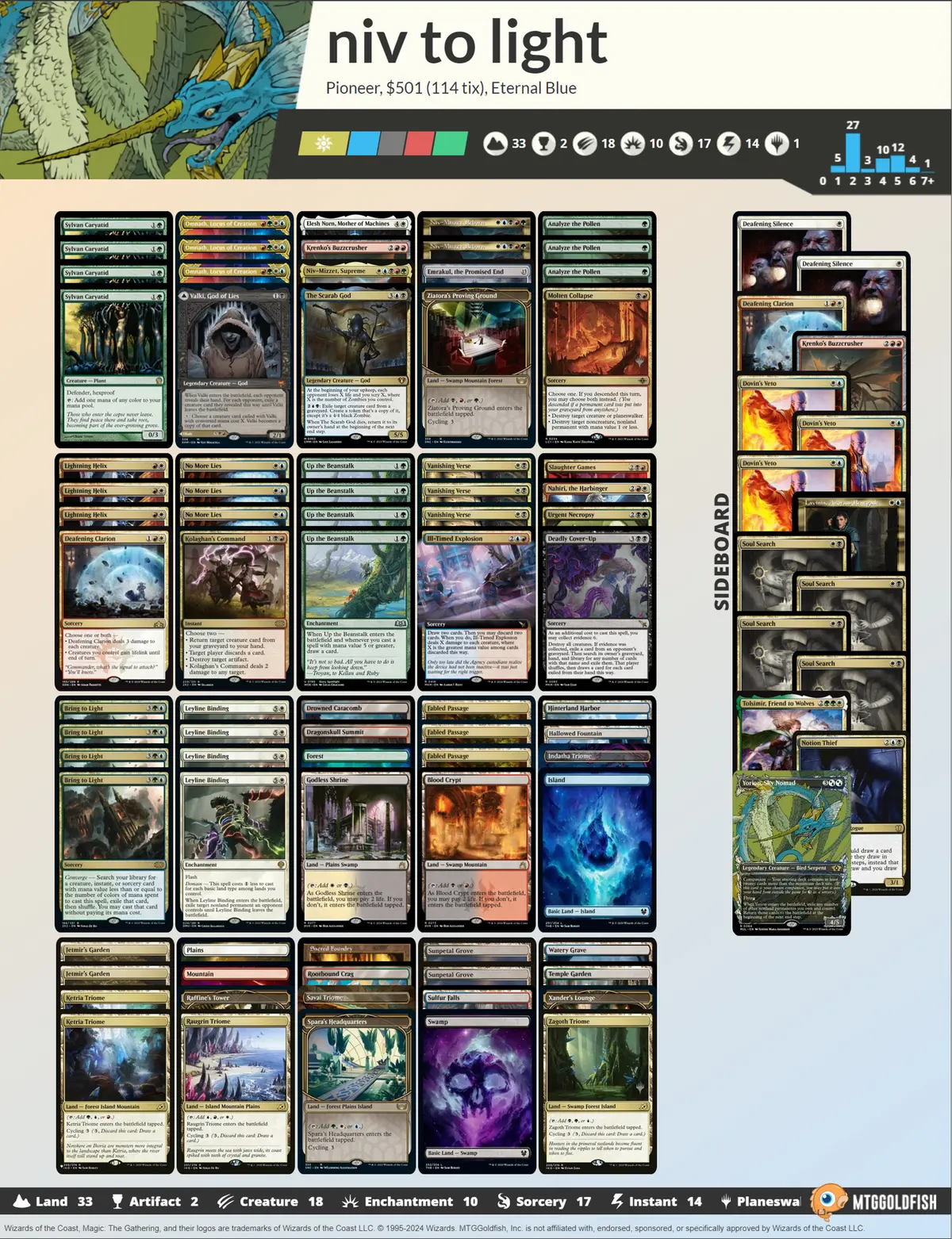
How the Deck Works
The play style sits somewhere between midrange and control. Roughly 90% of games are spent trading resources, trying every way to drag the game into the late game and finish it by building a huge resource advantage with expensive cards.
This deck has two core cards:

This is the card that generates the resource advantage: reveal the top 10 cards of your library, and for every two-color combination you can take one spell into your hand. To go with this card, the deck contains a large number of gold spells so that this ability earns us roughly 2 to 4 cards at once.

The most important card in the deck. Pay five mana (three generic plus blue and green), and depending on the number of colors of mana spent to cast this spell, search your library for an instant, sorcery, or creature card and cast it for free.
Because of its tutor nature, we can reduce the number of copies of any important card in the deck. Basically we only run one copy of each (plus the four copies of this card, which makes five), so we can compress the deck and include more singleton answers for different situations, making this a sort of alternative toolbox deck.
Remember that casting this card requires color fixing: you find a card with mana value equal to or less than the number of colors you used to cast it, so you can’t simply search for anything just because you’ve counted out the mana.
Bring to Light and Modal Double-Faced Cards
One more thing worth mentioning is the rules interaction between Bring to Light and modal double-faced cards. The play players probably see most often is using Bring to Light to cast Valki, God of Lies // Tibalt, Cosmic Impostor and bring out the 7-mana planeswalker on the back.
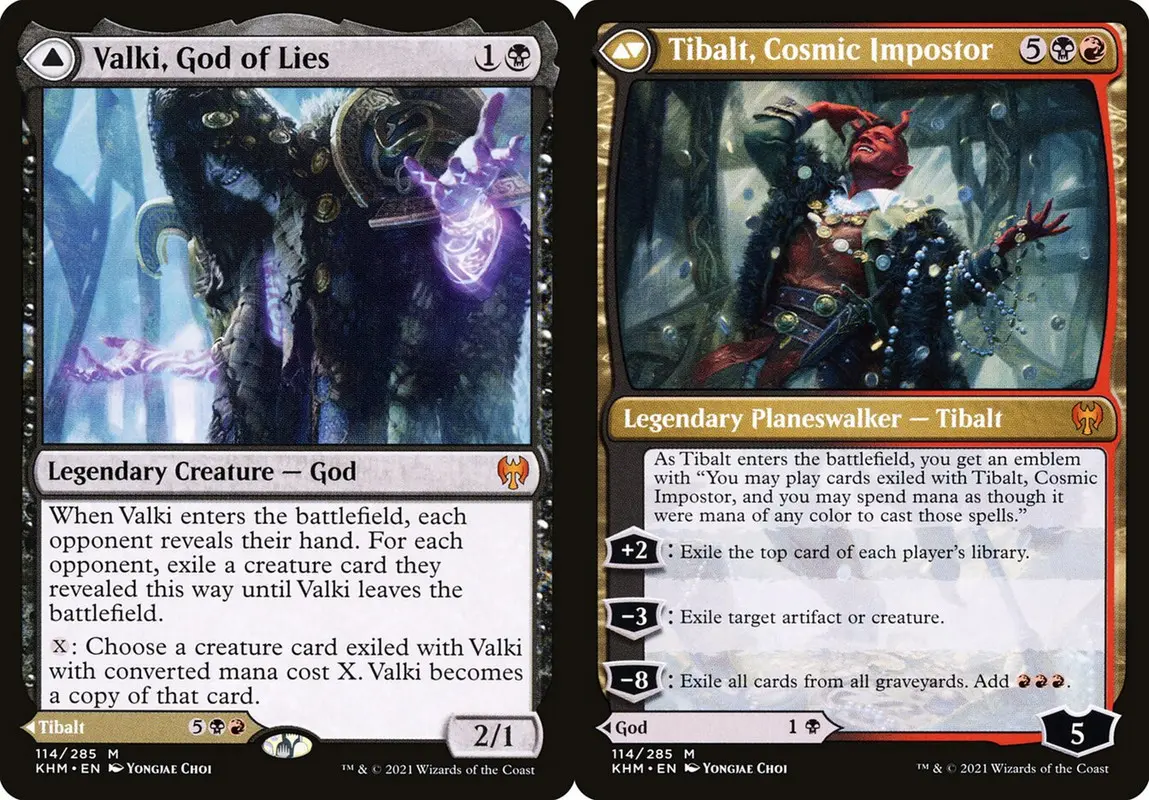
You might ask: doesn’t Bring to Light only let you cast five-mana cards at most, since you can pay at most five colors?
This is where the mechanics and ordering that apply when Bring to Light resolves come in.
When you cast Bring to Light to find Valki, God of Lies // Tibalt, Cosmic Impostor, the rules process it like this:
- Cast Bring to Light for five mana, paying at least two colors.
- When Bring to Light resolves, a double-faced card in the library is treated as having only its “front face” characteristics. Since the front of this card is Valki, God of Lies, it is treated as a “two-mana card” while searching the library, so by the rules it can be found by Bring to Light.
- Because it was found by Bring to Light, you may exile Valki and cast it without paying its mana cost.
- When casting Valki, the player chooses whether to cast its front or back face. Since both faces are treated as the “same card” by the rules, the player can cast its back face, “Tibalt, Cosmic Impostor”, without paying its mana cost.
When this card was first released, the rules for the cascade ability hadn’t been changed yet, which led to a flood of Modern games where players used three-mana cascade spells to bring out “Tibalt, Cosmic Impostor”. It became so rampant that Wizards made an emergency change to cascade. Now the only way left to bring out Valki, God of Lies // Tibalt, Cosmic Impostor without paying 7 mana is by using Bring to Light.
Adding the New Cards
Murders at Karlov Manor brought many gold spells that suit this deck. Since we are a five-color deck, besides playing tri-lands, the deck also includes cards like Sylvan Caryatid and Fabled Passage to adjust the mana base, so most of the time we don’t need to worry much about being unable to cast these spells.

No More Lies is a new card that Azorius Control plays, and our deck can enjoy its benefits too. As a two-mana counterspell it is very forgiving: it can create effective disruption early on and can also be used to counter back in a counter war. The downside is that once costs explode in the late game, it doesn’t have as much impact.

The reprint of Lightning Helix in this set is the strongest upgrade for this deck. For two mana it kills a small creature and gains three life, solving the old problem of this deck frequently getting beaten to death by aggro decks in the early game.

A cheaper version of Casualties of War. It can destroy multiple targets at once, on the condition that you collect evidence X, where X is the total mana value of the spell’s targets. It’s very good against decks that play many types of permanents.

The new sweeper: after drawing two cards, you may choose whether to discard two cards. If you discard, it deals damage to every creature equal to the highest mana value among the discarded cards.
After discarding, a sweeper trigger goes on the stack, and the opponent can respond to it at this point.

An artifact aimed at the extremely unfavorable matchup against Lotus Field. When it enters, it destroys a nonbasic land of your choice, and because the ability doesn’t target, it bypasses Lotus Field’s own hexproof ability.
It also solves a long-standing problem of the deck: being unable to use Leyline Binding to remove a manland.

A destroy-style sweeper combined with a Cranial Extraction-style effect. You can collect evidence 6 when casting it, and on resolution choose a card in the opponent’s graveyard and exile all cards with the same name from the opponent’s hand, library, and graveyard.
The sweep and the name-exile are part of the same sentence on resolution, so the opponent can’t respond to which card you cut.

This is probably the single card that strengthened this deck the most since the set released. Not only does it cost just one mana, but by additionally collecting evidence 8 it changes the effect from finding a basic land into your hand to finding any land or creature card into your hand. We can use this tutor effect to find the deck’s core cards (such as Niv-Mizzet Reborn) or targeted answers for a very low cost, hugely impacting the game.
And since our spells’ costs tend to be high, collecting evidence 8 in the mid to late game is basically no trouble.
Matchups and Sideboarding
This section explains the approach for different matchups and the sideboard choices.
Rakdos Midrange
| Side In | Side Out |
|---|---|
| +1 Tolsimir, Friend to Wolves | -1 Slaughter Games |
| +1 Krenko’s Buzzcrusher | -1 Emrakul, the Promised End |
| +1 Deafening Clarion | -1 Urgent Necropsy |
This matchup is basically free, because once the game reaches the mid to late stage, all of your topdecks are stronger than theirs. The opponent can only win by racing for a quick kill, so we need more effective ways to clear the board to stop them from doing that.
After sideboarding, the opponent brings in more discard. If the opponent strips your hand with discard, it doesn’t matter how strong a hand you keep, it all gets stripped. So we basically want to keep a hand with at least 3-4 lands and some early spells (which are useful if they don’t have discard), to make sure we have something to do early and that the topdecks we draw later become effective draws.
With Bring to Light, search based on the current board: find the sweeper if they have many creatures, Valki, God of Lies // Tibalt, Cosmic Impostor for a troublesome single creature, and Niv-Mizzet Reborn to refill your hand.
Izzet Phoenix
In game one, the opponent most likely has only Spell Pierce or Jwari Disruption as counterspells, so they can hardly stop our game plan. Most of our removal exiles, and we also have a Cranial Extraction-style spell, so it is very hard for Phoenix to win game one. As for removal, try to leave exile effects for Phoenix and destroy effects for Ledger Shredder.
In the sideboarded games, since we don’t know what counterspells the opponent will bring in, we first take out cards that the opponent won’t counter (expensive ground creatures, expensive destroy-style removal, and so on), and bring in cards that disrupt the opponent’s plan plus a few discard spells (bring in more discard if you want to take out other things). During the game, rank the cards in your hand by importance and play them starting from the least important, trying to bait out all their counterspells before resolving the important spells.
We keep the sweeper in game one because we may need to deal with the board that Young Pyromancer creates, and keeping Lightning Helix gives a chance to kill Young Pyromancer early or an on-time turn-two Ledger Shredder.
With Bring to Light, prioritize finding Niv-Mizzet, Supreme: it has ward against monocolored and flying, and the opponent’s whole deck has only Otawara, Soaring City to deal with it.
If the board gets out of control, usually Phoenix has already crawled out. At that point, find the sweeper with the Cranial Extraction effect, Deadly Cover-Up, collect evidence 6, and cut every Phoenix, and the opponent has basically lost. Also, in the sideboarded games, if the cut succeeds, remember to look at their deck and note which counterspells the opponent brought in, so you can plan the counter-baiting better. For example, if the opponent has Mystical Dispute, you can consider waiting until 8 mana to make your play, and if they have Negate but no Disdainful Stroke, you can consider slamming a big creature spell at 5 mana.
Abzan Amalia Combo
| Side In | Side Out |
|---|---|
| +4 Soul Search | -1 Kolaghan’s Command |
| +1 Deafening Clarion | -1 Emrakul, the Promised End |
| -1 The Scarab God | |
| -1 Nahiri, the Harbinger | |
| -1 Krenko’s Buzzcrusher |
This is also basically a favorable matchup, but if the opponent successfully pulls off the combo and gains too much life, then besides our kill clock becoming very slow, if they filter their way to Aetherflux Reservoir we are exposed to being killed. So we should still avoid letting them assemble the combo as much as possible.
The opponent has a pure creature deck. Besides relying heavily on the combo to win, it is very afraid of sweepers, so we want to first use destroy-style removal to kill Amalia Benavides Aguirre so it falls into the graveyard, and later use Bring to Light to find Deadly Cover-Up, sweep, and cut all the Amalia Benavides Aguirre too. If that succeeds, winning the game is practically a sure thing. Of course, if the opponent has no combo yet and just casts it straight, removing it with Leyline Binding works too. Also note that Vanishing Verse can’t remove Amalia Benavides Aguirre; we only use it to remove its life-gain source, or the combo’s other piece, Wildgrowth Walker.
In the sideboarded games, we take out cards that cost too much and don’t matter much in this matchup, and bring in sweepers to handle creatures and discard to dismantle the opponent’s combo.
Azorius Control
| Side In | Side Out |
|---|---|
| +4 Soul Search | -3 Lightning Helix |
| +3 Dovin’s Veto | -1 Ill-Timed Explosion |
| -1 Deadly Cover-Up | |
| -1 Deafening Clarion | |
| -1 Elesh Norn, Mother of Machines |
I think quite a few people consider this matchup fairly bad, but I personally consider it about 50-50. The new Azorius Control builds mostly run No More Lies and have stopped playing hard counters, so we have more room to get our spells past their counterspells. And as long as Up the Beanstalk, the best card against control, is on the battlefield to keep our resources flowing, the opponent will lose because they can’t counter all of our spells.
The most common reason we lose to Azorius Control is getting beaten to death by The Wandering Emperor or the tokens from a hard-cast Shark Typhoon. Remember to save removal or counterspells to handle these two threats.
In the sideboarded games, we take out the spells that fight creatures and bring in discard and counterspells. For the opening hand, we want hands with Up the Beanstalk, or hands that can hit their land drops on time.
For play style: if you have a counterspell in hand, you want to deploy threats while holding the counter for the opponent’s expensive spells. If you don’t, rank your hand by importance again, play from the least important, and bait out their counterspells as much as possible. Once you have 8 mana, you can start considering casting creature spells to pressure them.
As for what to find when Bring to Light resolves, it depends heavily on the current situation and your guess at the opponent’s hand. Usually we prioritize Valki, God of Lies // Tibalt, Cosmic Impostor, the side that casts the planeswalker, or find Niv-Mizzet Reborn directly to dig and try to widen the resource gap. If you are certain to be killed by a manland next turn, you have to find Krenko’s Buzzcrusher to blow up that manland.
Lotus Field Combo
An extremely unfavorable matchup. Basically, the only way to win in game one is to dig for Krenko’s Buzzcrusher to blow up the opponent’s Lotus Field, but since we win too slowly, the opponent gets too much time to assemble the combo, so all we can do is find a way to kill the opponent faster.
In the sideboarded games, we basically take out creature removal and some spells that don’t have time to matter, and bring in every disruption tool to stop the opponent from winning. The best cards we can draw in this matchup are Krenko’s Buzzcrusher or Lavinia, Azorius Renegade.
Krenko’s Buzzcrusher can blow up the opponent’s Lotus Field on turn 3 or 4 and leave a 4/4 clock on the battlefield to speed up the kill, while Lavinia, Azorius Renegade can make the opponent’s engine completely crash.
We keep Vanishing Verse because it can remove their land-untapping creatures, Lier, Disciple of the Drowned, and Omniscience if it has unfortunately already entered.
As for what to name when you draw the Cranial Extraction-style spell, it depends on the opponent’s win condition. When I don’t know, I just cut Hidden Strings. For the opponent to finish in a single turn, they rely heavily on Hidden Strings to generate extra mana, so the best way to slow them down is to cut their cheap land-untapping spell.
Boros Convoke
| Side In | Side Out |
|---|---|
| +1 Tolsimir, Friend to Wolves | -1 Slaughter Games |
| +1 Deafening Clarion | -1 Emrakul, the Promised End |
An extremely unfavorable matchup. You only win by drawing the sweeper, and sometimes even drawing it isn’t enough. All you can do is pray the opponent doesn’t convoke on turn two, and try to survive to the late game and fight them with creatures.
There is basically nothing in the sideboard that specifically targets this deck. Just bring in cards that are useful against creature decks, take out anything that is as good as a dead card when drawn, and then try to find an opening hand with a sweeper or several single-target removal spells to hold off the aggro as much as possible.
Boros Heroic
| Side In | Side Out |
|---|---|
| +2 Deafening Silence | -1 Slaughter Games |
| +1 Deafening Clarion | -1 Emrakul, the Promised End |
| +1 Tolsimir, Friend to Wolves | -1 The Scarab God |
| -1 Krenko’s Buzzcrusher |
A reasonably okay matchup. The opponent’s pump spells need to work together with creatures on the battlefield, so we just need to find a way to remove all of the opponent’s creatures.
In the sideboarded games we bring in two Deafening Silence to slow them down, prevent the opponent from casting too many pump spells and killing us in one turn, and buy more time to draw the sweeper and solve everything at once. Then we bring in more creature removal so that the opponent’s outs don’t multiply, and take out the creatures that have less impact on the matchup.
Conclusion
Murders at Karlov Manor gave this Bring to Light Niv-Mizzet deck a major boost. The addition of Lightning Helix and No More Lies lets the deck deal better with early threats and slow the tempo down to the mid to late game, giving us a better chance to land our expensive spells and get ahead of the opponent. Meanwhile, the tutor nature of Analyze the Pollen lets us smooth the mana base and find key creatures in the deck to change the course of the game.
I think the deck has risen to the level where it can fight the other top decks in the current meta, and most of its matchups against them are not even unfavorable. But five colors still has its mana base concerns, and since the deck is partly a toolbox, it demands more understanding of the deck from the pilot than other two- or three-color decks do.
Either way, I still highly recommend playing this Five-Color Bring to Light Niv-Mizzet deck. There is a little over a month and a half to go until the next Pioneer season, and then we’ll see how far this deck can go!
- Title
- Pioneer Five-Color Bring to Light Niv-Mizzet
- Author
- Enki
- Created at
- March 6, 2024
- License
- This work is licensed under CC BY-NC-SA 4.0 .