Something About Rakdos Midrange

Note: This article was translated from Chinese by AI and may contain errors. Read the original Chinese version.
Before We Start
Before we start, let me briefly talk about why I wanted to write this article.
First, as an MTG player who plays in tournaments, I’m more familiar with the formats the official side is currently pushing, which over the past year means Standard and Pioneer.
As for Standard, I’ve always played it half-heartedly. I’d just piece together the cheap mono-blue deck first and figure out the rest later, and at worst borrow cards from friends. The main reason is that I’m kind of fed up with a deck that costs 500 bucks but can only be played for a bit over a year, and I’d have to keep chasing updates to the decklist with every new set.
So compared with Standard, I prefer Eternal formats.
Right around then Wizards was about to relaunch the Pro Tour, and the domestic qualifiers were about to start, so I got ready to dive into Pioneer.
At the very beginning I built Lotus Field Combo, the one that races to get Lotus Field + Thespian’s Stage out early, then keeps resetting those two lands to earn mana and finish with a combo. Since you only need to buy a Pioneer Challenger deck plus a bit more to complete it, and I had always wanted to try a combo deck in a constructed format, I built it.
Later, because it required quite a lot of practice, and honestly after playing it a long time it got a bit boring (always doing the same thing), and it was easy to get myself stuck with my own bad hands, I planned to build another deck, a prowess deck.
…And then only after the format balanced itself out on the tournament floor did they ban Winota, and to deal with Phoenix they also locked up Expressive Iteration along the way. After one night’s sleep, the prowess deck I was almost done building had taken a bullet too.
Although it could still be played without Iteration, getting a card banned is just really annoying, and it wasn’t until right before the Taiwan MITQ was about to start that I built a Bant Humans deck.
…Then in a win-in match my Collected Company whiffed twice, thanks.
After playing for a while with not-so-good results, I started wondering whether I’m just not suited to this kind of deck. I borrowed a few other decks along the way, but none felt right, so in the end I still took Lotus Field and stumbled through the first season of MITQ in a daze.
(The second season of MITQ was Standard, which has nothing to do with Pioneer, so I’ll skip it here.)
When the third season started, I again took out Lotus Field first, but in the first or second MITQ I played, everything blew up and I kept getting stuck with bad hands, which finally made me resolve to dismantle Lotus Field.
So I started looking for decks again. The Collected Company archetypes in the environment at that time only had Angels left, and because of the trauma from those earlier whiffs I didn’t really want to touch a similar deck, and Green Devotion was ruled out for the same reason.
Along the way I also played control and Greasefang, and basically touched almost every top-tier deck. In the end, because I made top eight with Rakdos midrange in a tournament of about 2X players, and top four the following week, I decided to build Rakdos midrange, and I’ve been playing it all the way to now.
Decklist
First, some parts of the build should never change no matter what:
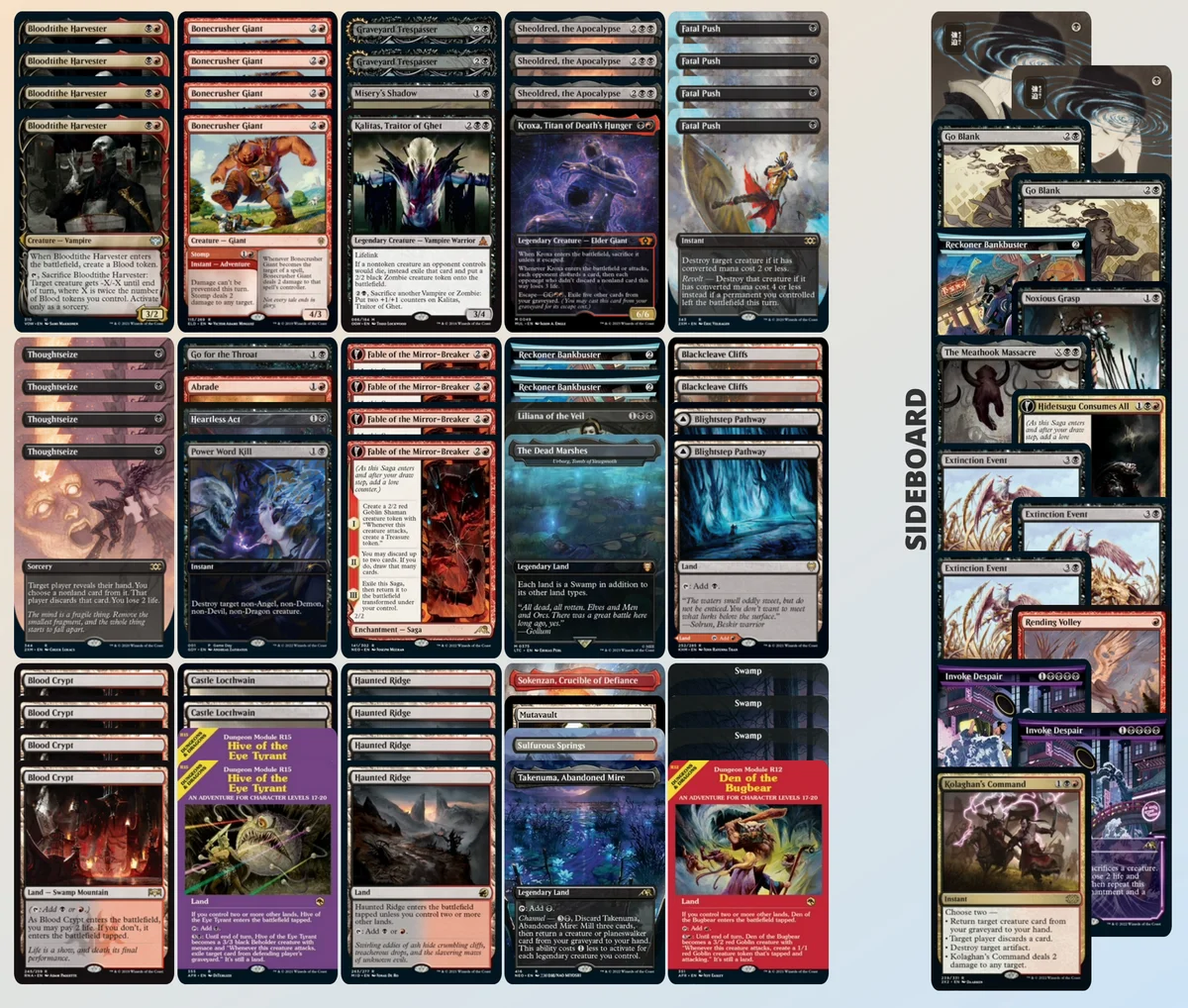
4x Bloodtithe Harvester
First is an excellent one-for-many creature that can be used as removal/filtering/an attacker.
4x Bonecrusher Giant
Besides being a Shock, it comes with the effect that damage can’t be prevented (this is fairly important, as it can stop protection-from-color type effects), and it’s also a creature with excellent stats.
4x Fatal Push
The best one-mana removal in the environment.
4x Thoughtseize
The best discard in the environment.
4x Fable of the Mirror-Breaker
A card so strong in Standard that it got banned; there’s no reason not to run the full four. It filters, makes a Goblin, makes Treasure, and is also a win con (and a “how to lose”).
25x ~ 26x Lands
I’ll write more about the lands later.
Next are the other creatures. I’m currently using the following extra creatures:
1x Kroxa, Titan of Death’s Hunger
Very comfortable in mirror matches and against control, and also useful against Rogues (whether it resolves or not doesn’t matter, I get to push down the graveyard count first).
1x Misery’s Shadow
The aim is to keep the sacrifice Cat-Oven from spinning, to jam up the flip-two-use-one of Unlucky Witness, and also to stop the death effects of Green Devotion’s Cavalier of Thorns and Old-Growth Troll.
2x Graveyard Trespasser
A slightly awkward card. In the current environment most graveyard hate wants to exile everything, but its life gain is quite important in some matchups (mirror, aggro), and I haven’t found a better replacement for now.
2x Sheoldred, the Apocalypse + 2x Archfiend of the Dross
A rather large number of four-drop creatures. Archfiend of the Dross is a tech card that only appeared in the last month or two, meant to fight the whole pack of aggro decks and creature decks, and it also works wonders against Green Devotion (though it still gets blocked by Cavalier of Thorns, at least it won’t die). Since our deck already has plenty of removal, its life-loss effect can speed up the game, but the downside is that it squeezes Sheoldred’s slot. I’ll adjust according to the environment, and if its payoff isn’t high I’ll change this back to three Sheoldred plus one Invoke Despair or one Skysovereign, Consul Flagship.
Edit(July 12, 2023):
I later changed to 3x Sheoldred, the Apocalypse + 1x Kalitas, Traitor of Ghet, our old friend we haven’t seen in nearly a year.
The main reason is that there’s a lot of convoke in the environment now. Although Archfiend of the Dross is more comfortable against sacrifice, honestly the number of players south of Taichung who play sacrifice and play it well is really too small compared with convoke, and quite a few Rakdos midrange players now worry about Archfiend of the Dross and skip Power Word Kill for Heartless Act. Kalitas has a chance to dodge Heartless Act by sacrificing a Zombie or Vampire, so I chose to put the old friend back.
And I also earned my qualification at 台中諾亞 with this build.
Next are the remaining cards:
4x 2 drop Instant Speed Removal Spell
Here I chose one of each of four two-mana removal spells to handle various kinds of decks. Every removal spell has a drawback, so to make up for those drawbacks I take a bit of each (shrug.
1x Liliana of the Veil
It suppresses control, combo, or decks like Green Devotion that hoard hand advantage, forcing the opponent to join the topdecking crowd, and we can use the cards in our hand first before using her +1, creating a resource gap.
2x Reckoner Bankbuster
I originally had one main and one sideboard Bankbuster, with the extra slot holding a removal spell, but I found that in the current environment (at least the southern one) one more card-draw vehicle seems better, so I changed to two main and one sideboard.
Finally, the lands. The current mainstream configurations roughly fall into two types: Shota Yasooka’s 26-land, three-Mutavault configuration used at Pro Tour Philadelphia, and Misplacedginger’s 25-land, three-Castle Locthwain configuration. I roughly follow Misplacedginger’s configuration, with some fine-tuning.
Of course some cards will definitely not change:
4x Blood Crypt
4x Haunted Ridge
The rest is adjusted to personal preference:
2x Blackcleave Cliffs + 2x Blightstep Pathway + 1x Sulfurous Springs
Other fixing lands. I personally don’t like modal double-faced lands, mainly because they’re not flexible enough in the late game, and Blackcleave Cliffs used to be three copies, but it was too easy to get stuck on turn four unable to hard-cast Sheoldred on time, which is awkward, so I cut it to two and put Sulfurous Springs in the extra slot to hold things up.
1x Den of the Bugbear + 2x Hive of the Eye Tyrant + 1x Mutavault
It used to be 2x Den of the Bugbear + 2x Hive of the Eye Tyrant, but honestly Den of the Bugbear isn’t that suited to Rakdos. Although its attacking power is better than Hive of the Eye Tyrant’s, it has no trample and can’t gain any resource advantage. At least Hive of the Eye Tyrant has menace and fills the graveyard, but its four-mana activation is too heavy, so I changed one to Mutavault. The reason I didn’t run three like Shota Yasooka is that I wanted to avoid color screw early, in hopes of casting the Invoke Despair that comes in from the sideboard on time.
1x Takenuma + 1x Sokenzan
I’m quite satisfied with how these two have worked so far, so I’m keeping them.
1x Urborg + 2x Castle Locthwain
I considered kicking Urborg out to avoid fixing the opponent’s colors in matchups against black decks, but after thinking about it, most matchups against black decks probably won’t be lost because of one Urborg, so I kept it. The two Castle Locthwain provide a higher hit rate; although sometimes there’s no room to activate them at all (four mana is so expensive), they’re quite important when needed. The reason I didn’t run more is that there are too few Swamps (even though I’ve already put in three basic Swamps), and I don’t want to get stuck unable to cast things early.
3x Swamp
It was originally 2x Swamp + 1x Mountain, but honestly most of the time I’d look at the Mountain in my hand thinking “why don’t you make black”, so I just switched to Swamp.
The sideboard is just for reference. Rakdos midrange is a deck that demands a great deal of matchup understanding and player skill, and if you ask ten Rakdos players you’ll get eleven sideboard strategies (seriously), so I’ll only give some of my views here.
2x Duress
Some people run one Duress main, in which case I put only one Duress in the sideboard, since most matchups don’t need that many discard spells. Anyway, two total across main and side.
1x Reckoner Bankbuster
Mentioned just now, skipping.
1x Rending Volley + 1x Noxious Grasp
One of each of the two color-hosers. For a while I played a version with 1x Rending Volley + 2x Noxious Grasp, but it felt a bit redundant so I cut one.
1 The Meathook Massacre + 3x Extinction Event
Sweepers, plenty of sweepers. The reason I don’t run Ritual of Soot is to dodge the two-mana white battle, it’s less effective against aggro, and there aren’t many Convoke decks now, so I can’t find a reason to bring Ritual of Soot. I run one Meathook to fight sacrifice and to sweep up Boros Convoke.
2x Invoke Despair
For mirrors, control, and combo; the one-for-many is so strong.
1x Hidetsugu Consumes All
I bring one HCA to fight sacrifice, convoke, and Greasefang: after they make a row of tokens, just sweep them away and wave goodbye.
1x Kolaghan’s Command
Some people put this card in the main deck, but I personally don’t like its three-mana cost that much, so I put it in the sideboard.
2x Go Blank
For control and combo, decks that hoard hand resources, or decks that use the graveyard. I don’t personally like it, but it seems I have no choice but to run it.
I used to also bring one Unlicensed Hearse, but recently it has hardly had a chance to make it into a game, so I changed it to Go Blank.
Finally, here’s the decklist link.
Starting Hands, Countermeasures and Mulligan
Let’s talk about opening hands first. Regardless of the opponent, I’d like the opening hand to look like this:
2-3x Lands and no color screw (one can produce red and the other black)
0-2x 1 drop tempo
1-3x 2 drop tempo
0-1x 3+ drop tempo
Among the 1 drops and 2 drops, at least one or two should be removal.
Here’s an example:
2x Lands
1x Thoughtseize
1x Fable of the Mirror-Breaker
1x Power Word Kill
1x Reckoner Bankbuster
1x Random Card
The above counts as a pretty comfortable hand, and it’s a hand you can keep against most matchups (except that against control, combo, and aggro it’s a bit uncomfortable).
But if you’re sure the opponent is combo or control, you need to adjust. Against control and combo you lean toward hands with more pressure, for example:
3x Lands
1x Thoughtseize
1x Bloodtithe Harvester
1x Bonecrusher Giant
1x Fable of the Mirror-Breaker
A hand like this puts much more pressure on the board. Also, if the opponent is control, I’d consider casting Fable of the Mirror-Breaker first and Bonecrusher Giant after, to dodge sweepers, and the Giant’s adventure can be used to ping down The Wandering Emperor herself or the 2/2 she makes.
And when playing against aggro (such as mono-white Humans or Gruul Vehicles), you’d consider hands with more removal, for example:
3x Lands
1x Fatal Push
1x Abrade
1x Bloodtithe Harvester
1x Bonecrusher Giant
With this kind of hand, first stabilize against the opponent’s early board pressure, and then talk about what to draw to win.
Epilogue
I had actually planned to write about strategies and sideboarding against various archetypes, but the meta is changing too fast now, and the half-finished content I’d written earlier had to be painfully scrapped because I kept adjusting my decklist and the meta went around another full circle.
I’ll finish that part in one go when I have time.
Also, I’ve recently been researching Grixis builds. So far I’ve tested
- Clone-Demon
- Pure Grixis midrange
- Grixis Yorion 80 cards
- Grixis Atraxa Gacha
but I haven’t found a build I like yet. As for what to bring to MIT #4, I’m still not sure, but barring surprises it will again be a black-red-based deck.
The reasons are about the same as other Rakdos players’: Rakdos midrange is a deck that can plan a game plan around the opponent’s deck. After seeing the decklist, when deciding whether to play or draw and while shuffling, you can already start thinking about your plan, without having to decide how to play based on your opening hand, and it has a corresponding answer for most decks (5c Enigmatic Fires being an exception = =).
The fourth season of MITQ isn’t over yet, and I hope this article gives Rakdos players who are still fighting some new ideas.
It’s fine if you disagree with some of what I’ve said; at least it offers another perspective to refer to.
See you at the venue!
Edit: Post WOE
This is an article I posted on my own blog back then I would absolutely never say it was moved over just to pad the article count in the website’s early days.
However, quite a while has passed since the time of writing. At one point its usage dropped to the level of a second-tier deck, but after the end of August it slowly climbed back to the top tier.
Also, since WOE is about to be released, let me write a bit about how I’d want to improve the deck after WOE. Two cards have caught my eye: 2. The End
The End

Needless to say, The End is for fighting Green Devotion: exiling Cavalier of Thorns or Karn directly relieves a lot of our pressure.
It’s also comfortable for killing control’s Teferi, Hero of Dominaria, or the Torrential Gearhulk in Indomitable Creativity, or even Greasefang itself (although a four-mana removal spell against Greasefang seems a bit too slow, it’s still worth trying).
Barring surprises I’ll put one in the main deck, possibly replacing a removal spell or Liliana, and this part still needs more testing and adjustment.
Beseech the Mirror

Beseech the Mirror is for replacing the slot of the third Sheoldred or Kalitas. Few matches use the third Sheoldred, and when it is used you’re usually about to lose anyway.
Rather than that, I’d swap one of those slots for a more flexible card like Beseech the Mirror, which can find Sheoldred depending on the situation, or find the targeted sideboard card you brought in during sideboard games.
For example, when playing against Green Devotion, Extinction Event is sometimes more important than Sheoldred, and it also reduces the number of duplicate cards in the sideboard, freeing up space for other sideboard cards.
Also, Rakdos midrange makes a huge number of tokens, so there’s no worry at all about Bargain failing to trigger, and if worst comes to worst you can eat the Kiki or the Bankbuster to dig for cards, which is better than being unable to do anything.
However, all of the above testing has to wait until WOE is on MTGA, and it also has to go through the baptism of the meta. Let’s see how to change the deck before the end of October.
- Title
- Something About Rakdos Midrange
- Author
- MiohitoKiri5474
- Created at
- August 20, 2023
- License
- This work is licensed under CC BY-NC-SA 4.0 .