Secrets of Strixhaven (SOS) Limited: Post-Release Observations

Note: This article was translated from Chinese by AI and may contain errors. Read the original Chinese version.
Article Recap
Secrets of Strixhaven (SOS) was officially released on April 24, 2026. Readers are welcome to look back at the articles we have already published:
- For the mechanics, see this article: Secrets of Strixhaven Mechanics Explained
- Published SOS rating articles
- Secrets of Strixhaven (SOS) Limited Introduction: Multicolor
- Secrets of Strixhaven (SOS) Limited Introduction: White
- Secrets of Strixhaven (SOS) Limited Introduction: Blue
- Secrets of Strixhaven (SOS) Limited Introduction: Black
- Secrets of Strixhaven (SOS) Limited Introduction: Red
- Secrets of Strixhaven (SOS) Limited Introduction: Green
- Secrets of Strixhaven (SOS) Limited Introduction: Colorless, Lands, SPG
- Secrets of Strixhaven (SOS) Limited Introduction: SOA
SOS Post-Release Observations
- The updates below focus on how common and uncommon cards actually feel in testing. The sample size is not large, so try them out yourselves and let’s discuss together!
- This article was published in the first week after SOS’s release. Limited will keep evolving afterward, and that is part of the charm of Limited.
Updating the Core Game Plans of the Five Colleges
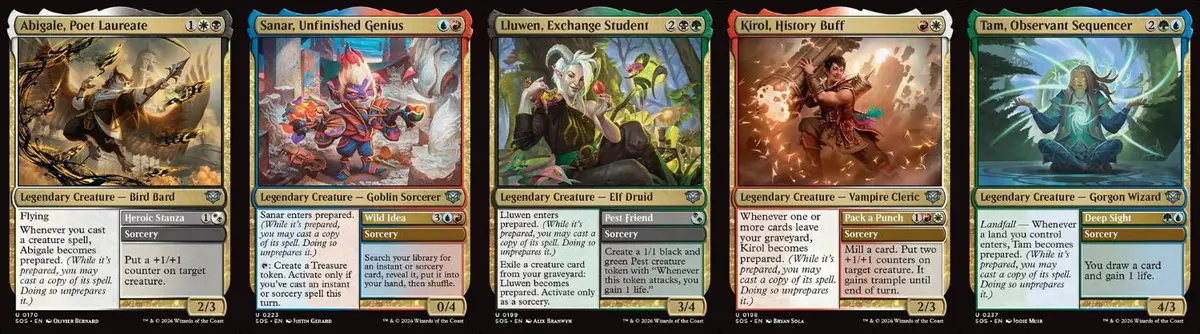
The conclusion first: when one of these five uncommon legends is on the battlefield, if you feel your advantage steadily growing, congratulations, your deck is built (or drafted) right!
- WhiteBlack Silverquill:
- Repartee aggro: grow your creatures and remove the enemy’s, and snowball a strong board advantage through the Repartee mechanic. The traditional plan of creatures plus combat tricks is still very effective in the white-black pair. However, this build demands correct sequencing, so I recommend committing to it during the draft.
- BlueRed Prismari:
- Spells aggro: cheap spells trigger Opus many times over, and with Expressive Firedancer
 you can deal tons of damage.
- Ramp midrange (mostly one-shot): built around Sanar, Unfinished Genius // Wild Idea
 , relying on Treasures or other ramp to fully unlock the maximum payoff of Opus cards (casting a spell with five or more mana). Abstract Paintmage
 is especially important on this route.
- Spells aggro: cheap spells trigger Opus many times over, and with Expressive Firedancer
- BlackGreen Witherbloom:
- Lifegain beatdown: activated by Bogwater Lumaret
 at its core, a linear all-in aggro plan alongside payoff cards like Pest Mascot
 .
- Infusion midrange: use Lluwen, Exchange Student // Pest Friend
 to deploy 1/1 Pests to fill the board and steadily gain life, maximizing the value of Infusion cards.
- Graveyard control: built around Cheerful Osteomancer // Raise Dead
 , trading with lots of high-power, low-toughness creatures and repeatedly recurring creatures from the graveyard in the midgame to make victory inevitable.
- Lifegain beatdown: activated by Bogwater Lumaret
- RedWhite Lorehold:
- Graveyard-leaving beatdown: steadily get cards out of the graveyard, and use Kirol, History Buff // Pack a Punch
 to beef up your creatures.
- Flashback control: unlike black-green’s graveyard plan of reusing creatures, red-white is better at accumulating graveyard resources in the early and midgame and using flashback spells to win in the late game.
- Graveyard-leaving beatdown: steadily get cards out of the graveyard, and use Kirol, History Buff // Pack a Punch
- GreenBlue Quandrix:
- Ramp control: as the card design of Tam, Observant Sequencer // Deep Sight
 indicates, keep making land drops and steadily snowball resources the opponent can’t keep up with. This plan peaks in the late game at five or six lands and badly needs the ability to survive the early turns. Ramp spells let you reach that safe zone earlier, which is very important.
- Increment midrange: a trap. This set isn’t slow enough to let you play a pile of early creatures with weak stats and slowly grow them in the midgame and late game to finish the job.
- Ramp control: as the card design of Tam, Observant Sequencer // Deep Sight
The Self-Contradiction of the GreenBlue Quandrix College
1. Contradiction one: the paradox of survival and growth
Continuing from the previous section, the strength of green-blue in this set should be ramp control: hold the ground early and win late. Yet the pair’s creature theme, Increment, requires you to first take a hit to your stats and then gain growth. That is a glaring logical contradiction, which is why we can identify Increment creatures as a possible trap signal. Let’s explain with this card.

Apart from doing almost nothing on the turn it enters, the uncommon Fractal Tenderis practically an unplayable five-mana 3/3 unless you have later spells costing four or more, or an active way to place counters. Most other Increment common and uncommon creatures also start out underpowered, and need at least one or two Increment resolutions to barely make up for it. If you don’t take special care to grab flyers, big plays after ramping, or tempo-swinging cards, green-blue can easily end up stalling into a draw while the creatures line up, or get pushed to death one-sidedly by the opponent’s flyers.
On the other hand, cards like Fractal Mascot and Paradox Surveyor
 are the ones green-blue needs to take early. The former enters with a stun counter and a 6/6 trample body. Barring an extreme situation where you are far behind, its arrival basically pauses the opponent’s offense for a turn, and a 6/6 trampler is also a winning way to counterattack. As for the latter, its 3/3 reach body holds your life total early, and its ETB can find the best-fit card at any stage of the game.
Still, Increment deserves a little defending: Tester of the Tangential is one of the few Increment creatures among the uncommons worth playing. Besides supporting green-blue, it also performs quite well in bluered! Paired with cheap spells and another creature like Elemental Mascot
 , you move the counters over at the beginning of each combat, and then any spell costing two or more lets it put the counters back. In blue-red, it is a good card that maintains tempo advantage (interacting with cheap spells) while also strengthening the board (moving counters to bolster stats).
2. Contradiction two: the misleading mana curve
The design of Increment tempts players to stuff their decks with higher-cost spells to trigger it more often, but that also pushes the deck’s curve too high and can worsen into clunky, uncastable hands. To use powerful expensive spells effectively, the key is still to use ramp to clear that threshold, rather than slowly grinding along with Increment creatures.
In short, Increment inherently needs time to grow, and that clashes with the ramp-control strategy green-blue is good at (Increment creatures usually can’t serve as good blockers early on). If we want to move into green-blue while drafting, the focus should be on whether ramp-related cards are flowing, not on concluding that green-blue is open just because Increment creatures keep coming.
Toughness 4 Matters!
In this environment there are many high-toughness, low-power creatures with toughness 4 or more. Their existence defines several things:
- The performance of ground creatures with 4 power (or that can actively grow to 4 power) varies enormously. For example, Rehearsed Debater
 and Imperious Inkmage
 look nearly identical at first glance, but against a blocker like Rubble Rouser
 , their offensive strength is worlds apart.
- Removal that merely deals 3 damage to a creature, or gives -3/-3 or less, is weak, such as Impractical Joke
 or Last Gasp
 .
- Two-mana creatures with no growth ability, or with a mediocre ETB, get worse the later you draw them as turns go on. Like the bears in many blackgreen decks.
To counter this restriction, we can adjust our strategy as follows:
- Using X-cost creatures or removal adds flexibility at different stages of the game.
- Choose removal that deals 4 damage or gives -4/-4 or more, such as Unsubtle Mockery
 or Dismember
 from the Archive.
- Prefer quality over quantity in creature selection. Rather than going aggro, survive the early game with removal and counterspells and build your main force from three- and four-drops onward. This should be more stable (especially in blackgreen).
- Even when playing aggro, keep the toughness-4 threshold in mind when choosing creatures, and pick cards accordingly.
Timely Removal and Counterspells Got Better! And They Usually Swing the Tempo
The creature-to-spell ratio in this set is generally more “balanced” than in other sets. Rather than increasing creature density, a lone creature plus spells snowballing is usually more efficient, and this is even more true for the white-black and blue-red aggro plans.
For exactly this reason, compared with other Limited formats, a plan built on lots of counterspells or removal works better. A well-timed counterspell or removal spell that takes out the opponent’s key creature often swings the tempo, and even sorcery-speed removal can usually achieve this.
Sword and Shield: White-Based Aggro and Blue Bounce
Red-white and black-white are both good at putting counters on creatures to grow them and attack, but this kind of offense is easily crippled by a single bounce spell. Blue-red is good at gaining a tempo advantage off bounce, so cards like Matterbending Mage suit blue-red better. Green-blue, if its early defense is lacking, may find that a simple bounce only delays things by a turn, so it needs to be used alongside creatures, or use Proctor's Gaze
 to disrupt the opponent’s tempo while ramping yourself forward.
Watch Out for Sweepers
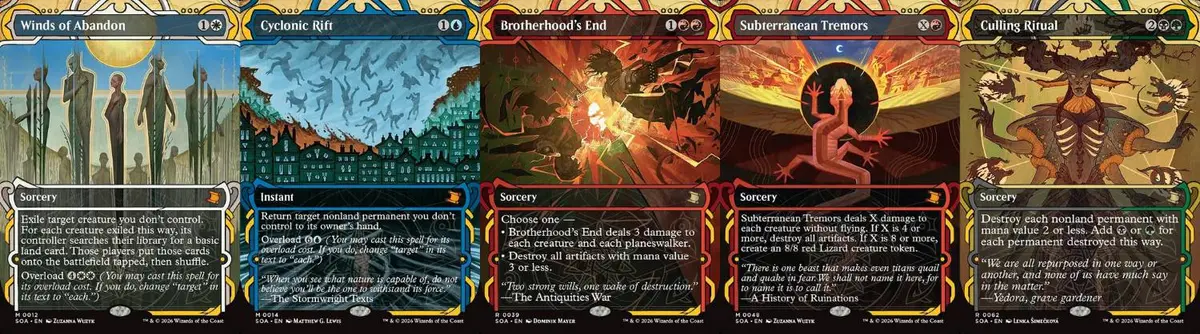
The two white and blue Overload spells in the Archive cards both count as one-sided sweepers, and red’s Subterranean Tremors can basically clear the board as well. Brotherhood's End
 deals 3 to everything, a narrower range, but it is still an effective midgame sweeper. As for Culling Ritual
 , which only sweeps mana value 2 or less, it is more awkward, and can only perform well against extreme white-black aggro or green-blue built around X/X Fractal tokens. Still, in sideboarded games, if you are one of those two archetypes, or a deck that gets punished by a mana-value-2 sweep, be aware that this card exists.
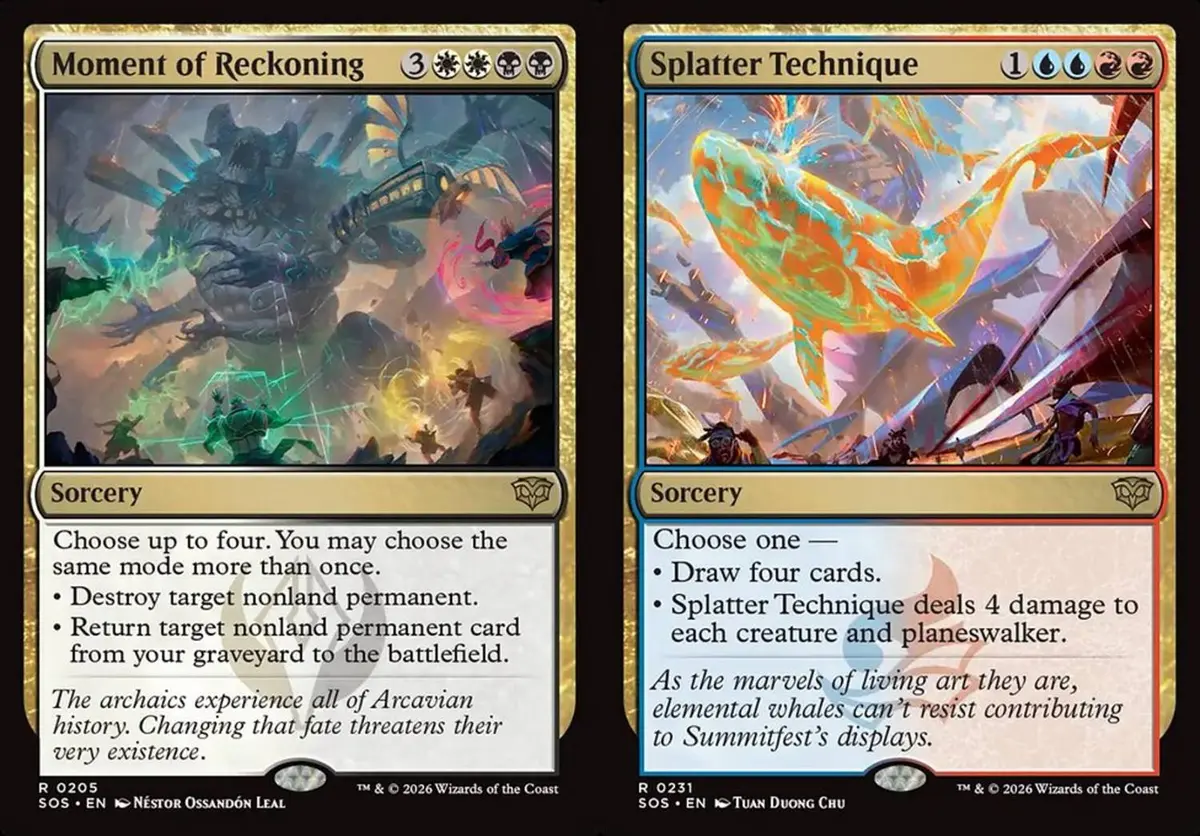
The two cards in the main set are also close to sweeper strength, especially the white-black Moment of Reckoning , which is almost a one-sided sweeper plus a big boost to your board advantage, and usually turns the game around once it resolves. Even if the opponent’s lands lack one of the colors needed to cast it, as long as they have a Treasure on the battlefield or a chance to find other colors of mana, you need to pay it some attention. The reason I didn’t mention Artistic Process
 is that if your deck gets punished by a five-mana sweep of two damage across the board, you probably built it wrong.
Conclusion
The SOS Limited format has only five color pairs, yet it plays like it has more than 10 themes, and I haven’t even discussed the possibilities of Converge in three or more colors! With the addition of the Mystical Archive cards in SOA, the dimension of spell interaction has also risen sharply. This set plays out in very varied ways and is worth getting friends together to draft and study. I’m sure there are still many strategies not mentioned in this article waiting to be developed!
Let’s enter the flow state together and master the best ways to use the Mystical Archive!
- Title
- Secrets of Strixhaven (SOS) Limited: Post-Release Observations
- Author
- cephille
- Created at
- April 24, 2026
- License
- This work is licensed under CC BY-NC-SA 4.0 .