Secrets of Strixhaven (SOS) Limited Review — Multicolor

Note: This article was translated from Chinese by AI and may contain errors. Read the original Chinese version.
Secrets of Strixhaven (SOS) has its prerelease on April 17, 2026, and officially launches a week later on April 24, 2026. Want to know more about card ratings and recommendations for Limited? Then check out this SOS Limited review series!
- For the mechanics, see this article: Secrets of Strixhaven Mechanics Explained
Archetype Themes
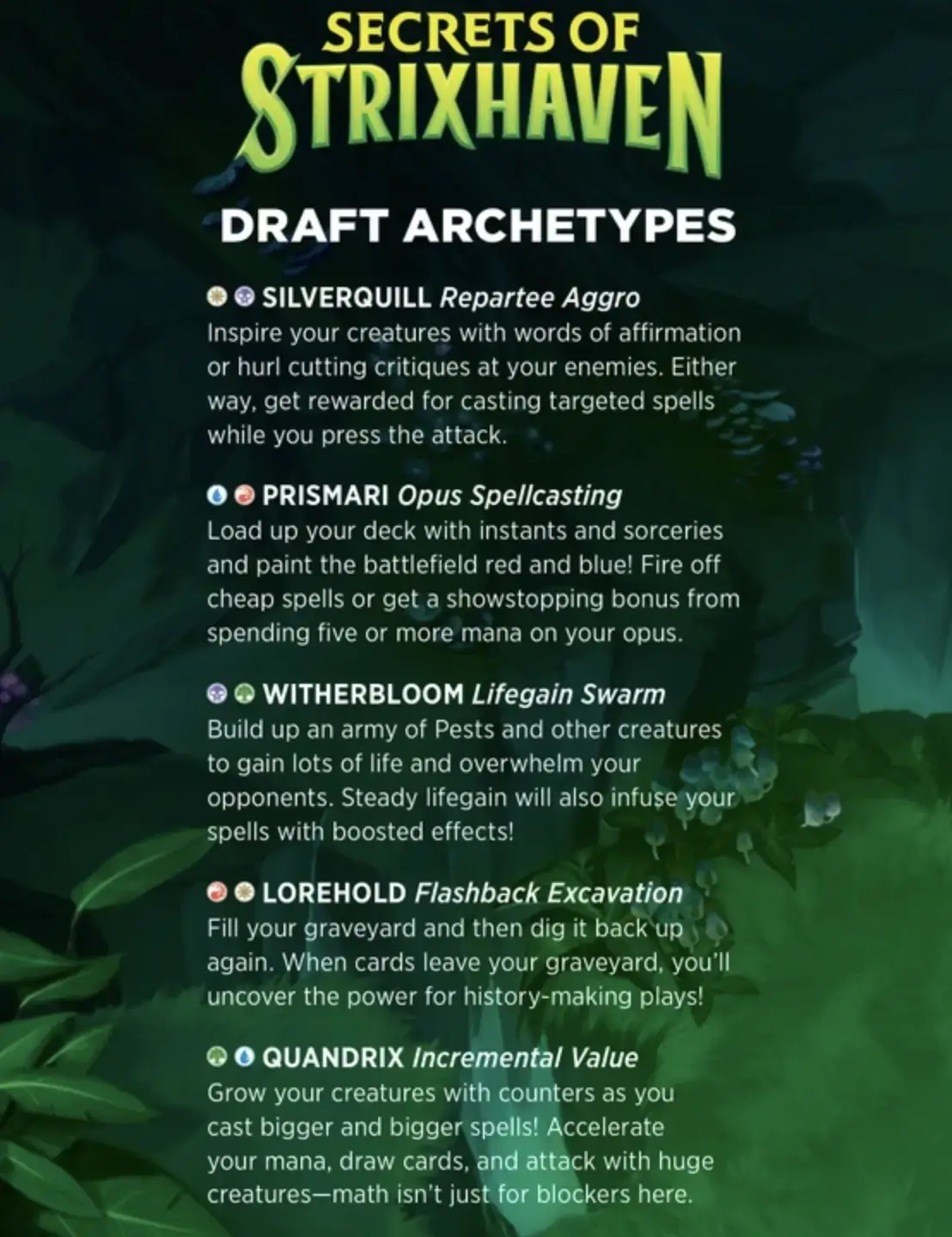
White-Black Silverquill College
Signature mechanic: Repartee
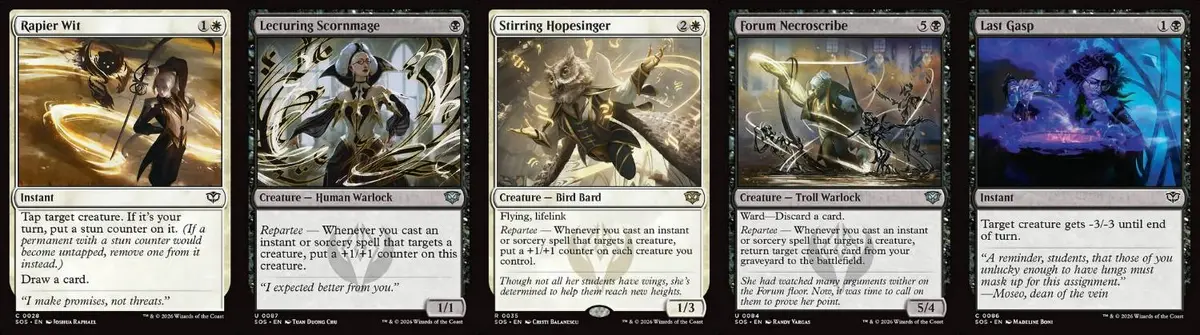
Repartee triggers when you cast an instant or sorcery that targets a creature, so in Limited there are at least two trigger situations:
- When you use removal / a tapping effect and target a creature an opponent controls, creatures with Repartee abilities trigger;
- When you use a beneficial spell and target a creature you control, creatures with Repartee abilities trigger.
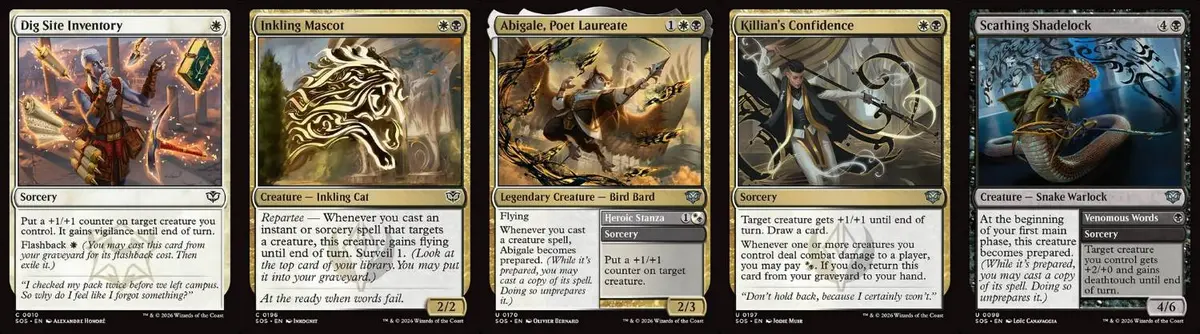
So our game plan is very clear. Use the “Prepared” state you get after casting a creature with Abigale, Poet Laureate // Heroic Stanza to produce a copy spell that can place counters, gaining multiple benefits: widening the board, growing your creatures, and frequently triggering Repartee. As for single-card synergies, the white-black common Inkling Mascot
 gains flying and surveil 1 through Repartee, which makes your later draws better; the uncommon Killian's Confidence
 amplifies the snowball value of this archetype and has potential for reuse. If you need a stable, low-rarity trigger source, the white Dig Site Inventory
 ‘s flashback ability lets it count as two spells, while the black Scathing Shadelock // Venomous Words
 reliably produces copies, making sure Repartee abilities are maximized every turn.
All of the scenarios above are the Repartee mode that benefits your own side. On the other hand, you can also hold a pile of removal and use creatures with powerful Repartee effects to out-argue your opponent into speechlessness!
Blue-Red Prismari College
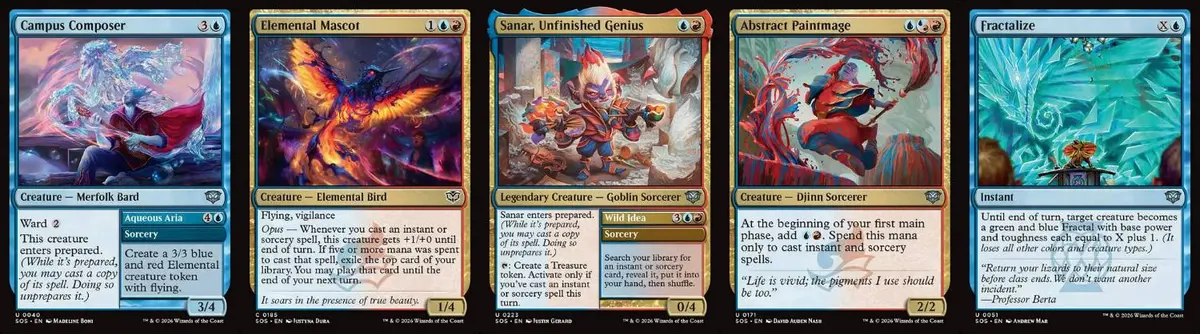
Signature mechanic: Opus
So how do we reliably get the maximum payoff from the Opus mechanic? First, let’s find some clues from the two-color uncommon legend. Sanar, Unfinished Genius // Wild Idea can tap to make a Treasure when you trigger Opus, which helps you cast high-cost instants/sorceries. Also, his Prepared copy spell costs five, which also helps you fully unlock Opus payoffs. The instants/sorceries you find continue the cycle of triggering Opus + making Treasures. The common Elemental Mascot
 ‘s Opus payoff, besides increasing its power, gives an extra reward if you trigger Opus by casting a spell with five mana. Another card, Abstract Paintmage
 , provides two extra mana, making it easier to cast high-cost instants/sorceries. There are also quite a few creatures with Prepare effects like Sanar; a Prepared creature with its own five-mana spell, like Campus Composer // Aqueous Aria
 , can come down as a curve creature first, and if you have room, you can then cast a copy of the Prepare spell. Finally, spells with an X cost, like Fractalize
 , can also serve as flexible Opus trigger sources, so don’t forget to pick them up early when building a blue-red deck.
But don’t forget that the five mono-colored Lesson sorceries with Paradigm, after the first cast, only trigger the base effect of Opus on their next free copy, and don’t satisfy the extra condition of being cast with five or more mana.
Black-Green Witherbloom College
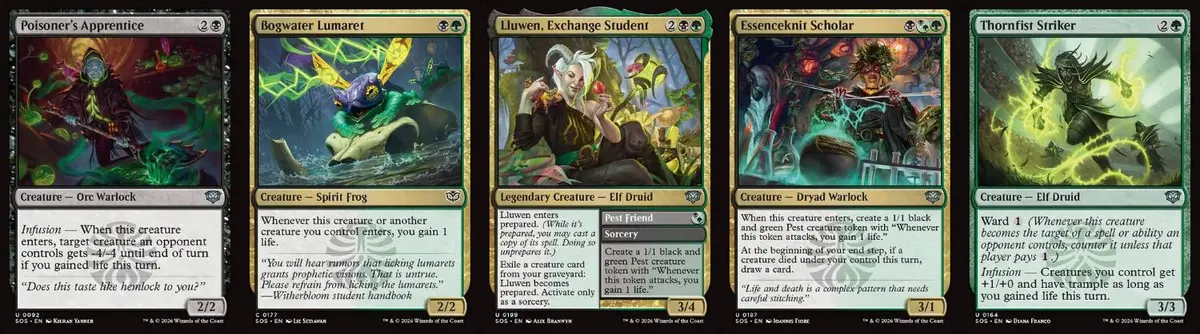
Signature mechanic: Infusion, i.e., having gained life this turn
Lluwen, Exchange Student // Pest Friend is an exchange student from the plane of Lorwyn. Besides repeatedly exiling creature cards from your graveyard to get Prepared again and again, the 1/1 Pest tokens it makes not only fill the board but, through the life gain they provide when attacking, let the later Infusion cards deliver their full benefit. For the common I picked Bogwater Lumaret
 rather than Pest Mascot
 , because this card is simply too important in black-green: not only itself, but any creature entering the battlefield gains you life, and the gap between the upper and lower limits of your Infusion cards in black-green decks with or without it is huge! Another card, Essenceknit Scholar
 , makes a Pest when it enters, and when those Pests die after attacking you also draw an extra card. Among the Infusion cards, Poisoner's Apprentice
 is just a 3-mana 2/2 when it enters on its own, but if it enters while Infused, it becomes an efficient removal spell. This shows how important life gain is in black-green. And with Thornfist Striker
 , your creatures’ combat strength differs enormously whenever you are Infused, and this can even happen on blocks!
Infusion is a checking effect: it only looks at whether you gained life this turn, and if so, the Infusion card’s effect resolves in its Infused state, with no extra triggers or use of the stack. Therefore, cards like Pest Mascot
Red-White Lorehold College
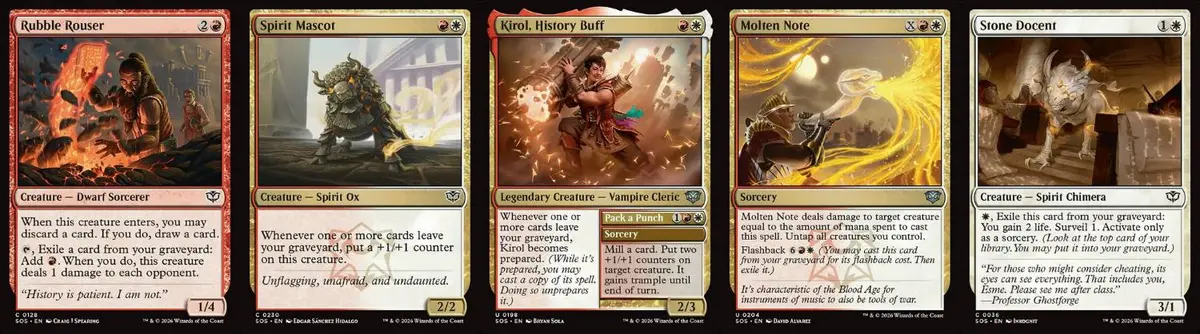
Signature mechanic: Flashback
Kirol, History Buff // Pack a Punch becomes Prepared whenever cards leave your graveyard, and the Prepare spell copy lets you mill + strengthen your creatures. The common Spirit Mascot
 simply grows whenever cards leave your graveyard, simple and brutal. Another flashback spell, Molten Note
 , is a reliable removal spell by itself, and flashback triggers a graveyard-leaving effect, letting you earn extra resources from flashback cards in your graveyard in the very late game; two for the price of one is great. Among the red-white commons, the red Rubble Rouser
 and the white Stone Docent
 both have the ability to proactively remove cards from the graveyard, and bringing a few makes your red-white deck run more smoothly!
For ease of description, we at the Forum use “graveyard-leave” here to refer to the effects of “When/Whenever one or more cards leave your graveyard…” Please note this is not an officially used keyword ability.
All of the following situations trigger “graveyard-leave” effects:
- Exiling from the graveyard: exiling a target card from a target graveyard / your graveyard.
- Returning to hand: returning a target card from a target graveyard / your graveyard to your hand.
- Reanimating: returning a target creature/permanent card from a target graveyard / your graveyard to the battlefield.
- If Ark of Hunger
is on the battlefield, when we tap it to mill a card and use that card this turn, that also triggers graveyard-leave.
It seems Wizards went to considerable trouble to give Lorehold students some history to study, but if such a long sentence could be consolidated into a single keyword, that would be even better.
Green-Blue Quandrix College
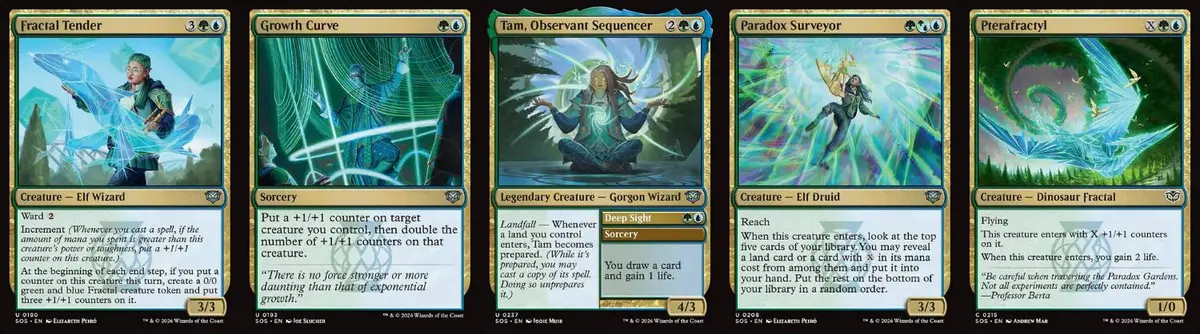
Signature mechanic: Increment
To understand more deeply what green-blue is about, we should go back to the two-color uncommon legend Tam, Observant Sequencer // Deep Sight . The effect is simple: play a land to trigger Landfall and become Prepared, then cast the Prepare copy spell to draw cards (the life gain is incidental). This implies two other messages: ramp, and that drawing cards will bring new finishers. Another card, Paradox Surveyor
 , mainly supports the ramp side, whether you fetch a land to keep ramping or, with enough lands, fetch an X-cost spell like Pterafractyl
 to end the game.
Before explaining the outlet for card draw, let’s look at another dimension: counters (most commonly +1/+1 counters, which we at the Forum often call “beans”). Not only does Increment place beans; cards like Growth Curve can also place lots of beans, and cards like Fractal Tender
 have both: you can cast a high-cost spell to trigger its Increment, or actively place beans on it, or even, getting a bit wicked, use cards like Fractal Mascot
 to put stun counters on it! And once you can keep placing beans on it, your Fractal tokens will soon crush the opponent.
Finally, drawing cards is great, sure, but besides making the opponent collapse on their own with a huge card advantage, are there other ways to end the game after drawing a pile of cards?

This is the one: the more cards you draw, the better this card’s effect. Of course, be careful not to draw your library dry first! This set has no effects that shuffle the graveyard back into the library!
The Savior of Sealed — Converge
Have you ever opened a Black-Green prerelease box in Limited but all your other packs were Red-White? In other sets, you might be forced to play three or more colors with an unstable mana base, praying for a start with a normal, functional curve. In SOS Limited, the situation above can still happen, but the existence of Converge cards means that even if your colors are wrong, you can still put up a decent, above-average fight.
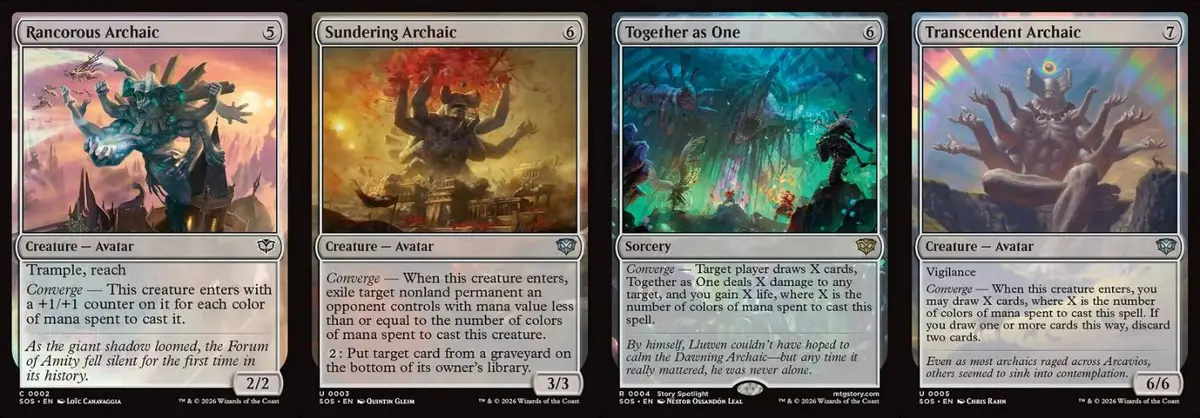
In two-color decks, Converge cards only deliver their base floor, with roughly filler-level power or worse; but in decks of three or more colors, each additional color when casting a Converge spell noticeably boosts its power!
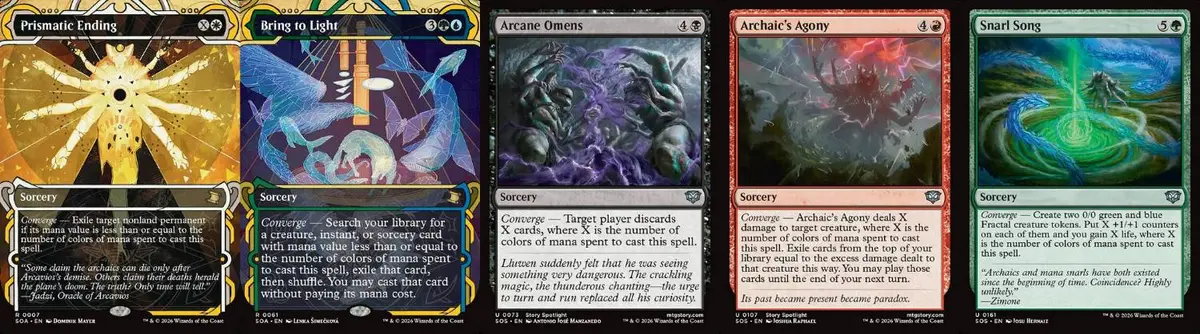
Counting the Mystical Archive (SOA) this time, there are 5 colored Converge instants/sorceries in total. When your sealed pool is a wreck, don’t forget to look their way; maybe you’ll find new possibilities!
Let’s Look at the Card Counts by Category in SOS!
| Category | SOS (count) | SOA (count) | SPG (count) | Prepare spells (count) | Total |
|---|---|---|---|---|---|
| Instant | 45 | 35 | 0 | 8 | 88 |
| Sorcery | 55 | 30 | 0 | 28 | 113 |
| Enchantment | 5 | 0 | 1 | 0 | 6 |
| Artifact | 11 | 0 | 2 | 0 | 13 |
| Land | 19 | 0 | 0 | 0 | 19 |
| Planeswalker | 2 | 0 | 0 | 0 | 2 |
| Creature | 138 | 0 | 8 | 0 | 146 |
Also, here are some creature types with card interactions:
- Wizards: 22 in the main set, in every color except black (the black ones are called Warlocks), appearing mainly in green-blue, with 19 cards. White has 2 and Red has 1. In addition, among the 10 SPG cards that can be opened in regular boosters of this set, 7 are creatures of the Wizard type; counting those, there are 29 in total.
- Spirits: 5 creatures are Spirits; apart from Bogwater Lumaret, which is Black-Green, the other 4 are all Red-White. In addition, 5 Red-White cards make 2/2 Spirit tokens. 10 Spirit-related cards in total.
- Pests: 4 creatures are Pests, appearing only in Black-Green. In addition, 5 Black-Green cards make 1/1 Pest tokens. 9 Pest-related cards in total.
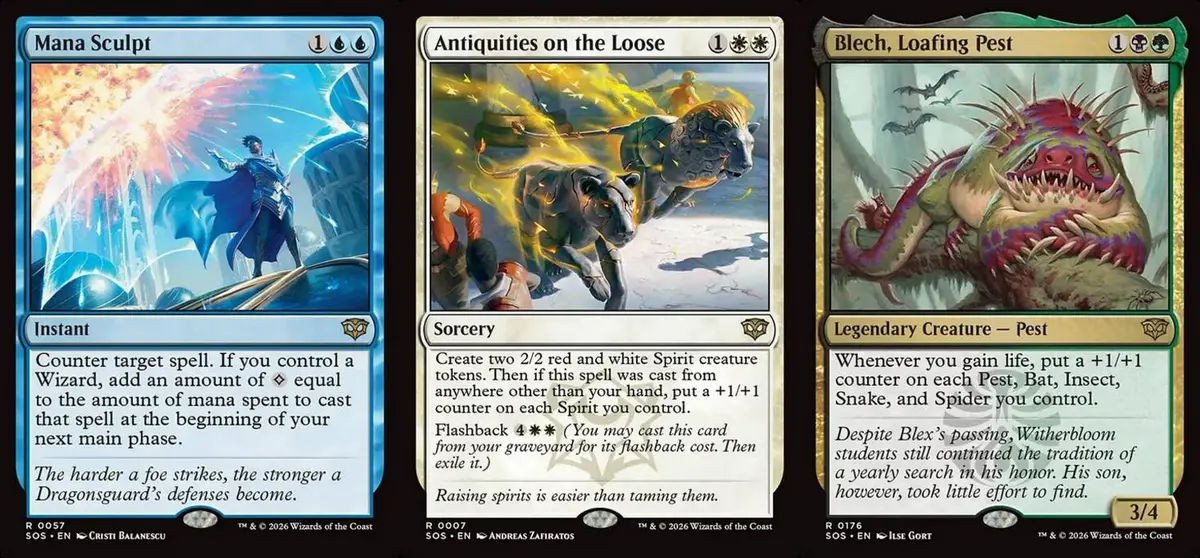
The tribal payoff cards are all collected above for you; you're welcome.
Rating Scale
5.0: Unconditional first pick, brings an almost game-winning advantage
4.5: Unconditional first pick if in the right colors, brings a major advantage
4.0: Worth a first pick, excellent synergy with the archetype theme, can be the deciding card for splashing / switching colors or entering the archetype
3.5: Top uncommon, common, or other sufficiently strong card with good synergy with the archetype theme, can be a key card for entering the archetype
3.0: Important card for the archetype theme, and other above-average cards, which you’ll want in your final deck
2.5: Average, usually a decent curve filler
2.0 to 1.0: Below average, basically you’d rather not play it; can be used as filler when necessary but not too many
0.5 to 0.0: Unplayable, basically never play it; it will only help you lose
Ratings
Score: 3.0
Comment: Think of it as a 3-mana 2/3 flyer. While it’s on the battlefield, each time you cast a creature spell you may also cast a two-mana sorcery that puts a +1/+1 counter on the target creature. As long as you have enough creatures, it is a very stable Repartee engine.
Score: 2.5
Comment: Although it gives you two mana to make later spells easier to cast, its body is too poor, and the payoff for investing three mana in it may not be good enough.

Score: 4.0
Comment: For four mana, making a copy of a non-Aura permanent you control with a 6/6 body is a bargain. At four mana, the copied creature’s stats are mostly a gain. If you truly have no target you can even copy a land, making a 6/6 land creature copy. Just remember that a creature that just entered can’t tap unless it has haste, even if it’s a land.
However, there are still situations where the opponent responds with removal and you get blown out, so check beforehand whether the opponent can interfere before choosing a target.
Score: 4.0
Comment: A very strong resource engine. It can activate by itself, and if you use the milled card in the turn you mill it, the passive effect triggers graveyard-leave and drains 1. But note that to use the milled card you still have to follow that card’s timing for casting. If you mill a land on the opponent’s turn, of course you can’t use it.

Score: 3.0
Comment: The effect is very strong: tap three untapped creatures to copy an instant or sorcery. But why isn’t it blue-red?!

Score: 4.0
Comment: There are many tricks to play. Increment lets you put a +1/+1 counter on it whenever you cast a spell with a mana value greater than its power, and each time a counter is placed you get one extra mana of any color. That extra mana can pay for its activated ability to make X/X Fractal tokens, making it an activated engine that comes with its own finisher. Even if you don’t play it that way, coming down at four mana and then flashing in an X >= 5 creature every turn from the fifth turn on will give your opponent a huge headache.

Score: 3.5
Comment: Even on its own, gaining life once turns it into a 4/5, which is great value; paired with Teacher's Pest it keeps attacking, keeps gaining life, and keeps growing; or paired with Lluwen, Exchange Student // Pest Friendto make an army of Pests, your opponent will soon be unable to hold on.
Besides Pests, two other creature types in this set can also benefit from its bonus!
- Snake: Scathing Shadelock // Venomous Words
- Insect: Cuboid Colony
Score: 3.5
Comment: This time the black-green theme gets payoffs from gaining life or from cards with the Infusion keyword, and this common is an excellent curve creature and mechanic enabler. If you play black-green, you must pick it!

Score: 2.5
Comment: Choose the first mode if the opponent has many cards in hand, and the second if you have more cards in hand. But there’s a hidden risk: when you draw it in a topdeck war with the opponent, it’s basically a dead card. But high risk, high reward; I believe some hardcore gamblers will still want to try it XD

Score: 4.0
Comment: As long as it’s on the battlefield and you still control a creature, it keeps bringing high-value creatures in your graveyard back! Trading small for big is the norm, and the attached drain effect can deliver extra value!

Score: 4.0
Comment: A truly fierce pony! It enters as a 3/3 haste with ward {1}, grows whenever Opus triggers, and if you paid five mana it also makes a copy of itself! Once Colorstorm Stallion is on the battlefield, each of your big spells is accompanied by an endless stream of ponies trampling your opponent flat!

Score: 3.5
Comment: A 6-mana 6/6 is a decent body, and it comes with a face-only Lightning Helix on entering, and when it dies you at least gain a card, no loss (discard 0 cards, draw 0 + 1 = 1 card).

Score: 3.5
Comment: A 4-mana 4/3 that doesn’t lose you a card on entering + takes 1 life from the opponent. Each Repartee can bounce a creature; besides gaining value from your own creatures’ enter/leave abilities, it can also remove the opponent’s tokens. This is quite effective against the green-blue archetype’s mass of Fractals. Apart from being locked to its archetype and nearly impossible to splash, it is a very strong card.

Score: 3.0
Comment: Its body on entering is too weak, making it a poor topdeck, but if it can come down early, a trampling flyer that has a chance to keep growing is still worth the investment.

Score: 3.5
Comment: Finding a creature to put into your hand or an Entomb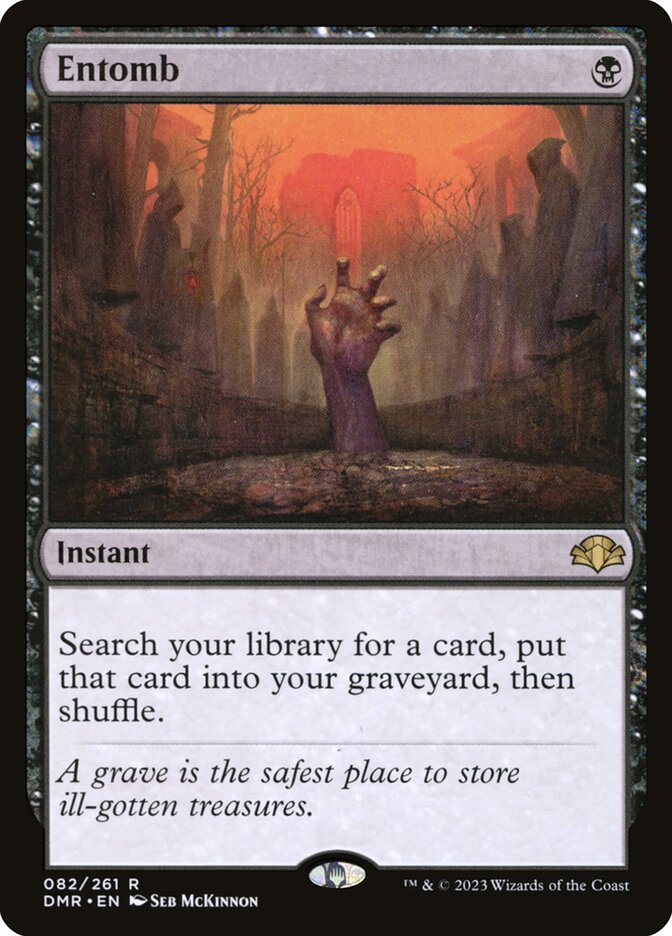 offers excellent flexibility.
Score: 3.5
Comment: A 3-mana 1/4 vigilance flyer that gains power with every Opus trigger, good on both offense and defense. If you trigger Opus with five or more mana, you can also “earn” an extra card; I’d be delighted to see it when playing blue-red.

Score: 3.0
Comment: Lessons from Life for one more mana as an instant version. Instant-speed draw three for five is playable, and putting an extra land onto the battlefield is all the better.
Score: 3.5
Comment: It makes a Pest on entering, and when your creatures die you draw cards; a must-pick when playing black-green.

Score: 2.5
Comment: Completely useless early, but in the mid-to-late game, with X >= 4, a single cast can bring an advantage the opponent can’t reverse, provided your life total is high enough to pay for it. The synergy with white-black Repartee aggro is also a bit awkward, so I docked some points.
Score: 3.0
Comment: The body of Colossal Dreadmaw with an enter-the-battlefield effect in the style of Frost Lynx
 ; Limited in 2026 really is this strong!
Score: 3.5
Comment: As a 3/3 it may be a bit hard to Increment, but the end-of-turn effect of making a 3/3 Fractal only looks at whether you placed a counter on it that turn, and even putting a stun counter on it counts XD

Score: 3.0
Comment: A 2-mana 1/4 body is sturdy enough, but X-cost spells are hard to come by; if you have some, you can earn a little extra card advantage. If your deck has no chance of casting X spells, you probably shouldn’t play it.
Note: even if X=1, you still look at the top card of your library and draw it.

Score: 3.0
Comment: A 3-mana sorcery that removes an artifact or kills a creature, and the life gain also triggers the black-green Infusion mechanic. You’ll pick it when playing black-green.
Score: 3.0
Comment: Proactively placing at least 2 counters will have lots of synergies in the green-blue Increment archetype, so I’ll give it a higher score for now.

Score: 3.0
Comment: Paired with the red-white Flashback mechanic, or some graveyard-leaving effects, it should have a chance to grow very large. Every so often you can also discard a card to take a big gulp, which is quite strong.

Score: 2.5
Comment: A 3-mana 3/3 vigilance that surveils 2 on entering; plain and unadorned.
Score: 3.0
Comment: It takes off with Repartee + surveil 1; considering white-black is on the faster side this time, this card’s damage output should be quite important.
Score: 3.0
Comment: Even just a two-mana counter placement that cycles itself is worth using in the faster white-black archetype; and once your creature connects with the opponent, you can pay one {B/W} to return it to your hand! This card helps a lot in reliably triggering Repartee abilities; if you play white-black, be sure to pick it up early to stock up on debate material!
Score: 3.0
Comment: A 2-mana 2/3 survives a collision with a 2/2, giving it an innate advantage in body. With flashback or cards leaving the graveyard you get a 3-mana mill-yourself-one + two counters for trample; it keeps delivering value mid-to-late game, which is great.
Score: 3.5
Comment: You and Kirol, History Buff // Pack a Punchmust be good buddies! But playing four colors is still too hard, so skip it for now. A 4-mana 3/4 that can cast a Prepare spell on entering, making a 1/1 Pest for one mana, which gains life when it attacks. As long as you have enough creatures in your graveyard, its activated ability lets you keep making Pests, giving it a chance to be a great one-card army.

Score: 2.5
Comment: Lorehold Charm, but all three modes are a bit awkward in Limited:
- Each opponent sacrifices a nontoken artifact; you’d only want this when the opponent has a two-color rare artifact (such as Ark of Hunger) that’s earning a lot.
- Returning a creature or artifact with mana value 2 or less from the graveyard to the battlefield; there are hardly any targets in Limited worth doing this for.
- Lorehold isn’t the Boros Legion; its ability to go wide is limited, and it’s harder to fully realize the whole-team pump + trample effect. But the third option is already the most practical.

Score: 5.0
Comment: A 5-mana 5/5 flying haste is super strong. After that, every instant and sorcery has Miracle {2}, and it even comes with a triggered ability on the opponent’s upkeep that lets you choose whether to rummage. Whether it’s your turn or your opponent’s, as long as the card order comes out right, it’s a miracle every day!
Note: if you play this Elder Dragon in Limited, when drawing the first card each turn, don’t put that card directly into your hand; look at it first outside your hand, and if it’s an instant or sorcery and you want to cast it right then, reveal it to your opponent and cast it with Miracle {2}. This reduces many unnecessary disputes, such as how you prove that card was really just drawn.

Score: 3.0
Comment: The floor is a two-mana way to play an extra land from your hand (lands are zero-cost permanents), and to be really strong it should have at least X >= 4, refilling your hand and putting a threat on the battlefield at the same time, but to be good it still needs a certain amount of ramp. Because you draw first and then put the permanent onto the battlefield, if X is large enough, you can also see what you drew before deciding.

Score: 3.0
Comment: A pun-based tribute to Mind Rot . But this time the design is quite clever: if the opponent discards a land, it actually helps you ramp, and if they don’t, they solidly discard two real cards, which is quite annoying. And a land discarded and returned to the battlefield still passes through the graveyard, so against red-white it still triggers the opponent’s graveyard-leaving effects.
Score: 3.5
Comment: The floor is a two-mana 2 damage to a target creature + untap all your creatures, finishing off a creature after combat and giving your creatures pseudo-vigilance, a very good balance of offense and defense. And with its X cost, it’s a reliable answer whenever you draw it. Flashback lets you use it again, and dealing 8 damage leaves almost no creature alive.

Score: 4.5
Comment: Very strong. Whether destroying up to 4 nonland permanents, returning up to four nonland permanents from the graveyard, or choosing any 4 targets split between the two, it’s a super bomb. The only two problems are the seven-mana cost and the difficulty of splashing it, but the second is no problem in white-black.

Score: 3.0
Comment: While it’s on the battlefield, you can pay the cost of a creature and two mana to exile an instant/sorcery from the opponent’s graveyard this turn and cast it (you still must pay that spell’s cost and follow its timing restrictions), and doing so lets you put a +1/+1 counter on every creature you control. Whether it’s strong is hard to say, but being able to use the opponent’s cards should excite many NTR fans, right?!


Score: 3.5
Comment: In black-green, at four mana it can open a body-size gap over the other archetypes in one stroke, and if you can land Bogwater Lumaretbeforehand, it will certainly enter as a 6/6 threat. As long as you have enough life gain cards, it’s a good payoff card, and even a 4-mana 4/4 vigilance reach isn’t bad.
Score: 3.5
Comment: Basically only for the green-blue archetype; the score is for when you’re drafting that archetype, and other colors can skip it. A 3-mana 3/3 that looks at five cards and takes a land on entering is already very good, and it also has a chance to grab a strong X-cost spell.
Score: 2.5
Comment: A 2-mana Bogwater Lumaret; at three mana it becomes a 3/4 right away, and afterward each creature entering gains life and places a counter. Its trample on the body can break through the opponent’s defense when attacking, a designated common pairing for black-green. But if you don’t have enough life gain, this card gets much weaker.

Score: 3.0
Comment: The enter-the-battlefield ability may sometimes have no target, but a 3-mana 3/2 first strike is strong enough. If what you exile is a card you previously cast that has flashback, it’s like casting the same card three times XD

Score: 3.0
Comment: Prismari Charm. All three effects look like they have a chance to be used in the right situation, and blue-red needs lots of instants or sorceries to trigger Opus, so pick it if you play this archetype, but don’t splash three colors for it.
- Surveil 2 then draw 1 sees up to 3 cards deep, great when you need filtering.
- Dealing 1 damage to each of two targets is a little awkward to use; although it can trigger Repartee, out of colors it shouldn’t be used that way.
- Returning a nonland permanent to hand is probably the most practical option when using this card as an answer.

Score: 4.0
Comment: A 7-mana 7/7 big dragon is strong enough, and ward that requires paying 5 life is also brutal; once the opponent’s life is pressed to 5 or below, if they have no flyer to block, they’ve basically lost. Giving instants and sorceries Storm is a bit subtle, as you need to cast at least two instants/sorceries in the same turn to benefit from it.
Here is a simple calculation. Suppose you control the blue-red Elder Dragon and can cast 3 Prismari Charmin a turn. You first cast the first Charm choosing the second mode, dealing 1 to each of two targets (Storm 0 to 1); then cast the second Charm choosing the first mode, surveil 2 then draw 1, and because of Storm 1 there’s one extra copy, for a total of two surveil 2 then draw 1 (Storm 1 to 2). Finally, cast the third Charm choosing the third mode to return a target nonland permanent to hand, and because of Storm 2 there are two extra copies, returning 3 nonland permanents in total (Storm 2 to 3).

Score: 3.0
Comment: On turn four you can do some interference + ramp at instant speed, and next turn cast a six-mana spell in total, which is quite nice.

Score: 5.0
Comment: A 4-mana planeswalker with 5 loyalty is already super hard to kill; activate [+2] on entering, and next turn you can [-6] for the ultimate, after which all your later life gain turns into a nightmare of life loss for the opponent! Even if the game doesn’t let you go for the ultimate, you can repeatedly use [0] to refill your hand, [-3] to kill any threat the opponent has, then keep switching between the first through third abilities; if the opponent has no planeswalker removal, they should just concede and save time for the next game.
Score: 3.5
Comment: Very flexible; the floor is a two-mana instant that gains 2 life + one creature dies (a creature with 0 toughness entering the battlefield dies immediately). But if you draw it in the mid-to-late game, it’s a very powerful threat: flash it in to block, eat the opponent’s attacker, and counterattack next turn!

Score: 2.5
Comment: You may be able to discard/mill it into the graveyard and cast it with its flashback cost, gaining more added value in red-white.

Score: 3.0
Comment: Quandrix Charm. Its range of use is probably slightly smaller than Prismari Charm. Each single option is not strong enough, but combined it’s a flexible, good card.
- A one-shot Quench
 .
- Destroy an enchantment, but this set has very few targets, and few are worth destroying.
- A target creature instantly becomes a 5/5 or larger monster, which can catch the opponent off guard.

Score: 5.0
Comment: A 6-mana 6/6 trampling dragon that Cascades when cast; if the flip goes well, the 1+1 board explodes. And it even makes your later instants or sorceries Cascade as well. A super bomb among bombs!
Note: Cascade starts flipping cards from the top of the library while the spell is on the stack, until you flip a card with a lower mana value than that spell, and you may cast that card for free (you must decide whether to cast it the moment it’s flipped). For example, when you cast this green-blue dragon for six mana, any card you flip with a total mana value <= 5 can be cast for free.

Score: 2.5
Comment: A 6-mana sorcery that draws three and discards two is lackluster; it returns 5 mana to you, but that also depends on whether you have a next card to combo into. Unless you lack cards that trigger Opus with five or more mana, blue-red should have better choices.

Score: 2.5
Comment: Looking and discarding a card only at four mana is on the weak side. But placing two counters can trigger Repartee, so it’s a playable filler in white-black.

Score: 3.0
Comment: With this guitar on the battlefield, your later sorceries/instants are much easier to cast, and especially X-cost spells explode! Its activated ability needs seven cards in hand to keep drawing, which should be relatively hard to achieve in Limited. When you have a big card advantage in hand, turn it into a board advantage as soon as possible and head toward victory!

Score: 3.0
Comment: For five mana it gives everything +2/+2 and menace, which has evasion and isn’t bad; attacking also gains extra life, and has a chance to earn extra life gain payoffs.
Score: 3.5
Comment: A 2-mana 0/4 is sturdy, and it isn’t a Defender, so if you can pump it up it can attack too. If you’ve cast a spell, it can tap to make a Treasure, which effectively helps you reach Opus with five or more mana. On average, if it isn’t answered right away after entering, it can at the very least make two Treasures (casting the Prepare spell Wild Idea, and the instant/sorcery it finds).

Score: 3.5
Comment: A 2-mana 2/2 menace is a very reliable early attacker, Repartee lets it keep growing, and even after it dies it can pass its counters on to other creatures, very high quality!

Score: 3.5
Comment: Silverquill Charm. Short and sweet; all three options are good.
- Placing two counters at instant speed not only makes the opponent misjudge combat but also triggers Repartee.
- Exiling a target creature with mana value 2 or less has a narrow range in Limited, but it can be used to kill creatures like Pterafractylthat are a two-mana-value creature after entering, widening its range slightly.
- Finishing off a creature and draining 3, simple and brutal, a must for aggro.

Score: 4.5
Comment: A 4-mana 4/4 vigilance dragon, which should rule the skies when it lands; every instant/sorcery has Casualty 1, which is a bit subtle, since white-black isn’t that good at making tokens this time, but if paired with some creature cards that can return from the graveyard, this ability becomes quite competitive. Conversely, if every Casualty costs you an actual creature card, the performance it can deliver is much more limited.

Score: 3.5
Comment: I expect it to perform well in white-black built on Repartee: keep Repartee-ing, keep drawing, keep draining, keep feeling great. It pairs well with Killian's Confidence.

Score: 2.5
Comment: If used well, this is still a 2-3 for 2 (this card + 1 to 2 of my creatures for 2 of the opponent’s creatures), and if the two creatures the opponent sacrifices are of higher value, it’s a good trade.
But let’s assume a scenario:
- I’m on the play and play creatures on turns two, three, and four; the opponent follows with two creatures on turns three and four. I cast this card, sacrificing my weaker two-mana and three-mana creatures as the cost, and in return eat the opponent’s three-mana and four-mana creatures, draining 2 from it. That trade sounds pretty good, right? What if one of the creatures I sacrificed was a token made along with another creature? It feels even more profitable!
- Conversely, suppose the opponent plays creatures on turns two and three first; if we play a creature on turn two + this card on turn three, we can achieve an asymmetrical two-for-two sweep, forcing the opponent to play stronger four-plus-mana creatures, or they immediately fall behind on tempo!
Summary: this is a card that takes some skill to use well. You need to evaluate the current situation to create an asymmetrical effect. Everyone is welcome to study it together~

Score: 4.0
Comment: Even without triggering Opus with five mana, two or even three spells in a row can make this creature deal tons of damage, and a five-mana Opus can even turn a turn’s worth of pump into three permanent counters, a very reliable four-mana curve play!
Score: 2.5
Comment: If you can reliably make cards in your graveyard leave, it keeps growing; otherwise it’s just a bear.

Score: 4.0
Comment: A 5-mana draw-four Tidings , or deal 4 to all creatures and planeswalkers; both options are quite powerful, and what used to be two separate cards is now combined into one, which is outrageous!

Score: 3.0
Comment: A 4-mana 4/4 body is not bad, and looting on entering and attacking makes it more attractive.

Score: 3.0
Comment: The red-white archetype’s passive graveyard-leave source; play it before combat, and once in combat you can start exiling from the graveyard. With lifelink it also earns an extra life difference on offense and defense.

Score: 3.5
Comment: Even on an empty board it’s a 5-mana 4/5 that takes a card into your hand on entering. With more creatures it looks deeper. Incidentally, this card can really be viewed as a {2}{W}{B}{B} creature, so if the black-green archetype needs a creature with lots of self-mill, you could consider splashing it. Also, if you have enough creatures on the battlefield, play this first and then Fix What's Broken, with excellent effect!

Score: 3.0
Comment: A 5-mana instant that deals 5 and also throws in a Sleight of Hand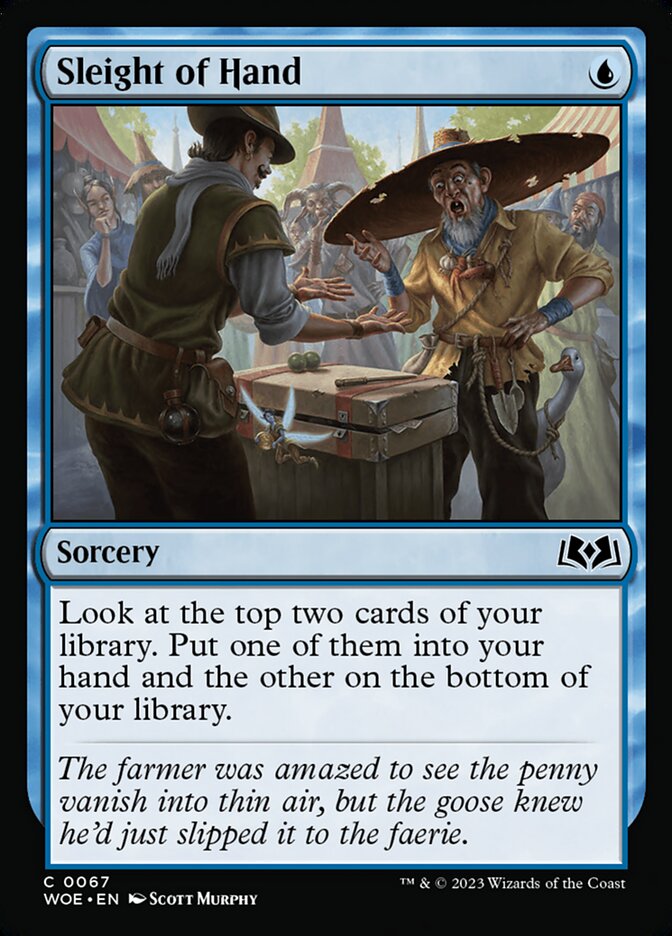 . It also unlocks the maximum Opus payoff once. Its only downside might be being a bit clunky.

Score: 3.5
Comment: Exiles one target nonland permanent + the top card of your library. Quite versatile:
- Exile one of the opponent’s high-cost threats, forcing the opponent to spend their mana next turn to cast it again, or else it’s as good as removed.
- Exile the opponent’s token, and it can’t come back.
- In response to the opponent’s removal, exile your own nonland permanent and bring it back on your own turn.
Note: this card creates two delayed triggers on resolution, so remember to check clearly before the end of the following turn whether either side wants to use the cards it exiled. Once that time passes, there’s no chance!
Score: 3.5
Comment: Playing a land makes it Prepared, and each time you cast the Deep Sight at the lower left you draw one and gain one; left alone it earns a lot of resources, and the 4-mana 4/3 body itself is a passable size.
Score: 3.5
Comment: A stable Infusion (life gain) activator; basically it just attacks recklessly to earn the Infusion bonus effects, and it doesn’t matter if it dies, since for two mana you can bring it back at instant speed to keep fighting next turn.

Score: 3.5
Comment: Not very efficient as removal, but viewed as a two-mana instant draw-two-discard-one that can optionally pay extra to increase damage, it’s strong enough.

Score: 4.0
Comment: Lightning Strike + tap a target creature; one card can stop two creatures at once on offense and defense, a rare good card!

Score: 4.0
Comment: A creature/artifact sweeper that costs life; you can choose the best cost according to the current board and thereby reap the greatest reward. For example, first stabilize with a high-cost creature to hold off the opponent’s small creatures, then use this to achieve a one-sided sweep! Being able to destroy artifacts means that against an opponent earning resources with two-color rare artifacts, we can take those away along with the sweep, great!
However, the downside of a sweeper that costs life is still that you can’t sell too much life, lest you be unable to use it when you finally need it, so pay particular attention to the balance between your life total and the board when using it.

Score: 3.0
Comment: Discarding it from hand makes it an activated-ability version of Nagging Thoughts , and keeping it in hand in the mid-to-late game lets you make two 3/3 flyers.

Score: 3.0
Comment: A 4-mana instant that deals 5 and exiles is already playable, and paired with cards like Startled Relic Slothit can even be cast for two less, quite flexible.

Score: 3.0
Comment: Witherbloom Charm, which probably has the strongest set of three options among the five Charms:
- You can proactively sacrifice excess lands or unusable permanents to draw two cards (two for two), or in response to the opponent’s removal sacrifice the targeted permanent (two for three).
- Gaining 5 life looks ordinary at first, but that much life is almost a full turn of offense and defense, so you can treat it as a one-shot Fog
 . Life gain is also exactly this black-green archetype’s theme, so there are plenty of chances for extra benefits.
- Destroying a nonland permanent with mana value 2 or less makes it a mini Abrupt Decay
 ; destroying the opponent’s Comforting Counsel
 at 4 counters will leave them wanting to cry.

Score: 4.0
Comment: If 3 creatures are already on the battlefield, a 5-mana 5/5 flying deathtouch dragon is still quite good. But the reason I give it a relatively low score is its second ability, which gives your instants and sorceries Affinity for creatures. We can briefly compare it with the other four Elder Dragons:
- White-black’s Silverquill, the Disputantgives Casualty
- Red-white’s Lorehold, the Historiangives Miracle {2}
- Green-blue’s Quandrix, the Proofgives Cascade
- Blue-red’s Prismari, the Inspirationgives Storm
Except for red-white, the other three archetypes either earn directly or have a chance to earn a lot when casting instants or sorceries. And even for red-white, as long as Miracle casts a high-impact spell, casting it for two mana is great value. However, Affinity for creatures only helps your later instants/sorceries be easier to cast, with the cost reduction depending on creature count. In a Limited format dominated by creature combat, this passive ability can’t be called weak, but its impact on how the game develops may be quite limited.

Score: 2.5
Comment: A 7-mana 5/7 body should be hard to answer, and on entering it lets you cast an instant/sorcery for free. Maybe it could be a finisher in a ramp deck to play around with, but if your deck can’t reach seven mana, forget it.
Conclusion
Locking into five colors in drafts is becoming more and more common; I hope this isn’t a sign of Wizards getting lazy with Limited XD Returning to Strixhaven, I strongly feel that card power has grown explosively over these four or five years. Is that a good thing? I’m not sure. But even so, Limited’s variety is still fun, and every two-color theme surely still has many undiscovered tactics and game plans, so let’s keep experiencing them!
- Title
- Secrets of Strixhaven (SOS) Limited Review — Multicolor
- Author
- cephille
- Created at
- April 13, 2026
- Updated at
- April 15, 2026
- License
- This work is licensed under CC BY-NC-SA 4.0 .