A New Build for Bant Poison After MKM

Note: This article was translated from Chinese by AI and may contain errors. Read the original Chinese version.
Before We Start
As the saying goes, those who came before planted the trees so we could enjoy the shade… wait, no, I mean we can see further by standing on the shoulders of giants. We always improve decks we are interested in with this spirit, so let’s start with the Bant Poison build from before MKM was released.
January 2024 high-finishing Bant Poison list
This list won the Standard Challenge 32 on 2024-01-06. I looked through a round of lists, and I consider it fairly representative, so let’s start from how this build works.
The Build Before MKM
Why Bant?
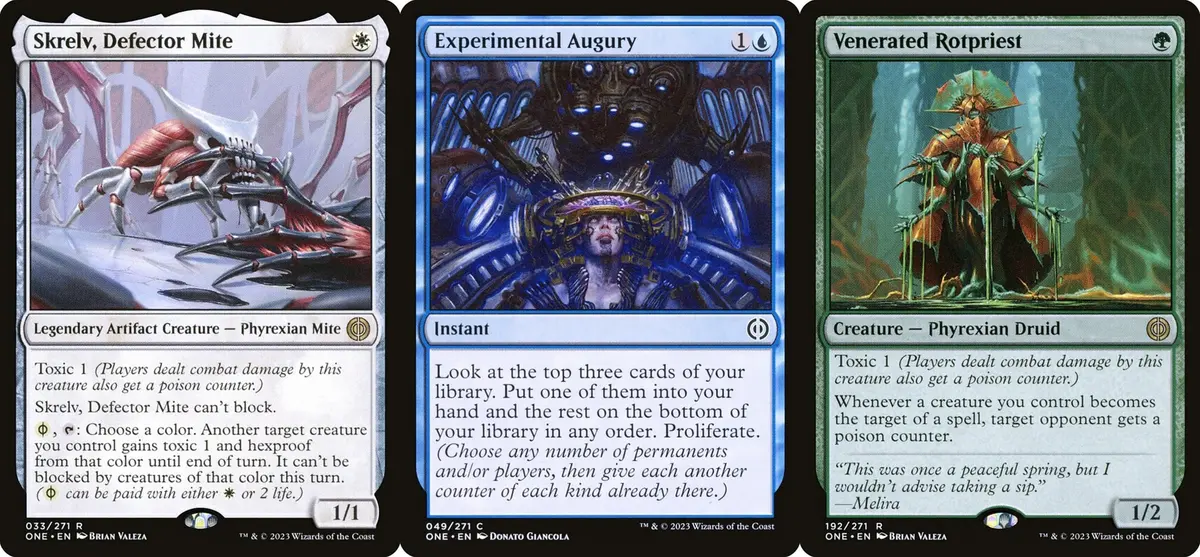
Let me use these three cards to represent the three dimensions of winning for Bant Poison:
- White’s toxic creatures
- Blue’s proliferate spells
- Green’s Venerated Rotpriest
From the first poison counter that a low-cost toxic creature puts on the opponent, the match officially starts counting down. There is no chance of resetting it to zero, and all the opponent can do is win the game as fast as possible before getting their 10th poison counter. Toxic creatures deal poison as they attack, so you deal damage and poison at the same time. Even without comparing it to its predecessor, infect, it is actually a relatively inefficient way to win compared with simply pumping and attacking. This also means a poison deck needs other ways to add poison counters to the opponent in order to win.
This is where proliferate, the effect that lets you add one more of any kind of counter, becomes important. It means that once the first poison counter is on, even if your toxic creatures cannot connect with the opponent, you still have a chance to deliver poison from a distance!
But one card for one poison counter is still too slow. Is there a way to poison the opponent faster? That is how Venerated Rotpriest came into being: a single card that has both passive resilience against removal and an ability that acts like an active pump-and-poison! I had a similar idea on my personal fan page when ONE had just been released, and anyone interested can go back and take a look: link
The combination of Rotpriest and March of Swirling Mist has also been proven to be more than a party trick, but a real trump card you can win with! Whether it is the pairing with Rotpriest, an extra way to dodge removal and sweepers, or actively phasing out an annoying blocker so the poison damage gets through, all of it makes Bant Poison more flexible and aggressive under these three dimensions, and this is the main reason a poison deck has to be Bant.
The Soft Spots of Standard Bant Poison
Having covered the deck’s composition and its winning formula, let’s look at what the problems of Bant Poison currently are.
- Not drawing toxic creatures / Venerated Rotpriest
This is the original sin of every creature-based deck. When ONE had just been released, I saw people try March of Burgeoning Life to solve this problem. However, green’s March is, after all, not Chord of Calling. Not only does it have the problem of being a 2-for-1 for the opponent’s removal when targeted, but being unable to fetch a creature that is not on the board means it cannot fully solve the problem either, and it cannot re-fetch the creature you need after a sweeper. Later this idea was shelved.
Until Standard reprints Chord of Calling, Collected Company, or a similar card, this problem can only be solved with mulligans and by accumulating good karma in everyday life.
Toxic creatures cannot get through
This is actually very common, but there are now some solutions. Whether it is pumping with The Seedcore to make a 3/2, or the pseudo-evasion made by Skrelv, Defector Mite, combined with the deck’s plentiful bounce and phase-out effects, all of these can ease this problem.Having Rotpriest but no tricks
Except in cases of really bad draws, you generally cast Rotpriest only when you have both a trick and the mana. Experimental Augury was also added to ease this problem, by picking up a proliferate effect at the same time.Having tricks but no creatures
Mulligans can solve this problem to a large extent. If you end up keeping such a hand, either you have already mulliganed twice and still could not find one, or the pilot may need to get more familiar with how this deck works.Color screw
Basically, aggro decks of three or more colors easily run into this problem. I can only say that running 21 to 22 lands for three colors was really a stretch, and drawing a bunch of The Seedcore while your hand is full of blue tricks might blow up in your face. Currently the lands that can provide three colors are all creature-type-restricted lands. You need to cast creatures reliably while also using tricks smoothly, and the current mana base is still a bit of a stretch. Until Standard reprints a land like Mana Confluence, this problem is hard to improve, and you can only trade off between the deck’s consistency and its power.
If the problems above leave you drawing nothing but lands or the wrong colors no matter what, consider a charitable donation or doing more good deeds. Love and peace and MTG.
New Ideas After Adding MKM
After previewing all the MKM cards, the first card that jumped onto my search radar was this one:

At first glance this three-mana 2/2 seems to have nothing to do with a poison deck. However, when we look back at the soft spots of the current Bant Poison build mentioned in the previous section, this card’s pairing with Bant Poison shows itself.
- On the matter of toxic creatures not getting through, the first ability of Delney, Streetwise Lookout makes creatures with power greater than 3 unable to block. That already sidesteps the creature sizes of most midrange decks, and decks with blockers of power less than 2 already have many ways to handle them, so adding Delney makes your toxic creatures’ attacks even deadlier.
- Delney’s second ability makes triggered abilities of creatures you control with power 2 or less trigger an additional time. Let’s see how Bant Poison benefits from this:
- Venerated Rotpriest’s passive effect gives the opponent 1 extra poison counter
- When Crawling Chorus dies, it instead sends out two 1/1 Phyrexian Mite tokens with toxic 1
- Annex Sentry can exile two of the opponent’s creatures with mana value 3 or less when it enters
- Delney, costing three mana, fills exactly what Bant Poison lacks most: the game-changing three-drop that decks like Esper or other black-based midrange decks have, such as Raffine, Scheming Seer and Gix, Yawgmoth Praetor. Her addition gives Bant Poison the ability to take off on turn three with the whole deck, whether it is
- turn one Crawling Chorus, turn two Jawbone Duelist, turn three Delney;
- turn one Skrelv, turn two Skrelv’s Hive, turn three Delney;
- turn one Rotpriest, turn two Skrelv’s Hive, turn three Delney, turn four keep the Hive going to make a second 1/1 Mite while holding up blue March…
These are all very good aggressive openings, especially the third scenario, which can basically achieve a turn-four kill in a game where you are ahead and the opponent has no interference. This is unlike the previous build, where from turn three you blindly slam one- and two-drops or hold up tricks to protect against removal and sweepers. Considering the legendary nature of the creature, I think Bant Poison can test 3 copies of Delney. Below is the author’s suggested new Bant Poison build after MKM, which is really just a test version with 3 copies of Delney added.
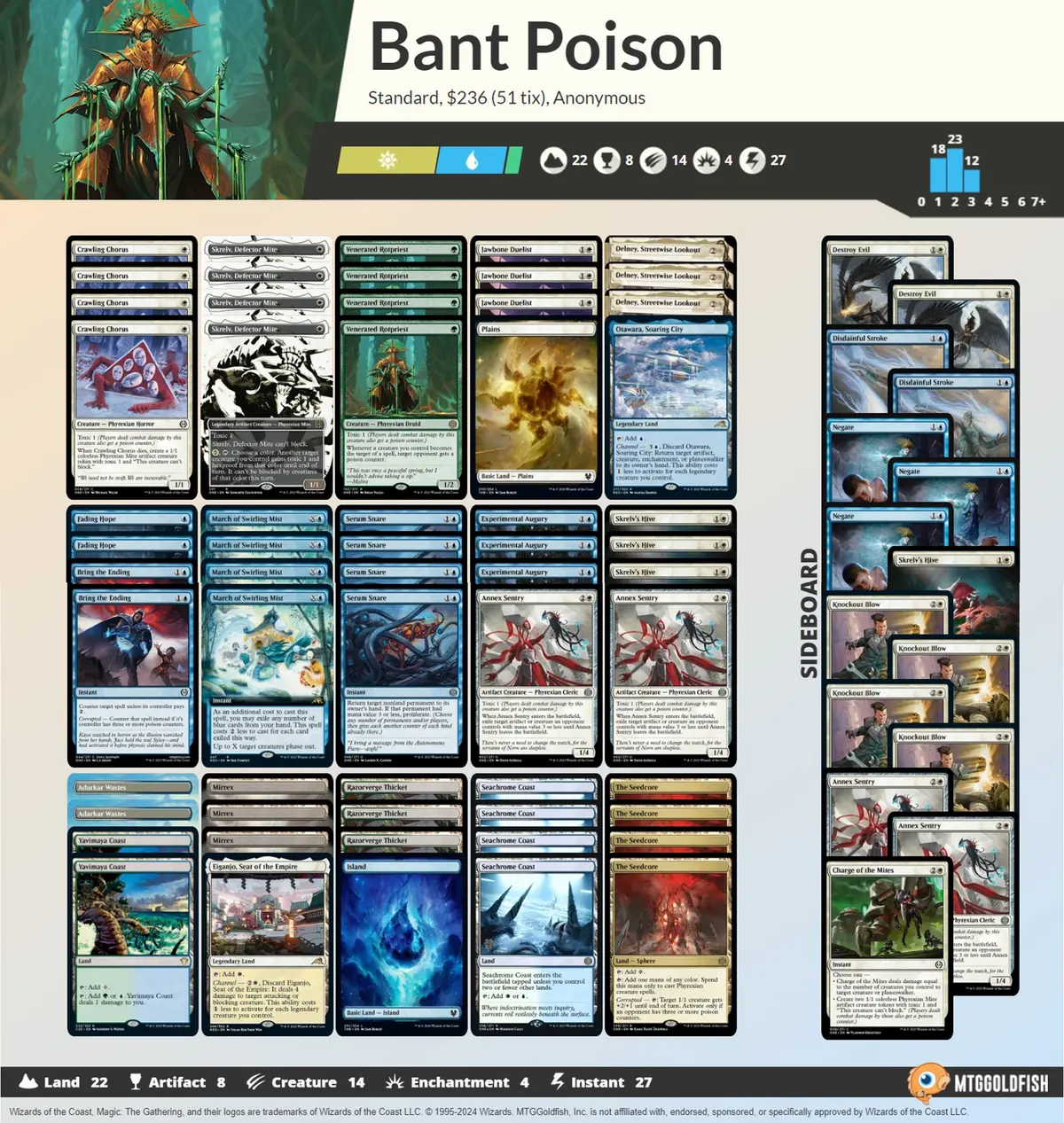
Conclusion: Testing Impressions of the Update
After testing and discussing this update with friends, we found a few potential risks:
Delney is not a Phyrexian, so there may be color issues
As the title says, in extreme cases, if your lands are all The Seedcore and Mirrex, Delney may still fail to show up on time even with three lands.MKM brought the disguise and cloak mechanics
Face-down creatures in MKM are 2/2s with ward {2}, and any removal or bounce is very hard to use against ward {2}. Face-down creatures being colorless also makes Skrelv’s pseudo-evasion hard to use, so attacking through without The Seedcore on the board to pump may get you stonewalled.Delney does not necessarily get removed when she comes out
Basically we are still a poison deck, so the toxic creatures played early are sure to eat the removal first. If they were not all killed earlier, Delney, arriving on turn three, can still help the deck gain a bigger advantage. That said, drawing her into an empty board is terrible, so you can consider cutting down to 2 copies.
A Bant Poison deck that made the top 8 with a 5-0-2 record at the Denver Standard RCQ on 2024-02-11 also ran Delney as 1 main deck and 1 sideboard.[Bant Toxic by Tyler Novak](https://melee.gg/Decklist/View/368403)
That wraps up this round of build testing. Interested players are welcome to try it out for real, and if you have any questions, feel free to leave a comment and tell us. Thank you all!
- Title
- A New Build for Bant Poison After MKM
- Author
- cephille
- Created at
- February 16, 2024
- License
- This work is licensed under CC BY-NC-SA 4.0 .