A Closer Look: Standard Cave Bending
Note: This article was translated from Chinese by AI and may contain errors. Read the original Chinese version.
Introduction

In the story of Avatar: The Last Airbender, The Cave of Two Lovers is said to be the birthplace of earthbending. This set recreates it with its Saga and the land Secret Tunnel, which are also the set’s only Cave cards. Coincidentally, The Lost Caverns of Ixalan happens to have a whole Cave theme to pair with. So how much can the two new cards strengthen Cave decks?
Card Analysis
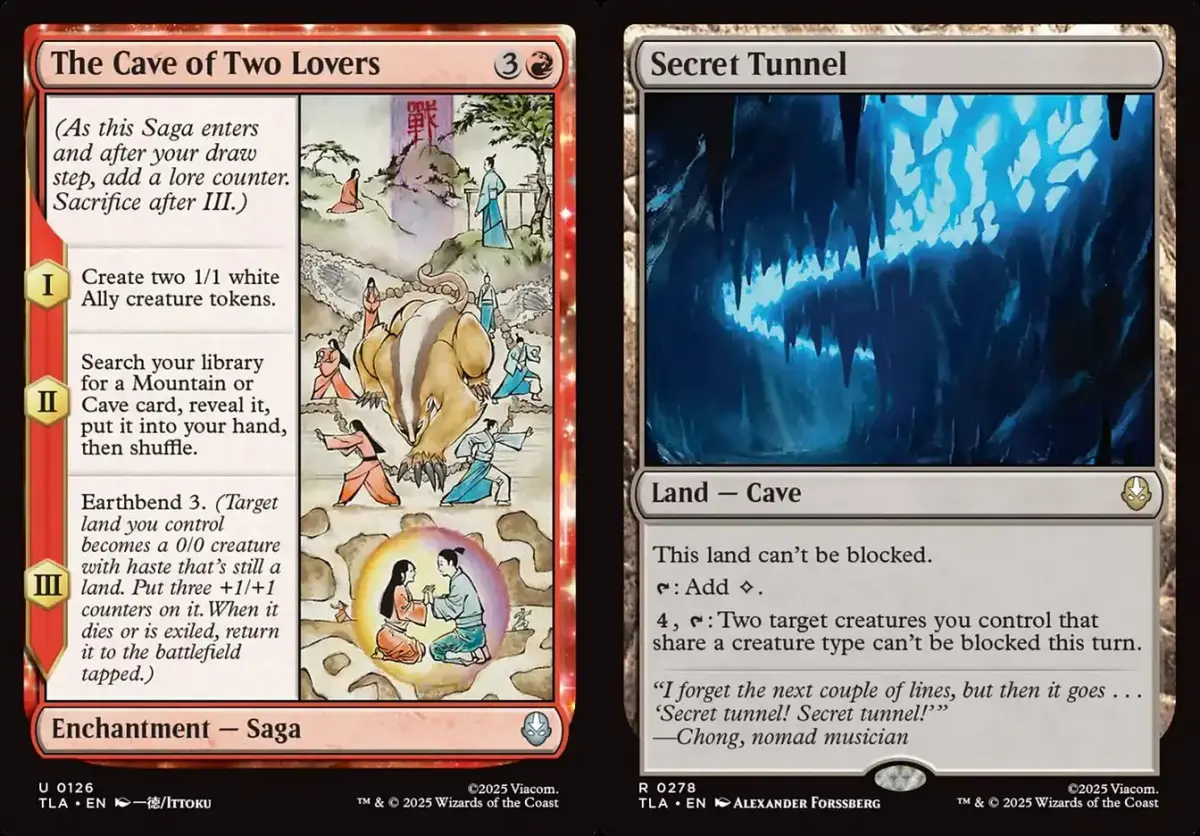
The Cave of Two Lovers
Enchantment — Saga
(As this Saga enters and after your draw step, add a lore counter. Sacrifice after III.)
I — Create two 1/1 white Ally creature tokens.
II — Search your library for a Mountain card or a Cave card, reveal it, put it into your hand, then shuffle.
III — Earthbend 3. (Target land you control becomes a 0/0 creature with haste that’s still a land. Put three +1/+1 counters on it. When it dies or is exiled, return it to the battlefield tapped under your control.)
//
Secret Tunnel
Land — Cave
This land can’t be blocked.
{4}, {T}: Two target creatures you control that share a creature type can’t be blocked this turn.
In the Cave theme, the Saga The Cave of Two Lovers plays a role similar to Scampering Surveyor: create blockers plus find a specific Cave. Although The Cave of Two Lovers has no ramp ability, it gains a chapter III of Earthbend 3, which matches the unblockable ability of Secret Tunnel, becoming a strong attacker that ignores the opponent’s creature lineup.
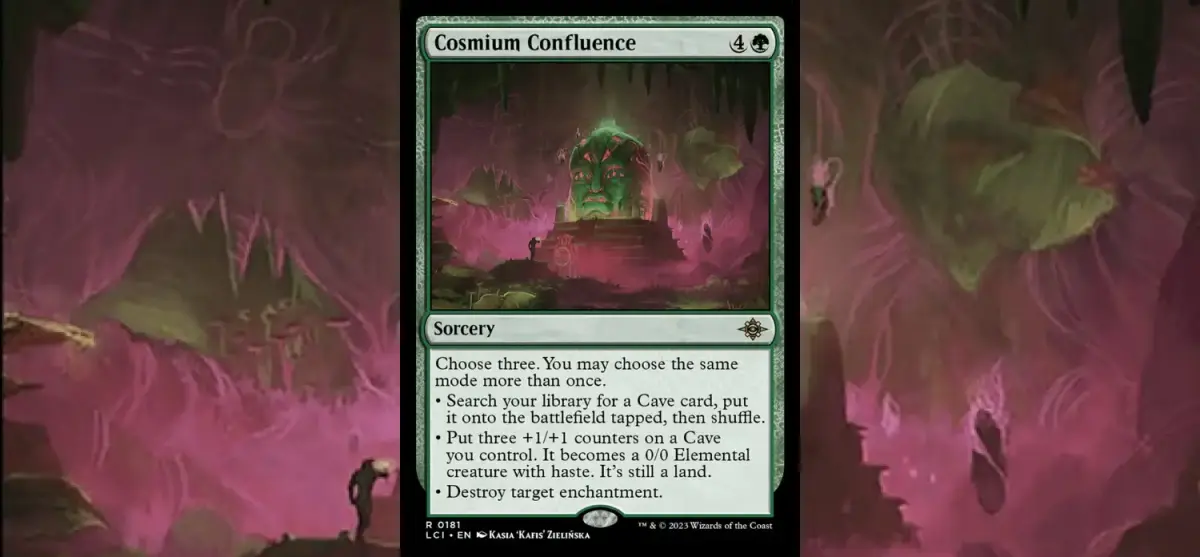
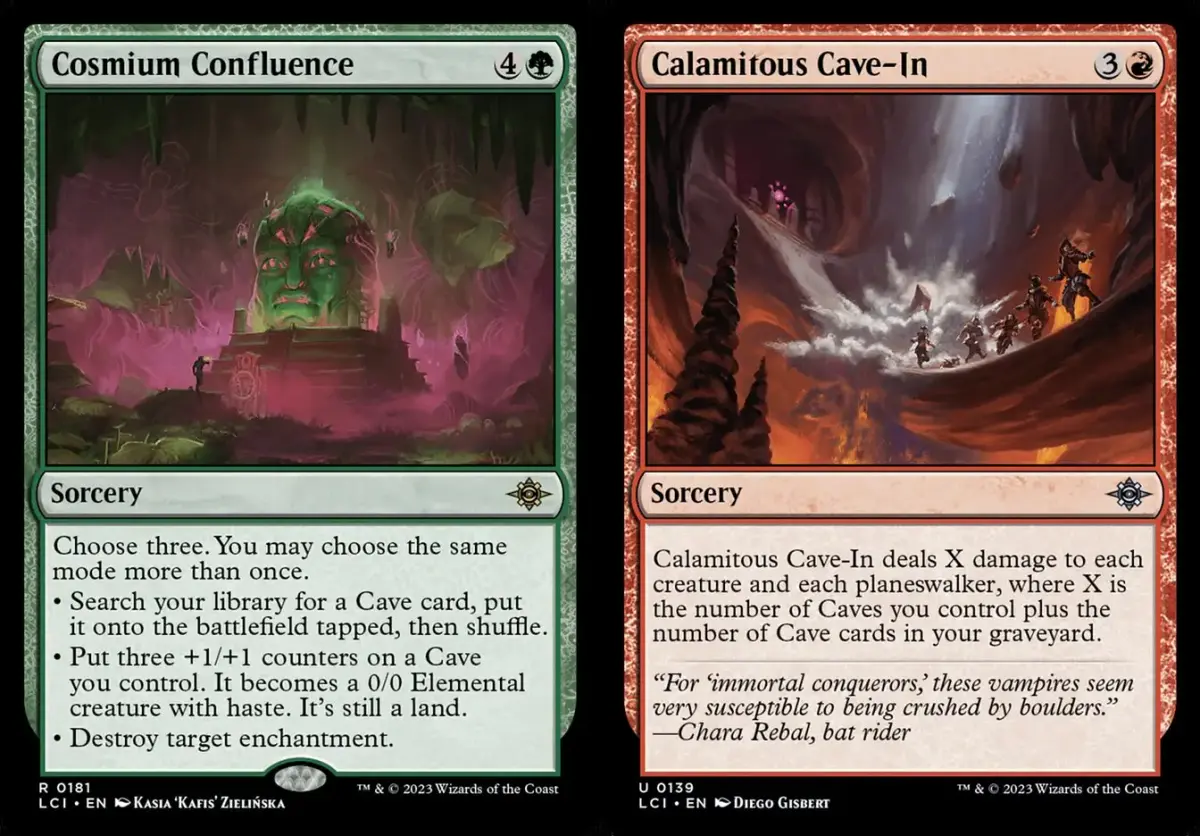
So what does the Cave theme look like? Put simply, it takes Cosmium Confluence as its core: find a Cave and put it onto the battlefield tapped / make a target Cave a 0/0 creature and put three +1/+1 counters on it / destroy a target enchantment. You choose three times and can repeat the same option, so it is not only versatile but also quite flexible. And enchantments happen to be a major category in the current Standard environment, so one Cosmium Confluence can destroy three enchantments, making it a strong answer against enchantment-based decks.
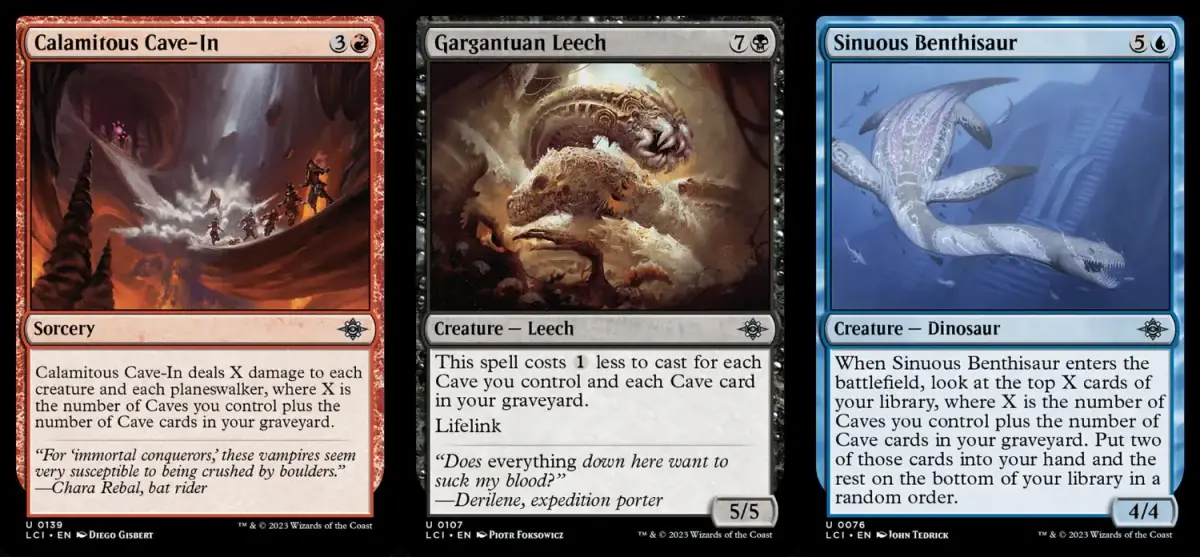
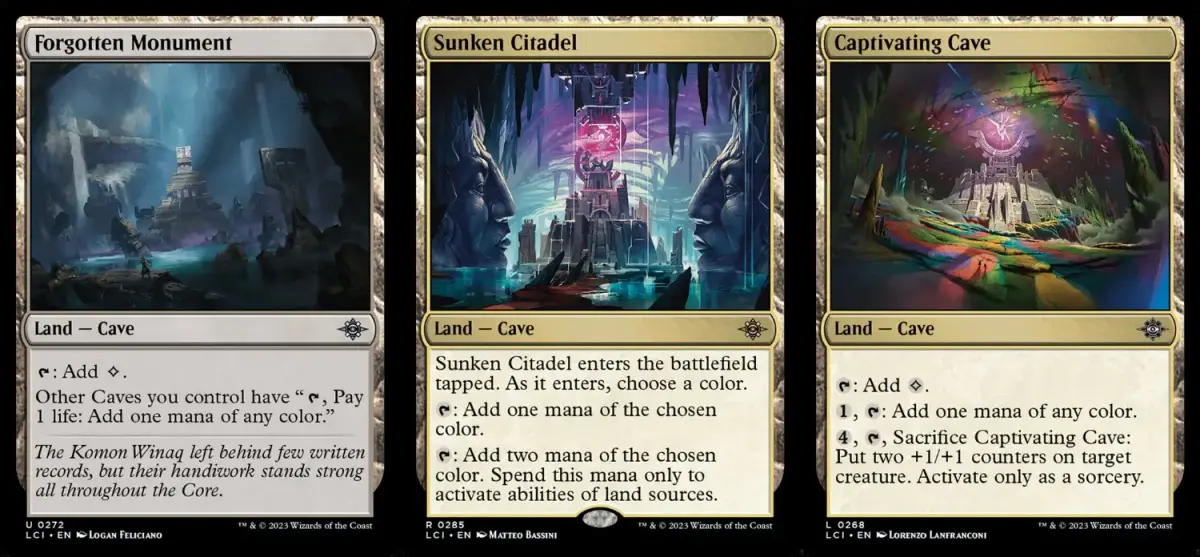
In addition, interactive cards that look at the number of Caves mostly count Caves on the battlefield plus in the graveyard, so even if you sacrifice your Caves or the opponent blows them up, those cards are unaffected. Examples include the sweeper Calamitous Cave-In, which deals damage equal to the number of Caves to all creatures and planeswalkers; the lifelink creature Gargantuan Leech, which costs less based on the number of Caves; and the card-filtering creature Sinuous Benthisaur, whose look depth equals the number of Caves. All of them have higher stability than other land themes. And for the various commonly needed utility lands there are corresponding Cave variants, so the whole system looks quite complete, but it has one huge flaw: Caves have no dual lands. Although there is the colorless Cave Forgotten Monument, which lets other Caves produce any color, until you draw it or find it, the color-fixing experience is even worse than a multicolor deck with only basic lands.
So I built it as a red-green two-color deck, only mixing in a few third-color mid-to-late-game cards. The decklist is as follows:
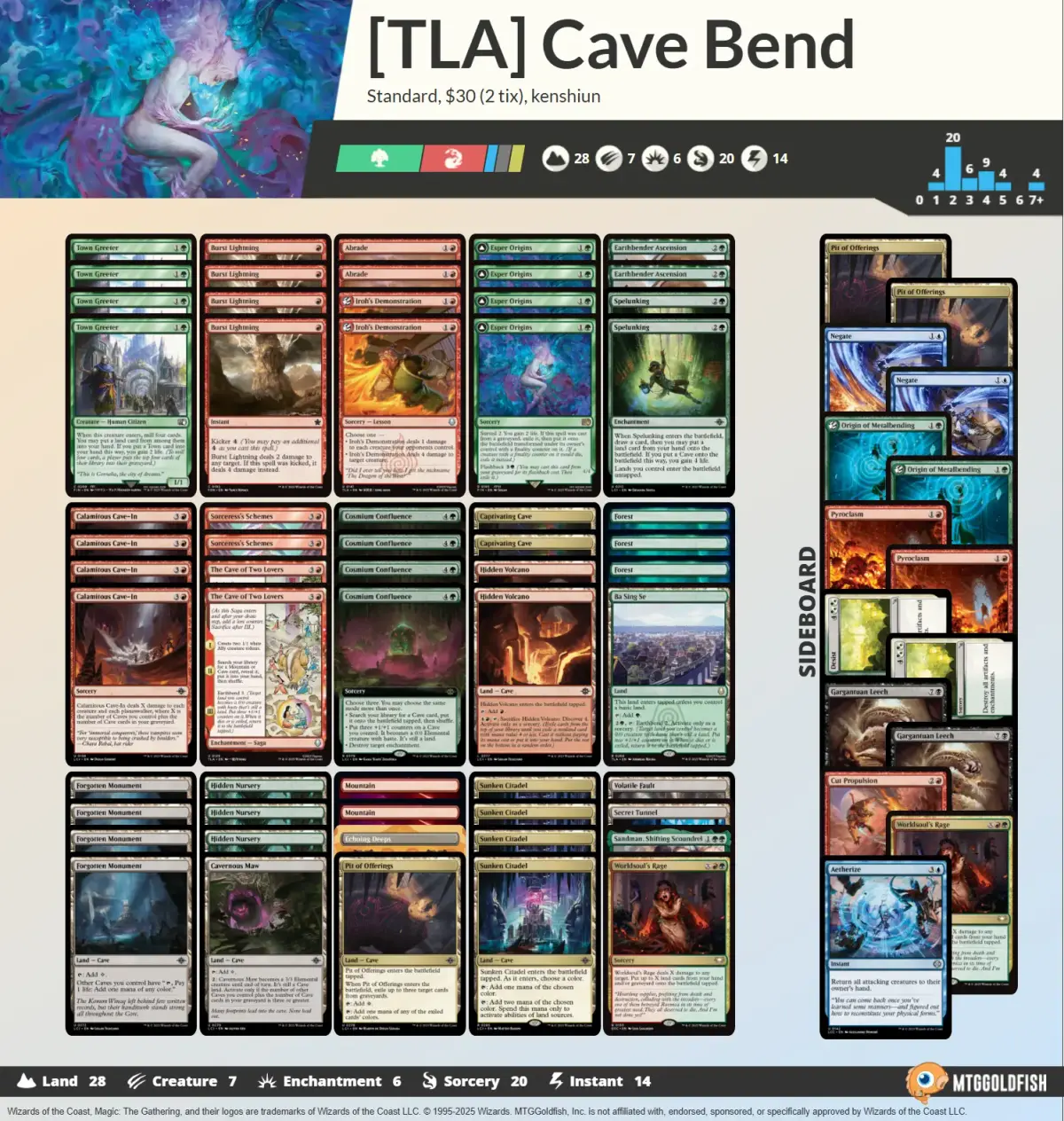
First, the land composition. The backbone of the fixing is a full set of Forgotten Monument, which gives other Caves the ability to produce any color, plus Sunken Citadel, which picks a color on entering, then two Captivating Cave to bring the count to ten. Including the single-color Caves that can be sacrificed to Discover, Hidden Nursery and Hidden Volcano, and basic lands, we set the two colors around the baseline (15 cards), and the rest are utility lands. Because the tutoring ability of the Cave system is strong, you basically only need one copy of each utility land, and can directly find whichever one you need. There is the main attacker Secret Tunnel, the land-destroying Volatile Fault, the graveyard-exiling Pit of Offerings, the manland Cavernous Maw, Echoing Deeps, the replacement when a utility land goes to the graveyard, and the only non-Cave utility land, Ba Sing Se.
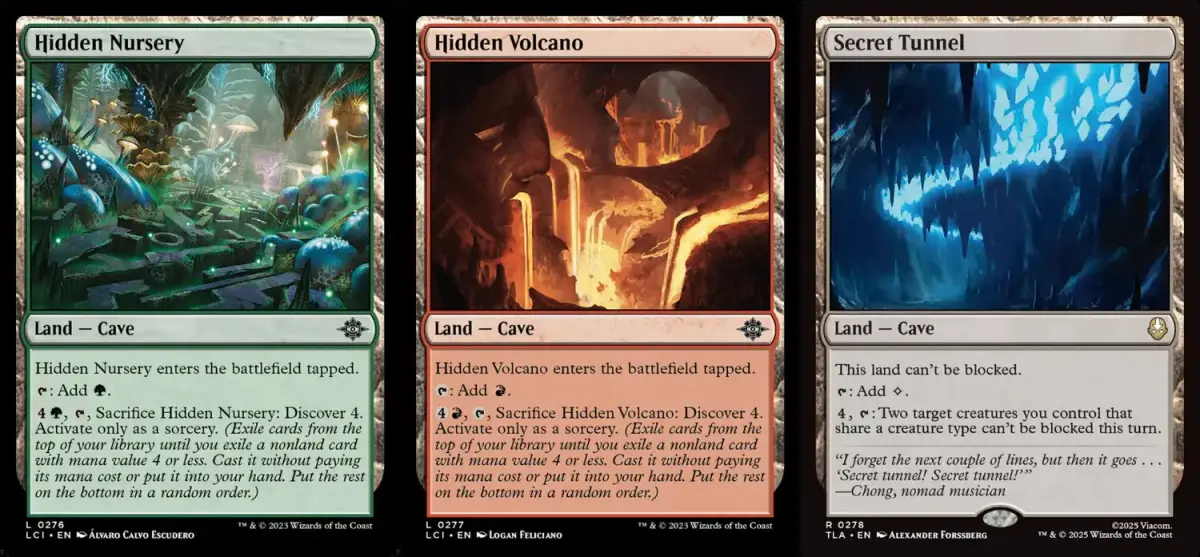
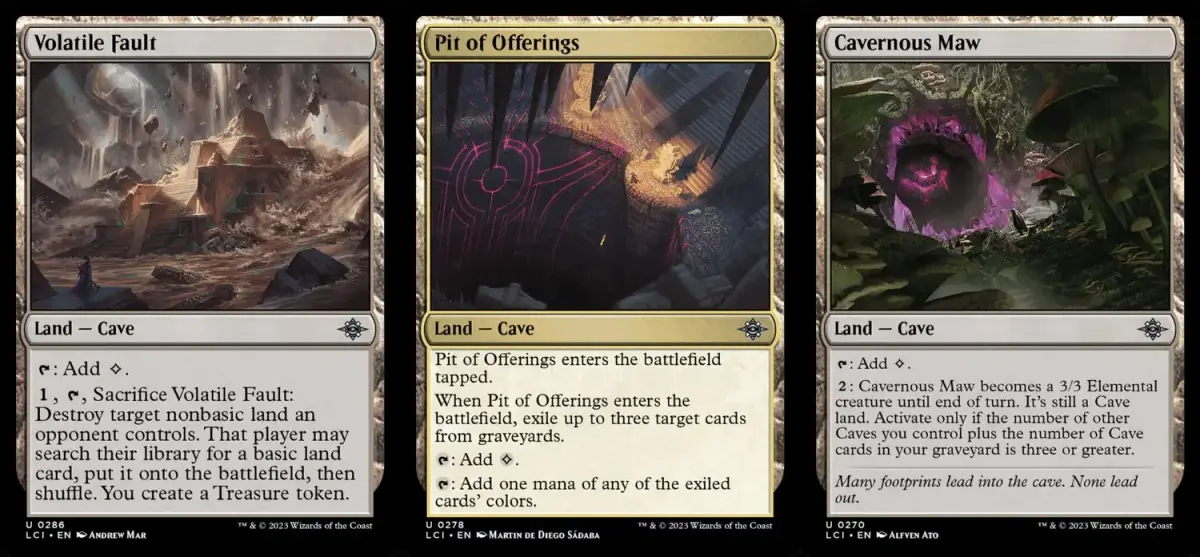
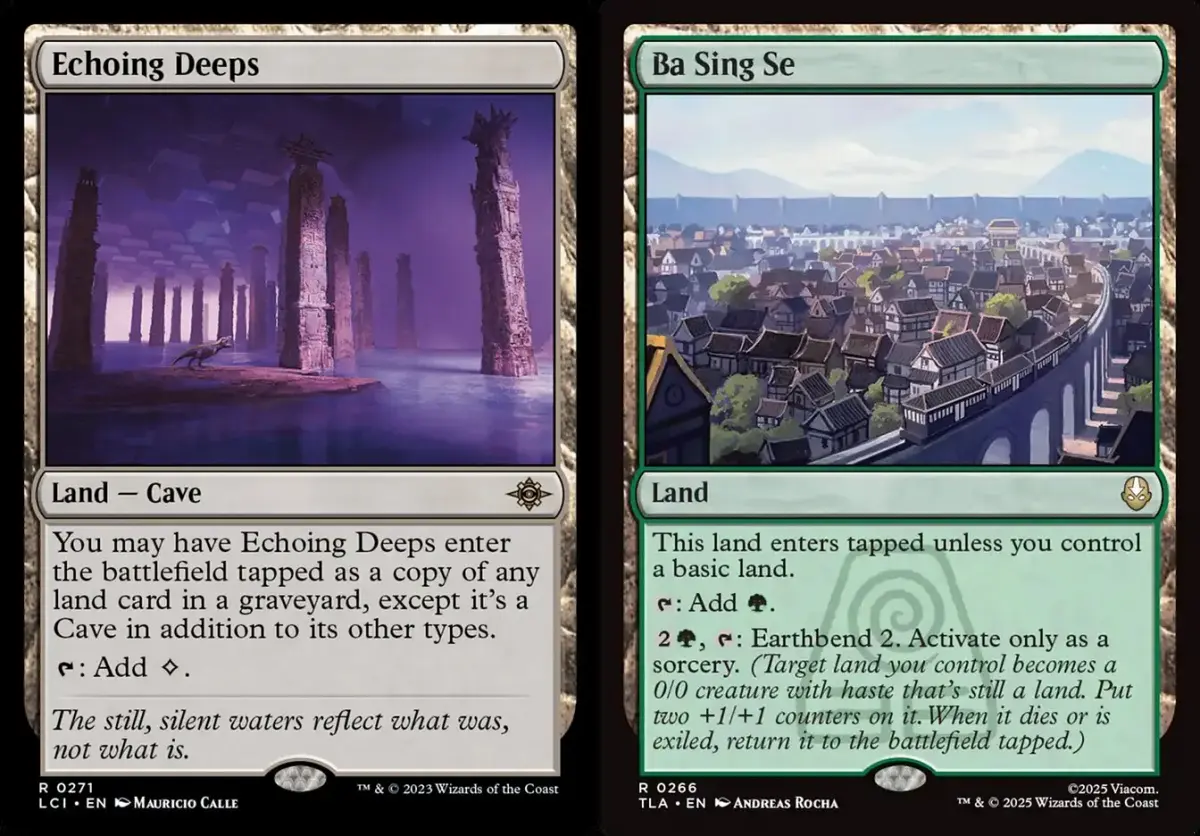
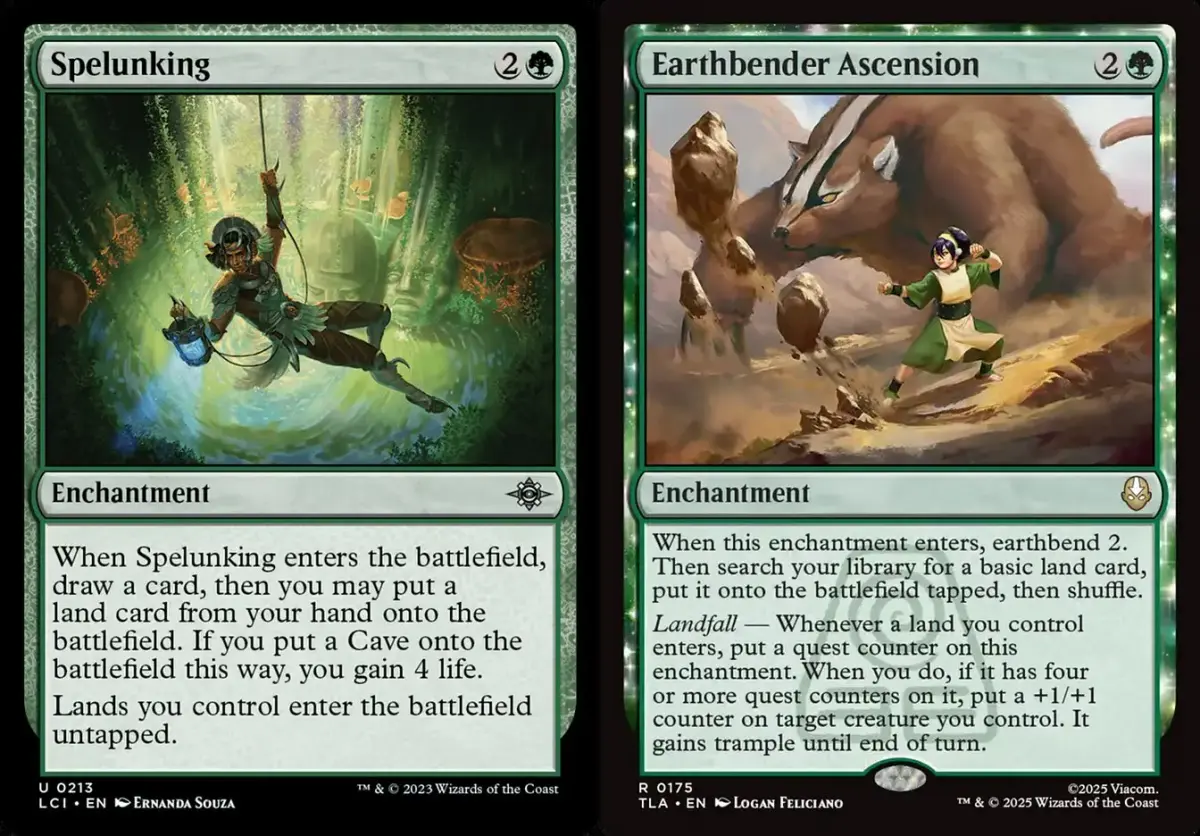
As for the Cave system’s nonland cards, the previously mentioned Cosmium Confluence and Calamitous Cave-In, whose colors match, are naturally played at full playsets, plus two Spelunking for ramp. Besides making all your lands that would enter tapped enter untapped, this enchantment draws a card and puts a land onto the battlefield on entering, and if that land is a Cave you gain 4 life, helping you survive the early to mid game. But why not play a full set of it? Because its enter-untapped effect doesn’t stack and doesn’t help the board’s combat power at all, so I mix in two Earthbender Ascension, which also have a ramp effect and provide offense by earthbending on entering and counters to strengthen combat power, to balance it out.
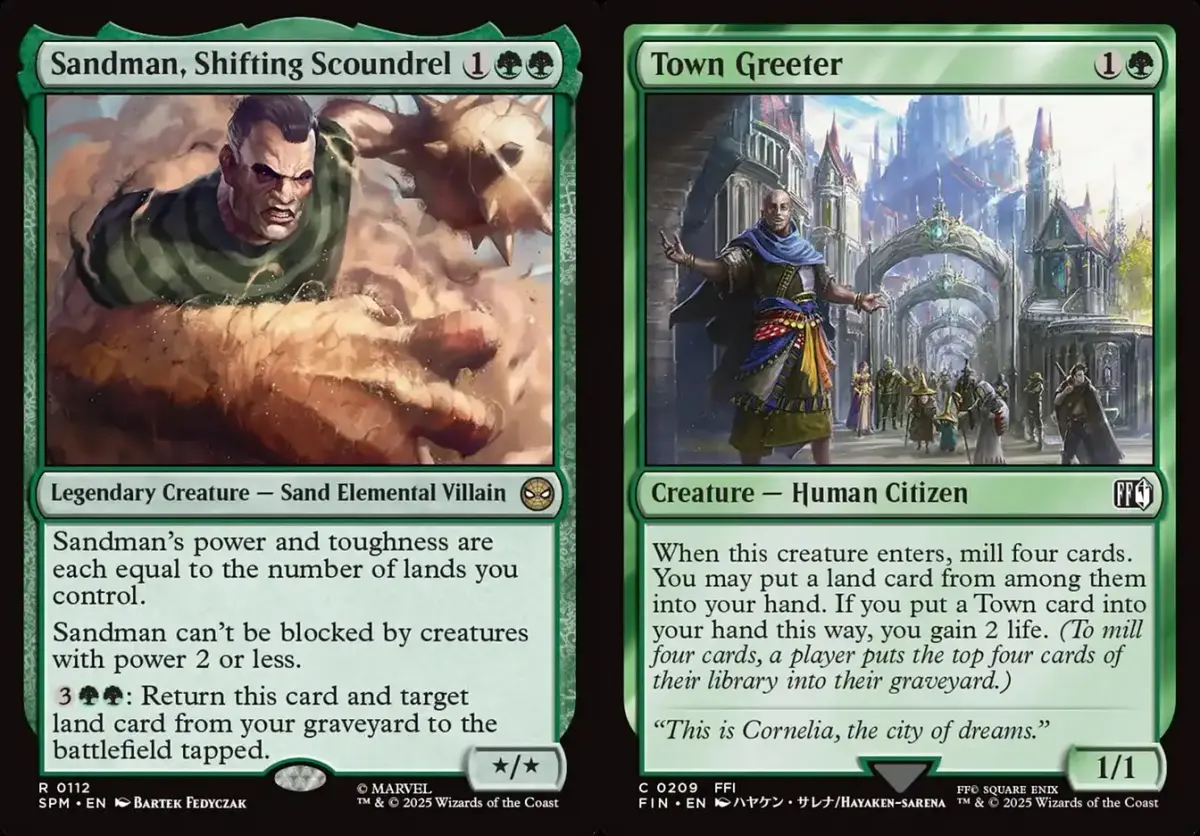
For creatures, I chose to play one copy of the actual master of sand-bending (?), Sandman, Shifting Scoundrel. Sandman’s size is determined by the number of lands you control, and in a ramp deck its body can often grow to double digits; it can also pull lands from the graveyard back onto the battlefield, a persistent threat that’s hard to deal with for midrange and slow decks lacking exile effects. There is also Town Greeter, which mills four and takes a land on entering, filtering lands into your hand early when you lack them, while milling excess Caves or flashback spells into the graveyard to raise the deck’s stability.
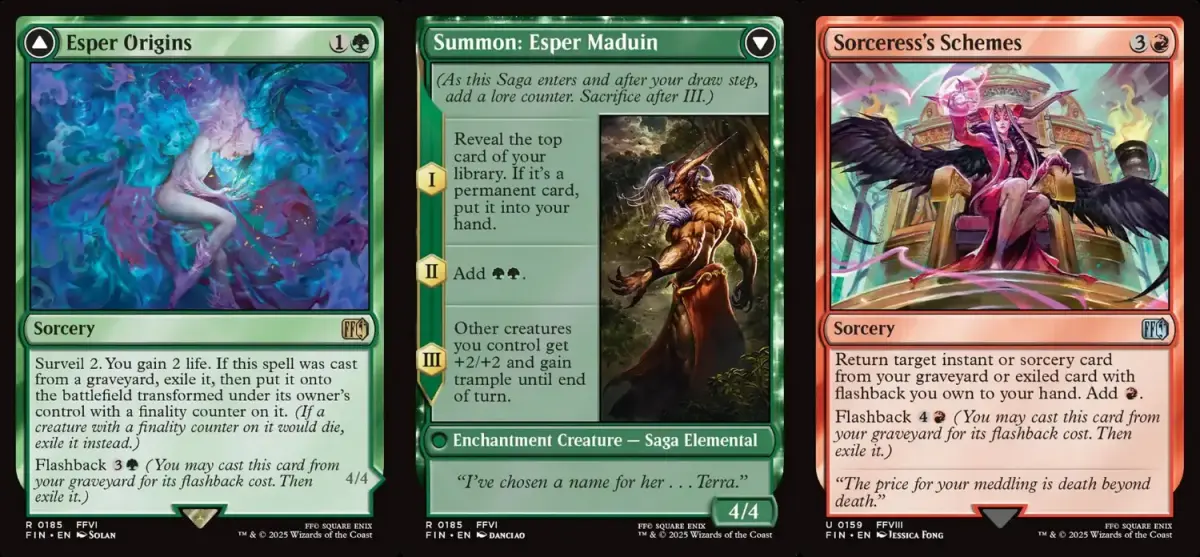
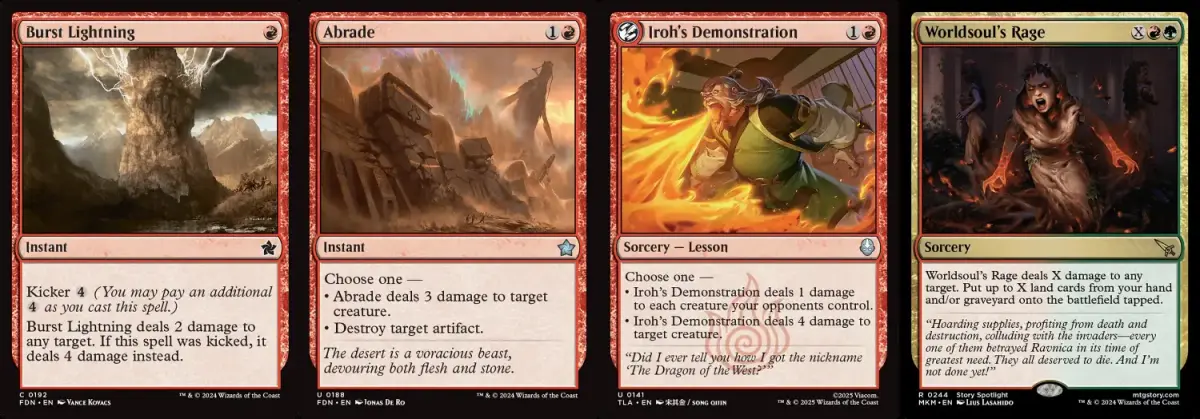
Finally, the spells. Since the deck design has a slight graveyard-stacking nature, I use the flashback combination of Esper Origins and Sorceress’s Schemes. When Esper Origins is cast from the graveyard it transforms into FFVI’s Esper Maduin, which can loot, gain life, draw cards, ramp and pump the whole team; not only does it draw a card when it enters, but when it reaches chapter III it lets Town Greeter or Ally tokens deliver real damage. Sorceress’s Schemes picks up an instant or sorcery from the graveyard or a flashback card from exile; not only can it be reused from the graveyard, it can also return Esper Origins or another Sorceress’s Schemes from exile to hand, and as long as you have enough mana, you can recycle spells endlessly. For removal I picked the direct-damage Burst Lightning, Abrade for artifacts, Iroh’s Demonstration, which can burn or sweep, and one Worldsoul’s Rage, an X-cost finisher that deals that much damage to any target and puts up to that many lands onto the battlefield.
Gameplay Demo
For a deck whose paper price may be under 1000 TWD, this Cave deck has decent fighting power against both aggro and control. The main deck burn and big and small sweepers can suppress the opponent’s creature development, and the earthbending-led offense is enough to give traditional control a headache. When I tested on MTGA, I once played against Esper Control; although it was a Bo1 match, the two sides wrestled for a full 40 minutes, and in the end I decided the game by pushing all my lands in one wave, showing that its performance in a long game is not to be underestimated either.
Conclusion
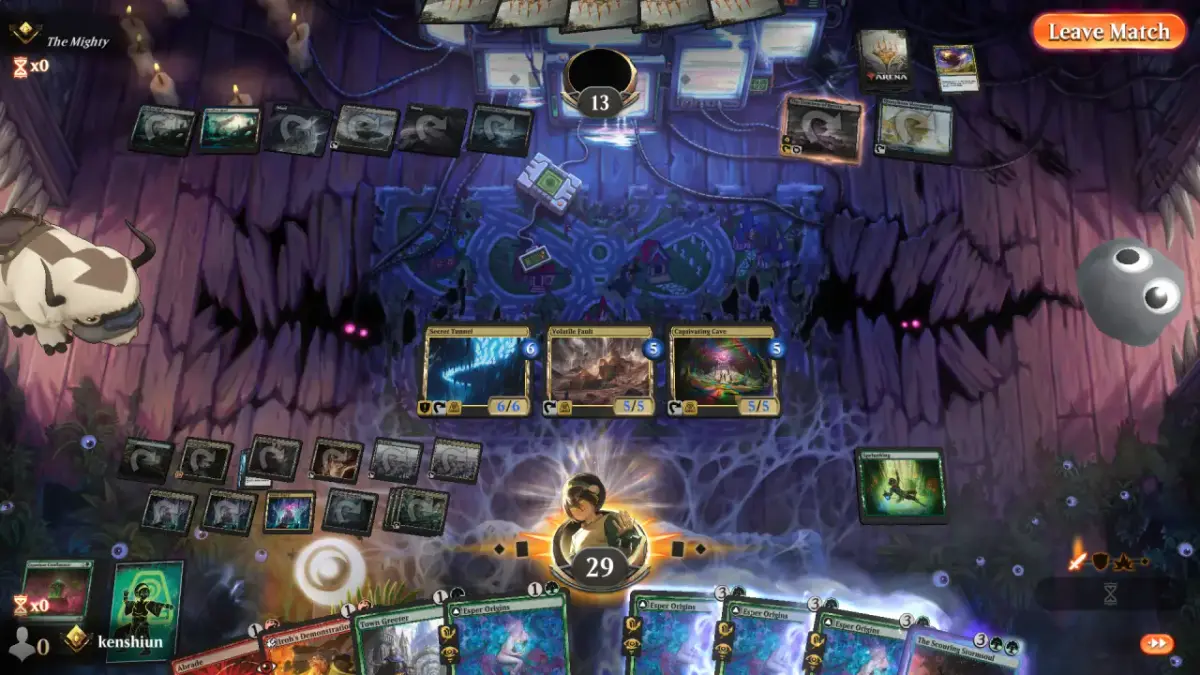
Finally, a little puzzle. As shown in the image above, I ate a blue-black finishing mill combo: Singularity Rupture sweeps the board and mills half, then on the next turn Riverchurn Monument’s Exhaust is activated, milling cards equal to the number of cards in the graveyard. Usually against this trick your library gets milled out directly, but I survived with two cards left in the library and won back on the next turn. How was this done? Why not build it and play it, and there are more fun plays waiting for you to discover.
- Title
- A Closer Look: Standard Cave Bending
- Author
- JerobaMTG
- Created at
- December 7, 2025
- License
- This work is licensed under CC BY-NC-SA 4.0 .