
The Impact of Foundations on Standard

Note: This article was translated from Chinese by AI and may contain errors. Read the original Chinese version.
Before We Start
What cards are actually in Foundations? How is it different from the core sets of the past? Is it old wine in a new bottle? Through this article, I hope readers can come to appreciate just how impactful and transformative Foundations (FDN) will be. Let’s take a look together!

What’s in Foundations?
Here we’ll go through the products in the main FDN release to explain what this set is made of.
- Play Booster: You can open cards numbered FDN 001 to 291, where numbers 272 to 281 are basic lands and numbers 282 to 291 are full-art basic lands. Of the 271 nonbasic cards, numbers 001 to 133 are new cards debuting in FDN, while 134 to 271 are reprints that appeared in earlier sets. In addition, there is a certain chance to open Special Guests (SPG) cards numbered 74 to 83!
- Collector Booster: Besides the cards you can open in Play Boosters, you can also open cards numbered FDN 292 to 487, including showcase, borderless, and extended-art cards, plus special collector-oriented foils. The categories are too complicated to cover here, so friends keen on collecting can look at the card images on scryfall.
- Beginner Box: Besides using some of the cards from regular Play Boosters, it adds 77 reprints numbered 488 to 564 and a new card numbered 730, Hinterland Sanctifier
 , for a total of 78 new Standard recruits.
- Starter Collection: This product is a true Standard gift pack! Besides using some of the cards from regular Play Boosters, it adds 163 cards numbered 565 to 727: powerhouses that dominated Standard over the past 5 to 15 years, useful removal, or quality sideboard cards.
Foundations alone adds a total of 512 cards! Basically, one set is the equivalent of two sets, and going well beyond that, the targeted reinforcement of the Starter Collection greatly increases the density of constructed-playable cards! Even the Beginner Box, which leans toward newbie promotion, contains some cards with constructed potential! In a typical Standard set in the past, at least about a third of the cards were designed for limited and weakened in constructed power. But after browsing the 512 newly Standard-legal cards in Foundations, I believe it contains at least as many constructed-strength cards as 2 to 3 ordinary Standard sets would offer.
In short, more than 300 cards with Standard constructed strength are handed out in one go in Foundations. If this isn’t a gift pack, what is? Even better, these cards can be used in Standard for the next 5 years, until they rotate out in 2029.
Foundations’ Impact on Standard
Having seen what’s in Foundations, let’s briefly discuss this set’s impact on Standard and introduce some cards that I privately believe have an influence on Standard.
First, pouring 512 Standard-legal cards in at once undoubtedly adds more than double the usual reading burden for players in a single set. Although Foundations has chosen cards with intuitive text and less complex mechanics wherever possible, this volume is still quite challenging, especially for new players. This is where the design of the Starter Collection and the Beginner Box shows its value: new players can follow the instructions in the boxed products to gradually learn Magic’s card design and game mechanics, and this process naturally becomes the “cornerstone” of new players’ experience and understanding of Magic.
The Ten “Cornerstone” Cards!
Next, in this article I’d like to try discussing 10 kinds of cards that I personally believe will greatly shake up today’s Standard and keep exerting influence. They are listed in order of set number from smallest to largest, and have nothing to do with power or how promising they are. As for the definition of “cornerstone,” it’s entirely my own biased interpretation, so just enjoy it and don’t take it too seriously.
The definition of “cornerstone”:
As the name suggests, it relates to the Chinese translation of this set’s name, Foundation. But the extended meaning here is this: if you’re a player who quit 10 to 15 years ago and came back with Foundations, these cards will feel very familiar, as if you had never left the game; yet these cards haven’t been reprinted in Standard for at least 5 years, and Foundations brings them all back to Standard at once.
1. Authority of the Consuls

If this Enchantment lands early, a single card can buy white midrange or control decks precious breathing room and some life. In addition, one card can shut down the Urabrask's Forge that red-based sideboards have been using lately, an opponent’s unearth ability, or weaken one-turn attack-boosting effects like Imodane's Recruiter // Train Troops
 . I wouldn’t be too surprised to see it in the sideboard of a white-based aggro deck.
2. Day of Judgment

A four-mana sweeper with no side effects. The last time it appeared was 13 years ago in M12, and since then, apart from the two-color sweeper Supreme Verdict , there have been no more four-mana sweepers, or at least none without some less controllable side effects, like Depopulate
 . Instead, Standard since then has printed many five-mana sweepers with some positive abilities, such as Fumigate
 and Sunfall
 . But in terms of timing, a four-mana pure sweeper with no side effects is still what white-based control decks need, and this reprint fills that gap.
3. Burst Lightning

As a Shock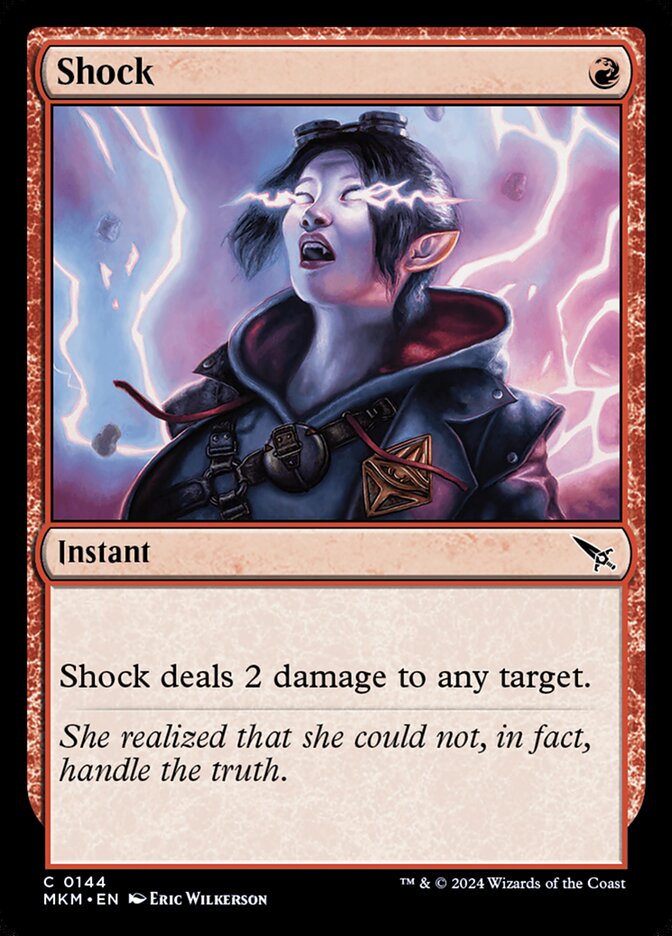 that can be kicked to deal 4 damage, it has much more flexibility in use. Of course, the vast majority of the time it’s still used like a Shock, but having a kicker damage boost to topdeck in the midgame and late game gives red aggro decks a hidden midrange winning edge.
4. Llanowar Elves

How long has it been since we saw a one-mana mana dork in Standard? Since Llanowar Elves from DOM left us, a full 6 years! And now Foundations welcomes Llanowar Elvesback, so green creature/midrange decks have a real chance to return to the front of the Standard meta! New Standard decks will also have to find answers to a turn-one mana dork, or some means of disruption to interfere with its acceleration into mid- to high-cost threats!
5. Opt

A one-mana instant-speed cantrip is extremely important for blue-based decks that need to dig quickly or fill the graveyard, and obviously the existing White-Blue tempo decks will get a boost. Other low-curve blue flash or tempo decks will also run more consistently thanks to the Opt reprint.
6. Unsummon

Unsummon? Isn’t a one-mana bounce spell too ordinary to be listed among the ten cornerstone cards? And wasn’t it last printed in M20, only five years ago?
Simply put, it’s the kind of card you feel will always be around, but the day it’s gone, you miss having it. In Standard of the last five years, basically no blue one-mana bounce spells were printed. The closest effect is Into the Flood Maw from BLB, which most of the time is indeed an upgraded Unsummon, but only being able to target the opponent’s creatures/nonland permanents leaves a bit less room in play, and Unsummon’s return fills that gap. Occasionally using it to save your own high-value creature is quite profitable.
To riff on this a bit, cards like Duress and Negate
 are similar: it’s hard to imagine Standard going five years without them. They also fit the definition of “cornerstone” quite well, and of course they’ve been added this time too, so make good use of them for the next five years!
7. Maelstrom Pulse

Although Standard also has a similar card like Legions to Ashes , what makes Maelstrom Pulse strong is that besides the bonus of killing same-named token creatures, it can destroy two or more same-named cards at once! Two Archfiend of the Dross
 ? Burned down! Three Urabrask's Forge? Burned down!!!
Maelstrom Pulse? A pulse-pounding delight, and gladly so.
Small reminder: if you have a permanent on your own board with the same name as the one you want to destroy with Maelstrom Pulse, then when the spell resolves, all permanents with that name on your side will be destroyed as well. It only cares about the name, not who controls it.
8. Boros Charm

A superstar of Modern Boros Burn is now entering Standard too. Paired with a host of quality burn spells, whether Standard can withstand the impact of a near-complete Boros Burn is a key point worth watching.
Back to this card’s effect: although most of the time it’s a two-mana, 4-damage direct damage spell, the other two modes, all permanents you control gaining indestructible and a single creature gaining double strike for the turn, push this card’s playability to another level. I believe Boros burn will take up a seat in the Standard meta, and the fact that burn is hard to interact with will surely be a major key to breaking Standard going forward.
9. The Three-Mana Non-Legendary Tribal Lords
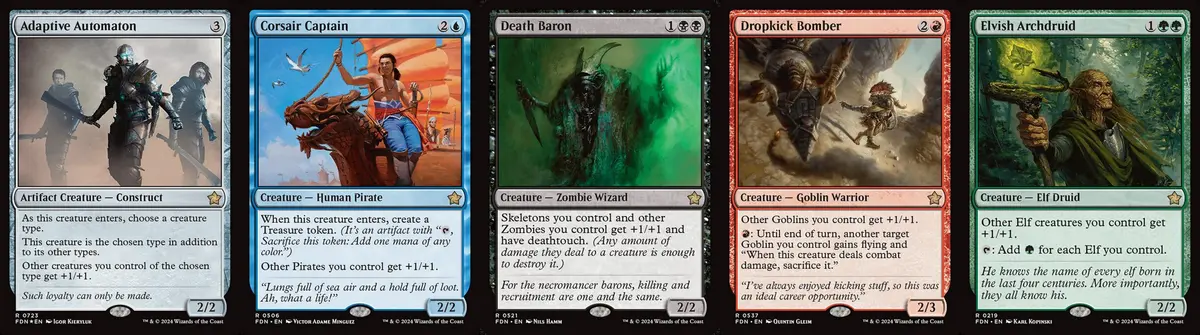
Since these are all similar in nature, being three-mana, non-legendary creatures with a tribal lord effect (other creatures of that type you control get +1/+1), please allow me to introduce all five in one card slot. Among these five lords, black’s Death Baron covers Zombies and Skeletons, red’s Dropkick Bomber
 covers Goblins, and green’s Elvish Archdruid
 covers Elves. Apart from Skeletons, the other three are evergreen MTG tribes with plenty of tribal supporters, so I believe they won’t lack job opportunities, and at least some enthusiastic players will help them find a way out.
Adaptive Automaton is, strictly speaking, a reinforcement of the tribal theme: in a theme that already has tribal lords, it can serve as an extra lord effect, and in decks that don’t have a tribal theme yet but are built around a specific creature type, it can also be inserted as a three-drop to slot into that theme (Figured it out? It can also be used as a three-mana Demon!)
As for blue’s Corsair Captain … honestly, the Pirate theme isn’t strong right now, and its own ability is mediocre. But the fun of MTG lies in its changes. Maybe one day the Pirate theme becomes viable and just needs one more three-mana lord, and then it can naturally go out and get to work!
Incidentally, the reason I didn’t specially feature white’s two Cat tribal lords, Arahbo, the First Fang and Regal Caracal
 , is that one is a three-mana lord but legendary, and the other is a five-mana lord. Both are already strong enough on their own and don’t necessarily need to be tied to a tribal theme, so I’ll skip them here, but don’t forget they exist when building decks!
10. Some Color-Hate Cards
For the last slot, I hesitated for a long time, because there are still many cards with a chance to stir up a storm in Standard, but they’re far from the “cornerstone” definition above. When I examined these color-hate cards (haters of a single color aimed at the two enemy colors), I thought, these are the ones!
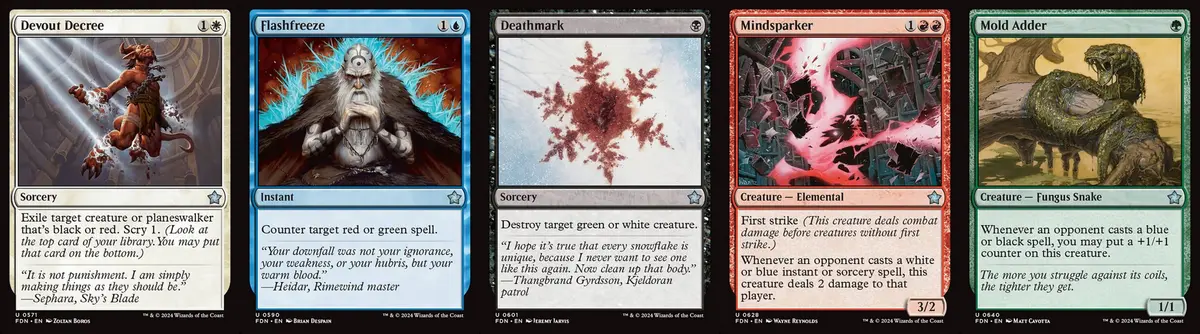
The color-hate cards reprinted in Foundations come from different core sets:
- Devout Decree
 : M20
- Flashfreeze
 : M10
- Deathmark
 : M10
- Mindsparker
 : M14
- Mold Adder
 : M10
What do these color-hate cards have to do with the cornerstone? Quite a bit. First, color-hate cards have always appeared in core sets of the past, and since Foundations is the Standard-promotion set that inherits from core sets, printing these cards makes perfect sense. But the ones selected are quite interesting! I personally feel that the effects of blue’s Flashfreezeand black’s Deathmarkare very significant against their enemy colors, and as long as that enemy color has a high share of the meta, they will basically see play. As for the other three cards, I believe their usage should not be too high, since by current Standard power they’re all rather weak cards, so the focus remains on how the blue and black color-hate cards perform in Standard going forward.
Don’t forget that MOM, which hasn’t rotated out yet, also has the following color-hate cards available as sideboard options, and a comparison will show which is stronger.
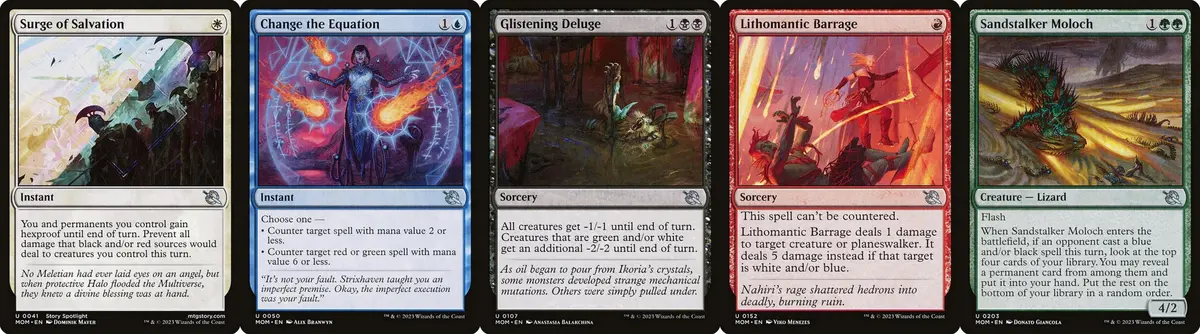
The above is just my own arbitrary list of important individual cards with direct or strong impact on the future of Standard, and I expect to keep seeing them over the next five years. Of course, MTG will keep evolving, and this article is only a prediction for now, so we need to stay open-minded and keep watching changes in the environment and the chemistry brought by new sets.
My Personal View on Investing in Foundations
After discussing the impact of new cards on the environment, let’s talk about the economic side. The intuitive part is about investing in the new set. Suggestions for different player groups are written here for your reference, and you can just choose the way that suits you best to play this game:
Commander Players
Although Foundations has no Commander precons, it still has new cards numbered 001 to 133, and Collector Boosters can also open beautiful showcase, borderless, and extended-art cards, so basically treat it as an ordinary Standard set and pick the products you need.
If you have a soft spot for showcase cards, Foundations Jumpstart also has some new showcase cards to collect, plus an extra 29 new cards usable in your Commander builds. In addition, the Foundations Starter Collection has a full-art alternate-art foil Gigantosaurus , worth considering for those interested in collecting.
By the way, the Starter Collection also contains these three cards commonly used in Commander… Players who want to collect a particular set symbol may want to keep an eye on them.


Modern-and-Up Constructed Players
Foundations is a set specially built to reinforce Standard, and basically not many of its cards are strong enough to impact Modern, Legacy, or even Vintage. However, Foundations Jumpstart has 23 new cards usable in Legacy and above (not legal in Modern), so don’t forget to look at the card list!
Pioneer Players
Although many Foundations reprints are already Pioneer-legal, the set also brings many pre-RTR cards into Standard, which lets Pioneer use them too. I strongly recommend Pioneer players go through the full card list and then review their own collection to see whether there are cards they might use but don’t own yet. If the number of missing cards is large enough, you can consider buying 1 box of the Starter Collection as a supplement, complemented by buying singles to fill out what you need.
Standard Players
I personally regard Foundations as a Standard set with the weight of two sets released at once, and for its scope of impact please refer to What’s in Foundations?. As with the advice for Pioneer players, after going through the full card list, first review your own collection, and if you’re missing many of the newly added cards, you can consider buying the Starter Collection plus singles to fill out the set.
Players Who Quit Years Ago and Recently Want to Play Standard Again
If you’re an old friend who quit long ago and recently saw the news and want to try coming back to Standard, then this is a very good time to return. For this type of player I assume you already have a basic grasp of the MTG rules; if you’re a newbie not yet familiar with how to play, I suggest skipping ahead to the Complete Beginners! section below. If your budget allows, you can even consider buying 2 to 4 boxes of the Starter Collection at once to fill out the cards Foundations adds. Each box also comes with 3 FDN Play Boosters, and after opening them you can look at what deck you want to build and try to fill in the single cards you need. Further investment should go toward the lands of other Standard sets.
I can’t help recommending again the Foundations Standard Preliminary published on this site a few days ago, where 35 constructed decks serve as a touchstone for the new Standard, boldly trying new cards and blending them into the current Standard card pool. I personally think it was done quite well. Readers are welcome to look back when you hit a bottleneck in deckbuilding, and you’ll surely find new discoveries and gains.
Complete Beginners!
For complete beginners who, after finishing the tutorial, want to learn more about MTG, Foundations is a very good set for newbies. Most cards don’t have much text, and the keywords and rules used are relatively simple.
I personally highly recommend that new players buy a Beginner Box from a nearby store and read the included Reference Guide Booklet carefully to understand more about how to play. The Beginner Box contains 10 monocolor, 20-card themed decks, with two themes for each color. It plays like Jumpstart: mix two decks of different themes together and you can start playing, which is very intuitive. If two friends buy a Beginner Box, they can quickly understand how the game works by playing against each other, and I believe it’s a very good product for newbies to get started. Once you have a grasp of the basic game concepts and have some friends to play with, you can consider pooling money with friends to buy 2 to 4 boxes of the Starter Collection, sharing resources or using other creative ways to lower the barrier to deckbuilding, and explore the charm of Standard constructed further.
Through the cards in the Starter Collection and Beginner Box, players can gradually learn Magic’s card design and game mechanics, and naturally become the “cornerstone” of these new players’ experience and understanding of Magic. And don’t forget, the companions who experience this game with you and get through the beginner growing phase together often become important friends in your future memories, or even your life.
To newbie friends, we also highly recommend reading this MTG Beginner’s Guide. After understanding the basic concepts in the article and some essential MTG knowledge, the next step is to go to a card store to play and discuss with others! If you have related questions, feel free to message the Guildmages’ Forum 魔風集會所 fan page too!
Conclusion: Foundations, the Evergreen Warm Winter of Standard
After a new Standard set is released, the first few weeks are always conservative to some degree: existing front-of-the-meta decks still hold a relative majority, but at the same time some original experimental decks appear. Then one or several refined decks in a dominant position will rise unexpectedly, driving the meta’s self-iteration and ushering in a Standard environment where a hundred flowers bloom… I believe this story is no exception for Foundations. The difference, however, is that as mentioned earlier, this is 512 Standard cards arriving at once! The turbulence in this process and all sorts of wild, unconventional ideas will surely gradually appear on the Standard tournament scene. Let’s keep an open mind and enthusiastically join this Standard feast! And don’t forget, the ongoing MITQ#9 and store championships are all Standard events!
As for the design of the Starter Collection, I think it’s the strongest support Wizards of the Coast has given to promoting the game to newcomers in recent years. From the massive increase in Standard-legal cards to the affordable pricing strategy and the representativeness of the chosen cards in Standard, you can feel that Wizards means it with this reinforcement of Standard. I sincerely hope this approach can lower the barrier to entering the game a bit, letting more players experience the fun and charm of this game!
Foundations will bring Standard an evergreen warm winter lasting five years, and after that, can it nurture a spring full of blossoms and vitality? Let’s keep playing and find out!
- Title
- The Impact of Foundations on Standard
- Author
- cephille
- Created at
- November 14, 2024
- License
- This work is licensed under CC BY-NC-SA 4.0 .
Related Articles

I Drafted Alone: Solo Drafting with Reality Fracture (FRA)
October 16, 2026
Article Translation — Reid Duke's "Level One": Choosing Your Deck
August 17, 2026

Article Translation: Reid Duke's "Level One": Sequencing
July 24, 2026
Article Translation: Reid Duke's "Level One": Playing in a Grand Prix: Part I
June 13, 2026