Handling Defeat: cephille's Standard Dimir Midrange Retrospective

Note: This article was translated from Chinese by AI and may contain errors. Read the original Chinese version.
Before We Start
After the June 30, 2025 B&R announcement, the Standard environment saw its largest set of bans since 2020. Dimir midrange, left completely untouched, leapt from being suppressed by red aggro in the previous season to the hot favorite of the tournament scene… Uh, maybe that’s a bit overheated?
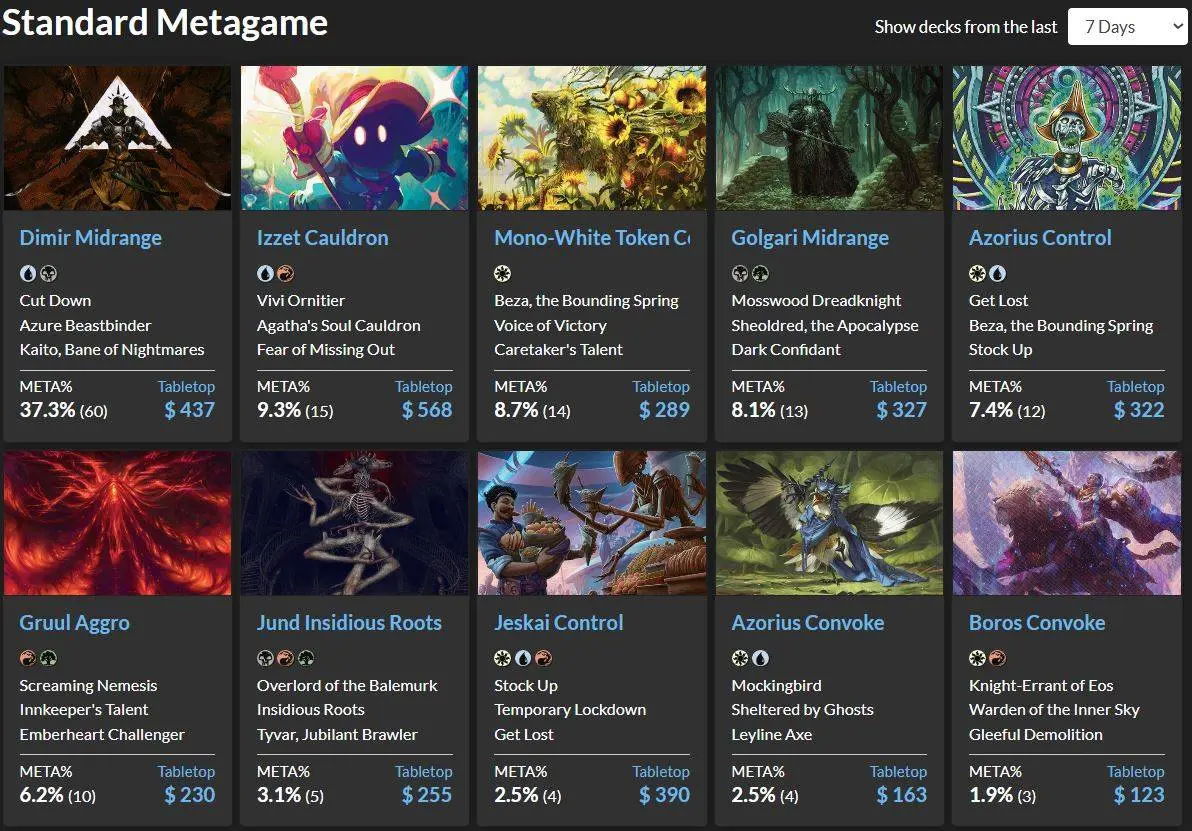
MTGGoldfish confirmed date: July 5, 2025
If we only look at the week of June 30 to July 6, it seems to be the biggest blight in this Standard environment! But this deck did not enjoy such a scene from the very start. With Standard about to rotate, readers may not be very interested in this topic, but I still want to try to organize the thread of this process, as a summary of my year and a half of journey.
While writing, I often thought of the player interviews that faintmama and I published on the Forum. We focused on players who have already proven themselves, but what about the times before they were “seen”, and the many more players who are still working hard? Do those moments have anything worth looking at? How do we view and feel about “winning” and “losing”?
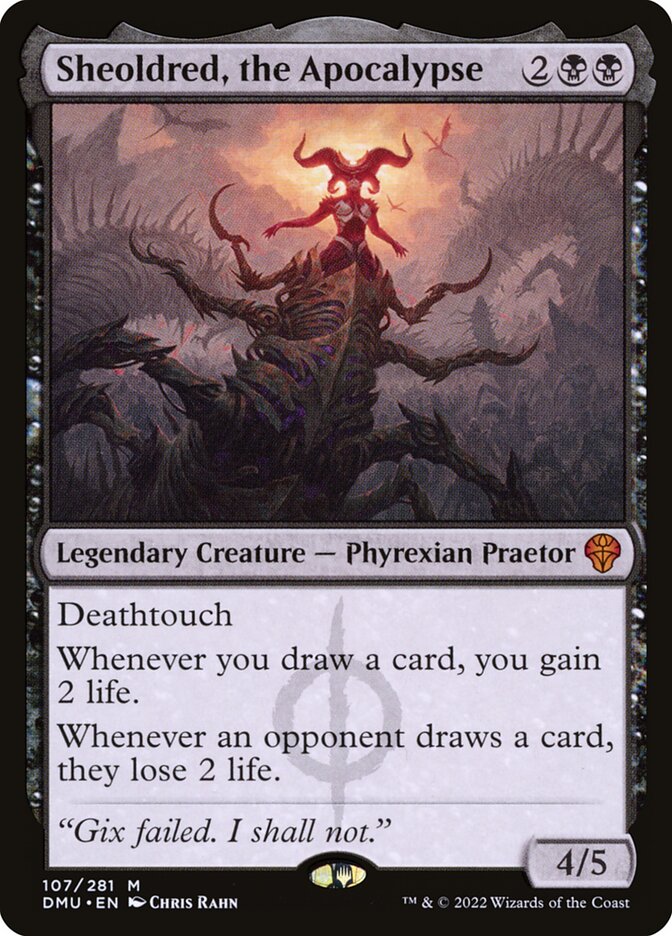
This article is dedicated to the Sheoldred, the Apocalypse in my deck. Thank you for accompanying me these two years, and congratulations on graduating XD but what do I do when my draws no longer gain life
Why Did I Choose Dimir Midrange?
It wasn’t because this deck is the strongest, though of course that was a consideration at the very beginning. A deck’s strength changes as new sets keep releasing, but the core way of playing does not.
Dimir midrange is a deck with lots of early interaction and mid-game threats, building a unique tempo-counterattack deck through the three components of blue-black: draw, counter, kill. The deck has no super bomb that decides the game in one blow, and no combo that nearly wins the game once assembled; what leads you to victory is that you constantly make subtle adjustments to your main deck and sideboard according to the current meta. You could put it this way: to play Dimir midrange well, you must keep a sharp instinct for the meta at all times, and use understanding and game plans to generate card advantage and then win.
A deck like this is like an amoeba: change a few cards, or even change none but approach playing it with a new idea, and you can have a brand-new game experience. And the Dimir midrange mirror may also be one of the hardest mirrors in the environment. Play or draw, the choice of opening hand, how to disrupt the opponent’s proactive plan, whether we can follow the disruption with a threat to take back tempo… there are so many variables that the mirror often can’t give a clear game plan, and improvising and thinking your way to victory is the biggest key.
What attracts me most about playing Dimir midrange is that the more time you invest, the more you can bring out unique tactics gained through practice in certain situations, and every adjustment feels like an evolution. You can always do “better”.
2024 to 2025: My Dimir Midrange Journey
Looking back, in this year and a half I have written 23 posts on my personal fan page with Dimir midrange as the theme, some of which were also organized into articles on the Forum. To write this retrospective, I picked them up again and relived the feelings I had when writing them. And after the dregs of these emotions settled, some crystals with a faint glow have been repeatedly sending through my mind the thoughts they want to tell.
Behind the glittering major tournaments, how many such crystals in the dark are calling out, struggling, and fading? Allow me to magnify my own sentimentality a little and try to speak my own “voice of the defeated”.
20240113 Magic Star MITQ
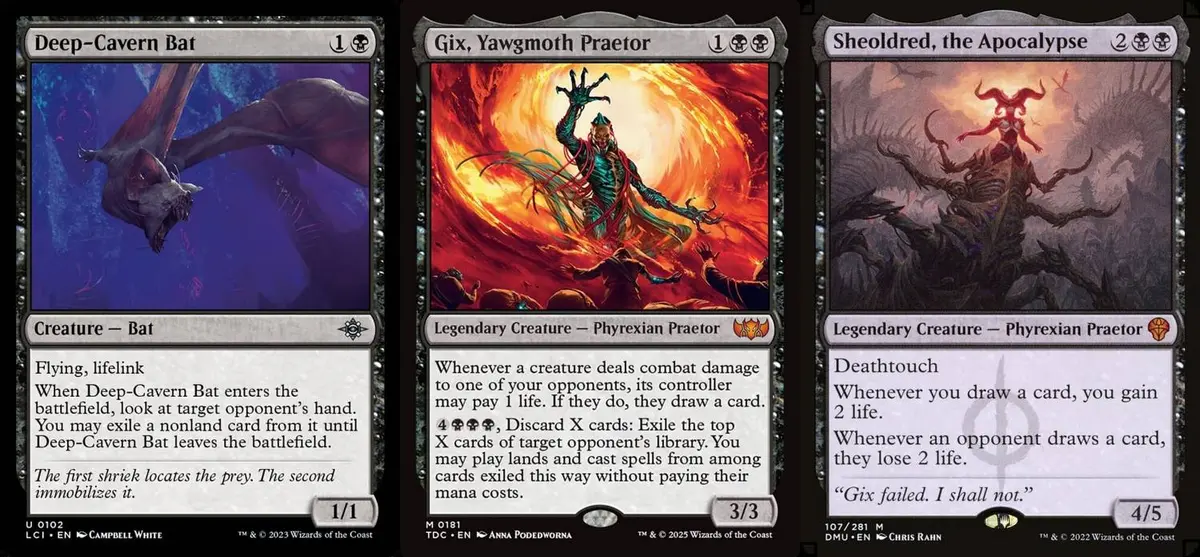
In the 2023 season I used UW Soldiers, a tempo deck that I have always liked and habitually used. During the Forum’s early days I also wrote this piece, The Evolution and Outlook of Standard UW Soldiers, to briefly describe my own understanding. However, at the end of 2023, after witnessing black-based decks with the twin Praetors and the overwhelming force of curving out on turns two, three, and four and making Magic look so easy, plus the weakness of the Soldier tribe not getting enough support after LCI, I decided to switch to Dimir midrange for the following Standard seasons.
Although I didn’t play this MITQ very well, I came to appreciate more deeply the power of Gix, Yawgmoth Praetor and of Sheoldred.
20240127 ALG MITQ - cephille’s Standard Dimir Midrange Analysis and Tournament Report (Qualified for MIT#6)
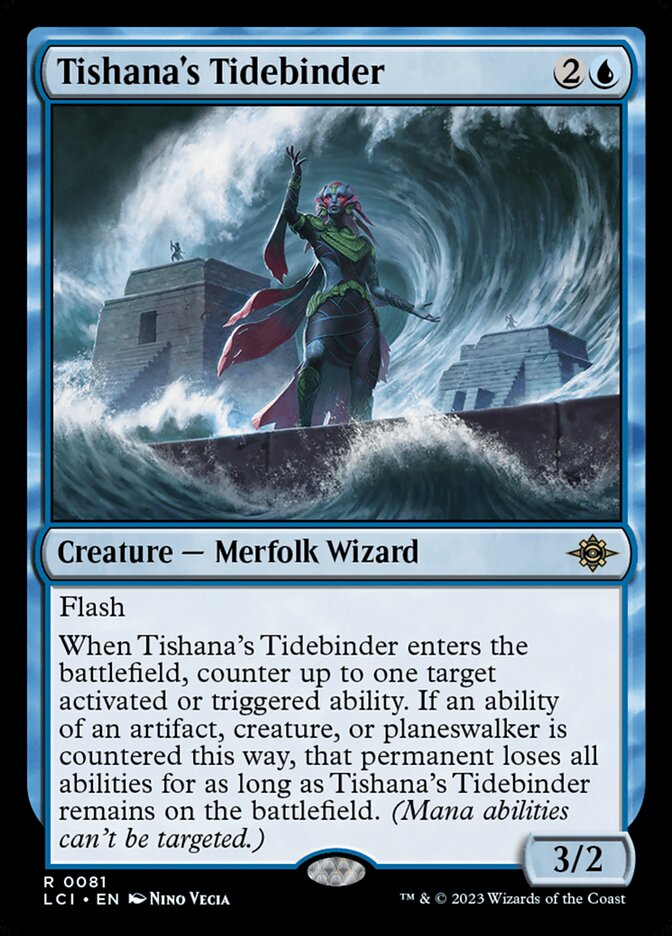
Fortunately, I earned my MIT#6 qualification without playing too many rounds, and I therefore confirmed the outstanding disruptive strength of Tishana’s Tidebinder in the Standard environment. For the following seasons, Tidebinder was always an important member I would not take out of my 75 cards.
20240330 卡士多 Standard Monthly
20240427 卡士多 APAC Standard
20240504 卡士多 Standard Store Championship
This period was basically a process of repeated testing and constantly cutting the deck’s original core, Gix, Yawgmoth Praetor, down to zero copies. With the rise of Convoke decks, the meta made me more and more anxious the more I played, and my win rate was basically under forty percent. By early May, the original Dimir midrange build, with Convoke blocking the road ahead and control/Ramp evolving behind us to also bring Tishana’s Tidebinder as anti-counterspell tech, fell into a dilemma, caught between advancing and retreating and nearly ready to give up and switch to playing Convoke…
20240529 cephille’s MIT#6 Preparation and Tournament Report: Sultai Midrange
In the end it still wasn’t tuned well. Three colors was a nice change, but it still didn’t respect the meta’s Convoke enough, and I was thoroughly punished in the win-and-in-for-top-eight match. If I fast-forward to now, a year later, I would say that one main, two sideboard The Filigree Sylex was necessary. I did see similar builds back then, but I let it pass without studying the usage scenarios in depth.

Although I missed out on the top eight, I still traveled to Amsterdam by myself to attend Magic Con, and rethought the meaning of this journey amid the European summer scenery and the company of friends. That is also what led to the new chapter of the story at Magic Spotlight: Final Fantasy a year later.
20240914 桌遊侍 Standard Store Championship
Two weeks before the release of DSK, I still didn’t know that Dimir midrange was about to receive the biggest boost of its Standard life. Although I was beaten silly by the various small-animal decks of BLB, the gain was that in this tournament I established the versatile flexibility of Three Steps Ahead, and after that it rarely left my 75 (though it was always in the sideboard; nothing to be done, the environment kept getting faster).
If thinking two steps ahead in a match isn’t enough, then think three steps ahead!

20241030 MTGA Mythic
DSK arrives in force!!!
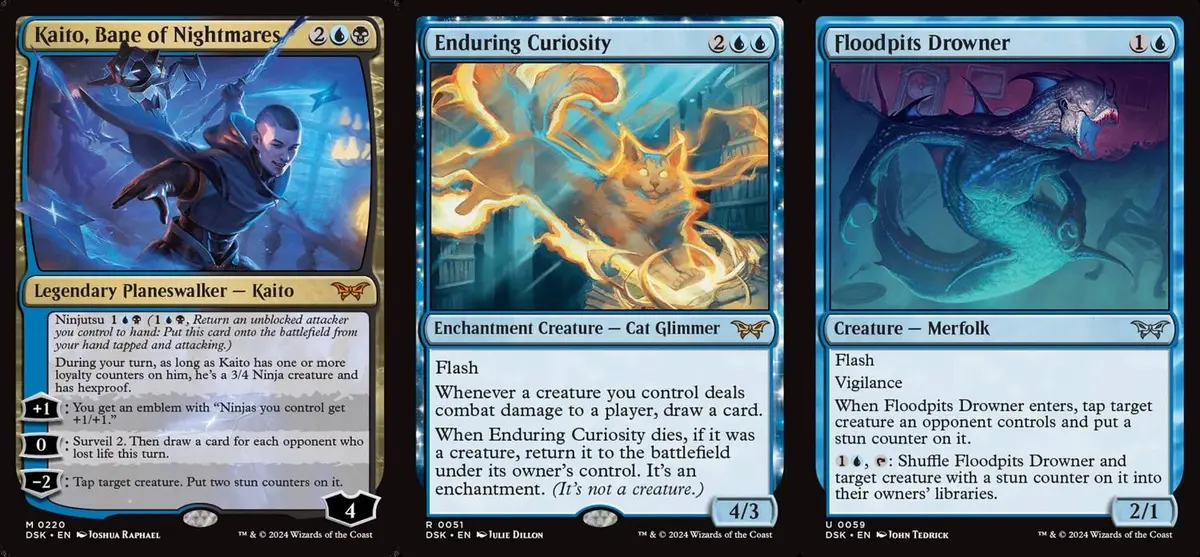
Gix? Unctus, Grand Metatect? Gone are those days. If you ask, the answer is to play the blue cat (Enduring Curiosity)!
In this version of the build, because I always topdecked Spyglass Siren and it got worse the more I used it, I was so annoyed that I just pulled it out, and the new stars Floodpits Drowner and Kaito, Bane of Nightmares were still in the testing phase, so I politely played only 2 copies of each. I later found out that was a big mistake: before the rise of red aggro, they were extremely important deck cores starting at 3 copies each.
Later, Kaito also proved how perverse a planeswalker that comes down with ninjutsu on turn three, is super hard to kill, and can keep attacking really is. Because of this, Siren was also filled back up to 4 copies, with the aim of spreading out as many decoys as possible on turns one and two so Kaito can come down smoothly. As soon as a single Enduring Curiosity resolves, it turns into Doraemon and grants all my wishes, not to mention having two or more on the battlefield at once! Floodpits Drowner not only plays the extremely important role of defender in later matchups against red aggro, its excellent performance of removing and attacking at once makes it an important blocker for Dimir midrange on the draw to stop the opponent’s turn-three ninjutsu! After this, the story of the DSK three musketeers was about to be written with great fanfare, and this was only the prelude.
20241103 CM APAC Standard
Takeaway this time: Nowhere to Run is better removal than Cut Down, and I also used 2 main and 1 sideboard in my deck. However, what I didn’t make clear here is that this was an environment dominated by aggro decks like Boros Mice and Gruul Prowess that carried tons of protection spells, with Sheltered by Ghosts, Innkeeper’s Talent, and Overprotect used in large numbers. Otherwise, one-mana Cut Down is far more efficient than two-mana Nowhere to Run.

20241117 CM MITQ
From this event on, I entered an inner-demon state of “I don’t lose much against anything else, but I never win against Domain Ramp”. Looking back, my mindset had probably cracked a bit, and I wasn’t aware of this state at the time. I still enjoyed the process of iterating and refining the deck very much, but as I kept failing at MITQs, my self-doubt grew more and more serious.
20241129 Deep Dive: Learning Dimir Midrange from Reid Duke
Looking back to this point, I am still quite proud that I tried to write this Deep Dive. As for why I wanted to write this article, mainly I needed to watch others’ games and, through the advice RD gave, establish a baseline in my own mind. After writing this article, I also rebuilt my confidence in my understanding of Dimir midrange.
20241130 幻想 MITQ
Although I made top four, there was only 1 qualification that time, so I had to keep playing.
20241207 桃園貓 MITQ
Although I again failed to get a qualification, thanks to the earlier reconstruction of my baseline, I started to be able to look calmly at the things in games that I could not control.
20241215 CM MITQ
There’s not much to say about this event: I was preparing my sideboard until three in the morning and had to play at ten in the morning, so not falling asleep mid-match was already good XD And just like the takeaway from 20241103, Nowhere to Run is a super good card in a field mostly of Boros and Gruul like this, and it was me as the user who failed to use it well.
20241221 松江貓 MITQ (Alternate for MIT#9 Qualification)
Although I got the qualification as an alternate by placing 5th in the finals, this should have been the one I was least satisfied with after the event in these two months. What I was dissatisfied with was not only the result but my own performance in the games. Sometimes I don’t play that way in practice, but in actual games, for some reason, I just keep playing in a direction that gets more and more wrong. Post-event review: my state during games greatly affects my performance, and I hope to find a way to make my performance “uniform” in the future, but that is not easy (laughs).
20241222 Magic Star Standard Store Championship
Sometimes, what you failed to do well in one tournament has to be recovered in another. In this game I pulled off my own “god-tier play” in another Dimir mirror, and I felt pretty good about myself, thinking I was Yuki Ichikawa in the PT M15 top eight.
Further reading: The Best Play Through the Competitive Magic Lens? Analyzing Yuki Ichikawa’s Golgari Charm
20250223 卡士多 MITQ
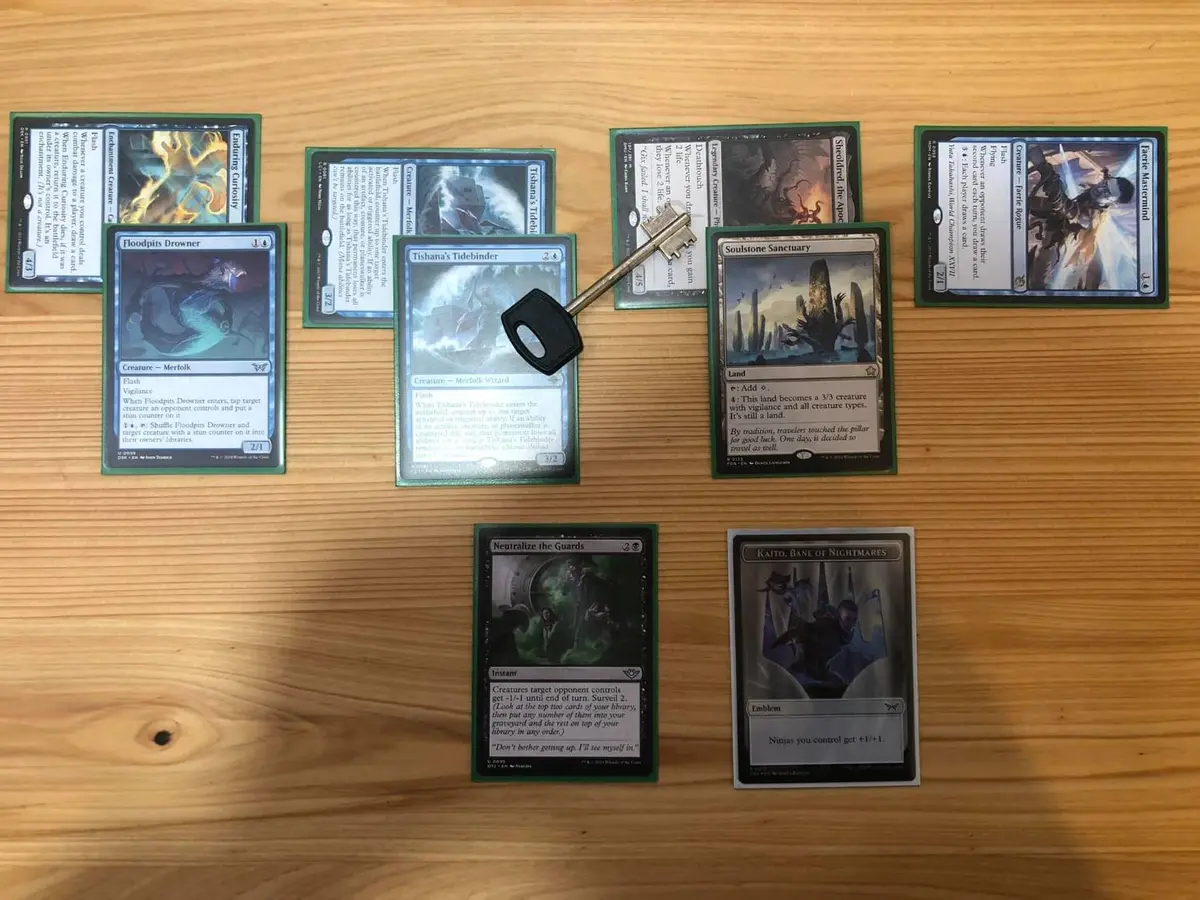
Over the year-end, Lunar New Year, and the preparation for MIT#8, Standard was temporarily shelved. The post-event rehab practice session was again built on Dimir midrange, but with large-scale attempts at the new Vehicles from DFT. Conclusion first: compared with the original Dimir midrange, they are still not strong enough. Subterranean Schooner, which once had a brief moment in Dimir midrange, still faces the awkward situation of being unable to get past Preacher of the Schism, also from LCI; and Mu Yanling, Wind Rider, in the shadow of the blue cat, still needs to find a build suited to her. The Last Ride a.k.a. the Death’s Shadow car, I quite liked in my attempts over this period, since it adds a source of card draw and a threat that fights back in the mid-to-late game and is not easily removed by sweepers, which is quite nice. However, after Temporary Lockdown rose in usage, this line of thinking gradually became a scrapped plan.
After EOE releases and Standard rotates, the environment will still have sweepers like Ultima, so the day Vehicles rise again is still far off…

20250301 Fan Page Post
An echo of the inner demon from long ago on 20241117: my Dimir can never beat Domain Ramp.
This time it was because Matt Nass won PT DFT with Domain Ramp, and this old deck came back into players’ view. Strangely, from mid-February until this post went out, I could not win a single Domain match; I always got turned around! A full dose of PTSD, just when the frown had eased it came back to my heart…
I personally really dislike complaining that a deck is too strong without trying hard, but after several times being beaten by new players piloting Domain Ramp, even after all kinds of BM, I really found it hard to keep enjoying this matchup…
20250309 Fan Page Post
…But as I showed before, you get up where you fell. This week I happened to have more time to play, so I played a few more small events. The conclusion is still that against Domain you basically don’t win, and a build that splashes red with Overlord of the Boilerbilges is even harder to play. But after this week I let it go: against a Domain that draws itself out of everything, you basically can’t win; if both sides draw normally, you still have a chance. Based on this understanding, I went on to develop all kinds of scenarios and plays against Domain Ramp. Looking back, I was really a bit obsessive back then, but it was also a process I had to go through.
20250518 MIT#9
I wrote less on the fan page in March, April, and May, and basically kept preparing for the MIT#9 tournament with the partners I met through the Forum, 平方, and NMT. Once again I had no good result at this tournament. It would be a lie to say I wasn’t sad, but my ability to adjust my mindset has become better and better.
At this MIT#9 and at MIT#6 nearly a year ago, I made the same mistake: not respecting the format’s mainstream aggro decks enough. Last time it was Boros Convoke, this time the even fiercer Izzet Prowess, with Cori-Steel Cutter brought by TDM after its release. It’s only natural that my Dimir Dragon midrange, with a speed out of step with the times, got smashed. And not playing The Filigree Sylex was still a wrong decision.
20250622 MTGA Mythic
Again and again, where you fall is where you get back up. This time I finally learned to play Sylex, and one main, one sideboard Vren, the Relentless to blow up that crowd of Otters and Monks, then reanimate them into my army of Relentless Rats! Spotlight: Final Fantasy, here I come!

20250628 Spotlight: Final Fantasy Tournament Report
The results afterward proved that Dimir midrange against red aggro is a 40-60 matchup, or even lower. In a build you have already respected and specialized thoroughly, you must draw well enough and have your hate cards in hand, while the opponent must draw somewhat poorly, or at least stumble a little, for you to have a chance of winning. The reverse offers no chance at all.
But I have no regrets at all. I took Dimir midrange and fully exercised the experience I have accumulated over the past year and a half, and I also won 2 matches against Izzet Prowess, losing to another 2 Izzet Prowess and two mono-red aggro.
While preparing for the tournament, a thought kept popping up: in this Standard environment I need Spell Snare. Spell Pierce is a terrible mid-to-late-game topdeck, Duress can’t stop the opponent’s topdecks, and Change the Equation sometimes comes too late early on, when the opponent has already set the knife or Manifold Mouse.
Of course, it looks like Wizards has no plan to print Spell Snare in Standard; they went straight to the knife and banned the knife, Monstrous Rage, and Heartfire Hero. That works too.
20250705 MTGA Mythic
After the June 30 B&R, I quickly hit Mythic within two days. Actually, once practice reaches this level, hitting Mythic on MTGA has gone from a challenge where you don’t know if you can do it to something you just decide whether you want to spend the time on. I mainly played this time to leave a keepsake, and also as a closing to this year and a half of practice.
Reflections on Winning and Losing
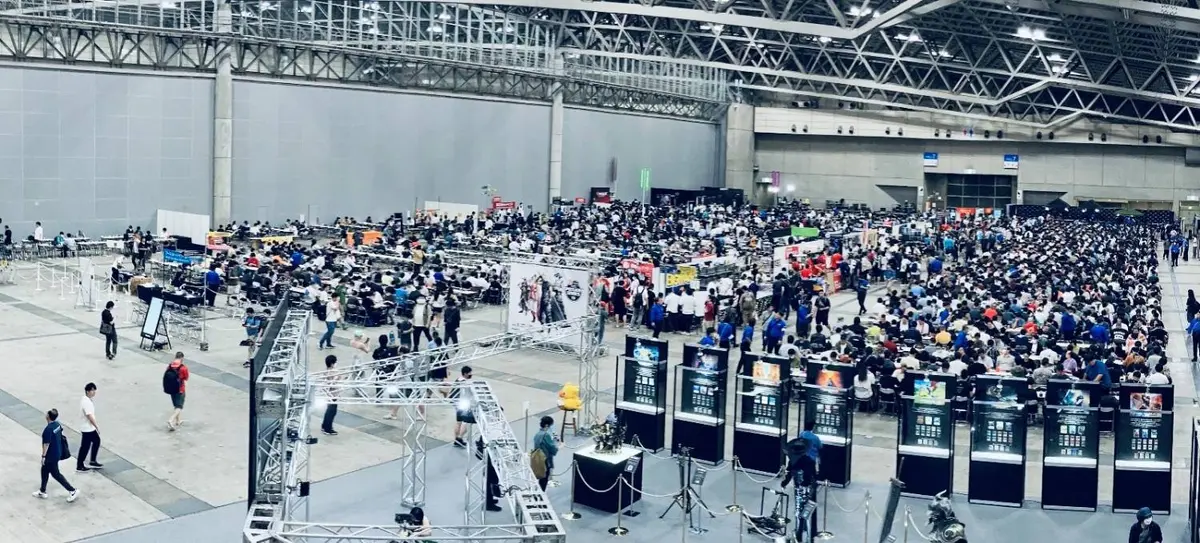
On Day 1 of the Spotlight, at the moment when it was already certain I would not make Day 2, I stood on the second floor of the venue, about to take the escalator down to the first floor, from a high vantage point looking at the bustling crowd taking part in the Spotlight. Besides the 2,250 players in the main event, there were three times or more other players, their friends and family, judges, vendors, and staff of the organizers who had come to the venue. A tournament has only one champion, and even counting the top eight, the people who can be called “winners” are truly few. Competitive events are a zero-sum game, and I know that very well.
So what were those many, hundreds of times more people doing here?
In fact I already knew the answer by heart: competition is not the only way to enjoy this game. Entering big tournaments, exchanging with players from all over, finding rare treasures at the venue, complaining together with your friends and then fighting on again the next day… Everyone is different, and everyone who comes to the venue has their own goals. Even if one of them goes unfulfilled, we can draw energy and joy from other directions. Amazingly, the switch between them is so natural. It’s a bit of a cliche, but the key is still what our “heart” is like in the way we see the world.
I have been obsessed, and I have also had sudden enlightenment; several times I felt bitter at coming home defeated, and I was also angry at games that gave me no chance of winning, so angry that I left the venue roaring loudly… These feelings were all real, but emotions pass and growth accumulates. When you stop now and then to look around, you find a group of friends supporting one another and spurring each other on to climb out of the valley of disappointment; I found that I could also be honestly happy for others’ victories, and feel immensely fulfilled by someone’s “god-tier play”.
How fortunate we are not to live in an age of samurai duels with real swords or bloody storms in the martial world; our failures do not need to cost precious lives. We fail again and again, yet also grow stronger again and again. I have written 23 records, but the games I have lost and won are far more than that number, and the me writing this retrospective now has more refined skill and understanding than the me at every cross-section in time back then, and I will keep getting stronger and will not stay at this stage. Having finished this article, I will keep moving forward again.
Conclusion
The reason a game is fun is that it is only a game. It is not a promotion at work, not others’ recognition, not some title for winning… those illusory things that you cannot control and that make you anxious about gains and losses. We must always play this game for ourselves, to enrich our own deep experience, and then, the luckiest part is that there is a group of people who play together with you!
Interaction between people is an endless treasure, so let’s play Magic: The Gathering together! May you who have read this far also find such a deck to accompany you through a wonderful journey.
- Title
- Handling Defeat: cephille's Standard Dimir Midrange Retrospective
- Author
- cephille
- Created at
- July 10, 2025
- License
- This work is licensed under CC BY-NC-SA 4.0 .