cephille's Standard Dimir Midrange Analysis and Tournament Report

Note: This article was translated from Chinese by AI and may contain errors. Read the original Chinese version.
Before We Start
This article was written the week before MKM released. After MKM joins Standard on February 2, 2024, the Standard meta will surely be shuffled again, so players interested in this deck should adjust and refine it for the current environment. The road of MTG is one of constant improvement and never ends.
The author took first place at the ALG MITQ on January 27, 2024 with this deck, earning a spot in the Season 6 MIT. In the next section I will introduce the deck and some of my own understanding, and the last section is the tournament report.
This Standard season, I was torn between Rakdos and Dimir Midrange. Rakdos still relies on high-quality creatures and the discover package to overwhelm opponents, but if I like winning through resource advantage this much, why not just play Domain? Also, the fact that every interaction in Rakdos other than removal is sorcery-speed made it hard for me to adapt, as someone used to playing tempo decks (I can’t play Magic without flash creatures). So when the ALG Top 8 decklists were announced that day, I immediately switched to Dimir Midrange, which is why this article exists.
This is the decklist I used as a reference, from 黃永銘, who qualified at the first ALG MITQ#6: Dimir Midrange 20240107_ALG MITQ#6 黃永銘
After I started playing Dimir Midrange, I also tested it at other events. For those tournament reports, see here: 20240113_MagicStar MITQ#6.
Deck Introduction
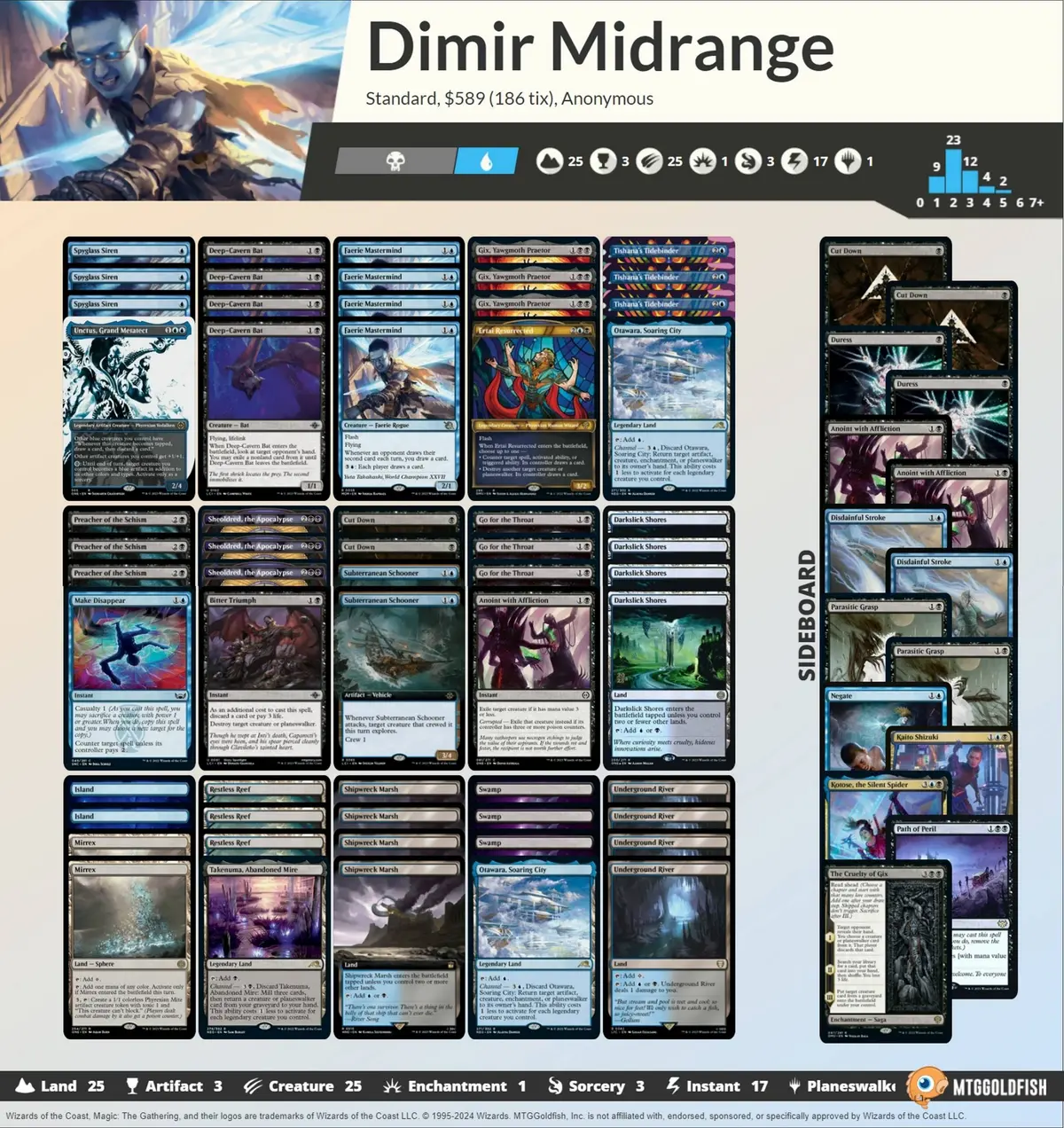
This is the version I played today, January 27, 2024: Dimir Midrange 20240127_ALG MITQ#6 cephille
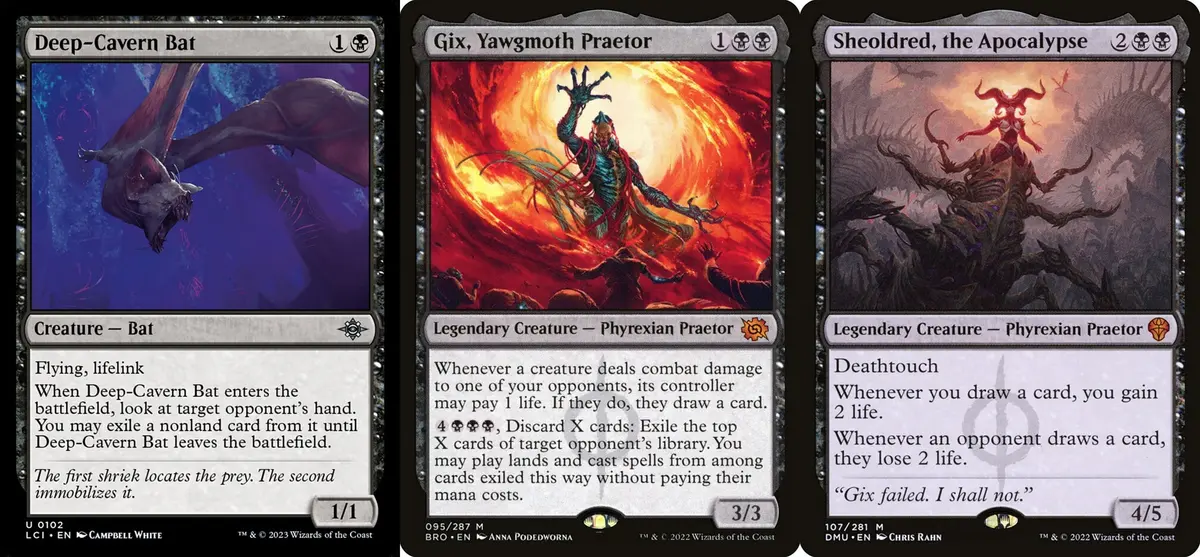
After LCI’s release, the unchanging core of black-based midrange is Deep-Cavern Bat, Gix, Yawgmoth Praetor, and Sheoldred, the Apocalypse. These three cards are absolutely the core of the core in black-based midrange right now. Basically every build plays them, and if you aren’t, you probably couldn’t fit them in.
The Love and Hate of Deep-Cavern Bat
Basically, you can think of the Bat as a Thoughtseize in Standard that can attack players, doesn’t hurt your life total, and can even gain you life, and that is how strong the Bat is. The Bat takes one card from your opponent’s hand and shows you their game plan. If the opponent has no removal or other way to deal with the Bat, the rest of the game will be very uncomfortable for them, especially against multiple Bats. Of course, when you’re on the draw and the opponent plays a Bat first, sees your whole hand, and you can’t remove it, you will hate this card deeply.
Two Demon Judges, Who Can Compete?
Three-mana Gix is a reasonable explanation for not choosing Esper Midrange. Unlike the connive of Raffine, Scheming Seer, Gix lets every point of combat damage dealt to a player become a card for one life. And if you follow it up with Sheoldred on four, that is the opponent’s nightmare: every card in your hand becomes life, and every draw the opponent makes must be more careful, and the fact that failing to answer Sheoldred means losing still holds in the current Standard.
Standard Two-Three-Four, Magic Is So Easy
So the ideal black midrange sequence is:
Turn two, Bat takes a card from the opponent’s hand -> turn three, Gix comes down and Bat attacks to draw -> turn four, Sheoldred comes down and builds a huge board advantage.
Does that look familiar? This is the winning two-three-four curve of the former Standard Esper Midrange. Today’s Esper Midrange likewise puts the Bat on the two-drop slot, and uses both Gix and Raffine as three-drops that transform the deck on turn three, so that after Sheoldred comes down on turn four, the board is hard for the opponent to turn around. Every black-based Standard midrange deck is doing this, with only slight swaps at each point of the curve. The core concept is exactly the same.
You Have Wedding Announcement, I Have a Three-Mana 2/4

After a round of testing, Preacher of the Schism (the three-mana 2/4) saw gradually rising play thanks to its excellent abilities. A three-mana 2/4 deathtouch body looks defensive at first glance, but its two attack triggers each fit the current situation just right:
- When your life total is higher, you can lose 1 life to draw a card, which helps keep up pressure and expand your advantage;
- When your life total is lower, you create a 1/1 lifelink Vampire. One more lifelink blocker lets you stabilize the board with less worry;
- When your life total equals the opponent’s, that is the situation where the advantage is maximized, and both triggers happen. So you sometimes see the interesting sight of Preacher players deliberately using a painland to lose life and match the opponent’s life total to maximize this benefit.
Of course, comparing Wedding Announcement to a three-mana 2/4 may not be quite fair, because as long as Wedding Announcement enters and isn’t removed, one card serves as a creature maker, a card draw engine, and an anthem. The Preacher, on the other hand, must attack every time to trigger, and creatures are easier to remove than enchantments. However, after Invoke Despair was banned in Standard, enchantments have always been the eternal weakness of black decks, and having a three-mana 2/4 that earns resources along another axis is also key. Your deck can’t go two-three-four with everything easy every game, and even if you do, the opponent will have removal and counterspells to interfere.
So, Why Dimir Midrange?
Having covered the core black, let’s talk about why the build chooses Dimir over other black-based midrange. The reasons are simple: the one-drop, Tishana’s Tidebinder, and more instant-speed interaction.
1. The One-Drop

Dimir Midrange decks now all choose Spyglass Siren as the one-drop, but I think this is only a stopgap choice. If there is a better one-drop, I wouldn’t necessarily keep choosing the Siren. The Siren’s advantage is that it’s a flier, which is crucial when using Gix as the three-drop. We very much want our deck to draw a card once Gix comes down on turn three, and the turn-two Bat draws a lot of hate, so naturally we want Bat followed by Gix to draw cards. If that doesn’t work, at least the Bat has absorbed one of the opponent’s removal spells, and then the Siren fills the role of letting Gix draw after it comes down. And of course, if the opponent can’t remove the Bat and Gix, then on turn three we draw two extra cards after attacking, which is a whole different story.
The one-drop can be swapped, but the premise is that it has evasion on turn one, and ideally some added value. I’m not sure whether Stalactite Stalker or other one-drops after MKM’s release will be viable options, so I’ll leave that to players to try.
2. Tishana’s Tidebinder
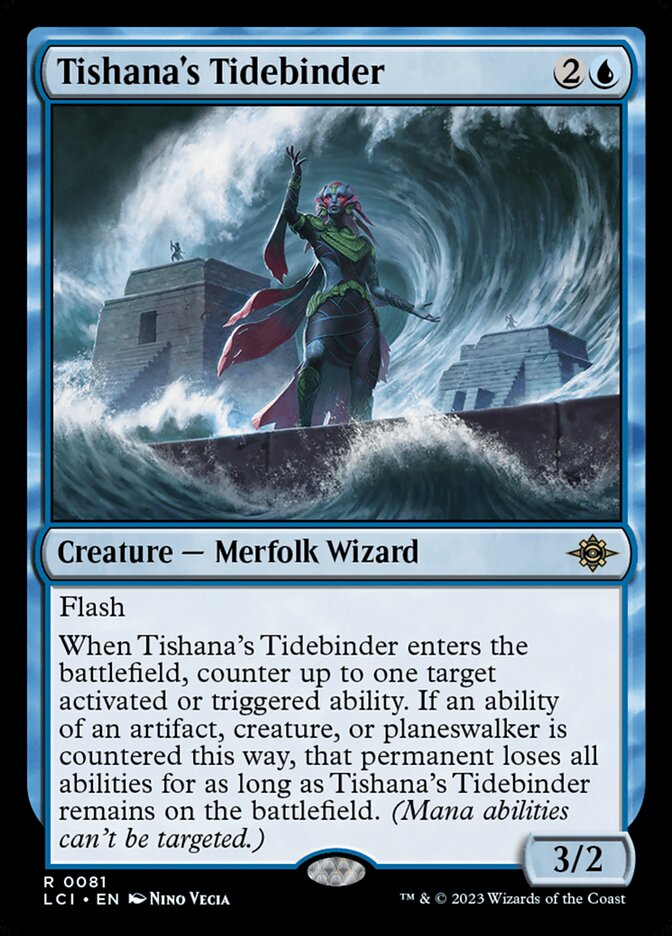
Tishana’s Tidebinder, aka the Stifle that beats people up, is absolutely the most important reason I chose Dimir. In any past format, even when a card could counter activated or triggered abilities, its practical value was usually low, because if the source is a permanent, that permanent is already on the battlefield, and countering the ability leaves the threat in place, and an activated ability can just… be activated again XD
But once LCI printed the Tidebinder, all of that changed. Except that it can’t interact with spells directly, any activated or triggered ability, with three blue-producing lands in front of it, must first ask the Tidebinder whether it’s allowed to resolve. And if a creature’s, planeswalker’s, or artifact’s ability gets countered this way, that permanent is a vanilla blank for as long as the Tidebinder stays on the battlefield.
If you’d like to know more about the interactions the Tidebinder brings to the table, come read this article on the site: The Flash Deck the Opponent Can’t Counter: Mono-Blue Merfolk. I must say, the Tidebinder is a very skill-intensive card, with a floor and ceiling far wider than any other single card in Standard. The more you understand it, the more you see its depth and endless potential!
3. More Interference
By interference I mean cards like Faerie Mastermind.

A two-mana flash 2/1 flier. Yay, I know how to play Magic again! Just kidding, Faerie Mastermind’s strength goes far beyond that. It is a hater of the opponent drawing extra cards: Up the Beanstalk, the connive of Raffine, Scheming Seer, even popping a Blood or Clue token to draw the extra card. When your opponent flashes in a Faerie Mastermind and says “you draw, I draw, that’s fair, right?”, you must feel like this card is broken, doesn’t it? And playing blue is exactly about being that opponent across the table! When you’ve stabilized the board and are alongside Sheoldred, you can sometimes activate its ability to speed up the kill.
Another one worth mentioning is the blue channel land, Otawara, Soaring City. In my understanding, this card is crucial at the right time and hard to interact with. It can bounce the enchantments that are hardest for us to handle (the opponent’s Leyline Binding when they’re tapped out, Wedding Announcement, Temporary Lockdown in the sideboard, etc.) to catch the opponent off guard. After weighing things, I decided to cut one basic Island to bring the Otawara count up to two. I know this might make my mana base a bit worse or get me stuck, but I think it is a risk worth taking.
Finally, let me talk about my current understanding of counterspells. LCI reprinted Cavern of Souls, and Standard is basically a creature-based format, so when you hold a counterspell and the opponent has Cavern of Souls, you are in a very weak position. Of course, since you’re playing blue, putting in a suitable counterspell to watch for some of the opponent’s deadly noncreature spells is also important, but having it in the sideboard is enough. I think you shouldn’t bring Make Disappear anymore, and Negate alone is enough.
Sideboard Choices
Dimir Midrange sideboards are mostly similar, so I’ll talk about just one card. I won’t mention the identical ones, or the ones that didn’t feel like good sideboard cards in play.

Anoint with Affliction is my most-played removal, mainly aimed at the unfavorable matchup, UW Mentor, and some creature-based combos (i.e. Four-Color Legends, Simic Cauldron/artifacts, etc.). What they have in common is that the key creatures cost three or less, and failing that you can at least kill a Raffine for three mana. The exile effect is even more crucial against UW Mentor, which digs up graveyard cards. Ever since the same Haughty Djinn got dug back three times and beat me to death at the last Magic Star MITQ#6, I decided I had to include this exile removal. Two in the sideboard wasn’t enough, so I made room for one in the main deck.
Also, I seriously wanted to play graveyard hate, but the three-drop slot already has the three-mana 2/4, Gix, the Tidebinder, and so on, so I really had no room for Graveyard Trespasser, and it isn’t necessary either. Unlicensed Hearse in the sideboard is too narrow in use, since Standard has no deck like Pioneer’s Greasefang that is dead without graveyard hate. After much thought, the best solution is this three-mana exile removal. Kill it and you’re done, and there are always the right targets in a creature-based environment.
Personal Touch — Unctus, Grand Metatect

Let’s welcome Unctus, Grand Metatect! Actually this card wasn’t my idea. I saw a friend’s Dimir deck play it at a tournament once, tried it, found it quite good and fitting Dimir’s strategy. Here’s a brief look at its clever uses, and anyone interested can develop it further:
- The first ability, when other blue creatures you control become tapped, draw a card then discard a card. This pairs well with the deck’s structure of one- and two-mana blue creatures, including two Subterranean Schooner. If you don’t have turn-three Gix, no problem, you have turn-three Unctus, and following it with Sheoldred on turn four isn’t necessarily worse. Note, though, that the first ability puts a separate trigger on the stack each time another blue creature becomes tapped, each looting one at a time. This differs from Raffine’s connive X, so you must resolve the loots one by one.
- The second ability gives other artifact creatures you control +1/+1. With the Schooner in the deck, and with the rising number of three-mana 2/4s that often can’t get through, this is one good reason we still keep the Schooner.
- The third ability lets you, at sorcery speed, pay one blue mana or 2 life to give your creature the additional types blue and artifact. This means it can actively let your creatures gain the bonus from its second ability, which is crucial in Dimir, since that extra point of power is often the threshold between getting through and not. And if the opponent isn’t paying attention, after your ability resolves it’s too late to use Go for the Throat on a creature that has gained the artifact type. In today’s Standard, where black removal still centers on this card, that can sometimes pay off.
January 27, 2024 ALG MITQ#6 Tournament Report
Round 1: 2-1, Opponent: Simic Cauldron
- In game one, the opponent had about three Tyvar, Jubilant Brawler in hand. They played one, then my next three Bats took the other two. They played two or three Fallaji Archaeologist, but those got nothing and sat on the ground as 1/4s. Their only pressure was Likeness Looter turned into a Sleep-Cursed Faerie. Although the opponent played the Cauldron in the late game, it basically couldn’t hold up against the pressure of my board, and after I removed the Looter I attacked with everything to win.
| Side Out | Side In |
|---|---|
| -3 Spyglass Siren | +2 Anoint with Affliction |
| -2 Subterranean Schooner | +1 Negate |
| +1 Kotose, the Silent Spider | |
| +1 Duress |
- In game two, the opponent assembled the Cauldron pieces very quickly. I saw there were still 10-odd minutes left and decisively conceded.
- In game three I regained the play and won by killing all of the opponent’s creatures.
Round 2: 2-0, Opponent: UW Tempo
- In game one, the opponent dug back Haughty Djinn, which was exiled. Although they played Monastery Mentor and made a Monk token, when it attacked I flashed in Faerie Mastermind, crewed the Schooner, and blocked the Mentor dead, and the game was basically over after that.
| Side Out | Side In |
|---|---|
| -2 Cut Down | +2 Anoint with Affliction |
| -3 Spyglass Siren | +1 Negate |
| +1 Kotose, the Silent Spider | |
| +1 Duress |
- In game two, the opponent stumbled. A Bat took their only Get Lost, and after seeing two March of Swirling Mist, I held Negate and removal and took this game without any suspense.
Round 3: 0-2, Opponent: Bant Toxic
- In game one I kept getting beaten by 1/1 poison creatures, pumped and proliferated. I barely blocked with flash creatures and cleared out four toxic creatures, but by then I was at 9 poison counters with no room to retreat. With only a Gix left on my board I started hitting back, two attacks in, then added a Faerie Mastermind and a Bat, and the opponent was at 8 life, so I thought I was safe. But the opponent slammed down Skrelv, Defector Mite and followed up with Venerated Rotpriest, and I made mistakes that cost me the win:
- I misread the Rotpriest’s passive: you get poison counters when it is targeted by a spell, so bouncing with Otawara (an ability) would not have triggered it. I bounced Skrelv too early, before the Rotpriest landed, and of course the opponent just replayed it.
- On my turn I kept attacking with the Faerie and Bat. Here I should have attacked with only the Bat or Gix, since I had to keep one blue and one black creature back to guard against Skrelv’s ability. So I was killed by a Rotpriest that had been given the ability.
Post-game review: continuing to push was actually right, because the opponent could topdeck a proliferate and I’d explode, so I couldn’t play slow. The key was that I misread the Rotpriest’s ability and wasted the Otawara. The correct play was to keep one Gix back and keep attacking with the other two, then use Otawara to bounce the Rotpriest that had been given the ability and stall the opponent, and I’d have won.
| Side Out | Side In |
|---|---|
| -1 Make Disappear | +2 Parasitic Grasp |
| -3 Go for the Throat | +2 Anoint with Affliction |
| -2 Faerie Mastermind | +2 Cut Down |
| -1 Ertai Resurrected | +1 Path of Peril |
- In game two I mulliganed to six, saw a two-three-four curve and three lands, so I just kept. I didn’t draw a single one of my four Cut Downs. The opponent’s sideboarded Destroy Evil killed two Sheoldreds in a row, and they slammed Skrelv’s Hive to make three 1/1 Mite tokens, then played Venerated Rotpriest. After they hit me to 5 poison counters, I used March of Swirling Mist with X=3 to phase out their Rotpriest, a freshly made 1/1 Mite, and my own blocker (I was at 7 poison), and then the three 1/1 Mites all attacked and I died of poison.
Round 4: 2-1, Opponent: Four-Color Legends
- In game one the opponent stumbled (was stuck with a weak hand), and the opponent’s Rona, Herald of Invasion loots were limited by my Faerie Mastermind on the board, so they didn’t get many. After I killed their key creatures, I landed Unctus, Grand Metatect and drew a pile of cards, and they conceded.
| Side Out | Side In |
|---|---|
| -3 Spyglass Siren | +2 Parasitic Grasp |
| -2 Subterranean Schooner | +2 Anoint with Affliction |
| +1 Kotose, the Silent Spider |
- In game two, the opponent played turn-two Rona, which I removed on my own turn, then they played Relic of Legends and I played a three-mana 2/4. But the opponent followed up with Glissa Sunslayer, which held off my attack for a turn. Though both sides started trading blows, the opponent played Inti, Seneschal of the Sun, which made Glissa bigger the more she hit. The Sheoldred I played later got removed and everything collapsed.
- In game three all my removal showed up, and against creature-based combos, winning on removal is a sure thing.
In round five I drew with 丈丈, finishing sixth and entering the Top 8.
Top 8: Thanks to 永銘
I was a bit nervous walking up to the Top 8 table, since there was still a match to fight for real. Then I sat down and found…
“Hey, isn’t that 永銘?”
(For the reference behind the above, see SamuelChang’s PT Barcelona Travelogue (Part 1))
Thanks to 永銘 for giving me the idea of playing Dimir Midrange and for even being my Top 8 “mushroom”. He is truly my provider! 永銘 is my boss!
Top 4: Thanks to 丈丈
After watching the ultimate showdown in the Top 8 between Egavas and 及人 in an Esper Midrange mirror, I entered the Top 4 and secured the qualification, and then 丈丈 let me win. Thanks to 丈丈.
Finals: 2-1, Opponent: Red Aggro
- In game one the opponent was on the play, I was stuck on two lands, the opponent’s board was attacking for 7 and my life was at 11, and I gave up struggling. GG
| Side Out | Side In |
|---|---|
| -4 Faerie Mastermind | +2 Cut Down |
| -1 Bitter Triumph | +2 Anoint with Affliction |
| -1 Ertai Resurrected | +2 Parasitic Grasp |
- In game two, one-two-three-four, and although Sheoldred number one was removed, there was a number two. Win.
| Side Out | Side In |
|---|---|
| -2 Gix, Yawgmoth Praetor | +1 Path of Peril |
| +1 Duress |
- In game three the opponent was on the play but mulliganed to five. The opponent’s board was only a single Monastery Swiftspear played on turn two, attacking over and over. I played turn-one Siren and turn-two Bat, which got hit by Lightning Strike. I saw the remaining two cards in their hand were Nahiri’s Warcrafting and Urabrask’s Forge. On turn three I sacrificed a Map and saw Unctus, Grand Metatect on top of my library, which made the Siren a 2/2; I attacked and passed the turn. The opponent was stuck on three lands, and after the Swiftspear attacked they used Play with Fire to hit my face, and I responded with Anoint with Affliction to remove it. On my next turn I struck back with Sheoldred, forcing out the opponent’s Nahiri’s Warcrafting, then played Unctus to prepare to defend against the opponent’s Forge, and stalled for three turns with Unctus blocking + the Siren’s attack triggering loots. Though discarding two Parasitic Grasp in the middle instead of discarding the Gix that would have cost me life was honestly a bit overconfident. The opponent played a second and third Forge in a row, but when the first and second Forges triggered on the fourth counter, they were countered by my first and second Tidebinders respectively, leaving the smallest one. In the end, with the opponent at 11 and me at 4, the opponent played Furnace Punisher with no hand, and I attacked with my whole team, including the Restless Reef, and activated Unctus’s third ability to pump +3 power and took the win. Well… I won, but don’t copy my sloppy play XD
Conclusion: Dimir Midrange vs. Other Black-Based Midrange
| Type | Pros | Cons |
|---|---|---|
| Dimir Midrange | 1. Best tempo 2. Highest card draw | 1. Weaker creature quality 2. Highest difficulty to pilot |
| Rakdos Midrange | 1. Strongest offense 2. Best Unfair ability | 1. Nearly all interaction is sorcery-speed |
| Golgari Midrange | 1. Comprehensive removal, not afraid of enchantments 2. An extra Plan B of winning with a manland | 1. Hard to beat Domain in the main deck |
| Orzhov Midrange | 1. Comprehensive removal, not afraid of enchantments 2. Can play sweepers 3. Can play the mainstream powerful enchantments | 1. Hard to beat Domain in the main deck |
This is the table I put together from my own understanding. You can see that Golgari and Orzhov Midrange also have things they’re good at, and have better answers to enchantments, which give Dimir and Rakdos such headaches. But because Domain control holds the number-one spot in the meta, it directly squeezes the survival space of black-based midrange in these two color pairs. Of course, this is only this season’s Standard meta. Next week is the release of the new set MKM, and Standard will surely change dramatically then, bringing a new look.
- Title
- cephille's Standard Dimir Midrange Analysis and Tournament Report
- Author
- cephille
- Created at
- January 28, 2024
- License
- This work is licensed under CC BY-NC-SA 4.0 .